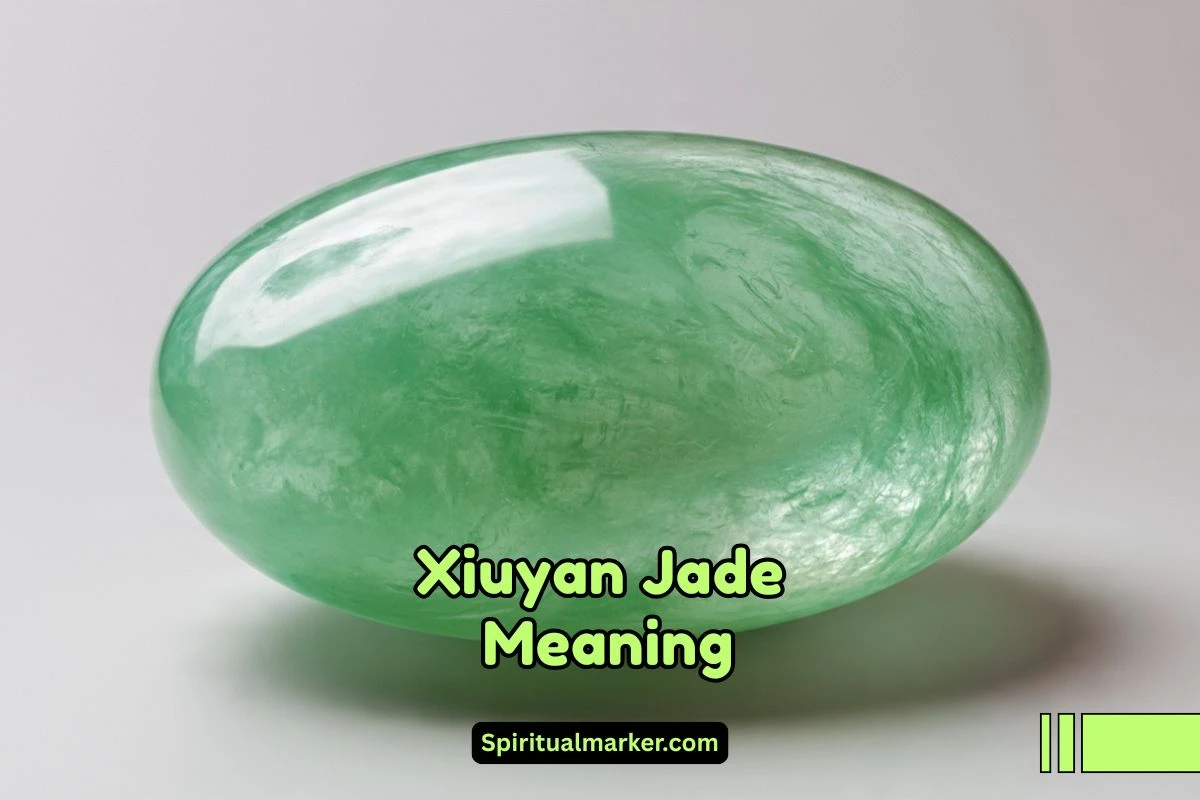
Xiuyan jade is a type of serpentine jade from China. Its soft green color and smooth texture evoke peace and harmony. In spiritual practice, this stone carries nurturing and balancing energy.
The Xiuyan jade meaning often involves health, longevity, and emotional balance. It is a stone of the heart chakra, helping to soothe emotions and attract peace. A spiritual meaning of green jade shares that jade focus, though green jade carries a more prosperous energy.
Xiuyan jade is used in crystal healing to support physical health, calm the mind, and enhance meditation. It can also symbolize wisdom and tranquility. The stone's energy is gentle and grounding.
If you feel drawn to Xiuyan jade, it may signal a need for balance. A spiritual meaning of nephrite jade also deals with jade, though nephrite carries a more protective energy.
5 Key Takeaways
- Xiuyan jade has over 7,000 years of documented history in Chinese spiritual and cultural traditions.
- It symbolizes purity, protection, harmony, longevity, and emotional healing across multiple traditions.
- Many practitioners connect Xiuyan jade with the heart chakra and the energy of calm, grounded love.
- Xiuyan jade is a form of serpentine-based jade, softer than nephrite, but rich in spiritual and historical significance.
- Wearing or meditating with Xiuyan jade is believed to encourage emotional stability, inner peace, and spiritual clarity.
What Is Xiuyan Jade?
Xiuyan jade is a naturally occurring stone mined primarily from Xiuyan County in Liaoning Province, China. It belongs to the serpentine mineral family and typically displays colors ranging from pale celadon green to deep emerald, with some varieties showing creamy white, yellow-green, or translucent tones. Its surface often has a waxy, smooth appearance that makes it visually calming and pleasant to handle.
Mineralogically, Xiuyan jade is classified as antigorite serpentine, a magnesium silicate hydroxide mineral. This distinguishes it from the harder nephrite and jadeite varieties more commonly known in Western markets. However, within Chinese tradition, Xiuyan jade has always carried full jade status because of its cultural, historical, and energetic significance rather than its mineral classification alone.
Many people confuse Xiuyan jade with nephrite or jadeite because of the visual similarities. However, Xiuyan jade typically feels slightly lighter and softer. It rates between 2.5 and 4 on the Mohs hardness scale, making it more delicate than true nephrite. Spiritually, many practitioners describe Xiuyan jade as carrying a gentler, more inward energy compared to the more active, protective energy often associated with nephrite jade.
Origins and Formation
Xiuyan jade forms through a geological process called serpentinization. This happens when olivine-rich rocks in the earth’s mantle interact with hydrothermal fluids over millions of years. The process slowly transforms the original rock into serpentine minerals, including the antigorite variety that gives Xiuyan jade its characteristic smooth texture and green coloring.
The Xiuyan region sits on one of the world’s largest and oldest serpentine deposits. Mining there dates back to the Neolithic period, roughly 7,000 years ago. Archaeological excavations have found Xiuyan jade artifacts in ancient burial sites, offering strong evidence that early Chinese communities viewed this stone as sacred rather than purely ornamental.
China remains the primary source of Xiuyan jade today. The Liaoning Province deposit continues producing high-quality material, and the stone remains deeply embedded in Chinese cultural identity. Some spiritual traditions believe that stones formed through long geological processes carry a kind of stored patience and ancient energy that younger materials cannot replicate.
Key Properties
| Property | Details |
|---|---|
| Color | Pale green, emerald green, celadon, white-green, translucent |
| Composition | Antigorite serpentine (magnesium silicate hydroxide) |
| Hardness | 2.5 to 4 on the Mohs scale |
| Chakra Association | Primarily the heart chakra |
| Symbolism | Purity, protection, harmony, longevity, emotional healing |
| Primary Source | Xiuyan County, Liaoning Province, China |
| Transparency | Translucent to opaque |
| Energy Style | Calming, grounding, emotionally nurturing |
Historical Use of Xiuyan Jade
No stone in Chinese history carries the same cultural weight as jade. The ancient Chinese used it to mark social rank, spiritual devotion, and moral character. Xiuyan jade specifically appears among the oldest jade artifacts ever found in China. Burial objects made from Xiuyan jade were unearthed at Xinglongwa sites dating back to approximately 5500 BCE, making this one of humanity’s earliest known jade traditions.
During the Zhou Dynasty, jade became deeply embedded in Confucian philosophy. Scholars compared jade’s qualities to human virtue. Its hardness represented courage. Its smoothness symbolized benevolence. Its sharp edges that never cut carelessly represented justice. Confucius wrote: “The superior man finds in jade all the excellent qualities of humanity.” Xiuyan jade shared in this philosophical legacy as one of China’s primary jade sources for ceremonial objects.
Imperial families across multiple dynasties used jade for ritual vessels, court ornaments, and burial suits. The famous jade burial suits of Han Dynasty royalty, sewn together with gold or silver wire, represented a belief that jade could preserve the soul and prevent physical decay after death. Xiuyan jade contributed material to this tradition because of its regional abundance and spiritual reputation.
In traditional Chinese medicine, jade was believed to nourish the body. Healers and scholars wrote about jade’s ability to cool the body, calm the mind, and support organ function. Stone rollers, gua sha tools, and jade combs made from Xiuyan jade were used to promote circulation and emotional calm. This medical tradition continues influencing modern wellness practices today.
5 Spiritual Meanings of Xiuyan Jade
1. Purity of Heart and Mind
Purity sits at the center of Xiuyan jade’s spiritual identity. In Chinese philosophical and spiritual traditions, jade represented moral and spiritual cleanliness. It was not simply a physical substance but a living reflection of inner character. Owning and wearing jade was believed to encourage the wearer to live in alignment with their highest values. Xiuyan jade carries this symbolism directly into modern spiritual practice.
Many people feel drawn to Xiuyan jade during periods when life has felt morally or emotionally complicated. Situations involving betrayal, moral compromise, emotional confusion, or spiritual disconnection can leave people feeling internally clouded. Xiuyan jade spiritually represents the possibility of returning to a cleaner emotional and spiritual state. Its gentle color and smooth surface reinforce this symbolism visually and texturally.
This meaning also extends into mental clarity. Purity in spiritual traditions rarely refers only to moral perfection. It often describes a state of mental stillness where fear, ego, and self-deception fall away and honest self-awareness becomes possible. Xiuyan jade symbolizes that kind of inner clearing. Many practitioners use it during meditation specifically to create mental and emotional transparency.
Its connection with purity also carries a deeply personal dimension. People rebuilding their sense of self after difficult experiences, including trauma, addiction recovery, relationship breakdown, or professional failure, often describe needing a symbol of inner renewal. Xiuyan jade provides that symbolism without judgment. It reflects the belief that purity is not about perfection but about honest return to one’s true nature.
2. Protection and Spiritual Shielding
Across Chinese history, jade served as a powerful protective talisman. Families gave jade pieces to newborns as gifts of protection. Warriors carried jade amulets into battle. Travelers kept jade objects close to ward off misfortune and negative spiritual energy. Xiuyan jade inherited this protective tradition because of its deep connection to China’s earliest jade culture.
In spiritual terms, protection means different things to different people. Some believe it refers to shielding oneself from genuinely harmful external energies. Others interpret it as emotional protection, maintaining inner stability when external pressures become overwhelming. Both interpretations apply naturally to Xiuyan jade. Its calming energy is frequently described as creating an internal boundary between the person and emotional turbulence.
Many crystal practitioners place Xiuyan jade near doorways, carry it in bags or pockets, or wear it as a pendant because they believe it creates a protective energetic presence. In Chinese feng shui traditions, jade placed near entryways is believed to filter negative energy before it enters the home. Xiuyan jade specifically carries this tradition because of its ancient role in household spiritual practice.
Protection also has a deeply psychological dimension. People navigating emotionally unsafe relationships, workplace stress, social anxiety, or grief often describe feeling energetically exposed and vulnerable. Xiuyan jade spiritually represents the creation of a grounded inner space that external pressures cannot easily penetrate. This protective symbolism makes it a meaningful companion during emotionally difficult transitions.
3. Harmony and Emotional Balance
Xiuyan jade is deeply associated with harmony because Chinese spiritual philosophy has always treated jade as a balancing force between opposing energies. Traditional Chinese thought, rooted in Taoist and Confucian frameworks, emphasizes the importance of balance between yin and yang, between action and rest, between emotion and reason. Jade symbolized this balance physically and spiritually.
Emotional balance is one of the most frequently cited reasons people turn to Xiuyan jade today. Life regularly creates situations where emotions swing toward extremes. Grief can feel bottomless. Anger can feel consuming. Anxiety can feel relentless. Xiuyan jade spiritually represents the stabilizing center between emotional extremes. Many practitioners describe its energy as gently pulling scattered emotions back toward a coherent center.
This harmonizing energy also influences relationships. Families, partnerships, and friendships frequently experience emotional imbalance caused by unresolved tension, poor communication, or accumulated resentment. Xiuyan jade carries the symbolic energy of emotional reconciliation. In some Chinese traditions, gifting jade to someone represents a desire for peace and ongoing harmony between two people.
On a personal level, harmony with Xiuyan jade often means alignment between thought, emotion, and action. Many people feel internally divided. They think one thing, feel another, and act in ways that satisfy neither. Xiuyan jade spiritually symbolizes the gradual movement toward inner coherence where personal values, emotional reality, and daily behavior begin to align more naturally over time.
4. Longevity and Vitality
Ancient Chinese culture strongly associated jade with longevity, vitality, and life force. This belief ran so deep that emperors consumed jade powder mixed into drinks hoping to extend their lives. While modern understanding recognizes this practice as physically harmful, the spiritual belief behind it reflects jade’s profound symbolic connection with sustained life energy.
Xiuyan jade carried this longevity symbolism directly. Artifacts shaped as dragons, turtles, and pine trees, all traditional Chinese symbols of long life, were frequently carved from Xiuyan jade. Giving someone a jade piece carved in these forms was considered a deeply meaningful wish for their health, vitality, and long life.
In modern spiritual practice, this symbolism translates into themes of sustained personal energy, emotional resilience, and physical wellness. People navigating chronic illness, recovery from exhaustion, or prolonged stress sometimes feel drawn to Xiuyan jade because its energy is described as quietly restorative rather than energetically stimulating. It supports vitality through stability rather than intensity.
Traditional Chinese medicine viewed Xiuyan jade as beneficial to the kidneys, the organ system most closely connected with life force energy in TCM theory. Jade gua sha tools and massage implements made from this stone were used to support circulation and encourage the smooth movement of vital energy throughout the body. This tradition bridges the physical and spiritual dimensions of Xiuyan jade’s longevity symbolism.
5. Wisdom and Moral Integrity
Confucius listed wisdom among jade’s defining virtues. In his teachings, jade symbolized the cultivated person who pursues knowledge, moral clarity, and ethical behavior not from obligation but from genuine inner alignment. Xiuyan jade, as one of China’s oldest jade sources, carries this philosophical legacy as part of its core spiritual identity.
Wisdom in spiritual contexts rarely means simply accumulating information. It describes the ability to apply knowledge with compassion, discernment, and ethical awareness. Xiuyan jade symbolizes this applied wisdom. Its energy is frequently described as encouraging slower, more reflective thinking rather than reactive decision-making. Many practitioners use it during moments requiring careful personal discernment.
Moral integrity forms another dimension of this symbolism. People regularly face situations where personal values clash with social pressure, financial temptation, or emotional convenience. Xiuyan jade spiritually represents the grounded commitment to one’s deepest values even when external circumstances make compromise feel easier. This makes it a meaningful stone for people navigating ethically complex situations.
Its wisdom symbolism also connects with humility. Ancient Chinese tradition emphasized that true wisdom involves recognizing the limits of one’s knowledge. Jade, described as smooth yet firm, symbolized the balance between intellectual confidence and personal humility. Xiuyan jade reflects this same energy, encouraging people to remain open to growth while staying grounded in their core values.
6 Healing Properties of Xiuyan Jade
1. Emotional Calming and Stress Relief
Xiuyan jade consistently appears in spiritual traditions as a stone of emotional calm. Its energy is rarely described as stimulating or intensifying. Instead, most practitioners describe it as bringing emotional activity down to a quieter, more manageable level. This quality makes it especially valuable for people whose emotional lives feel chronically overactive, anxious, or exhausting.
Stress creates a particular kind of emotional noise. The mind replays concerns. Emotions react to threats before rational evaluation completes. Physical tension builds in the body. Sleep suffers. Over time, chronic stress changes how people experience their own emotional responses. Xiuyan jade symbolically and energetically represents a counterforce to that chronic activation. Its calming energy encourages the nervous system toward rest rather than alertness.
Traditional Chinese medicine specifically associated jade with cooling excess heat in the body and calming emotional agitation linked to what TCM calls liver qi stagnation, a pattern associated with frustration, irritability, and emotional tension. While modern crystal healing operates differently from TCM, the underlying philosophy of jade as an emotionally cooling stone remains consistent across both traditions.
Many people place Xiuyan jade in areas where they spend time during stressful periods, including work desks, meditation spaces, and bedroom nightstands. Its simple physical presence acts as a visual and tactile reminder to slow down. That reminder, consistent and gentle, can carry real psychological weight over time.
2. Heart Chakra Activation
In contemporary crystal healing traditions, Xiuyan jade connects strongly with the heart chakra, the energy center governing love, compassion, forgiveness, emotional trust, and empathy. A balanced heart chakra supports emotional openness, healthy personal boundaries, and the capacity to give and receive love without fear or compulsion. A blocked or imbalanced heart chakra may manifest as emotional guardedness, resentment, codependency, or difficulty forming meaningful connections.
Xiuyan jade’s green color naturally aligns it with heart chakra symbolism. Green is the primary color associated with this energy center across multiple healing systems. Its gentle, earthy green tones are believed to encourage the heart chakra to open gradually without forcing vulnerability before the person feels emotionally ready. This quality distinguishes it from more intensely activating heart stones.
Many practitioners place Xiuyan jade directly over the chest during meditation or breathwork sessions targeting emotional healing. This positioning is believed to allow the stone’s energy to interact most directly with the heart chakra. Others wear Xiuyan jade pendants that rest near the chest for sustained heart chakra support throughout daily life.
Heart chakra healing with Xiuyan jade frequently involves the theme of self-love. Many emotional difficulties, including chronic people-pleasing, fear of rejection, emotional self-abandonment, and destructive relationship patterns, trace back to difficulty loving oneself with the same compassion offered to others. Xiuyan jade symbolizes the quiet, patient cultivation of that inner love as a foundation for all other emotional healing.
3. Energetic Protection from Negativity
Xiuyan jade’s protective reputation reaches back thousands of years. Its healing application as an energetic shield continues in modern crystal traditions. Many practitioners believe the stone creates a stable, grounded energetic boundary around the person carrying or wearing it. This boundary is described as filtering environmental emotional energy without creating emotional isolation or disconnection.
This healing property matters most for people who describe themselves as highly sensitive or emotionally permeable. Empaths, caregivers, therapists, teachers, and others in emotionally demanding roles often report absorbing the emotional states of people around them involuntarily. Over time, this emotional absorption creates exhaustion, confusion about one’s own feelings, and difficulty maintaining personal emotional clarity.
Xiuyan jade symbolically supports the development of clearer energetic boundaries. It does not block compassion or emotional sensitivity. Instead, many practitioners describe it as helping people engage empathetically with others while maintaining their own emotional coherence. This distinction between emotional openness and emotional merger forms an important part of its protective healing symbolism.
Many people in emotionally draining environments, including hospitals, schools, social work settings, and busy family households, keep Xiuyan jade objects nearby. The stone’s role in these contexts is less about dramatic energetic shielding and more about providing a consistent grounding anchor that helps the person return to their own emotional center after engaging with others’ emotional needs.
4. Supporting Physical Wellness
Traditional Chinese medicine and ancient Chinese wellness philosophy consistently placed jade within physical healing contexts. While modern medicine does not recognize crystal healing as clinically validated treatment, the historical use of Xiuyan jade for physical wellness reflects a tradition worth acknowledging for its cultural depth and consistency across generations.
TCM practitioners historically associated jade with kidney health, bone strength, and fluid regulation. In Chinese medical theory, the kidneys store the body’s foundational life force energy, called jing. Stones believed to support kidney health were therefore viewed as deeply connected to longevity and physical vitality. Jade held a primary position in this belief system.
Modern wellness applications of Xiuyan jade most commonly appear in gua sha tools, face rollers, and massage implements. Gua sha using jade tools is believed to encourage lymphatic drainage, reduce facial tension, and support skin circulation. These practices carry forward ancient jade wellness traditions in a contemporary format that continues attracting practitioners worldwide.
The physical coolness of Xiuyan jade also plays a role. Jade naturally retains a cool temperature, which makes it physically calming against warm or inflamed skin. Some people use chilled Xiuyan jade tools to soothe headaches, eye tension, or facial puffiness. This practical physical application aligns with the stone’s broader symbolism of calming excess heat and restoring balance.
5. Encouraging Abundance and Prosperity
Jade has carried associations with abundance, prosperity, and good fortune throughout Chinese history. The phrase “gold has a price but jade is priceless” reflects how deeply embedded jade’s value is in Chinese cultural consciousness. Xiuyan jade shares this prosperity symbolism because of its historical role in ceremonies, gifts, and cultural exchanges marking significant life moments.
In feng shui, jade is frequently placed in wealth corners of homes or businesses to attract positive energy and support financial flow. Carved jade objects representing fish, dragons, or coins are common prosperity symbols in Chinese homes. Xiuyan jade pieces in these forms carry both the traditional jade prosperity symbolism and the specific historical significance of China’s oldest jade source.
This healing property also has a psychological dimension. People struggling with scarcity mindset, financial anxiety, or deep beliefs about unworthiness often find that the symbolism of prosperity stones helps shift internal emotional patterns. Xiuyan jade, with its ancient connection to imperial wealth and cultural significance, carries a particularly powerful symbolic resonance in this context.
Abundance in spiritual traditions rarely refers only to money. It encompasses emotional richness, meaningful relationships, creative vitality, and spiritual fulfillment. Xiuyan jade’s broader healing properties, including emotional calming, heart chakra support, and harmonizing energy, all contribute to this wider experience of abundance. Many people report that addressing emotional and spiritual imbalances naturally opens space for greater life richness in multiple dimensions simultaneously.
6. Deepening Spiritual Awareness
Xiuyan jade carries a long association with spiritual refinement and inner awareness. In Confucian philosophy, the process of working with jade, polishing it, carving it, and studying its qualities, was compared to the process of developing character. The Chinese idiom cut, filed, chiseled, polished (切磋琢磨) describes this process of moral and spiritual self-cultivation through sustained effort and attention.
This metaphor translates directly into Xiuyan jade’s healing symbolism for spiritual growth. Spiritual development rarely arrives instantly. It develops through sustained attention, honest self-reflection, and patient engagement with one’s own inner life. Xiuyan jade spiritually represents this slow, deliberate process of becoming more deeply aware of oneself.
Many meditation practitioners use Xiuyan jade because they find its energy supports inward focus without mental distraction. Unlike stones associated with heightened psychic awareness or intense energetic experiences, Xiuyan jade symbolizes a quieter, more introspective spiritual quality. It encourages looking inward with patience and honesty rather than seeking dramatic spiritual experiences.
Its spiritual awareness symbolism also connects to ancestral and collective wisdom. Because Xiuyan jade has been used in spiritual practice for over 7,000 years, some practitioners believe it carries an accumulated energetic resonance with countless generations of human spiritual seeking. Holding it during meditation or prayer can feel like connecting with something far older and larger than any individual life.
How to Use Xiuyan Jade for Spiritual Growth
People use Xiuyan jade in many ways depending on their intentions and spiritual practice. Wearing it as jewelry remains one of the most common approaches. Pendants resting near the chest align the stone with the heart chakra. Bracelets allow physical contact throughout daily activity. Rings on the left hand, traditionally considered the receiving side in many cultures, are believed to draw the stone’s calming and protective energy inward.
During meditation, holding a piece of Xiuyan jade in both hands or placing it over the chest creates a physical anchor for inward focus. Many practitioners begin meditation sessions by setting a clear intention while holding the stone, using it as a symbolic bridge between everyday consciousness and deeper reflective awareness. Its natural coolness can also help ground attention in the physical body rather than scattered thinking.
Placing Xiuyan jade in living spaces brings its harmonizing and protective energy into the home environment. Many people position it near entryways, in bedrooms for sleep support, or on work desks for emotional grounding during demanding professional periods. In feng shui applications, placement in the east sector of a room is associated with family harmony and health, both of which align naturally with Xiuyan jade’s symbolism.
Some practitioners use Xiuyan jade during journaling, breathwork, or emotional processing sessions. Holding the stone while writing about difficult emotions or personal intentions is believed to support honest self-reflection. Its calming energy may help reduce the emotional reactivity that sometimes makes personal reflection feel overwhelming or unsafe.
Caring for Xiuyan Jade
Xiuyan jade requires gentle, consistent care because of its moderate hardness and sensitivity to harsh chemicals. Store pieces separately from harder stones like quartz, amethyst, or topaz to prevent scratching. Soft cloth pouches or padded jewelry boxes work best for protecting its surface during storage.
Clean Xiuyan jade using lukewarm water and mild soap applied with a soft cloth. Rinse thoroughly and dry gently afterward. Avoid ultrasonic cleaners, steam cleaning, or chemical jewelry cleaners. These methods may damage the stone’s surface or structural integrity over time.
Remove Xiuyan jade jewelry before swimming, bathing, or engaging in heavy physical activity. Prolonged exposure to chlorinated water, saltwater, or physical impact may gradually affect its appearance and quality. Occasional exposure to sunlight is generally fine, but avoid extended direct sun exposure, which can sometimes affect color over time.
For energetic cleansing, many practitioners use moonlight, sound bowls, sage smudging, or placing the stone near cleansing herbs. Some prefer placing Xiuyan jade on a bed of dry rice or near a small bowl of water with sea salt nearby rather than submerging it. Personal spiritual practice will guide which cleansing method feels most aligned with individual beliefs and traditions.
Xiuyan Jade Meaning at a Glance
| Aspect | Details |
|---|---|
| Primary Meaning | Purity, protection, harmony, and spiritual refinement |
| Chakra Association | Heart chakra |
| Main Spiritual Symbolism | Longevity, moral integrity, emotional balance, wisdom |
| Common Colors | Pale green, emerald green, celadon, translucent white-green |
| Hardness | 2.5 to 4 Mohs |
| Primary Source | Xiuyan County, Liaoning Province, China |
| Historical Significance | Over 7,000 years of documented spiritual use in China |
| Emotional Associations | Calm, resilience, compassion, self-worth, inner peace |
| Popular Uses | Jewelry, meditation, feng shui, gua sha, home placement |
| Care Needs | Gentle cleaning, separate storage, avoid harsh chemicals |
A Final Note
Xiuyan jade holds a rare combination of qualities. Few gemstones carry both 7,000 years of documented spiritual history and a living tradition of active use in modern wellness and crystal healing communities. That continuity alone speaks to something genuine in the stone’s resonance with human experience across vastly different cultural periods.
Its meanings, purity, protection, harmony, longevity, wisdom, and emotional healing, form a deeply coherent symbolic family. Each quality supports the others. Purity enables wisdom. Harmony supports longevity. Protection creates the safety needed for genuine emotional healing. Xiuyan jade symbolizes not a single isolated virtue but a connected way of living that ancient Chinese philosophy recognized as deeply human.
If you feel drawn to Xiuyan jade, you might consider wearing it as a pendant near the heart, using it during meditation for emotional centering, or placing it somewhere in your home where its calming presence can work gently and consistently. Whether you engage with it through a metaphysical lens or appreciate it purely as a historically significant natural stone, Xiuyan jade rewards attention. Its quiet depth has sustained human fascination for millennia, and that depth remains just as accessible today.