
Black moonstone is a stone of mystery and feminine energy. Its dark surface shimmers with a subtle glow. In spiritual practice, this stone carries protective and intuitive energy.
The black moonstone meaning often involves intuition, new beginnings, and emotional healing. It is a stone of the crown and sacral chakras, helping to enhance psychic ability and nurture creativity. A spiritual meaning of black onyx shares that black-stone focus, though onyx carries a more grounding energy.
Black moonstone is used in crystal healing to calm anxiety, enhance intuition, and support spiritual growth. It can also symbolize protection and feminine power. The stone's energy is mysterious and nurturing.
If you feel drawn to black moonstone, it may signal a need for intuition. A spiritual meaning of moonstone also deals with moonstone, though white moonstone carries a more gentle energy.
Key Takeaways
- Black moonstone symbolizes protection, intuition, feminine energy, and emotional transformation.
- Many spiritual traditions connect black moonstone with new moon energy and cycles of personal renewal.
- People commonly use black moonstone during shadow work, meditation, grief processing, and creative awakening.
- Black moonstone belongs to the feldspar mineral family and displays a distinctive internal shimmer called adularescence.
- Wearing black moonstone as jewelry, especially near the throat, third eye, or crown, may support clarity, emotional grounding, and spiritual awareness.
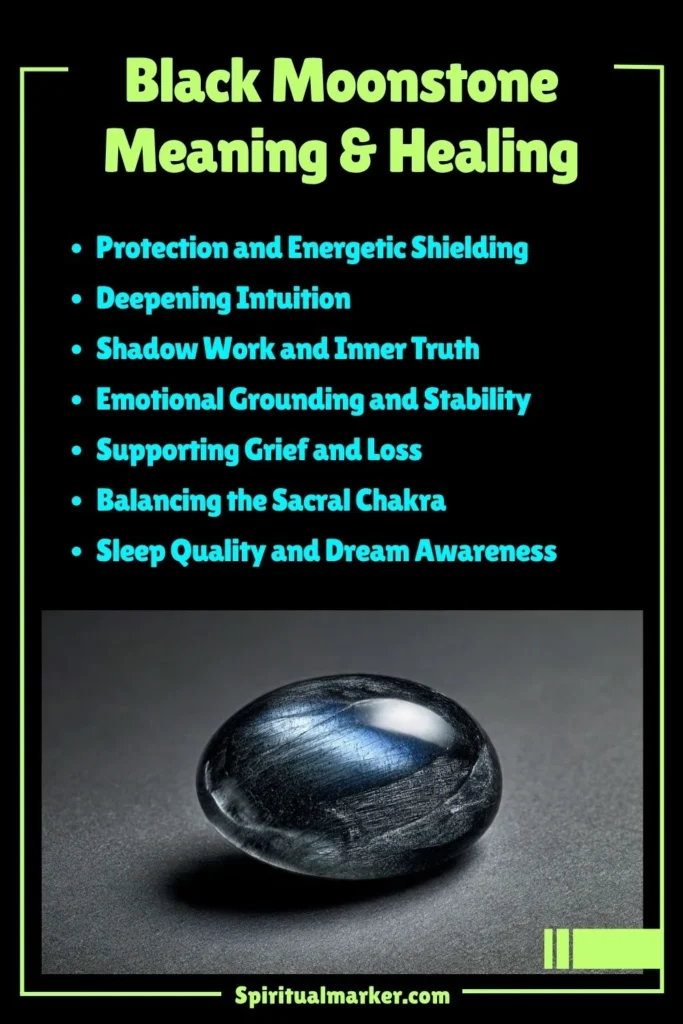
What Is Black Moonstone?
Black moonstone is a naturally occurring feldspar mineral known for its dark base color and distinctive internal glow. Most black moonstones range from deep charcoal and dark gray to near-black with silver, white, or peach shimmer moving across the surface when light hits it at certain angles.
That visual shimmer comes from a phenomenon called adularescence. It occurs because moonstone consists of alternating layers of feldspar minerals, specifically orthoclase and albite. Light passes between those layers and scatters, creating the soft, rolling glow that gives moonstone its name.
Black moonstone is often confused with labradorite because both display inner light and dark base tones. However, labradorite shows sharper metallic flashes of blue, green, gold, and orange, a phenomenon called labradorescence. Black moonstone’s shimmer feels softer, more fluid, and more internally glowing than labradorite’s bold surface display.
Chemically, moonstone belongs to the potassium aluminum silicate mineral family. Its Mohs hardness sits between 6 and 6.5, making it moderately durable but still susceptible to chipping or scratching with rough handling.
Origins and Formation
Black moonstone forms through the same geological process as all moonstones. Feldspar minerals crystallize slowly within cooling igneous rocks. As temperatures drop, the alternating mineral layers form and gradually create the internal structure responsible for adularescence.
The color difference between white moonstone and black moonstone comes primarily from trace mineral content and the conditions under which the stone formed. Higher concentrations of certain minerals during crystallization contribute to darker, more opaque base tones.
Madagascar produces the most significant deposits of black moonstone in the world. Madagascan black moonstone is especially prized for its strong adularescence and relatively deep color. Other sources include India, Sri Lanka, Tanzania, Brazil, and parts of the United States.
Indian moonstone has carried cultural and spiritual significance for thousands of years. Ancient Sanskrit texts referenced the stone in connection with lunar deities. Traders and spiritual practitioners valued it long before modern crystal healing traditions formalized its metaphysical properties.
The geological rarity of strong, high-quality black moonstone with vivid internal shimmer adds to its spiritual reputation. People across traditions have long believed that the rarer and more visually striking a stone, the more potent its energetic qualities.
Key Properties at a Glance
| Aspect | Details |
|---|---|
| Primary Meaning | Protection, intuition, emotional transformation |
| Chakra Association | Third Eye, Crown, Sacral |
| Main Spiritual Symbolism | New moon energy, feminine power, shadow work |
| Common Colors | Deep gray, charcoal, near-black with silver or peach shimmer |
| Hardness | 6 to 6.5 Mohs |
| Main Sources | Madagascar, India, Sri Lanka, Brazil |
| Emotional Associations | Introspection, emotional courage, inner clarity |
| Popular Jewelry Types | Pendants, rings, cabochon bracelets |
| Spiritual Uses | Meditation, shadow work, new moon rituals |
| Care Needs | Gentle cleaning, separate storage, avoid harsh chemicals |
Historical Use and Cultural Significance
Moonstone’s spiritual reputation stretches back thousands of years. Ancient Roman naturalist Pliny the Elder wrote that moonstone shifted appearance according to the phases of the moon. Roman and Greek civilizations associated it with lunar deities including Selene, Diana, and Hecate. Some ancient cultures believed wearing moonstone during travel, especially ocean travel, offered divine protection.
In ancient India, moonstone held deeply sacred status. Hindu traditions connected it directly with the divine feminine, lunar cycles, and the god Chandra, who embodied the moon. Some texts recommended moonstone as a wedding gift symbolizing passion, clarity, and new beginnings. White and lighter moonstones received more frequent mention historically, but darker varieties were still associated with protective lunar energy and the mysterious aspects of feminine spirituality.
In European folklore of the Middle Ages, moonstone was sometimes called the “traveler’s stone.” People believed it protected travelers on nighttime journeys and helped lovers see clearly into one another’s hearts under moonlight.
Modern metaphysical traditions expanded the stone’s spiritual significance considerably. Crystal healing communities in the 20th and 21st centuries specifically identified black moonstone as distinct from white moonstone in both energy and purpose. While white moonstone became associated with emotional softness and divine feminine light, black moonstone developed a reputation for protection, depth, shadow integration, and new beginnings rooted in inner darkness.
Black moonstone became particularly associated with new moon rituals in contemporary spiritual communities. The new moon phase, when the sky appears fully dark, symbolizes planting seeds, setting intentions, beginning inner journeys, and working with hidden aspects of the self. Black moonstone’s dark appearance made it a natural symbol for these themes.
5 Spiritual Meanings of Black Moonstone
1. Protection and Energetic Shielding
Black moonstone carries a strong reputation for protection in spiritual traditions worldwide. Its dark, dense appearance visually mirrors the idea of an energetic shield. Many people who work with this stone describe feeling less emotionally reactive after carrying it. They report fewer feelings of being drained by others, less emotional vulnerability in difficult environments, and a stronger sense of energetic boundaries.
Protection in spiritual contexts does not always mean physical safety. More often, it refers to emotional and energetic protection. Sensitive people frequently absorb emotional energy from their surroundings, from the moods of others, stressful environments, or emotionally charged conversations. Over time, this absorption creates fatigue, emotional overload, and a blurred sense of personal emotional identity.
Black moonstone spiritually represents the ability to remain present without becoming energetically overwhelmed. Its symbolism centers on maintaining inner stability while navigating external emotional turbulence. This is different from emotional detachment or avoidance. Instead, it reflects engaged, grounded awareness that doesn’t lose itself in outside energy.
This protective symbolism also connects to its historical association with night and darkness. Many traditions viewed darkness not as threatening but as a protective force. Night offers stillness, concealment, and a slower pace that daylight rarely provides. Black moonstone reflects these qualities by symbolizing protection through inner quiet and grounded awareness rather than aggressive defense.
Many practitioners carry black moonstone when entering emotionally demanding situations. Job interviews, difficult family conversations, public appearances, hospital visits, and conflict resolution scenarios often leave sensitive individuals emotionally depleted. Black moonstone spiritually symbolizes an energetic layer of support during those challenging interactions.
2. Deepening Intuition
Of all the spiritual meanings connected to black moonstone, its relationship with intuition stands out as particularly significant. Moonstone across all varieties has long been associated with lunar energy, and the moon itself has served as a powerful symbol of intuition, cyclical wisdom, and inner knowing across nearly every major culture in human history.
Intuition operates beneath logical analysis. It functions as a form of knowing that arrives before reasoning catches up. Many people experience intuition as a feeling in the body, a sudden clarity, a gut sense about a person or situation, or an unexplained certainty that guides decision-making. Scientific research in cognitive psychology, including work from researchers like Gerd Gigerenzen on heuristics and intuitive judgment, confirms that intuitive processing is a genuine and often accurate form of intelligence, not simply irrational impulse.
Black moonstone spiritually represents strengthening that inner knowing. Many practitioners use it during meditation to quiet external mental noise and create space for deeper, subtler awareness to surface. Its connection to the third eye chakra reinforces this theme. The third eye is associated with inner vision, clarity, pattern recognition, and spiritual perception beyond ordinary sensory experience.
People often report that consistent work with black moonstone corresponds with increased awareness of emotional patterns, more reliable gut instincts, and a deeper ability to read situations accurately. Whether this reflects the stone’s direct energetic influence or simply the meditative self-awareness practices people engage in while using it, the outcome is the same. Intuition deepens.
Its symbolism also connects to lunar cycles. The moon is never fully visible all at once. It reveals itself gradually through phases. Similarly, intuition rarely arrives as complete, immediate certainty. Black moonstone spiritually reflects the process of allowing inner knowing to develop patiently, phase by phase, without forcing clarity before it naturally emerges.
3. New Beginnings and Intentional Cycles
Black moonstone holds particularly strong symbolism around new beginnings. This connection comes directly from its association with the new moon phase. In lunar cycle traditions, the new moon represents the very start of a new cycle. The sky appears dark. Possibility feels unlimited. Seeds can be planted without yet knowing exactly how they will grow.
This symbolism differs importantly from the “fresh start” energy people often associate with springtime or the new year. New moon energy is quieter and more internal. It involves setting intentions from a place of stillness rather than excitement. It requires honest self-reflection about what needs releasing before new growth becomes possible.
Black moonstone spiritually embodies this intentional beginning. Its dark surface reflects the quiet space before visible change occurs. Many people use it when starting new life chapters. Career transitions, relationship renewals, creative projects, healing journeys, and spiritual practices all benefit from the grounding intentionality that black moonstone symbolizes.
The stone also represents cyclical thinking rather than linear thinking. Western culture heavily emphasizes linear progress, moving forward, leaving the past behind, and measuring growth in straight lines. But many ancient traditions understood time and growth as cyclical. Life moves in spirals, returning to similar themes with new depth and perspective each time.
Black moonstone symbolizes that cyclical wisdom. People working through recurring emotional patterns, healing old wounds that resurface, or revisiting creative themes from new angles often find resonance with this stone. It reminds people that returning to familiar terrain does not represent failure. It may represent deeper readiness to process something that previously felt inaccessible.
4. Shadow Work and Inner Truth
Among crystal healing practitioners, black moonstone is most powerfully associated with shadow work. Shadow work, a term drawn from the psychological framework of Carl Jung, refers to the process of examining the parts of oneself that have been suppressed, denied, or unconsciously hidden. These might include difficult emotions, unacknowledged fears, repressed desires, inherited patterns, or aspects of personality that feel uncomfortable or socially unacceptable.
Jung described the shadow not as the evil part of a person but as the unknown part. Anything a person does not consciously acknowledge tends to fall into the shadow. Shadow material often drives behavior unconsciously until it receives intentional attention. Many patterns of self-sabotage, emotional reactivity, relationship difficulties, and recurring life challenges have roots in unexamined shadow material.
Black moonstone spiritually represents the courage and safety needed to look inward honestly. Its dark appearance symbolizes the willingness to enter emotional darkness without panic. Many practitioners use it during journaling sessions, therapeutic reflection, dream analysis, or meditative introspection aimed at uncovering unconscious emotional patterns.
The stone does not promise that shadow work will feel comfortable. It rarely does. But its spiritual symbolism centers on compassionate self-examination rather than harsh self-judgment. Many healing traditions emphasize that shadow material holds valuable information. The emotions people most strongly avoid often contain the clearest signals about unmet needs, unhealed wounds, or suppressed authentic identity.
Black moonstone supports this process by symbolizing grounded emotional safety. People feel less likely to flee from difficult self-discovery when they feel internally steady. The stone’s protective qualities work in tandem with its shadow work symbolism, creating a sense of internal holding that makes deeper honesty feel possible.
5. Feminine Energy and Emotional Wisdom
Moonstone across all varieties has historically carried strong associations with feminine energy. This does not mean the stone is exclusively for women or that its symbolism only applies to femininity as a gender expression. In spiritual and metaphysical traditions, feminine energy refers to a set of qualities that anyone can embody regardless of gender. These include receptivity, intuition, nurturing, emotional depth, cyclical awareness, and creative flow.
Black moonstone specifically carries a more grounded and internally focused version of feminine energy than white or rainbow moonstone. White moonstone often symbolizes the full moon’s outward luminosity and emotional openness. Black moonstone connects more closely with the dark moon, the hidden face, the inner knowing, and the quiet power found in stillness and depth.
Many spiritual traditions emphasize that feminine energy has been systematically undervalued in modern culture. Linear productivity, logical analysis, assertive action, and outward achievement receive greater social recognition than introspection, emotional intelligence, receptivity, and cyclical rest. Black moonstone symbolizes a reclamation of those quieter qualities as genuine strengths rather than weaknesses.
Its connection to emotional wisdom is particularly meaningful. Emotional intelligence, the ability to recognize, process, and effectively navigate emotions in oneself and others, is now recognized as one of the most valuable human capabilities. Research by psychologists Peter Salovey and John Mayer, who developed the formal concept of emotional intelligence in the 1990s, confirmed that emotional awareness significantly influences decision-making, relationship quality, and overall well-being.
Black moonstone spiritually reflects the development of this emotional intelligence. Its symbolism encourages turning inward, listening to emotional signals, and developing greater awareness of emotional patterns. This is not passive or escapist. It is deeply active inner work that shapes how people relate to themselves and others.
6 Healing Properties of Black Moonstone
1. Emotional Grounding and Stability
Black moonstone is widely regarded as an emotionally grounding stone. Unlike crystals that amplify emotional intensity, black moonstone tends to have a stabilizing effect. People experiencing emotional turbulence, anxiety, grief, overwhelm, or emotional reactivity often turn toward it for a sense of inner steadiness.
Emotional grounding refers to a person’s ability to remain present and regulated even when emotions feel destabilizing. Research in clinical psychology consistently shows that emotional regulation, the ability to manage and process emotional states without being overwhelmed, forms a foundation for mental health, resilience, and effective decision-making.
Many practitioners carry or hold black moonstone during emotionally intense moments. Some keep it in pockets or bags during stressful workdays. Others hold it during difficult conversations, medical appointments, or periods of grief. Its physical weight and smooth texture create a tactile anchor, a simple grounding point that helps redirect attention to the present moment.
Its dark coloring reinforces this grounding symbolism. Earthy tones in spiritual traditions often correlate with stability, depth, and rootedness. Black absorbs rather than reflects, symbolizing the capacity to hold emotional energy without scattering it outward chaotically. This quality makes black moonstone particularly meaningful for people who feel emotionally unmoored or easily destabilized by external circumstances.
Emotional grounding with black moonstone is not about suppressing feelings. It is about creating enough internal stability that emotions can be felt and processed without overwhelming behavior or judgment. This distinction matters because healthy emotional processing requires both feeling and stability simultaneously.
2. Supporting Grief and Loss
Grief is one of the most physically and emotionally demanding human experiences. Loss disrupts a person’s sense of identity, routine, and future. Research on grief, including foundational work by Elisabeth Kubler-Ross and contemporary grief studies, consistently shows that healthy grieving requires time, emotional permission, and supportive presence rather than premature resolution or emotional suppression.
Black moonstone frequently appears in the spiritual practices of people navigating loss. Its symbolism aligns powerfully with the grief experience because it does not rush toward resolution or demand emotional brightness. Instead, it reflects the reality that some healing happens in darkness, stillness, and inward turning rather than immediate recovery.
Many people who grieve feel intense pressure to recover quickly. Cultural expectations around “moving on” can create shame around prolonged sadness. Black moonstone spiritually symbolizes permission to remain in the process of grief without hurrying. Its dark, quiet appearance mirrors the emotional landscape of loss without trying to artificially brighten it.
At the same time, its connection to new beginnings and cycles offers a gentle long-term perspective. Grief does not mean permanent emotional devastation. Like the new moon that precedes a full lunar cycle, the darkest period of grief often contains the seeds of eventual emotional renewal. Black moonstone holds both realities simultaneously, the necessity of present grief and the quiet possibility of future healing.
Practitioners often use black moonstone in combination with rose quartz for grief support. Rose quartz brings gentle compassion and emotional warmth while black moonstone provides protective grounding and emotional depth. Together, they create a complementary energetic framework for navigating loss.
3. Enhancing Creative Flow
Creativity and intuition operate through similar neurological pathways. Both require the mind to move beyond habitual thinking, make unexpected connections, and trust non-linear ways of knowing. Research in neuroscience and creativity, including studies on default mode network activity in the brain, confirms that creative insight often emerges during states of relaxed, open awareness rather than during focused analytical effort.
Black moonstone’s association with intuition and receptive inner awareness makes it a natural companion for creative work. Many artists, writers, musicians, and designers report using it during creative blocks or during the early stages of a project when inspiration feels elusive. Its symbolism centers on allowing rather than forcing, which aligns with how creative flow actually functions.
Creative blocks often arise from excessive self-judgment, fear of failure, perfectionism, or rigid thinking patterns. Black moonstone spiritually represents moving through those internal barriers by softening critical mental activity and encouraging receptive inner listening. Many creative traditions across cultures emphasize that great creative work arrives when the creator becomes a clear channel for something deeper than conscious intention.
The stone’s connection to lunar energy reinforces this creative symbolism. Moonlight has long been a metaphor for creative inspiration because it illuminates quietly and indirectly. It reveals beauty that harsh daylight can flatten. Black moonstone symbolizes that kind of indirect illumination, the gentle inner light that reveals creative possibilities when analytical pressure temporarily softens.
Writers, poets, visual artists, and spiritual practitioners often keep black moonstone near workspaces or hold it during the early morning hours when the mind sits between sleep and full wakefulness. That liminal state, neither fully unconscious nor fully analytical, frequently produces the richest creative insights.
4. Balancing and Awakening the Sacral Chakra
The sacral chakra, located in the lower abdomen, governs creativity, emotional flow, pleasure, sensuality, desire, and the ability to experience life with vitality and authentic feeling. When the sacral chakra feels blocked or imbalanced, people may experience emotional numbness, creative stagnation, low motivation, disconnection from pleasure, or difficulty processing and expressing emotions freely.
Black moonstone is frequently associated with sacral chakra healing because its symbolism centers on emotional depth, creative flow, feminine energy, and cyclical awareness. All of these qualities directly correspond with healthy sacral chakra function.
Many spiritual practitioners use black moonstone during meditations focused on emotional release, creative renewal, or reconnecting with desire and authentic feeling after periods of emotional suppression or chronic stress. They often place it on the lower abdomen during lying-down meditation or hold it while focusing on slow, intentional breathing.
The sacral chakra’s element is water, which moves, flows, and changes shape without losing its essential nature. Black moonstone’s lunar associations reinforce this water connection because the moon governs ocean tides. Many people intuitively associate both moonstone and water with emotional fluidity, creative rhythms, and the capacity to move through emotional states without becoming rigidly fixed in any single feeling.
Restoring healthy sacral energy often involves giving emotional life more space to breathe. Chronic overwork, emotional suppression, perfectionism, or constant analytical focus tends to stagnate sacral energy over time. Black moonstone symbolizes the restoration of emotional vitality and creative aliveness through patient, nurturing inner attention.
5. Third Eye and Crown Chakra Activation
Beyond the sacral chakra, black moonstone carries strong associations with the third eye chakra and the crown chakra. The third eye chakra, located at the center of the forehead, governs intuition, inner vision, clarity, and the ability to perceive patterns and truths beyond ordinary sensory experience. The crown chakra, at the top of the head, represents spiritual awareness, connection to higher consciousness, and expanded perspective.
Many practitioners believe that consistent work with black moonstone gently activates and balances both of these energy centers simultaneously. Its connection to intuition aligns directly with third eye function. Its association with spiritual depth, cyclical wisdom, and inner illumination connects it with crown chakra awareness.
People often use black moonstone during meditation, breathwork, and visualization practices specifically aimed at developing spiritual perception and inner clarity. Some hold the stone at the forehead during lying-down meditation. Others place it above the head or simply hold it in both hands while sitting in quiet inner focus.
Developing third eye awareness does not always mean experiencing dramatic visions or psychic episodes. For most people, it manifests more subtly as sharper intuitive awareness, greater pattern recognition, stronger dream recall, increased sensitivity to emotional atmospheres, and a deepening sense of inner knowing that informs daily decisions.
Black moonstone spiritually supports this gradual process of inner vision development. Its symbolism encourages patience, darkness-tolerance, and trust in non-linear knowing, all qualities essential to developing genuine third eye clarity rather than simply performing spiritual sophistication.
6. Sleep Quality and Dream Awareness
Black moonstone carries a notable reputation for improving sleep quality and enhancing dream awareness within spiritual traditions. Many practitioners place it on the bedside table, under the pillow, or in the bedroom environment to support deeper, more restful sleep and more vivid or meaningful dreams.
Its calming, protective symbolism contributes to this use. Sleep often eludes people who feel emotionally unsafe, mentally overstimulated, or energetically drained by the day’s demands. Black moonstone’s protective and grounding qualities symbolically create an emotionally safer internal environment, one that allows the nervous system to release daily stress and settle into genuine rest.
Dream awareness holds particular significance in many spiritual traditions. Jungian psychology treats dreams as direct communications from the unconscious mind containing valuable information about emotional processing, unresolved conflicts, creative possibilities, and emerging psychological insights. Indigenous traditions across Africa, the Americas, and Asia have long treated dream experiences as meaningful encounters with spiritual dimensions.
Black moonstone’s connection to shadow work and inner truth makes it a natural companion for dream journaling practices. Many practitioners keep a journal beside their bed and record dreams immediately upon waking while black moonstone remains nearby. Over time, patterns in dream content often reveal recurring emotional themes, unresolved inner conflicts, or emerging creative and spiritual awareness.
Its lunar symbolism reinforces the dream connection powerfully. The moon itself has governed the night, the unconscious, and the dream world across nearly every major cultural and spiritual tradition. Black moonstone spiritually reflects this ancient correspondence between lunar wisdom and the inner life of dreams.
How to Wear Black Moonstone Jewelry for Spiritual Growth
Black moonstone jewelry appears in many forms, including rings, pendants, earrings, bracelets, and cabochon settings. Each placement carries slightly different spiritual significance depending on your personal intention.
Pendants worn near the throat or upper chest sit close to the throat chakra and heart area. This placement supports emotional communication, self-expression, and the bridging of emotional wisdom into speech. People who struggle to express emotional truths or communicate from a place of genuine feeling often find this placement particularly meaningful.
Rings keep the stone in constant tactile contact with the hands. In spiritual traditions, hands represent giving, receiving, and creative action. Wearing black moonstone as a ring symbolizes bringing intuitive awareness into everyday actions and interactions.
Bracelets allow the stone to rest against the pulse point, a place where many practitioners believe energetic exchange between stone and wearer intensifies. Many people wear black moonstone bracelets during emotionally demanding days, spiritual practice sessions, or creative work periods.
For those interested in deeper spiritual practice, many practitioners use black moonstone specifically during new moon ceremonies. They hold the stone while setting intentions, journaling, or meditating during the new moon phase. This aligns the stone’s symbolism with the lunar energy it most strongly represents.
Some people combine black moonstone with labradorite for amplified intuition, with selenite for crown chakra clearing, or with obsidian for deeper shadow work and protective grounding. These combinations are entirely personal and depend on individual energetic sensitivities and spiritual goals.
Caring for Black Moonstone Jewelry
Black moonstone requires thoughtful care because of its moderate hardness and internal layered structure. With proper care, it maintains both its physical beauty and its symbolic significance for years.
Store black moonstone separately from harder gemstones like diamonds, sapphires, or rubies. Softer stones scratch easily when stored together in unprotected jewelry boxes. Soft fabric pouches or padded compartments work best for long-term storage.
Clean black moonstone gently using lukewarm water and mild soap. Use a soft cloth or very soft brush. Avoid ultrasonic cleaners, steam cleaning, and harsh chemical solutions. These can disrupt the delicate internal structure responsible for adularescence and permanently damage the stone’s appearance.
Remove black moonstone jewelry before physical activities involving impact, heavy lifting, or chemical exposure. Household cleaning products, chlorine in swimming pools, and intense physical contact all pose risks to the stone’s surface and structural integrity.
In terms of spiritual cleansing, many practitioners use moonlight exposure as their preferred method, particularly during the full or new moon phase. Others use sound cleansing with singing bowls or tuning forks, placing the stone beside dried herbs, or setting it on selenite charging plates. These practices vary widely according to personal spiritual tradition and should reflect what resonates most authentically with your own beliefs.
A Final Note
Black moonstone holds a rare combination of qualities. It feels simultaneously grounding and spiritually expansive. It symbolizes both deep protection and courageous inner honesty. Its dark surface and soft inner shimmer reflect the same paradox at the heart of genuine growth: the most meaningful transformation often begins in quiet, unseen places.
Whether you are drawn to black moonstone for its striking visual beauty, its protective symbolism, its connection to intuition, or its deep association with emotional truth, this stone carries layers worth sitting with patiently. Many people find that their relationship with black moonstone shifts and deepens over time, much like the lunar cycles it represents.
If black moonstone keeps appearing in your awareness, that pull likely reflects something personally meaningful in your current inner journey. Some people wear it as a daily spiritual companion. Others bring it out specifically during new moon rituals, creative sessions, shadow work practices, or emotionally demanding seasons of life. However you choose to work with it, allow the stone’s symbolism to meet you where you actually are rather than where you think you should be.