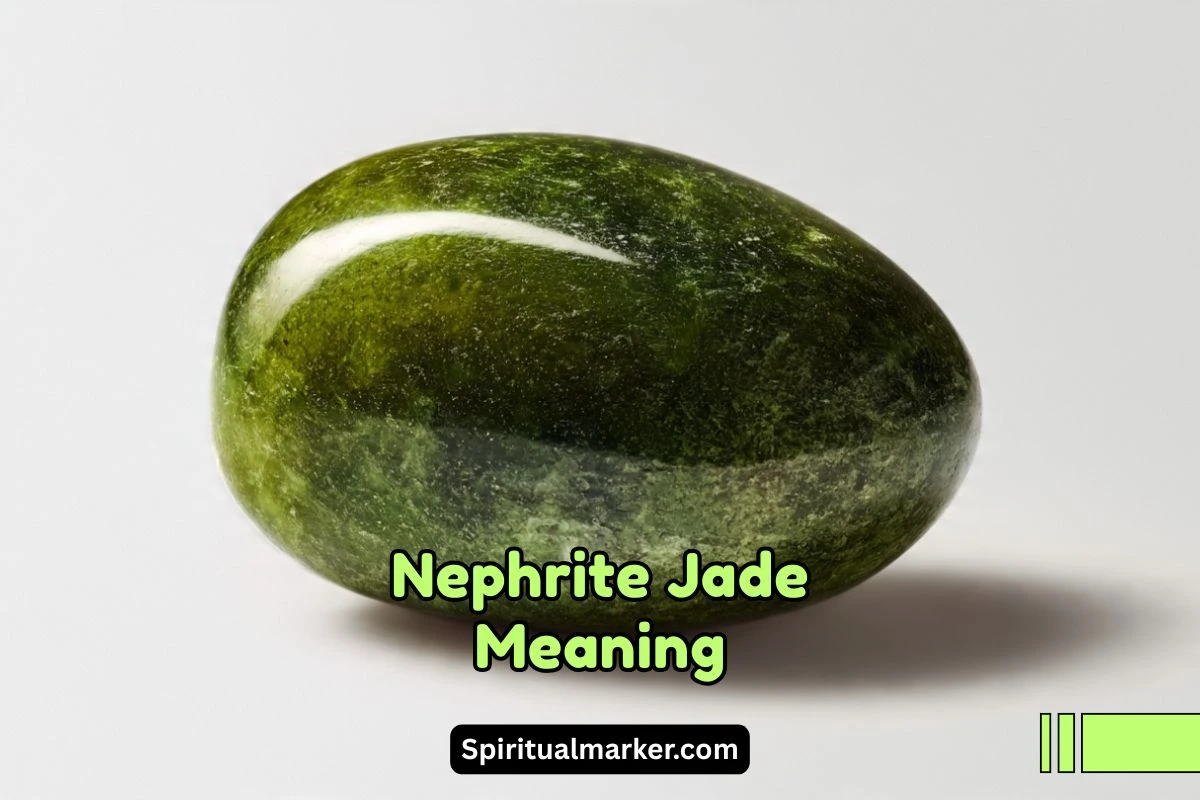
Nephrite jade is one of the oldest known stones. Its soft green color and smooth texture feel deeply calming. In spiritual practice, this stone carries protective and nurturing energy.
The nephrite jade meaning often involves protection, harmony, and emotional balance. It is a stone of the heart chakra, helping to attract love and abundance. A spiritual meaning of green jade shares that jade focus, though green jade carries a more prosperous energy.
Nephrite jade is used in crystal healing to support physical health, calm the mind, and enhance meditation. It can also symbolize wisdom and tranquility. The stone's energy is gentle and grounding.
If you feel drawn to nephrite jade, it may signal a need for balance. A spiritual meaning of white jade also deals with jade, though white jade carries a more purifying energy.
Key Takeaways
- Nephrite Jade symbolizes wisdom, protection, longevity, emotional balance, and spiritual strength.
- Ancient Chinese culture considered Nephrite Jade the most sacred stone in existence, calling it the “Stone of Heaven.”
- Nephrite Jade connects primarily with the heart chakra and is also associated with grounding energy.
- This stone has a dense, fibrous structure that makes it one of the toughest gemstones despite its moderate hardness.
- Wearing or meditating with Nephrite Jade is believed to promote inner peace, clarity, courage, and long-term emotional resilience.
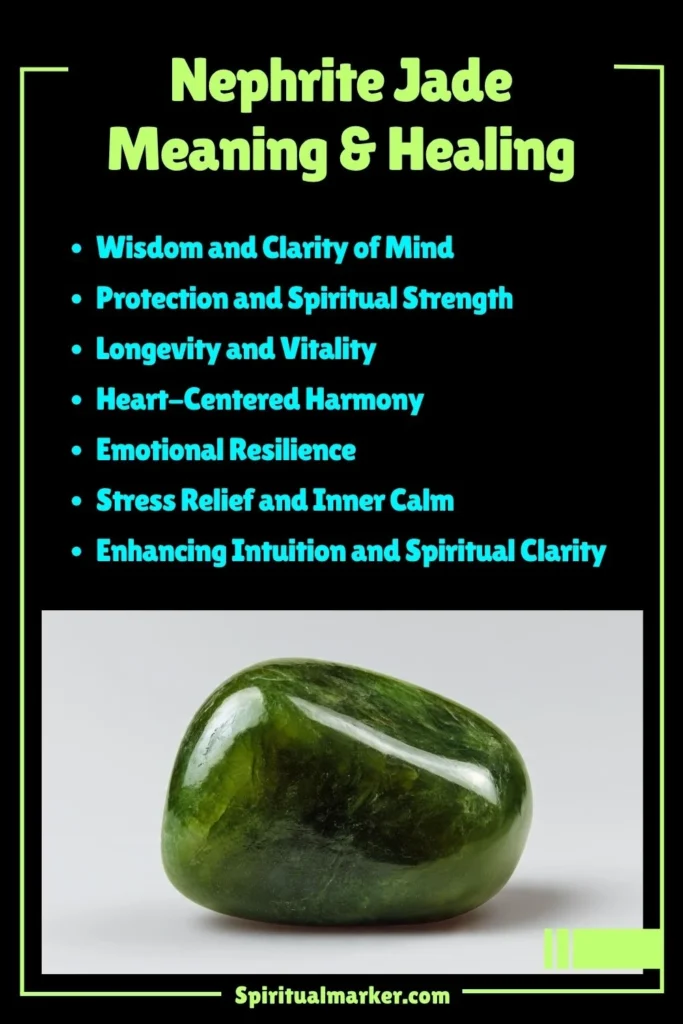
What Is Nephrite Jade?
Nephrite Jade is a naturally occurring silicate mineral belonging to the amphibole group. Its primary mineral component is actinolite or tremolite, which forms in tightly interlocked fibrous crystals. This fibrous structure gives Nephrite Jade an extraordinary toughness that far exceeds what its surface hardness suggests. Ancient peoples valued it not just for beauty but for durability, often using it to craft tools, weapons, and sacred objects.
Most people use the word “jade” loosely to refer to any green stone with a smooth, waxy surface. However, true jade refers to only two distinct minerals: Nephrite and jadeite. These two stones share visual similarities but differ significantly in structure, rarity, and spiritual reputation. Nephrite Jade tends to display earthy, muted greens ranging from pale celadon to dark forest green. Jadeite can display more vivid, intense greens, including the highly prized “Imperial Jade” shade.
Nephrite is generally more accessible than jadeite, though fine-quality Nephrite still holds significant value. Its texture feels smooth and slightly greasy or waxy when polished. That distinctive surface quality has long contributed to its reputation as a stone deeply connected to earth energy, life force, and natural wisdom.
Many people are also surprised to learn that Nephrite Jade is not fragile. Despite measuring between 6 and 6.5 on the Mohs hardness scale, its interlocked fibrous crystal structure makes it exceptionally resistant to breaking. Ancient peoples specifically chose it for tools and weapons because of this toughness. That same quality mirrors its spiritual symbolism of strength, resilience, and endurance.
Origins and Formation
Nephrite Jade forms under high-pressure, low-temperature metamorphic conditions. It develops primarily in serpentinite rock environments where tectonic activity creates the specific geological conditions required. The formation process takes an immense amount of time and geological energy, which connects the stone spiritually to themes of patience, endurance, and deep inner strength.
China has historically been the most famous source of Nephrite Jade, particularly the deposits found near Khotan in the Xinjiang region. Traders transported this jade along the ancient Silk Road for centuries, spreading its cultural and spiritual influence far beyond China’s borders. Chinese civilization’s relationship with Nephrite Jade dates back at least seven thousand years, making it one of the oldest continuously revered gemstones in recorded human history.
Other significant sources include Canada, Russia, New Zealand, Australia, Taiwan, and parts of Central Asia. New Zealand’s Nephrite Jade, called pounamu by the Maori people, holds immense cultural and spiritual importance in Polynesian tradition. Canadian Nephrite, particularly from British Columbia, has become an important commercial source in recent centuries.
The stone’s color comes from the presence of iron within its mineral structure. Higher iron content typically produces darker, deeper greens. Lower iron levels create paler, more translucent greens. Some Nephrite also appears in black, white, yellow, or gray shades, though green remains by far the most recognized and symbolically significant color variety.
Key Properties
| Property | Details |
|---|---|
| Mineral Group | Amphibole (Actinolite/Tremolite) |
| Color Range | Pale celadon, olive green, forest green, dark green, black |
| Hardness | 6 to 6.5 Mohs |
| Toughness | Exceptionally high due to fibrous crystal structure |
| Chakra Association | Heart chakra, Root chakra |
| Primary Symbolism | Wisdom, protection, longevity, emotional balance |
| Main Sources | China, Canada, New Zealand, Russia, Australia |
| Transparency | Opaque to slightly translucent |
| Energy Style | Grounded, protective, nurturing, stabilizing |
| Spiritual Uses | Meditation, protection, emotional healing, spiritual growth |
Historical Significance of Nephrite Jade
The history of Nephrite Jade reads more like a story of human devotion than a geological record. No other stone has inspired the same level of sustained cultural reverence across so many independent civilizations simultaneously.
In ancient China, Nephrite Jade held a position above all other precious materials. The philosopher Confucius described jade as embodying eleven virtues, including benevolence, wisdom, courage, purity, and righteousness. Chinese emperors were buried in full jade suits. Jade ceremonial objects accompanied the dead into the afterlife. Imperial courts used jade seals, jade cups, and jade sculptures as objects of divine authority. The phrase “Stone of Heaven” was not poetic exaggeration. It reflected a genuine cultural belief that Nephrite Jade carried divine energy from the celestial realm.
The Maori people of New Zealand developed an equally profound relationship with pounamu. They carved Nephrite Jade into hei-tiki figures, which are ancestral pendants believed to carry the spiritual presence of ancestors. Warriors wore jade weapons and ornaments as symbols of status, courage, and spiritual protection. Pounamu objects were treated as taonga, meaning treasured possessions that held immense spiritual and genealogical significance. These objects were never discarded. They were passed down through families as sacred links between living descendants and ancestral spirits.
In Mesoamerica, both Aztec and Maya civilizations associated jade with life, death, and rebirth. Jade masks covered the faces of royalty in burial ceremonies. Jade beads were placed in the mouths of the deceased to represent the spiritual breath needed for the afterlife journey. The green color of jade connected symbolically with maize, fertility, rain, and the living forces of nature. Jade carried more cultural weight than gold in many Mesoamerican contexts because it was seen as a direct representation of life force itself.
Neolithic cultures across Europe and Asia also used Nephrite for tools, weapons, and ceremonial objects thousands of years ago. Archaeological sites in Switzerland, Germany, Poland, and Britain have yielded Nephrite axe heads and carvings that confirm the stone’s ancient and widespread human significance. These early uses combined practical value with symbolic meaning, suggesting that even prehistoric peoples understood Nephrite as something more than ordinary stone.
5 Spiritual Meanings of Nephrite Jade
1. Wisdom and Clarity of Mind
Nephrite Jade has carried the symbolism of wisdom across cultures that never interacted with each other. That pattern is significant. When independent civilizations independently associate a single material with the same quality, that convergence points toward something deeply intuitive in human perception.
Ancient Chinese philosophy treated jade as the physical embodiment of wisdom. Confucian texts described its qualities as moral and intellectual virtues made visible in stone form. Jade’s density represented thoughtfulness. Its smooth surface represented the refined mind. Its capacity to maintain polish over centuries represented wisdom that does not erode under pressure. These were not random associations. They were carefully constructed metaphors built around the actual physical properties of Nephrite Jade itself.
In spiritual practice, Nephrite Jade is often connected with mental clarity during moments of confusion, indecision, or emotional overwhelm. People working through complex decisions sometimes turn to the stone as a symbolic anchor. Holding it during reflection is believed by many practitioners to help quiet the mental noise that obscures clear thinking.
Wisdom in this context means more than intellectual knowledge. It encompasses emotional intelligence, patience, discernment, and the ability to see situations clearly without distortion. Nephrite Jade symbolizes all of these qualities. Its energy is patient and deliberate. It does not push toward hasty conclusions. It encourages stillness before action, which is itself a form of wisdom.
The stone also symbolizes accumulated understanding. Just as Nephrite Jade forms over immense geological time, wisdom develops slowly through lived experience. You cannot force it or rush it. Nephrite Jade reflects this same patience-centered approach to personal and spiritual development.
2. Protection and Spiritual Strength
Across nearly every culture that revered Nephrite Jade, protection formed a central part of its spiritual meaning. Maori warriors carved jade weapons and wore jade ornaments believing the stone strengthened them against physical and spiritual harm. Chinese travelers carried jade amulets on long journeys for protection against negative forces. Mesoamerican priests used jade in rituals designed to guard the community against malevolent spiritual energies.
The protective symbolism of Nephrite Jade extends beyond physical danger. Many spiritual traditions associate the stone with psychic protection and energetic shielding. People who feel emotionally drained by others, sensitive to environmental energies, or vulnerable during stressful life periods often gravitate toward Nephrite Jade as a stabilizing protective presence.
This protective energy feels grounded and reliable rather than aggressive. Nephrite Jade does not symbolize combative strength. Instead, it represents the kind of protection that comes from deep inner stability. A person with strong roots does not fall easily in a storm. Nephrite Jade spiritually reflects that same rooted, unshakeable quality.
Its protective symbolism also extends to spiritual boundaries. Maintaining healthy boundaries in relationships, work, and spiritual practice requires a clear sense of self and the strength to honor personal needs without guilt or fear. Nephrite Jade is often associated with the confidence and inner strength required to uphold those boundaries consistently.
Many people wear Nephrite Jade jewelry daily as a protective talisman. The stone’s physical durability mirrors its spiritual symbolism. It does not chip easily. It does not lose its luster under normal conditions. That enduring quality reflects the kind of protection it symbolizes: steady, long-lasting, and deeply rooted.
3. Longevity and Vitality
No other gemstone shares Nephrite Jade’s long historical connection with longevity and physical vitality. In ancient China, emperors consumed powdered jade mixed into beverages, believing it could extend life and strengthen the physical body. While modern medicine does not support ingesting jade, this practice reveals how deeply the stone was associated with life force and vitality in the ancient world.
The Chinese word for jade, “yu,” also carried connotations of beauty, grace, and sustained flourishing. Jade objects were given as gifts for weddings and important life milestones because of their association with long, healthy, harmonious lives. This association was so strong that jade became the default symbol of good wishes across an enormous range of life events.
Spiritually, longevity symbolism in Nephrite Jade points toward more than just a long life span. It also encompasses sustained inner vitality, emotional endurance, and the ability to remain spiritually alive during difficult seasons. Many people experience periods in life where they feel emotionally deadened, spiritually depleted, or disconnected from their own sense of purpose. Nephrite Jade symbolizes the enduring life force that persists beneath those difficult phases.
The stone’s connection to vitality also reflects its visual qualities. Deep green is universally associated with growing, living things. Forests, plants, and living landscapes radiate green energy. Nephrite Jade carries this same visual vitality into the spiritual symbolism of life, growth, and natural thriving.
Many practitioners believe Nephrite Jade supports physical and emotional energy over time. They view it as a stone of sustained nourishment rather than quick stimulation. Its energy builds slowly and consistently rather than flaring dramatically. This makes it particularly meaningful for people seeking long-term well-being rather than temporary relief.
4. Heart-Centered Harmony
Nephrite Jade holds a deeply significant connection with the heart chakra in crystal healing traditions. The heart chakra governs love, compassion, emotional trust, empathy, and the capacity for meaningful human connection. When heart chakra energy flows freely, people often experience emotional openness, healthy relationships, and a grounded sense of inner peace. When blocked, emotional patterns like resentment, fear of vulnerability, or chronic emotional guardedness may develop.
In Chinese spiritual philosophy, Nephrite Jade was described as the stone most closely aligned with human virtue and moral goodness. Virtue in this context was understood as heart-centered. It meant acting from compassion, fairness, and genuine care for others rather than from self-interest or ego. Wearing or working with jade was believed to strengthen a person’s alignment with these heart-centered values over time.
Nephrite Jade’s harmony symbolism extends beyond emotional relationships. It also encompasses inner harmony, which refers to the alignment between thoughts, emotions, actions, and values. Many people experience internal conflict when their daily choices drift away from what they genuinely believe or care about. Nephrite Jade spiritually represents the process of realigning with core values and restoring inner coherence.
In relationships, the stone is often associated with compassionate communication and emotional patience. It does not symbolize dramatic romantic passion. Its energy is warmer and more sustainable than that. Nephrite Jade reflects the kind of love that endures over decades because it is rooted in genuine care, mutual respect, and emotional honesty rather than surface-level attraction.
Many people also associate Nephrite Jade with forgiveness. Forgiveness here does not mean minimizing harm or pretending pain did not happen. It means releasing the emotional weight of resentment before it damages the person carrying it. Nephrite Jade symbolizes the heart’s capacity to heal without losing itself in bitterness.
5. Spiritual Grounding and Ancestral Connection
Nephrite Jade carries a unique spiritual duality that few other stones share. It connects simultaneously with earthly grounding and ancestral spiritual wisdom. This combination appears in Maori culture most explicitly, where pounamu objects literally served as physical vessels for ancestral presence. The stone was understood as a living link between the visible world and the spiritual lineage of a family or tribe.
In Chinese tradition, jade’s connection to ancestors appeared in burial practices. Surrounding the deceased with jade was not merely symbolic. It was believed to preserve the spiritual essence of the deceased and facilitate their transition between worlds. Jade communicated the family’s desire for ancestral protection and spiritual continuity across generations.
For modern practitioners, this ancestral symbolism often translates into a sense of spiritual rootedness. Knowing where you come from, honoring those who shaped your lineage, and carrying forward values worth preserving are all themes that Nephrite Jade reflects. The stone’s enduring nature mirrors the enduring thread of human lineage itself.
Its grounding energy also appears in its physical qualities. Nephrite Jade feels heavy and solid in the hand. It does not feel light or airy. That weight symbolizes earthly presence, stability, and connection to physical reality. People who feel emotionally scattered, spiritually unmoored, or disconnected from their sense of purpose sometimes find Nephrite Jade’s grounding energy particularly stabilizing.
Spiritual grounding through Nephrite Jade encourages presence rather than escape. It symbolizes the courage to remain fully engaged with life’s challenges rather than retreating into denial or avoidance. This quality of engaged presence is itself a form of spiritual strength that Nephrite Jade has represented across thousands of years of human spiritual history.
6 Healing Properties of Nephrite Jade
1. Emotional Resilience
One of Nephrite Jade’s most widely recognized healing associations involves emotional resilience, which is the capacity to recover from hardship without losing emotional stability or personal integrity. Unlike stones associated with emotional softness or vulnerability, Nephrite Jade represents the stronger, more enduring dimension of emotional health.
People drawn to Nephrite Jade during difficult periods often describe needing strength more than comfort. After prolonged hardship, grief, loss, chronic stress, or emotional exhaustion, many individuals feel their emotional reserves running dangerously low. They may feel reactive, fragile, or easily overwhelmed by challenges they would normally handle with ease. Nephrite Jade spiritually represents the rebuilding of emotional strength during these depleted periods.
This healing property reflects the stone’s historical use among warriors and rulers. Both Maori warriors and Chinese emperors associated jade with strength under pressure. The stone was not soft or yielding in their traditions. It was tough, enduring, and capable of withstanding enormous force without breaking. That same quality translates into emotional symbolism about persisting through adversity without losing core identity.
Emotional resilience through Nephrite Jade is not about suppressing pain or pretending difficulties do not exist. Instead, it symbolizes developing the inner foundation strong enough to hold difficult emotions without being overwhelmed by them. You can feel fear, grief, and uncertainty while remaining emotionally functional and spiritually grounded. Nephrite Jade reflects that quality of rooted emotional strength.
2. Stress Relief and Inner Calm
Nephrite Jade has long been associated with promoting inner calm and reducing emotional tension. Its dense, grounding energy contrasts with the mental overstimulation that characterizes modern stress. Holding or wearing the stone during anxious periods is believed by many practitioners to help slow racing thoughts and restore emotional steadiness.
Ancient Chinese physicians associated jade with calming the nervous system and promoting balanced qi, or life force energy. While these claims belong to traditional medicine rather than clinical science, the psychological principle behind them holds meaningful relevance. Physical contact with smooth, cool, heavy objects can activate the parasympathetic nervous system response, which is the body’s natural relaxation mechanism.
Nephrite Jade’s weight and smooth texture may contribute to this calming effect in a practical, physical sense. Holding a cool, polished jade stone during moments of anxiety or emotional stress provides tactile grounding, which can interrupt cycles of anxious thought by redirecting attention to sensory experience in the present moment.
Spiritually, Nephrite Jade symbolizes emotional calm that comes from inner strength rather than external circumstances changing. True calm does not depend on everything going well. It develops from a rooted inner stability that remains present even when situations are difficult. This form of calm is more durable and meaningful than temporary relief, and it reflects the deeper healing property Nephrite Jade represents.
3. Physical Well-Being and Vitality Support
Many traditional healing systems across Asia, particularly Traditional Chinese Medicine (TCM), associated jade with physical health and bodily vitality. Jade rollers and gua sha tools made from Nephrite Jade have been used in Chinese skincare and healing practices for centuries. These tools were believed to promote circulation, reduce inflammation, and support the body’s natural healing processes.
Modern skincare has adopted jade facial rollers widely, and research suggests that jade tools used for facial massage may support lymphatic drainage, reduce puffiness, and improve circulation when used regularly. While these effects relate to the tool’s physical properties rather than crystal metaphysics, they demonstrate that Nephrite Jade’s association with physical health has maintained real practical relevance across cultures.
In crystal healing traditions, Nephrite Jade is associated with the kidneys, adrenal glands, and overall immune function. Traditional Chinese healers believed jade supported kidney health specifically, and since the kidneys in TCM connect to vitality, longevity, and ancestral energy, this association carries significant symbolic weight.
Whether approached from a metaphysical or practical angle, the common thread in Nephrite Jade’s physical healing reputation is sustained nourishment and long-term vitality rather than dramatic immediate effects. This steady, supportive quality aligns with the stone’s broader symbolism of endurance and longevity.
4. Clearing Emotional Blockages
Nephrite Jade carries a strong reputation in crystal healing traditions for helping clear emotional blockages that accumulate over time through unresolved experiences. Emotional blockages form when difficult feelings such as grief, shame, anger, or fear are suppressed rather than processed. Over months or years, these unresolved emotions can affect mental clarity, relationship patterns, physical energy, and spiritual openness.
The heart chakra particularly benefits from this clearing quality. When the heart chakra is blocked, people may struggle with trust, emotional intimacy, self-worth, or the ability to give and receive love freely. Nephrite Jade’s association with heart-centered energy positions it as a stone that works slowly but consistently toward reopening emotional pathways that have closed under the weight of past pain.
This healing property works differently than stones associated with intense emotional release. Nephrite Jade does not typically symbolize sudden emotional breakthroughs or dramatic cathartic experiences. Instead, it represents the gradual loosening of emotional constriction over time. A person might notice they are reacting with less defensiveness, opening up more easily in conversations, or feeling less weighed down by old memories.
Spiritual practitioners often use Nephrite Jade during regular meditation over extended periods rather than in single dramatic sessions. The stone’s healing symbolism rewards patience and consistency. This approach mirrors the Confucian jade virtues of steady character development rather than impulsive behavioral change.
5. Enhancing Intuition and Spiritual Clarity
While Nephrite Jade is primarily associated with grounding and heart energy, it also carries connections with spiritual clarity and heightened intuition in many traditions. Chinese spiritual philosophy described jade as a bridge between the earthly and celestial realms. Its physical density connected it to earth, while its beauty and luminosity connected it to the heavens.
This dual nature gives Nephrite Jade an interesting spiritual quality. It grounds you in physical reality while also opening channels for deeper spiritual perception. Practitioners who use the stone during meditation often describe a quality of mental quietness that allows subtle spiritual awareness to surface more clearly. When the noise of anxious thought reduces, intuitive insight becomes easier to access.
In Maori tradition, pounamu was believed to carry ancestral spiritual knowledge within its physical structure. The stone itself was understood as a form of spiritual communication across generations. This belief reflects a deep intuitive understanding of jade as a spiritually intelligent material rather than simply a decorative stone.
For people developing their spiritual practice, Nephrite Jade represents grounded intuition rather than unmoored spiritual flight. It encourages insights rooted in wisdom and lived experience rather than abstract fantasy. This makes it particularly valuable for individuals who want to deepen spiritual awareness without losing connection to practical reality.
6. Promoting Abundance and Good Fortune
Nephrite Jade holds one of the strongest symbolic connections to abundance, prosperity, and good fortune in any gemstone tradition. This is not a minor cultural footnote. In Chinese culture, jade is still actively given as a gift to attract good luck, financial prosperity, and harmonious life circumstances. Its reputation as a lucky stone stretches back at least five thousand years and remains very much alive in contemporary Chinese communities worldwide.
This prosperity symbolism does not refer narrowly to financial wealth. In the broader spiritual sense, abundance through Nephrite Jade encompasses health, meaningful relationships, creative fulfillment, emotional well-being, and spiritual richness. The Chinese concept of good fortune covered all dimensions of a flourishing life, not just material accumulation.
Many crystal practitioners believe Nephrite Jade supports abundance by first helping clear the internal energetic obstacles that block prosperity. Fear, self-doubt, emotional constriction, and unresolved psychological blocks can prevent people from taking the risks, building the relationships, or maintaining the focus needed for genuine success. By supporting emotional resilience and inner harmony, Nephrite Jade creates a more fertile inner environment for abundance to develop.
The stone’s association with longevity further strengthens its prosperity symbolism. Lasting prosperity requires sustained effort, patience, and the ability to maintain direction through setbacks. Nephrite Jade reflects all of these qualities. Its energy is not about quick wins or sudden luck. It represents the kind of deep, rooted flourishing that develops steadily over a lifetime.
How to Wear Nephrite Jade Jewelry for Spiritual Growth
Wearing Nephrite Jade jewelry creates sustained contact between the stone and your energy field throughout the day. Most spiritual traditions connected with jade recommend wearing it directly against the skin to maximize this contact.
Jade bangles hold particular cultural significance in Chinese tradition. Many Chinese women wear jade bangles continuously from the time they receive them, believing the stone and the wearer develop a mutual relationship over time. The bangle is said to absorb something of the wearer’s energy while offering its own protective, harmonizing influence in return.
Nephrite Jade pendants worn near the heart directly align the stone with heart chakra energy. This placement is particularly meaningful if your intention involves emotional healing, compassion, forgiveness, or relationship harmony. The pendant’s contact with the chest creates a constant subtle reminder of those intentions throughout daily life.
Jade rings have carried royal and ceremonial significance across Chinese history. Wearing jade on the hands connects its energy with daily actions, decisions, and interactions. Some practitioners believe this placement strengthens mindful, values-aligned behavior throughout the day.
Many people combine Nephrite Jade with complementary stones to build layered energetic intentions. Black tourmalinemay amplify Nephrite’s protective qualities. Rose quartz may deepen its compassion and love symbolism. Amethystmay support the spiritual clarity dimension of jade’s energy. Citrine may strengthen the prosperity and abundance themes.
Set a clear intention when you first wear or hold Nephrite Jade. Intention matters in most spiritual traditions because it focuses the mind and aligns emotional energy with a specific purpose. Hold the stone quietly for a few moments, breathe slowly, and mentally or verbally state what healing, strength, or quality you are inviting into your life.
Caring for Nephrite Jade Jewelry
Nephrite Jade is physically durable due to its tightly interlocked crystal structure, but it still benefits from thoughtful care to preserve its beauty and energetic integrity over time.
Clean Nephrite Jade using lukewarm water and a mild, natural soap. Use a soft cloth or soft brush to gently clean the surface. Rinse thoroughly and dry completely before storing. Avoid harsh chemical cleaners, ultrasonic machines, and steam cleaners. These methods may damage the stone’s surface or compromise its structural integrity over time.
Store Nephrite Jade separately from harder gemstones like diamonds, sapphires, or topaz, which can scratch the jade surface. Soft fabric pouches or padded jewelry boxes work well. While Nephrite is tougher than many stones, its surface can still be scratched by harder materials.
Remove Nephrite Jade before heavy physical activity, swimming in chlorinated water, and exposure to strong household chemicals. Extended exposure to harsh conditions may gradually affect the stone’s appearance and structural integrity.
Nephrite Jade can tolerate mild sunlight better than water-based stones like opal, but prolonged intense sun exposure may cause color shifts in some specimens over years of daily wear. Brief, indirect sunlight exposure is generally safe.
For energetic cleansing, many practitioners prefer moonlight exposure overnight, particularly during a full moon. Placing Nephrite Jade on natural soil or grass for a short time is another grounding cleansing method that aligns with the stone’s earthly symbolism. Sound cleansing with singing bowls or bells is also commonly used. Avoid submerging jade in salt water for extended periods, as salt may eventually affect the stone’s surface polish.
Table: Nephrite Jade at a Glance
| Aspect | Details |
|---|---|
| Primary Meaning | Wisdom, protection, longevity, emotional harmony |
| Chakra Association | Heart chakra, Root chakra |
| Main Spiritual Symbolism | Strength, vitality, ancestral connection, abundance |
| Common Colors | Pale celadon, olive green, forest green, dark green |
| Hardness | 6 to 6.5 Mohs |
| Toughness | Exceptionally high |
| Main Sources | China, Canada, New Zealand, Russia, Australia |
| Emotional Associations | Resilience, calm, emotional balance, compassion |
| Popular Jewelry Types | Bangles, pendants, rings, carvings |
| Spiritual Uses | Meditation, protection, ancestral work, grounding, prosperity |
| Care Needs | Gentle cleaning, separate storage, avoid harsh chemicals |
| Historical Significance | Sacred in Chinese, Maori, and Mesoamerican traditions |
A Final Note
Nephrite Jade stands in a category of its own among gemstones. Its symbolism is not built on folklore from a single culture. It developed independently across multiple civilizations separated by thousands of miles and thousands of years. That convergence says something important about the stone’s capacity to resonate with deep human experience.
Its meaning centers on wisdom, protection, longevity, and heart-centered harmony. Its healing properties reach across emotional resilience, spiritual grounding, physical vitality, and the quiet clearing of accumulated inner tension. Its historical significance places it among the most culturally important materials human civilization has ever valued.
Whether you wear Nephrite Jade as jewelry, keep a carved piece on your desk, or use it during meditation, the stone carries weight in the most meaningful sense. Not just physical weight, but the accumulated weight of thousands of years of human devotion, spiritual meaning, and cultural wisdom.
If Nephrite Jade has drawn your attention, that pull likely reflects something specific about where you are in life right now. Perhaps you need strength more than comfort. Perhaps you are seeking clarity in a season of confusion. Perhaps you want to reconnect with something steady and rooted beneath the surface noise of daily life. Nephrite Jade has accompanied human beings through all of those experiences across millennia. You would not be the first person to find something profoundly stabilizing in this ancient green stone.