
Howlite is a stone of calm and awareness. Its white color veined with gray evokes stillness and patience. In spiritual practice, this stone carries soothing and grounding energy.
The howlite meaning often involves calm, patience, and emotional healing. It is a stone of the crown chakra, helping to quiet the mind and invite peace. A spiritual meaning of white jade shares that white-stone focus, though jade carries a more purifying energy.
Howlite is used in crystal healing to reduce stress, improve sleep, and support meditation. It can also symbolize wisdom and tranquility. The stone's energy is gentle and nurturing.
If you feel drawn to howlite, it may signal a need for calm. A spiritual meaning of white moonstone also deals with white stones, though moonstone carries a more lunar energy.
Key Takeaways
- Howlite symbolizes calm, patience, emotional awareness, and spiritual openness.
- Many traditions connect howlite with the crown chakra, making it a stone of higher awareness and mental clarity.
- People frequently use howlite for sleep support, stress relief, meditation, and anger management.
- Howlite has a porous surface that absorbs dye easily, making it one of the most commonly imitated stones in the gem trade.
- Wearing or holding howlite regularly may deepen feelings of inner stillness, reduce emotional reactivity, and support personal growth.
What is Howlite?
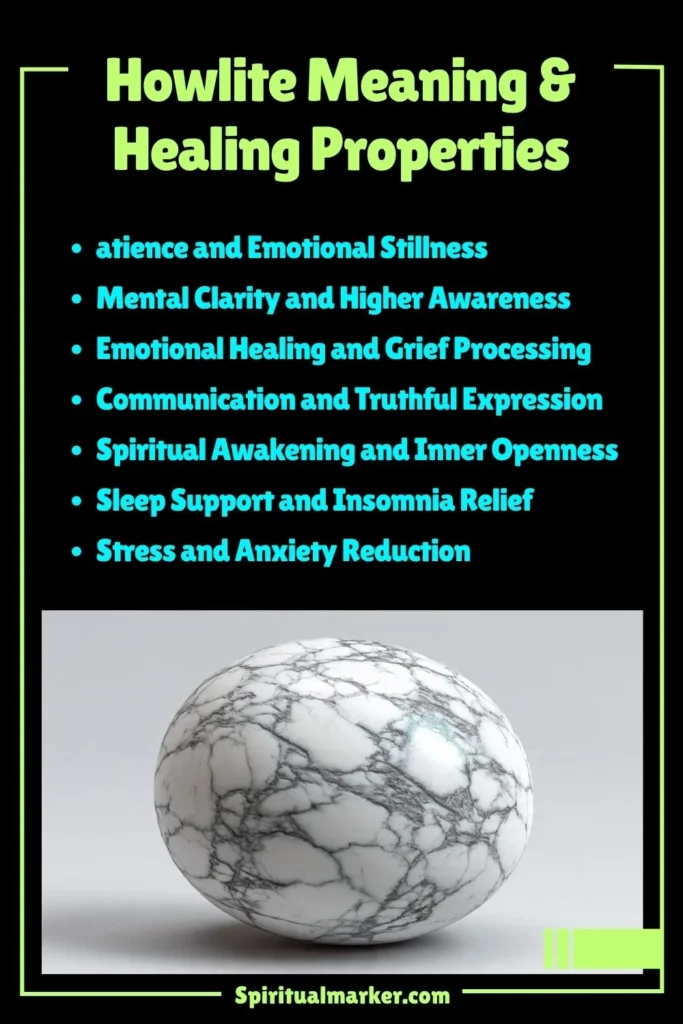
Howlite is a calcium borosilicate hydroxide mineral with a naturally white or off-white color. Its surface displays an intricate network of grey or black veins, giving it a marbled, almost web-like appearance. That pattern makes each piece completely unique.
The stone has a dull, chalky luster when raw and takes on a smoother finish when polished. It does not display dramatic color shifts or iridescent flashes. Its visual appeal comes entirely from texture, contrast, and quiet elegance.
Mineralogically, howlite belongs to the borate mineral family. It forms in irregular nodules and masses rather than distinct crystals. Its surface is highly porous, which allows dyes to absorb deeply and evenly. This quality has led to widespread use of dyed howlite as an imitation for turquoise, red coral, and lapis lazuli in the gemstone trade.
Spiritually and emotionally, howlite carries a reputation that feels consistent across many healing traditions. Its energy is almost universally described as calming, clarifying, and grounding. Whether held during meditation or worn as jewelry throughout a busy day, howlite seems to carry a singular intention: slow down, breathe, and become more aware.
Origins and Formation
Howlite was first identified in Nova Scotia, Canada, in 1868. Geologist Henry How discovered it during a gypsum mining operation. Miners originally considered it a nuisance because its nodules interfered with gypsum extraction. How later described and named the mineral, giving it the name it carries today.
The stone forms through evaporite processes in sedimentary rock environments. This happens when water rich in boron and calcium slowly evaporates, leaving mineral deposits behind in layered formations. Over geological time, these deposits solidify into the chalky, nodular masses associated with howlite.
Major howlite deposits exist in Canada, the United States (particularly California and Nevada), Mexico, Turkey, Germany, Russia, and Serbia. California and Nova Scotia remain among the most significant producing regions.
Because howlite absorbs color so readily, the gem trade has used it for decades as a substitute for more expensive stones. Dyed blue howlite is especially common in turquoise imitation jewelry. Buyers should look for consistent pricing, chalky weight, and grey veining patterns to distinguish natural howlite from dyed versions.
Key Properties
| Property | Details |
|---|---|
| Color | White, off-white, sometimes grey |
| Composition | Calcium borosilicate hydroxide |
| Hardness | 3.5 on the Mohs scale |
| Chakra Association | Crown chakra, third eye chakra |
| Symbolism | Calm, patience, awareness, emotional healing |
| Common Sources | Canada, USA, Mexico, Turkey, Russia |
| Transparency | Opaque |
| Energy Style | Stillness, grounding, mental clarity |
Historical Use of Howlite
Howlite does not carry the ancient historical record of stones like jade or lapis lazuli. Its formal identification is relatively recent. However, white stones with marbled patterns have held spiritual and ceremonial significance in many cultures across history, and howlite fits naturally within those traditions.
Indigenous North American communities in regions where howlite occurs have used white minerals in ceremonial and spiritual contexts. White stones, broadly, have symbolized purity, spiritual protection, and connection to higher realms across countless traditions worldwide.
In the nineteenth and early twentieth centuries, howlite gained commercial attention primarily as a decorative and imitation stone. Its ability to accept dye made it commercially versatile, even as its spiritual properties remained largely unrecognized in mainstream culture.
The crystal healing movement of the twentieth century brought howlite into spiritual focus. Healers and practitioners began working with it intentionally for its calming properties, crown chakra associations, and emotional balancing effects. By the late twentieth century, howlite had become a staple stone in many crystal collections.
Today, howlite appears in jewelry, meditation practices, home decor, and energy healing work around the world. Its gentle energy continues to attract people who value stillness over stimulation in their spiritual lives.
5 Spiritual Meanings of Howlite
1. Patience and Emotional Stillness
Patience sits at the very center of howlite’s spiritual identity. Many crystal practitioners consider it the defining quality this stone carries. That reputation developed because howlite is repeatedly associated with reducing emotional reactivity and creating internal calm during moments of stress, frustration, or conflict.
Impatience and emotional reactivity often emerge from mental overload. When the mind processes too much at once, emotions can spike suddenly and disproportionately. People say things they regret, make hasty decisions, or become emotionally volatile without fully understanding why. Spiritually, howlite is believed to interrupt this cycle at the mental level rather than just suppressing surface emotions.
This distinction matters. Suppressing an emotion and genuinely calming the mind are two entirely different processes. Many spiritual symbols associated with emotional control focus on suppression, which often creates deeper tension over time. Howlite’s symbolism centers on authentic emotional stillness, the kind that develops when the mind genuinely slows down rather than forces itself into silence.
People who work with howlite during meditation often describe a gradual quieting of mental chatter. Racing thoughts begin to slow. Emotional urgency softens. That experience aligns closely with howlite’s spiritual meaning. Its energy is not about emotional numbness but about creating enough internal space to respond thoughtfully rather than react impulsively.
This symbolism carries particular meaning for people in high-pressure environments. Parents, caregivers, teachers, healthcare workers, and professionals who manage constant demands often find that patience becomes genuinely difficult to maintain. Howlite spiritually represents a reminder to pause before responding, to breathe before acting, and to let stillness do the work that force cannot.
2. Mental Clarity and Higher Awareness
Howlite holds a strong connection with the crown chakra, the energy center associated with higher consciousness, spiritual awareness, mental clarity, and connection to wisdom beyond everyday thinking. This chakra sits at the top of the head and represents the meeting point between individual awareness and broader spiritual understanding.
When the crown chakra feels open and balanced, people often experience mental clarity, focused thought, spiritual receptiveness, and a sense of meaning that extends beyond surface-level concerns. When it feels blocked or overloaded, confusion, mental fog, overthinking, and spiritual disconnection may follow.
Howlite’s white color immediately signals its crown chakra affinity. White has symbolized spiritual openness, purity, and higher awareness across cultures and traditions for thousands of years. Howlite carries this same visual and energetic language. Its calm, unmarked white surface reflects a quality of mental openness that many people consciously seek during spiritual practice.
Many meditation practitioners use howlite specifically because they believe it quiets mental noise without dulling awareness. This combination makes it particularly valuable. Clearing mental clutter ideally sharpens perception rather than diminishing it. Howlite’s spiritual symbolism reflects this goal. It represents the kind of mental clarity that emerges when distracting thoughts settle and deeper awareness becomes accessible.
Crown chakra work also involves recognizing thought patterns that limit personal growth. Fear-based thinking, rigid beliefs, compulsive worry, or deeply conditioned assumptions often operate beneath conscious awareness. Howlite spiritually symbolizes the willingness to examine those patterns honestly without becoming emotionally overwhelmed. Its calming energy creates a safe mental space for genuine self-examination.
3. Emotional Healing and Grief Processing
Grief and emotional pain sit quietly in the body long after their original cause has passed. Many people carry unprocessed sadness, disappointment, emotional loss, or grief that has never found a proper outlet. These emotional burdens can affect sleep, relationships, motivation, and general emotional well-being in ways that are not always easy to identify or explain.
Howlite carries spiritual symbolism that speaks directly to this experience. Its energy is described as emotionally gentle, non-threatening, and patiently supportive. Unlike stones associated with emotional intensity or rapid emotional confrontation, howlite symbolizes the quiet, gradual process of emotional healing. It represents making room for pain without being consumed by it.
Many crystal healers use howlite during grief support work because it helps create emotional safety without emotional pressure. A person grieving a loss, whether through death, relationship ending, career collapse, or personal disappointment, often needs space more than they need answers. Howlite spiritually mirrors that need. Its symbolism centers on stillness, presence, and gentle emotional acknowledgment.
The stone’s association with emotional healing also extends to releasing emotional patterns rooted in past trauma. Old emotional wounds frequently influence present-day reactions in ways people do not always recognize. Someone who experienced emotional abandonment may become disproportionately afraid of rejection. Someone hurt by broken trust may struggle with vulnerability in healthy relationships. Howlite symbolizes the slow, patient process of examining and releasing these emotional imprints without shame or harsh self-judgment.
This healing symbolism also reflects emotional honesty. Genuine emotional recovery usually begins when people stop hiding their pain and start acknowledging it clearly. Howlite spiritually encourages this kind of honest emotional presence. It does not promise instant recovery but represents faithful, patient emotional movement toward greater wholeness.
4. Communication and Truthful Expression
Howlite carries a strong association with truthful, calm, and effective communication. This connection developed partly through its crown and third eye chakra associations and partly through the stone’s broader reputation as a calming influence on emotional reactivity.
Communication often breaks down not because people lack the right words but because emotions overwhelm the space where thoughtful words could form. Anger, defensiveness, fear, or emotional pain frequently take control of conversations before clarity has a chance to emerge. Many difficult conversations spiral into conflict not because the core issue is unresolvable but because emotional intensity makes calm exchange impossible.
Howlite spiritually represents the calming bridge between feeling and speaking. Its energy is believed to slow emotional reactivity enough that people can express themselves more honestly and carefully. In relationship contexts, this symbolism becomes especially important. Honest communication rarely thrives inside emotional storms. Howlite symbolizes the stillness that allows authentic speech to emerge.
This does not mean suppressing emotional truth. Genuine communication includes emotional honesty. Howlite’s symbolism encourages emotional authenticity delivered with awareness and calm rather than emotional urgency that often distorts what people actually need to say. Many practitioners believe the stone encourages people to speak from a place of deeper self-understanding rather than momentary emotional reaction.
Its connection to truthful expression also extends inward. Many people struggle to be honest with themselves about their own needs, desires, emotional patterns, or personal truths. Self-deception is often emotionally comfortable in the short term but deeply limiting over time. Howlite spiritually represents the courage and calm required to be truthful with oneself, even when that truth feels uncomfortable or inconvenient.
5. Spiritual Awakening and Inner Openness
Howlite is frequently associated with spiritual awakening because of its crown chakra connection and its reputation for quieting mental noise. Spiritual awakening, in most traditions, does not arrive through mental force or emotional urgency. It tends to develop in moments of genuine stillness when awareness opens naturally beyond habitual thinking.
Mental stillness is one of the rarest and most valuable spiritual conditions. Most people live inside constant internal commentary. Thoughts about the past, concerns about the future, judgments about the present moment, and emotional reactions to daily events create a nearly continuous stream of mental activity. Genuine spiritual openness often requires stepping outside that stream, even briefly.
Howlite symbolically supports this process. Many practitioners believe its energy helps create the mental quiet necessary for deeper spiritual awareness to emerge. This is why howlite is commonly used during meditation, contemplative prayer, mindfulness practice, and other reflective spiritual disciplines. Its calming influence on the mind appears to support the kind of inner openness that spiritual insight requires.
Its symbolism in spiritual awakening also involves releasing attachment to fixed beliefs or rigid mental frameworks.Spiritual growth frequently requires a willingness to question assumptions, expand understanding, and remain open to perspectives that challenge comfortable certainties. Howlite spiritually represents this quality of openness. It symbolizes a mind that is settled enough to remain curious and flexible rather than defensive and closed.
For many people, spiritual awakening is not a single dramatic event but a gradual process of increasing awareness, expanding perspective, and deepening personal honesty. Howlite reflects this slower, quieter form of spiritual development. It represents the patient, cumulative journey of becoming more awake, more present, and more genuinely alive to the depth of experience.
6 Healing Properties of Howlite
1. Sleep Support and Insomnia Relief
Howlite is one of the most widely recommended crystals for sleep support. This reputation is consistent across crystal healing traditions and personal testimonials from practitioners around the world. Its association with sleep comes directly from its calming energy, which many believe helps quiet an overactive mind before bed.
Insomnia and poor sleep quality frequently originate in mental overactivity rather than physical exhaustion. Many people feel physically tired but cannot sleep because their minds continue processing worries, plans, conflicts, or unresolved emotional material after the body has settled. This disconnect between physical fatigue and mental restlessness is one of the most common sleep challenges in modern life.
Howlite spiritually addresses this disconnect by encouraging the mind toward stillness. Many practitioners place howlite under their pillow, on a bedside table, or hold it briefly before sleep as part of a nightly calming ritual. While scientific research on crystal healing remains limited, the ritual of intentional calm preparation for sleep has established psychological benefits regardless of the stone involved.
Its symbolism around sleep also connects with dream awareness and emotional processing during rest. Some traditions believe howlite enhances awareness of meaningful dreams, particularly those connected with unresolved emotional material or spiritual insight. Whether this reflects direct energetic influence or the power of intentional focus, many people report more vivid and emotionally meaningful dreams while sleeping near howlite.
Chronic sleep disruption affects emotional resilience, cognitive function, immune health, and mental clarity. Any practice that supports consistent, restful sleep carries meaningful health value. For those who value both spiritual intention and practical sleep improvement, howlite represents a gentle, non-invasive place to begin.
2. Stress and Anxiety Reduction
Stress reduction is perhaps the most universally recognized healing property attributed to howlite. Its calming visual appearance, gentle energy, and crown chakra association all contribute to a consistent reputation for reducing internal emotional pressure during difficult periods.
Modern stress often originates from mental overload rather than physical danger. The human nervous system responds to perceived psychological threats, such as financial pressure, relationship conflict, career uncertainty, or social anxiety, with similar physiological responses to physical danger. This creates a state of chronic low-level stress that accumulates silently over time, affecting mood, sleep, digestion, emotional regulation, and long-term health.
Howlite’s healing symbolism in stress reduction centers on interrupting this cycle at the mental level. Many practitioners use it during meditation, breathwork, journaling, or quiet reflection as a physical anchor for intentional calm. The act of holding a cool, smooth stone while breathing slowly creates a sensory grounding point that helps shift attention away from anxious thinking and toward present-moment awareness.
Its association with patience also plays a role in stress relief. Many stress responses involve urgency and the feeling that everything demands immediate resolution. Howlite spiritually represents the opposite quality. It symbolizes the understanding that not everything must be resolved right now. Some situations require time, patience, and trust in gradual development rather than immediate action.
Many people also find that regular howlite use builds emotional resilience over time rather than simply providing temporary relief during acute stress. This longer-term benefit aligns with howlite’s broader symbolism of patient, gradual emotional development.
3. Anger Management and Emotional Regulation
Anger is a natural and sometimes necessary emotion. It signals when boundaries have been crossed, when injustice has occurred, or when core values feel threatened. However, unmanaged anger frequently causes significant harm in relationships, careers, and personal well-being. Many people seek support for reducing the intensity and frequency of reactive anger.
Howlite carries a strong association with anger management within crystal healing traditions. Its calming energy is specifically linked with reducing emotional reactivity, softening frustration responses, and creating enough internal space between feeling and action for thoughtful responses to emerge.
Many practitioners who work with anger-related emotional challenges use howlite because its energy does not demand emotional suppression. Suppressing anger without processing it often leads to deeper emotional tension, passive-aggressive behavior, or eventual emotional outbursts that feel disproportionate to their immediate triggers. Howlite’s symbolism centers on emotional regulation rather than emotional denial. It represents calming the nervous system enough to engage with anger consciously rather than reactively.
This healing property connects directly with howlite’s crown chakra association. When the mind operates from a calmer, more aware place, emotional responses tend to become more measured and intentional. Rather than reacting from the most emotionally charged part of the nervous system, people can respond from a place of greater clarity and self-awareness.
Some meditation traditions specifically incorporate howlite during anger-focused breathwork or contemplative exercises because the stone’s presence helps maintain emotional steadiness during the difficult process of examining intense emotional material. Its calming symbolism acts as a gentle counterweight to emotional intensity.
4. Bone and Joint Wellness
Within traditional crystal healing frameworks, howlite has long been associated with physical wellness related to bones, teeth, and joints. This association follows the ancient correspondence principle common across many healing traditions, where a stone’s composition or appearance reflects its healing affinities. Howlite’s calcium-rich mineral content led early healers to connect it with calcium-dependent bodily systems.
Modern scientific research does not support the idea that crystals directly treat or cure physical conditions. Crystal healing is a complementary practice, not a medical treatment. However, within the context of holistic wellness traditions, howlite is often used alongside other health-supporting practices for people managing joint discomfort, bone health concerns, or dental wellness.
The stone’s calming properties may offer indirect physical benefits through stress reduction. Chronic stress contributes to systemic inflammation, compromised immune function, disrupted sleep, and impaired physical recovery. By supporting mental calm and emotional regulation, howlite may complement physical health in ways that extend beyond direct physical effects.
Always consult qualified medical professionals for physical health concerns. Crystal healing traditions offer complementary support within a broader wellness approach and should never replace appropriate medical care.
5. Focus and Memory Support
Howlite is frequently associated with mental focus, memory, and learning because of its crown chakra and third eye connections. These energy centers relate to cognitive function, mental clarity, perception, and the capacity to process and retain information.
Mental distraction is one of the most common challenges people face during learning, creative work, problem-solving, or focused study. Anxiety, emotional turbulence, environmental overstimulation, and sleep deprivation all compromise the mind’s ability to concentrate effectively. Howlite’s calming symbolism addresses several of these root causes simultaneously.
Many students, writers, researchers, and creative professionals keep howlite at their workspaces because they believe its presence encourages focused, clear thinking. Whether this reflects direct energetic influence or the psychological benefit of an intentional environmental cue, the practice of creating a calm, intentional workspace supports cognitive performance.
Some practitioners also associate howlite with reducing the mental fog that often follows emotional exhaustion or chronic stress. When the mind has been running on high alert for extended periods, the ability to think clearly, retain new information, and access creative insight diminishes noticeably. Howlite’s calming influence on mental overactivity may help restore clearer cognitive functioning during or after these demanding periods.
6. Supporting Positive Habits and Personal Growth
Positive personal transformation requires consistent effort over time. Many people struggle not with knowing what they need to change but with maintaining the emotional steadiness required to sustain meaningful behavioral shifts. Impatience, self-criticism, emotional reactivity, and discouragement frequently interrupt long-term growth efforts.
Howlite carries deep symbolic support for patient, sustained personal development. Its core spiritual meaning revolves around steadiness, awareness, and calm perseverance. These are not dramatic qualities. They do not promise instant results. But they represent the qualities most consistently present in people who achieve meaningful, lasting personal change.
Many people use howlite as a daily reminder of their commitment to growth. Wearing a howlite bracelet, keeping a tumbled stone on a desk, or beginning each morning by holding howlite during a quiet moment can serve as a physical anchor for intentional personal development. The stone becomes a consistent, visible symbol of the values and habits a person is actively cultivating.
Its connection with emotional regulation also supports habit formation. Emotional reactivity, impulsive decision-making, and stress-driven behavior frequently undermine positive habits. By supporting greater emotional steadiness, howlite indirectly creates a more stable internal environment where healthy new patterns can develop and strengthen over time.
How to Wear Howlite Jewelry for Spiritual Growth
Howlite is widely available in jewelry form, and how you wear it matters spiritually. Many practitioners choose howlite based on their specific intentions rather than purely aesthetic preferences.
Bracelets are among the most popular howlite jewelry choices. The wrist offers frequent contact throughout the day, and many people find that touching or glancing at the stone during stressful moments creates a brief but effective mindfulness pause. Left-wrist bracelets are traditionally associated with receiving energy, while right-wrist placement is linked with projecting intentional energy outward.
Necklaces and pendants worn near the throat or chest carry different symbolic significance. Howlite pendants positioned near the throat chakra may support clearer, more truthful communication. Those worn lower near the chest bring howlite’s calming energy closer to the emotional center of the body.
Rings attract those who want howlite’s energy present during active tasks and daily interactions. Some practitioners believe rings keep howlite engaged during moments of decision-making or interpersonal communication, where its calming influence feels most immediately useful.
Many people also combine howlite with complementary stones to create layered energetic effects. Amethyst pairs naturally with howlite for deepened meditation and crown chakra work. Clear quartz may amplify howlite’s calming properties. Lepidolite, known for anxiety relief, works harmoniously alongside howlite’s stress-reducing symbolism.
Caring for Howlite Jewelry
Howlite requires careful handling because of its relatively low hardness rating of 3.5 on the Mohs scale. This makes it considerably softer than most gemstones commonly used in jewelry. Proper care preserves both its appearance and structural integrity over time.
Store howlite separately from harder stones to prevent surface scratching. A soft fabric pouch or a padded jewelry box compartment protects it effectively between wearings.
Clean howlite gently using a soft, damp cloth or a very mild soap solution. Rinse briefly with lukewarm water and dry immediately. Avoid soaking howlite because its porous structure absorbs water readily, which can weaken the stone over time and affect any surface treatment or dye it may carry.
Keep howlite away from harsh chemicals, cleaning agents, perfumes, and hairsprays. Apply cosmetics, perfume, and haircare products before putting on howlite jewelry, not after.
Protect howlite from extended sunlight exposure. While brief sunlight exposure is generally harmless, prolonged ultraviolet exposure may cause slight yellowing or surface degradation over time.
Energetic cleansing for howlite is straightforward. Moonlight is one of the most recommended methods because it avoids the heat and direct sunlight exposure that could potentially damage the stone. Some practitioners prefer sound cleansing using singing bowls or bells. Sage smudging and visualization methods also appear frequently in howlite cleansing practices.
Table: Howlite Meaning at a Glance
| Aspect | Details |
|---|---|
| Primary Meaning | Calm, patience, and emotional awareness |
| Chakra Association | Crown chakra, third eye chakra |
| Main Spiritual Symbolism | Stillness, clarity, inner honesty, spiritual openness |
| Common Colors | White, off-white with grey or black veining |
| Hardness | 3.5 Mohs |
| Main Sources | Canada, USA, Mexico, Turkey, Russia |
| Emotional Associations | Patience, emotional regulation, self-awareness |
| Popular Jewelry Types | Bracelets, necklaces, pendants, rings |
| Spiritual Uses | Meditation, sleep support, anger management, crown chakra healing |
| Care Needs | Avoid soaking, keep from direct sunlight and harsh chemicals |
A Final Note
Howlite is a stone that rewards patience. That may be the most fitting quality for a gem whose entire spiritual identity revolves around exactly that virtue.
Its meaning is not loud or dramatic. It does not promise instant transformation or overwhelming emotional breakthroughs. Instead, howlite represents the quiet, cumulative power of sustained inner awareness. Calm thought. Patient growth. Honest self-examination. These are the qualities it symbolizes most consistently across spiritual traditions, healing practices, and personal experience.
People gravitate toward howlite during the seasons of life when the mind runs too fast, emotions feel too heavy, and rest seems impossible to find. That attraction is worth paying attention to.
If howlite keeps drawing your eye or your hand, that pull may be telling you something worth listening to. Some people wear it for its spiritual associations. Others keep it nearby as a tactile reminder to breathe. Many simply find that its presence, steady and pale and quietly beautiful, creates a feeling of calm that is difficult to explain but very easy to appreciate.
For your care routine, consider cleansing your howlite under moonlight monthly and setting a personal intention while holding it before each meditation session to deepen its connection with your spiritual practice.