
White jade is a stone of purity and peace. Its soft, milky surface feels smooth and calming. In spiritual practice, this stone carries gentle and purifying energy.
The white jade meaning often involves clarity, serenity, and spiritual connection. It is a stone of the crown chakra, helping to calm the mind and invite peace. A spiritual meaning of green jade shares that jade focus, though green carries a more growth-oriented energy.
White jade is used in crystal healing to cleanse the aura, promote relaxation, and support meditation. It can also symbolize purity and new beginnings. The stone's energy is soft and nurturing.
If you feel drawn to white jade, it may signal a need for peace. A spiritual meaning of white howlite also deals with white stones, though howlite carries a more calming energy.
5 Key Takeaways
- White jade meaning centers on purity, wisdom, inner peace, and spiritual protection across multiple ancient traditions.
- Ancient China regarded white jade as the most sacred of all gemstones, associating it with virtue and divine energy.
- White jade connects primarily with the crown chakra and, depending on tradition, with the heart chakra as well.
- Its healing properties include emotional protection, mental clarity, stress reduction, and energetic cleansing.
- White jade requires gentle care due to its moderate hardness and sensitivity to harsh chemicals and extreme temperatures.
What Is White Jade?
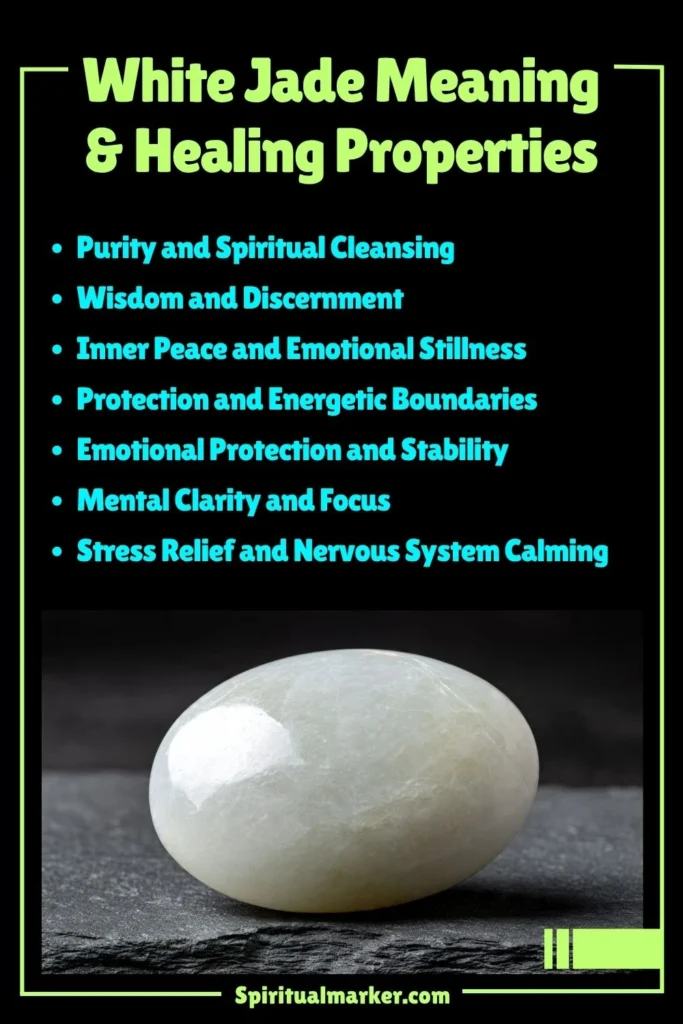
White jade is a naturally occurring gemstone recognized by its creamy, pale, or milky white coloration. It belongs to the broader jade mineral family, which includes two distinct minerals: nephrite and jadeite. Both can appear in white form, though they differ significantly in composition, density, and rarity.
Nephrite white jade forms from calcium magnesium silicate minerals. It has a fibrous internal structure that makes it extremely tough despite its moderate hardness. Many ancient Chinese jade carvings used nephrite because of this toughness and its availability in white, cream, and pale green shades. Jadeite white jade, by contrast, forms from sodium aluminum silicate. It is denser, rarer, and generally more expensive. The most valued form of jadeite is nearly translucent white with a glassy surface quality.
People sometimes confuse white jade with white quartz, white agate, or even white howlite because of surface visual similarities. However, jade has a distinctive waxy to resinous luster that sets it apart. When you hold a well-polished piece of white jade, the surface feels smooth, cool, and slightly heavy in a way that feels grounding rather than lightweight.
The stone’s white color comes from the absence of significant iron or other coloring minerals during formation. Some pieces carry subtle cream, gray, or pale green undertones depending on trace mineral content. Fully white, near-translucent jadeite pieces rank among the most sought-after and expensive in the gemstone world.
Origins and Formation of White Jade
White jade forms deep within the earth under specific geological conditions involving high pressure and relatively low temperature. These conditions occur most commonly in subduction zones, where tectonic plates collide and force minerals deep underground before slowly returning them to the surface over geological timescales. This process alone takes millions of years.
Historically, Myanmar (Burma) produces some of the world’s finest jadeite, including high-quality white and lavender varieties. China, Canada, Russia, New Zealand, and Guatemala also contribute significant jade deposits. New Zealand nephrite holds deep cultural importance for the Maori people, who call it pounamu and consider it a national treasure. Canadian nephrite, particularly from British Columbia, produces large quantities used in both carving and jewelry globally.
The geological rarity of white jade, combined with the time required for its formation, adds depth to its symbolic associations. In spiritual traditions that value patience, endurance, and long-term wisdom, white jade often serves as a physical embodiment of those very qualities. It did not form quickly. Neither does the inner peace it symbolizes.
Key Properties of White Jade
| Property | Details |
|---|---|
| Mineral Type | Nephrite or Jadeite |
| Color | Creamy white, milky white, pale translucent white |
| Hardness (Mohs) | Nephrite: 6 to 6.5 / Jadeite: 6.5 to 7 |
| Luster | Waxy to resinous |
| Chakra Association | Crown chakra (primarily), Heart chakra (secondary) |
| Primary Symbolism | Purity, wisdom, protection, peace, spiritual clarity |
| Key Sources | Myanmar, China, New Zealand, Canada, Russia, Guatemala |
| Transparency | Opaque to slightly translucent |
| Energy Style | Calm, protective, purifying, grounding wisdom |
| Common Uses | Jewelry, carvings, meditation, spiritual protection |
Historical and Cultural Significance of White Jade
Few gemstones in human history carry the cultural weight of white jade. In ancient China, jade held a position that no other material could match. The philosopher Confucius described jade as embodying the five cardinal virtues: benevolence, wisdom, courage, justice, and purity. White jade, with its luminous clarity, became the highest expression of that philosophy. Chinese emperors used white jade seals, ceremonial vessels, and burial suits to symbolize divine authority and moral perfection.
The Chinese word for jade, yu, appears in hundreds of idioms and proverbs still used today. Calling someone “as pure as jade” remains one of the highest compliments in the Chinese cultural tradition. Ancient Chinese believed jade connected the earthly and divine realms. White jade in particular was often buried with the deceased to protect and guide the soul in the afterlife.
In New Zealand, Maori culture treated pounamu (greenstone and white nephrite) as among the most sacred objects a person could possess. Heirloom jade pendants called hei-tiki were passed through generations, absorbing the spiritual essence of each owner. The more hands a piece of pounamu passed through, the more powerful it was believed to become. This tradition reflects a fundamentally different view of aging and history: not as things that diminish value, but as forces that deepen it.
Mesoamerican cultures including the Olmec and Maya civilizations prized jade above all other materials, including gold. White and pale jade was used in masks, jewelry, and offerings to the gods. Rulers were buried with jade placed in their mouths, hands, and chest to carry divine energy into the next world. These cultures saw jade as a living material connected to breath, water, fertility, and divine power.
This convergence of reverence across completely separate civilizations, Chinese, Mesoamerican, and Pacific Island traditions, reflects something profound. White jade clearly resonated at a deep human level, independent of cultural borrowing or shared communication. That near-universal recognition of its significance forms part of what makes it so spiritually compelling today.
5 Spiritual Meanings of White Jade
1. Purity and Spiritual Cleansing
The most consistent spiritual meaning associated with white jade across cultures is purity. Its white color carries immediate symbolic weight. White has long represented moral cleanliness, spiritual innocence, and freedom from corruption in traditions ranging from Eastern philosophy to Western religious imagery. White jade embodies this symbolism in physical form.
In spiritual practice, purity rarely refers only to moral behavior. It often refers to energetic clarity. People accumulate emotional residue from stress, conflict, grief, resentment, and daily overstimulation. This accumulated energy can create a sense of heaviness, confusion, or disconnection from one’s deeper spiritual center. White jade symbolizes the process of clearing that residue and returning to a cleaner, clearer internal state.
Many crystal practitioners describe white jade as an energetically “clean” stone. Unlike some crystals associated with intense transformation or emotional intensity, white jade feels stable and clarifying. Its spiritual energy is commonly compared to still, clear water. It does not stir things up. It helps settle them. For people who feel spiritually muddied by life circumstances, white jade’s symbolism of purity can feel deeply restoring.
This meaning also connects to intention setting. Because white jade carries associations with clarity and cleanliness, some practitioners use it when they want to begin something new from a spiritually clean foundation. Starting a new phase of life, releasing old emotional patterns, or committing to a spiritual practice can all carry greater symbolic power when anchored by a stone whose primary meaning is purification.
2. Wisdom and Discernment
White jade carries deep associations with wisdom, particularly the quiet, grounded kind that develops through patient observation rather than intense experience. Confucius described jade as symbolic of wisdom because it reflects light without being showy about it. True wisdom, in that tradition, does not broadcast itself. It radiates gently, like the soft glow of polished white jade in natural light.
In modern spiritual practice, white jade is often associated with discernment. This refers to the ability to see situations clearly, separate important information from noise, and make decisions from a place of inner clarity rather than emotional reactivity. Many people turn to white jade during periods of confusion, major decision-making, or life transitions precisely because its symbolism centers on clear-headed wisdom rather than emotional intensity.
The stone’s geological formation process reinforces this symbolism. White jade forms slowly, under enormous pressure, over millions of years. The wisdom it represents is not sudden insight or dramatic revelation. It is the kind of wisdom that accumulates gradually through honest self-examination, patient observation, and a willingness to sit with uncertainty rather than force premature conclusions.
Many people who value white jade spiritually keep it nearby during meditation, journaling, or quiet reflection. They describe feeling more mentally settled when working through complex problems. Whether that reflects the stone’s energy or simply the calming effect of a meaningful object, the result, clearer thinking and more grounded decision-making, aligns precisely with the stone’s traditional spiritual meaning.
3. Inner Peace and Emotional Stillness
Inner peace forms one of white jade’s most recognized spiritual themes. Across every culture that valued it, white jade consistently represented a calm, stable inner state that remained unshaken by external turbulence. That resilient stillness is not passive or indifferent. It reflects a deep rootedness in one’s own center that allows life’s difficulties to be met without losing balance.
Modern life creates enormous amounts of emotional noise. Responsibilities pile up. Relationships create friction. Uncertainty generates anxiety. Most people spend significant energy managing emotional turbulence without ever finding the still point beneath it. White jade spiritually points toward that still point. Its symbolism is not about avoiding difficulty but about remaining grounded within it.
Many meditation traditions use physical anchors to support the practice of returning to stillness. A breath, a word, a posture, or a physical object can all serve this function. White jade works this way for many practitioners. Holding it during meditation creates a tactile reminder of the quality of mind they are cultivating. The stone’s cool, smooth weight in the hand provides a grounding sensory experience that supports the mental work of quieting internal chatter.
White jade’s association with inner peace is also deeply relevant during periods of grief, loss, or significant life change. These experiences naturally disturb emotional equilibrium. White jade does not promise that pain will disappear. Its spiritual meaning is subtler than that. It represents the possibility of finding a quiet center even within pain, a place of inner stability that grief cannot fully erase.
4. Protection and Energetic Boundaries
White jade has a strong historical identity as a protective stone. Ancient Chinese emperors carried jade not only as a symbol of status but as spiritual armor against negative forces. Warriors wore jade amulets believing it shielded them from harm. Maori warriors carried pounamu pendants whose spiritual power was believed to protect the wearer through conflict. This protective symbolism appears so consistently across cultures that it deserves serious attention.
In modern crystal healing, white jade’s protective qualities are understood in energetic terms. People who feel emotionally porous, easily absorbing stress, negativity, or emotional heaviness from others, often describe white jade as creating a kind of inner boundary. It does not create walls that shut out genuine connection. Instead, its symbolism centers on a calm, clear field that allows meaningful engagement while filtering out harmful energetic influences.
This protective quality connects directly to white jade’s association with purity. A stone that symbolizes spiritual cleanliness naturally also symbolizes protection from contamination. In spiritual terms, this means remaining internally clear even when the surrounding environment is chaotic, emotionally draining, or energetically heavy. White jade spiritually represents the ability to move through difficult environments without being destabilized by them.
Many people carry white jade in high-stress environments, workplaces with intense social dynamics, medical settings, or emotionally demanding caregiving situations, precisely because they associate it with protective clarity. Whether approached as metaphysical protection or simply as a meaningful grounding object, white jade serves this function for a significant number of people across very different belief systems.
5. Spiritual Connection and Divine Alignment
Ancient traditions universally treated white jade as a bridge between the human and divine. Chinese emperors offered jade to heaven during elaborate ceremonies. Mesoamerican priests used jade in rituals meant to communicate with gods. Maori tradition held that pounamu carried the spiritual essence of ancestors and connected the living to their lineage. This pattern of using white jade as a spiritual connector appears in every culture that valued it.
In contemporary spiritual practice, white jade’s association with the crown chakra reflects this same theme. The crown chakra sits at the top of the head and governs spiritual connection, higher consciousness, and awareness beyond personal ego. When this energy center feels open and balanced, people often describe a sense of being part of something larger than their individual concerns. White jade symbolically supports this expanded awareness.
This does not require any specific theological framework. The sense of connection white jade represents can be understood as connection to one’s own deepest nature, to the natural world, to other people, or to whatever concept of the sacred resonates personally. White jade’s spiritual symbolism is broad enough to hold all of these interpretations because its core meaning, clarity, purity, and openness to the larger reality, supports each of them equally.
People often report that white jade supports spiritual practices including prayer, meditation, contemplation, and mindfulness because it creates a felt sense of openness and clarity. That felt sense may be the stone’s most important spiritual contribution. It does not deliver mystical experiences. It helps create the inner conditions in which genuine spiritual connection becomes possible.
6 Healing Properties of White Jade
1. Emotional Protection and Stability
White jade’s most widely recognized healing property is emotional protection. People who feel emotionally overwhelmed, easily affected by others’ moods, or chronically drained by social environments frequently describe white jade as stabilizing. Its energy, calm and boundaried without being cold, helps many people maintain emotional equilibrium in demanding circumstances.
This protective stability becomes particularly valuable during periods of vulnerability. Grief, illness, major transitions, and relational conflict all create emotional openness that can feel destabilizing. White jade spiritually represents the grounded core of self that remains intact even when circumstances feel fragile. Many practitioners use it during recovery periods specifically because it symbolizes inner solidity that does not depend on external conditions being resolved.
The distinction between emotional protection and emotional numbness matters here. White jade does not represent shutting down emotions or avoiding feeling. Its healing symbolism centers on feeling fully while remaining rooted in a stable inner center. Emotions can move through without sweeping the person away. That combination of emotional presence and inner stability forms the core of this healing property.
2. Mental Clarity and Focus
White jade is strongly associated with mental clarity in healing traditions. People often turn to it when facing complex decisions, studying or doing intellectual work, or working through confusing life situations. Its energetic quality, clear and calm rather than stimulating or intensifying, supports the kind of focused attention that allows thinking to become cleaner and more organized.
Modern neuroscience supports the idea that calm states produce better cognitive performance. Anxiety and stress narrow attention and reduce the brain’s capacity for complex reasoning. A stone that helps someone feel calmer and more centered may therefore genuinely support clearer thinking, regardless of the mechanism. White jade’s healing association with mental clarity reflects this relationship between emotional calm and cognitive function.
Many people who work in intellectually demanding fields keep white jade on their desk or workspace. Some report that its presence helps them feel more focused. Others appreciate its aesthetic calm as a visual anchor during mentally intense periods. Both responses align with white jade’s traditional identity as a stone of wisdom and clear perception.
3. Stress Relief and Nervous System Calming
White jade carries a well-established reputation for stress relief in crystal healing traditions. Its calming energy is frequently described as physically soothing as well as emotionally steadying. The tactile experience of holding a smooth, cool piece of white jade can trigger the body’s relaxation response in a way that many people find genuinely helpful during tense moments.
Research in psychophysiology has documented that certain sensory experiences, including tactile contact with cool, smooth surfaces, can reduce physiological stress markers such as heart rate and cortisol levels. Whether white jade works through purely metaphysical mechanisms or through its sensory qualities, many people experience real calming effects during moments of high stress when holding or wearing it.
Crystal healers often recommend white jade for people managing chronic stress, anxiety, or nervous system dysregulation. They position it not as a replacement for professional mental health care but as a complementary tool that supports the body’s natural capacity for calm. Its consistent historical association with peace and stillness across cultures suggests that humans have long experienced something genuinely calming in this stone’s presence.
4. Supporting Healthy Boundaries
One of the more nuanced healing properties of white jade involves its association with healthy boundaries. Boundaries in a healing context refer to a person’s capacity to define what they will and will not accept, energetically, emotionally, and relationally, without guilt, fear, or collapse. Many people struggle with this. White jade’s protective, clarifying symbolism often resonates with those doing the difficult work of building stronger internal limits.
Its healing energy around boundaries is not aggressive or defensive. White jade does not symbolize walls or hostility. Instead, its protective quality is calm and clear. It represents knowing your own center well enough that external pressure cannot easily displace it. That inner knowledge, combined with the emotional stability white jade also symbolizes, creates the internal conditions in which boundaries become possible to set and maintain.
People in caregiving roles, teachers, medical professionals, therapists, parents, frequently find themselves energetically depleted because they give so much of themselves to others. White jade is often recommended within crystal healing traditions for exactly this population. Its healing symbolism supports replenishment, self-protection, and the preservation of the personal center that makes sustained caring possible.
5. Encouraging Honest Self-Reflection
White jade’s association with purity extends into its healing properties around self-reflection. Purity, in a psychological sense, can mean seeing oneself clearly without the distortions created by excessive self-criticism, denial, or defensive self-justification. White jade symbolically supports the kind of honest self-examination that leads to genuine growth rather than harsh judgment.
Many spiritual traditions emphasize that clear self-knowledge forms the foundation of meaningful inner development. The ancient Greek inscription at the Temple of Apollo at Delphi, “Know Thyself,” reflects this universal wisdom. White jade’s symbolism aligns with this principle. It represents seeing oneself, including one’s flaws and limitations, with clarity and equanimity rather than shame or avoidance.
People engaged in therapy, journaling, shadow work, or spiritual direction often find white jade a meaningful companion to these practices. Its calming, clarifying energy supports the emotional steadiness needed to look at difficult inner material without becoming destabilized. That combination of honesty and stability makes it a particularly useful healing symbol for anyone committed to genuine self-knowledge.
6. Promoting Restful Sleep and Energetic Cleansing
White jade has long been placed in sleeping spaces within various cultural traditions. Ancient Chinese households kept jade objects near sleeping areas to promote peaceful rest and protect against disturbing energies during the night. This tradition reflects an intuitive understanding of the stone’s calming qualities and its association with energetic cleansing.
In modern crystal healing, white jade is sometimes placed near the bed or under the pillow to support restful sleep. People who find their minds racing at night, replaying worries or processing unresolved emotional content, often describe white jade as helping quiet that nighttime mental activity. Its symbolic association with stillness and purification extends naturally into the healing context of sleep.
Energetic cleansing, in crystal healing terms, refers to the process of clearing accumulated emotional and energetic residue from a person’s field. White jade, as a symbol of purity and clarification, is frequently used in cleansing rituals. Some practitioners pass it over the body during energy healing sessions. Others simply keep it in personal spaces they want to feel energetically clear. Either way, its cleansing symbolism reflects the same core quality the stone has always represented: clarity, purification, and the return to a clean, settled inner state.
White Jade and Chakra Healing
White jade connects most strongly with the crown chakra, the energy center located at the top of the head. In chakra systems originating in Hindu and Buddhist traditions, the crown chakra governs spiritual awareness, connection to higher consciousness, and the experience of unity beyond individual ego. When this chakra functions well, people often describe a sense of expansiveness, spiritual receptivity, and calm clarity that extends beyond ordinary thinking.
White jade’s qualities of purity, clarity, and spiritual openness align naturally with crown chakra energy. Using white jade during meditation or spiritual practice may help some people access a quality of awareness that feels less constricted by habitual mental patterns. Whether understood as chakra work or simply as the effect of a deeply calming spiritual object, the result supports the same expanded, clear awareness the crown chakra represents.
Some traditions also associate white jade with the heart chakra, particularly in its role as a stone of compassion, gentleness, and emotional wisdom. The heart chakra governs love, empathy, forgiveness, and the capacity for genuine connection. White jade’s calming, compassionate energy resonates with these qualities, making it useful in healing work that involves emotional relationships, self-compassion, or recovery from emotional wounds.
Working with both chakras simultaneously reflects white jade’s dual nature as both a spiritually orienting stone and an emotionally grounding one. It can help you reach upward toward expanded awareness while remaining connected to the emotional warmth and relational wisdom of the heart center. That vertical integration, spiritual height anchored in emotional depth, represents one of white jade’s most distinctive and valuable qualities.
How to Use White Jade for Spiritual Growth
White jade works beautifully as a meditation companion. Hold a piece in your palm during sitting practice and allow its cool, smooth weight to anchor your attention. Many practitioners find that its tactile quality helps the mind settle more quickly and return to stillness more easily when attention wanders. You can also place it at the crown of your head during lying-down meditation to focus energy on the crown chakra.
Wearing white jade jewelry allows continuous contact throughout the day. Pendants worn near the throat or heart keep the stone’s energy close to upper body centers. Bracelets allow the stone to rest against the pulse points, which many practitioners associate with deeper energetic absorption. Rings carry the stone through daily activity where its protective and clarifying qualities may feel most needed.
Placing white jade in your home or workspace creates a continuous environmental influence. Many people position it on a desk, near a meditation space, or in a bedroom. Some place it at the entrance of a home as a protective threshold stone. These practices reflect white jade’s traditional identity as a protective and purifying presence in living spaces.
Some practitioners pair white jade with complementary stones. Amethyst amplifies crown chakra activity and spiritual clarity. Clear quartz amplifies white jade’s purifying properties. Rose quartz combines heart-centered compassion with white jade’s emotional stability. These combinations allow you to build a more nuanced energetic field suited to specific healing intentions.
How to Care for White Jade
White jade is durable but requires thoughtful care. Its hardness ranges from 6 to 7 on the Mohs scale, meaning harder minerals can scratch it. Store white jade separately from diamonds, sapphires, and other hard gemstones. Soft fabric pouches or padded compartments in a jewelry box protect its surface during storage.
Clean white jade using lukewarm water and mild soap. Wipe gently with a soft cloth and dry thoroughly before storing. Avoid ultrasonic cleaners, steam cleaning equipment, and harsh chemical cleaners. These methods can damage the stone’s surface or compromise the integrity of its structure, particularly in nephrite jade where the fibrous layers can be affected by prolonged exposure to harsh substances.
Remove white jade jewelry before swimming, particularly in chlorinated pools or saltwater. Avoid wearing it during intense physical activity or while using cleaning products. Prolonged direct sunlight can affect the color of some jade pieces over time, so store it away from bright windows when not in use.
Many people who value white jade spiritually also practice energetic cleansing. Common methods include leaving the stone in moonlight overnight, placing it near dried sage or lavender, using sound vibrations from singing bowls, or burying it briefly in dry sea salt. The method matters less than the intention behind it. Regular cleansing, both physical and energetic, keeps white jade at its best.
White Jade Meaning at a Glance
| Aspect | Details |
|---|---|
| Primary Meaning | Purity, wisdom, and spiritual protection |
| Chakra Association | Crown chakra (primary), Heart chakra (secondary) |
| Main Spiritual Symbolism | Clarity, inner peace, divine connection, discernment |
| Common Colors | Creamy white, milky white, pale translucent white |
| Hardness | 6 to 7 Mohs (varies by nephrite or jadeite) |
| Main Sources | Myanmar, China, New Zealand, Canada, Russia |
| Emotional Associations | Calm, protection, stability, honest self-reflection |
| Popular Jewelry Types | Pendants, bangles, rings, carved amulets |
| Spiritual Uses | Meditation, protection, energetic cleansing, chakra work |
| Care Needs | Gentle cleaning, protected storage, avoid harsh chemicals |
A Final Reflection
White jade has earned its reputation across thousands of years and multiple civilizations not through marketing or trend cycles but through consistent human experience. People held it during moments of fear, confusion, grief, and spiritual longing and found something steady in its presence. That steadiness, cool, clear, and deeply rooted, reflects exactly what white jade has always represented.
Its spiritual meaning speaks to something most people carry quietly: the desire for a center that holds when everything else feels uncertain. White jade does not promise magic. It offers something more grounded. A symbolic reminder that clarity, purity, and inner peace are not destinations to arrive at but qualities to return to, again and again, throughout an entire lifetime.
If white jade has drawn your attention, you might consider keeping a piece nearby during your next period of transition, decision-making, or inner work. Some people find it most meaningful as jewelry, worn daily as a wearable intention. Others prefer a carved piece in a meditation space or a simple tumbled stone held during prayer. You might also consider pairing white jade with a journaling practice to support the honest self-reflection it symbolizes. However you choose to work with it, white jade rewards patience and quiet attention, which may be the most fitting tribute to a stone whose greatest teaching is stillness.