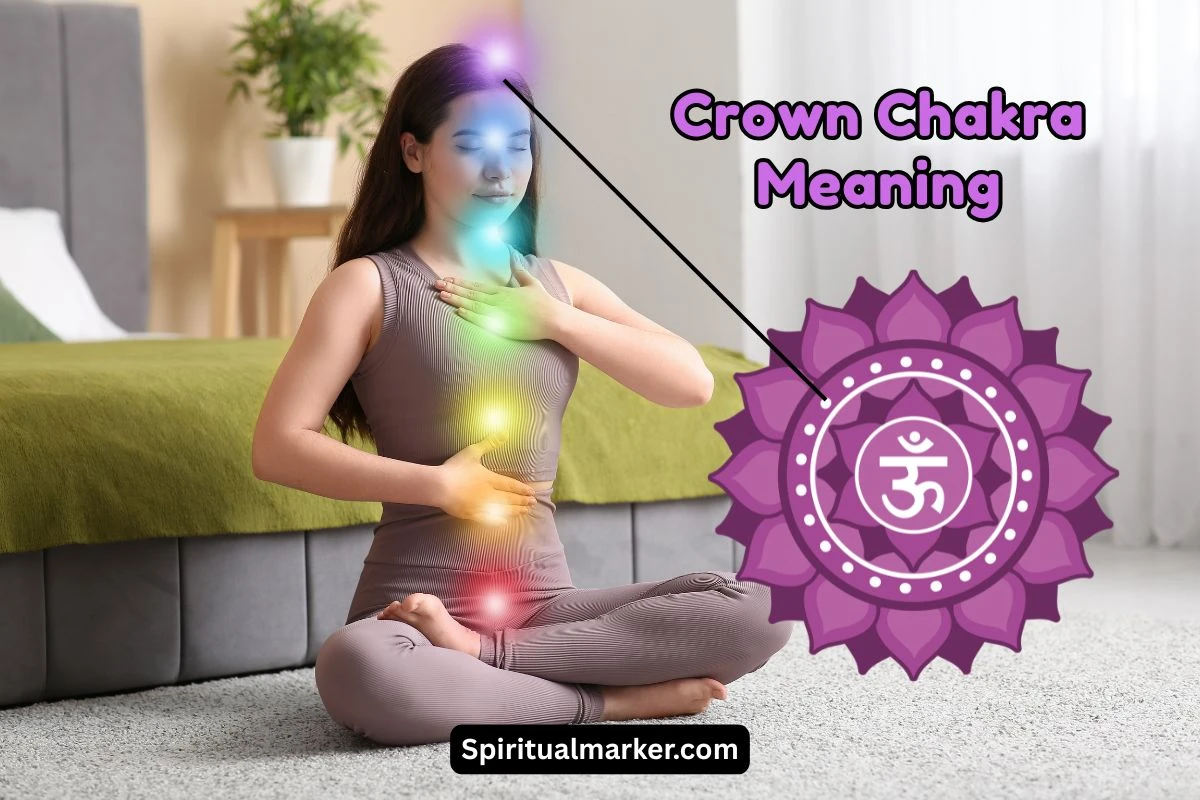
The crown chakra sits at the top of the head. It is the seventh chakra, often called Sahasrara, which means thousand-petaled lotus. This energy center connects you to the divine and to universal consciousness.
The crown chakra meaning often involves spiritual connection, enlightenment, and divine wisdom. When balanced, it brings a sense of peace and purpose. A spiritual meaning of third eye chakra shares that chakra focus, though the third eye relates to intuition and inner vision.
When blocked, the crown chakra can cause feelings of isolation, confusion, or disconnection. Practices like meditation, prayer, and spending time in nature can help open it. The color associated with this chakra is violet or white.
If you feel disconnected from spirit, the crown chakra may need attention. A spiritual meaning of throat chakra also deals with chakra symbolism, though the throat relates to communication.
What Is the Crown Chakra (Sahasrara)?
At the very top of the chakra system sits a force so profound that ancient yogis called it the seat of pure consciousness. The Crown Chakra, known in Sanskrit as Sahasrara, is the seventh and final primary chakra in the traditional yogic energy system. The word “Sahasrara” translates directly to “thousand-petaled,” a reference to the lotus flower with a thousand petals that symbolizes this chakra’s limitless, blooming potential.
While the other six chakras are associated with distinct aspects of your physical, emotional, and psychological life, the Crown Chakra operates on an entirely different plane. It is the gateway through which individual consciousness merges with universal consciousness. It is where the personal “you” dissolves into something far greater, something beyond name, form, and limitation.
In the yogic and Hindu traditions, Sahasrara is considered the dwelling place of Shiva, the pure, unchanging awareness that underlies all of existence. When the sacred feminine energy of Kundalini Shakti rises up through the spine and reaches the Crown Chakra, it unites with Shiva in a moment of supreme enlightenment. This union represents the ultimate goal of many spiritual traditions: the realization that you are not separate from the divine. You are the divine.
The Crown Chakra is not just a spiritual concept reserved for monks and mystics. It is a living, active center of energy within you right now. Every moment of genuine awe, peace, clarity, or spiritual insight you have ever experienced has been a glimpse of Sahasrara opening. Every time you have felt completely at peace with life, deeply connected to something greater than yourself, or touched by a beauty you could not explain with words, that was your Crown Chakra speaking.
This chakra is often described as the point where time meets eternity, where the finite meets the infinite, and where your personal story releases into a much larger, more luminous truth.
Where Is the Crown Chakra Located?
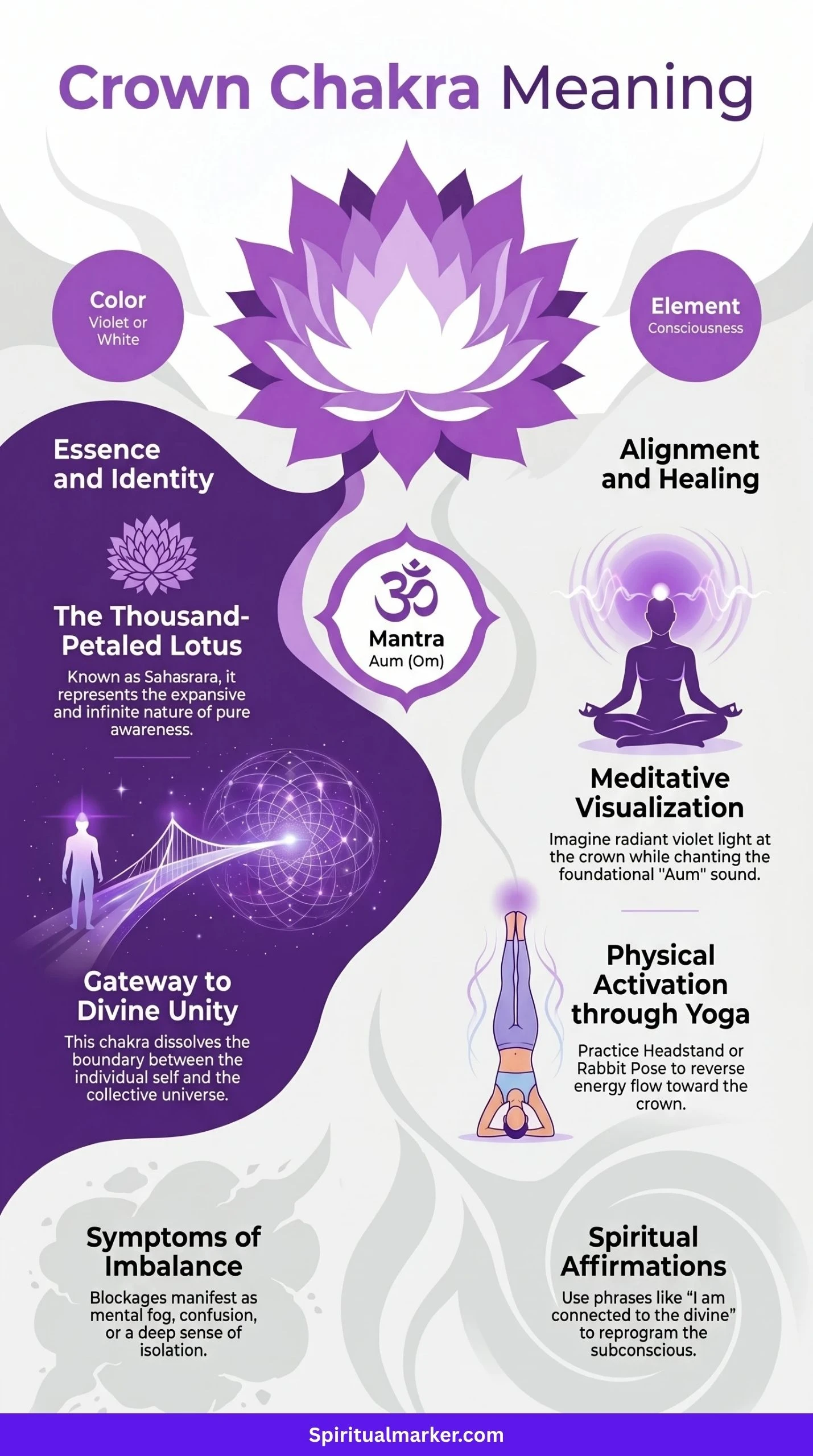
The Crown Chakra is located at the very top of the head, at the crown, where a newborn’s soft spot (the fontanelle) remains tender for the first months of life. This is not a coincidence. Many spiritual traditions view the fontanelle as the entry and exit point of the soul, a place where the boundary between the human and the divine is literally thin.
In physical terms, Sahasrara corresponds to the cerebral cortex, the pineal gland, and the upper brain. The pineal gland, often called the “third eye gland” or the body’s internal clock, produces melatonin and regulates sleep and waking cycles, but its deeper function has fascinated philosophers and mystics for centuries. Descartes famously called it the “seat of the soul.” Researchers have found that the pineal gland contains photoreceptor cells similar to those in the eyes, and some scientists associate it with the production of DMT (dimethyltryptamine), a compound linked to states of deep spiritual experience and visionary consciousness.
The Crown Chakra does not only sit at the physical crown. Energetically, it extends slightly above the top of the head, forming what many traditions describe as a luminous halo or aureole of light. This is precisely why religious iconography across cultures, from Christian saints to Buddhist Bodhisattvas to Hindu deities, depicts divine figures with a radiant circle of light around the head. The halo is not metaphor. It is an ancient recognition of the energetic reality of Sahasrara.
When this chakra is open and active, you may physically feel a tingling, warmth, or light pressure at the top of your head during meditation or moments of deep prayer. Some practitioners describe it as a gentle pulsing or even a sensation of the skull opening upward. These are recognized signs in yogic literature that prana (life force energy) is moving freely through the seventh chakra.
What Is the Crown Chakra Responsible For?
The Crown Chakra governs a vast and deeply significant range of human experience. Unlike the lower chakras that govern survival, desire, power, love, expression, and intuition, Sahasrara governs the overarching awareness within which all of those experiences arise.
At its most essential level, the Crown Chakra is responsible for your connection to the divine, to universal intelligence, and to the greater web of life. It shapes your sense of meaning and purpose, your capacity for spiritual insight, and your ability to access wisdom that comes not from books or logic, but from a deeper, quieter knowing.
Sahasrara also governs your neurological function and cognitive integration. On a physiological level, it oversees the brain, the central nervous system, and the overall harmony of all your body’s systems. This is why a balanced Crown Chakra often correlates with exceptional mental clarity, emotional equanimity, and physical vitality, not because it forces these things, but because it unifies the entire system beneath it.
On a psychological level, the Crown Chakra is responsible for your relationship with belief, faith, and the experience of transcendence. It determines whether you move through life feeling meaningfully connected to something larger, or whether you feel isolated, purposeless, and cut off from any sense of the sacred. People with an open Crown Chakra tend to approach life with a quality of trust and openness that is not naivete, but a deeply grounded recognition that life, at its core, is intelligent and benevolent.
The seventh chakra also carries responsibility for what might be called ego transcendence. The ego, that vital but limited sense of “I,” does its necessary work through the lower chakras. But at the Crown, the question of identity expands far beyond the personal. Sahasrara asks you to hold a larger identity, one that includes the personal self but is not confined to it.
Characteristics of the Crown Chakra
Element
The Crown Chakra transcends the classical five elements (earth, water, fire, air, ether) associated with the lower chakras. Sahasrara is associated with pure consciousness or cosmic energy, sometimes referred to as “Chit” in Sanskrit, the pure awareness that is the substrate of all existence. Some traditions associate it with light itself, not visible light, but the primordial, undifferentiated light of awareness from which all forms emerge.
This is a profound distinction. Every other chakra is grounded in the phenomenal world through its element. The Crown Chakra points beyond phenomena entirely, toward that which perceives all phenomena. It is the element that contains all elements. It is the space in which everything else exists.
Color
The Crown Chakra is most commonly associated with two colors: violet and white. Violet sits at the highest frequency end of the visible light spectrum, just before light transitions into ultraviolet, which is invisible to the human eye. This makes violet a deeply symbolic color for a chakra that marks the boundary between the visible and the invisible, the known and the unknowable.
White represents the totality of all colors combined, all light unified. In many advanced tantric and yogic traditions, the Crown Chakra is depicted as brilliant, luminous white, reflecting its nature as the integration of all the chakra energies below it. When all seven chakras are harmonized and their energies rise to meet at the Crown, what emerges is not a single color but the pure white light of complete awareness.
In healing and visualization practices, surrounding the crown of your head with violet or brilliant white light is a powerful and widely used technique for stimulating and opening Sahasrara.
Symbol
The symbol of the Crown Chakra is the thousand-petaled lotus (Sahasrara Padma). The lotus is a recurring symbol throughout Eastern spiritual traditions for a profound reason. The lotus grows with its roots deep in muddy water, rises through the water, and blooms in radiant beauty above the surface. It is a perfect metaphor for spiritual awakening: rooted in the material world but flowering into pure light.
The thousand petals of the Sahasrara lotus are arranged in 20 layers of 50 petals each. Each petal contains a Sanskrit letter, encompassing all 50 letters of the Sanskrit alphabet multiple times, representing the totality of all language, all vibration, all knowledge. At the center of the lotus sits a circular full moon, within which rests a luminous triangle pointing downward (Shakti descending) and one pointing upward (Shakti ascending), representing the perfect union of the divine masculine and feminine.
The color of the lotus varies by tradition: some describe it as golden, others as violet, and others as the brilliant, incandescent white that contains all colors. The center circle is often depicted as pure, radiant light without a specific hue, pointing toward the colorless nature of pure consciousness itself.
Mantra
The seed mantra (bija mantra) of the Crown Chakra is “AUM” (also written as OM). But in many traditions, Sahasrara is described as beyond sound, associated with the primordial silence from which all sound arises. The mantra “OM” itself is understood not as a conventional word but as the sound of the universe, the primordial vibration that underlies all creation.
When you chant OM, you are not just producing a sound. You are aligning your individual vibrational frequency with the fundamental frequency of existence. The “A” resonates in the lower belly, the “U” moves into the chest and throat, and the “M” vibrates in the skull and cranium, directly stimulating the Crown Chakra. The silence that follows the “M” represents the Crown Chakra itself: the pure, unbounded awareness that underlies all vibration.
Some traditions also associate the Crown Chakra with the mantra “So Hum,” meaning “I am That,” a direct affirmation of your identity with the universal consciousness. Others use “Aham Brahmasmi,” one of the great Vedantic mahavakyas (great sayings), meaning “I am Brahman, I am the Absolute.” These mantras are not just poetic. They are vibrational tools designed to shift your sense of identity from the limited personal self toward the boundless awareness of Sahasrara.
Deity
In the Hindu tantric system, the Crown Chakra is associated with Shiva in his highest form, sometimes depicted as Parabrahman, the Absolute beyond all attributes. The goddess associated with Sahasrara is Shakti in her supreme aspect as Mahashakti or Adi Shakti, the primordial cosmic power. Their union at the Crown represents the nondual reality at the heart of all existence: consciousness and energy, awareness and matter, masculine and feminine, inseparable and eternally one.
Gland
The pineal gland is the endocrine gland most directly associated with the Crown Chakra. Located near the center of the brain, roughly between the two hemispheres, the pineal gland has been a subject of fascination across cultures and centuries. In addition to its role in regulating circadian rhythms through melatonin production, it has been linked by various researchers to states of deep meditation, mystical experience, and non-ordinary consciousness.
Ancient Egyptians depicted the pineal gland in their art and believed it to be the seat of the soul. The Greek philosopher Plato referenced it in discussions of the third ventricle and consciousness. In modern neuroscience, research continues into the pineal gland’s sensitivity to light and its broader role in consciousness, though much remains to be understood. In energetic terms, activating the Crown Chakra and the pineal gland go hand in hand.
Emotions, Mental Health and the Crown Chakra
The relationship between the Crown Chakra and your emotional and mental life is both subtle and profound. Unlike the lower chakras, which have obvious emotional correlates (the Heart Chakra and love, the Solar Plexus and confidence, the Sacral and desire), the Crown Chakra’s emotional influence operates at a more fundamental level. It shapes the overall quality and texture of your inner life rather than specific emotional states.
When your Crown Chakra is open and balanced, you experience what might best be described as equanimity: a deep, stable inner peace that does not depend on circumstances. This is not emotional numbness or spiritual bypassing. It is the genuine capacity to be fully present with all of your emotions, including the difficult ones, without being overwhelmed or defined by them. You feel your joy, your grief, your fear, and your love fully, but you are no longer at their mercy. You are the awareness within which they arise and pass.
Research in the field of contemplative neuroscience has found that long-term meditators, people who have systematically cultivated states associated with Crown Chakra activation, show measurable changes in brain structure and function. Studies by neuroscientist Richard Davidson at the University of Wisconsin’s Center for Healthy Minds found that experienced meditators showed significantly greater activity in the left prefrontal cortex, an area associated with positive emotions and resilience, compared to non-meditators. They also showed reduced reactivity in the amygdala, the brain’s threat-detection center.
The Crown Chakra also profoundly influences your relationship with meaning and purpose, which are foundational to mental health. Psychiatrist and Holocaust survivor Viktor Frankl, who developed logotherapy, found that the single most powerful predictor of psychological survival and flourishing was a person’s ability to find meaning in their experience. The Crown Chakra is precisely the energy center that provides this capacity. When it is open, even suffering becomes meaningful. When it is closed, even comfort can feel hollow.
Spiritual depression, sometimes called the “dark night of the soul,” a term coined by the Spanish mystic St. John of the Cross, is often experienced when a person is in transition between a closed and an opening Crown Chakra. It is the feeling of having lost the old framework for meaning before the new, more expansive one has arrived. Recognized as a genuine spiritual and psychological phenomenon by many therapists and spiritual directors, the dark night is not a pathology but a passage. The Crown Chakra is both the doorway that requires this passage and the light on the other side of it.
Signs and Symptoms of a Blocked Crown Chakra
Emotional and Psychological Symptoms
A blocked or underactive Crown Chakra creates a very specific kind of suffering. It is not the raw, immediate pain of a wounded Heart Chakra or the anxious urgency of a dysregulated Root Chakra. It is a deeper, more diffuse sense of disconnection and meaninglessness.
When Sahasrara is blocked, you may feel profoundly alone in the universe, as though your existence is a cosmic accident with no deeper purpose or significance. This existential loneliness is different from ordinary social loneliness. You can be surrounded by people who love you and still feel this particular emptiness. It is the loneliness of feeling cut off from the sacred, from any sense that life has inherent meaning or that you belong to something greater.
Rigidity in belief systems is another hallmark of a blocked Crown Chakra. When you cannot access the open, receptive awareness of Sahasrara, the mind tends to cling tightly to fixed frameworks, whether religious dogma, ideological certainty, or cynical materialism. This rigidity is not conviction; it is fear. It is the ego’s attempt to create a sense of security in the absence of genuine spiritual groundedness. You may find yourself deeply threatened by ideas or beliefs that differ from your own, or conversely, you may swing to a complete spiritual nihilism, a belief that nothing has any ultimate meaning whatsoever.
Inability to connect spiritually is perhaps the most direct symptom. Prayer feels hollow. Meditation feels impossible. Moments of awe or transcendence feel inaccessible. Even if you once had a rich spiritual life, a blocked Crown Chakra can leave you feeling as though that access has been mysteriously revoked.
Other emotional and psychological symptoms include:
Apathy and chronic purposelessness, a grinding sense that nothing truly matters. A quality of intellectual arrogance or spiritual superiority, particularly in those who are spiritually active but have a blockage specifically at the Crown rather than a general spiritual disengagement. Chronic confusion about one’s identity, values, and direction in life. Addictive patterns aimed at recreating or chemically inducing transcendent states, such as substance use or compulsive spiritual seeking that never settles into genuine peace. Extreme materialism combined with a kind of hollow despair, the recognition that material success is not delivering the fulfillment that was promised.
Physical Symptoms
Because the Crown Chakra governs the brain, the central nervous system, and the pineal gland, its physical symptoms are primarily neurological and systemic.
Chronic headaches and migraines centered at the top of the head are among the most commonly reported physical symptoms. These are distinct from tension headaches (more associated with the Third Eye Chakra) and tend to have a pressing, heavy quality, as though something at the crown is congested or unable to circulate freely.
Sleep disorders are closely linked to Crown Chakra imbalance, particularly through the pineal gland’s role in melatonin production. Insomnia, hypersomnia (sleeping too much), and disrupted circadian rhythms can all reflect a dysregulated Sahasrara. Many people with significant Crown Chakra blockages report a disturbed relationship with sleep, including vivid or disturbing dreams, sleep paralysis, or chronic fatigue that does not improve with rest.
Sensitivity to light and sound, particularly in situations that would not ordinarily be overwhelming, can indicate a Crown Chakra that is either blocked or hyperactivated. Cognitive difficulties, including brain fog, poor concentration, and difficulty integrating complex information, are also associated with Sahasrara imbalance.
An overactive Crown Chakra, while less commonly discussed, creates its own distinct set of challenges. An overactive Sahasrara can produce spiritual mania, a grandiose identification with divine consciousness that lacks the grounding provided by the lower chakras. This can manifest as extreme dissociation from ordinary reality, a sense of being untethered from the physical world, obsessive spiritual seeking, or in severe cases, depersonalization and derealization. The Kundalini tradition is explicit that Crown Chakra activation without adequate grounding in the lower chakras is destabilizing rather than liberating. The whole system must be cultivated in balance.
How to Heal and Balance the Crown Chakra
Healing the Crown Chakra requires a fundamentally different approach than healing the lower chakras. The lower chakras respond readily to physical practices: grounding your feet on the earth, hip-opening yoga poses, breathwork, crystals, and diet. The Crown Chakra responds primarily to practices of stillness, surrender, and selfless service.
This is not to say that physical practices have no role. They absolutely do, as we will cover. But the deepest nourishment for Sahasrara comes from practices that quiet the ego’s noise long enough for the deeper, vaster awareness to be recognized. You do not “create” Crown Chakra balance through effort in the way you might build strength or flexibility. You cultivate the conditions in which it naturally arises.
Regular, dedicated meditation is the single most powerful practice for Crown Chakra healing. Not meditation as relaxation (though that is valuable), but meditation as the genuine inquiry into the nature of awareness itself. Practices such as Self-inquiry (Atma Vichara) as taught by Ramana Maharshi, Dzogchen in the Tibetan Buddhist tradition, and Jnana Yoga in the Advaita Vedanta tradition are specifically designed to activate and stabilize Crown Chakra consciousness.
Selfless service (Seva) is another powerful Sahasrara activator. When you act without the expectation of personal gain, without feeding the ego’s narrative of deserving or accumulating, you create a momentary but real dissolving of the boundary between self and other. This is Crown Chakra energy in action. The Hindu, Buddhist, Christian, and Sufi traditions all recognize this. Giving freely, genuinely, and without attachment is one of the most direct paths to the openness of Sahasrara.
Nature immersion, particularly open sky gazing, is a time-honored practice for stimulating the Crown Chakra. Looking at the vast open sky, especially at night under a field of stars, naturally induces the expansive, boundary-dissolving awareness that Sahasrara represents. This is why many indigenous and contemplative traditions have used stargazing, mountaintop retreats, and desert vigils as spiritual practices.
Fasting and dietary simplification can support Crown Chakra activation. When the digestive system is given rest, a significant amount of the body’s pranic energy, ordinarily devoted to digestion, becomes available for higher energetic processes. Light, pure, sattvic foods, those described in Ayurveda as promoting clarity and lightness, support the elevated frequencies of Sahasrara. Fresh fruits, vegetables, herbal teas, and pure water are all supportive.
Prayer and devotion, in whatever tradition resonates with you, are powerful Crown Chakra practices. True devotional prayer is not petition or bargaining. It is the opening of the heart and mind toward something greater, an act of genuine surrender and trust. This quality of surrender is the very essence of Crown Chakra energy.
Crown Chakra Affirmations for Spiritual Connection and Awakening
The power of Crown Chakra affirmations lies not in repetition for its own sake, but in the genuine shift of identity that can occur when you repeatedly align your words with your deepest truth. These affirmations are most effective when spoken slowly, with intention, during meditation or quiet contemplation. Let each one settle fully before moving to the next.
- I am connected to the infinite wisdom of the universe.
- I am more than my body, more than my thoughts, more than my story.
- I trust the intelligence of life completely.
- Divine light flows through me freely and abundantly.
- I am open to receiving higher guidance and wisdom.
- I release the need to understand everything and rest in the peace of knowing.
- I am at one with all of existence.
- My consciousness expands with each breath I take.
- I am a vessel of pure awareness.
- The divine moves through me in every thought, word, and action.
- I am eternally connected to the source of all life.
- I release separation and return to wholeness.
- I am guided by a wisdom greater than my own mind.
- I am both fully human and fully divine.
- Peace is my natural state of being.
- I am the awareness in which all experiences arise and dissolve.
- I am worthy of spiritual awakening.
- The universe supports my highest evolution.
- I live in gratitude for the miracle of consciousness.
- I release all fear and open fully to the infinite.
Crown Chakra Meditation for Divine Connection
This Sahasrara meditation is designed to take you step by step into the open, luminous awareness of the Crown Chakra. Dedicate at least 20 to 30 minutes to this practice, choosing a time when you will not be disturbed.
Preparation: Sit comfortably with your spine erect, either cross-legged on the floor or seated in a chair with both feet flat on the ground. Allow your hands to rest softly in your lap, palms facing upward in a gesture of receptivity. Gently close your eyes.
Begin with three deep, deliberate breaths. With each inhale, draw your awareness upward through the length of your spine. With each exhale, let any tension in your body dissolve completely. Allow your breath to settle into its natural rhythm and simply observe it for several minutes, without control or manipulation.
Body awareness: Slowly sweep your awareness from the base of your spine up through each chakra, taking a moment to feel each energy center as a warm, glowing sphere. Root at the base. Sacral below the navel. Solar Plexus at the stomach. Heart at the center of the chest. Throat at the neck. Third Eye at the brow. Allow each sphere of light to brighten as your awareness passes through it, as though you are lighting a series of lanterns along a staircase.
Crown activation: Now bring your full attention to the very top of your head. Visualize a magnificent, thousand-petaled lotus resting at the crown, its petals closed. With each breath, imagine the petals beginning to open, one by one, in concentric circles, slowly, beautifully, radiating a luminous violet light that becomes increasingly white and brilliant as it opens.
As the lotus reaches full bloom, visualize a beam of pure, white cosmic light descending from infinite space above you, entering through the open crown of your head. This light is not something foreign or external. It is the light of your own deepest nature, returning home. Allow it to pour down through the center channel of your body, filling each chakra below with its radiance, flowing down through your legs and the soles of your feet, anchoring this divine light fully into the earth.
Resting in awareness: Now let go of all visualization. Set aside the lotus, the light, the breath awareness. Let everything go. Simply rest in the bare, open awareness that remains when all technique is released. This open, contentless awareness is Sahasrara itself. You do not need to create it. You do not need to maintain it. You only need to stop obscuring it with activity and thought.
When thoughts arise, do not fight them. Simply notice that you are the awareness within which those thoughts are appearing. Return to that open awareness again and again, without frustration, without judgment. This returning is the practice.
Rest here for as long as feels natural, ideally 15 to 20 minutes. When you are ready to return, bring your awareness gently back to your breath, feel the weight of your body, and slowly open your eyes, taking a moment before moving.
10 Crown Chakra Yoga Poses to Open and Activate Sahasrara
Yoga and the Crown Chakra share a deep etymological and philosophical connection. The word “yoga” comes from the Sanskrit root “yuj,” meaning to yoke or unite, and this union of individual consciousness with universal consciousness is precisely the domain of Sahasrara. These ten poses are specifically chosen for their capacity to stimulate the crown of the head, activate the nervous system, and create the conditions for the deep stillness and openness that Sahasrara requires.
1. Corpse Pose (Shavasana)
Shavasana is the most sacred pose in the entire yoga tradition, and it is specifically associated with Crown Chakra consciousness. In this pose, you lie flat on your back, arms at your sides, palms facing upward, and you do absolutely nothing. This is far more challenging than it sounds. Shavasana is the practice of conscious surrender, of releasing every effort, every intention, every layer of doing, and resting as pure being.
This is Crown Chakra territory. The practice of Shavasana mimics the state of deep meditative absorption known as samadhi, where the boundaries of the individual self dissolve and consciousness rests in its own nature. Hold Shavasana for a minimum of 5 minutes, ideally 10 to 15. Allow the crown of your head to feel heavy and open, pressing gently toward the earth. Visualize the thousand-petaled lotus at the crown gently blooming as you release all effort.
2. Headstand (Sirsasana)
Sirsasana, or headstand, is traditionally called the “king of all asanas,” and its relationship to the Crown Chakra is direct and literal: your full body weight is balanced directly on the crown of the head. This creates intense stimulation of the Sahasrara region and is believed to reverse the downward flow of prana, drawing vital energy upward toward the higher centers.
Begin with a supported variation at a wall if you are new to inversions. Place a folded blanket under your head for cushioning. Interlace your fingers and create a stable triangular base with your forearms. Place the crown of the head (not the forehead or the back of the skull) onto the floor within the cup of your hands. Slowly walk the feet toward your hands, engage the core, and lift one leg and then both into the inversion.
Hold for 30 seconds to 3 minutes, breathing steadily. The increased blood flow to the brain during Sirsasana has been associated with improved cognitive function, mental clarity, and in yoga tradition, direct stimulation of the pineal gland. Come down slowly and always follow Sirsasana with Shavasana.
3. Rabbit Pose (Sasangasana)
Sasangasana offers a gentler inversion that still powerfully stimulates the Crown Chakra by placing the crown of the head on the floor with a different degree of weight and compression than headstand. From a kneeling position, sit back on the heels and grasp the heels with both hands. Exhale and round the spine, bringing the crown of the head toward the knees. Allow the very top of the head to rest on the floor while the hips rise toward the ceiling, creating a stretching sensation along the entire length of the spine.
This pose creates a gentle compression and stimulation of the Crown Chakra point while simultaneously stretching the back of the neck and the entire cervical spine. It relieves tension in the neck and shoulders, areas that often hold the energetic congestion that prevents prana from flowing freely to the seventh chakra. Hold for 5 to 8 breaths, breathing deeply into the back body.
4. Supported Shoulderstand (Salamba Sarvangasana)
The name “Sarvangasana” means “all limbs pose” or “pose of all parts,” and it is traditionally considered the “queen of asanas,” complementary to the “king” Sirsasana. While the headstand stimulates Sahasrara directly through head weight-bearing, the shoulderstand activates the Crown Chakra by creating a sustained inversion that floods the upper body and brain with fresh blood and prana.
Lie on your back and swing your legs up and over, supporting your lower back with your hands, thumbs toward the front and fingers toward the spine. Align the body in a straight line from shoulders to feet, chin tucked toward the chest in the traditional chin lock (jalandhara bandha). This chin lock is highly significant for Crown Chakra work because it seals prana in the upper body, preventing its descent, and compresses the thyroid and parathyroid glands while directing energy upward toward Sahasrara.
Hold for 1 to 5 minutes with smooth, steady breathing. Never force the neck in this pose. Always use a folded blanket under the shoulders for support, keeping the neck free.
5. Fish Pose (Matsyasana)
Matsyasana is the natural counter-pose to shoulderstand and completes the Crown Chakra sequence by opening the energy pathway from the opposite direction. While shoulderstand closes the chest and directs energy upward, Fish Pose arches the spine, opens the chest and throat fully, and most significantly, places the very crown of the head on the floor while the heart lifts toward the sky.
Lie on your back, place your hands under your hips palms down, and press into your forearms to lift the chest. Arch the back and let the top of the head come to the floor, opening the throat fully. The Crown Chakra rests on the earth in Matsyasana, a grounding touch that simultaneously opens the uppermost energy center. There is a beautiful symbolism here: the crown touching the earth while the heart reaches for the sky, reminding you that authentic spiritual awakening is always fully embodied, never disconnected from the ground.
Hold for 5 to 8 slow, expansive breaths, breathing deeply into the broad opening of the chest.
6. Child’s Pose (Balasana)
Balasana is the yoga posture of surrender, and it speaks directly to the Crown Chakra because surrender is the essential language of Sahasrara. From a kneeling position, sit back onto the heels and extend the arms forward, or allow them to rest alongside the body, forehead resting on the floor. The crown of the head points forward, gently stretching the neck.
This pose creates a protective, womb-like stillness that encourages the nervous system to downregulate from sympathetic (fight-or-flight) activation toward deep parasympathetic rest. This shift is essential for Crown Chakra work. The seventh chakra cannot open from a place of stress, urgency, or striving. It opens from profound relaxation and inner spaciousness.
Hold Balasana for 10 to 20 breaths, allowing your forehead and crown to become heavy, releasing any efforting in the body and the mind. Many practitioners find that Crown Chakra insights and moments of genuine stillness arise spontaneously in this pose.
7. Lotus Pose (Padmasana)
The lotus is the symbol of the Crown Chakra itself, and sitting in Padmasana creates a direct physical embodiment of the seventh chakra’s image. This is the traditional meditative posture described in yoga texts as the seat from which the highest states of consciousness are accessed. The interlocking of the legs in full lotus creates a closed energy circuit in the lower body, preventing prana from dispersing outward and directing it upward through the central channel toward the Crown.
If full lotus is not available to you, Half Lotus (Ardha Padmasana) or a simple cross-legged seat is a completely valid alternative for Crown Chakra meditation. The key elements are an erect spine, a relaxed but lifted crown of the head, and a quality of relaxed, alert attention. Place the backs of the hands on the knees in Jnana Mudra (index finger and thumb touching, remaining fingers extended), which traditionally symbolizes the union of individual consciousness with universal consciousness, a perfect symbolic gesture for Sahasrara meditation.
8. Extended Triangle Pose (Trikonasana)
Trikonasana builds the energetic infrastructure that supports Crown Chakra opening. By creating a strong, stable foundation in the legs and hips while simultaneously opening the entire lateral body and extending one arm toward the sky, Triangle Pose cultivates the grounded expansiveness that is essential for healthy Sahasrara activation. An untethered Crown opening without the stability of the lower chakras is disorienting. Triangle Pose builds both dimensions simultaneously.
Stand with feet wide apart, one foot turned out 90 degrees, the other slightly inward. Extend arms parallel to the floor and hinge at the hip, extending the front hand toward the shin, ankle, or floor, while the opposite arm reaches straight up toward the sky. Feel the entire side body open from hip to crown. Turn the gaze upward to follow the raised hand and feel the energy of the pose rising from the grounded earth connection in the feet all the way up through the long line of the spine to the open Crown.
Hold each side for 5 to 8 breaths, breathing into the fullest opening of the pose.
9. Seated Forward Bend (Paschimottanasana)
The Sanskrit name of this pose translates to “intense stretch of the west,” the “west” being the back body, the side facing away from the rising sun and therefore associated in yogic symbolism with introspection, surrender, and turning inward. Seated Forward Bend is a profound Crown Chakra pose because it physically represents the bowing of the self in humility and reverence, the very quality of consciousness that allows Sahasrara to open.
Sitting with legs extended straight in front, inhale to lengthen the spine, then exhale and fold forward from the hips, extending the chest toward the thighs and, in the full expression of the pose, allowing the forehead to come toward the shins. The crown of the head points forward, the ego bows, the spine surrenders, and the entire back body is laid bare, vulnerable, and open to the sky.
Practitioners often experience a quality of deep, introspective stillness in this pose that is specifically associated with the higher chakras. Hold for 8 to 15 breaths, releasing the effort with each exhale and allowing the fold to deepen naturally without forcing.
10. Savasana with Crown Chakra Visualization (Advanced Closing Savasana)
Every yoga session ideally closes with Shavasana, but this extended, intentional Crown Chakra Savasana is the ultimate integration practice. Lie flat, allow the body to become completely still, and bring your awareness to the crown of the head. Visualize the thousand-petaled lotus in full bloom, radiating the most beautiful, luminous violet-white light you can imagine.
With each natural exhale, feel the lotus glow more brightly. With each inhale, feel the light from above pouring down into the open crown, filling the entire body with radiance. Slowly, allow all imagery to dissolve, the lotus, the light, the breath awareness, and simply rest in the open, silent awareness that remains. This is not sleep. This is the wakeful presence of Sahasrara, conscious, clear, and boundlessly peaceful.
Rest in this state for a minimum of 10 minutes. The insights, integrations, and states of genuine peace that arise in this final Savasana are the fruits of the entire practice. Do not rush past them.
Crystals and Stones for Crown Chakra Activation
Crystals are vibrational tools that can support Crown Chakra healing through their energetic resonance with the seventh chakra’s frequencies. While they are not a substitute for the inner work of meditation, surrender, and selfless service, they can create a supportive energetic environment and serve as powerful focal points for intention.
Amethyst is the quintessential Crown Chakra crystal. Its deep violet color perfectly mirrors the color of Sahasrara, and its reputation across cultures and centuries as a stone of spiritual wisdom, sobriety, and higher consciousness reflects its genuine energetic alignment with the seventh chakra. Place amethyst at the crown of the head during Savasana or meditation for direct energetic stimulation.
Clear Quartz is the master healer among crystals and a powerful Crown Chakra stone. Its clarity and amplifying properties resonate with the pure, transparent awareness of Sahasrara. It is often called the “stone of light” and is used across many healing traditions to amplify intention and raise energetic frequency.
Selenite carries an extraordinarily high vibration and is closely associated with angelic realms and higher guidance. Named after Selene, the Greek goddess of the moon, selenite has a translucent, otherworldly quality that mirrors the luminous awareness of the Crown Chakra. It is one of the few crystals that never needs cleansing, as it is believed to maintain its own high vibration naturally.
White Howlite and Moonstone are both associated with Crown Chakra work, the former for promoting the deep calm and mental quiet that Sahasrara requires, and the latter for its connection to the cycles of consciousness, intuition, and divine feminine wisdom.
Essential Oils for the Crown Chakra
Aromatherapy offers a direct biochemical pathway to the brain through the olfactory system, making it a particularly effective tool for Crown Chakra work. The olfactory nerve is the only sensory pathway that connects directly to the limbic system and the cerebral cortex without an intermediate relay station, meaning that aromatic molecules from essential oils reach the brain almost instantaneously.
Frankincense has been used in sacred rituals across virtually every major spiritual tradition for thousands of years. The Egyptian, Hebrew, Christian, Islamic, and Buddhist traditions all recognized its capacity to elevate consciousness and deepen spiritual practice. Modern research has identified a compound in frankincense called incensole acetate, which has been shown to activate ion channels in the brain that alleviate anxiety and depression, directly supporting the Crown Chakra’s domain.
Lavender is calming and clarifying, supporting the deep relaxation and mental quietude required for Sahasrara to open. Lotus essential oil, though rare and precious, is one of the most directly resonant Crown Chakra oils, its very image being the symbol of the seventh chakra. Sandalwood has been used in Eastern spiritual practice for millennia and is associated with the deepest states of meditation and prayerful consciousness.
Apply these oils diluted in a carrier oil to the crown of the head, the temples, or the back of the neck, or use them in a diffuser during meditation practice.
Crown Chakra Foods and Nutrition
The Crown Chakra’s relationship with food and nutrition is more subtle than the lower chakras, which have direct elemental connections to specific food types. Sahasrara resonates most with practices of fasting, simplicity, and purity rather than with specific foods.
Intermittent fasting and periods of dietary simplification free up significant amounts of digestive energy and make the body lighter and more responsive to subtle energetic practices. This is why virtually every major contemplative tradition, from Christian monasticism to Buddhist practice to Ayurvedic cleansing, includes periods of fasting or dietary restriction.
When eating, sattvic foods best support Crown Chakra energy. Sattvic foods in Ayurvedic understanding are those that promote clarity, lightness, and equanimity: fresh fruits and their juices, raw honey, pure water, herbal teas (particularly those with adaptogenic or nervine herbs like ashwagandha, tulsi, and passionflower), lightly cooked vegetables, ghee, and almonds.
Purple foods are also traditionally associated with Crown Chakra support, including purple grapes, plums, blackberries, and purple cabbage. Their rich anthocyanin content is a powerful antioxidant that protects brain cells and supports neurological health, the physical counterpart to Sahasrara’s domain.
Final Thoughts
The Crown Chakra is not a destination you arrive at once and possess forever. It is a dimension of your own awareness that has always been present, like the sky that remains unchanged regardless of whatever weather passes through it. Every spiritual practice, every act of genuine compassion, every moment of surrender and presence is your Sahasrara quietly, steadily opening.
Begin with one practice from this guide. Sit for five minutes in silence and ask yourself: what would it feel like to trust life completely? Add a single affirmation to your morning. Practice one yoga pose with the conscious intention of opening the crown. These small, consistent acts compound over time into genuine transformation.
Your most important practice may simply be learning to rest. Not sleep, but the conscious resting as pure awareness that the Crown Chakra both requires and rewards. In a culture that valorizes doing, achieving, and accumulating, the radical act of simply being, of resting in the open sky of your own consciousness without agenda or effort, is the most direct path to Sahasrara.
The ancient Vedic scriptures say: “Tat Tvam Asi.” Thou art that. You are already that which you are seeking. The Crown Chakra does not create your connection to the divine. It reveals the connection that was never broken.
References
- https://myyogateacher.com/articles/crown-chakra-sahasrara-guide
- https://www.7chakracolors.com/chakra/crown/
- https://en.wikipedia.org/wiki/Sahasrara
- https://www.daisyjewellery.com/blogs/our-world/behind-the-meaning-the-crown-chakra
- https://www.yogajournal.com/yoga-101/chakras-yoga-for-beginners/intro-sahasrara-crown-chakra/
- https://www.netmeds.com/c/health-library/post/sahasrara-crown-chakra-meaning-location-balance-and-unblock-the-power-with-these-yoga-poses
- https://www.youtube.com/watch?v=09sBrq6B7Wg