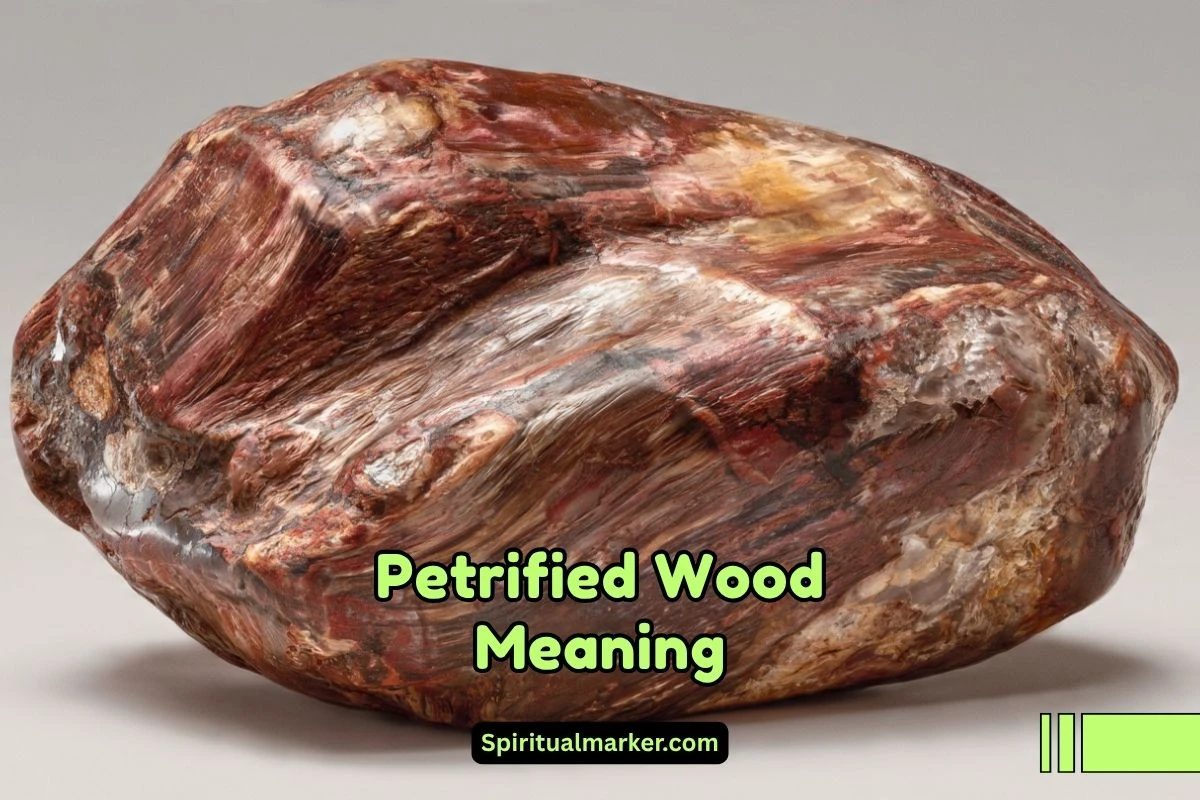
Have you ever held a piece of petrified wood and felt something ancient and steady pass through your hands? Many people describe that feeling immediately. There is a weight to it, not just physical, but almost emotional. It feels permanent. It feels like something that has survived far longer than any worry you currently carry.
Petrified wood is not technically a crystal in the traditional sense. It is fossilized wood. Over millions of years, organic wood slowly transforms into stone as minerals replace the original organic material. The grain patterns, rings, and textures of the original tree remain perfectly preserved. What you hold is both a piece of ancient life and a piece of the earth itself.
For centuries, people across many cultures have valued petrified wood for its grounding energy, its connection to deep time, and its symbolism of patience and endurance. Spiritual practitioners, healers, and gemstone enthusiasts often reach for petrified wood during periods of instability, major life change, or emotional overwhelm. Its energy does not rush or push. It steadies.
This article covers the full meaning of petrified wood, its spiritual symbolism, healing properties, historical significance, and practical ways to use it. You will also learn how to wear petrified wood jewelry and care for this extraordinary ancient stone.
5 Key Takeaways
- Petrified wood symbolizes patience, grounding, strength, and deep transformation through time.
- Many spiritual traditions connect petrified wood with the root chakra and ancestral energy.
- People often use petrified wood during major life transitions, emotional instability, and personal growth journeys.
- Petrified wood is technically a fossilized gemstone, millions of years old, making it one of the most ancient healing tools in use today.
- Wearing or carrying petrified wood may strengthen feelings of stability, calm, and connection to your own roots.
What is Petrified Wood?
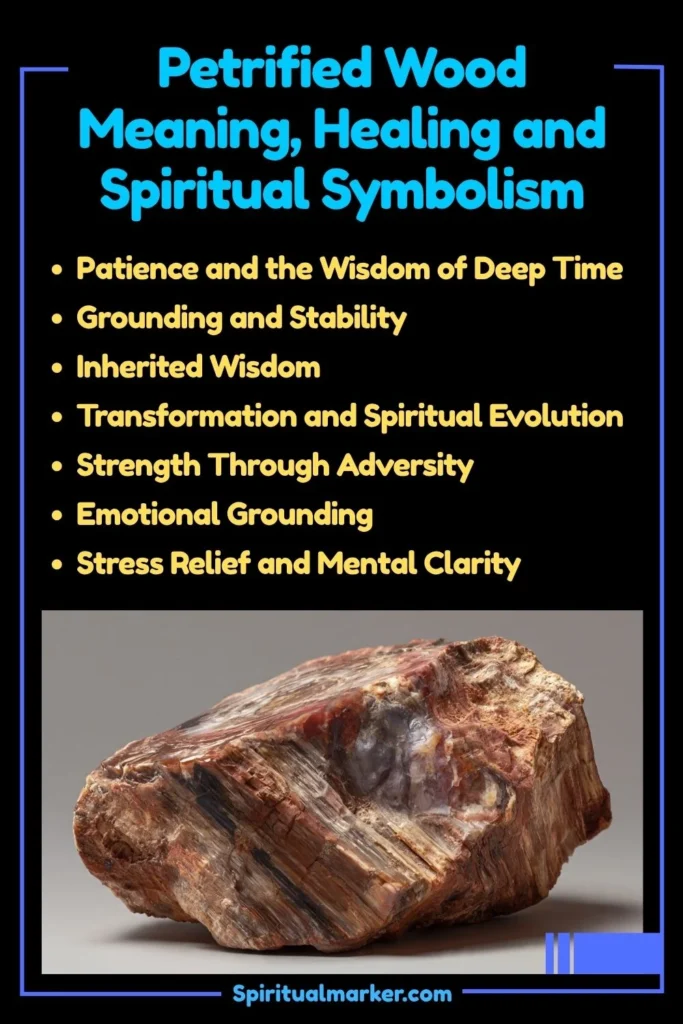
Petrified wood is fossilized wood that has transformed into stone over millions of years. The word “petrified” comes from the Greek word petra, meaning rock or stone. When ancient trees fell and became buried under sediment, groundwater carrying dissolved minerals slowly infiltrated the wood’s cellular structure. Over an extraordinarily long period, those minerals replaced the organic material cell by cell. The result is stone that still looks like wood.
The wood’s grain patterns, bark textures, growth rings, and even insect damage can remain perfectly visible. A piece of petrified wood may look like a freshly cut log from a distance. Up close, you realize it is completely solid stone.
Mineralogically, petrified wood is primarily composed of silica, most commonly in the form of quartz, chalcedony, or opal. Different minerals create different colors. Iron oxides produce reds, yellows, and oranges. Manganese creates purples and blacks. Carbon leaves dark browns and blacks. Silica alone creates white and grey tones.
Many people confuse petrified wood with regular stones or fossils. It is both. It is a fossil because it preserves ancient organic material. It is also a gemstone because of its mineral composition, hardness, and beauty. Spiritually, this dual identity as both living history and earth mineral makes petrified wood uniquely powerful in healing traditions.
Origins and Formation
Petrified wood forms through a process called permineralization. After a tree falls and becomes buried beneath sediment, oxygen is cut off, slowing decomposition. Mineral-rich groundwater seeps through the wood. Over thousands to millions of years, silica and other minerals slowly fill the wood’s cell walls and cavities.
The process requires the right conditions. The wood must be buried quickly enough to prevent full decomposition. Groundwater must carry the right mineral concentrations. And time, enormous amounts of it, must pass.
Most petrified wood is between 10 million and 300 million years old. The famous Petrified Forest National Park in Arizona, USA, contains trees from the Late Triassic period, roughly 225 million years ago. That is older than the dinosaurs that would later define that era.
Major sources of petrified wood include the United States, Indonesia, Madagascar, Argentina, Egypt, Australia, and Tanzania. Each region produces petrified wood with distinct color patterns depending on local mineral content.
Indonesia produces some of the most visually striking petrified wood, often showing rich browns, reds, and golden tones. Madagascar produces stunning pieces with deep blacks and silvers. Arizona produces the iconic multicolored petrified logs of the Chinle Formation. Each piece carries the geological signature of its origin.
Key Properties
| Property | Details |
|---|---|
| Composition | Silica (quartz, chalcedony, or opal) |
| Hardness | 6.5 to 7 on the Mohs scale |
| Chakra Association | Root chakra, sometimes third eye |
| Symbolism | Patience, grounding, ancestral wisdom, transformation |
| Common Sources | USA, Indonesia, Madagascar, Egypt, Argentina |
| Colors | Brown, red, yellow, black, grey, cream, green |
| Energy Style | Deeply grounding, stabilizing, ancient |
| Fossil Age | Typically 10 to 300 million years old |
Historical Use of Petrified Wood
Ancient peoples recognized petrified wood as something extraordinary. They did not always understand the geological process behind it, but they understood that it was different from ordinary stone. Many cultures associated it with magic, spiritual power, and connection to forces beyond ordinary life.
Native American tribes in the American Southwest lived alongside the massive petrified logs of present-day Arizona. Many tribes considered petrified wood sacred. The Navajo people believed it represented the bones of the great giant Yietso. The Apache saw it as carrying protective spiritual energy. Handling or removing petrified wood from certain areas was considered spiritually significant or even forbidden in some traditions.
In ancient Egypt, petrified wood was found near desert trade routes. Egyptians used it for tools, ornaments, and sacred objects. Its durability and unusual appearance made it a material associated with permanence and divine resilience.
Early Chinese traditions valued fossilized materials as objects of longevity and ancestral connection. Petrified wood fit naturally into philosophical frameworks that emphasized continuity between past and present generations.
In later metaphysical and crystal healing traditions, petrified wood became associated with root chakra work, ancestral healing, emotional grounding, and spiritual patience. Modern practitioners continue many of these practices, particularly during life transitions, grief recovery, and personal reinvention periods.
5 Spiritual Meanings of Petrified Wood
1. Patience and the Wisdom of Deep Time
Petrified wood carries one of the most profound symbols available in the gemstone world: patience expressed across geological time. It did not transform overnight. It did not change in a decade or even a century. The process that turned living wood into stone unfolded across millions of years of quiet, consistent, mineral-by-mineral transformation.
This process mirrors one of the most difficult truths in personal growth. Real change rarely happens quickly. Most meaningful transformation in a person’s life develops slowly, through repeated effort, quiet discipline, and long stretches where progress feels invisible. The outside may look unchanged while something fundamental shifts internally.
Many spiritual practitioners carry petrified wood as a physical reminder of this principle. When impatience becomes overwhelming, holding something that took 200 million years to form puts personal timelines into a completely different perspective. That career shift that feels too slow. That emotional healing that seems incomplete. That personal goal that feels too distant. All of these feel different when measured against the quiet patience embedded in petrified wood.
This symbolism also reflects trust in natural process. A tree did not choose to become petrified wood. The transformation happened through a natural interaction of environment, time, and chemistry. Spiritually, this resonates with the idea that not every meaningful transformation in life requires force, urgency, or constant intervention. Some of the most profound personal changes happen when people release control and allow natural processes to unfold.
There is also a resilience embedded in this patience symbolism. The wood survived. It did not dissolve into the earth, even after millions of years of pressure and change. It remained, transformed and strengthened. Petrified wood spiritually reflects endurance through long periods of difficulty, carrying the energy of something ancient that has seen every kind of change and remained standing.
For people moving through grief, long-term illness, slow recovery, or extended periods of uncertainty, this meaning can feel deeply comforting. The stone seems to say, wordlessly, that endurance itself is enough. Surviving is enough. Slowly becoming something new, across whatever time it takes, is entirely valid.
2. Grounding and Stability
Grounding is one of the most consistently associated spiritual properties of petrified wood, and the connection makes intuitive sense. Trees are nature’s most visible symbols of grounding. Their roots extend deep into the earth while their branches reach toward the sky. They stand through storms, seasons, drought, and time.
Petrified wood carries this grounding energy in a concentrated, mineralized form. It is literally the earth’s version of a tree, transformed through earth’s own mineral processes. In spiritual traditions, grounding refers to feeling emotionally stable, mentally clear, and connected to physical reality rather than lost in anxiety, overthinking, or emotional instability.
Modern life creates enormous amounts of ungroundedness. Constant digital stimulation, rapid information overload, financial uncertainty, relational stress, and emotional pressure all pull people out of present-moment awareness. Many individuals feel scattered, anxious, mentally fractured, or emotionally adrift without fully understanding why.
Petrified wood symbolizes reconnection to stability. Its energy is consistently described as heavy in the best possible sense. Not heavy like burden, but heavy like an anchor. When emotional or mental energy feels too scattered or too elevated into anxiety, petrified wood symbolically pulls that energy downward into steadiness, clarity, and calm.
For root chakra work specifically, petrified wood is considered ideal because the root chakra governs security, survival, physical needs, and the sense of belonging in the world. When this chakra feels balanced, people experience emotional steadiness, financial clarity, physical safety, and a sense of being solidly present in their own lives. When it feels blocked, fear, instability, and chronic anxiety often become dominant experiences.
Petrified wood’s connection to ancient trees, earth, and deep time makes it a natural energetic match for root chakra healing. Holding or carrying it during stressful periods is believed to help restore that sense of internal stability, not by eliminating real challenges, but by strengthening the inner foundation from which those challenges are faced.
3. Ancestral Connection and Inherited Wisdom
Few healing tools carry the ancestral symbolism that petrified wood does. Most gemstones formed from geological processes over millions of years. Petrified wood is different because it was once alive. It was once a breathing, growing part of a forest ecosystem. The cellular memory of that living thing is preserved in the stone you now hold.
Many indigenous and ancestral spiritual traditions emphasize the importance of connection to those who came before. Ancestors in these traditions are not only biological relatives but also the broader lineage of wisdom, survival strategies, and accumulated knowledge passed down through generations. Petrified wood spiritually represents this lineage concept because it literally carries preserved life across millions of years.
For individuals working through ancestral trauma healing, generational patterns, or family emotional legacies, petrified wood may feel deeply relevant. It symbolizes the strength of ancestors who survived, adapted, and carried life forward. It can remind people that they carry within them the resilience of every generation that came before them.
This symbolism becomes especially meaningful during genealogical exploration, when people are actively researching their family histories and trying to understand inherited patterns. Petrified wood represents the idea that the past does not disappear. It transforms. It becomes part of what we are now, just as the mineral structure of ancient groundwater became part of the wood now preserved as stone.
Spiritual practitioners working with ancestral themes sometimes place petrified wood on altars dedicated to honoring those who came before them. Others carry it during meditation focused on releasing inherited emotional wounds while honoring the strength passed down through family lines. Both approaches reflect the same spiritual theme: the past is always present in transformed form, and working with that understanding can bring profound healing.
4. Transformation and Spiritual Evolution
Transformation sits at the heart of petrified wood’s most profound spiritual meaning. The stone itself is the living embodiment of transformation. Something that was once alive, flexible, growing, and organic became permanent, crystallized, and mineralized through an extraordinary natural process. The identity of the original tree did not disappear. Its form completely changed.
This paradox reflects one of the most important spiritual truths in personal growth. Real transformation does not erase who you were. It incorporates, integrates, and builds on what came before. Just as the grain patterns and growth rings of the original tree remain visible in the stone, the experiences, relationships, and phases of your past remain part of who you are even after deep personal change occurs.
Many people fear transformation because they associate it with loss. Changing careers feels like losing identity. Leaving relationships feels like losing a version of oneself. Healing emotional wounds feels like letting go of familiar, if painful, patterns. Petrified wood spiritually reassures that transformation is not erasure. It is preservation through profound change.
This symbolism is especially relevant during major life transitions. Career shifts, relationship endings, relocations, grief recovery, spiritual awakenings, health crises, and personal reinvention all involve the terrifying but necessary process of becoming someone new while carrying the truth of who you were. Petrified wood symbolically reflects this whole process, not just the beginning or the end, but the long mineral-by-mineral transformation in between.
Spiritual evolution also fits naturally into petrified wood’s symbolic framework. Many people on spiritual paths experience long periods of apparent stillness where external life looks unchanged but deep internal restructuring is occurring. Like the wood slowly filling with minerals beneath the sediment, inner change often proceeds invisibly before it becomes visible in a person’s behavior, relationships, or life circumstances.
For this reason, many meditation practitioners keep petrified wood visible during periods of deep inner work. Its presence serves as a reminder that transformation is occurring even when progress cannot be seen directly.
5. Strength Through Adversity
Petrified wood survived conditions that would have destroyed ordinary materials. It passed through burial, immense geological pressure, volcanic events, erosion, and millions of years of change. What emerged is harder, more durable, and in many ways more beautiful than what existed before. This physical reality carries direct spiritual symbolism.
Strength through adversity does not mean avoiding difficulty. It means being changed by difficulty in ways that ultimately increase resilience, depth, and capacity. People who have survived significant hardship often describe a quality of inner solidity that did not exist before those experiences. They describe feeling harder to destabilize emotionally, more clear about what truly matters, and more deeply connected to what genuinely sustains them.
Petrified wood spiritually reflects this earned strength. It does not symbolize strength that was always there unchanged. It symbolizes strength created through transformation under pressure. The original wood had a different kind of strength. The petrified wood has another kind entirely. Both are real. Both are valuable. The second kind is the strength of someone who has been fully tested and remained.
Many people carry petrified wood during recovery from illness, trauma, addiction, grief, or prolonged adversity. Its energy does not promise that difficulty will disappear. Instead, it symbolizes the reassurance that endurance itself creates something lasting and strong.
This strength symbolism also includes emotional resilience. People who continue showing up, continuing to grow, and choosing healing despite repeated difficulty develop an inner stability that becomes genuinely difficult to shake. Petrified wood represents that specific quality of strength, steady, quiet, and hard-earned over significant time and pressure.
6 Healing Properties of Petrified Wood
1. Emotional Grounding
Petrified wood’s most recognized healing property is its capacity to support emotional grounding. When emotions feel chaotic, overwhelming, or destabilized by external circumstances, many crystal healing practitioners turn toward this ancient stone.
Emotional grounding in healing traditions refers to the process of returning from heightened emotional states back to a baseline of calm, clarity, and present-moment awareness. Anxiety often pulls attention into imagined futures. Grief frequently pulls attention into the past. Petrified wood symbolically anchors attention to the present by connecting its user to something ancient, solid, and completely stable.
This healing property is especially relevant for people experiencing chronic anxiety, emotional overwhelm, or panic. Holding a grounding stone during acute emotional distress provides both physical and symbolic support. The physical sensation of cool, solid stone in the hand can interrupt escalating thought patterns. The symbolic presence of something millions of years old can reframe present difficulties into a broader context.
Root chakra work with petrified wood often targets this grounding function directly. Practitioners may hold petrified wood during breathwork, place it at the base of the spine during meditation, or keep it nearby during emotionally vulnerable moments. The intention is to strengthen the energetic foundation from which emotional regulation becomes possible.
This healing property also reflects practical daily use. Many people keep petrified wood on their desks during stressful workdays. Others carry small tumbled pieces in pockets or bags during commutes, difficult meetings, or emotionally demanding interactions. The stone does not transform external circumstances, but many people report that its presence helps them respond from a calmer internal state.
2. Stress Relief and Mental Clarity
Petrified wood is frequently associated with stress relief because its deeply grounding energy naturally counters the mental overstimulation that chronic stress creates. Most stress-related mental experiences involve racing thoughts, difficulty concentrating, emotional reactivity, and a persistent sense of being overwhelmed by too much information or too many responsibilities simultaneously.
The healing tradition behind petrified wood suggests that its ancient, unhurried energy provides a meaningful counterweight to modern mental pressure. Holding or keeping near something that formed across millions of years creates a subtle but real perceptual shift. Current problems, though genuinely difficult, can feel more proportionate when viewed through the lens of deep geological time.
Mental clarity as a healing property connects to petrified wood’s root chakra associations. Many metaphysical traditions teach that mental cloudiness often originates from emotional instability or feeling unsafe and unsupported at the foundational level. When root chakra energy feels blocked or depleted, people may experience difficulty making decisions, inability to focus, persistent anxiety, and a sense of mental noise that does not quiet.
Petrified wood’s healing work in this area is not about mental stimulation. It does not accelerate thinking or sharpen analytical ability. Instead, it quiets unnecessary mental noise by strengthening the emotional foundation beneath thought. When people feel genuinely stable and secure internally, their thinking naturally becomes clearer, calmer, and more purposeful.
Many practitioners place petrified wood in work environments or study spaces for this reason. Its presence is intended to create a calming energetic field that supports sustained concentration. Others use it during journaling, planning, or creative work when mental clarity feels elusive.
3. Support During Life Transitions
Petrified wood has become a go-to healing stone for people navigating major life changes. Career transitions, relationship endings, geographic relocations, retirement, grief recovery, health diagnoses, spiritual shifts, and personal reinvention all share a common quality: they disrupt familiar structures of identity and routine while requiring the development of new ones.
This disruption creates a specific kind of emotional and psychological stress. People know who they were in the context of their previous life. They do not yet know who they will be in the emerging one. That gap between known and unknown can feel deeply uncomfortable, sometimes frightening.
Petrified wood spiritually and healing-wise addresses this specific discomfort by symbolizing successful transformation. The stone has already navigated its own version of complete identity transformation and arrived at something enduring and beautiful. Many people find this symbolically reassuring during personal transitions that feel overwhelming or uncertain.
Its grounding energy during life transitions serves a practical healing function. Change often creates emotional instability. People may alternate between excitement and grief, confidence and doubt, clarity and confusion. Petrified wood’s stabilizing energy is believed to help people remain more emotionally consistent during these fluctuating periods, not suppressing the natural emotional range of change, but maintaining a stable inner core beneath it.
This healing property explains why grief counselors, life coaches, and spiritual guides in crystal-adjacent traditions often recommend petrified wood specifically for transitional periods. It does not rush the process. It supports sustained presence throughout it.
4. Strengthening Personal Foundations
Personal foundations in healing traditions refer to the core beliefs, values, relationships, practices, and internal resources that provide stability, meaning, and direction in daily life. When these foundations feel weak, unclear, or threatened, people experience a specific kind of existential anxiety that differs from ordinary situational stress.
Petrified wood is associated with strengthening personal foundations because its symbolic and healing energy consistently points toward roots, stability, and enduring structure. Just as a tree’s root system determines its stability during storms, a person’s inner foundations determine their capacity to navigate difficulty without losing their essential sense of self.
Many people lose touch with their personal foundations during prolonged stress, trauma, or significant life change. They may forget what genuinely matters to them, disconnect from values that previously guided decisions, or abandon practices that once sustained their well-being. Petrified wood’s healing energy is believed to help people reconnect with what is fundamentally true about themselves beneath whatever external circumstances are currently challenging them.
For those working through identity confusion, spiritual questioning, or major personal reinvention, this healing property can feel particularly meaningful. The stone does not impose an external identity. It symbolizes reconnection to something inherent and enduring that was always present beneath the surface of changing circumstances.
Practitioners sometimes use petrified wood during values clarification work, boundary setting practices, or self-discovery exercises. Its presence symbolically supports the excavation of personal truth in the same way that geological processes revealed the truth of ancient wood hidden beneath stone.
5. Ancestral and Generational Healing
Ancestral healing has grown significantly as a recognized healing modality within both spiritual and psychological communities. Researchers and therapists now acknowledge that trauma can transmit across generations through epigenetic mechanisms, learned behavioral patterns, cultural conditioning, and unconsciously inherited emotional responses.
Petrified wood is uniquely suited to this healing work because of its literal biological lineage. It was a living organism. It carries preserved cellular memory across millions of years. This quality makes it a natural symbolic tool for working with inherited patterns, generational wounds, and ancestral strength.
People working through generational patterns of fear, emotional avoidance, addiction, shame, or trauma often report feeling that the source of their difficulties exists somewhere beyond personal history. They may recognize patterns repeated across multiple generations of their families. Healing these patterns requires acknowledging inherited wounds while also honoring inherited strengths.
Petrified wood healing in this context involves both releasing what no longer serves and strengthening what is genuinely worth carrying forward. Ancestral healing practitioners sometimes work with petrified wood during breathwork, meditation, or reflective practices focused on honoring family lineage while consciously choosing different patterns for future generations.
This healing property also connects to the theme of legacy. What do you want to pass forward? What patterns do you want to transform in your own lifetime so they do not continue down your family line? Petrified wood, as a stone of transformation across deep time, symbolically supports the intention of healing what was inherited and consciously shaping what comes next.
6. Building Long-Term Resilience
Resilience in modern psychological research refers to the capacity to recover from adversity, adapt to change, and continue functioning effectively despite difficult circumstances. It is not a fixed trait that people either have or lack. It is a quality that develops through repeated encounters with difficulty, especially when those encounters are navigated with support, reflection, and intentionality.
Petrified wood’s healing symbolism aligns closely with this evidence-based understanding of resilience. The stone did not form resilient through a single dramatic event. It built structural integrity through millions of years of slow, consistent mineral deposition. Each molecule of silica that replaced wood fiber contributed incrementally to the eventual solidity of the stone.
This metaphor reflects how human resilience actually develops. Small acts of courage accumulate. Consistent emotional honesty builds self-knowledge. Repeated choices to keep going through discouragement create a track record of personal endurance that becomes its own source of confidence. Petrified wood symbolically reflects this incremental resilience-building process.
Many people use petrified wood in healing practices focused on long-term goals rather than immediate relief. Its energy is not associated with quick fixes, dramatic emotional releases, or instant transformation. Instead, practitioners connect it with sustained effort, patient growth, and the building of genuine inner strength through consistent engagement with personal development over meaningful periods of time.
This healing property also includes post-traumatic growth, the psychological phenomenon where people emerge from severe adversity with new strengths, deeper perspectives, and greater meaning that would not have developed without the difficult experience. Petrified wood spiritually and healing-wise represents exactly this kind of hard-won, pressure-forged strength.
How to Wear Petrified Wood Jewelry for Spiritual Growth
People wear petrified wood jewelry in many forms, including bracelets, pendants, rings, and earrings. Because petrified wood connects most strongly with the root chakra, many practitioners prefer wearing it closer to the body’s lower energy centers. Bracelets and rings on either hand maintain consistent physical contact throughout the day.
Some people prefer petrified wood pendants worn on longer chains. This positioning allows the stone to rest closer to the solar plexus or heart area, which some practitioners believe supports emotional grounding alongside root chakra stabilization.
Wearing petrified wood daily during periods of major life transition, chronic stress, or personal reinvention is a common spiritual practice. The consistent contact maintains awareness of the stone’s symbolism throughout ordinary daily activities. Many people find that simply noticing the weight of the stone during stressful moments provides an immediate grounding effect.
Some practitioners combine petrified wood with complementary stones. Black tourmaline may amplify protective grounding energy. Smoky quartz may support emotional clearing alongside stabilization. Moss agate may connect petrified wood’s ancient nature energy with living earth energy. Red jasper may deepen the root chakra connection and add vitality to grounding work.
Setting an intention before wearing petrified wood is a common practice in spiritual traditions. This might be as simple as holding the stone, breathing deeply, and mentally stating a specific intention such as “I choose stability,” “I trust my own transformation,” or “I am grounded and present.” This practice connects the stone’s symbolism to a conscious personal intention.
Caring for Petrified Wood
Petrified wood is durable relative to many gemstones because its primary composition is silica-based quartz or chalcedony, ranking 6.5 to 7 on the Mohs hardness scale. This makes it more resilient than softer stones like opal or selenite, but it still benefits from thoughtful care.
Cleaning petrified wood is straightforward. Use lukewarm water, mild dish soap, and a soft cloth or soft-bristled brush. Gently clean surface dirt from the natural grain patterns. Rinse thoroughly and dry with a soft cloth. Avoid harsh chemical cleaners, abrasive materials, or prolonged soaking.
Store petrified wood separately from harder stones like sapphire, topaz, or diamonds that could scratch its surface. A soft pouch or padded jewelry box compartment works well for pieces worn as jewelry. Larger display pieces can sit openly but benefit from being placed away from areas where they might fall or receive heavy impact.
Avoid prolonged direct sunlight for petrified wood pieces that contain significant chalcedony or opal components, as these may fade over extended sun exposure.
For energetic cleansing, many practitioners use sound cleansing with singing bowls or bells, moonlight exposure overnight, or placing the stone on selenite. Burying petrified wood briefly in clean soil is also practiced because of its earth connection. Smudging with sage or palo santo is another common method.
Re-energizing petrified wood by placing it outdoors on natural ground, near trees, or in direct contact with soil reconnects it with its earth origins. Many practitioners believe this restores its grounding energy after extended use during emotionally demanding periods.
Table: Meaning of Petrified Wood at a Glance
| Aspect | Details |
|---|---|
| Primary Meaning | Patience, grounding, and transformation through deep time |
| Chakra Association | Root chakra (primary), third eye (secondary) |
| Main Spiritual Symbolism | Ancestral wisdom, endurance, resilience, stability |
| Common Colors | Brown, red, yellow, black, grey, cream, green |
| Hardness | 6.5 to 7 Mohs |
| Main Sources | USA, Indonesia, Madagascar, Egypt, Argentina, Australia |
| Age Range | Typically 10 to 300 million years old |
| Emotional Associations | Steadiness, inner strength, trust in process, calm |
| Popular Jewelry Types | Bracelets, pendants, rings |
| Spiritual Uses | Grounding, ancestral healing, life transitions, resilience work |
| Care Needs | Gentle cleaning, soft storage, energetic cleansing with sound or moonlight |
A Final Note
Petrified wood stands apart from most healing stones because its meaning is written into its very existence. It does not need symbolic interpretation layered onto it from outside. The stone itself tells a story of patience, survival, transformation, and endurance across a timescale that makes human struggles feel genuinely proportionate.
People who feel drawn to petrified wood often describe a pull they cannot immediately articulate. Perhaps they are navigating a slow and uncertain period of personal change. Perhaps they are rebuilding after significant loss. Perhaps they simply need something steady and ancient to hold during a chapter when very little feels stable.
Its spiritual meaning centers on trust. Trust in your own transformation even when it feels invisible. Trust in your capacity to endure. Trust in the wisdom you have inherited and the strength you are actively building. Trust that the slow mineral-by-mineral process of becoming who you are meant to be is already happening, even when the external evidence has not yet appeared.
If petrified wood has caught your attention, that connection may already be reflecting something important within your current journey. Keep it nearby during difficult mornings. Hold it when impatience becomes overwhelming. Let its ancient steadiness remind you that the most enduring things in existence took exactly as long as they needed to become what they are.