
You spot a tiny acorn on the sidewalk, half hidden under fallen leaves, and something about it stops you. Maybe it rolled off a curb right in front of you. Maybe you picked one up as a child and never quite forgot how it felt in your palm. There is a reason this small oak seed has captured human imagination for thousands of years. The acorn spiritual meaning runs far deeper than its size suggests, touching themes of potential, patience, protection, and rebirth that appear across nearly every major spiritual tradition on earth.
This small nut carries an old kind of wisdom. Druids carried it in their pockets. Norse villagers placed it on windowsills to guard their homes. Native American communities relied on it for survival through winter. Every culture that encountered the acorn seemed to sense the same thing: greatness can begin in the smallest, most overlooked places. If an acorn has crossed your path recently, in real life or in a dream, this article will walk you through every layer of its spiritual symbolism, its presence in world religions, and what it might be quietly telling you about your own life right now.
Key Takeaways
- The acorn symbolizes potential, growth, and patience, reminding you that small beginnings can lead to remarkable outcomes.
- Ancient cultures, including the Celts, Druids, Norse, and Native Americans, viewed the acorn as sacred, protective, and tied to fertility and immortality.
- In biblical and Christian symbolism, the acorn echoes themes of faith as a mustard seed and the slow, steady unfolding of God’s plans.
- Seeing an acorn often signals a season of new beginnings, hidden strength, or spiritual grounding entering your life.
- Dreaming about acorns typically reflects untapped potential, personal growth, or a need to trust the process of your own unfolding.
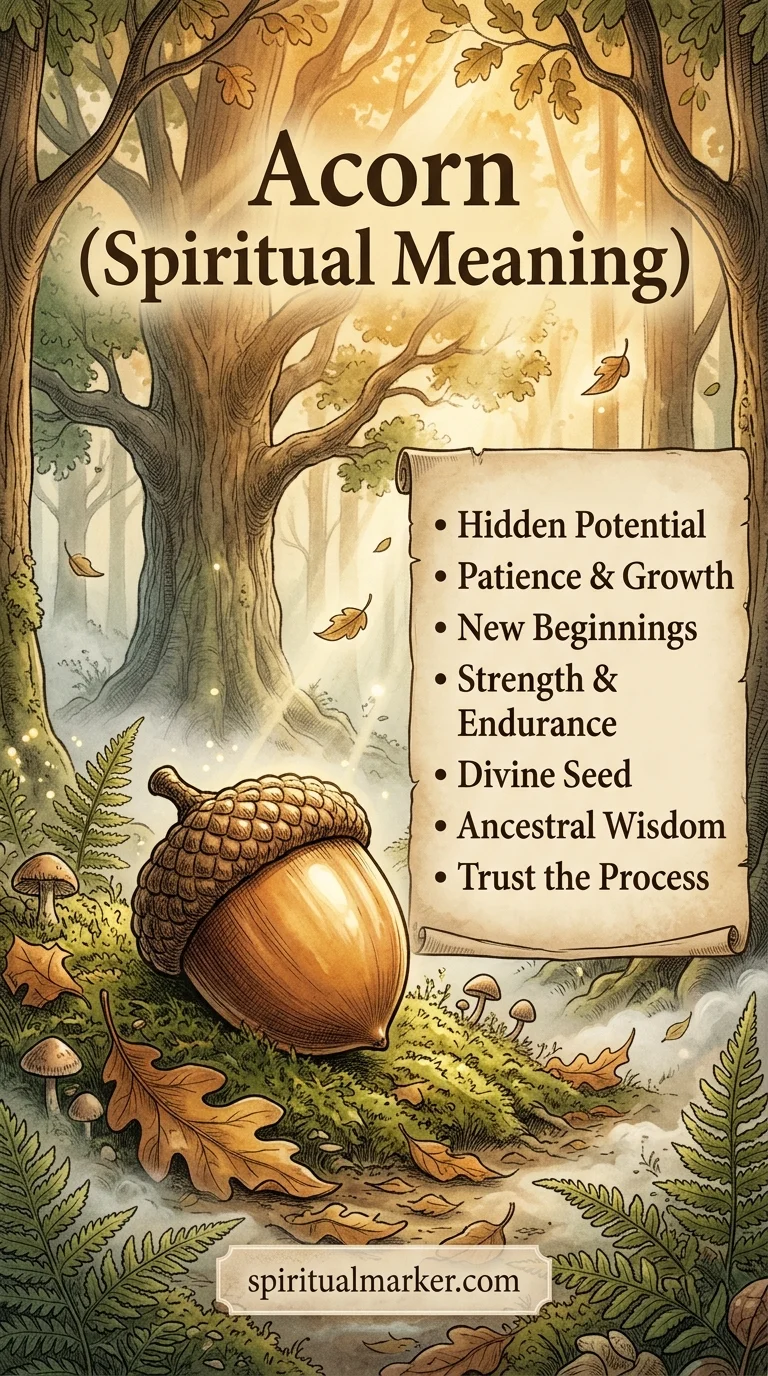
What Is an Acorn and Why Does It Hold Spiritual Power?
An acorn is the fruit and seed of the oak tree, encased in a hard shell and topped with a small woody cap. It looks unremarkable at first glance. Yet inside that tiny shell sits the complete blueprint for a tree that can live for centuries and grow taller than a building. This contrast between size and destiny is exactly why the acorn carries so much spiritual weight across human history.
You already sense this if you have ever held one. It feels disproportionate to what it represents. A single oak tree can produce thousands of acorns in one season, yet only a small fraction will ever take root and mature. That rarity gives the acorn a quiet kind of dignity. It is not loud about its power. It does not announce its future. It simply waits, buried in soil, until conditions align and transformation becomes possible. Spiritually, this waiting period is the heart of the acorn’s meaning. It teaches you that real growth often happens out of sight, long before anyone can see results.
The word “acorn” itself carries old roots. Some etymologists trace it back to Old English and Germanic words connected to “field fruit” or the fruit of the open land, while folk tradition often links it to the Celtic term for oak. Druids, the priestly class of the ancient Celts, are even thought by some scholars to draw their name from the same linguistic root as the oak tree. That connection alone tells you how seriously ancient spiritual teachers regarded this small seed. They did not see it as ordinary food. They saw it as a vessel of hidden wisdom, a physical reminder that the divine often works through the smallest and most patient forms.
What Does Seeing an Acorn Symbolize or Represent?
When an acorn shows up in your awareness, whether on a walk, in your garden, or somewhere unexpected, it usually points to a message about timing and potential. You may be standing at the edge of something new without fully realizing it yet. The acorn often appears during seasons of quiet preparation, right before a major shift in your career, relationships, or inner growth begins to take visible shape.
Many people who notice acorns repeatedly describe feeling like they are being nudged toward patience. You might be working hard on a goal that has not produced visible fruit yet. The acorn arrives almost like a gentle reassurance. It whispers that effort invested now will not be wasted, even if the results are still buried beneath the surface. This idea connects closely to Ralph Waldo Emerson’s well known reflection that the creation of a thousand forests rests inside a single acorn, a thought that captures just how much unseen power small beginnings hold.
Seeing an acorn can also represent protection and grounding. Its hard shell shields the seed inside from harsh weather and predators, much like your own boundaries protect your energy and your dreams while they are still fragile. If you have been feeling exposed or unsure how to guard your goals from outside doubt, the acorn’s structure offers a quiet lesson in self protection without isolation. It stays connected to the earth even as it shields what is growing within.
7 Spiritual Meanings of the Acorn
The acorn holds layered symbolism that has been interpreted consistently across continents and centuries. Below are seven of the most significant spiritual meanings tied to this small but mighty seed.
1. Potential and Untapped Power
The acorn is perhaps the clearest natural symbol of hidden potential that exists in the plant world. It contains, in miniature form, everything required to become a tree that can live for hundreds of years and tower over an entire forest. This is why so many spiritual teachers and writers reach for the acorn when they want to describe human capability that has not yet been activated. You carry abilities, ideas, and strengths right now that have not fully emerged, just as the oak waits silently inside the seed. The acorn invites you to trust that your current size or stage says nothing about your final form.
2. Patience and Slow, Steady Growth
An oak tree does not rush. Acorns can take months to germinate, and the resulting tree often will not produce its own acorns until it reaches twenty to fifty years of age. This timeline forces a spiritual lesson that modern life rarely teaches: meaningful growth cannot be forced into a faster schedule. The acorn asks you to release the pressure of instant results and instead trust a longer, steadier arc. Your dreams, like the oak, may require seasons of darkness and stillness before any visible progress appears above the soil.
3. Protection and Spiritual Shielding
Norse villagers once placed acorns on their windowsills, believing the seed would protect their homes from lightning strikes because the oak tree was sacred to Thor, the god of thunder. Celtic communities carried acorns in their pockets as protective talismans against illness and misfortune. This widespread belief in the acorn as a guardian symbol reflects something true about its physical design too. Its hard outer shell exists specifically to shield the vulnerable seed inside until it is ready to root. Spiritually, the acorn reminds you that protecting your inner growth, your half formed ideas and tender hopes, is not weakness. It is wisdom.
4. Fertility, Abundance, and New Life
Because a single mature oak can drop thousands of acorns each season, the seed naturally became a symbol of fertility and abundance in Celtic and Norse traditions. It represented not just the ability to create life but the sheer generosity of nature itself, producing far more than seems necessary so that even amid loss, new life continues. If an acorn enters your awareness during a season of trying to conceive, start a family, build a business, or birth a creative project, it often signals that abundance is closer than it appears, even if only a small fraction of effort ultimately takes root.
5. Resilience Through Hardship
An acorn often has to survive freezing winters, hungry wildlife, and dry soil before it ever gets the chance to sprout. Out of thousands produced by a single tree, only a tiny number will survive long enough to become saplings. That harsh filtering process gives the acorn deep symbolic ties to resilience and perseverance. Napoleon Hill once observed that the strongest oak grows not in shelter but out in the open, forced to battle wind and storm to survive. The acorn carries that same message. Difficulty is not necessarily a sign that something is wrong. It can be the exact condition required for strength to take root.
6. Wisdom and Spiritual Insight
Druids consumed acorns and oak related foods during certain rituals, believing the seed could grant prophetic insight and deepen their connection to spiritual realms. The oak tree itself was widely viewed as a gateway between the physical world and the divine, and the acorn, as its seed, inherited that reputation for sacred knowledge. If you find yourself drawn to acorns during a period of study, prayer, or meditation, it may reflect a genuine deepening of your own inner wisdom, one that is still forming and has not yet fully revealed itself to your conscious mind.
7. Renewal and the Cycle of Life
Ancient Celts associated the acorn with the sun’s return after winter, viewing its fall to the earth as a promise that spring and renewal would always follow darkness. This cyclical symbolism placed the acorn alongside other seasonal markers of death and rebirth found throughout nature based spirituality. The seed falls, seems to disappear into the soil, and then returns transformed into something far greater. This pattern mirrors so much of human experience, including grief that eventually softens, failures that eventually teach, and endings that eventually clear space for something new to grow.
Acorn Meaning and Symbolism Across Cultures and Religions
Few natural symbols appear with such consistency across unrelated cultures the way the acorn does. From the British Isles to the forests of North America, communities that never had contact with one another independently arrived at strikingly similar conclusions about this small seed.
In Celtic and Druidic tradition, the acorn held some of its highest status. The oak was considered sacred, a living gateway to the Otherworld, and acorns from it were treated as protective tokens carrying wisdom, fertility, and spiritual power. Some scholars even believe the word “druid” itself derives from an old root connected to the oak, which would mean the very identity of these priestly teachers was bound to the tree and its seed. Druids reportedly carried acorns for protection and consumed them in certain rites, hoping to absorb a portion of the oak’s deep, prophetic knowing.
Norse mythology placed the acorn under the protection of Thor, the god of thunder and strength. Oak trees were believed to attract lightning more often than other species, and rather than fearing this, Norse communities saw it as proof of the tree’s connection to Thor’s raw power. Families would place acorns on windowsills during storms, trusting that the seed would honor Thor and turn lightning away from their homes. The oak also played a practical role in Viking life, since its dense wood built some of the strongest ships and structures of the era, reinforcing the acorn’s link to durability and courage.
In ancient Greece, the oak tree was sacred to Zeus, king of the gods, and the oracle at Dodona delivered prophecies interpreted from the rustling of oak leaves by priestesses known as the Selli. While the acorn itself carried less direct symbolism in Greek thought compared to the tree, it still represented the seed of divine strength and endurance that the oak embodied. Roman writers such as Pliny the Elder referenced oaks and acorns when discussing themes of sustenance, fertility, and resilience, carrying forward much of the reverence inherited from Greek tradition.
For many Native American communities, particularly groups in California such as the Miwok and Pomo peoples, acorns were far more than symbolic. They were a primary food source, ground into flour and prepared in ways that sustained entire communities through long winters. This practical dependence gave the acorn a layered spiritual meaning tied to abundance, foresight, and gratitude. Storing acorns required planning months in advance, so the seed became a teacher of patience and preparation, virtues considered essential to survival and spiritual maturity within these communities.
Acorn Symbolism in World Mythologies
Mythology often preserves spiritual truths in story form long after their original ritual context fades, and the acorn appears in several memorable mythological threads worth examining on their own.
One compelling theory traces part of the word “acorn” back to the Eleusinian Mystery traditions of ancient Greece, connecting it to Kore, also known as Persephone, daughter of Demeter and Zeus. Since oak trees were sacred to both deities, the acorn symbolically represented the seed and fruit of these powerful gods. Persephone’s own story, her descent into the underworld followed by her seasonal return, mirrors the acorn’s journey into the dark earth before it reemerges as new life. This is not a coincidence so much as a pattern. Cultures across the world kept reaching for the same metaphor because the natural cycle of the seed so perfectly captured their understanding of death, descent, and renewal.
English folklore added its own layer of enchantment to the acorn through fairy mythology. Stories describe fairies using acorns as tiny cups or cradles, a detail that gave the seed a magical, almost otherworldly charm in the popular imagination. This whimsical association persisted into later European storytelling and still shapes how acorns appear in art, jewelry, and children’s literature today, often symbolizing the delicate, hidden magic present in small and ordinary things.
Heraldic tradition across medieval Europe also embraced the acorn as a meaningful emblem. Families and clans incorporated acorn motifs into coats of arms and crests to represent strength, endurance, and the promise of growth passed down through generations. An acorn sprig used as a crest signaled independence and quiet confidence, a visual shorthand for a family that understood its current standing was only the beginning of a much larger legacy still unfolding.
The Oak Tree and Acorn Connection
You cannot fully understand acorn symbolism without considering its relationship to the oak tree itself. The two are spiritually inseparable, almost like a single teaching split into two stages. The oak represents strength, wisdom, longevity, and stability that has already been earned through time. The acorn represents the same qualities in seed form, still unproven but already complete in design.
This relationship offers a powerful spiritual mirror for your own life. You are, in many ways, both the oak and the acorn at once. Parts of you have already grown strong through years of lived experience, weathered storms, and accumulated wisdom. Other parts of you remain seed like, full of potential that has not yet broken through the surface. The oak does not rush the acorn, and the acorn does not envy the oak. Each understands its place within a single unfolding process. When you see an acorn, it often serves as a reminder to extend that same patience toward the parts of yourself still waiting to grow.
Acorn Biblical Meaning and Christian Symbolism
The acorn itself is not named directly in scripture, since oak forests common to the British Isles and Northern Europe differ from the trees referenced in biblical texts written in the Near East. However, the spiritual principles the acorn embodies align closely with several well known biblical themes, which is why so many Christian writers and teachers have adopted the acorn as a meaningful illustration of faith.
The clearest parallel exists between the acorn and the parable of the mustard seed. In Matthew 13:31 to 32, Jesus compares the kingdom of heaven to a mustard seed, the smallest of seeds, which grows into a tree large enough for birds to nest in its branches. The acorn carries this exact message in physical form. It looks insignificant, yet it holds the capacity to become something vast enough to shelter countless creatures. Christians who reflect on acorn symbolism often see it as a tangible reminder that faith does not need to be large to be powerful. A small, sincere seed of belief can grow into something that shapes generations.
The Bible also frequently uses oak trees as symbols of strength, endurance, and divine presence. In Genesis 35:8, Rebekah is buried beneath an oak, and throughout the Old Testament oaks mark significant covenant moments and sacred meeting places. Isaiah 61:3 speaks of God’s people being called “oaks of righteousness,” planted by the Lord to display his glory. Since the acorn is the seed of the oak, it naturally inherits this association with righteousness rooted deeply enough to withstand storms. For believers, the acorn becomes a quiet visual prayer, a reminder that spiritual maturity, much like the oak’s growth from seed, requires time, rootedness, and trust in God’s timing rather than human urgency.
Galatians 6:9 offers another fitting connection, encouraging believers not to grow weary in doing good, since in due season they will reap a harvest. The acorn’s long, hidden process before visible growth mirrors this exact encouragement. Faith planted today may not show fruit for years, yet scripture insists the harvest will come for those who remain faithful through the waiting.
Dreaming About Acorns: Spiritual and Psychological Meanings
Dreams involving acorns tend to surface during transitional periods of life, and both spiritual traditions and modern dream psychology offer overlapping interpretations worth exploring together.
From a spiritual perspective, an acorn appearing in a dream often signals that a significant new beginning is forming beneath the surface of your waking awareness. Carl Jung, the influential psychologist who studied symbolic dream imagery extensively, often connected seeds and nuts to what he called the process of individuation, the lifelong journey toward becoming your most complete and authentic self. A dream featuring an acorn may suggest that your unconscious mind has already identified potential within you that your conscious thoughts have not yet caught up to recognizing.
The specific condition of the acorn in your dream often shapes the message further. A sprouting or germinating acorn tends to reflect new opportunities actively taking root in your life, suggesting you are entering a season where previous effort begins to show visible results. A pile of acorns, especially if you are gathering them, often points toward themes of abundance, preparation, or storing resources for a future need you can sense approaching even if you cannot name it yet. A withered, cracked, or rotting acorn, on the other hand, frequently represents missed opportunities, stalled plans, or a need to reassess a goal you have been neglecting.
Psychologically, dreaming about acorns can also reflect anxiety around timing and readiness. If you wake up uneasy after such a dream, it may point to fear that you are not progressing quickly enough toward your goals. The acorn’s own biology offers gentle reassurance here. Oak trees famously take decades before producing their first acorns, and even then most acorns never become trees at all. Your dream may be inviting you to release comparison and trust that your timeline, however slow it feels, is still valid.
Acorn as a Spirit Animal and Personal Talisman
While the acorn is not an animal, many nature based spiritual practices treat plant and seed symbols with the same reverence as traditional spirit animals, often referring to them as plant allies or seed totems. People who feel a strong pull toward the acorn as a personal symbol often share certain traits. They tend to be quiet builders rather than loud announcers of their plans. They value long term thinking over short term gratification, and they often carry an inner steadiness that others notice even during difficult seasons.
If the acorn feels like your personal talisman, you may find it helpful to carry one in your pocket, place one on your desk, or wear acorn inspired jewelry as a daily reminder of patience and untapped potential. This practice echoes exactly what Celtic and Norse communities did centuries ago, treating the small seed as a physical anchor for an invisible spiritual truth. The ritual itself does not need to be complicated. Simply holding an acorn during moments of doubt can help recenter your focus on growth that is happening, even when you cannot yet see it.
A Final Note
The acorn never asks to be impressive before it is ready. It simply waits, rooted in trust, until the right season calls it forward into something far larger than its current shape. That patience is the real gift hidden inside this small seed, and it is one worth carrying with you long after you put this article down.
If an acorn has recently crossed your path, consider treating it as an invitation rather than a coincidence. Take a slow walk outdoors and notice where else nature might be whispering similar messages of patience to you. You might also keep an acorn somewhere visible at home, a small daily reminder that your own growth, however hidden it feels right now, is already underway. Should questions about timing or direction keep surfacing in your life, a season of quiet reflection or prayer may help you hear what your own inner oak is already trying to tell you.