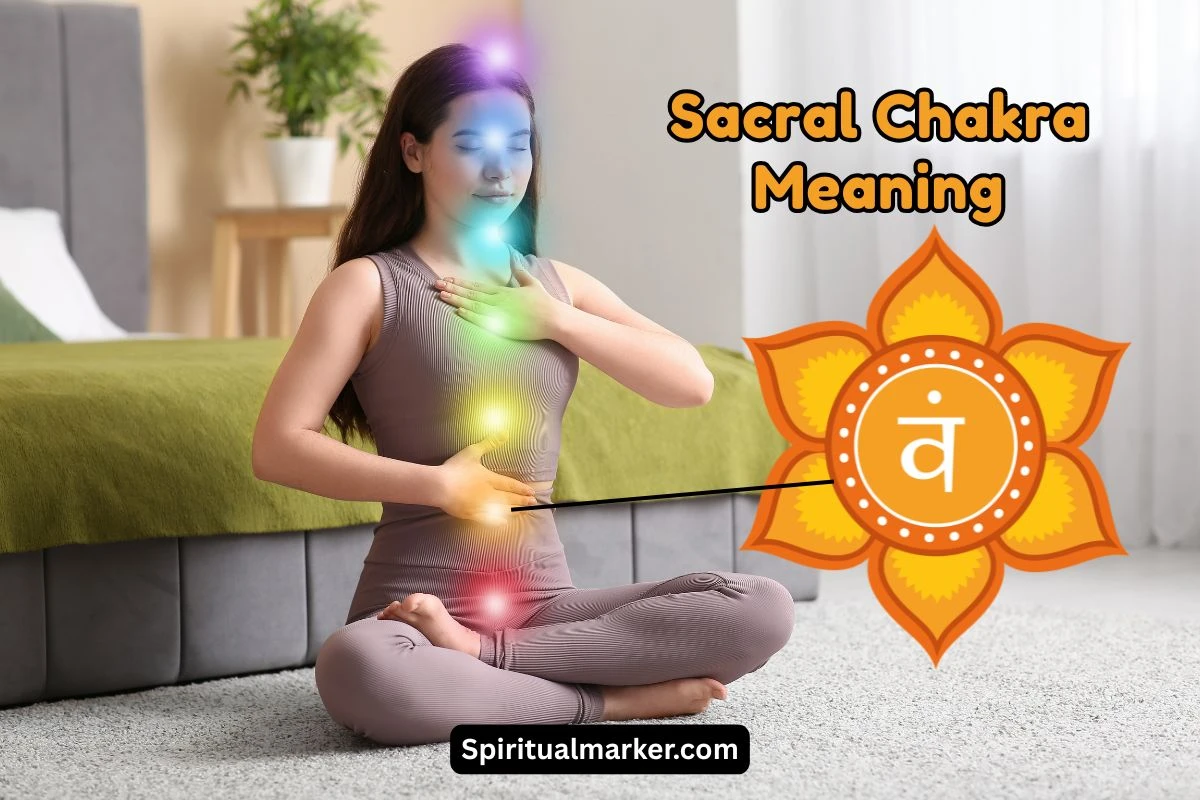
The sacral chakra sits below the navel. It is the second chakra, often called Svadhisthana, which means sweetness. This energy center governs creativity, sexuality, and emotion.
The sacral chakra meaning often involves pleasure, passion, and the ability to flow with life. When balanced, it brings joy and creative expression. A spiritual meaning of solar plexus chakra shares that chakra focus, though the solar plexus relates to personal power.
When blocked, the sacral chakra can cause creative blocks, emotional numbness, or guilt around pleasure. Practices like dancing, art, and spending time near water can help open it. The color associated with this chakra is orange.
If you feel creatively stuck, the sacral chakra may need attention. A spiritual meaning of root chakra also deals with chakra symbolism, though the root relates to survival and grounding.
What Is the Sacral Chakra (Svadhisthana)?
You know that feeling when creativity rushes through you like a current, when you feel genuinely alive, present in your body, and connected to the people around you? That energy lives in your sacral chakra.
The sacral chakra, known in Sanskrit as Svadhisthana, is the second of the seven primary chakras in the traditional yogic system. The word Svadhisthana breaks down into two Sanskrit roots: sva, meaning “self” or “one’s own,” and adhisthana, meaning “dwelling place” or “abode.” Together, Svadhisthana translates to “one’s own dwelling place” or “the seat of the self.” This poetic name tells you something important about the energy housed here. It is deeply personal, closely tied to how you experience yourself as a feeling, creating, desiring being.
In ancient Hindu tradition, the chakras are described as spinning wheels of subtle energy located along the central channel of the body, called the sushumna nadi. The Svadhisthana chakra was first mentioned in classical texts like the Sat-Cakra-Nirupana, a 16th-century Sanskrit text that systematically described the six chakras of the human body. While modern wellness culture has adapted and expanded these teachings, the core essence of the sacral chakra has remained remarkably consistent across centuries.
The sacral chakra governs your emotional life, sensual experience, creative expression, and capacity for pleasure. It is the energy center that pushes you beyond basic survival (which is the domain of the root chakra) into the richer territory of feeling, connecting, and creating. Where the root chakra asks “Am I safe?”, the sacral chakra asks “How does life feel?” It is the part of you that reaches for joy, intimacy, and self-expression.
At its healthiest, Svadhisthana energy expresses itself as a fluid, open, joyful relationship with life. You feel emotionally agile, creatively inspired, comfortable in your body, and capable of genuine intimacy with others. When this energy is balanced, you do not suppress desire or shame pleasure. You honor the full spectrum of your emotional experience without being swept away by it.
Understanding the sacral chakra is not just a spiritual exercise. It has real, tangible effects on how you live, create, love, and heal.
Where Is the Sacral Chakra Located?
The sacral chakra is located in the lower abdomen, approximately two to three inches below the navel, near the area of the sacrum (the triangular bone at the base of the spine). Some traditions place it slightly higher, around the level of the hypogastric plexus, a nerve network in the pelvic region. Either way, the energy of Svadhisthana is centered in the lower pelvis and reproductive organs.
This location is not coincidental. The pelvic region is the physical seat of creation in the most literal sense, housing the reproductive organs and the sacral nerve plexus. From a purely anatomical perspective, this part of the body governs fluid balance (kidneys, bladder), reproductive function, and the flexibility of the lower spine and hips. These physical structures mirror the energetic qualities of the sacral chakra: flow, fluidity, creation, and movement.
In yogic anatomy, the sacral chakra is associated with the svadhisthana granthi, a psychic knot or blockage point that can prevent the flow of kundalini energy (the dormant spiritual energy) upward through the body. Working through this knot is considered a major milestone in spiritual development, as it involves releasing deep emotional conditioning, particularly around pleasure, guilt, and sexuality.
When you feel tension in your hips, lower back, or pelvis, or when emotions feel stuck and heavy in your gut, you are often experiencing sacral chakra energy that needs attention. The body and the energy body speak the same language here.
What Is the Sacral Chakra Responsible For?
The sacral chakra carries a wide and rich range of responsibilities across your emotional, creative, relational, and physical experience. It is one of the most dynamic chakras precisely because it touches so many dimensions of daily life.
Creativity and artistic expression are among the sacral chakra’s most celebrated domains. This is not limited to traditional arts like painting or music. Sacral energy fuels any act of creation: problem-solving, cooking, building a business, writing, dancing, or raising a child. When Svadhisthana is open and active, you feel a natural, effortless flow of ideas and the motivation to bring them into being.
Sensuality and pleasure are equally central. The sacral chakra teaches you that pleasure is not a frivolous indulgence but a legitimate and necessary part of a full human life. It governs your relationship with all sensory experience, including taste, touch, sound, movement, and intimacy. A healthy sacral chakra allows you to be fully present in your body, to feel without shame, and to receive pleasure without guilt.
Emotional intelligence lives here too. The sacral chakra is responsible for your ability to feel and process emotions as they arise rather than suppressing or bypassing them. It governs emotional fluidity, the capacity to move through grief, joy, frustration, and longing without becoming permanently stuck in any one state.
Relationships and intimacy are shaped by this chakra as well. Svadhisthana governs not just romantic or sexual connection but all forms of one-on-one relating. It influences your capacity for vulnerability, closeness, and genuine emotional exchange with others. Healthy sacral energy means you can be present with another person without losing yourself.
Finally, the sacral chakra governs desire and healthy boundaries. It teaches you to know what you want, to honor your needs without apology, and to draw clear boundaries from a place of self-awareness rather than fear.
Characteristics of the Sacral Chakra
Element
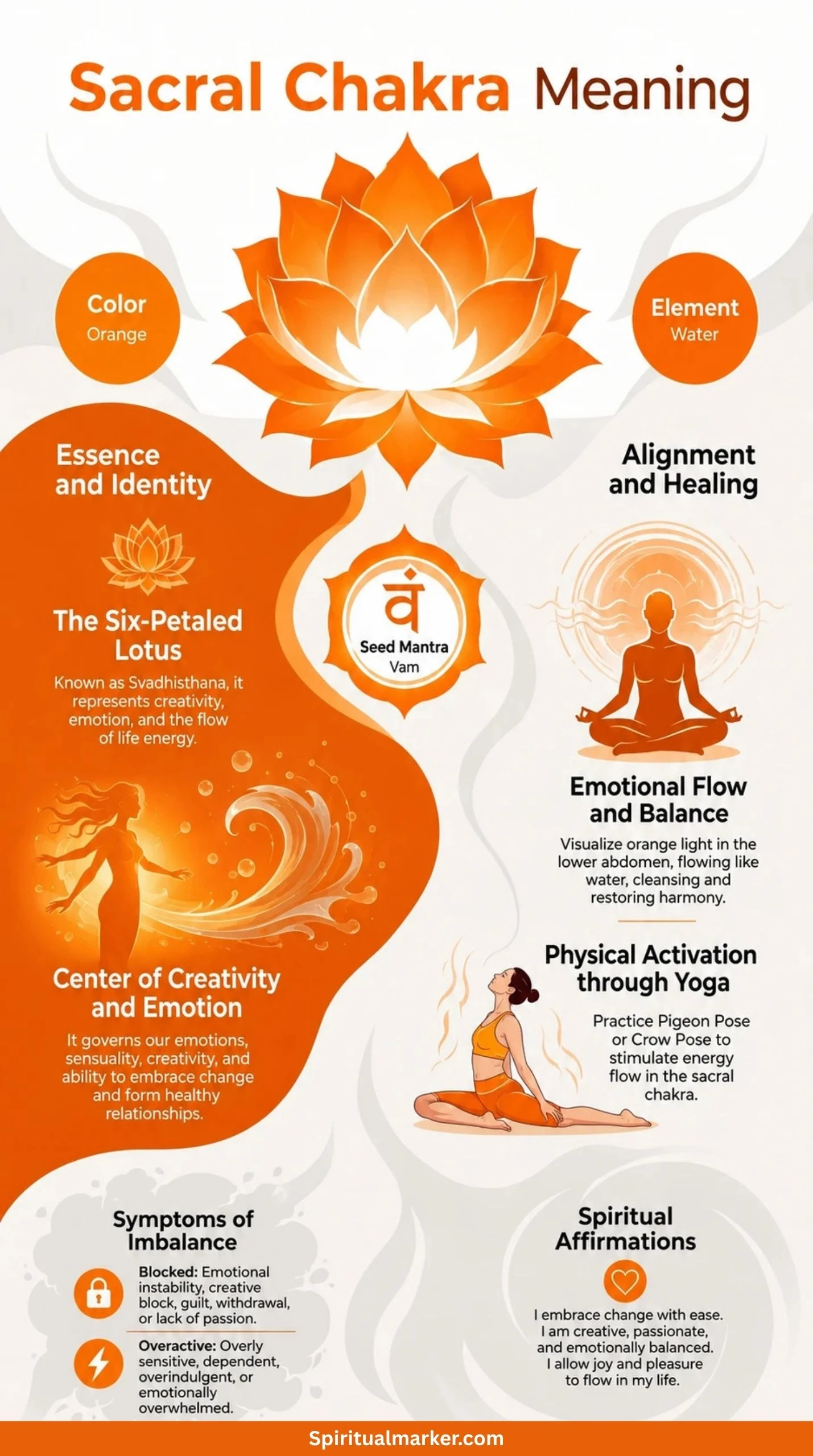
The sacral chakra is associated with the water element. This single correspondence tells you nearly everything you need to know about its essential nature. Water flows. It adapts to its container without losing its essence. It nourishes, cleanses, and sustains life. It can be calm and still or powerful and turbulent.
Water energy in Svadhisthana reflects emotional fluidity and creative flow. Just as a river finds its way around obstacles, sacral energy asks you to remain fluid in the face of life’s changes rather than rigid and resistant. The water element also connects to the moon, tides, and the rhythmic cycles of nature, reminding you that you too have natural rhythms of energy, creativity, and emotion that deserve to be honored rather than forced.
When sacral energy is balanced, you move through life with the grace and adaptability of water. When it is blocked, you feel stagnant, like a pond that has stopped flowing.
Color
The sacral chakra color is orange. This warm, vibrant hue sits between the red of the root chakra and the yellow of the solar plexus, and it perfectly captures the essence of Svadhisthana. Orange is the color of creative fire meeting emotional warmth, of sunrise and autumn, of ripe fruit and glowing embers.
In color psychology, orange stimulates enthusiasm, sociability, creativity, and sensory pleasure. It is an inviting, energizing color that encourages connection and expression. Working with orange consciously, whether through wearing it, surrounding yourself with it, or visualizing it during meditation, can help stimulate and awaken sacral chakra energy.
Orange also holds deep cultural associations with vitality and abundance. In many traditions, orange is used in festivals, ceremonies, and sacred spaces to invoke joy and creative force. The sacral chakra’s orange glow is a reminder that your creativity and pleasure are sacred too.
Symbol
The sacral chakra symbol is a circle surrounded by a crescent moon shape at the bottom, with six lotus petals. Each visual element carries specific meaning within yogic symbolism.
The six petals represent the six vrittis, or qualities of the mind, associated with Svadhisthana: affection, pitilessness, feeling of all-destructiveness, delusion, disdain, and suspicion. These are not negative traits to suppress but energetic tendencies that arise when the sacral chakra is unbalanced. Awareness of them is the first step toward integration.
The circle at the center represents the water element and the unending cycle of birth, death, and rebirth. Within the circle sits a crescent moon, a symbol deeply connected to the tides, feminine energy, and the cyclical nature of emotion and creativity. The crescent moon also points to the unconscious depths from which creative inspiration and emotional wisdom arise.
The entire symbol pulses with fluid, cyclical, generative energy, a visual reminder that the sacral chakra is always moving, always creating, always connected to something deeper.
Mantra
The seed mantra (bija mantra) of the sacral chakra is “VAM” (pronounced vam or wam). In Kundalini and tantric yoga traditions, bija mantras are considered sonic seeds, concentrated packets of vibrational energy that, when chanted, activate and harmonize the corresponding chakra.
Chanting VAM creates a specific resonance in the lower abdominal region that stimulates Svadhisthana energy. The sound vibrates through the pelvic bowl, gently awakening creative force, loosening emotional holding patterns, and encouraging the natural flow of energy through the second chakra.
You can chant VAM aloud during meditation, intone it silently during yoga practice, or simply rest your awareness on the sound as you breathe. Consistent practice with this mantra can create noticeable shifts in emotional fluidity, creative energy, and the sense of ease in your body over time.
Associated Planet and Deity
The sacral chakra is associated with the moon and the planet Jupiter in different traditions. The moon connection speaks directly to its relationship with cycles, tides, emotional rhythms, and the unconscious, while Jupiter connects to expansion, abundance, and generosity, qualities that bloom when the sacral chakra is healthy and open.
The presiding deity of Svadhisthana in Hindu tradition is Vishnu, the preserver, in his form as Brahma’s partner in creation. The goddess associated with this chakra is Rakini Shakti, depicted with two heads symbolizing the dual nature of pleasure and pain, and her energy governs the entire domain of sacral experience.
Emotions, Mental Health and the Sacral Chakra
The sacral chakra and emotional health are inseparably linked. This is the chakra most directly connected to your inner emotional life, and its state of balance or imbalance will show up plainly in how you feel, process, and express your emotions day to day.
When Svadhisthana energy flows freely, you experience what psychologists might call emotional regulation: the ability to feel strong emotions without being overwhelmed, to process difficult feelings without shutting down, and to return to equilibrium relatively quickly after being triggered. This is not emotional numbness or spiritual bypassing. It is genuine emotional agility rooted in self-awareness and self-compassion.
Research in somatic psychology supports the chakra system’s intuition here. Studies on adverse childhood experiences (ACEs) consistently show that early emotional wounding, particularly experiences involving shame, abandonment, abuse, or neglect, creates lasting dysregulation in the nervous system that manifests in the body. This dysregulation is frequently held in the pelvic region, hips, and lower abdomen, the exact anatomical territory of the sacral chakra.
Shame is the emotion most directly associated with sacral chakra imbalance. Brené Brown’s extensive research on shame describes it as “the intensely painful feeling or experience of believing that we are flawed and therefore unworthy of love and belonging.” Sacral chakra wounding almost always carries this quality. Whether the shame originated around your body, your desires, your creative expressions, or your emotional needs, it contracts the natural openness and flow of Svadhisthana energy.
Guilt is another dominant emotion here. Unlike shame, which attacks the self (“I am bad”), guilt arises from actions (“I did something bad”). Both emotions, when chronically held without resolution, create stagnation in the sacral chakra. They teach the body to contract around pleasure, pull away from intimacy, and suppress creative impulses.
A balanced sacral chakra, on the other hand, supports mental health in profound ways. It underpins your capacity for joy, not happiness as a performative state but deep, embodied delight in being alive. It enables genuine intimacy in relationships, which research consistently identifies as one of the strongest protective factors for mental health. It fuels creative expression, which functions as a powerful form of emotional processing and self-understanding.
Depression, particularly the variety that feels like numbness, emptiness, or disconnection from pleasure, is frequently associated with sacral chakra shutdown. Anxiety, especially the kind tied to intimacy, sexuality, or creative performance, often points to sacral chakra hyperactivity or wounding. Both states benefit from the sacral chakra healing practices described later in this guide.
Signs and Symptoms of a Blocked Sacral Chakra
The sacral chakra can become blocked, underactive, or overactive. All three states create real disruption in your life, though they manifest differently. Understanding which pattern resonates for you is the first step toward meaningful healing.
Emotional Symptoms
An underactive or blocked sacral chakra tends to show up as a withdrawal from life’s pleasures and a kind of emotional flatness. You might find yourself feeling disconnected from your emotions, unable to access joy, passion, or genuine excitement about anything. Life starts to feel like something you manage rather than something you live.
Creative blocks are a hallmark sign. You might once have loved painting, writing, music, or some form of creative expression, but now the well feels dry. The inspiration does not come, and when you force yourself to try, the output feels mechanical and lifeless. This is not a failure of talent. It is a signal that your sacral energy needs tending.
Difficulty with intimacy is another significant indicator. A blocked sacral chakra can make you feel shut down sexually, emotionally unavailable in close relationships, or perpetually guarded around vulnerability. You might crave connection but find yourself pulling away the moment things get real. Fear of abandonment often lives here alongside a deep resistance to depending on others.
Low self-worth connected specifically to your body, your desires, or your creativity is a sacral chakra wound. If you feel shame about your sexuality, if you believe your needs are too much, or if you consistently dismiss your own creative instincts, your Svadhisthana energy is contracted.
An overactive sacral chakra tells a different story. Here, the energy is not blocked but excessive and dysregulated. You might experience intense emotional swings, feeling euphoric one moment and devastated the next. Emotional dependency in relationships is common, as is an addictive relationship with pleasure. This can manifest as overeating, excessive sexual activity, substance use, or compulsive spending, all attempts to fill an emotional void through sensory stimulation.
Co-dependency, the pattern of losing yourself in another person’s needs or emotions, is a classic overactive sacral chakra dynamic. Boundaries collapse, your emotional state becomes entirely contingent on those around you, and your sense of self dissolves in relationship.
Physical Symptoms
The body is always listening to the energy body. A blocked or imbalanced sacral chakra often produces tangible physical symptoms, particularly in the organs and systems governed by this energy center.
Lower back pain is among the most common physical manifestations. The sacrum itself, the bone after which this chakra is partly named, can carry significant tension when sacral energy is stagnant. Many people with chronic lower back issues also carry deep emotional wounding in the areas governed by Svadhisthana.
Hip tightness and pain follow closely. The hips are widely recognized in yoga and somatic therapy as one of the primary storage sites for unprocessed emotion. The phrase “we store our issues in our tissues” is particularly apt for the hips. Deep hip openers in yoga often trigger unexpected emotional releases, which is a direct expression of sacral chakra energy moving.
Reproductive health challenges, including irregular menstrual cycles, fertility difficulties, sexual dysfunction, or discomfort during intimacy, can be linked to sacral chakra imbalance. This does not mean these conditions are “only” energetic in origin. They are typically multifaceted. But addressing the sacral chakra as part of a holistic approach to these issues can be genuinely supportive.
Bladder and kidney issues, including urinary tract infections or chronic bladder tension, sometimes correlate with sacral chakra blockage. The kidneys are the organs most associated with the water element and fear in traditional Chinese medicine, creating an interesting correspondence with the sacral chakra’s emotional territory.
Digestive sensitivity in the lower abdomen, including symptoms like irritable bowel syndrome (IBS), can sometimes be tied to sacral chakra energy, particularly when there is a clear emotional component to flare-ups.
How to Support and Balance the Sacral Chakra
Healing and balancing the sacral chakra is not a one-time event. It is an ongoing practice of returning to your body, your emotions, and your creative life with intention and compassion. The approaches below work on multiple levels simultaneously, addressing the physical, emotional, and energetic dimensions of Svadhisthana.
Movement is medicine for the sacral chakra. Because this energy center lives in the hips and pelvis, any form of movement that opens and mobilizes this area is directly supportive. Hip circles, dance, fluid yoga sequences, and even a simple daily walk taken with awareness of your pelvic movement can begin to shift stagnant sacral energy.
Creative expression without judgment is one of the most powerful sacral chakra healers. You do not need to produce a masterpiece. You need to create for the sake of creating. Pick up a paintbrush, write three pages by hand each morning (the “morning pages” practice from Julia Cameron’s The Artist’s Way is a well-known method for unblocking creative energy), cook a new recipe, plant a garden, or make music. The act of creating, not the outcome, is what heals Svadhisthana.
Time near water is a natural remedy for sacral chakra imbalance. Swimming, taking a long bath, sitting beside a river or ocean, or even giving yourself an intentional shower where you consciously imagine water cleansing your sacral energy can be genuinely restorative. The water element of this chakra responds powerfully to its physical counterpart.
Working with the color orange in your environment or wardrobe is a simple but effective tool. Eating orange foods like sweet potatoes, oranges, carrots, mangoes, and papaya nourishes the sacral chakra on a physical and symbolic level. These foods also tend to be rich in nutrients that support reproductive and urinary health.
Emotional processing work is often necessary for deeper sacral chakra healing. This might look like journaling, working with a therapist, practicing somatic exercises, or engaging in breathwork practices that help release stored emotional tension from the body. You cannot think your way out of a sacral chakra wound. It lives in the body and requires embodied approaches to heal.
Crystals commonly used for sacral chakra healing include carnelian (the quintessential sacral stone, known for stimulating creativity and passion), orange calcite (for emotional release and creative flow), moonstone (for emotional balance and cyclical awareness), and tiger’s eye (for motivation and courage in creative endeavors). Hold them during meditation, place them on your lower abdomen during relaxation, or simply keep them nearby as intentional focal points.
Essential oils that support sacral chakra healing include ylang-ylang, sandalwood, sweet orange, jasmine, and clary sage. These oils have long been used in aromatherapy for their effects on mood, sensuality, emotional release, and creative stimulation.
Sacral Chakra Affirmations for Creativity, Pleasure, and Emotional Flow
Affirmations work on the sacral chakra by directly countering the shame, guilt, and contraction that commonly block Svadhisthana energy. They are not magic words. They are deliberate redirections of the mind, repeated consistently enough to begin reshaping habitual thought patterns and the emotional states they generate.
Use these affirmations during meditation, journaling, or any moment you notice sacral chakra tension. Speak them aloud when possible. Let them land in your body, not just your mind.
- I honor my body and all the wisdom it holds.
- I am worthy of pleasure, joy, and abundance.
- My creativity flows freely and naturally.
- I release guilt and shame from my body and my life.
- I am in tune with my emotions and I move through them with ease.
- Desire is healthy. My needs and wants are valid.
- I am deeply connected to my creative power.
- I allow pleasure and delight into my daily life.
- My relationships are nourishing, honest, and supportive.
- I trust the flow of life and move with it gracefully.
- I am comfortable in my body and at home in my skin.
- I create from a place of joy, not fear or obligation.
- My emotions are messengers, not enemies.
- I release what no longer serves my emotional wellbeing.
- I am open to intimacy and genuine connection.
- My sacral chakra is balanced, vibrant, and free.
- I give myself permission to feel everything fully.
- I am a naturally creative being.
- Pleasure does not require justification. I receive it freely.
- I honor my cycles and rhythms with compassion and grace.
Sacral Chakra Meditation for Emotional Flow and Creative Awakening
Meditation is one of the most direct routes to sacral chakra healing. This guided visualization works with the water element, the color orange, and the bija mantra VAM to activate and balance Svadhisthana energy. Practice it for 10 to 20 minutes, ideally daily or several times a week for best results.
Find a comfortable seated position, either cross-legged on the floor or in a chair with your feet flat on the ground. Let your hands rest gently in your lap, palms facing upward. Close your eyes and take three deep, slow breaths. With each exhale, release any tension you are holding in your jaw, your shoulders, and your belly.
Now bring your awareness to the area just below your navel, roughly two to three inches beneath your belly button. Sense into this space. You might notice warmth, pulsing, tightness, or simply a gentle presence. There is no right or wrong experience. Just observe with open, gentle attention.
Begin to visualize a warm, glowing orange light at this point in your body. See it as a softly luminous orb, like a small sun or a glowing ember. With each inhale, let this light grow a little brighter and a little warmer. With each exhale, let it expand gently outward, filling your entire pelvic bowl with a soft orange radiance.
As you continue breathing and visualizing, begin to chant the bija mantra VAM silently or softly aloud. Let the sound vibrate through your lower abdomen. Feel it resonating in your hips, your sacrum, your creative center. With each repetition, you are sending a clear signal of healing and activation to your sacral chakra.
Now bring to mind the quality of water. See a calm, clear body of water: a gentle river, a still lake, a slow ocean wave at dawn. Notice how water moves, adapting, flowing, nourishing everything it touches without losing its essential nature. Invite your emotions to move like water. If something feels stuck or painful, do not force it. Simply breathe and imagine the water element gently dissolving any stagnation, any held pain, any contraction.
Spend a few minutes simply resting in this space of flow and warmth. If images, memories, creative ideas, or emotions arise, witness them without judgment. They are the language of your sacral chakra. You do not need to analyze them now. Just let them surface and move.
When you are ready, take three deep breaths, each one a little deeper and fuller than the last. On your final exhale, gently seal the energy you have cultivated by pressing your palms lightly against your lower abdomen for a moment. Thank your body. Thank your creative energy. Thank yourself for showing up.
Open your eyes slowly and give yourself a moment before returning to your day. After practice, many people find it helpful to journal whatever arose during the meditation, capturing the creative impressions and emotional insights that the sacral chakra offers.
10 Sacral Chakra Yoga Poses to Awaken and Balance Svadhisthana Energy
Yoga is uniquely well-suited to sacral chakra healing because it works directly in the physical territory of Svadhisthana: the hips, pelvis, lower back, and inner thighs. The following ten poses build a complete practice that opens, activates, and balances sacral chakra energy.
1. Bound Angle Pose (Baddha Konasana)
Bound Angle Pose is the archetypal sacral chakra opener. Sit on the floor and bring the soles of your feet together, letting your knees fall open to either side like the pages of a book. Hold your feet or ankles and sit tall. This posture directly opens the inner groins and the pelvic floor, the core territory of Svadhisthana.
Rather than pushing your knees toward the ground, simply breathe into the inner thighs and let gravity do its work. Hold for two to five minutes with eyes closed, visualizing orange light filling your pelvis. This is one of the most healing poses in the entire yoga canon for sacral chakra blockage related to shame, sexuality, and emotional suppression.
2. Pigeon Pose (Eka Pada Rajakapotasana)
Pigeon Pose is legendary in yoga circles for its ability to release deep emotional holding in the hips. From a downward-facing dog position, bring one knee forward and place it behind the corresponding wrist, extending the other leg straight back. Lower your hips and fold forward over your front leg.
The depth of the hip opening here, combined with the forward fold, creates a profound release in the outer hip and piriformis muscle, areas where unprocessed emotions often lodge. It is common to experience unexpected emotional releases in Pigeon Pose. This is not a malfunction. It is the sacral chakra doing its work. Stay in the pose for two to five minutes on each side and breathe through any discomfort.
3. Low Lunge (Anjaneyasana)
Low Lunge opens the hip flexors, which are chronically tight in most modern people due to prolonged sitting. Step one foot forward into a lunge, lower the back knee to the ground, and sink your hips forward and down. Lift your arms overhead and breathe.
The hip flexors are intimately connected to the emotional state of the sacral chakra. The psoas muscle, one of the primary hip flexors, has been called “the muscle of the soul” by somatic therapist Liz Koch due to its deep connection to the fight-or-flight stress response. Opening the hip flexors in Low Lunge is a direct act of sacral chakra healing, releasing held tension, fear, and emotional guardedness from the core of the body.
4. Goddess Pose (Utkata Konasana)
Goddess Pose is one of the most actively empowering poses for sacral chakra energy. Stand with your feet wide apart, toes turned out at a 45-degree angle, and sink into a wide squat. Bend your elbows to 90 degrees with palms facing forward. This is a standing hip opener that activates the inner thighs, pelvic floor, and sacral energy simultaneously.
The posture has a quality of rootedness combined with openness that perfectly mirrors a balanced sacral chakra. Hold it for 30 seconds to a minute while chanting VAM silently or breathing deeply into the pelvic bowl.
5. Seated Wide-Angle Forward Bend (Upavistha Konasana)
Seated Wide-Angle Forward Bend stretches the inner thighs and groins while encouraging surrender through the forward fold. Sit on the floor with your legs extended wide apart in a V shape. Keep a long spine as you hinge forward from the hips, reaching toward the floor or your feet.
This pose works directly on the inner groin line, one of the primary pathways of sacral chakra energy in the body. The yin-like quality of the forward fold encourages a receptive, inward state of awareness that supports emotional processing and sacral chakra meditation. Hold for two to three minutes.
6. Supine Butterfly (Supta Baddha Konasana)
Supine Butterfly is the restorative counterpart to Bound Angle Pose. Lie on your back and bring the soles of your feet together, letting your knees fall open to either side. Place your hands on your lower abdomen and close your eyes.
This is a deeply nourishing, non-effortful pose that allows the sacral chakra to simply open under its own weight and gravity. It is particularly effective for people whose sacral chakra blockage is linked to exhaustion, emotional burnout, or chronic stress. The supine position signals safety to the nervous system, making it easier for the body to release held tension in the pelvis and hips.
7. Hip Circles (Chakravakasana Variation)
Hip Circles bring fluid, wave-like movement to the pelvis, directly stimulating the water element of the sacral chakra. Come onto all fours in a tabletop position and begin to make slow, wide circles with your hips, moving in one direction for several rotations before reversing.
This movement is deceptively powerful. It mobilizes the sacrum, the lumbar spine, and the entire pelvic girdle, breaking up stagnation and inviting the natural fluidity of sacral energy to express itself. Many dance traditions, from belly dance to African dance to salsa, center the pelvis precisely because pelvic movement is inherently connected to vitality, creativity, and joy.
8. Camel Pose (Ustrasana)
Camel Pose is a heart-opening backbend that also powerfully activates the entire front line of the body, including the lower abdomen and pelvic region. Kneel with your knees hip-width apart, place your hands on your lower back, and gently arch backward. If it is accessible, reach for your heels.
The strong stretch through the hip flexors and lower abdomen in Camel Pose opens the front of the sacral chakra, an area often contracted in people who carry shame, self-protection, or emotional guardedness. It takes courage to open the front of the body this fully. That courage is itself a sacral chakra healing action. Hold for five to ten breaths and counterpose with Child’s Pose.
9. Reclined Twist (Supta Matsyendrasana)
Reclined Twist gently wrings out tension from the lower back and sacral region while massaging the abdominal organs associated with the sacral chakra (kidneys, bladder, and reproductive organs). Lie on your back, draw one knee to your chest, and guide it across your body to the opposite side while extending your same-side arm out to the floor.
This pose creates a gentle traction on the sacrum and a lateral opening through the hip, releasing stored tension in the deep hip rotators. Combined with deep breathing and a focus on the orange light of the sacral chakra, this is a beautifully accessible and potent healing posture for any level of practitioner.
10. Flowing Dance or Free Movement (Svadhisthana Vinyasa)
Not every yoga practice needs to follow a structured sequence. One of the most profoundly healing practices for the sacral chakra is free, intuitive movement set to music that resonates with you. This might not fit the traditional mold of a “yoga pose,” but in the spirit of Svadhisthana, it deserves its place.
Put on music that moves you. Stand in the center of a room and simply begin to move however your body wants. Let your hips lead. Let your arms sweep. Let your movement be imperfect and unplanned. Authentic, spontaneous movement breaks through sacral chakra armor in a way that structured poses sometimes cannot. Five to ten minutes of free movement can shift sacral energy more effectively than an entire hour of controlled exercise.
Connecting with the Water Element to Heal the Sacral Chakra
The water element is the most potent natural ally for sacral chakra healing. Water mirrors the essential qualities of Svadhisthana: it flows around obstacles, it adapts without losing itself, it nourishes life, and it moves in cycles.
Spending time near natural bodies of water is one of the simplest and most effective sacral chakra remedies. Research published in the journal Health and Place has shown that proximity to blue spaces (oceans, rivers, lakes) is associated with reduced stress, improved mood, and increased feelings of wellbeing, outcomes that map directly onto sacral chakra healing. Sitting beside a river, swimming in the ocean, or simply listening to rain can recalibrate Svadhisthana energyin ways that are difficult to articulate but deeply felt.
Mindful bathing is a water ritual available to nearly anyone. Rather than a rushed shower, give yourself the gift of an intentional bath or shower in which you consciously engage with the water. As the water runs over your lower abdomen and hips, visualize orange light being activated and any stagnant energy being washed away. This is not superstition. It is using sensory experience to guide the mind and body toward a healing state.
Staying well hydrated is also a simple, practical act of sacral chakra care. The water element governs the kidneys, bladder, and fluid balance in the body. Chronic mild dehydration impairs cognitive function, mood, and physical energy in measurable ways. Drinking enough water is one of the most grounded ways to honor the sacral chakra’s physical domain.
Sacral Chakra and the Creative Life
One dimension of the sacral chakra that deserves particular attention is its relationship to creativity as a spiritual practice. The sacral chakra does not distinguish between artistic creativity and the creativity of everyday life. It sees both as expressions of the same fundamental life force.
The Japanese concept of ikigai (reason for being) and the sacral chakra share meaningful common ground. Both point to the importance of engaging with activities that feel meaningful, pleasurable, and alive, rather than merely productive or obligatory. A healthy sacral chakra supports your ability to identify and pursue your ikigai by keeping you connected to what genuinely delights and energizes you.
Psychologist Mihaly Csikszentmihalyi’s concept of flow states is perhaps the most scientifically articulated description of optimal sacral chakra creative energy. Flow is described as “the optimal experience,” a state of complete absorption in a challenging but manageable task, characterized by effortlessness, joy, and time distortion. This is sacral chakra energy at its most functional: creative life force moving freely, purposefully, and joyfully through you.
Nurturing your creative life is not a luxury. For the sacral chakra, it is a necessity. Make space for it. Protect it. Treat your creative practice with the same seriousness you give to any other health practice.
Final Thoughts
The sacral chakra is your gateway to a fully lived life. It is the energy center that says yes to experience, yes to feeling, yes to creating, and yes to the full, complicated, beautiful range of being human.
Healing Svadhisthana is rarely linear. It involves revisiting old wounds around shame, pleasure, and creativity with compassion and patience. It requires you to learn, perhaps for the first time, that your desires are not dangerous, your emotions are not too much, and your creative impulses are not frivolous. These are the core messages of a healthy sacral chakra, and they run directly counter to much of what many people absorb from culture, family, and experience.
Start simply. Move your hips. Sit by water. Write or paint or cook something with no agenda. Say one sacral chakra affirmation each morning before your feet hit the floor. Practice VAM meditation for ten minutes. Take a yoga class focused on hip openers. These small, consistent actions accumulate into real, lasting shifts.
The sacral chakra does not ask you to be perfect. It asks you to be present, fluid, and willing to feel. It asks you to honor the creative, emotional, sensual being that you are. That willingness is all the healing it needs to begin.
References
- https://www.7chakracolors.com/chakra/sacral/
- https://www.healthline.com/health/mind-body/sacral-chakra
- https://www.yogajournal.com/yoga-101/chakras-yoga-for-beginners/intro-sacral-chakra-svadhisthana/
- https://www.shvasa.com/yoga-blog/what-is-the-sacral-chakra
- https://en.wikipedia.org/wiki/Svadhishthana
- https://www.verywellmind.com/sacral-chakra-7557185
- https://yoga.issaonline.com/blog/post/a-yogis-guide-to-the-sacral-chakra-svadhishthana
- https://tarostarot.com/blog/sacral-chakra-guide