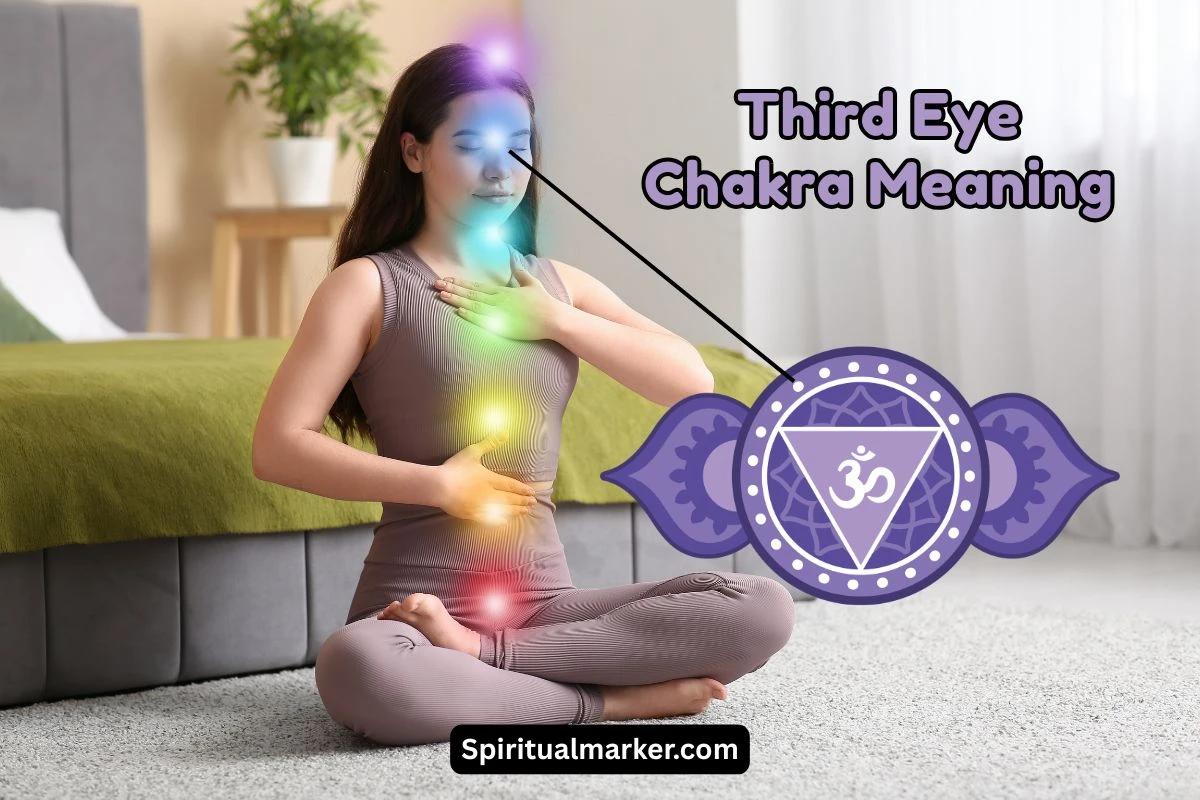
The third eye chakra sits between the eyebrows. It is the sixth chakra, often called Ajna, which means command or perception. This energy center governs intuition, imagination, and inner vision.
The third eye chakra meaning often involves psychic ability, wisdom, and spiritual insight. When balanced, it brings clarity and trust in your inner voice. A spiritual meaning of crown chakra shares that chakra focus, though the crown relates to divine connection.
When blocked, the third eye can cause confusion, doubt, or difficulty trusting your instincts. Practices like meditation, journaling, and spending time in darkness can help open it. The color associated with this chakra is indigo.
If you feel disconnected from your intuition, the third eye may need attention. A spiritual meaning of heart chakra also deals with chakra symbolism, though the heart relates to love and compassion.
What Is the Third Eye Chakra (Ajna)?
There is a reason the Third Eye Chakra has captivated spiritual seekers, yogis, and mystics across thousands of years and dozens of cultures. It is not just a concept. It is an experience. The moment your inner vision sharpens, your gut feelings become impossible to ignore, and life begins to feel less like a series of random events and more like a coherent, meaningful journey, that is the Ajna Chakra awakening.
The word Ajna comes from Sanskrit and translates to “command” or “perceive.” It is the sixth chakra in the traditional seven-chakra system rooted in ancient Hindu and yogic philosophy. Unlike the lower chakras that govern physical survival, emotional connection, and personal power, the Third Eye Chakra operates in the realm of perception, intuition, imagination, and inner knowing.
In yogic tradition, the Ajna Chakra is considered one of the most significant energy centers in the human body. It sits at the intersection of the three major nadis (energy channels) in the body: the Ida, Pingala, and Sushumna. This convergence makes it a powerful gateway between the physical and the spiritual, between what you see and what you sense.
The Third Eye is not limited to Eastern philosophy. Ancient Egyptians revered it through the Eye of Horus, a symbol of protection, royal power, and good health. The pineal gland, a small, pine-cone-shaped endocrine gland in the brain, has long been associated with the Third Eye by both spiritual traditions and modern researchers. Philosopher René Descartes called it “the seat of the soul.” Modern neuroscience confirms it plays a key role in producing melatonin and regulating circadian rhythms, which influence sleep, consciousness, and altered states of awareness.
When your Ajna Chakra is open and balanced, you think clearly, trust your intuition, and perceive the deeper patterns behind life events. You are not easily swayed by fear or illusion. You act from a place of inner clarity rather than external pressure.
Where Is the Third Eye Chakra Located?
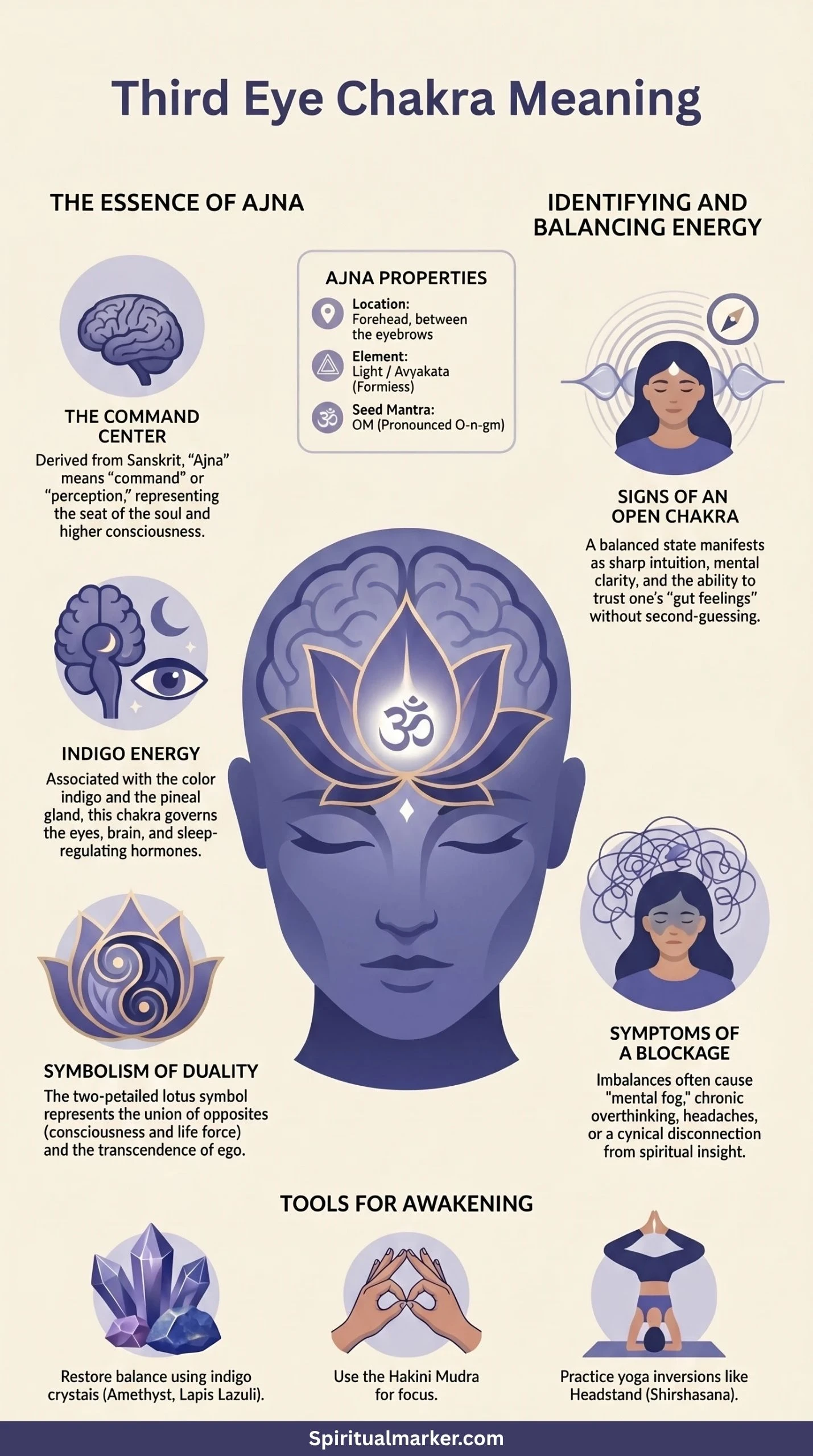
The Third Eye Chakra is located in the center of the forehead, slightly above the space between the eyebrows. This point is often called the Ajna point or the brow chakra. In many traditions, it corresponds precisely to the location of the pineal gland, which sits deep in the center of the brain, roughly behind the forehead.
During meditation, yoga, or moments of deep concentration, you may feel a subtle pressure, tingling, or warmth in this area. That sensation is commonly interpreted as the awakening or activation of the Ajna Chakra. Practitioners who regularly engage in pranayama (breathwork), meditation, and mindfulness often report increased sensitivity in this region as their awareness deepens.
Physically, this chakra governs the brain, eyes, pituitary gland, pineal gland, and the neurological system to a significant degree. Its energy influences your ability to focus, visualize, and process sensory information at a higher level than ordinary perception allows.
The Third Eye is sometimes depicted as a lotus flower with two petals, representing the duality of the conscious and subconscious mind, the analytical and the intuitive, the masculine and the feminine. At its center lies the seed syllable “OM”, reinforcing its connection to universal consciousness and the highest forms of perception.
What Is the Third Eye Chakra Responsible For?
The Ajna Chakra governs a wide spectrum of mental, perceptual, and spiritual functions that directly shape how you experience and interpret reality.
On a mental level, it is responsible for critical thinking, concentration, memory, and the ability to synthesize complex information into meaningful insight. It is the chakra of discernment. When it functions well, you can see situations clearly, cut through confusion, and make decisions from a place of inner truth rather than reactive emotion.
On an intuitive level, the Third Eye Chakra is the source of your gut feelings, premonitions, and psychic sensibilities. Whether or not you subscribe to the idea of psychic ability, everyone has experienced a knowing that preceded logical explanation. That is the Third Eye at work.
On a spiritual level, Ajna is the chakra of inner vision and enlightenment. It opens the door to higher states of consciousness, lucid dreaming, astral awareness, and the perception of subtle energies. Many spiritual traditions teach that awakening the Third Eye is a prerequisite for experiencing deeper spiritual states and connecting with one’s higher self.
The Third Eye also plays a fundamental role in imagination and visualization. Artists, writers, musicians, and creative thinkers often operate with a highly active Ajna Chakra. The ability to picture something vividly in the mind before it exists in the world is a direct function of this energy center.
Characteristics of the Third Eye Chakra
Element
The Third Eye Chakra is associated with the element of Light. Unlike the lower chakras, which are tied to earth, water, fire, air, and ether, the Ajna transcends the material elements and aligns with pure illumination. Light here represents both literal perception and metaphorical clarity. It is the light that dispels ignorance, the light of awareness that makes all things visible and knowable.
Some traditions also associate the Third Eye with the element of time, reflecting its connection to foresight, prophetic vision, and the ability to perceive patterns across past, present, and future.
Color
The color most strongly linked to the Third Eye Chakra is indigo, a deep, rich blue-violet that sits between blue and violet on the color spectrum. Indigo represents depth, intuition, introspection, and the bridge between the conscious and the divine. It is a color associated with the night sky and the inner cosmos, both vast, mysterious, and full of unseen intelligence.
Some systems also attribute the color deep purple to the Ajna Chakra, especially in contexts that emphasize its spiritual and mystical dimensions. When working with Third Eye healing, surrounding yourself with indigo tones, wearing indigo clothing, or meditating with indigo light can support energetic alignment.
Symbol
The symbol of the Ajna Chakra is a two-petaled lotus flower (also called the winged lotus) with a circle in the center. Within the circle sits an inverted triangle, symbolizing the downward flow of spiritual consciousness into material awareness, and at its heart rests the seed syllable “AUM” (OM), the primordial sound of the universe.
The two petals represent the two primary aspects of the mind: the conscious and the subconscious, logic and intuition, the sun and the moon. They also represent the meeting of the left and right brain hemispheres, the analytical and the creative, working in harmony.
Mantra
The seed mantra (bija mantra) of the Third Eye Chakra is “AUM” or “OM”. Chanting or silently repeating this sound during meditation is believed to activate and resonate with the Ajna energy center. OM is considered the most sacred syllable in Hindu, Buddhist, and Jain traditions. It represents the sound of universal creation, the vibration from which all existence emerges.
When you chant OM with focus directed toward the brow center, the vibrational frequency of the sound is said to stimulate the pineal gland and awaken latent perceptual capacities. Even Western acoustic research acknowledges that certain sound frequencies produce measurable effects on brain activity and consciousness.
Ruling Planet
The Third Eye Chakra is ruled by Jupiter in Vedic astrology, the planet of wisdom, expansion, and higher knowledge. Some Western systems also associate it with Neptune, the planet of dreams, psychic perception, and spiritual transcendence. Both planetary associations reinforce the Ajna Chakra’s role as the gateway to expanded awareness and cosmic understanding.
Associated Glands
The pineal gland is the primary physical correlate of the Third Eye Chakra. The pituitary gland, sometimes associated with the Crown Chakra, also has a close functional relationship with Ajna, as both work together to regulate the endocrine system, influencing mood, sleep, hormonal balance, and states of consciousness.
Emotions, Mental Health, and the Third Eye Chakra
The Third Eye Chakra has a profound and direct relationship with your mental and emotional landscape. When it is open and balanced, you experience clarity of thought, emotional intelligence, and a calm, grounded sense of inner knowing. You are able to observe your emotions without being consumed by them. You can witness your thoughts, recognize patterns, and choose responses rather than react automatically.
A healthy Ajna Chakra supports strong psychological resilience. You trust yourself. You can navigate uncertainty without spiraling into anxiety because you have access to an internal compass that points toward truth. Your perception is sharp but not paranoid. You see people and situations as they are, rather than through the distorting lens of fear, wishful thinking, or unresolved conditioning.
The connection between the Third Eye Chakra and mental health is more than metaphorical. Research into mindfulness and meditation, both practices that directly engage the Third Eye, consistently shows improvements in anxiety, depression, cognitive flexibility, and emotional regulation. A 2011 Harvard study found that mindfulness meditation physically increased the cortical thickness of the brain, particularly in areas linked to attention, interoception, and sensory processing.
When the Third Eye Chakra is overactive, you may experience obsessive thinking, over-intellectualization, vivid and disturbing nightmares, hallucinations, or a detachment from reality. The mind races and cannot find stillness. Paranoia and an overabundance of psychic sensitivity without grounding can become overwhelming.
When it is underactive or blocked, you may feel mentally foggy, indecisive, and cut off from your intuition. Life feels flat and mechanical. You struggle to visualize your future, trust your inner voice, or perceive anything beyond the surface of daily life. Creativity suffers. Purpose feels distant.
The emotions most directly associated with a blocked or imbalanced Third Eye include confusion, self-doubt, close-mindedness, cynicism, and a pervasive sense of disconnection from meaning. The healing emotions associated with an open Ajna are clarity, wonder, insight, and a quiet certainty that you are on the right path.
Signs and Symptoms of a Blocked Third Eye Chakra
Emotional and Mental Symptoms
Recognizing a blocked Third Eye Chakra is the first step toward healing it. Many people carry this blockage without realizing that what they dismiss as “just the way they are” is actually an energy imbalance that can shift.
Self-doubt is one of the most common signs. You second-guess your decisions constantly, looking to others for validation because you have lost trust in your own perception. This is not a personality flaw. It is a signal from your energy body.
Mental fog or brain fog is another hallmark symptom. You may struggle with concentration, memory, or the ability to think clearly, even when you are otherwise rested and healthy. Ideas feel sluggish. Creativity dries up. You go through the motions of daily life without really engaging with it.
Rigidity and close-mindedness often accompany a Third Eye blockage. You find yourself dismissing new ideas without genuine consideration, clinging to familiar worldviews out of fear rather than reasoned conviction. The mind becomes a locked room.
Difficulty visualizing is particularly telling. If you close your eyes and try to picture a simple object or a future scenario and find it nearly impossible, your Third Eye may need attention. Visualization is a core function of the Ajna Chakra, and its absence reflects an energetic contraction in that space.
Anxiety and overthinking are also linked to Third Eye imbalance. Paradoxically, a blocked or erratic Ajna can produce excessive, looping mental activity rather than stillness. This is different from the clear, focused thinking of a balanced chakra. It is scattered, fearful, and circular.
Disconnection from intuition rounds out the emotional picture. You have gut feelings but you ignore them or cannot hear them anymore. You feel cut off from any sense of spiritual meaning or inner guidance.
Physical Symptoms
The Third Eye Chakra governs specific physical structures, and its imbalances often manifest in those areas.
Persistent headaches or migraines, particularly in the forehead or behind the eyes, are among the most frequently reported physical symptoms of Third Eye dysfunction. Pressure in the brow area, sinus issues, and tension headaches may all reflect Ajna imbalance.
Vision problems such as eye strain, blurred vision, or difficulty focusing may have a physical cause but can also be compounded or influenced by Third Eye blockage. Energetically, the eyes are the physical counterpart of the inner vision that the Ajna Chakra governs.
Sleep disturbances are strongly connected to the Third Eye, given its relationship with the pineal gland and melatonin production. Insomnia, disturbed sleep, vivid or frightening dreams, and difficulty achieving deep, restful sleep can all signal Ajna imbalance.
Hormonal imbalances may arise because the pineal and pituitary glands, which are physically linked to this chakra, regulate key hormonal processes. Disruptions in mood, energy, and physiological cycles may carry an energetic component rooted in the Ajna Chakra.
Neurological symptoms such as dizziness, difficulty with balance, and heightened sensitivity to light and sound can sometimes reflect an overactive or disrupted Third Eye energy field.
How to Support and Balance the Third Eye Chakra
Balancing the Third Eye Chakra is not a single act. It is a practice built from consistent intention, self-awareness, and multiple healing modalities working together. No single technique is a cure-all. The most effective approach combines inner work with physical practices and supportive rituals.
Meditation is the single most powerful tool for Third Eye activation and balance. Specifically, focusing your attention on the brow center during meditation, whether through visualization, breath awareness, or silent repetition of OM, trains your awareness to anchor in the Ajna region. Over time, this sharpens your perception and opens channels of inner knowing that were previously quiet.
Journaling serves as a practical bridge between your inner life and your conscious mind. Writing down your dreams, intuitive impressions, synchronicities, and insights cultivates the habit of paying attention to the subtle signals your Third Eye sends. Many people carry profound intuitive wisdom they never tap because they have never learned to trust it. Journaling makes it tangible and real.
Reducing screen time and information overload is a profoundly underrated Third Eye practice. The modern information landscape floods the mental field with noise, making it nearly impossible to hear the quiet voice of inner knowing. Creating intentional periods of silence, digital detox, and mental stillness directly supports Ajna health.
Crystal healing offers a tangible, accessible way to work with the Third Eye’s energy. Amethyst, lapis lazuli, labradorite, sodalite, and fluorite are all deeply connected to the Ajna Chakra and are used by energy healers to open and balance it. Placing these stones on your forehead during meditation or carrying them throughout the day supports the energetic field of the Third Eye.
Aromatherapy using frankincense, sandalwood, clary sage, juniper, and lavender essential oils can stimulate and calm the Third Eye, depending on whether it needs activation or grounding. Diffusing these scents during meditation or applying them (diluted) to the brow area has been used in spiritual practices for centuries.
Dietary support for the pineal gland includes consuming iodine-rich foods like seaweed and leafy greens, antioxidant-rich foods such as blueberries and dark chocolate, and reducing processed foods, fluoride exposure, and alcohol, all of which can calcify or suppress pineal function.
Sound healing using singing bowls tuned to the frequency of the Ajna Chakra, binaural beats in the theta brainwave range (4 to 8 Hz), and the mantra OM can penetrate deeply into the brain’s activity patterns, promoting the relaxed, receptive states in which the Third Eye naturally opens.
Third Eye Chakra Affirmations for Clarity and Inner Vision
Affirmations work by directly reprogramming the mental patterns and beliefs that keep a chakra locked. For the Third Eye, the limiting beliefs typically center on self-doubt, distrust of one’s perception, and fear of seeing clearly. The following affirmations counter those patterns at the root.
Repeat them slowly, with intention, while focusing your awareness on the brow center. Morning or evening is ideal, especially in a meditative state.
- I trust my intuition completely.
- My inner vision is clear, sharp, and reliable.
- I see the truth in all situations with clarity and compassion.
- I am open to the wisdom that flows through me.
- My mind is focused, calm, and deeply perceptive.
- I trust the messages I receive from within.
- I see beyond appearances to the deeper truth of every situation.
- My imagination is a powerful tool for creation and healing.
- I am connected to my higher self and guided by inner wisdom.
- I release all mental fog and confusion. Clarity is my natural state.
- I honor and act on my intuitive guidance.
- I am deeply in tune with the subtle energies around me.
- My perception expands with each breath I take.
- I am not afraid of what I see within myself or in the world.
- I live in alignment with my highest truth.
Use these affirmations daily. Write them in a journal. Speak them aloud. Let them become part of how you relate to your own mind and perception.
Third Eye Chakra Meditation for Activation and Clarity
A dedicated Third Eye meditation practice does not need to be long or elaborate to be effective. Even ten to fifteen minutes of focused practice can produce meaningful shifts in awareness over time.
Step 1: Find a quiet, comfortable seated position. Close your eyes and take three deep, slow breaths, exhaling fully each time. Let your shoulders drop. Release any tension in your face, jaw, and forehead.
Step 2: Bring your awareness to the center of your forehead, the Ajna point. You do not need to force anything. Simply place your gentle attention there, like a soft spotlight.
Step 3: Begin to breathe in through the nose with the intention that each inhale draws indigo or violet light into the brow center. Visualize this light as a glowing orb that grows slightly brighter and more expansive with each breath.
Step 4: Silently or aloud, begin to repeat the mantra OM. Feel the vibration move toward the center of your skull. Let it settle there. Let it hum.
Step 5: After several minutes, simply rest in the stillness. Do not seek visions or force experiences. Allow whatever arises to surface naturally. A thought, a feeling, a flash of knowing. Receive it without judgment.
Step 6: When you are ready, gently wiggle your fingers and toes. Take one final deep breath. Open your eyes slowly. Take a moment before moving back into the activity of your day.
Practicing this meditation three to five times per week creates a cumulative effect. Many practitioners report increased dream vividness, stronger intuitive hits, improved focus, and a growing sense of spiritual alignment within the first few weeks of consistent practice.
10 Third Eye Chakra Yoga Poses to Activate and Balance Ajna Energy
Yoga is one of the most holistic and time-tested paths to chakra healing. Poses that stimulate the Third Eye region do so through forward folds, inversions, and poses that bring the forehead into contact with the earth or a support, activating the brow center directly. They also build the quality of focused, inward attention that characterizes a healthy Ajna.
1. Child’s Pose (Balasana)
Child’s Pose is perhaps the most direct Third Eye yoga posture available. When you rest your forehead gently on the mat, you are quite literally placing the Ajna point in contact with the earth element, grounding the Third Eye while simultaneously drawing awareness inward. From a kneeling position, sink your hips back toward your heels, extend your arms forward (or rest them alongside your body), and let your forehead rest on the floor. Stay for one to three minutes, breathing deeply. Feel the gentle pressure on the brow center as an anchor for inward attention.
2. Standing Forward Fold (Uttanasana)
In Uttanasana, the inversion of the head below the heart increases blood flow to the brain and the brow region, stimulating both the pineal gland area and the Ajna Chakra. Stand with feet hip-width apart. On an exhale, hinge forward from the hips, letting the torso fold over the legs. Soften your knees as needed. Let the crown of the head hang heavy toward the floor. Hold for five to eight breaths, feeling the blood move toward the head and the tension of the day release.
3. Downward Facing Dog (Adho Mukha Svanasana)
Downward Facing Dog combines the benefits of inversion with active engagement, making it a powerful Third Eye pose. From hands and knees, lift the hips up and back, forming an inverted V shape. Press firmly through the hands, lengthen through the spine, and allow the crown of the head to release toward the floor. The position of the head below the heart, combined with the lengthening of the spine and the activation of focused breath awareness, creates ideal conditions for Third Eye stimulation.
4. Dolphin Pose (Ardha Pincha Mayurasana)
Dolphin Pose is a forearm variation of Downward Dog that brings extra attention to the brow area. Begin on forearms with elbows shoulder-width apart. Interlace fingers or keep forearms parallel, then lift the hips to mirror the downward dog shape. The head hangs freely. The sensation in the brow center is often more pronounced in this pose than in standard Downward Dog, making it an excellent Third Eye activator.
5. Eagle Pose (Garudasana)
Eagle Pose demands intense, single-pointed concentration, the hallmark of a healthy Third Eye. Stand on one foot, wrap the opposite leg over the standing leg, and wind the arms in the opposite direction at chest height. Hold your gaze on a fixed point in front of you. This drishti (focused gaze) practice trains the mind’s ability to focus, which is one of the core mental capacities governed by the Ajna Chakra. Hold for five breaths on each side.
6. Seated Meditation Pose with Shambhavi Mudra (Sukhasana with Shambhavi)
Shambhavi Mudra is the practice of turning the eyes upward and inward toward the Third Eye while in a relaxed seated position. This mudra has been practiced in yoga and tantra for thousands of years as a direct method of stimulating the Ajna Chakra. Sit comfortably in Sukhasana (Easy Pose). Close your eyes gently. Without straining, turn your gaze upward toward the point between the eyebrows. Hold for five to ten breaths. This simple practice sends a direct energetic signal to the brow center.
7. Plow Pose (Halasana)
Halasana is a powerful inversion that floods the brain and head with circulation while creating a significant amount of internal, contemplative energy. Lying on your back, lift your legs and torso upward, then fold your legs over your head until your toes touch or near the floor behind you. Support your lower back with your hands if needed. The chin-to-chest position in this pose stimulates the Jalandhara Bandha (throat lock), which in yogic physiology helps direct prana upward through the chakras, including the Ajna. Hold for five to eight breaths.
8. Supported Shoulderstand (Salamba Sarvangasana)
Known as the queen of asanas, Shoulderstand directs intense upward-moving energy through the entire spinal column and toward the head. Lie on your back and lift your legs and hips skyward, supporting your lower back with your hands. The body becomes a vertical channel. In this position, prana flows forcefully toward the upper chakras, making it one of the most effective postures for activating both the Third Eye and the Crown Chakra. Build up to holding for one to three minutes.
9. Wide-Legged Forward Fold with Forehead on Floor (Prasarita Padottanasana)
Prasarita Padottanasana offers a wide-stance forward fold that, when practiced deeply, brings the crown of the head or the forehead toward or onto the floor, directly activating the Ajna point. Stand with feet wide, two to three feet apart. Fold forward from the hips, walking your hands toward the center between your feet. Allow the head to release toward the floor. The gentle weight of the head in this position creates a mild, stimulating pressure on the crown and brow centers.
10. Corpse Pose with Third Eye Focus (Savasana)
Savasana is typically practiced at the end of a yoga session as a pose of total surrender and integration. For Third Eye work, practice it with intention by placing a folded cloth or crystal (such as amethyst) on the brow center and directing your awareness there throughout the pose. Lie flat on your back with arms slightly away from the body and palms facing up. Close your eyes. Breathe naturally. Let your awareness rest in the brow center. Allow the energy activated throughout the practice to settle and integrate into the Ajna point.
Crystals for the Third Eye Chakra
Working with healing crystals aligned with the Third Eye can meaningfully support your Ajna healing practice. Crystals carry vibrational frequencies that interact with the body’s own energetic field, and those resonant with indigo and violet frequencies are particularly effective for this chakra.
Amethyst is the quintessential Third Eye crystal. Its deep violet color and high vibrational frequency make it a natural companion for meditation, dream work, and spiritual opening. Placed on the brow center during meditation or kept on a bedside table, amethyst supports clarity, psychic receptivity, and restful, insightful dreams.
Lapis Lazuli has been revered since ancient Egyptian times as a stone of wisdom and truth. Its deep blue hue with golden flecks connects directly to the Ajna Chakra and supports clear communication between your inner wisdom and your conscious mind.
Labradorite is the stone of transformation and mystical awareness. It shimmers with an iridescent inner light, a fitting physical metaphor for the Third Eye itself. Labradorite supports the development of psychic gifts, strengthens intuition, and offers protection during deep inner work.
Sodalite calms an overactive, racing mind and supports the rational side of the Third Eye, the ability to think clearly, discern truth, and integrate logical and intuitive knowing. It is particularly useful when overthinking is the dominant symptom.
Clear Quartz amplifies the energy of any chakra it is directed toward and serves as a programmable energy tool that can intensify Third Eye work when used alongside a clear intention.
Third Eye Chakra and the Pineal Gland: The Science and the Spiritual
The connection between the pineal gland and the Third Eye Chakra is one of the most fascinating intersections of ancient wisdom and modern science. The pineal gland is a tiny, pea-sized endocrine gland tucked deep in the center of the brain. Unlike most brain structures, it is not divided into left and right hemispheres. It sits at the midpoint, single and centrally located, much like the Third Eye itself.
The pineal gland produces melatonin, which regulates sleep-wake cycles and is deeply linked to states of consciousness, including deep sleep, dreaming, and meditative states. Some researchers and spiritual teachers also associate the pineal gland with the endogenous production of dimethyltryptamine (DMT), sometimes called the “spirit molecule,” which has been linked to near-death experiences, mystical states, and vivid visionary experiences. While the science here remains contested and evolving, the intersection is undeniably provocative.
The pineal gland contains photoreceptor cells similar to those found in the retina of the eye. In simpler organisms, the pineal gland literally functions as a light-sensitive “third eye.” In humans, while it no longer directly perceives light, it remains exquisitely sensitive to light cycles through its melatonin production, which is suppressed by light and stimulated by darkness.
Calcification of the pineal gland is a well-documented phenomenon, increasingly common due to fluoride exposure, processed food consumption, chronic stress, and electromagnetic radiation. In energetic terms, calcification is directly correlated with Third Eye blockage. Practices that support pineal decalcification, including reducing fluoride intake, consuming chlorophyll-rich foods, spending time in natural sunlight, and practicing deep meditation, align almost exactly with practices that spiritual traditions recommend for Third Eye activation.
Foods That Support the Third Eye Chakra
Nutrition plays a surprisingly concrete role in supporting Third Eye health, largely through its effect on the pineal gland and brain function. Certain foods directly support pineal gland health, reduce calcification, and support the neurological functions governed by the Ajna Chakra.
Dark leafy greens such as spinach, kale, and chard are rich in chlorophyll, magnesium, and antioxidants that support brain health and help detoxify heavy metals associated with pineal calcification. Blueberries, acai, and other dark berries are among the most powerful brain-protective foods available, rich in anthocyanins that cross the blood-brain barrier and reduce neuroinflammation.
Raw cacao contains a rich profile of phenylethylamine, theobromine, and magnesium, compounds associated with elevated mood, heightened awareness, and neurological support. Many Third Eye practitioners include raw cacao in their spiritual practice routines for this reason.
Herbs such as mugwort, gotu kola, and bacopa monnieri have long histories of use in traditional medicine systems as cognitive enhancers and dream intensifiers, both functions of an active Third Eye. Ginger and turmeric reduce neuroinflammation and support overall brain health.
Reducing or eliminating processed sugar, alcohol, and highly processed foods also removes energetic and physiological noise that obscures the Third Eye’s natural clarity.
Third Eye Chakra and Dreams
The Third Eye Chakra is intimately connected to the dream state. Dreams have been treated as messages from the deeper mind, from the divine, or from the unconscious since human consciousness first reflected on itself. In the framework of the Ajna Chakra, vivid, meaningful, and memorable dreams are a sign of Third Eye activation.
When the Ajna Chakra begins to open or deepen, many people report a sudden increase in dream vividness, lucid dreaming, and prophetic or symbolic dreams. These are not random. They reflect the awakening of the deeper perceptual faculties governed by this chakra.
Keeping a dream journal beside your bed and recording your dreams immediately upon waking is one of the most effective practices for deepening Third Eye awareness. Over time, patterns emerge. Symbols repeat. Meanings become clearer. The inner language of the Ajna Chakra becomes more fluent.
Lucid dreaming, the practice of becoming consciously aware that you are dreaming while still in the dream state, is considered a direct expression of advanced Third Eye function. Practices such as setting a dream intention before sleep, using amethyst or mugwort on the bedside table, and reviewing your day’s experiences with mindful attention before bed all support the development of lucid dreaming.
Connecting the Third Eye to the Other Chakras
The Third Eye does not function in isolation. It is part of an interconnected energetic system, and its health is influenced by the health of every chakra below it.
The Root, Sacral, and Solar Plexus Chakras provide the grounding and personal power necessary to keep Third Eye activation from becoming destabilizing. A person with a highly active Third Eye but poorly grounded lower chakras may experience the opening as overwhelming, disorienting, or anxiety-inducing. This is why grounding practices are essential companions to Third Eye work.
The Heart Chakra acts as a purifier. When the heart is open, the visions and perceptions of the Third Eye are infused with compassion and love rather than fear and judgment. An open heart ensures that what you see, you see with empathy.
The Throat Chakra is the bridge through which the insights of the Third Eye become articulated and shared. Many teachers, artists, and visionaries work at the intersection of these two chakras, translating what the inner eye perceives into words, sounds, and forms that can reach others.
The Crown Chakra, just above the Third Eye, is its natural partner. Together, Ajna and Sahasrara form the highest chakra dyad, governing spiritual perception and the experience of unity consciousness. A fully activated Third Eye without a correspondingly open Crown can become trapped in psychic experience for its own sake. When both are aligned, perception becomes a vehicle for genuine spiritual liberation.
Final Thoughts
The Third Eye Chakra is not a mystical abstraction reserved for advanced yogis or spiritual teachers. It is a living, breathing dimension of your consciousness that you work with every time you trust your gut, dream vividly, think clearly, or look beyond the obvious to perceive something deeper.
Caring for the Ajna Chakra means investing in your inner life. It means making space for silence in a noisy world, trusting the signals your deeper mind sends, and cultivating the courage to see clearly, even when clarity is uncomfortable.
When you commit to this work, something shifts. The world does not change, but your ability to perceive it deepens. Decisions become clearer. Relationships make more sense. You stop sleepwalking through life and start engaging with it as the conscious, perceptive being you are.
Start small. Meditate for ten minutes with your attention at the brow center. Write down your dreams tomorrow morning. Repeat one affirmation with genuine intention. Carry an amethyst in your pocket. These are not grand gestures. They are consistent signals to your energetic system that you are ready to see more clearly.
The Third Eye is always there, waiting for your attention. When you give it that attention, it gives you back something invaluable: the ability to navigate your own life with wisdom, clarity, and genuine inner sight.
References
- https://midtownyogastudios.com/blog/third-eye-chakra
- https://www.yogajournal.com/yoga-101/chakras-yoga-for-beginners/chakratuneup2015-intro-ajna/
- https://www.7chakracolors.com/chakra/third-eye/
- https://en.wikipedia.org/wiki/Ajna
- https://blog.mindvalley.com/third-eye-chakra-ajna/
- https://myyogateacher.com/articles/third-eye-chakra-complete-guide
- https://www.bigshakti.com/third-eye-ajna-chakra-power-to-enlighten