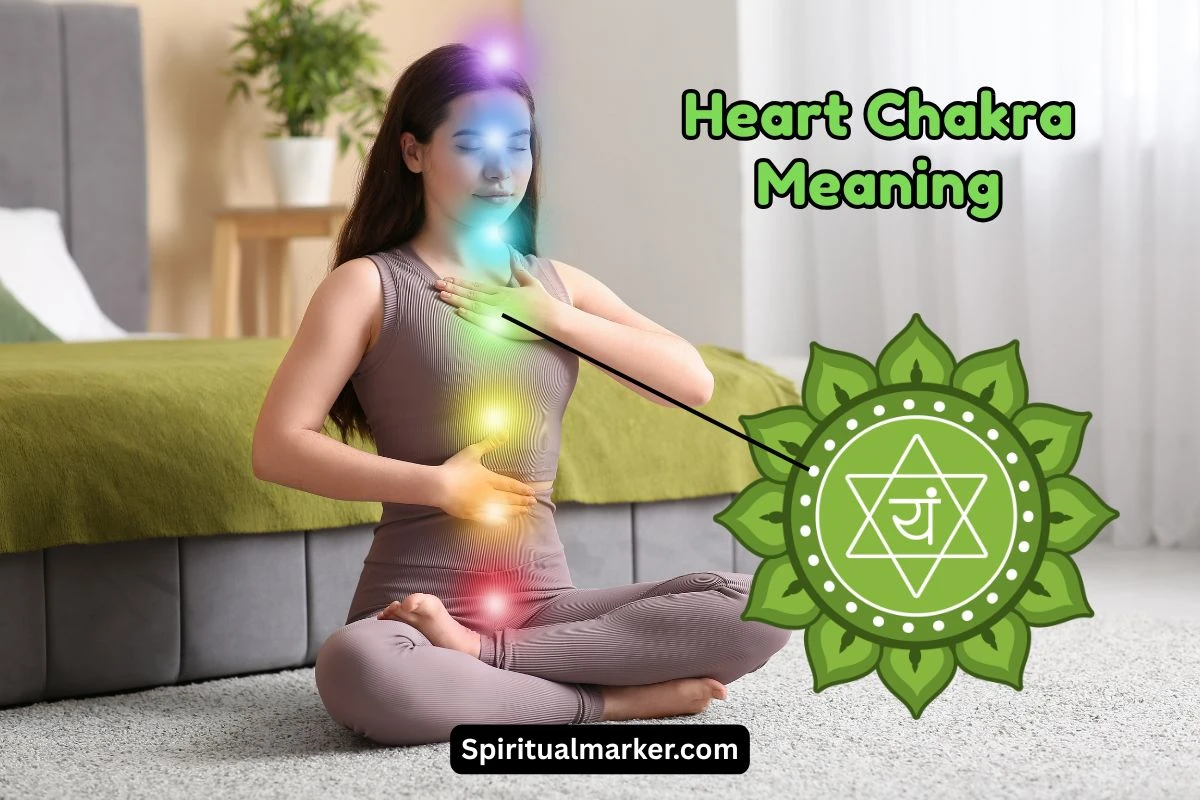
The heart chakra sits in the center of the chest. It is the fourth chakra, often called Anahata, which means unstruck. This energy center governs love, compassion, and connection.
The heart chakra meaning often involves love, forgiveness, and emotional healing. When balanced, it brings a sense of peace and deep connection to others. A spiritual meaning of throat chakra shares that chakra focus, though the throat relates to communication and truth.
When blocked, the heart chakra can cause loneliness, resentment, or difficulty giving and receiving love. Practices like gratitude, forgiveness, and spending time with loved ones can help open it. The color associated with this chakra is green or pink.
If you feel disconnected from love, the heart chakra may need attention. A spiritual meaning of solar plexus chakra also deals with chakra symbolism, though the solar plexus relates to personal power.
What Is the Heart Chakra (Anahata)?
At the very center of the seven-chakra system sits a chakra unlike any other. The Heart Chakra, known in Sanskrit as Anahata, is the fourth primary energy center in the body and the energetic bridge between the three lower chakras and the three upper chakras. It is not just a metaphysical concept. It is the living, pulsing core of your emotional and spiritual life.
The word Anahata translates directly from Sanskrit as “unstruck,” “unbeaten,” or “unhurt.” This name carries profound wisdom. It suggests that beneath every heartbreak, every disappointment, and every wound you have ever carried, there exists a place within you that remains eternally whole. That is the essence of the Anahata Chakra: a space of pure, undamaged love that cannot be destroyed, only obscured.
In ancient Vedic texts and the yogic tradition, the Heart Chakra is considered the seat of the soul. It governs your capacity for love, not only romantic love, but self-love, compassion, forgiveness, empathy, and your deep sense of connection to all living things. When this chakra functions in balance, you move through the world with warmth and generosity. You give and receive love freely. You forgive without bitterness, and you feel genuinely connected to others.
The Anahata Chakra is also where the personal meets the universal. The three chakras below it, Root, Sacral, and Solar Plexus, are primarily concerned with physical survival, pleasure, and personal power. The three above it, Throat, Third Eye, and Crown, govern expression, intuition, and spiritual connection. The Heart Chakra holds all of these together. It is the meeting point of earth and sky, of the human and the divine, of the self and the other.
Many spiritual traditions beyond yoga also recognize the heart as the center of love and wisdom. In Sufism, the heart is the mirror of the divine. In Christianity, the Sacred Heart symbolizes unconditional love and sacrifice. In Traditional Chinese Medicine, the heart houses the Shen, or spirit. These parallel teachings across cultures reinforce what yogic philosophy has known for centuries: the heart is the most powerful center in the human energy system.
Where Is the Heart Chakra Located?
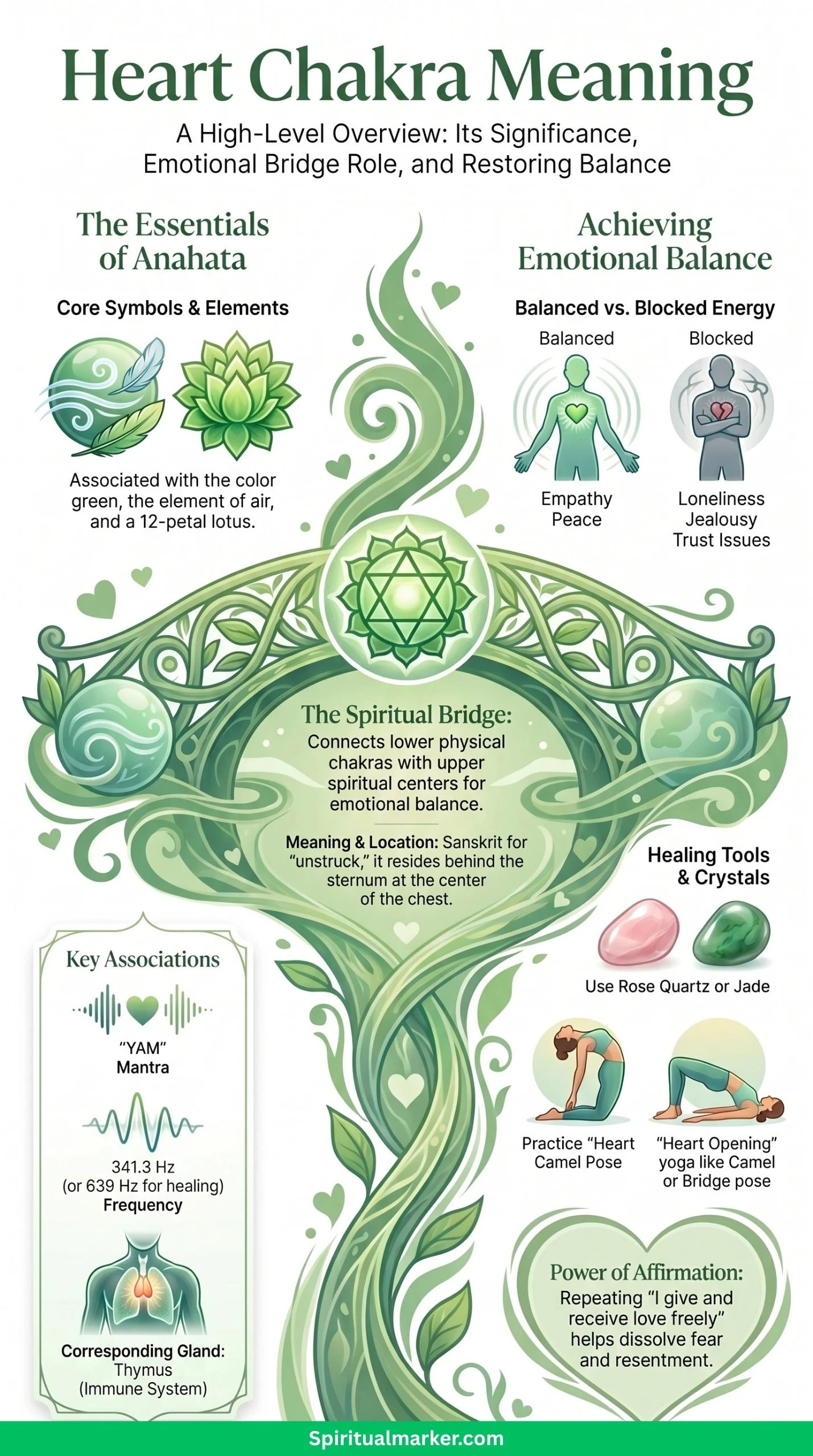
The Heart Chakra is located at the center of the chest, in the region of the physical heart and the cardiac plexus. More precisely, it sits at the level of the fourth thoracic vertebra, directly behind the sternum and aligned with the heart organ itself. However, it is slightly to the right of the physical heart and extends outward in all directions as a spinning wheel of energy.
In the body, the Heart Chakra governs the heart, lungs, chest, upper back, shoulders, arms, and hands. This is why so many physical symptoms of a blocked heart chakra manifest in these areas. Tightness in the chest, tension between the shoulder blades, shallow breathing, and even chronic upper back pain can all point to energy stagnation in the Anahata region.
The thymus gland is also directly associated with the Heart Chakra. The thymus plays a critical role in immune function, particularly in the development of T-cells that protect the body from illness. Interestingly, research in psychoneuroimmunology has shown that emotional states directly influence immune function, which gives scientific credibility to the idea that emotional healing and heart chakra work can have tangible physiological effects.
When you place your hand on your chest in a moment of grief, gratitude, or love, you are instinctively connecting with this energy center. That gesture is universal across cultures, and it is not coincidental. The body already knows where love lives.
What Is the Heart Chakra Responsible For?
The Heart Chakra is responsible for your entire emotional landscape as it relates to love, connection, and compassion. It is the energetic source from which you experience and express the full spectrum of heart-centered emotions and relational qualities.
At its most fundamental level, the Anahata Chakra governs love in all its forms: romantic love, parental love, friendship, self-love, and the expansive love of all humanity and nature. It is the chakra that makes genuine human connection possible. Without a functioning Heart Chakra, relationships feel hollow, transactional, or threatening.
Compassion is another primary responsibility of this chakra. Compassion is the ability to feel another person’s pain without losing yourself in it. A balanced Heart Chakra allows you to hold space for others, offer support, and empathize deeply, while still maintaining healthy boundaries. This is a crucial distinction that many people miss: the Heart Chakra is not about losing yourself in others. It is about loving fully while remaining whole.
The Anahata also governs forgiveness, one of the most transformative and difficult emotional processes a human being can undertake. Holding onto resentment, anger, or grief creates stagnation in this chakra. Forgiveness does not mean condoning harm. It means releasing the emotional weight so that it no longer controls you. Many healing traditions across the world, from Tibetan Buddhism to Ho’oponopono in Hawaiian culture, place forgiveness at the very center of spiritual and emotional wellbeing.
Grief is also housed in the Heart Chakra. The capacity to grieve fully and healthily is actually a sign of an open heart. When you suppress grief, deny loss, or refuse to mourn, that energy calcifies in the Anahata and eventually manifests as emotional numbness, resentment, or physical tension in the chest and upper body.
Additionally, the Heart Chakra is responsible for inner peace, gratitude, joy, and the sense of unity with all life. When it is balanced and open, you feel a quiet sense of belonging, as if you are connected to something larger than yourself. That feeling is not spiritual delusion. It is the natural state of a healthy, open heart center.
Characteristics of the Heart Chakra
Element
The Heart Chakra is associated with the element of Air. This is deeply symbolic. Air is invisible yet essential. You cannot see it, but you feel its presence constantly. You cannot survive without it, yet you rarely think about it. Love and compassion operate in much the same way. They are the invisible forces that make life worth living.
Air also represents freedom, expansion, and breath. Just as air has no fixed shape and moves freely in all directions, love in its purest form is unconditional and boundless. The breath, which is the most direct physical expression of the air element, is intimately linked with the heart chakra. This is why deep, conscious breathing is one of the most immediate and powerful tools for heart chakra activation. When you expand your breath, you expand your capacity for love.
In yogic philosophy, Prana, the vital life force that flows through all living things, is carried by the breath. The Heart Chakra is the primary gateway through which Prana enters the subtle body. This is why pranayama, or yogic breathing practices, are so effective in stimulating and balancing Anahata energy.
Color
The Heart Chakra color is green, a vibrant, lush green that evokes the natural world in its most alive and abundant state. Green is universally associated with growth, renewal, healing, and the natural world. Think of the color of a thriving forest, a meadow in spring, or new leaves after rain. These are all expressions of the same energy that flows through a healthy Heart Chakra.
In color therapy, green is the color of balance. It sits at the exact midpoint of the visible light spectrum, which mirrors the Heart Chakra’s position at the center of the seven-chakra system. Green balances the warm red-orange-yellow spectrum of the lower chakras with the cool blue-indigo-violet of the upper chakras.
A secondary color associated with the Heart Chakra is pink. Where green represents healing, growth, and universal love, pink carries the energy of gentle self-love, tenderness, and nurturing compassion. Many heart chakra practices use both green and pink crystals to address different dimensions of heart healing. Rose Quartz, with its soft pink hue, is one of the most widely used stones for heart chakra work precisely because it embodies this tender, self-directed quality of love.
Symbol
The Heart Chakra symbol is a lotus flower with twelve petals, arranged around a central geometric composition. Each element of this symbol carries layered meaning rooted in ancient Vedic tradition.
The twelve petals represent twelve divine qualities that are awakened when the heart is open: love, joy, peace, harmony, empathy, understanding, purity, clarity, compassion, unity, forgiveness, and bliss. These are not aspirational ideals alone. They are energetic frequencies that naturally emerge from a balanced Anahata Chakra.
Within the lotus, there are two interlocking triangles forming a six-pointed star, known as the Shatkona in Sanskrit. This is similar in appearance to the Star of David but carries its own distinct meaning in Hindu cosmology. One triangle points upward, representing the upward movement of earthly energy toward the divine. The other points downward, representing divine energy descending into the material world. Their intersection symbolizes perfect balance between spirit and matter, exactly the function the Heart Chakra serves in the chakra system.
At the center of the symbol is often depicted the seed syllable YAM, the Bija mantra of the Heart Chakra. The antelope or deer is the animal associated with Anahata, representing sensitivity, grace, and gentleness.
Mantra
The seed mantra (Bija mantra) of the Heart Chakra is YAM (pronounced “yum”). Chanting this sound is not merely a vocal exercise. In yogic tradition, Bija mantras are considered to be the vibrational essence of the chakra itself. They carry a specific frequency that resonates with and activates the energy center they correspond to.
When you chant YAM with intention, the vibration moves through your chest, stimulating the cardiac plexus and creating movement in the heart region’s energy field. Regular mantra practice with YAM is associated with releasing emotional blockages, softening the heart after grief or trauma, and opening the capacity for deeper compassion.
You can chant YAM aloud in a sustained tone, or you can repeat it silently during meditation. The key is sustained intention combined with the sound. Pair the chant with a focus on the heart center and a conscious intention of love or healing, and the effect is significantly amplified.
Beyond YAM, the sound of the Heart Chakra is also carried in words of genuine affirmation, gratitude, and loving speech. Every time you speak with true kindness, you activate Anahata energy. Every time you silently repeat “I love you” to yourself with authenticity, you nourish this chakra.
Ruling Planet
The Heart Chakra is associated with Venus, the planet of love, beauty, and relationships in both Western astrology and Vedic Jyotish. Venus governs your capacity for affection, your aesthetic sense, and the quality of your closest relationships. When Venus energy is strong in your life, you attract loving connections, find beauty in the ordinary, and move through relationships with grace.
The sun is also associated with the Heart Chakra in some traditions, particularly in relation to radiance, warmth, and the generous giving of light without expectation of return. Like the sun, an open heart shines on everyone equally.
Emotions, Mental Health, and the Heart Chakra
The relationship between the Heart Chakra and emotional health is one of the most significant and well-documented aspects of chakra theory, and it maps surprisingly well onto modern psychological understanding.
When the Anahata Chakra is balanced and open, you experience a rich, stable emotional life. You are capable of deep love and connection without losing yourself. You can set healthy boundaries, not from fear or resentment, but from a clear understanding of your own needs and values. You feel genuine empathy without emotional exhaustion. You experience gratitude naturally, even amid difficulty. And you carry a fundamental sense of worthiness, the quiet inner knowing that you deserve love, belonging, and care.
The Heart Chakra is intimately connected to attachment patterns, a concept well-studied in developmental psychology. Research on attachment theory, pioneered by John Bowlby and expanded by many others, shows that early relational experiences shape our capacity for love and connection throughout life. People with secure attachment styles tend to have naturally open heart chakras. People who experienced emotional neglect, abandonment, or betrayal in childhood often develop heart chakra wounds that show up as either emotional walls or desperate clinging in adult relationships.
Grief and loss live most deeply in the Heart Chakra. When you lose someone you love, whether through death, separation, or estrangement, the heart chakra contracts in a protective response. This is natural and necessary in the short term. But when grief is left unprocessed, it calcifies into chronic sadness, emotional numbness, or an inability to trust and love again. Unhealed grief is one of the most common causes of a chronically closed or blocked Heart Chakra in adults.
Resentment and bitterness also heavily impact this chakra. Resentment is essentially stored anger and hurt that has not been processed or released. It occupies space in the heart’s energy field and prevents the free flow of love. Many people carry resentment toward parents, ex-partners, or others who caused them harm, often without fully realizing how much energetic weight that resentment carries.
Loneliness is another emotional state deeply tied to heart chakra health. Chronic loneliness is not merely a social condition. It is an energetic one. When the heart chakra is closed, you can be surrounded by people and still feel profoundly alone, because the channel through which genuine connection flows is blocked.
On the positive side, a thriving Heart Chakra supports emotional resilience. People with open, balanced Anahata energy tend to bounce back from heartbreak more effectively, maintain healthier long-term relationships, experience higher levels of life satisfaction, and show greater capacity for forgiveness. They are not immune to pain, but they move through it without becoming hardened by it.
Signs and Symptoms of a Blocked Heart Chakra
Emotional Symptoms
Recognizing a blocked Heart Chakra begins with honest self-observation. The emotional symptoms are often deeply familiar, so familiar that many people mistake them for fixed personality traits rather than signs of energetic imbalance.
Fear of intimacy is one of the most prevalent signs. You may deeply want love and connection, but when someone gets close, something inside you pulls back, builds walls, or finds reasons to push them away. This protective mechanism developed for a reason, often rooted in past hurt, but it keeps you isolated from the very thing you most need.
Difficulty forgiving is another strong indicator. If you find yourself replaying old wounds on a mental loop, holding grudges that stretch back years, or feeling a hardness when you think about people who have hurt you, your heart chakra is signaling that it needs attention. Forgiveness is not a moral obligation. It is energetic self-liberation.
You might also notice a tendency toward codependency, which is the opposite of a closed heart. This is an overactive or imbalanced heart chakra that manifests as losing yourself completely in others’ needs, sacrificing your own wellbeing to feel needed or loved, or confusing love with control. An unbalanced heart chakra swings between these poles, sometimes closing off completely and sometimes opening in ways that lack boundaries.
Jealousy and possessiveness in relationships, emotional numbness or disconnection from feelings, chronic lonelinesseven in the presence of others, an inability to trust others or believe in the goodness of people, excessive self-criticism and self-judgment, and a pervasive sense of unworthiness are all signs that the Anahata Chakra is not flowing as it should.
Depression and anxiety are frequently linked to heart chakra imbalances as well. While mental health conditions are complex and multifactorial, the emotional experience of depression often includes exactly the qualities of a closed heart: numbness, disconnection, inability to feel joy or love, and a sense of isolation from the world.
Physical Symptoms
The body and the energy system are not separate. Physical symptoms in the heart chakra region are often the body’s way of communicating what the emotional self has been unable to process or express.
Chest tightness or pain (when cardiac causes have been ruled out) is one of the most direct physical signals of heart chakra stress. You may notice a feeling of heaviness or pressure in the chest area, particularly during emotionally challenging periods. Many people describe grief as a physical ache in the chest, which is the body literally registering the chakra’s distress.
Shallow breathing or a chronically tight diaphragm is strongly associated with heart chakra blockage. Because the air element governs this chakra, constricted breathing reflects constricted heart energy. Many people hold their breath unconsciously when they feel emotionally unsafe, and over time this becomes a chronic pattern.
Upper back pain, particularly between the shoulder blades, is another common physical manifestation. The shoulder blades are sometimes called the “wings of the heart,” and tension in this area often correlates with emotional carrying or holding back. People who habitually protect their hearts may literally round their shoulders forward, physically guarding the chest.
Respiratory issues such as frequent colds, bronchitis, asthma, or general lung weakness can reflect chronic heart chakra imbalance. The lungs are the organs most directly governed by this chakra, and their health is intimately tied to how freely love and grief flow through the system.
Cardiovascular concerns, immune system weakness (connected to the thymus gland), poor circulation in the arms and hands, and shoulder or arm tension are all physical manifestations that may point toward heart chakra imbalance. It is important to always address physical symptoms with qualified medical care, but chakra healing practices can be a powerful complementary support.
How to Open, Heal, and Balance the Heart Chakra
Healing the Heart Chakra is not a one-time event. It is an ongoing practice of returning to love, again and again, especially when it is difficult. The following approaches work together as a holistic system for restoring Anahata’s natural, free-flowing energy.
Practicing self-compassion is the foundation of heart chakra healing. Psychologist Kristin Neff’s research on self-compassion shows that treating yourself with the same kindness you would offer a good friend in a moment of difficulty significantly reduces anxiety, depression, and emotional reactivity. For the Heart Chakra, self-compassion is not a luxury. It is the bedrock. You cannot genuinely open your heart to others if it is closed to yourself.
Working with grief consciously is essential. This means allowing yourself to feel loss, to cry, to sit with sadness rather than numbing, distracting, or suppressing it. Grief that is witnessed and honored moves through. Grief that is buried stays lodged in the chest. Therapeutic support, journaling, grief rituals, or even simply allowing yourself time to cry can all facilitate this process.
Forgiveness practices, such as the Hawaiian Ho’oponopono mantra (“I’m sorry, please forgive me, thank you, I love you”), loving-kindness meditation (Metta), or structured forgiveness journaling, create profound movement in the heart energy field. These practices do not require the other person to change or even know that you are forgiving them. They release the energetic grip that unresolved hurt has on your heart.
Spending time in nature, particularly in green, lush environments, directly nourishes the heart chakra through sympathetic resonance with the air element and the green color frequency. A walk through a forest, sitting near water, or gardening can all function as powerful heart-opening practices.
Green and pink foods such as leafy greens, broccoli, green apples, avocados, and green tea nourish the heart chakra through the principle of color resonance and their high nutrient density. Healthy fats support cardiovascular health, and the heart chakra responds to foods that genuinely nourish the physical heart.
Crystals for the heart chakra include Rose Quartz (gentle self-love and compassion), Green Aventurine (emotional healing and luck in love), Rhodonite (healing emotional wounds and fostering forgiveness), Malachite (transforming old heartbreak into wisdom), and Emerald (activating unconditional love). Place these stones on your chest during meditation, carry them throughout the day, or keep them in your living space.
Essential oils such as rose, ylang-ylang, geranium, bergamot, and eucalyptus all resonate with heart chakra energy. Rose oil in particular is among the highest-vibration essential oils and is traditionally associated with unconditional love. Diffusing these oils during meditation or applying diluted versions to the chest area can enhance heart chakra work.
Heart Chakra Affirmations for Love, Compassion, and Healing
Affirmations work on the heart chakra by consciously rewiring the internal narrative that either supports or sabotages your capacity for love. The heart carries deep-seated beliefs about whether you are worthy of love, whether relationships are safe, and whether the world is fundamentally kind or threatening. Affirmations, practiced consistently and with genuine feeling, gradually replace limiting beliefs with expansive ones.
The key to effective heart chakra affirmations is feeling the words rather than just saying them. Take a breath, place your hand on your chest, close your eyes, and let each statement land in your body rather than staying in your mind.
I am worthy of deep and lasting love.
My heart is open, strong, and whole.
I give and receive love freely and without fear.
I forgive myself for all past mistakes and release them with compassion.
I forgive those who have hurt me and I release resentment from my heart.
Love flows through me easily and abundantly.
I am connected to all living beings through the power of love.
My heart heals more deeply with each passing day.
I am deserving of kindness, care, and affection.
I choose to love myself completely, including the parts I am still learning to accept.
Compassion comes naturally to me.
I am safe to love and be loved.
My relationships are grounded in mutual respect, care, and genuine connection.
I radiate love from the inside out.
I am grateful for the love that is present in my life right now.
The universe supports me in giving and receiving love.
I release all fear around love and open myself to its healing power.
I am at peace with my past and I welcome love into my present.
My heart is a center of healing energy for myself and for others.
I attract loving, healthy, and nurturing relationships.
Use these affirmations in the morning as a conscious intention-setting practice, or return to them any time you notice your heart closing, your breath tightening, or old fear beginning to surface.
Anahata Chakra Meditation for Deep Heart Opening
Heart chakra meditation is one of the most direct and transformative tools available for opening Anahata energy. The following practice draws from both yogic tradition and the modern science of compassion-based meditation, which has been extensively studied at institutions including Stanford University and the Greater Good Science Center.
Find a comfortable seated position with your spine gently upright and your hands resting naturally. You can sit cross-legged on the floor or comfortably in a chair, whatever allows your spine to be long without being rigid.
Close your eyes and begin to deepen your breath. Inhale slowly through your nose, allowing your chest and ribcage to expand fully. Exhale slowly, letting the chest soften. Do this five times, consciously directing the breath into the heart region. Feel the expansion on each inhale as an act of opening.
Bring your attention to the center of your chest. Visualize a soft, luminous green light at the heart center, like the glow of emerald or new leaves in sunlight. With each inhale, allow this light to grow brighter and expand. With each exhale, let it radiate outward in all directions, filling your chest, your upper body, and eventually your entire energetic field.
Begin to call to mind someone you love easily. This might be a child, a close friend, a beloved pet, or anyone for whom warmth arises naturally and without effort. Notice what that love feels like in your body. Feel it in your chest, in your breath, in the quality of your attention. Let it be full and present.
Now gently expand that feeling to include yourself. Silently repeat: “May I be happy. May I be healthy. May I feel loved. May I be at peace.” Let these words move through your heart slowly, with sincerity rather than performance. If resistance arises, simply notice it without judgment and return to the breath.
Continue expanding outward: to people you are neutral toward, to people you find difficult, and eventually to all living beings everywhere. This is the classical Metta (Loving-Kindness) meditation, which brain imaging research has shown to increase activity in regions associated with empathy, positive emotion, and emotional regulation.
Rest in the feeling of open-hearted love for as long as feels natural. Before completing the practice, take three slow breaths, place both hands on your chest, and silently offer gratitude to your own heart for all the love it carries.
10 Heart Chakra Yoga Poses to Open and Balance Anahata Energy
Yoga is one of the oldest and most effective tools for working with the chakra system. For the Heart Chakra, poses that open the chest, expand the front body, and release the shoulder girdle are particularly powerful. These postures physically counteract the protective rounding and closing that happens when the heart has been hurt.
1. Camel Pose (Ustrasana)
Camel Pose is one of the most powerful heart-opening postures in all of yoga. Kneeling with your hips over your knees, you arch deeply backward to reach your hands toward your heels, lifting the sternum toward the sky and allowing the chest to open fully. This posture takes courage, which is appropriate, because opening the heart always does. The deep backbend directly stimulates the cardiac plexus and the thoracic spine, releasing tension accumulated in the heart chakra region. Hold for 30 to 60 seconds with steady, expansive breathing.
2. Wheel Pose (Urdhva Dhanurasana)
Wheel Pose, or full backbend, is the most intense heart-opening posture available in a standard yoga practice. Lying on your back, you press into your hands and feet and lift your entire torso off the floor into a deep arch. The chest is fully open, the throat exposed, and the front body stretched from hip to chin. This pose requires and builds significant physical and emotional courage. It is associated with breakthrough moments in heart chakra healing, and practitioners often report strong emotional releases while in or after this posture.
3. Cobra Pose (Bhujangasana)
Cobra Pose is a gentle yet deeply effective heart opener accessible to most practitioners. Lying on your belly, you press through your hands and lift your chest off the floor, drawing the shoulder blades together and down the back. The heart is lifted and open, the belly grounded to the earth. This pose symbolically mirrors the act of rising after being brought low, exactly the emotional journey of heart chakra healing. It is excellent for people beginning heart chakra yoga work, as it is less intense than full backbends.
4. Bridge Pose (Setu Bandhasana)
Bridge Pose offers a supported heart-opening experience. Lying on your back with knees bent and feet flat on the floor, you lift your hips and chest toward the ceiling, interlacing your hands beneath your back. The chest is elevated, the sternum moves toward the chin, and the front body opens gently. Bridge Pose is accessible, therapeutic, and deeply stabilizing. It combines heart opening with grounding through the feet and shoulders, making it ideal for people who are working through grief or emotional vulnerability and need both openness and safety.
5. Fish Pose (Matsyasana)
Fish Pose is a classic heart chakra posture that directly stimulates the thymus gland and fully opens the chest. Lying on your back, you arch your upper spine, placing the crown of the head on the floor and lifting the sternum high. The heart center is the highest point of the body, literally elevated above everything else. In yogic tradition, Fish Pose is considered a direct activator of heart chakra energy and is often practiced as a counter-pose to shoulder stands. The sensation of the open chest in this pose is unmistakable.
6. Puppy Pose (Uttana Shishosana)
Puppy Pose is a beautifully gentle heart opener that invites surrender. Beginning in a tabletop position, you walk your hands forward while keeping your hips over your knees, allowing your chest to melt toward the floor and your arms to extend forward. The heart drops, the spine lengthens, and the shoulders open softly. This pose is sometimes called the “melting heart” pose, which perfectly captures its effect. It is deeply releasing for the thoracic spine and shoulder region and is wonderfully appropriate for practitioners who are in the midst of an emotional healing process.
7. Supported Fish Pose with Bolster
Supported Fish Pose uses a yoga bolster or rolled blanket placed lengthwise beneath the spine, gently lifting the chest and opening the front body in a fully passive, supported way. This is a restorative variation that allows the heart to open without any muscular effort. When the body is supported, the nervous system can relax more completely, and emotional releases that are held in the body have more space to move through. This pose is particularly beneficial for people dealing with grief, trauma, or emotional exhaustion who need gentle, supportive heart chakra work.
8. Eagle Pose (Garudasana)
Eagle Pose works the heart chakra in a different way than backbends. In this standing balance, the arms are wrapped around each other in a tight bind, compressing the upper back and shoulder blades. When you release and open the arms from this compressed position, the heart space floods with an expansive, released sensation. Eagle Pose teaches the cycle of contraction and expansion that is at the heart of Anahata’s lesson: sometimes closing temporarily in order to open more fully is not a failure. It is part of the rhythm of a healthy heart.
9. Seated Cat-Cow with Heart Focus
Seated Cat-Cow brings a flowing, breath-synchronized movement directly to the heart center. Sitting cross-legged or in a chair, you inhale to arch the spine and lift the sternum forward and up (Cow), then exhale to round the spine and draw the heart back and in (Cat). This gentle, rhythmic movement massages the thoracic spine, stimulates the cardiac plexus, and synchronizes breath with movement in a way that is deeply calming and opening for the heart chakra. Practicing ten rounds of seated Cat-Cow with full attention on the heart center is one of the simplest and most effective heart chakra practices available.
10. Savasana with Heart-Centering Visualization
Corpse Pose (Savasana) is the essential closing posture for any yoga practice, and for heart chakra work, it becomes a profound integration tool. Lying fully on your back with arms and legs relaxed and open, palms facing up, you consciously release all effort and allow the body to receive. For heart chakra purposes, you can place one hand on your chest during Savasana and visualize the green light of Anahata expanding with each breath. Integration happens in stillness. The opening created by the preceding poses settles into the body and the energy field during Savasana. Never skip this pose, especially in a heart-focused practice.
Heart Chakra Healing Through Relationships and Daily Life
One of the most powerful yet often overlooked arenas for heart chakra healing is ordinary daily life, specifically the quality of attention and intention you bring to your relationships and interactions.
Every time you listen to someone with genuine presence, without planning your response, without checking your phone, without half of your attention elsewhere, you activate heart chakra energy. Deep listening is an act of love, and it nourishes the Anahata in both the listener and the one being heard.
Acts of generosity and service are profoundly heart-opening. Research by Sonja Lyubomirsky and others in positive psychology consistently shows that giving to others, particularly in small, everyday ways, increases the giver’s sense of wellbeing and connection. In heart chakra terms, generosity is love in action. It creates a flow of giving that opens and sustains the heart’s energy.
Practicing gratitude shifts the heart chakra’s frequency more immediately than almost any other practice. Gratitude is not toxic positivity or denial of difficulty. It is the conscious choice to acknowledge what is genuinely good, beautiful, and worthy in your life, even when challenges are present. A daily practice of writing three genuine, specific things you are grateful for can produce measurable changes in emotional wellbeing within weeks, according to research by Robert Emmons at UC Davis.
Healthy boundaries are also a heart chakra practice, even though they might not seem romantic or spiritually expansive. Boundaries are how you protect the heart’s energy so that it remains available for genuine connection rather than being drained by one-sided relationships. A heart without boundaries is not more open. It is more vulnerable to the kind of exhaustion and resentment that closes the heart over time.
The Heart Chakra and Relationships
The Anahata Chakra is the energetic foundation of all meaningful relationships. The quality of your intimate partnerships, friendships, family bonds, and even your relationship with strangers reflects, to a significant degree, the state of your heart chakra.
In romantic relationships, the heart chakra governs your capacity for true intimacy, which is the willingness to be fully seen by another person, including the parts of yourself you are not proud of, and to see them in return with equal honesty and compassion. Many relationships that struggle or fail do so not because of a lack of attraction or compatibility, but because one or both people have heart chakra wounds that make true vulnerability feel too threatening.
Secure, loving relationships actually heal the heart chakra. This is why therapeutic relationships, deep friendships, and loving partnerships are among the most powerful healing modalities available. When someone treats you with consistent kindness, keeps their word, and loves you through difficulty, the heart chakra’s learned belief that love is unsafe slowly and powerfully begins to dissolve.
The heart chakra also governs the love you have for yourself, and this is perhaps its most critical function. Self-love is not narcissism or self-centeredness. It is the foundation of all other love. When you fundamentally believe you are worthy of love and care, you attract and sustain healthier relationships. You set better boundaries. You leave situations that harm you. You give from abundance rather than scarcity. The work of heart chakra healing and the work of building genuine self-love are one and the same.
Heart Chakra and the Spiritual Path
In the yogic system, the Heart Chakra represents a major threshold on the spiritual journey. The three lower chakras deal primarily with earthly, personal, and ego-centered concerns: survival, pleasure, power, and identity. The three upper chakras point toward higher consciousness, cosmic connection, and transcendence of the individual self. The Heart Chakra is where these two halves of human experience meet and integrate.
Many spiritual traditions teach that love is the path itself, not merely an emotion along the way. In Bhakti Yoga, the yoga of devotion, the heart is the primary instrument of spiritual practice. The devotee opens the heart fully to the divine and allows love to be both the method and the destination. Rumi, the 13th-century Sufi poet, wrote extensively about the heart as the site of divine encounter. His work, thousands of years after its composition, still resonates because it speaks to something universal in the human spiritual experience.
In the context of chakra awakening, opening the Heart Chakra is often described as the key turning point. Many practitioners report that once the heart genuinely opens, the upper chakras, which govern expression, insight, and cosmic awareness, begin to awaken more naturally. Love, it seems, is the prerequisite for all higher spiritual development. You cannot access genuine wisdom or spiritual clarity while the heart is closed. The two go together.
The Heart Chakra also governs what the Vedantic tradition calls Ahimsa, the principle of non-harm. This is the ethical expression of heart chakra energy in action: the commitment to causing as little harm as possible to all living beings through your thoughts, words, and actions. Mahatma Gandhi’s entire philosophy of non-violent resistance was an expression of Ahimsa in the political and social sphere, demonstrating how a principle rooted in heart chakra wisdom can transform not just individuals but entire societies.
Final Thoughts
The Heart Chakra is not a concept to be analyzed from a distance. It is a living experience that you can choose to deepen every single day. The work of Anahata is some of the most challenging and most rewarding inner work available, because it asks you to remain open in a world that sometimes seems designed to make you close.
Healing the heart chakra does not mean becoming impervious to pain. It means building the courage to love fully, grieve honestly, forgive genuinely, and return to openness again and again after life closes you down. That cycle of closing and reopening is not a failure of the heart. It is its nature.
If you are beginning this journey, the most important first step is simply honest self-awareness. Notice where you are holding back love, from others, from the world, and most importantly, from yourself. That noticing, done with gentleness rather than judgment, is already an act of heart chakra healing.
You might begin with five minutes of Metta meditation each morning, a daily gratitude practice, or simply placing your hand on your chest before sleep and whispering something kind to yourself. The path does not require grand gestures. It requires consistent, loving attention.
The Anahata is always there beneath your wounds, your armor, and your history: whole, bright, and waiting to be remembered. The practices in this guide, the affirmations, the yoga poses, the meditations, the everyday acts of love and generosity, are all different roads that lead to the same destination. Your own open heart.
References
- https://www.7chakracolors.com/chakra/heart/
- https://blog.mindvalley.com/heart-chakra/
- https://myyogateacher.com/articles/heart-chakra-anahta-guide
- https://yoga.issaonline.com/blog/post/heart-chakra-anahata-what-it-is-blockages-balance-and-yoga-poses
- https://www.yogapedia.com/definition/5524/heart-chakra
- https://www.artofliving.org/us-en/meditation/chakras/heart-chakra-fourth
- https://www.thepranichealers.com/heart-chakra
- https://en.wikipedia.org/wiki/Anahata