
The solar plexus chakra sits above the navel. It is the third chakra, often called Manipura, which means city of jewels. This energy center governs confidence, willpower, and personal power.
The solar plexus chakra meaning often involves self-esteem, determination, and the ability to take action. When balanced, it brings a sense of purpose and inner strength. A spiritual meaning of heart chakra shares that chakra focus, though the heart relates to love and compassion.
When blocked, the solar plexus can cause low confidence, indecision, or a need for control. Practices like setting goals, exercise, and spending time in the sun can help open it. The color associated with this chakra is yellow.
If you struggle with confidence, the solar plexus may need attention. A spiritual meaning of sacral chakra also deals with chakra symbolism, though the sacral relates to creativity and emotion.
What Is the Solar Plexus Chakra (Manipura)?
You know that feeling in your gut when you step into a room and own it? That quiet, unshakeable sense of “I’ve got this”? That energy lives in your Solar Plexus Chakra, known in Sanskrit as Manipura, meaning “City of Gems” or “Lustrous Jewel.”
The Manipura chakra is the third primary energy center in the traditional Hindu chakra system. It sits between the lower chakras that ground you and the upper chakras that open you to love and wisdom. This position is not accidental. Manipura is the energetic bridge between your physical instincts and your higher emotional intelligence. It is where raw survival energy transforms into purposeful, directed action.
In ancient yogic philosophy, the seven chakras are spinning wheels of energy that run along the central channel of the body, called the Sushumna nadi. Each chakra governs specific physical organs, emotional patterns, psychological tendencies, and spiritual qualities. The Solar Plexus Chakra is responsible for some of the most essential aspects of human psychology: personal power, self-worth, willpower, and identity.
The concept of Manipura appears extensively in Tantric texts, including the Sat-Chakra-Nirupana, a 16th-century Sanskrit text that describes the chakra system in precise detail. These teachings describe Manipura as the seat of Agni, the sacred fire that drives digestion, metabolism, transformation, and ambition.
When your solar plexus chakra is balanced, you act decisively, set clear boundaries, take responsibility for your life, and radiate an inner confidence that others can sense. When it falls out of balance, that fire either burns too low, leaving you passive and insecure, or burns too hot, making you controlling, aggressive, and power-hungry.
This guide walks you through everything: what Manipura governs, what happens when it becomes blocked, and exactly how to heal and activate it through affirmations, meditation, yoga, and practical daily practices.
Where Is the Solar Plexus Chakra Located?
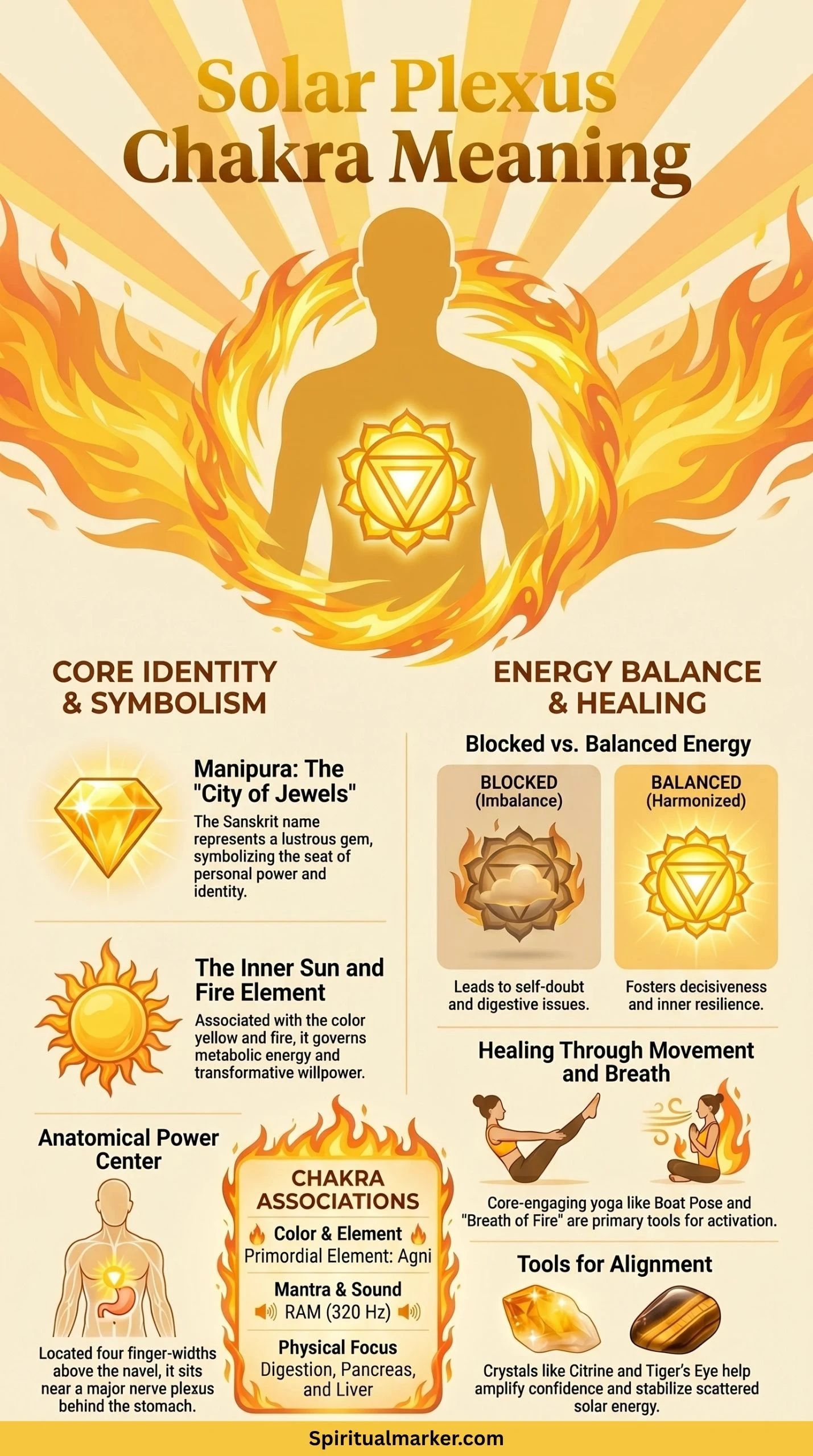
The Solar Plexus Chakra is located in the upper abdomen, roughly between the navel and the sternum, at the level of the solar plexus nerve plexus. In anatomical terms, this corresponds to the area around the celiac plexus, a dense network of nerves located behind the stomach and in front of the aorta.
More specifically, the Manipura chakra sits approximately two to three inches above the navel, at the base of the ribcage. When chakra teachers refer to the “solar plexus,” they are pointing to this intricate nerve center that governs much of the body’s digestive and autonomic activity.
This is not a random location. The solar plexus nerve network is sometimes called the “abdominal brain” because it contains more neurons than the spinal cord. It communicates directly with the brain through the vagus nerve, which is why stress, anxiety, and fear so often manifest as physical sensations in the stomach, such as “butterflies,” nausea, or a sinking feeling. These sensations are your Manipura chakra communicating with you.
In yogic anatomy, the chakra’s exact energy point (kshetram) is located at the solar plexus on the front of the body, while its deeper activation point is said to correspond to the T8-T10 vertebral region at the back. Practitioners working with breathwork and yoga often feel a radiating warmth or pulsing sensation in this region when Manipura energy is stimulated.
What Is the Solar Plexus Chakra Responsible For?
The Manipura chakra governs a wide range of physical, psychological, and spiritual functions. Its domain is everything related to self and will: who you believe you are, how much power you claim, and how effectively you act on your intentions.
On a physical level, Manipura is associated with the digestive system, including the stomach, liver, pancreas, gallbladder, small intestine, and spleen. It also influences the adrenal glands, which regulate cortisol and adrenaline, the hormones most directly tied to the stress response. When Manipura is healthy, digestion runs smoothly, metabolism is efficient, and the body manages stress with resilience.
On a psychological level, this chakra is the energy center of ego identity, not in the negative sense, but in the sense of a coherent sense of self. It answers the question: “Who am I as an individual?” It governs self-esteem, self-confidence, personal agency, and the ability to set and pursue goals. A balanced Manipura gives you the psychological backbone to say no, to take risks, and to trust your own judgment.
On a spiritual level, Manipura represents the awakening of conscious will. The lower two chakras, Muladhara and Svadhisthana, operate largely through instinct and emotion. Manipura is where conscious intention begins. It is where you stop reacting to life and start directing it.
The key responsibilities of the Solar Plexus Chakra include:
- Regulating personal power and confidence
- Governing willpower and self-discipline
- Processing identity and self-worth
- Managing the digestive system and metabolism
- Influencing decision-making and mental clarity
- Supporting the ability to establish and maintain boundaries
- Driving ambition, motivation, and goal achievement
- Transforming raw energy into purposeful action
Characteristics of the Solar Plexus Chakra
Element
The element of the Solar Plexus Chakra is Fire (Agni). This is perhaps the most defining characteristic of Manipura. Fire transforms everything it touches. It converts raw food into fuel, raw ore into metal, and raw experience into wisdom. In the same way, Manipura transforms unconscious energy into conscious power.
The fire element governs metabolism in the broadest sense, not just physical digestion, but the digestion of experiences, emotions, and information. When your inner fire burns well, you process challenges efficiently, extract meaning from difficulty, and convert setbacks into growth. When it burns too low, everything feels heavy and unprocessed. When it rages out of control, it consumes you.
Ancient Ayurvedic medicine also connects the fire element to Pitta dosha, the mind-body type characterized by intensity, ambition, and drive. People with a dominant Pitta constitution often have naturally active Manipura energy, though they must learn to modulate it so it does not become domineering.
Color
The Solar Plexus Chakra color is yellow, specifically a bright, radiant, sun-like yellow. This color is not subtle or pastel. It carries the quality of sunlight at noon, bold and energizing.
Yellow has deep psychological associations with intellect, confidence, optimism, and clarity. Studies in color psychology, including research published in the Journal of Environmental Psychology, support the idea that yellow environments stimulate mental activity and lift mood. This aligns precisely with Manipura’s domain.
When you visualize a bright yellow glow at your solar plexus during meditation, you are activating the symbolic and energetic resonance of this chakra. The yellow light represents the inner sun, the source of your personal power that never requires external validation to shine.
Symbol
The Manipura symbol is a downward-pointing triangle inside a circle surrounded by ten lotus petals. Each element carries meaning.
The ten petals represent the ten pranas, or vital energy currents, that govern different physiological and psychological functions in the body. They also correspond to ten specific negative states that Manipura must overcome, including shame, fear, jealousy, treachery, sadness, ignorance, and others described in classical Tantric texts.
The downward-pointing triangle represents fire moving downward and outward into manifestation. It symbolizes the transformation of spirit into matter, and the channeling of higher energies into concrete action and physical reality.
The circle at the center sometimes contains the seed syllable RAM in Devanagari script, which is the bija mantra of Manipura. The overall symbol communicates a complete energetic portrait: ten vital forces converging into the fire of will, radiating outward as personal power.
Mantra
The seed mantra (bija mantra) of the Solar Plexus Chakra is RAM (pronounced “rum” as in the drink). Chanting RAM is one of the most direct ways to stimulate and balance Manipura energy.
In Sanskrit vibrational science, each bija mantra carries a specific frequency that resonates with its corresponding chakra. RAM is not an acronym. It is a pure sound vibration that activates the fire element within the energy body. When you chant or tone RAM, you can often feel a warmth or vibration building in the upper abdomen, which is direct evidence of the mantra engaging Manipura.
Chanting RAM for even five to ten minutes during meditation can produce noticeable shifts in mood, confidence, and energy. Many practitioners combine RAM chanting with pranayama (breathwork) for amplified results.
Deity
Traditional Tantric texts associate the Solar Plexus Chakra with the deities Rudra and Lakini. Rudra is a fierce, transformative aspect of Shiva, representing the power to destroy what no longer serves so that growth can occur. He embodies the intense, purifying quality of Manipura fire.
Lakini is the presiding goddess of Manipura, depicted with a dark blue or black complexion, three faces, and four arms. She holds a fire weapon, a thunderbolt, and a varada mudra (gesture of blessings). She represents abundance through personal empowerment, the principle that true prosperity comes from inner strength, not external circumstance.
Sense and Body Part
The sense associated with Manipura is sight, and the corresponding organ of action is the feet and legs. Sight in this context goes beyond physical vision. It encompasses the ability to see clearly, perceive truth, and hold a clear vision for your life. When Manipura is strong, you see your path with clarity and confidence. When it is weak, confusion, indecision, and short-sightedness dominate.
Emotions, Mental Health and the Solar Plexus Chakra
The relationship between the Solar Plexus Chakra and emotional health is profound and practical. Manipura is the energetic home of your psychological identity: how you see yourself, how you believe others see you, and how much of your authentic self you allow to emerge in the world.
Self-esteem is perhaps the emotional quality most closely tied to Manipura. Research in psychology consistently shows that healthy self-esteem is not about thinking you are better than others. It is about having a stable, accurate sense of your own worth that does not fluctuate dramatically with external feedback. This is exactly what a balanced Manipura chakra provides: a solid inner foundation of self-worth that is not dependent on approval, achievement, or comparison.
Shame is the core wound of a blocked Manipura. Shame differs from guilt in a critical way. Guilt says, “I did something bad.” Shame says, “I am bad.” Psychologist Brené Brown’s extensive research on shame identifies it as the emotion most corrosive to psychological wellbeing, and energetically, shame lodges directly in the solar plexus region. Many people carry years of accumulated shame as a chronic contraction in their upper abdomen, which manifests as hunched posture, digestive issues, and an inability to assert themselves.
Anger and its healthy expression are also governed by Manipura. Anger is not inherently negative. In its healthy form, anger is a signal that a boundary has been violated or an injustice has occurred. It provides the energy to act. When Manipura is blocked, anger either becomes suppressed, turning inward as depression and self-criticism, or it becomes explosive and misdirected, turning outward as aggression and control. Balanced Manipura transforms anger into assertive, constructive action.
Anxiety and the solar plexus have a well-documented connection. The solar plexus nerve network plays a direct role in the anxiety response. When you feel anxious, this region often physically tightens or knots. Many anxiety disorders involve chronic Manipura contraction: a constant bracing against perceived threats to the self. Healing this chakra through somatic practices, breath work, and mindfulness can produce significant relief from anxiety, a claim increasingly supported by research on the gut-brain axis and vagal nerve stimulation.
Personal power and how you relate to it is a nuanced emotional territory. Some people with Manipura wounds underuse their power, constantly deferring to others, seeking permission to take up space, and minimizing their accomplishments. Others overuse their power, becoming domineering, egotistical, and dismissive of others’ needs. True Manipura balance means wielding your power with both confidence and conscience.
Signs and Symptoms of a Blocked Solar Plexus Chakra
A blocked or imbalanced Solar Plexus Chakra does not announce itself with a label. It shows up in your daily life through patterns that feel frustratingly persistent, regardless of how hard you try to change them. These patterns fall into two categories: those arising from an underactive Manipura (deficient energy) and those from an overactive Manipura (excessive energy).
Emotional and Psychological Symptoms
When the solar plexus chakra is blocked or underactive, the emotional landscape tends toward contraction, self-doubt, and powerlessness. You may find yourself struggling with chronic low self-esteem and a persistent inner critic that undermines your efforts before they begin. Decision-making feels paralyzing because you distrust your own judgment. You seek constant reassurance from others and feel devastated by criticism or rejection.
People-pleasing is a hallmark symptom. When Manipura energy is deficient, you may compromise your own needs, opinions, and boundaries to avoid conflict or gain approval. Over time, this creates a deep disconnection from your authentic self and a building resentment that has nowhere healthy to go.
Feelings of helplessness, victimhood, and powerlessness are common. Life feels like something that happens to you rather than something you actively create. You may feel easily manipulated or controlled by dominant personalities and struggle to assert yourself even in situations where you clearly have the right to do so.
Procrastination and lack of follow-through often trace back to a weakened solar plexus. The fire needed to initiate and sustain action is low, so projects stall, goals remain perpetually “someday” aspirations, and the gap between who you are and who you want to be widens.
An overactive Manipura, by contrast, produces an entirely different set of challenges. The fire burns too hot, and what emerges is an excessive need for control, a domineering communication style, and an inflated ego that struggles to acknowledge its own limitations. You may find yourself manipulating or intimidating others to get what you want, becoming aggressive when challenged, and treating personal relationships as power dynamics to be won rather than connections to be nurtured.
Perfectionism in its most punishing form can also indicate Manipura imbalance, specifically an overactive or erratically functioning chakra. The drive to be beyond reproach is often a defense against the deep fear of being exposed as inadequate. The armor of perfectionism protects the wounded core, but at enormous personal cost.
Narcissistic patterns, while complex and multifactorial, often involve significant Manipura dysregulation. The compensatory self-aggrandizement of narcissism typically coexists with a deeply wounded sense of self-worth, a Manipura that swings between grandiosity and collapse.
Physical Symptoms
The physical symptoms of a blocked Solar Plexus Chakra are primarily centered in the digestive system, metabolism, and adrenal function. Since Manipura governs the fire of digestion, energetic imbalance in this chakra very often appears as digestive dysfunction.
Common physical symptoms include chronic digestive issues such as irritable bowel syndrome (IBS), acid reflux, gastric ulcers, bloating, and poor nutrient absorption. The stomach is exquisitely sensitive to emotional states, a connection so well established in gastroenterology that it has its own research field: psychogastroenterology. Studies consistently show that psychological states like stress, anxiety, and depression significantly impact gut function, which is exactly what you would expect given Manipura’s dual governance of emotional and digestive health.
Liver and gallbladder disorders are also associated with Manipura imbalance. In both Traditional Chinese Medicine and Ayurveda, the liver is the organ most associated with unexpressed anger and the fire element. Chronic anger suppression can manifest as liver congestion, gallstones, and impaired detoxification.
Adrenal fatigue or dysregulation is another significant physical manifestation. The adrenal glands, which sit atop the kidneys but energetically connect to the Manipura region, regulate the stress hormones cortisol and adrenaline. Chronic stress, a life marked by a persistent sense of threat to the self, burns out adrenal function over time, producing symptoms like fatigue, brain fog, sleep disruption, and immune compromise.
Metabolic disorders, including weight gain or loss that seems resistant to lifestyle interventions, can also reflect Manipura imbalance, since metabolism is essentially the biological expression of the fire element. Chronic fatigue, muscle weakness, and poor core strength are additional physical signs that this chakra needs attention.
How to Support and Balance the Solar Plexus Chakra
Balancing the Solar Plexus Chakra requires a multi-layered approach that addresses the physical body, the breath, the mind, and the energy field simultaneously. There is no single technique that does everything. The most effective approach combines several practices that work together synergistically.
Breathwork (Pranayama) for Manipura Activation
Breath is the most immediate tool you have for influencing your energy system. Because Manipura governs the fire element, breath practices that generate internal heat and stimulate the abdominal region are particularly effective.
Kapalabhati Pranayama, also known as Skull Shining Breath or Breath of Fire, is the single most powerful breathing technique for the solar plexus chakra. It involves rapid, rhythmic, forceful exhalations from the abdomen, with passive inhalations. Each exhale contracts the abdominal muscles sharply, creating a pumping action that directly massages the organs of the Manipura region, stimulates the solar plexus nerve complex, and generates significant internal heat.
A study published in the International Journal of Yoga found that Kapalabhati practice significantly influenced autonomic nervous system activity and improved gastric motility, providing physiological evidence for what yogis have known for centuries. Practice 30 to 100 rounds, three to five times per day, to feel its energizing effects on Manipura.
Bhastrika Pranayama (Bellows Breath) is another fire-activating technique. It involves forceful inhalations and exhalations of equal force and duration, again using the abdominal muscles vigorously. Bhastrika increases prana (vital energy) in the solar plexus region, stimulates the digestive fire, and produces clarity and assertiveness.
Diet and Nutrition for Solar Plexus Healing
Food is also medicine for the chakras, and foods that support Manipura tend to share qualities with fire: warming, stimulating, and yellow or golden in color.
Yellow foods carry the vibrational resonance of Manipura. Bananas, yellow peppers, corn, turmeric, ginger, lemons, and sunflower seeds are all associated with this chakra. Turmeric in particular is remarkable in this context because its active compound, curcumin, has been extensively researched for its anti-inflammatory effects on the gut, the exact organ system Manipura governs.
Digestive spices such as ginger, black pepper, cumin, fennel, and coriander support the fire of digestion directly. Ayurvedic medicine recommends beginning meals with a small slice of fresh ginger with rock salt and lemon to kindle digestive fire before eating.
Probiotic-rich foods such as yogurt, kefir, sauerkraut, and kimchi support gut health, and through the gut-brain axis, they directly influence mood, confidence, and stress resilience, all Manipura qualities.
Reducing sugar and processed foods is particularly important for Manipura health. These foods weaken digestive fire over time, cause blood sugar instability (which directly impacts mood and willpower), and create gut inflammation that impairs both physical and emotional health.
Crystals for Solar Plexus Chakra Healing
Crystals work through vibrational resonance, and certain stones carry frequencies that align naturally with Manipura energy. While the scientific evidence for crystal healing remains limited, the practice has a rich history in various healing traditions and many practitioners report genuine benefits.
Citrine is considered the master crystal of Manipura. Its bright yellow-orange color mirrors the chakra’s energy, and it has long been called the “merchant’s stone” because of its traditional association with abundance, confidence, and personal power. Citrine is unusual among crystals because it does not hold negative energy and reportedly does not need cleansing.
Yellow Jasper provides steady, grounding Manipura support. Where citrine is activating, yellow jasper is stabilizing. It is particularly useful when Manipura energy feels erratic or fluctuating, and it supports patience and determination in pursuing goals.
Tiger’s Eye combines Manipura’s fire energy with the grounding quality of the earth element. It is traditionally associated with courage, clear perception, and the ability to act from a place of both strength and discernment rather than impulsiveness or fear.
Pyrite, sometimes called Fool’s Gold, resonates strongly with solar plexus energy through its metallic, sun-like appearance and its traditional association with prosperity, confidence, and protective personal power.
To use crystals for Manipura healing, place them directly on your solar plexus area during meditation or lying relaxation, carry them in your pocket or wear them as jewelry, or arrange them on your altar or workspace.
Essential Oils for the Solar Plexus Chakra
Aromatherapy offers another accessible pathway to Manipura activation. The olfactory system connects directly to the limbic brain, the emotional processing center, which means scents can shift emotional states more quickly than almost any other sensory input.
Lemon and grapefruit essential oils carry bright, uplifting citrus energy that mirrors Manipura’s vitality. Research published in Behavioural Brain Research found that lemon essential oil reliably elevated mood and reduced anxiety in animal models, with evidence suggesting similar effects in humans.
Ginger essential oil directly supports the fire element. Used topically (diluted in a carrier oil) over the solar plexus, it creates literal warmth in the region and stimulates circulation and digestive function.
Bergamot is renowned for its confidence-building and anxiety-reducing properties, making it ideal for solar plexus work targeting self-esteem and assertiveness.
Black pepper and cinnamon essential oils carry fiery, stimulating qualities that support Manipura activation, particularly for those dealing with a deficient, underactive chakra.
Solar Plexus Chakra Affirmations for Power and Confidence
Affirmations work by gradually reprogramming subconscious belief patterns that undermine your sense of power and worth. The key to effective affirmations is repetition combined with emotional engagement. When you say an affirmation while also feeling its truth in your body, even partially, the neurological impact is significantly greater.
For best results, practice these solar plexus chakra affirmations in the morning, looking at yourself in a mirror, or during meditation with your hands resting on your solar plexus:
- I am confident, powerful, and capable of achieving everything I set my mind to.
- I trust myself completely, and my inner wisdom guides me well.
- I am worthy of respect, love, and all the good life has to offer.
- My personal power grows stronger every day.
- I take responsibility for my life and create my reality with intention.
- I am not defined by my past. I am defined by who I choose to be right now.
- I act with courage even when I feel uncertain.
- Setting boundaries is a loving act, both for myself and for others.
- I trust my decisions and move forward without second-guessing myself.
- I am worthy of success, and I claim it without apology.
- My inner fire burns brightly and guides me toward my purpose.
- I release the need for external validation. My worth is intrinsic and unconditional.
- I am the author of my story, and I write it with power and intention.
- I digest life’s experiences with ease and extract wisdom from every challenge.
- Confidence is my natural state. I return to it again and again.
Repeat each affirmation slowly, pausing to feel it land in your body. Notice any resistance. That resistance is exactly where the healing work needs to happen.
Grounding Solar Plexus Chakra Meditation
This guided Manipura chakra meditation is designed to activate, cleanse, and balance the solar plexus energy center. Set aside 15 to 20 minutes in a quiet space where you will not be disturbed.
Begin by sitting in a comfortable upright position, either cross-legged on the floor or seated in a chair with your feet flat on the ground. Close your eyes. Place both hands, one on top of the other, over your upper abdomen just below your sternum. Feel the warmth of your hands beginning to permeate the tissue beneath.
Take five deep, slow breaths into your belly, allowing the abdomen to expand fully on each inhale and contract completely on each exhale. With each exhale, release any tension or holding you notice in your abdominal region.
Now bring your awareness to the space beneath your hands. Visualize a small, flickering yellow-gold flame in the center of your solar plexus. It is warm, steady, and bright. Notice its quality right now. Does it burn low and uncertain? Does it flicker erratically? Does it feel hot and pressurized? Simply observe without judgment.
Begin to breathe into the flame. With each inhale, see golden sunlight flowing in through the top of your head and down into your solar plexus, feeding the flame. With each exhale, the flame grows steadier, warmer, and more radiant. The yellow light begins to expand outward from the center of your solar plexus like a sun growing to full brightness.
Silently repeat the bija mantra RAM three times on each inhale: RAM, RAM, RAM. Feel the vibration of this sound resonating in your abdominal cavity. Continue for several rounds of breath, allowing the yellow light to fill your entire torso, then your entire body, and finally to radiate outward around you in a sphere of golden light.
In this space of warmth and light, bring to mind a situation where you feel powerless, uncertain, or afraid. Hold it gently in your awareness without being consumed by it. See it in the golden light of your Manipura flame. Notice what the warmth of your own power and worth feels like in the face of this challenge. You are not powerless. You are a radiant, powerful being with everything you need.
Gradually bring your breath back to its natural rhythm. Begin to feel the weight of your body against the seat. Wiggle your fingers and toes. Take one final deep breath into the solar plexus, hold it for three seconds, and release completely. Open your eyes slowly.
Consistency is the key. Practice this meditation daily for 21 days and observe the shifts in your confidence, decisiveness, and self-worth.
10 Solar Plexus Chakra Yoga Poses to Balance and Activate Manipura
Yoga is one of the most powerful tools for solar plexus chakra healing because it works simultaneously on the physical body, the breath, and the energy field. The poses listed below specifically target the abdominal region, core strength, and the fire element, making them ideal for Manipura activation and balance.
1. Boat Pose (Navasana)
Navasana is the quintessential solar plexus chakra pose. It requires you to balance on your sitting bones with your legs lifted and your torso leaning back, forming a V-shape with your body. Holding this position demands intense engagement of the core muscles, which directly stimulates and strengthens the Manipura region.
Beyond the physical, Boat Pose is a challenge to your willpower and self-discipline. Staying in the pose when everything in you wants to release is a powerful metaphor for holding your ground in life. Modify with bent knees if needed, but commit to the posture fully. Hold for 30 seconds to one minute, breathing steadily.
The psychological benefit of Navasana is substantial. The very act of holding yourself up, literally, while maintaining steady breath builds a visceral sense of capability and self-trust that gradually transfers into daily life.
2. Warrior III (Virabhadrasana III)
Warrior III demands balance, focus, and full-body engagement. You stand on one leg with your torso and opposite leg extended horizontally, forming a T-shape. The core fires completely to maintain balance, and the gaze is steady and forward, mirroring the Manipura quality of clear, purposeful vision.
This pose directly challenges self-confidence and concentration. Wobbling is not failure; it is the body practicing equilibrium. Each time you find your balance and hold it, you are reinforcing the neural and energetic pathways associated with inner steadiness and personal power.
Practice Warrior III with the arms extended forward for maximum core activation, or with hands at the heart for a more internal, self-affirming variation. Hold for five to eight breaths on each side.
3. Bow Pose (Dhanurasana)
Dhanurasana is a powerful heart and solar plexus opener. Lying on your stomach, you bend your knees, reach back to clasp your ankles, and lift both your chest and legs simultaneously, balancing on your abdomen. This posture creates a deep stretch across the entire front body while massaging the digestive organs against the floor.
The Bow Pose stretches the core while simultaneously opening it, which is ideal for releasing contracted, blocked energy in the Manipura region. Many practitioners report feeling an emotional release during or after this pose, as held tension in the solar plexus is physically worked free.
Breathe fully into the chest and abdomen throughout the pose. Hold for three to five breaths, release, and repeat two to three times.
4. Warrior I (Virabhadrasana I)
Warrior I embodies the Manipura qualities of strength, purpose, and forward momentum. In this posture, you step one foot back into a wide lunge, bend the front knee to 90 degrees, and raise both arms overhead, gazing forward. The posture is expansive, upright, and powerful.
Warrior I stretches the hip flexors and psoas muscles, which are notorious repositories of stress and fear. The psoas is sometimes called the “soul muscle” in somatic therapy because it is the muscle that contracts during the fetal fear response and that contracts chronically in people living in a state of ongoing stress or self-protection. Releasing the psoas through poses like Warrior I directly addresses core-level fear and powerlessness stored in the body.
Hold for five to eight breaths on each side, pressing firmly through both feet and reaching actively through the fingertips.
5. Sun Salutations (Surya Namaskar)
Sun Salutations are a moving meditation that honors the solar energy intrinsic to Manipura. The Sanskrit word Surya means “sun,” and performing Surya Namaskar in the morning is one of the oldest, most direct methods of activating solar plexus energy.
A full round of Surya Namaskar involves 12 sequential postures that move the entire body through forward folds, backbends, lunges, and planks. The dynamic, rhythmic nature of the practice builds internal heat rapidly, activating the fire element. The coordination of breath with movement trains the nervous system to remain calm and capable under exertion, which is a direct training of Manipura resilience.
Practice 6 to 12 rounds every morning, moving with intention and breath. Visualize golden light radiating from your solar plexus with each movement.
6. Plank Pose (Phalakasana)
Plank Pose is deceptively simple and profoundly powerful for Manipura activation. Holding a straight line from head to heels in a push-up position engages virtually every muscle in the body, with the deepest demand placed on the core muscles surrounding the solar plexus region.
The mental challenge of Plank Pose is as significant as the physical. When the body begins to fatigue and the mind urges you to collapse, the ability to stay and breathe is a direct exercise in willpower, one of Manipura’s core functions. Research on mental resilience training confirms that deliberately choosing to endure discomfort in a controlled setting builds the neural pathways associated with self-regulation, determination, and confidence.
Begin with 30-second holds and build gradually to two to three minutes. Keep the breath smooth and the gaze steady.
7. Chair Pose (Utkatasana)
Utkatasana means “fierce pose”, and it earns that name. You stand with feet together, bend your knees as if sitting in an invisible chair, and raise your arms overhead. The thighs burn, the core engages fully, and the breath is tested.
Chair Pose builds heat, strength, and mental toughness simultaneously. It is often described as the pose that shows you your relationship with discomfort, which is exactly the territory Manipura governs. Willingness to stay in Chair Pose when it becomes uncomfortable is a powerful practice in tolerating the heat of personal transformation.
Hold for five to ten breaths, then release into Mountain Pose. Repeat two to three times per practice.
8. Revolved Triangle Pose (Parivrtta Trikonasana)
Twisting poses are the most direct yoga tools for digestive and solar plexus health. In Revolved Triangle, you stand in a wide-legged stance, hinge forward over your front leg, and twist to bring the opposite hand to the floor or a block while extending the top arm skyward.
The twisting action wrings and compresses the digestive organs, stimulating circulation, improving peristalsis, and releasing stagnation in the liver, spleen, and pancreas. All of these are organs directly governed by Manipura.
On an energetic level, twisting poses are said to wring out stagnant or blocked energy from the solar plexus region, much like wringing water from a cloth. After releasing the twist, fresh prana floods back in. Hold for five breaths on each side, breathing deeply into the compression.
9. Fire Log Pose (Agnistambhasana)
Agnistambhasana translates to “fire log” or “double pigeon”. The name itself reflects the fiery quality of Manipura. You stack your shins horizontally, one on top of the other, creating a stable base and opening the hips deeply.
While this is primarily a hip opener, the Agni (fire) in the name points to its connection with solar plexus energy. Hip-opening postures release stored emotional energy from the lower body, which then becomes available for Manipura to transmute into conscious power. Many practitioners experience strong emotional releases in this pose, particularly around themes of control, trust, and personal authority.
Breathe deeply and consciously for ten breaths per side. Use props generously.
10. Corpse Pose with Solar Plexus Focus (Savasana)
Savasana is never merely rest. In the context of solar plexus chakra practice, it is the essential integration period where everything you have activated, released, and cultivated during your practice settles into the tissues and energy body.
Lie flat on your back with your arms slightly away from your body and your feet hip-width apart. Place one hand on your solar plexus. Close your eyes and bring your full attention to the warmth radiating from beneath your palm. Visualize the yellow light of Manipura glowing steadily, like the sun at the center of your being.
Allow yourself to fully receive the fruits of your practice. Feel yourself as capable, powerful, and worthy, not because of what you did, but because of what you are. Stay for at least five minutes. This is where transformation is integrated.
Reconnecting with the Sun and the Fire Element
One of the most direct, natural, and scientifically supported methods for activating solar plexus chakra energy is intentional sun exposure. The sun is the macro-cosmic equivalent of Manipura. It radiates without apology, gives without depletion, and sustains life with its fire. Consciously connecting with solar energy is a form of sympathetic resonance that directly activates the inner fire of Manipura.
Solar gazing at sunrise or sunset, when the UV index is low, is a practice found in multiple ancient cultures. The Inca practice of Inti worship, the Egyptian reverence of Ra, and the Vedic tradition of Surya namaskara all recognize the sacred, life-giving power of the sun and its direct connection to personal vitality and spiritual awakening.
Even simpler than solar gazing, spending 20 to 30 minutes in morning sunlight without screens or distractions produces measurable benefits. The morning light calibrates your circadian rhythm, boosts serotonin production, stimulates vitamin D synthesis, and regulates cortisol, all of which directly support the adrenal and digestive functions governed by Manipura. Neuroscientist Andrew Huberman of Stanford University has extensively documented these mechanisms in his research on light, cortisol rhythms, and mental health.
Fire rituals offer another powerful reconnection with the fire element. Sitting before a fire, candle gazing (Trataka), or even cooking over an open flame are all practices that bring your awareness into direct relationship with the transformative power of Agni. In Trataka practice, you gaze steadily at a candle flame, which simultaneously strengthens visual focus (the Manipura sense) and builds concentration and mental willpower (core Manipura capacities).
Spending time in desert landscapes or other sun-drenched environments carries a natural Manipura-activating quality. The spare, bright, fiery quality of these environments resonates with the solar plexus frequency and has been noted by many practitioners to produce spontaneous increases in confidence, clarity, and purposefulness.
The Solar Plexus Chakra and Personal Power in Relationships
Manipura plays an often-underestimated role in relationship health. Many relationship dynamics, particularly patterns of codependency, people-pleasing, boundary-setting difficulties, and power imbalances, have their roots in solar plexus imbalance.
When Manipura is wounded, you may attract or tolerate relationships that diminish your sense of self, either because you subconsciously believe you do not deserve better or because you have not yet developed the energetic backbone to hold your ground. The Manipura wound says: “If I assert myself, I will lose love. If I take up space, I will be rejected.” This belief keeps people in relationships that slowly erode their sense of self.
Healthy Manipura energy in relationships looks like: clear, kind communication of needs and limits; the ability to disagree without dissolving; the confidence to leave situations that consistently undermine your dignity; and the self-possession to remain rooted in your own identity even in the midst of deep intimacy.
Healing Manipura is therefore not a solitary practice. It is fundamentally a relational practice: learning to bring your full, empowered self into connection with others, neither dominating nor shrinking, but meeting other people as your truest equal.
Final Thoughts
The Solar Plexus Chakra is the energetic center of your life’s authorship. When Manipura is healthy and open, you are not waiting for someone to give you permission to live fully. You are not shrinking to make others comfortable. You are not burning others to make yourself feel powerful. You are doing something far more compelling: you are showing up as the full, radiant, capable person you actually are.
The work of healing Manipura is deeply personal and often challenging. Shame is a stubborn guest. Self-doubt has often been a companion for years. The inner critic does not quiet easily. But every breath practice, every yoga session, every honest affirmation, and every moment of choosing your own clarity over someone else’s comfort is a vote for your own inner fire.
The Sanskrit meaning of Manipura is “City of Gems”, which is exactly what lives inside you when this chakra is fully alive: not one gem, but an entire city of them. Strength, clarity, purpose, courage, and warmth.
Start with one practice from this guide today. Not tomorrow, not when you feel ready. Now is the right moment to begin tending your inner fire.
References
- https://www.7chakracolors.com/chakra/solar-plexus/
- https://blog.mindvalley.com/solar-plexus-chakra/
- https://myyogateacher.com/articles/manipura-solar-plexus-chakra
- https://www.artofliving.org/us-en/meditation/chakras/solar-plexus-chakra-third
- https://www.yogapedia.com/definition/5522/solar-plexus-chakra
- https://www.centreofexcellence.com/understanding-and-healing-the-solar-plexus-chakra/
- https://healing-sounds.com/blogs/chakras/solar-plexus-chakra-meaning-location-importance