
Green jade is a stone of harmony and growth. Its rich, verdant color evokes nature and renewal. In spiritual practice, this stone carries balancing and healing energy.
The green jade meaning often involves prosperity, harmony, and emotional healing. It is a stone of the heart chakra, helping to attract love and abundance. A spiritual meaning of white jade shares that jade focus, though white carries a more purifying energy.
Green jade is used in crystal healing to attract luck, soothe emotions, and support physical healing. It can also symbolize wisdom and tranquility. The stone's energy is gentle and steady.
If you feel drawn to green jade, it may signal a need for balance. A spiritual meaning of green aventurine also deals with green stones, though aventurine carries a more luck-oriented energy.
Key Takeaways
- Green jade symbolizes harmony, wisdom, abundance, protection, and long life across cultures worldwide.
- Many spiritual traditions link jade with the heart chakra and the third eye chakra, supporting emotional and intuitive balance.
- People use green jade for emotional grounding, prosperity rituals, dream work, meditation, and ancestral healing.
- Jade exists as two distinct minerals: nephrite and jadeite. Both carry spiritual significance, but jadeite is rarer and typically more prized.
- Wearing green jade as jewelry, particularly close to the skin or heart, is believed to strengthen emotional resilience and energetic protection over time.
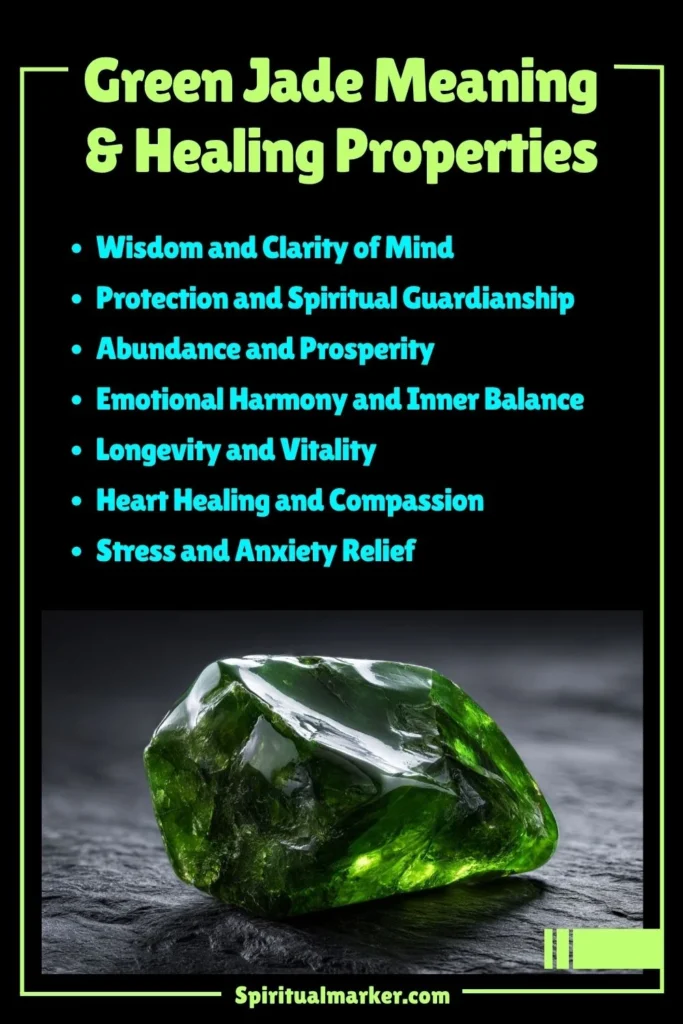
What Is Green Jade?
Green jade is an ancient gemstone with a rich, complex identity. Most people picture a smooth, waxy green stone when they think of jade. That image is accurate, but the full story is more layered. Jade actually refers to two entirely different minerals: nephrite and jadeite. Both are called jade, both appear green, and both carry deep spiritual reputations. However, they differ significantly in composition, origin, and rarity.
Nephrite is the more common of the two. It forms from calcium, magnesium, and iron silicates. Its texture is famously tough, denser than most gemstones. Nephrite jade was the primary jade used in ancient China, New Zealand, and parts of Europe. Its colors range from creamy white to deep forest green depending on iron content.
Jadeite is rarer and considered the more precious variety by most gemologists today. It forms from sodium and aluminum silicates and produces the vivid, almost luminous greens that people often associate with high-quality jade. Myanmar (formerly Burma) remains the world’s primary source of top-grade jadeite.
Both types share a reputation for emotional grounding, protection, and spiritual wisdom. In spiritual communities, the distinction between the two matters less than the stone’s energy, which both varieties carry in abundance.
Green jade often gets compared to other green stones such as green aventurine, green opal, or malachite. However, jade’s texture, density, and energetic character set it apart. It feels more substantial, both physically and symbolically. Where green opal feels emotionally fluid and tender, green jade feels steady, enduring, and deeply wise.
Origins and Formation
Green jade forms deep within the earth under specific geological conditions. Nephrite develops through metamorphic processes, where heat and pressure transform existing minerals over millions of years. Jadeite forms at high pressures in subduction zones, where tectonic plates collide and push material deep into the earth before it rises again slowly over geological time.
This lengthy, pressure-driven formation process contributes directly to jade’s spiritual symbolism. Many traditions associate jade with patience, endurance, and wisdom earned through difficulty. A stone that takes millions of years to form naturally reflects themes of resilience and long-term growth.
Key jade-producing regions include:
- Myanmar (Burma): The world’s leading source of imperial green jadeite
- China: Historically the most culturally significant jade region; primarily nephrite from Xinjiang and Hetian
- Guatemala: Ancient Mesoamerican source used by Maya and Olmec cultures
- New Zealand: Home of pounamu (Maori greenstone), a culturally sacred nephrite variety
- Russia and Canada: Important nephrite deposits in British Columbia and Siberia
- Kazakhstan and South Korea: Additional nephrite sources with cultural significance
Each region produces jade with slightly different visual character. Hetian jade from China tends toward creamy, pale greens and whites. Imperial jade from Myanmar displays that striking, vivid emerald green that commands the highest prices in international markets. Guatemalan jade carries a darker, more intense green linked to ancient Mesoamerican ceremony.
Key Properties
| Property | Details |
|---|---|
| Primary Meaning | Harmony, wisdom, protection, abundance |
| Mineral Type | Nephrite or Jadeite |
| Chakra Association | Heart chakra, Third Eye chakra |
| Main Spiritual Symbolism | Longevity, prosperity, emotional balance, protection |
| Common Colors | Emerald green, pale green, white-green, dark forest green |
| Hardness | Nephrite: 6 to 6.5 Mohs / Jadeite: 6.5 to 7 Mohs |
| Main Sources | Myanmar, China, Guatemala, New Zealand, Canada |
| Emotional Associations | Calm strength, wisdom, trust, emotional courage |
| Popular Jewelry Types | Bangles, pendants, rings, carvings |
| Spiritual Uses | Meditation, protection rituals, prosperity work, dream healing |
| Care Needs | Gentle cleaning, avoid harsh chemicals and extreme heat |
Historical Use of Green Jade
Few gemstones carry a historical record as deep and widespread as green jade. Its cultural significance spans at least 7,000 years across multiple continents. No other stone has held such consistent sacred status across completely unconnected civilizations.
Ancient China
In Chinese civilization, jade held a position of cultural supremacy that gold never fully achieved. Ancient Chinese philosophers called jade the “Stone of Heaven.” Confucius identified eleven virtues represented by jade, including wisdom, courage, modesty, and moral integrity. These virtues were not merely symbolic. They reflected a deep cultural belief that jade embodied the highest human qualities.
Chinese emperors wore jade seals. The deceased were buried with jade suits crafted from hundreds of carefully cut jade pieces sewn together with gold wire. Ancient physicians prescribed powdered jade as medicine for healing the body and extending life. Jade bi discs and cong ritual objects appeared in sacred ceremonies for thousands of years.
The phrase “gold is valuable, but jade is priceless” reflects how deeply embedded jade was in Chinese cultural life.
Mesoamerican Civilizations
On the opposite side of the world, the Maya, Olmec, and Aztec civilizations developed an equally intense reverence for jade. To these cultures, jade represented life, death, water, maize, and divine authority. Kings and priests wore jade jewelry and headdresses. Jade masks covered the faces of rulers in burial tombs. The most famous example, the jade burial mask of Pakal the Great at Palenque, remains one of the most recognized archaeological treasures in the world.
For the Maya, green jade’s color linked directly to maize and water, the two foundations of life in Mesoamerican culture. Jade did not simply symbolize wealth. It symbolized existence itself.
New Zealand and Polynesia
The Maori people of New Zealand developed a unique relationship with pounamu, their sacred nephrite greenstone. Jade tools, weapons, and ornaments were among the most treasured objects in Maori culture. The famous hei-tiki pendantcrafted from pounamu carried ancestral spiritual power. It was passed between generations and gained spiritual strength with each owner, becoming more meaningful over time rather than less.
Maori tradition held that pounamu pieces carried wairua, a spiritual essence or life force. These pieces were never simply decorative objects. They were living spiritual companions.
Ancient Europe and Western Asia
Neolithic Europeans used jade axes and tools long before understanding its spiritual symbolism fully. Archaeological sites across Switzerland, France, and Poland have produced polished jade axe heads that appear far too refined for practical use. Many researchers believe these were ritual or ceremonial objects rather than everyday tools.
In ancient Mesoamerican and Asian traditions, jade was independently believed to protect the wearer from illness, evil spirits, and emotional harm. The fact that cultures with no contact with each other reached similar spiritual conclusions about jade says something meaningful about the stone’s nature.
5 Spiritual Meanings of Green Jade
1. Wisdom and Clarity of Mind
Green jade has been synonymous with wisdom in Eastern spiritual traditions for millennia. This is not abstract symbolism. Ancient Chinese scholars, philosophers, and spiritual leaders actively wore jade as a symbol of their commitment to clear thinking, ethical behavior, and thoughtful judgment.
Confucian philosophy described jade as representing wisdom because it was thought to reflect the qualities that true wisdom produces: patience, transparency, smooth edges rather than harsh ones, and lasting value. A wise person, like jade, does not shout or demand attention. Wisdom in this tradition is quiet, enduring, and deeply grounded.
Spiritually, many practitioners today believe green jade supports mental clarity during confusion. When decisions feel overwhelming, when anxiety clouds judgment, or when emotional noise makes clear thinking difficult, jade is often used as a grounding companion. Its dense, calming energy is believed to slow mental overactivity without dulling awareness.
This connection to wisdom also involves honest self-reflection. Wisdom begins with knowing yourself accurately rather than ideally. Green jade spiritually encourages clear self-perception, not self-criticism, but honest awareness of patterns, strengths, fears, and growth edges. Many meditation practitioners keep jade nearby during journaling or reflective practices because they believe it supports honest introspection without emotional harshness.
The stone’s association with long life reinforces its wisdom symbolism. Wisdom in most spiritual traditions is not something young or hurried. It accumulates through experience, reflection, and patient observation. Green jade reflects this understanding beautifully.
2. Protection and Spiritual Guardianship
Across every major jade-using culture, protection emerged as one of jade’s core spiritual functions. The Chinese gave jade carvings to infants to guard against evil spirits. Mesoamerican rulers wore jade into battle and ceremony as divine protection. Maori warriors carried pounamu pendants as spiritual armor.
This universal protective symbolism is remarkable because these cultures developed it independently. No single cultural transmission explains why jade became a protective stone on every continent where it appeared. Many spiritual practitioners see this cross-cultural convergence as meaningful evidence of jade’s genuine energetic character.
In modern spiritual practice, green jade is frequently used for energetic shielding. People carry it to protect emotional boundaries, especially in high-stress environments, difficult relationships, or emotionally draining work situations. Unlike some protective stones that feel heavy or intense, jade’s protection feels steady and calm rather than defensive or aggressive.
Green jade is also associated with spiritual guardianship during sleep and dreams. Ancient Chinese tradition placed jade near sleeping areas to protect the mind during dreaming. Some modern practitioners continue this practice, keeping jade near their beds to encourage protective and healing dreams while reducing nightmares or emotional disturbances during sleep.
Many people also believe jade protects against self-deception, which may be the most subtle and significant form of protection it offers. A stone connected with clarity and wisdom naturally guards against the stories people tell themselves to avoid facing difficult truths.
3. Abundance and Prosperity
Few stones carry a stronger association with prosperity and abundance than green jade. In Chinese tradition, jade was so deeply connected to wealth and good fortune that carved jade figures of the laughing Buddha, money frogs, and koi fishbecame standard symbols in businesses and homes for attracting prosperity.
This connection to abundance extends beyond financial wealth. Jade’s prosperity symbolism includes emotional richness, relational depth, physical vitality, creative flourishing, and spiritual growth. It reflects abundance in the broadest possible sense, the fullness of a life well-lived rather than simply material accumulation.
Feng shui tradition places particular emphasis on jade for attracting good fortune, positive energy, and long-term growth. A jade plant or carved jade piece near the entrance of a home or workspace is believed to welcome beneficial energy and create an atmosphere of growing abundance.
Spiritually, this abundance symbolism connects to jade’s wisdom associations. True prosperity in many spiritual frameworks requires discernment. Knowing what to pursue, what to release, and what genuinely nourishes a good life demands the kind of wisdom jade represents. In this way, jade does not simply attract external wealth. It is believed to help develop the inner qualities that create and sustain genuine abundance.
Many practitioners use green jade during intention-setting rituals, new moon ceremonies, or prosperity meditations. They hold the stone while focusing on specific intentions related to growth, both inner and outer. The stone is viewed as a grounding anchor for those intentions rather than a magic solution.
4. Emotional Harmony and Inner Balance
Emotional balance runs through nearly every cultural tradition that valued jade deeply. The stone’s calm green color, its dense but smooth texture, and its long history of heart-centered use all contribute to its reputation as a deeply harmonizing stone.
In Chinese medicine and spiritual philosophy, health was understood as harmony between opposing forces. Too much of any energy, whether physical, emotional, or spiritual, created imbalance and suffering. Jade was used to restore this balance, calming excess emotional reactivity while strengthening emotional resilience in those who felt depleted.
Modern crystal traditions connect green jade with the heart chakra, the energy center associated with love, emotional trust, forgiveness, and relational health. Many practitioners believe jade helps people move from emotional reactivity toward emotional wisdom. This transition involves feeling emotions fully without being controlled by them.
Jade’s emotional harmony symbolism is particularly meaningful for people who experience emotional extremes. Those prone to intense emotional swings, difficulty regulating anger or anxiety, or patterns of emotional shutdown may feel drawn to jade’s steadying energy. Its symbolism encourages neither emotional suppression nor emotional chaos. It represents the calmer, wiser middle ground.
This harmony also extends to relationships. Jade is frequently used during periods of relational tension, family conflict, or partnership challenges. Its symbolism of patience, compassion, and long-term perspective encourages people to approach relational difficulties with greater emotional maturity rather than defensiveness.
5. Longevity and Vitality
Ancient cultures did not separate physical health from spiritual health. They understood that vitality, longevity, and life force were connected to spiritual harmony and emotional balance. Jade’s association with long life reflects this integrated understanding.
In ancient China, jade was genuinely believed to preserve the body after death, which explains the extraordinary jade burial suits created for emperors. Living rulers wore jade daily because they believed it sustained physical vitality, protected internal organs, and drew life force into the wearer. Ancient pharmacological texts prescribed jade-infused tonics for strengthening the body.
While modern medicine does not support these specific claims, the symbolism remains spiritually powerful. Green jade represents the will to live fully and vigorously. It connects with themes of physical renewal, bodily care, and the conscious choice to pursue a long, meaningful life.
This vitality symbolism also appears in jade’s connection to nature and seasonal renewal. Green, the color of growing plants, living forests, and spring renewal, naturally evokes the feeling of life continuing and replenishing itself. Many practitioners associate jade with natural rhythms of growth, encouraging people to align their personal healing with nature’s slower, more sustainable pace.
6 Healing Properties of Green Jade
1. Emotional Grounding
Green jade is widely valued for its grounding quality in emotional healing traditions. Unlike stones associated with heightened spiritual states or intense emotional release, jade tends to bring people back into themselves, gently and steadily.
Many people carry emotional anxiety that creates a sense of floating disconnection. The mind races forward into worry about the future or backward into regret about the past. Jade’s dense, physical presence is believed to anchor emotional attention back to the present moment. Crystal practitioners often recommend holding jade during anxious periods precisely because its weight and texture provide tactile grounding alongside its energetic symbolism.
Emotional grounding with jade is also connected to self-trust. Anxiety frequently erodes confidence in one’s own perceptions and judgment. A stone associated with wisdom naturally becomes a companion for rebuilding that self-trust. Many people describe feeling more emotionally steady when jade is nearby, not because the stone solves external problems, but because it supports a calmer internal state from which to face those problems.
This grounding quality makes jade particularly helpful during life transitions. Career changes, relationship endings, geographic moves, grief, and personal reinvention all involve periods of emotional disorientation. Green jade spiritually represents the steady ground beneath those changes, the part of a person that remains fundamentally stable even when external life shifts dramatically.
2. Stress and Anxiety Relief
Green jade’s reputation as a calming stone extends directly into stress relief and anxiety reduction. Its energy is consistently described as peaceful, unhurried, and emotionally cooling. In environments of high pressure, constant urgency, and relentless demands, jade represents a different energetic rhythm entirely.
Stress accumulates through sustained emotional and physical tension that rarely gets fully released. Modern life creates conditions where the nervous system stays in heightened alert states for prolonged periods. Crystal healing traditions suggest that objects with calming symbolic resonance, used consistently during mindfulness practices, can support the nervous system’s natural recovery processes.
Many practitioners place jade in work environments to counteract the agitated energy that often accumulates in high-demand spaces. Others wear jade bangles or rings throughout demanding days as a tactile reminder to breathe, slow down, and reconnect with emotional equilibrium.
Green jade’s connection to nature amplifies its anxiety-relieving symbolism. Research consistently shows that time in natural environments reduces cortisol levels and lowers psychological stress. Jade, with its deep green tones and associations with forests, rivers, and living landscapes, carries this natural calm symbolically into environments where nature itself is absent.
Jade is also associated with reducing excessive mental activity. Overthinking, rumination, and catastrophic thinking patterns are common features of anxiety. Jade’s wisdom symbolism naturally counters these tendencies. A stone associated with patient, clear-eyed wisdom encourages the mind toward measured observation rather than anxious speculation.
3. Physical Vitality and Wellness Support
Ancient healing traditions across China and Mesoamerica attributed direct physical healing properties to green jade. Chinese traditional medicine associated jade with kidney health, specifically, and general organ vitality, broadly. Healers used jade rollers on the face and body, a practice that has recently experienced a strong revival in modern wellness culture.
Contemporary jade rollers and gua sha tools are used widely today for lymphatic drainage, facial tension relief, and skin circulation support. While their physical benefits are supported more by massage mechanics than by the stone’s mineral properties, many users also value them for their symbolic and energetic significance.
Jade’s association with longevity reinforces its connection to physical wellness. A stone that symbolizes sustained, vibrant life naturally becomes a companion for people pursuing health, recovery, or vitality. Many people use jade during recovery periods from illness, injury, or exhaustion, viewing it as a grounding, encouraging presence rather than a medical treatment.
It is important to note clearly: jade is not a medical treatment. Anyone dealing with health concerns should work with qualified medical professionals. Crystal healing traditions represent spiritual and emotional support systems, not substitutes for medical care.
4. Heart Healing and Compassion
Green jade’s connection to the heart chakra positions it firmly within emotional healing work focused on love, forgiveness, and compassion. Heart healing is rarely simple or quick. It involves releasing deeply held pain, rebuilding emotional trust, and slowly reopening to vulnerability after being hurt.
Jade’s particular strength in this area comes from its symbolic patience. It does not represent explosive emotional releaseor dramatic healing breakthroughs. It represents the steady, daily work of becoming emotionally softer and more open over time. For many people, this slower symbolism feels more honest and more sustainable than promises of instant healing.
Forgiveness practices in many spiritual traditions involve jade because the stone’s long cultural history with wisdom and emotional balance supports the complex emotional work forgiveness requires. Forgiving another person, or oneself, rarely happens in a single moment. It usually develops through repeated emotional decisions made over extended periods. Jade’s steady, patient energy reflects this reality.
Compassion, both self-compassion and compassion for others, forms a central part of jade’s heart healing symbolism. Many people who feel emotionally wounded develop harsh internal dialogue as a secondary effect of that pain. Jade spiritually encourages softening that inner harshness while building the emotional courage needed to remain open to connection after experiencing hurt.
5. Prosperity and Abundance Activation
Green jade’s ancient association with wealth and good fortune makes it one of the most commonly used stones in prosperity and abundance work. Many spiritual practitioners use jade during intention rituals, goal-setting sessions, and abundance meditations focused on both material and non-material growth.
The key to understanding jade’s prosperity properties lies in its wisdom connection. Jade does not simply attract wealth through magical means in traditional frameworks. Instead, it is believed to support the clarity, patience, and disciplined judgment that create sustainable prosperity. It encourages thoughtful decisions over impulsive ones. It supports long-term thinking over short-term emotional reactivity.
In feng shui practice, green jade is placed strategically in wealth corners, business entrances, and workspaces to attract beneficial energy and support financial growth. Many business owners in Chinese cultural traditions keep jade carvings, particularly of the laughing Buddha, turtles, or koi fish, as prosperity symbols.
Even outside these specific cultural traditions, jade’s symbolism resonates with abundance work because it represents fullness rather than lack. A stone associated with long life, deep wisdom, and natural vitality naturally connects with the feeling of a life lived abundantly across every dimension, not just financially.
6. Dream Work and Intuitive Healing
Green jade’s protective and wisdom-associated properties have made it a traditional companion for dream work and intuitive development. Ancient Chinese tradition placed jade near sleeping areas specifically to support healing dreams, protect against nightmares, and strengthen the mind’s natural intuitive capacities during sleep.
Modern practitioners continue this tradition. Many people place jade under their pillows or on their bedside tables during periods when they seek clarity about important life decisions, emotional healing during sleep, or stronger dream recall. Some report more vivid, meaningful dreams when sleeping near jade, though individual experiences vary widely.
This connection to intuition aligns naturally with jade’s wisdom symbolism. Intuition, understood spiritually, is not random guessing. It is the accumulated wisdom of deep experience speaking through felt sense rather than logical analysis. A stone associated with wisdom naturally supports this quieter, more internal form of knowing.
Third eye chakra associations are also connected to jade’s intuitive properties. While the heart chakra remains the primary chakra linked to green jade, many practitioners also use it for third eye activation work related to clarity, foresight, and intuitive perception. Holding jade during meditation focused on these qualities is a common practice among crystal healers working with intuitive development.
How to Wear Green Jade Jewelry for Spiritual Growth
Green jade jewelry has been worn for spiritual purposes longer than almost any other gemstone in human history. The specific way you wear jade can reflect and reinforce different spiritual intentions.
Bangles and bracelets remain the most traditional jade jewelry form across East Asian cultures. Jade bangles are worn on the left wrist, traditionally the receiving side of the body in Chinese energetic tradition. The left wrist is believed to draw jade’s protective and beneficial energy inward, allowing the stone’s properties to integrate more deeply.
Pendants and necklaces work particularly well for heart chakra focused intentions. Wearing jade close to the chest, near the heart center, aligns the stone’s emotional healing energy with your emotional center. Many people wear jade pendants during grief recovery, relationship healing, or periods of emotional vulnerability.
Jade rings carry symbolic significance related to commitment and intention. Wearing jade on the ring finger of either hand can represent a commitment to your own healing, growth, or wisdom development. In various Asian traditions, specific fingers carry specific energetic associations, and jade rings were chosen accordingly.
Some spiritual practitioners combine jade with complementary stones for layered energetic support. Rose quartz amplifies themes of love and self-compassion alongside jade’s wisdom energy. Amethyst adds intuitive depth and calm spiritual clarity. Clear quartz is believed to amplify any stone’s energy when paired with it. Black tourmaline complements jade’s protective properties with grounding, boundary-protective energy.
The most important element of wearing jade for spiritual growth is intentionality. Putting jade on with conscious awareness of what you are inviting into your life strengthens its symbolic resonance. Whether you meditate while wearing it, set an intention when you put it on each morning, or simply choose it as a daily grounding companion, conscious engagement deepens the experience.
Caring for Green Jade Jewelry
Green jade is a relatively durable stone compared to many crystals. Both nephrite and jadeite score between 6 and 7 on the Mohs hardness scale, making them harder than many commonly used gemstones. However, durability does not mean invulnerability. Proper care preserves both jade’s physical beauty and its energetic vitality.
Cleaning green jade is straightforward. Warm water, mild soap, and a soft cloth are all you need. Gently wipe the surface, rinse thoroughly, and dry completely before storing. Avoid ultrasonic cleaners, steam cleaning equipment, and harsh chemical cleaners. These can damage jade’s surface or compromise the integrity of settings in jade jewelry.
Storage matters more than many people realize. Jade can be scratched by harder stones such as sapphire, ruby, or topaz if stored together carelessly. Keep jade pieces in separate soft fabric pouches or padded compartments in your jewelry box. Jadeite in particular deserves careful handling because many high-quality jadeite pieces are “A-grade,” meaning they carry no artificial treatments and their beauty is entirely natural.
Be aware that much commercially sold jade is treated. B-grade jade has been bleached and polymer-impregnated to improve color and clarity. C-grade jade has been artificially dyed. These treatments affect both the stone’s value and its energetic character in many practitioners’ views. When sourcing jade for spiritual use, purchasing from reputable dealers who specify treatment status is worthwhile.
Energetic cleansing practices for jade vary among spiritual traditions. Common methods include:
- Moonlight exposure: Placing jade near a window under moonlight overnight, particularly during full moon phases
- Sound cleansing: Using singing bowls, bells, or tuning forks near the stone to clear accumulated energy
- Earthing: Briefly placing jade directly on soil or near living plants to reconnect its energy with nature
- Sage or palo santo smoke: Passing jade through cleansing smoke for purification purposes
- Running water: Briefly holding jade under cool running water while setting a cleansing intention (suitable for jade specifically because of its relative hardness and non-porous surface)
Unlike more delicate stones such as selenite or malachite, jade handles water contact without damage, which makes water-based cleansing accessible for regular use.
Green Jade Meaning at a Glance
| Aspect | Details |
|---|---|
| Primary Meaning | Wisdom, harmony, protection, abundance |
| Mineral Type | Nephrite or Jadeite |
| Chakra Association | Heart chakra, Third Eye chakra |
| Main Spiritual Symbolism | Longevity, prosperity, emotional balance, guardianship |
| Common Colors | Emerald green, pale green, forest green, white-green |
| Hardness | 6 to 7 Mohs (varies by type) |
| Main Sources | Myanmar, China, New Zealand, Guatemala, Canada |
| Emotional Associations | Calm strength, emotional wisdom, trust, resilience |
| Popular Jewelry Types | Bangles, pendants, rings, carved figures |
| Spiritual Uses | Meditation, dream work, prosperity rituals, protection, grounding |
| Care Needs | Gentle cleaning with mild soap; store separately; avoid harsh chemicals |
A Final Reflection
Green jade is not a passing trend in crystal culture. It is one of humanity’s oldest spiritual companions, honored across civilizations that never communicated with each other yet arrived at remarkably similar conclusions. That convergence speaks to something real about this stone’s character.
Its meaning centers on wisdom, protection, emotional harmony, abundance, and the long, steady work of becoming more fully yourself. These are not simple or superficial themes. They reflect the deepest concerns of human experience across every culture and every era.
If you are drawn to green jade, that attraction is worth following. Some people feel immediately moved by its calm weight and rich green depth. Others gradually build a relationship with it through daily wearing or meditation. A few simply appreciate it as a beautiful object with extraordinary historical significance.
You might consider starting with a simple piece of jade jewelry, perhaps a pendant worn near your heart or a smooth palm stone kept in your pocket during demanding days. Notice what shifts, however subtly, in your emotional tone or sense of groundedness over time. Jade rarely announces itself dramatically. It works the way wisdom always works: quietly, patiently, and over time.