
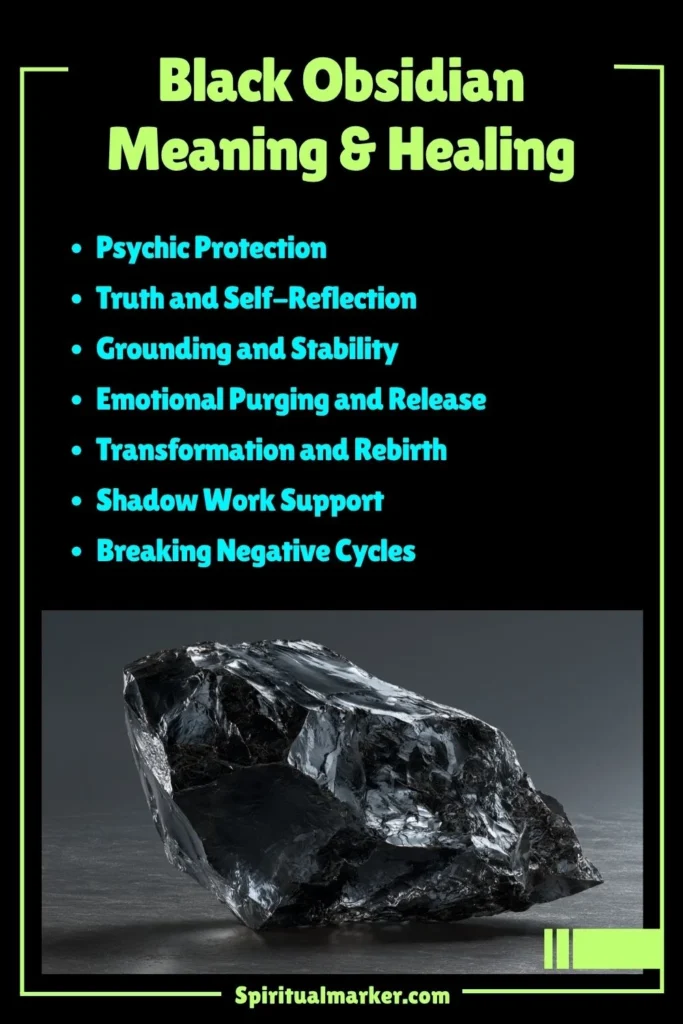
Black obsidian is a stone of truth and protection. Its glossy black surface reflects light like a mirror. In spiritual practice, this stone carries powerful and grounding energy.
The black obsidian meaning often involves protection, truth, and emotional healing. It is a stone of the root chakra, helping to dispel negativity and reveal hidden truths. A spiritual meaning of black tourmaline shares that black-stone focus, though tourmaline carries a more electric energy.
Black obsidian is used in crystal healing to ward off negativity, release emotional blockages, and support grounding. It can also symbolize resilience and transformation. The stone's energy is protective and reflective.
If you feel drawn to black obsidian, it may signal a need for truth. A spiritual meaning of black onyx also deals with black stones, though onyx carries a more grounding energy.
Key Takeaways
- Black obsidian symbolizes protection, truth, grounding, and powerful emotional transformation.
- Ancient civilizations used obsidian for weapons, mirrors, and ceremonial spiritual practices for thousands of years.
- Black obsidian connects primarily with the root chakra, supporting stability, safety, and energetic grounding.
- Many spiritual practitioners use black obsidian for shadow work, releasing negative patterns, and emotional purging.
- Wearing or carrying black obsidian may support emotional honesty, psychic protection, and inner strength during difficult life transitions.
What Is Black Obsidian?
Black obsidian is a naturally occurring volcanic glass. It forms when molten lava cools so rapidly that mineral crystals do not have time to develop. The result is a smooth, glassy, naturally black stone with a mirror-like surface and razor-sharp edges when broken.
Unlike most gemstones, obsidian is not a mineral. It is amorphous volcanic glass. Its chemical composition is primarily silicon dioxide, similar to quartz, but its rapid formation process gives it an entirely different structure and energy. Because of this, many people describe black obsidian as carrying raw, unfiltered natural power rather than the steady crystalline energy of minerals like quartz or amethyst.
The stone’s deep black color comes from the presence of iron and magnesium within the volcanic material. Some varieties contain small inclusions of different minerals that create unique visual effects. Rainbow obsidian shows iridescent color bands. Snowflake obsidian contains white cristobalite crystals. Mahogany obsidian shows reddish-brown streaks. However, classic black obsidian remains the most recognized and spiritually significant variety.
Its surface can be polished to an extraordinary mirror-like finish. Ancient peoples used this quality deliberately. Polished obsidian literally functioned as a mirror in cultures that lacked metal or glass technology. That reflective quality made it deeply symbolic across multiple civilizations.
Origins and Formation
Black obsidian forms in areas with volcanic activity. When silica-rich lava flows quickly and cools rapidly on contact with water or air, the result is volcanic glass rather than crystalline rock. This process happens suddenly, which makes obsidian symbolically connected with rapid change, powerful energy, and sudden transformation.
Major obsidian deposits exist in volcanic regions across the world. The United States, particularly Oregon, California, New Mexico, and Idaho, contains significant obsidian deposits. Other important sources include Mexico, Armenia, Italy, Greece, Japan, Iceland, Kenya, and New Zealand. Historically, the ancient Aztec and Mayan civilizations used Mexican obsidian extensively for ceremonial blades, mirrors, and ritual objects.
The volcanic origins of black obsidian are inseparable from its spiritual identity. Fire is central to transformation. Cultures that worked with obsidian recognized this instinctively. Stone born from volcanic fire carries a different energetic character than stone formed slowly beneath the earth over millions of years. Obsidian arrives in the world through intensity, pressure, and rapid change. Its spiritual symbolism reflects exactly that.
Because obsidian cools so quickly, it also fractures along naturally sharp edges. Ancient peoples discovered this early. Obsidian blades were some of the sharpest cutting tools in human history, sharper in many cases than surgical steel. This cutting quality carries spiritual symbolism too. Black obsidian spiritually represents cutting through illusion, cutting through denial, and cutting through emotional patterns that no longer serve you.
Key Properties
| Property | Details |
|---|---|
| Type | Volcanic glass |
| Composition | Primarily silicon dioxide |
| Hardness | 5 to 5.5 on the Mohs scale |
| Color | Deep black, glassy |
| Chakra Association | Root chakra (also third eye) |
| Symbolism | Protection, truth, grounding, transformation |
| Common Sources | USA, Mexico, Armenia, Italy, Iceland, Japan |
| Transparency | Opaque |
| Energy Style | Intense, direct, purifying, grounding |
| Luster | Vitreous (glass-like) |
Historical Use
The human relationship with black obsidian stretches back over 700,000 years. Archaeological evidence confirms that early humans used obsidian tools long before recorded history. No other stone material has served humanity across such a vast span of time and across so many different cultures simultaneously.
In ancient Mesoamerica, obsidian held spiritual and practical importance unlike almost any other material. The Aztecs called obsidian “iztli” and connected it with Tezcatlipoca, the god of night, sorcery, darkness, and the smoking mirror. Polished obsidian mirrors were sacred ritual objects used by priests and rulers. They believed the mirrors allowed communication with divine forces and revealed hidden truths. The very name Tezcatlipoca translates roughly to “smoking mirror,” directly referencing polished obsidian.
Aztec priests also used obsidian blades in ceremonial contexts. The stone’s cutting sharpness made it spiritually significant. It could divide visible from invisible, known from unknown, truth from deception.
In ancient Egypt, obsidian appeared in amulets, carved figures, and ritual objects. Egyptians imported obsidian from distant volcanic regions because they valued its protective and spiritual properties. It appeared alongside gold and lapis lazuli in burial contexts, suggesting high spiritual value.
Greek and Roman physicians used obsidian blades for surgical purposes because of their extraordinary sharpness. The Greek philosopher Theophrastus recorded obsidian as a black glass-like stone with sharp properties. Even in medical contexts, obsidian’s cutting quality was central.
In Mesoamerican ball courts, obsidian blades played ceremonial roles in rituals connected with sacrifice, transformation, and divine renewal. The belief that death and transformation were inseparable appears repeatedly in how cultures used obsidian spiritually.
Native American traditions across different regions viewed obsidian as a powerful protective stone. It was used in ceremonial practices, as arrowheads, and as a material believed to hold strong spiritual energy. Many traditions saw obsidian as a stone that could absorb and repel negative spiritual forces.
In medieval Europe, some practitioners of folk magic and divination used polished black stones, including obsidian, as scrying tools. The practice of gazing into dark reflective surfaces to receive spiritual visions survived for centuries. John Dee, advisor to Queen Elizabeth I, reportedly used a polished black obsidian mirror of Aztec origin for scrying purposes. That mirror still exists and is displayed at the British Museum today.
5 Spiritual Meanings of Black Obsidian
1. Psychic Protection
Black obsidian’s most recognized spiritual meaning is protection. Across dozens of unconnected ancient cultures, people independently reached the same conclusion. This stone deflects, absorbs, and neutralizes negative energy. That consistent cross-cultural belief reflects something deeply intuitive about its energetic character.
Many spiritual traditions describe the world as containing energies that affect human well-being beyond what is physically visible. Negative thought patterns, psychic disturbances, environmental stress, emotional manipulation, and harmful spiritual influences are all categories that spiritual practitioners work with regularly. Black obsidian is believed to create a powerful protective boundary against these influences.
Unlike stones associated with gentle shielding, black obsidian does not work subtly. Many people describe its protective energy as firm, decisive, and absolute. It does not simply deflect negativity passively. Many practitioners believe it actively absorbs harmful energies and prevents them from reaching the person carrying or wearing it.
This protective quality carries particular significance for people in emotionally draining environments. If you regularly spend time around emotionally manipulative people, high-stress workplaces, or environments that feel energetically heavy, black obsidian is frequently recommended in spiritual traditions as a grounding protective tool.
Some healers also use black obsidian to clear spaces of residual negative energy. Placing the stone in a home after emotional conflict, illness, or periods of stress is a practice found across multiple crystal healing traditions. Its absorptive quality is believed to draw out and neutralize energetic residue.
This protective meaning also connects to the stone’s volcanic origin. Fire burns away impurity. Ancient people understood this symbolically. A stone born from volcanic fire carries that same purifying energy. Black obsidian does not simply defend. It cleanses, purifies, and restores energetic clarity in the spaces and people it protects.
2. Truth and Self-Reflection
Black obsidian is widely called the stone of truth. This symbolism connects directly to its historical use as a reflective mirror. Just as polished obsidian reveals your physical face honestly without distortion, its spiritual energy is believed to reveal your inner emotional and psychological truth with equal clarity.
Many people find black obsidian uncomfortable at first. That discomfort is significant. It tends to surface what has been hidden, avoided, denied, or suppressed. Emotional patterns that operate below conscious awareness may rise to the surface when working closely with this stone. This is not a gentle or gradual process. Many practitioners describe it as a sudden moment of emotional clarity or uncomfortable honesty.
This meaning matters because self-deception is one of the most common emotional responses to pain, fear, or difficult experiences. People unconsciously develop narratives that protect them from uncomfortable truths. They minimize their role in conflicts. They deny emotional wounds that feel too vulnerable to acknowledge. They avoid examining behavioral patterns that create ongoing suffering.
Black obsidian spiritually represents the courage required for honest self-examination. It does not allow comfortable illusions to remain undisturbed. The ancient Aztec priests who used polished obsidian mirrors for divination understood this principle. Gazing into the dark mirror meant confronting what was truly there, not what you hoped to see.
Modern shadow work practices draw heavily from this symbolism. Shadow work involves consciously examining the parts of yourself that you typically suppress, deny, or project onto others. Psychologist Carl Jung described the shadow as the unconscious repository of rejected personality traits, emotional wounds, and unacknowledged impulses. Spiritual practitioners frequently associate black obsidian with shadow work because of its truth-revealing energy.
Working with this symbolism requires courage. But people who do the difficult work of honest self-reflection consistently report that it leads to greater emotional freedom, more authentic relationships, and stronger personal integrity. Black obsidian symbolizes that difficult but liberating process.
3. Grounding and Stability
Grounding is one of the central spiritual functions of black obsidian. The stone connects strongly with the root chakra, the energy center associated with physical safety, stability, belonging, and earthly presence. When the root chakra feels unbalanced, people often experience anxiety, disconnection, fear, instability, and a general sense of not feeling settled or safe.
Many people live largely in their heads. Mental activity, worry, planning, overthinking, and emotional reactivity keep awareness focused above the physical. Black obsidian spiritually pulls awareness back into the body and the present moment. Its heavy, dense, earthy energy makes it physically difficult to ignore when held. The weight and coolness of the stone anchor attention to the immediate physical reality.
This grounding quality is especially important during periods of emotional upheaval or major life transition. When grief, loss, change, uncertainty, or fear dominate your emotional landscape, staying connected to present physical reality becomes both difficult and critical. Spiritual grounding prevents people from becoming completely consumed by internal emotional storms.
The volcanic origin of obsidian connects it to earth energy in a particularly direct way. Lava is the earth’s inner substance made visible. Obsidian represents the earth’s deep interior solidified into physical form. Working with this stone is spiritually connected with accessing the earth’s stable, grounded, foundational energy.
Many practitioners use black obsidian during periods of transition precisely because transitions naturally destabilize the root chakra. Moving to a new place, ending a relationship, changing careers, experiencing financial instability, or navigating grief all create root chakra disruption. Black obsidian symbolically offers a way to reconnect with stability, safety, and groundedness during these unstable periods.
4. Emotional Purging and Release
Black obsidian is one of the most powerful stones associated with emotional purging. This is not always comfortable work. Unlike softer crystals that encourage gentle emotional release, black obsidian draws suppressed emotions directly to the surface with intensity and speed.
People carry enormous amounts of emotional material that never gets fully processed. Childhood wounds, grief that was never expressed, anger that felt too dangerous to show, fear that was dismissed as weakness, and shame that was buried deeply all become part of an emotional accumulation that affects behavior, relationships, and mental health for years or decades.
Black obsidian spiritually represents the willingness to face and release that emotional accumulation. Its purging energy is often described as intense because what it surfaces may have been suppressed for a very long time. People working closely with black obsidian during spiritual practices sometimes experience unexpected emotional releases, vivid memories, or sudden realizations about long-standing emotional patterns.
This purging quality connects with the stone’s volcanic origin. Volcanic eruptions release enormous pressure that has built up beneath the earth’s surface over long periods. The release is sudden, powerful, and transformative. Black obsidian carries this same symbolic energy in the emotional realm. It represents the release of internal emotional pressure that has been building in silence.
Many spiritual traditions teach that unexpressed emotional pain does not disappear. It accumulates. It changes shape. It begins influencing behavior, relationships, and physical health in ways that become increasingly difficult to recognize. Black obsidian symbolically offers permission to release that long-held material honestly and completely.
The emotional release associated with black obsidian is ultimately a purification process. After purging comes clarity. After emotional release comes the possibility of genuine healing, healthier patterns, and greater emotional freedom. Many people describe emerging from difficult black obsidian experiences feeling lighter, more honest, and more emotionally alive.
5. Transformation and Rebirth
Black obsidian is fundamentally a stone of transformation. Not the gentle kind. Not the comfortable kind. The kind of transformation that requires first destroying what no longer serves you before something new can grow in its place.
Volcanic landscapes embody this principle physically. Lava destroys everything in its path. Nothing survives contact with volcanic fire. But volcanic soil becomes some of the most fertile ground on earth. Plants grow rapidly and abundantly in volcanic regions because the destruction left behind extraordinary richness. Black obsidian spiritually carries this same paradox. Destruction and creation exist within the same cycle.
Many people are drawn to black obsidian during major life transitions precisely because the stone reflects what those transitions actually involve. Ending a relationship means grieving an identity built around that relationship. Leaving a career means confronting the fears and self-definitions attached to that role. Recovering from addiction means dismantling behavioral patterns that once felt essential. Real transformation always involves loss before renewal.
Black obsidian symbolically honors the destruction phase of transformation without rushing toward resolution. Many spiritual practices focus primarily on positive outcomes, overlooking the difficult reality that personal growth often begins with pain, disorientation, and loss. Black obsidian reflects the full truth of transformation, including its dark and difficult dimensions.
This symbolism connects to worldwide mythological traditions involving death and rebirth. The Aztec god Tezcatlipoca, associated directly with obsidian, represented the night, chaos, and destruction but also the hidden forces that drive transformation and cosmic balance. The dark mirror showed truth precisely because it reflected what light and comfort could not.
For people navigating deep personal transformation, black obsidian spiritually represents the courage to continue through difficult phases of change. It reminds you that transformation born from honest self-confrontation, emotional release, and genuine inner work produces the most lasting and meaningful results.
6 Healing Properties of Black Obsidian
1. Emotional Protection and Energetic Shielding
Black obsidian is used extensively as a protective healing tool in spiritual and crystal healing traditions. Many people feel emotionally vulnerable during healing processes. Opening old wounds, confronting difficult truths, and processing suppressed emotions all require a sense of safety and protection.
The stone is believed to create an energetic boundary that prevents external negative influences from disrupting internal healing work. People working through trauma recovery, emotional processing, grief, or major life changes often use black obsidian because they feel more emotionally protected during vulnerable periods.
This healing property also extends to protection from energy vampires, a term used in spiritual communities to describe people who consistently drain emotional or energetic resources. Whether this represents a literal energetic phenomenon or simply a metaphor for psychologically draining relationships, many practitioners report feeling more emotionally resilient and less depleted when working with black obsidian.
Healers also use black obsidian in their workspaces for protection. Energy workers, therapists, counselors, and coaches who regularly hold space for other people’s emotional material often use protective stones to maintain their own energetic boundaries. Black obsidian’s absorptive quality is believed to draw negative emotional residue away from the healer’s energy field after intense sessions.
2. Shadow Work Support
Shadow work is perhaps black obsidian’s most important healing application. Shadow work involves consciously engaging with the parts of yourself that typically remain hidden in the unconscious: rejected emotions, denied behavioral patterns, unacknowledged fears, suppressed desires, and unresolved wounds.
Carl Jung observed that the shadow does not disappear when ignored. It becomes more powerful. People who avoid shadow work often find their suppressed material expressing itself through destructive behavioral patterns, emotional reactivity, relationship conflicts, compulsive behaviors, or inexplicable emotional distress.
Black obsidian supports shadow work by helping surface subconscious material in a way that makes it accessible to conscious examination. Many practitioners meditate with black obsidian placed at the root chakra or held in both hands while intending to examine emotional patterns that are driving suffering or repetitive life experiences.
Research in psychology consistently confirms that unconscious emotional material influences conscious behavior significantly. Studies on attachment theory, emotional regulation, and trauma responses all demonstrate that unprocessed emotional experiences shape how people behave, relate, and make decisions long after the original experience has passed. Black obsidian’s healing symbolism aligns strongly with the psychological understanding of how shadow work supports genuine emotional healing.
3. Pain Relief and Physical Tension
In various healing traditions, black obsidian has been associated with relieving physical tension linked to emotional stress. The connection between emotional stress and physical pain is well documented. Research consistently shows that chronic stress, unresolved emotional trauma, and suppressed emotions can manifest as muscle tension, chronic pain, digestive issues, and immune system dysregulation.
Some energy healers place black obsidian along the spine or lower body during healing sessions. They associate it with releasing physical tension held in the body as a result of emotional stress or trauma. The root chakra connection plays a role here because the root chakra governs physical safety, and physical tension often concentrates in the lower body, legs, and base of the spine.
Traditional Chinese medicine and Ayurveda both recognize the direct relationship between emotional states and physical health. Black obsidian’s symbolism of releasing blocked emotional energy connects naturally with these healing philosophies, which view emotional stagnation as a contributor to physical discomfort and illness.
While black obsidian is not a medical treatment and does not replace professional healthcare, many people who work with it alongside conventional treatments report greater awareness of the emotional components of their physical discomfort, which can support a more holistic healing approach.
4. Mental Clarity and Focus
Black obsidian is associated with clearing mental fog and improving clarity. Its truth-revealing symbolism extends into the mental realm. Just as it cuts through emotional illusion, many practitioners believe it cuts through mental confusion, indecision, mental fog, and the psychological noise that accumulates during stressful or overwhelming periods.
Many people experiencing anxiety, depression, burnout, or emotional overwhelm describe difficulty thinking clearly. Decisions feel impossible. Priorities blur together. Mental focus becomes increasingly difficult to sustain. Black obsidian’s grounding energy is believed to help anchor scattered mental energy back into clear, focused awareness.
Its connection with the root chakra supports this healing property. When the root chakra feels destabilized, mental anxiety, fear-based thinking, and decision paralysis often increase. Grounding root chakra energy with black obsidian is believed to support calmer, clearer mental functioning.
Many practitioners use black obsidian before important decisions or difficult conversations. Holding the stone during reflection is believed to support more honest, clear-headed thinking by reducing emotional reactivity and mental noise. The result is a clearer perspective on what is truly important.
5. Breaking Negative Cycles
One of black obsidian’s most powerful healing properties involves breaking repetitive negative patterns. Many people find themselves trapped in cycles that they intellectually recognize as harmful but feel unable to escape. Unhealthy relationship patterns repeat across different partners. Self-destructive behavioral habits return despite strong intentions. Emotional reactivity continues despite genuine efforts to change.
Black obsidian healing work targets the unconscious roots of these cycles. Shadow work with this stone often reveals the hidden emotional beliefs, fears, or wounds that are driving repetitive patterns below the surface of conscious awareness. Once surfaced and acknowledged, these patterns become accessible for genuine healing and transformation.
Research in behavioral psychology supports the importance of making unconscious patterns conscious as a prerequisite for lasting behavioral change. Cognitive behavioral therapy, trauma-informed therapy, and acceptance and commitment therapy all work with this principle in different ways. Black obsidian’s healing symbolism aligns with this understanding by emphasizing conscious engagement with hidden emotional drivers.
Breaking negative cycles is rarely a single dramatic event. It usually involves repeated, honest engagement with uncomfortable emotional truth over time. Black obsidian spiritually represents sustained commitment to that process, even when it feels difficult, disorienting, or painful.
6. Grief and Loss Processing
Black obsidian supports emotional processing during grief and loss. Grief is one of the most complex and physically demanding emotional experiences humans navigate. It involves waves of intense emotion, periods of numbness, unexpected triggers, confusion about identity, and gradual reorganization of life around an absence.
Many grief traditions across cultures have incorporated dark stones, rituals of descent into symbolic darkness, and practices of confronting death honestly as part of healthy grief processing. Black obsidian aligns with this approach. It does not soften grief artificially or push toward premature emotional resolution. Instead, its symbolism supports honest engagement with the full emotional reality of loss.
People processing grief sometimes feel pressure to recover quickly, appear strong, or move forward before they feel emotionally ready. Black obsidian spiritually represents permission to enter the darkness of grief honestly. Its energy is associated with accompanying people through difficult emotional territory without bypassing the necessary depth of processing.
Grief also frequently involves confronting truths about relationships, choices, or experiences that become impossible to avoid after a loss. Black obsidian’s truth-revealing energy supports this dimension of grief work by helping people engage with difficult emotional realities rather than avoiding them through suppression or distraction.
Black Obsidian and the Chakra System
Black obsidian connects primarily with the root chakra, known in Sanskrit as Muladhara. The root chakra sits at the base of the spine and governs the foundational aspects of human experience: physical safety, belonging, survival, stability, identity, and earthly presence.
A balanced root chakra creates feelings of physical safety, groundedness, emotional stability, and a settled sense of belonging in the world. When the root chakra is blocked or depleted, anxiety, financial fear, physical insecurity, emotional instability, and a general sense of unsafety or disconnection often emerge.
Black obsidian’s heavy, dense, volcanic energy naturally resonates with root chakra work. Placing black obsidian at the base of the spine during energy healing sessions or meditation is a common practice among crystal healers working to restore root chakra balance.
Many practitioners also associate black obsidian with the third eye chakra, which governs intuition, inner vision, and the ability to perceive beyond surface appearances. The historical use of obsidian as a scrying mirror connects directly to this association. Black obsidian is believed to sharpen intuitive perception while simultaneously grounding the practitioner in physical reality, a rare combination that makes it uniquely valuable in spiritual practice.
Using black obsidian at both the root and third eye chakras simultaneously is sometimes described as creating a powerful vertical alignment between earth and vision, grounding higher intuitive perception in stable physical awareness.
How to Use Black Obsidian for Healing and Spiritual Growth
Black obsidian is a versatile spiritual tool that adapts to different healing intentions and practice styles. The following approaches are commonly used by spiritual practitioners.
Meditation is one of the most effective ways to work with black obsidian. Hold the stone in both hands or place it at the root chakra while sitting quietly. Set a clear intention before beginning. You might intend to surface a specific emotional pattern, release a particular emotional burden, or simply receive whatever awareness the stone brings. Be prepared for unexpected emotional material to surface. This is a sign the stone is working.
Shadow work journaling combined with black obsidian creates a powerful practice. Hold the stone while writing freely about emotional patterns, recurring life themes, fears, or areas of strong emotional reactivity. Write without editing or judging. Black obsidian’s truth-revealing energy supports honest introspective writing that often surfaces material your conscious mind might otherwise avoid.
Scrying with black obsidian mirrors is an ancient practice that continues today. Polished obsidian mirrors are commercially available specifically for this purpose. Scrying involves gazing softly into the reflective surface in a dimly lit environment while maintaining a relaxed, receptive mental state. Images, impressions, or symbolic visions may arise. This practice connects directly with obsidian’s oldest spiritual use.
Placing black obsidian in your living environment is believed to maintain protective and purifying energy in the space. Many practitioners place it near entrances, in bedrooms, or in workspaces. Near doorways and windows, it is associated with preventing negative energy from entering the space.
Carrying black obsidian during emotionally challenging days provides a physical anchor to its protective and grounding energy. Keep a tumbled stone in your pocket or bag during difficult meetings, emotionally charged conversations, or periods of heightened anxiety.
How to Wear Black Obsidian Jewelry for Spiritual Benefits
Black obsidian jewelry is widely available and ranges from simple tumbled pendants to intricately carved pieces. The form you choose often reflects your spiritual intention.
Pendants and necklaces are popular because they keep the stone close to the body consistently. When worn longer to sit near the solar plexus or lower, the stone maintains connection with protective and grounding energy throughout the day.
Bracelets and wrist jewelry allow the stone to remain in regular physical contact. Many practitioners wear black obsidian bracelets on the left wrist, which is traditionally associated in spiritual traditions with receiving energy. This placement is believed to maximize the stone’s protective and purifying influence on your personal energy field.
Rings are another common form. Wearing black obsidian on the index or middle finger is associated in various traditions with personal power, clarity of intention, and emotional protection during interactions with others.
Many people combine black obsidian with complementary stones to balance its intense energy. Clear quartz amplifies and clarifies black obsidian’s work. Rose quartz softens its intensity with compassionate energy. Smoky quartz deepens grounding while adding a gentler transmutation quality. Labradorite complements its intuitive and protective properties beautifully.
If you are new to working with black obsidian, wearing it for shorter periods initially is a common recommendation. Its intensity can feel overwhelming for people who have not worked with strong grounding or protective stones before. Start slowly and extend your wearing time as you become more comfortable with its energy.
Caring for Black Obsidian
Black obsidian is durable but requires thoughtful care. At 5 to 5.5 on the Mohs hardness scale, it is softer than many gemstones, including quartz and topaz. Harder stones can scratch its polished surface easily if stored together.
Store black obsidian separately in a soft cloth pouch or padded jewelry box. Keep it away from harder gemstones that might damage its surface. Despite its glass-like appearance, obsidian can chip or crack if dropped onto hard surfaces. Handle polished pieces with care.
Clean black obsidian gently with lukewarm water and mild soap using a soft cloth. Rinse thoroughly and dry completely before storing. Avoid prolonged water exposure, as this can dull the polished surface over time. Avoid ultrasonic cleaners, steam cleaning, or harsh chemical products that can damage the surface or internal structure.
Raw obsidian has extremely sharp edges. If you work with raw or rough pieces, handle them carefully. The same sharpness that made obsidian valuable as a cutting tool makes raw edges potentially hazardous.
Energetic cleansing of black obsidian is an important part of caring for the stone if you use it in healing or protective work. Because the stone is believed to absorb negative energy, many practitioners cleanse it regularly to prevent energetic saturation. Common methods include moonlight exposure overnight, sound cleansing using singing bowls or bells, smoke cleansing, or burying the stone briefly in earth.
Do not leave black obsidian in direct sunlight for extended periods. While it will not fade the way some colored stones do, heat and sudden temperature changes can stress the glass structure over time.
Table: Black Obsidian at a Glance
| Aspect | Details |
|---|---|
| Primary Meaning | Protection, truth, and transformation |
| Chakra Association | Root chakra (also third eye) |
| Main Spiritual Symbolism | Grounding, shadow work, emotional purging |
| Color | Deep black, vitreous luster |
| Hardness | 5 to 5.5 Mohs |
| Main Sources | USA, Mexico, Armenia, Italy, Iceland, Japan |
| Historical Significance | Used by Aztec, Egyptian, Native American, and many other cultures |
| Emotional Associations | Courage, honesty, emotional release, clarity |
| Popular Jewelry Types | Pendants, bracelets, rings |
| Spiritual Uses | Meditation, shadow work, scrying, protection, grounding |
| Complementary Stones | Clear quartz, rose quartz, smoky quartz, labradorite |
| Care Needs | Store separately, avoid harsh cleaners, regular energetic cleansing |
A Final Note
Black obsidian is not a stone for the faint-hearted. It demands honesty. It surfaces what has been hidden. It holds up a dark mirror and asks you to look at yourself clearly. That is exactly why so many people throughout human history have valued it, returned to it, and kept it close during the most challenging and transformative periods of their lives.
Its spiritual meaning centers on protection, truth, grounding, emotional purging, and deep transformation. Whether you approach it through a metaphysical lens or simply appreciate its volcanic beauty and ancient history, black obsidian consistently draws the people who are ready to engage with their deeper emotional reality.
If black obsidian has caught your attention, that pull is worth honoring. You might carry it for protection, work with it for shadow work and emotional clarity, or keep it as a symbol of the transformation you are navigating. Whatever brings you to this stone, it tends to offer exactly what is needed most.
Not comfort. Truth. And truth, even when it is difficult, is where genuine healing always begins.