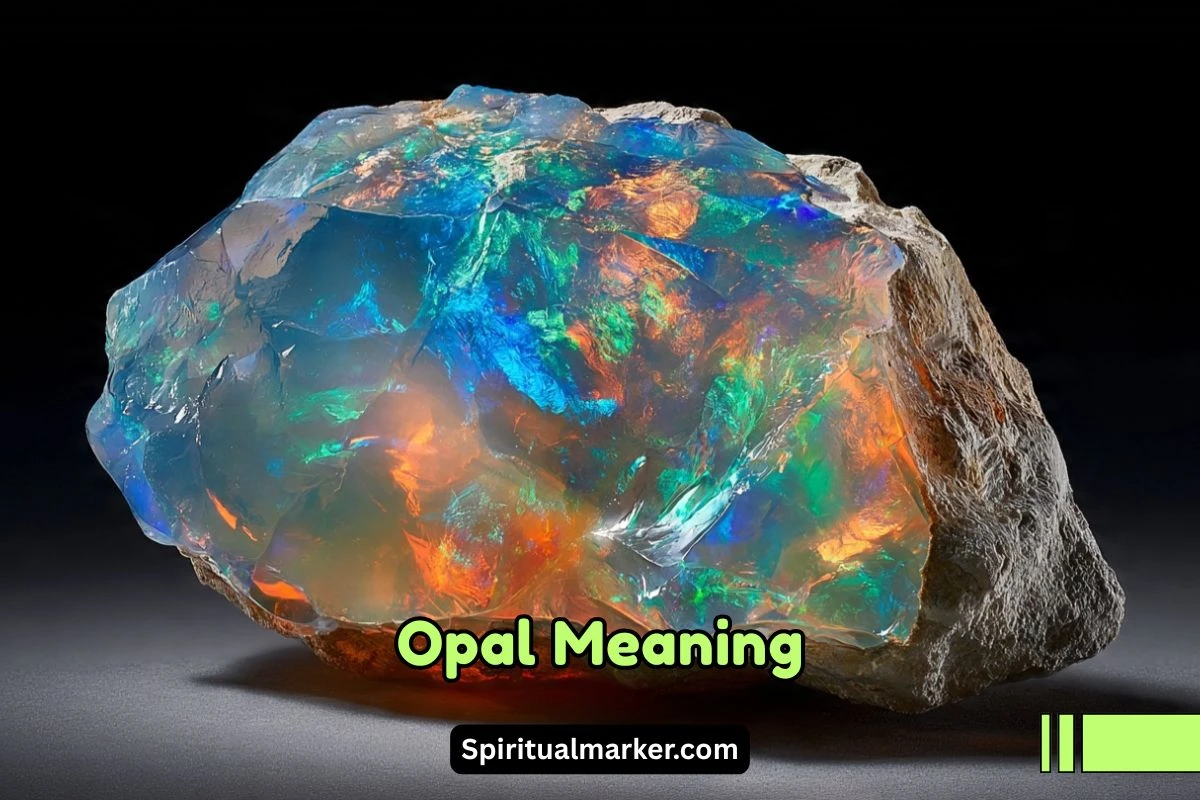
Opal is a stone of inspiration and creativity. Its iridescent colors shift and shimmer like a rainbow. In spiritual practice, this stone carries uplifting and transformative energy.
The opal meaning often involves creativity, emotional healing, and spiritual awakening. It is a stone of all chakras, helping to amplify emotions and enhance imagination. A spiritual meaning of Ethiopian opal shares that opal focus, though Ethiopian opal carries a more vibrant energy.
Opal is used in crystal healing to boost creativity, support emotional expression, and enhance meditation. It can also symbolize hope and transformation. The stone's energy is dynamic and inspiring.
If you feel drawn to opal, it may signal a need for creativity. A spiritual meaning of rainbow tourmaline also deals with multicolored stones, though tourmaline carries a more grounding energy.
Key Takeaways
- Opal symbolizes truth, hope, transformation, and emotional amplification across many spiritual traditions.
- Its shifting play of color connects it symbolically to intuition, creativity, and spiritual awareness.
- Opal is strongly associated with the crown chakra and third eye chakra, alongside secondary connections to the heart.
- Different opal varieties carry distinct healing properties, though all share core themes of emotional clarity and inner truth.
- Opal requires careful physical handling because of its water content and relatively soft structure.
What Is Opal?
Opal is a hydrated amorphous form of silica. Unlike most gemstones, it does not form a crystalline structure. Instead, tiny silica spheres arrange in stacked layers inside the stone. When light passes through those layers, it bends and scatters into a full spectrum of colors. That phenomenon is called play of color, and it is what makes opal uniquely spectacular among all gemstones.
Precious opal displays brilliant flashes of red, blue, green, orange, and violet as you tilt it. Common opal, also called potch, lacks that play of color. It still carries significant spiritual meaning, but its visual character feels more grounded and subdued.
Opal comes in many varieties. White opal, black opal, fire opal, boulder opal, crystal opal, and Ethiopian opal are among the most recognized. Each variety carries its own visual personality and slightly distinct energetic associations, but all share opal’s core spiritual identity.
The gemstone’s water content is one of its defining characteristics. Opal can contain anywhere from 3 to 21 percent water by weight. This makes it sensitive to sudden temperature shifts, prolonged heat, and very dry conditions. That sensitivity also carries symbolic meaning. Opal requires care. It rewards attentiveness. It reflects the emotional truth that beautiful things often need patient, thoughtful protection.
Origins and Formation
Opal forms over millions of years in areas where silica-rich water repeatedly flows through cracks and voids in rock. As the water evaporates, it leaves behind microscopic silica deposits that gradually accumulate. Over enormous stretches of geological time, those deposits solidify into opal.
Australia produces roughly 95 percent of the world’s precious opal. The Lightning Ridge region of New South Wales is globally famous for black opal, one of the rarest and most valuable opal varieties on Earth. Coober Pedy in South Australia is known as the opal capital of the world and produces abundant white and crystal opal.
Ethiopia has emerged as a major opal source in recent decades. Ethiopian opal, or Welo opal, displays exceptional play of color and absorbs water more readily than Australian varieties. It has quickly become popular in both jewelry and spiritual communities.
Other notable sources include Mexico, which produces fire opal famous for its bold orange and red tones. Brazil, Peru, Indonesia, and the United States also yield opal deposits, each with regional characteristics.
The geological patience required to form opal adds symbolic weight to the stone. Nothing about opal forms quickly. Its beauty develops across timescales that dwarf human lifetimes. Spiritually, that speaks to slow, deep transformation rather than instant change.
Key Properties at a Glance
| Aspect | Details |
|---|---|
| Composition | Hydrated amorphous silica |
| Hardness | 5.5 to 6.5 on the Mohs scale |
| Water Content | 3 to 21 percent |
| Chakra Association | Crown, third eye, and heart chakras |
| Primary Meaning | Truth, transformation, emotional amplification |
| Main Varieties | White, black, fire, boulder, crystal, Ethiopian |
| Major Sources | Australia, Ethiopia, Mexico, Brazil |
| Transparency | Opaque to transparent depending on variety |
| Energy Character | Amplifying, intuitive, emotionally revealing |
| Common Uses | Meditation, emotional healing, creative work, spiritual growth |
Historical Significance of Opal
Ancient Rome and Greece
The ancient Romans prized opal above almost every other gemstone. The Roman senator Nonius famously refused to give his opal ring to Mark Antony, choosing exile instead. Roman literature describes opal as a stone combining the fire of ruby, the green of emerald, the yellow of topaz, and the blue of sapphire. They called it opalus, the precious stone.
Romans linked opal with hope and good fortune. Wearing opal was considered a mark of refinement and spiritual favor. The stone’s shifting colors were read as signs of divine presence and changing destiny.
Ancient Greeks associated opal with prophecy and foresight. The word opal may derive from the Sanskrit word upala, meaning precious stone, which passed through Greek as opallios. In Greek culture, the stone’s visual complexity suggested access to hidden knowledge and spiritual truth.
Aboriginal Australian Traditions
Indigenous Australians hold some of the world’s oldest relationships with opal. Their traditions describe opal’s origins through the story of the creator descending to Earth on a rainbow. Wherever the creator’s foot touched the ground, the stones began sparkling with all the colors of that rainbow.
This story connects opal permanently to creation, divine presence, and the bridge between worlds. Aboriginal communities viewed opal as a deeply sacred stone that carried the energy of both earthly and spiritual realms. That understanding of opal as a bridge between dimensions echoes through many modern spiritual interpretations.
Middle Ages in Europe
Medieval Europeans had a complicated relationship with opal. Initially it was celebrated as the patronus furum, or patron of thieves, because people believed it could render its wearer invisible. Nobles and royals coveted opal for its protective and mystical associations.
The stone’s reputation shifted in the 14th century when opal was falsely associated with the Black Plague. Because opals were reported to briefly increase their play of color in fevered patients and then go dull after death, fearful populations connected the stone with illness. This association hurt opal’s reputation for centuries, though it never fully disappeared.
Queen Victoria dramatically rehabilitated opal’s image in the 19th century. She wore opal jewelry openly and gifted opal pieces to her daughters at their weddings. Her visible enthusiasm helped opal reclaim its status as a stone of elegance, beauty, and spiritual significance.
Ancient Arabic and Eastern Traditions
Arabic folklore described opal as having fallen from the sky during lightning storms. That story tied the stone to divine fire, celestial energy, and sudden spiritual illumination. Some Arabic texts described opal as a stone that could shield the wearer from disease and strengthen emotional resolve.
In Eastern traditions, opal appeared in texts describing stones that sharpen intuition and strengthen connection to spiritual realms. Its multi-colored nature made it a natural symbol for unity within diversity, reflecting the spiritual teaching that all things emerge from a single source.
5 Spiritual Meanings of Opal
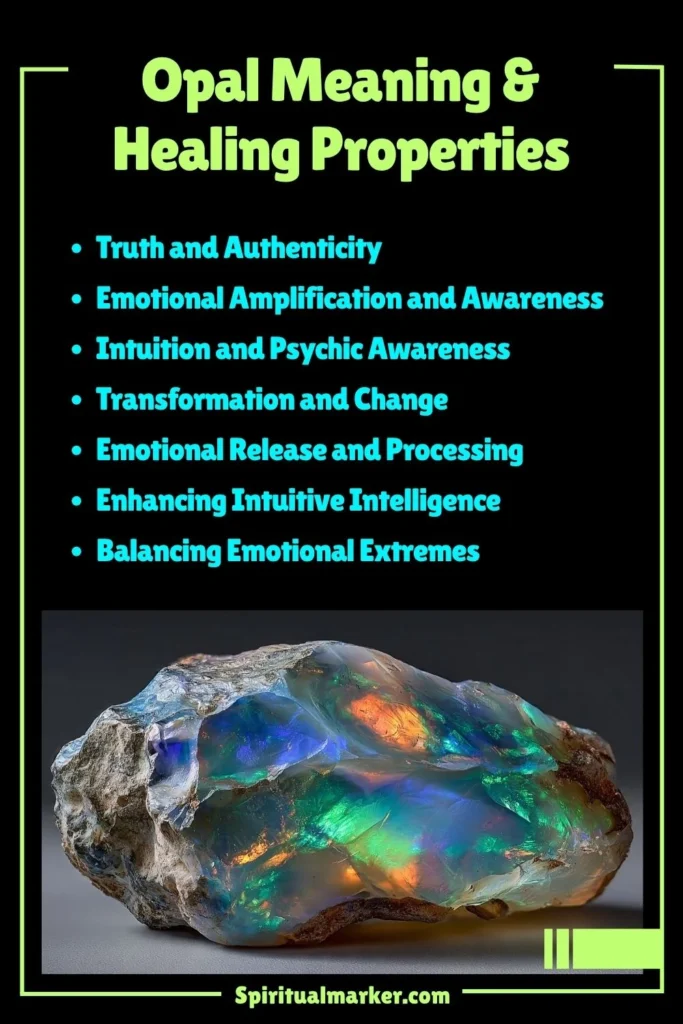
1. Truth and Authenticity
Opal has carried a deep connection to truth for thousands of years. This is not coincidental. The stone’s shifting colors make it impossible to pin down or define simply. It constantly reveals new facets. That visual behavior directly mirrors the nature of authentic truth, which reveals itself in layers rather than all at once.
Many spiritual traditions describe opal as a mirror stone. It reflects what already exists within the person holding it. If someone carries unresolved emotional tension, opal may amplify awareness of that tension. If someone is moving through a period of personal honesty and growth, opal may deepen that clarity further.
This amplifying quality is central to opal’s spiritual identity. Unlike some stones believed to send energy outward, opal turns attention inward. It encourages honest self-examination rather than comfortable self-deception.
The Ancient Romans recognized this. Their association of opal with hope was not simply optimism. It was linked to the hope that comes from seeing things as they truly are and choosing to move forward with that knowledge. That combination of truth and hope remains central to opal’s meaning today.
For people on spiritual paths involving shadow work, emotional healing, or personal reinvention, opal’s symbolism of truth feels especially resonant. It does not promise comfort. It promises clarity. That distinction makes it one of the spiritually most honest and demanding stones in the gem world.
2. Emotional Amplification and Awareness
Opal is widely described as an emotional amplifier. In spiritual and crystal healing communities, this is both its most celebrated quality and the one that requires the most awareness. Opal does not generate emotions from nothing. Instead, it seems to heighten whatever emotional state a person already carries.
This quality explains why experienced crystal practitioners often recommend opal for people who have already begun emotional healing work. Someone in the early stages of processing deep grief, trauma, or emotional suppression may find opal’s amplifying energy overwhelming without adequate support. Someone who has built emotional awareness and stability may find opal accelerates insight, empathy, and emotional clarity.
Spiritual texts across multiple traditions describe opal as a stone that makes hidden emotions visible. Feelings that have been suppressed, avoided, or unacknowledged for years may surface more readily in opal’s presence. This is not understood as harmful in most healing traditions. Instead, it is viewed as necessary emotional honesty that enables genuine healing rather than surface-level management.
Opal’s emotional amplification also connects to creativity. Emotions are the raw material of creative expression. People who work in writing, music, visual art, dance, or other creative fields often describe wearing or keeping opal near as a way of staying emotionally open and creatively available.
The stone symbolizes emotional courage. It represents the willingness to feel fully rather than selectively. In a cultural environment that often rewards emotional suppression and rational detachment, opal stands as a powerful counterpoint.
3. Intuition and Psychic Awareness
Opal is one of the most consistently referenced stones in traditions involving intuition, psychic perception, and spiritual vision. Its connection to the third eye and crown chakras makes it a natural symbol for inner knowing that transcends logical reasoning.
Ancient Greek associations with prophecy reflect this understanding. The stone’s ability to reveal different images depending on the angle of viewing became a metaphor for the multi-dimensional nature of intuitive perception. A purely logical mind sees reality from one fixed angle. Intuitive awareness can move between perspectives, sensing what is not yet visible through ordinary observation.
Many spiritual practitioners believe opal strengthens the ability to read emotional situations accurately. This is not described as supernatural in most traditions. Rather, it refers to the heightened emotional and social intelligence that develops when people learn to trust their inner sensing rather than suppressing it in favor of rigid analysis.
In meditative traditions, opal is used to quiet the noise of constant mental commentary. When the inner chatter slows, subtler perceptions often become more accessible. Dreams may sharpen. Pattern recognition in relationships and events may improve. A broader sense of life’s underlying connections may become more evident.
Opal symbolizes the courage to trust what you sense internally, even when external evidence has not yet confirmed it. That form of inner trust is at the heart of what most spiritual traditions describe as authentic intuition.
4. Transformation and Change
Opal’s visual nature makes it a natural symbol for transformation. The same stone looks entirely different from different angles, in different lighting, and at different moments. No single viewing captures the whole stone. This quality mirrors the experience of genuine personal transformation, which rarely looks the same from day to day or from the outside compared to the inside.
In many indigenous and ancient traditions, opal was associated with the rainbow, which universally symbolizes transition between states of being. Rainbows appear at the intersection of rain and sunlight, at the meeting point of storm and clarity. They are inherently transitional. Opal carries that same threshold quality in its symbolism.
People are frequently drawn to opal during major life transitions. Career changes, relationship endings, relocations, spiritual awakenings, and periods of profound personal questioning often increase attraction to this stone. Its energy is understood to support comfort with uncertainty, which is precisely what transformation requires most.
Transformation also involves releasing identity structures that no longer serve a person’s growth. Old beliefs, emotional patterns, relationship dynamics, and self-concepts must loosen before new ones can form. Opal symbolizes the willingness to release without knowing exactly what will replace what has been let go. That quality of open-handed trust in the process of change is one of the stone’s deepest spiritual gifts.
5. Hope and Creative Vision
Hope in its deepest spiritual sense is not passive wishing. It is an active orientation toward possibility. It involves seeing through current difficulty toward something better while remaining grounded enough to take steps in that direction. Opal has symbolized this quality of hope across many cultures for centuries.
The Roman connection between opal and hope was reflected in how they wore it. Opal was not merely decorative. It was worn as a talisman of positive forward movement, a reminder that even in turbulent times, beauty and light continue to exist beneath the surface of things.
In modern spiritual contexts, opal’s connection to hope frequently extends into creative vision. Creativity in its fullest sense is an act of hope. It involves believing that something valuable can be brought into existence that does not yet exist. Artists, writers, musicians, healers, and visionary thinkers of many kinds have historically felt a strong attraction to opal.
Opal encourages envisioning what is possible rather than remaining fixed on what currently exists. That quality makes it meaningful for anyone navigating a period of creative drought, personal stagnation, or spiritual uncertainty.
The stone’s visual play of light and color functions as a natural reminder. Even in darkness, light exists in many forms. Even in apparent stillness, constant and beautiful change is always occurring beneath the surface. That message is exactly what hope communicates at its most fundamental level.
6 Healing Properties of Opal
1. Emotional Release and Processing
Opal’s most prominent healing association involves emotional release. The stone is widely used in crystal healing traditions as a tool for accessing and processing emotions that have been stored beneath conscious awareness for extended periods.
Emotional suppression is remarkably common. Many people learn early in life that certain emotions are unacceptable, dangerous, or inconvenient. Fear, grief, anger, shame, and vulnerability frequently become buried beneath more socially acceptable emotional presentations. Over years, this suppression creates what many healers describe as emotional density, an accumulation of unprocessed feeling that affects mental clarity, physical energy, relationship quality, and spiritual awareness.
Opal is believed to gently soften emotional defenses without forcing overwhelming exposure. It creates conditions in which suppressed material can gradually surface within a manageable and awareness-supported context. Many practitioners use opal in healing sessions specifically focused on grief recovery, trauma processing, or emotional pattern recognition.
The key distinction in opal’s healing approach is emotional honesty over emotional avoidance. Rather than numbing or suppressing difficult feeling states, it encourages meeting them with awareness and compassion. That honest emotional engagement is what allows genuine release rather than continued suppression.
Regular opal meditation work is often described as producing gradual emotional lightening. People may notice they feel less reactive, more emotionally flexible, and more capable of experiencing joy and connection as suppressed material gradually clears.
2. Strengthening Creative Energy
Opal has one of the strongest historical and contemporary connections to creativity of any gemstone. Artists, writers, performers, musicians, designers, and other creative practitioners have reached for opal across centuries because of its widely reported ability to open and energize creative channels.
Creativity flows most freely from an emotionally honest and intuition-trusting state. When people are disconnected from their emotions, afraid of their inner perceptions, or locked in rigid mental patterns, creative energy typically becomes blocked or muted. Opal’s healing properties address precisely these conditions.
By encouraging emotional openness and intuitive trust, opal creates an internal environment where creative energy can move freely. Many crystal practitioners describe opal as one of the most effective stones for breaking through creative blocks that stem from emotional fear, self-doubt, or habitual mental rigidity.
Black opal specifically carries the strongest creative associations because of its depth of color and intensity of play. Fire opal energizes creative courage and willingness to take bold creative risks. White opal encourages more gentle and expansive creative vision. Each variety serves slightly different creative healing purposes.
3. Enhancing Intuitive Intelligence
Opal is one of the most consistently used crystals for developing and refining intuitive intelligence. That term refers to the capacity to perceive emotional and situational truth accurately through inner sensing rather than purely through logical analysis.
Intuitive intelligence is not mystical in the supernatural sense. Psychologists and neuroscientists increasingly recognize it as a genuine cognitive capacity involving rapid pattern recognition, emotional data processing, and somatic awareness. The challenge for many people in modern cultures is that this capacity is often dismissed, suppressed, or overridden by excessive emphasis on linear reasoning.
Opal’s healing work in this area involves validating and strengthening trust in inner perceptions. Many people sense things accurately, then immediately second-guess or dismiss those perceptions. That cycle of suppression gradually weakens intuitive confidence. Opal is believed to interrupt that cycle by creating conditions in which inner sensing receives attention, reflection, and eventually trust.
Practitioners report improved ability to read emotional dynamics in relationships, increased clarity about personal decisions, and greater sensitivity to the subtle energetic shifts that often precede significant change. These improvements are consistent with what developing intuitive intelligence looks like in psychological research on emotional intelligence and embodied cognition.
4. Supporting Spiritual Growth and Awakening
Opal has functioned as a stone of spiritual initiation in many traditions. Its connections to the crown and third eye chakras make it naturally resonant with experiences involving expanded spiritual awareness, deepened meditative states, and direct perception of spiritual reality.
In crystal healing frameworks, spiritual awakening refers to a gradual expansion of consciousness beyond habitual mental patterns. It involves perceiving life from a broader perspective, feeling connected to something larger than individual identity, and developing a more consistent relationship with stillness, presence, and inner truth.
Opal supports this process by amplifying spiritual sensitivity. People who meditate with opal frequently report deeper meditative states, more vivid and meaningful dream experiences, and stronger sense of connection to spiritual guidance or inner wisdom. The stone seems to thin the membrane between ordinary awareness and expanded perception.
Australian Aboriginal spiritual traditions already captured this understanding when they linked opal to the creator’s footsteps. The stone marks the place where divine presence touched the physical world. That metaphor communicates exactly what opal does spiritually: it marks and opens points of contact between the human and the sacred.
5. Balancing Emotional Extremes
Opal’s amplifying nature might seem counterproductive for people experiencing emotional instability. However, in skilled healing practice, its amplification serves a specific and valuable balancing function.
When emotional extremes exist, they typically involve repressed material exerting pressure against conscious awareness. The suppressed emotions create energetic imbalance. They do not remain quietly contained. Instead, they push outward in distorted forms such as disproportionate reactivity, chronic anxiety, numbness, or emotional flooding.
Opal’s amplification brings the suppressed material into conscious awareness where it can be met, acknowledged, and processed rather than continuing to exert unconscious pressure. This process initially may feel intensifying. Over time, as the suppressed emotional material is integrated, the emotional system tends toward greater balance and stability.
Many practitioners describe this as opal’s long-game healing quality. It is not a stone for instant emotional relief. It is a stone for people committed to genuine emotional resolution, which ultimately produces sustainable balance rather than temporary suppression.
6. Restoring Hope During Dark Periods
One of opal’s most compassionate healing properties involves its capacity to restore a sense of hope and possibility during periods of depression, grief, spiritual darkness, or profound personal loss.
Darkness of this kind is not simply sadness. It is the experience of disconnection from meaning, beauty, and the possibility of change. People in genuine spiritual or emotional darkness may feel that nothing will improve, that beauty has permanently disappeared, and that transformation is no longer available to them.
Opal’s visual nature speaks directly to this experience. Hold an opal in your hand and move it slightly. The colors shift. What appeared dark becomes luminous. What seemed still reveals constant motion. That physical demonstration carries deep healing symbolism for people who feel trapped in darkness.
The stone communicates through direct visual experience that light and color have not disappeared. They remain present even when not immediately visible. A small shift in perspective or position can reveal beauty and movement that existed all along.
Many healers use opal specifically in grief work and depression support for exactly this reason. Its visual play is not mere decoration. It is a living metaphor for hope’s persistence even through the heaviest human experiences.
Opal and the Chakras
Crown Chakra
The crown chakra sits at the top of the head and governs spiritual connection, higher consciousness, divine awareness, and the experience of unity. When this chakra flows freely, people feel connected to something larger than individual identity. They experience spiritual meaning, inner peace, and a sense of belonging to a greater whole.
Opal’s connection to the crown chakra is strong and historically consistent. Its play of light and color visually mirrors what crown chakra activation is said to feel like: multiple frequencies of awareness present simultaneously, each beautiful, none dominant. The stone’s amplifying quality also aligns with the crown chakra’s function of expanding awareness beyond ordinary mental boundaries.
Meditating with opal placed at the crown or held during crown chakra focused practice is a common recommendation in crystal healing traditions. Many practitioners report enhanced feelings of spiritual connection, inner peace, and expanded perspective during these sessions.
Third Eye Chakra
The third eye chakra sits at the center of the forehead and governs intuition, inner vision, imagination, and psychic perception. It is the energetic center through which people access inner knowing that exceeds ordinary sensory or logical input.
Opal’s association with the third eye directly reflects its historical and contemporary reputation as a stone of vision and prophecy. Ancient Greeks connected it to foresight. Medieval mystics used it in divination practices. Modern intuitive practitioners reach for it when developing or strengthening intuitive capacity.
For meditation focused on third eye activation, black opal or crystal opal are particularly recommended because of their depth and visual complexity. Holding opal at the third eye or placing it nearby during meditation is believed to support deepened intuitive access and clearer inner vision.
Heart Chakra
Opal also connects meaningfully to the heart chakra, the energetic center governing love, compassion, emotional openness, forgiveness, and empathy. This connection is somewhat less emphasized than opal’s crown and third eye associations, but it remains significant.
The heart chakra connection becomes especially evident when considering opal’s emotional amplification and healing properties. Emotional healing is heart work. The courage required to feel honestly, release emotional defenses, forgive past wounds, and remain emotionally open despite previous pain is fundamentally heart-chakra territory.
Green opal and pink opal carry the strongest heart chakra associations within the opal family. White opal also connects meaningfully to heart energy because of its soft, inclusive visual quality. Any opal variety used in emotional healing work engages the heart chakra to some degree through the nature of the work itself.
Different Varieties of Opal and Their Distinct Meanings
Black Opal
Black opal is the rarest and most spiritually intense of all opal varieties. Its dark body color allows play of color to appear with extraordinary brilliance and depth. Lightning Ridge, Australia, produces the most prized black opals in the world.
Spiritually, black opal connects with deep transformation, shadow work, accessing hidden truths, and courageous emotional exploration. It is not recommended for beginners in crystal work because its amplifying energy can feel very strong. For experienced practitioners, it is one of the most powerful transformational stones available.
Black opal symbolizes seeing clearly in darkness. It represents the courage to face what is hidden and the willingness to transform completely rather than making only surface-level changes.
White Opal
White opal is the most widely available and the most commonly used variety in jewelry and everyday spiritual work. Its light background allows colors to play gently across the surface. It carries an energy that feels inclusive, expansive, and emotionally gentle.
Spiritually, white opal connects strongly with hope, clarity, emotional openness, and spiritual purity. It is one of the most accessible opal varieties for people beginning work with the stone. Its energy amplifies without the intensity of black opal, making it suitable for a wider range of emotional and spiritual applications.
White opal particularly supports creative vision, communication, and the gentle opening of spiritual sensitivity.
Fire Opal
Fire opal gets its name from its bold orange, red, and yellow tones. It does not typically display the same play of color as precious opal, but its fiery hues carry tremendous visual and energetic impact.
Spiritually, fire opal connects with passion, creative courage, vitality, personal power, and the will to act boldly. It energizes rather than soothes. Where white opal encourages gentle opening, fire opal encourages decisive movement.
Mexican fire opal specifically has a long indigenous association with life force energy, protection, and the courage to pursue authentic desire. It carries an activating, warming quality quite distinct from other opal varieties.
Ethiopian Opal (Welo Opal)
Ethiopian opal has rapidly become one of the most beloved varieties in modern crystal communities. Its exceptional play of color, relative accessibility, and energetic freshness make it widely appealing.
Spiritually, Ethiopian opal carries strong associations with emotional healing, spiritual opening, and transformational energy. Many practitioners describe it as having a particularly uplifting and heart-expanding quality that combines healing and expansion simultaneously.
Because Ethiopian opal absorbs water, it requires careful care to avoid dehydration in very dry environments. This sensitivity reinforces its symbolic association with emotional depth and the need for conscious, caring attention.
Boulder Opal
Boulder opal forms within ironstone matrix rock in Queensland, Australia. The opal veins run through the host rock, and the two are typically kept together in finished stones and jewelry. The resulting appearance is uniquely textured, earthy, and visually complex.
Spiritually, boulder opal carries strong grounding energy that other opal varieties may lack. Its connection to the host rock anchors opal’s expansive and amplifying qualities within a stable earthly foundation. It symbolizes spiritual insight grounded in practical reality rather than disconnected from it.
How to Use Opal for Spiritual Growth
Meditation Practice
Opal meditation can be one of the most powerful and revealing practices available to people working on emotional healing, spiritual development, or creative opening.
Hold your opal in both hands or place it at the third eye or crown during meditation. Begin with simple breath awareness. Allow your attention to settle into the stone’s energy rather than directing it forcefully.
Many practitioners find that images, memories, emotional impressions, and intuitive insights arise naturally during opal meditation. Keep a journal nearby to record what surfaces. Over time, patterns often become visible that reveal important emotional or spiritual information.
Start with shorter sessions of ten to fifteen minutes, especially if you are new to working with opal. Its amplifying quality deserves respectful attention rather than casual overuse.
Creative Work
Keep opal near your creative workspace if you work in any creative field. Place it on your desk, writing table, art studio surface, or near your instrument. Many artists describe the stone’s presence as creating a subtle but consistent invitation toward emotional honesty in creative expression.
When you feel creatively blocked, hold the opal and breathe slowly. Allow the emotional state beneath the block to surface without judgment. Often the block itself contains the material needed to break through it.
Dream Work
Opal has a long historical association with dreams, vision, and inner imagery. Placing opal near your bed or under your pillow is a traditional practice in many crystal healing communities for enhancing dream vividness and dream recall.
Keep a dream journal by your bed. Record whatever you remember immediately upon waking. Over weeks of regular practice, many people report increased dream clarity, more symbolic dream content, and greater ability to extract meaningful insight from dream experience.
Daily Intention Setting
Wearing opal daily or carrying it as a pocket stone creates an ongoing invitation toward emotional honesty and intuitive awareness throughout daily life. Many people find it quietly but consistently shifts how they engage with emotional information in conversations, decisions, and personal reflection.
Setting a brief morning intention with your opal can amplify this effect. Hold the stone, breathe consciously, and state your intention for the day. This practice takes only a few minutes but creates a meaningful spiritual anchor that extends throughout the day.
How to Wear Opal Jewelry for Spiritual Benefit
Wearing opal jewelry is one of the most natural and elegant ways to maintain ongoing contact with the stone’s energy. The specific placement of opal jewelry carries symbolic and practical significance within crystal traditions.
Opal pendants worn at the heart or throat connect the stone’s energy to emotional processing and authentic communication. Many people find that wearing opal near the heart brings consistent emotional clarity and openness throughout the day.
Opal rings have been among the most popular forms of opal jewelry throughout history. Many spiritual practitioners believe that wearing opal on the hands strengthens conscious creative action and intuitive decision-making in daily interactions. The hands are instruments of creation and communication, making them naturally powerful locations for an opal’s energy.
Opal earrings place the stone near the third eye and crown areas, reinforcing its connection to intuitive awareness and spiritual sensitivity. Many meditators and intuitive practitioners prefer earrings for this reason.
Opal bracelets allow the stone to maintain regular contact with pulse points, which some practitioners believe strengthens the connection between the stone’s energy and the wearer’s own energetic field.
When choosing opal jewelry for spiritual purposes, follow your own intuitive attraction. The specific variety, color, and setting that draws your attention most strongly is often the most relevant to your current spiritual and emotional needs.
Caring for Opal Jewelry
Opal requires more careful handling than most gemstones because of its water content and relatively modest hardness. Its physical sensitivity reinforces its spiritual symbolism: beauty of this depth deserves and rewards thoughtful, consistent care.
Store opal jewelry separately from harder stones. Diamonds, sapphires, rubies, and other hard gems can easily scratch opal’s surface. A soft fabric pouch or padded compartment in a jewelry box provides appropriate protection.
Avoid prolonged exposure to direct sunlight, extreme heat, or very dry conditions. Opal can lose water content in persistently dry environments, leading to fine surface cracks called crazing. If you live in a very dry climate, storing opal with a damp cloth nearby can help maintain appropriate moisture.
Clean opal gently with lukewarm water, mild soap, and a soft cloth. Never use ultrasonic cleaners, steam cleaners, or harsh chemical solutions. These methods can damage opal’s surface and internal structure permanently.
Remove opal jewelry before intense physical activity, swimming, gardening, or household cleaning. Impact, chemicals, and rough handling all pose risks to the stone’s structural integrity.
For energetic cleansing, many practitioners use gentle methods suited to opal’s sensitivity. Moonlight is one of the most widely recommended methods. Full moonlight overnight provides energetic refreshment without any physical stress to the stone. Sound cleansing with singing bowls, bells, or chanting is another effective option that avoids physical contact. Some practitioners use breath cleansing by holding the opal and breathing consciously with clear intention.
Avoid burying opal in earth or placing it in water for extended periods, as both methods risk physical damage. Smudging with sage or palo santo can be used briefly if the smoke does not directly contact the stone’s surface for extended periods.
Table: Opal Meaning at a Glance
| Aspect | Details |
|---|---|
| Primary Spiritual Meaning | Truth, transformation, emotional amplification |
| Secondary Meanings | Hope, intuition, creativity, spiritual vision |
| Chakra Connections | Crown, third eye, heart |
| Main Varieties | Black, white, fire, boulder, crystal, Ethiopian |
| Healing Properties | Emotional release, creative activation, intuitive development |
| Best Uses | Meditation, creative work, dream enhancement, daily wear |
| Historical Associations | Roman hope, Greek prophecy, Aboriginal creation |
| Water Content | 3 to 21 percent |
| Hardness | 5.5 to 6.5 Mohs |
| Care Requirements | Gentle cleaning, avoid heat and dryness, soft storage |
| Energy Character | Amplifying, revealing, intuitively activating |
| Contraindications | Use with care during early emotional healing stages |
A Final Note
Opal stands alone in the gemstone world. No other stone combines visual complexity with such layered spiritual meaning. Its shifting colors, its deep historical roots, and its consistent association with truth, transformation, intuition, and hope make it genuinely singular.
The stone does not offer passive comfort. It offers honest reflection and compassionate amplification. It invites you to see yourself more clearly, feel more honestly, trust your inner perceptions more fully, and remain open to the slow and luminous process of genuine personal change.
Whether you are drawn to opal for its visual beauty, its spiritual symbolism, its healing associations, or simply an attraction you cannot fully articulate, that draw is worth following. Meaningful stones and meaningful moments often find each other naturally.
Opal has survived centuries of cultural change, fashion shifts, and shifting symbolic associations. It returns repeatedly to the same core qualities: truth, beauty, depth, and transformation. Those qualities are timeless because they reflect what human beings consistently need at the deepest levels of their experience.
If opal has been calling your attention, consider listening. It may be reflecting something in you that is ready to surface, strengthen, or finally be seen clearly.