
Ethiopian opal is a stone of inspiration and creativity. Its iridescent colors shift and shimmer like a rainbow. In spiritual practice, this stone carries uplifting and transformative energy.
The Ethiopian opal meaning often involves creativity, emotional healing, and spiritual awakening. It is a stone of all chakras, helping to amplify emotions and enhance imagination. A spiritual meaning of opal shares that opal focus, though Ethiopian opal carries a more vibrant energy.
Ethiopian opal is used in crystal healing to boost creativity, support emotional expression, and enhance meditation. It can also symbolize hope and transformation. The stone's energy is dynamic and inspiring.
If you feel drawn to Ethiopian opal, it may signal a need for creativity. A spiritual meaning of rainbow tourmaline also deals with multicolored stones, though tourmaline carries a more grounding energy.
Key Takeaways
- Ethiopian opal symbolizes transformation, emotional truth, spiritual amplification, and creative awakening.
- Many traditions associate Ethiopian opal with the crown chakra and third eye chakra.
- People often use Ethiopian opal during major life transitions, spiritual growth, intuitive development, and creative work.
- Ethiopian opal contains high water content and is more delicate than many gemstones.
- Wearing Ethiopian opal close to the body may amplify intuition, emotional awareness, and spiritual clarity.
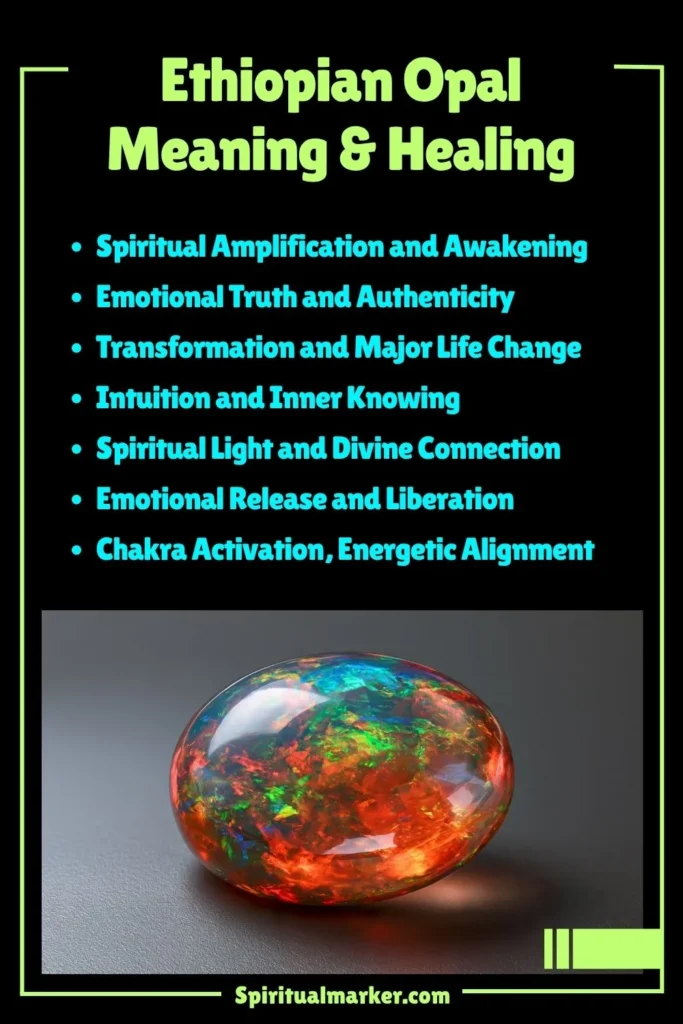
What Is Ethiopian Opal?
Ethiopian opal is a naturally occurring gemstone found primarily in Ethiopia, a country that has become one of the world’s most significant opal sources over the last few decades. What makes Ethiopian opal extraordinary is its play of color, a visual phenomenon where brilliant spectral flashes shift across the stone’s surface as light moves across it.
Mineralogically, opal forms from hydrated silica. Over thousands of years, silica-rich water seeps into rock cavities and crevices. As the water slowly evaporates, silica deposits harden into opal. In Ethiopian opal, the internal silica structure forms microscopic spheres arranged in regular patterns. When light enters the stone, it diffracts and scatters into those stunning color displays. This is not color from pigment. It is pure optical physics working inside the stone.
Ethiopian opal appears in several varieties. Welo opal, sourced from the Wollo Province, is the most widely known. It often appears white or amber in its base tone with intense, rolling colors flashing across its surface. Smoked opal and black Ethiopian opal also exist and carry slightly different visual and energetic qualities.
Many people compare Ethiopian opal to fire opal or Australian opal, but Ethiopian opal has its own distinct character. It tends to absorb water more readily, which can temporarily enhance its color display. This characteristic has earned it the nickname hydrophane opal. When submerged in water, many Ethiopian opals become more transparent and their colors deepen temporarily. This unique quality adds to its mystique.
Origins and Formation
Ethiopian opal has been geologically present for millions of years, but it only entered global gemstone markets in meaningful quantities during the 1990s and 2000s. The Wollo Province discovery around 2008 transformed Ethiopia into a world-recognized opal source almost overnight. Miners found deposits of exceptional quality that immediately attracted international attention.
The volcanic geology of Ethiopia contributes to the opal’s formation. Silica-rich fluids moved through rhyolite and ignimbrite rock formations over vast geological time. As those fluids cooled and settled in cavities, the silica hardened into opal. The volcanic origin is part of why Ethiopian opal carries such intense energy in spiritual traditions. Many healers believe volcanic stones carry transformative, fire-born energy that differs from sedimentary gemstones.
Ethiopian opal is primarily mined in two key regions. Shewa Province produced early Ethiopian opal discoveries, while the Wollo Province became the dominant source of the most vibrant and sought-after specimens. Today, Ethiopia is widely recognized alongside Australia as one of the most important opal-producing countries in the world.
The stone’s formation process spans enormous periods of geological time. This connects it symbolically with themes of patience, deep transformation, and layered growth, qualities that appear frequently in its spiritual symbolism.
Key Properties
| Property | Details |
|---|---|
| Color | White, amber, orange, transparent, with multicolor play |
| Composition | Hydrated amorphous silica |
| Hardness | 5.5 to 6.5 on the Mohs scale |
| Chakra Association | Crown chakra, third eye chakra, solar plexus chakra |
| Symbolism | Transformation, truth, intuition, spiritual fire |
| Common Sources | Wollo Province and Shewa Province, Ethiopia |
| Transparency | Transparent to opaque |
| Energy Style | Amplifying, transformative, spiritually expansive |
Historical Use
Opal has held sacred and symbolic status across human history for thousands of years. Ancient Romans considered opal among the most precious of all stones. Roman scholar Pliny the Elder described opal as carrying the fire of rubies, the sea-green of emerald, the yellow of topaz, and the blue of sapphire all within one stone. He called it a stone of supreme rarity and beauty.
In ancient Arabic tradition, people believed opals fell from the sky during lightning storms. They called it “the lightning stone” and associated it with celestial fire and divine communication. This belief gave opal a deeply spiritual reputation as a bridge between earthly and divine realms.
Ethiopian culture itself carries deep reverence for natural and spiritual power. While Welo opal only entered global markets recently, Ethiopia’s broader cultural relationship with the spiritual world has shaped how many healers interpret the stone’s energy. Ethiopian Orthodox Christian traditions, ancient Coptic practices, and indigenous spiritual systems all reflect a society deeply connected to spiritual symbolism.
In later metaphysical traditions, as Ethiopian opal became widely available, crystal practitioners quickly recognized its exceptionally strong energetic qualities. Its intense play of color became symbolic of spiritual illumination and the many facets of human consciousness. Modern crystal healers often place Ethiopian opal among the most powerful transformative stones available today.
5 Spiritual Meanings of Ethiopian Opal
1. Spiritual Amplification and Awakening
Ethiopian opal is one of the most widely recognized stones for spiritual amplification. Its energy does not whisper. It speaks clearly and directly. Many spiritual practitioners describe working with Ethiopian opal as turning up the volume on inner awareness. Intuitions become sharper. Spiritual messages feel clearer. Inner knowing becomes harder to ignore.
This amplifying quality can feel extraordinary for people ready to deepen their spiritual practice. But it can also feel overwhelming for those who are not emotionally prepared for what surfaces. This is one reason experienced crystal healers treat Ethiopian opal with deep respect rather than casual use. Its energy is genuine, strong, and spiritually purposeful.
The play of color within Ethiopian opal carries symbolic meaning in spiritual traditions. Colors symbolize different frequencies of consciousness and spiritual awareness. A stone that contains red, orange, gold, green, blue, and violet simultaneously represents the fullness of human spiritual experience. Nothing is hidden. Everything is illuminated. This makes it a powerful companion for anyone seeking spiritual clarity or deeper self-awareness.
Many spiritual practitioners use Ethiopian opal during meditation, prayer, vision work, and spiritual ceremony because they believe it opens perception beyond ordinary mental awareness. Some describe feeling a sense of expanded consciousness when holding the stone in quiet reflection. Others feel a stronger connection to intuitive guidance or spiritual protection during challenging periods.
The spiritual awakening associated with Ethiopian opal is rarely passive. It tends to create active spiritual engagement. Things that need to change become clearer. Patterns that limit growth become more visible. Truths that have been avoided begin demanding honest attention. This is powerful and purposeful, but it requires emotional courage and genuine readiness.
2. Emotional Truth and Authenticity
One of the most significant spiritual meanings of Ethiopian opal involves emotional truth. The stone is strongly associated with honesty, authenticity, and the courage to face emotional reality clearly. In crystal traditions, opal has long been called a “stone of truth” because of its perceived ability to surface what has been hidden or suppressed.
Many people spend years carrying emotional stories that no longer reflect who they truly are. Old wounds become identity. Past fears become emotional habits. Ethiopian opal spiritually represents the breaking open of that emotional rigidity. It encourages a person to look honestly at their internal emotional landscape without flinching or retreating.
This meaning is especially powerful because emotional truth often feels threatening. Admitting grief, fear, disappointment, or unspoken needs requires courage. Many people unconsciously construct emotional protective patterns that eventually become more limiting than the original pain they were meant to guard against. Ethiopian opal symbolizes the liberation that comes from dropping that protection and allowing authentic emotion to surface.
Spiritual traditions across multiple cultures associate authentic self-expression with healing and personal freedom. When people live in emotional honesty, relationships improve. Inner conflict reduces. Physical energy often improves. Mental clarity deepens. Ethiopian opal spiritually mirrors this sequence. Its energy is believed to support the process of emotional unmasking with strength and awareness.
This does not mean Ethiopian opal strips away all emotional defenses at once. Instead, its symbolism reflects a progressive emergence of authenticity. Over time, people who work with the stone often report feeling more emotionally genuine. More willing to speak truthfully. More comfortable being seen without pretense. This gradual emotional liberation forms a central theme in Ethiopian opal’s spiritual identity.
3. Transformation and Major Life Change
Ethiopian opal carries extraordinarily strong symbolism related to transformation. People frequently encounter this stone during major life transitions. Career shifts. Relationship endings. Grief. Spiritual crisis. Creative reawakening. The stone seems to appear when life is preparing to change significantly.
This symbolic connection to transformation feels deeply fitting when you consider the stone’s volcanic origins. Volcanic forces are among nature’s most powerful transformative processes. They destroy and create simultaneously. They bring ancient material to the surface. They reshape landscapes permanently. Ethiopian opal spiritually reflects this same quality. It symbolizes transformation that reshapes rather than simply rearranges.
Many spiritual teachers describe transformation as a process of releasing what no longer serves so that new possibilities can emerge. This process rarely feels comfortable. Old identities, relationships, habits, and beliefs may need to dissolve before new growth becomes possible. Ethiopian opal symbolizes both the courage required for genuine transformation and the spiritual fire that makes it possible.
For people in the middle of major life changes, Ethiopian opal serves as a powerful spiritual companion. It does not soften the process dramatically. Instead, it supports clarity within the chaos of change. People who work with it during transitions often describe feeling more spiritually held, more able to trust the process, and less terrified of the unknown.
Transformation also carries creative dimensions. Creative people are often drawn to Ethiopian opal for this reason. Artists, writers, musicians, and creators frequently report that the stone amplifies creative clarity and helps dissolve creative blocks. The connection between transformation and creativity runs deep. Both require releasing familiar patterns in favor of something new and unknown.
4. Intuition and Inner Knowing
Ethiopian opal has a powerful reputation for strengthening intuition. Its connection to the third eye chakra and crown chakra makes it a natural choice for anyone developing psychic awareness, spiritual discernment, or deeper inner knowing. Many practitioners call it one of the most intuition-enhancing stones available.
Intuition operates differently from rational thinking. It does not depend on logic, analysis, or sequential reasoning. Instead, it arises from deeper levels of awareness that often know things the conscious mind has not yet processed. Many people dismiss intuitive feelings as irrational or unreliable. Ethiopian opal spiritually challenges that dismissal. It encourages people to trust the knowing that arises before logic arrives.
The stone’s shifting colors are symbolically connected with this quality. Intuition is not fixed or rigid. It moves, shifts, and changes as awareness deepens. Ethiopian opal’s living, dancing color display mirrors the fluid, dynamic nature of genuine intuitive knowing. It never appears the same twice, just as genuine intuitive awareness adapts to each moment and situation.
Many people who practice dream work, spiritual journaling, oracle card reading, energy healing, or prayer use Ethiopian opal as a supportive tool because they believe it sharpens inner perception. Some report vivid dreams with clearer symbolic content. Others describe a stronger ability to sense emotional undercurrents in relationships or feel guided during important decisions.
Developing intuition requires trust, and trust requires practice. Ethiopian opal spiritually supports that practice by amplifying the signals that intuition naturally sends. The clearer and stronger those signals feel, the easier it becomes to distinguish genuine inner guidance from fear, wishful thinking, or emotional reactivity.
5. Spiritual Light and Divine Connection
Ethiopian opal’s most profound spiritual meaning may be its association with divine light and spiritual connection. Across cultures and throughout history, light has symbolized divine presence, wisdom, truth, and spiritual reality. Ethiopian opal, with its brilliant internal fire and spectral color display, has long been viewed as a stone that carries light within itself.
Many spiritual traditions teach that human consciousness has the capacity to connect with dimensions of awareness beyond ordinary physical experience. Prayer, meditation, contemplation, and spiritual practice all represent attempts to access that deeper dimension of reality. Ethiopian opal symbolizes the opening of that connection. Its energy is frequently described as spiritually uplifting rather than emotionally grounding.
Where some stones anchor energy downward toward earth and physical reality, Ethiopian opal tends to lift awareness upward toward broader spiritual perspective. This quality makes it especially meaningful for people seeking to understand their spiritual nature, reconnect with a sense of divine purpose, or move through spiritual confusion toward greater clarity.
Many healers connect Ethiopian opal with the concept of spiritual fire. In numerous traditions, fire represents purification, illumination, and divine energy. The ancient Arabic belief that opals fell from lightning storms reinforces this symbolism. Spiritual fire does not merely warm. It transforms, purifies, and illuminates what it touches. Ethiopian opal is believed to carry this same cleansing, enlightening quality within its luminous depths.
This spiritual meaning holds special significance for people experiencing what is sometimes called a dark night of the soul, a period of profound spiritual disorientation, loss of faith, or deep existential questioning. In those moments, Ethiopian opal symbolizes the return of inner light after spiritual darkness. It represents the persistent presence of divine connection, even when that connection temporarily feels invisible.
6 Healing Properties of Ethiopian Opal
1. Emotional Release and Liberation
Ethiopian opal is strongly associated with emotional release because its amplifying energy has a tendency to bring suppressed feelings to conscious awareness. Unlike gentler emotional stones that work slowly and subtly, Ethiopian opal tends to accelerate the surfacing of buried emotions. This quality can be deeply healing, but it requires emotional readiness and support.
Many people carry emotional wounds for years without fully processing them. Grief sits beneath humor. Anger hides beneath compliance. Fear disguises itself as busy-ness. These suppressed emotions do not disappear. They accumulate energetically and eventually affect physical health, relationship patterns, mental clarity, and spiritual well-being.
Ethiopian opal spiritually represents the courageous act of emotional honesty. Its energy encourages feelings to rise rather than sink deeper. Many practitioners who use it in healing contexts describe it as emotionally liberating. Once difficult feelings are acknowledged and processed, the relief can feel significant. Emotional heaviness lifts. Clarity returns. Creative energy reawakens.
This healing property requires that people approach Ethiopian opal with awareness and intention. Using it during periods of emotional stability rather than acute crisis tends to produce the most beneficial results. People working with therapists, spiritual directors, or trusted healing practitioners may find Ethiopian opal particularly supportive during processing work.
Emotional liberation is not simply about releasing pain. It also involves reconnecting with joy, curiosity, passion, and creative aliveness that emotional suppression may have quietly dampened over time. Ethiopian opal symbolizes this full spectrum of emotional revival.
2. Creative Awakening
Creative energy is one of Ethiopian opal’s most celebrated healing qualities. Artists, writers, musicians, poets, designers, and creators across many disciplines have found this stone to be a powerful creative catalyst. Its energy seems to bypass mental rigidity and open pathways to imaginative, inspired thinking.
Creative blocks are often emotional at their root. Fear of judgment, perfectionism, self-doubt, and emotional numbness all suppress creative flow. Ethiopian opal addresses these blocks at their energetic source by amplifying emotional honesty, reducing internal resistance, and restoring connection to authentic creative impulse. The result is frequently described as a creative awakening rather than a simple increase in productivity.
Many creative professionals keep Ethiopian opal in their studios, workspaces, or creative environments because they believe its presence supports inspired thinking. Some wear it during creative work to maintain emotional connection with their creative vision. Others use it during meditation before beginning creative projects to clear mental clutter and open receptive awareness.
Creative healing through Ethiopian opal also involves reclaiming creative identity. Many adults have buried their creative nature under years of practical demands, critical self-talk, or creative disappointment. Ethiopian opal symbolizes the restoration of that original creative aliveness. It reminds people that creativity is not separate from spiritual and emotional well-being. It is deeply connected to both.
3. Strengthening Intuitive Perception
Beyond spiritual symbolism, Ethiopian opal is practically used by many intuitive healers, therapists, coaches, and spiritual practitioners to strengthen their perceptive abilities during professional and personal work. Its association with the third eye chakra makes it a natural healing tool for anyone developing or refining intuitive and empathic capacities.
Intuitive perception is a learnable skill. Like any capacity, it strengthens with attention, practice, and the right conditions. Many practitioners believe Ethiopian opal creates energetic conditions that favor intuitive awareness. Mental noise reduces. Inner signals feel clearer. The gap between sensation and recognition narrows.
This healing quality is particularly valuable for people in helping professions, those whose work depends on reading people accurately, sensing emotional undercurrents, or making sound judgments in complex situations. Ethiopian opal is believed by many practitioners to sharpen discernment alongside intuitive sensitivity.
Some people also use Ethiopian opal to support dream awareness and symbolic thinking. Dreams often communicate through symbol and image rather than logical language. Ethiopian opal is believed by some to strengthen the mind’s ability to receive and interpret symbolic information from both inner and outer experience.
4. Supporting Personal Confidence and Self-Expression
Ethiopian opal is associated with personal confidence and authentic self-expression through its connection with the solar plexus chakra alongside its crown and third eye associations. The solar plexus governs personal power, self-worth, creative will, and the courage to be seen. Many people who feel emotionally or creatively blocked also experience underlying confidence challenges.
The stone’s healing energy is believed to restore personal confidence by connecting people with their authentic inner truth. When people feel internally aligned, confident self-expression tends to follow naturally. Ethiopian opal symbolizes that alignment between inner knowing and outer expression. It supports people in speaking, creating, and living from a place of genuine self-trust.
This healing property also has practical emotional dimensions. Many people experiencing social anxiety, fear of visibility, chronic self-doubt, or creative paralysis find that working with Ethiopian opal helps them reconnect with a stronger internal foundation. They begin trusting their own perceptions more. They feel more willing to share their work, ideas, and authentic perspectives.
5. Energetic Renewal During Burnout
Burnout is one of the most common challenges people face in contemporary life. Prolonged stress, emotional depletion, creative exhaustion, or spiritual dryness can leave people feeling hollow, disconnected, and without direction. Ethiopian opal is frequently associated with energetic renewal because its transformative fire symbolism directly addresses that state of depletion.
Many spiritual practitioners view burnout as a spiritual signal rather than simply a physical or psychological problem. It often indicates that a person has been living out of alignment with their authentic nature, creative energy, or spiritual values for an extended period. Ethiopian opal’s energy is believed to reignite that essential inner fire which burnout has temporarily extinguished.
Using Ethiopian opal during recovery from burnout is not about forcing energy or accelerating recovery. Instead, many practitioners describe the experience as remembering what matters. The stone’s amplifying quality helps people reconnect with what originally inspired them, what they genuinely value, and who they truly are beneath the accumulated weight of exhaustion and obligation.
6. Chakra Activation and Energetic Alignment
Ethiopian opal works across multiple chakras simultaneously, which distinguishes it from many single-chakra stones. Its primary associations include the crown chakra at the top of the head, the third eye chakra between the eyebrows, and the solar plexus chakra in the upper abdomen.
The crown chakra governs spiritual connection, higher consciousness, and the sense of divine relationship. When this chakra is open and balanced, people feel spiritually connected, guided, and aware of something larger than ordinary ego identity. Ethiopian opal is believed to activate and expand crown chakra energy in a way that feels illuminating rather than destabilizing.
The third eye chakra governs intuition, inner vision, perception, and symbolic awareness. Ethiopian opal is among the stones most frequently associated with third eye activation. Its energy helps refine inner sight, allowing people to perceive more clearly both inwardly and in their external lives.
The solar plexus chakra governs personal power, creative will, and authentic self-expression. Ethiopian opal’s solar plexus association connects its transformative energy to concrete areas of personal agency, helping people translate spiritual awareness into lived action.
When all three of these chakras work in harmony, people often experience a powerful alignment of spiritual vision, intuitive clarity, and personal confidence. Ethiopian opal symbolizes and supports this alignment in ways that few other gemstones can.
How to Wear Ethiopian Opal Jewelry for Spiritual Growth
Wearing Ethiopian opal as jewelry is one of the most popular ways people incorporate its energy into daily life. Pendants and necklaces are particularly meaningful because they position the stone near the heart and chest area, where emotional energy is often concentrated. Some practitioners specifically choose long-chain pendants that allow the stone to rest near the solar plexus chakra, supporting personal confidence and authentic expression.
Earrings featuring Ethiopian opal carry their own significance. Worn near the crown and third eye chakras, Ethiopian opal earrings are believed to strengthen intuitive perception and spiritual awareness throughout the day. Many people who work in creative or intuitive fields favor this placement.
Rings allow constant physical contact with the stone during active, engaged moments. Many people feel that wearing Ethiopian opal on the hands brings creative energy directly into their work. Writers, artists, healers, and musicians often prefer ring settings for this reason.
Bracelets offer regular skin contact during movement and activity. Some practitioners believe that consistent physical contact with Ethiopian opal allows its energy to support emotional awareness and energetic alignment more naturally throughout daily life.
Combining Ethiopian opal with complementary stones can create intentional energetic combinations. Labradorite amplifies intuitive protection alongside Ethiopian opal’s expansive energy. Amethyst adds calming spiritual clarity to the stone’s more intense amplifying qualities. Moonstone supports emotional receptivity and cyclical awareness. Clear quartz magnifies Ethiopian opal’s energy for those seeking deeper spiritual work.
Caring for Ethiopian Opal Jewelry
Ethiopian opal requires attentive and gentle care because of its relatively soft structure and high water content. Compared to harder gemstones like sapphire or diamond, Ethiopian opal is considerably more vulnerable to physical and environmental damage.
Store Ethiopian opal jewelry away from other harder stones that could scratch its surface. Individual fabric pouches or padded compartments in a jewelry box provide ideal protection. Avoid extreme heat, direct sunlight, and very dry conditions because these can cause the stone to dehydrate, crack, or lose its play of color over time.
Clean Ethiopian opal with lukewarm water, a drop of mild soap, and a soft cloth or soft brush. Dry it gently and completely afterward. Avoid ultrasonic cleaners, steam cleaning, harsh chemical jewelry cleaners, and abrasive materials entirely. These methods can penetrate the stone’s porous structure and cause permanent damage.
Remove Ethiopian opal jewelry before swimming, bathing, vigorous exercise, or household cleaning. Chlorine, saltwater, cleaning chemicals, and physical impact can all cause lasting harm to the stone’s structure and appearance.
Because Ethiopian opal is a hydrophane stone, exposure to water can temporarily alter its appearance and transparency. Many people find this fascinating to observe, but extended water exposure is still best avoided to protect the stone’s long-term integrity.
Spiritually, many practitioners cleanse Ethiopian opal energetically at regular intervals. Moonlight cleansing is popular because it avoids the heat and light risks of sunlight while still refreshing the stone’s energy. Sound cleansing using singing bowls or tuning forks is another safe method. Placing Ethiopian opal near selenite is widely believed to cleanse and recharge it gently without physical contact or water exposure.
Table: Ethiopian Opal Meaning at a Glance
| Aspect | Details |
|---|---|
| Primary Meaning | Transformation, spiritual amplification, emotional truth |
| Chakra Association | Crown, third eye, solar plexus chakra |
| Main Spiritual Symbolism | Spiritual fire, intuition, authentic self-expression |
| Common Colors | White, amber, orange, transparent, multicolor play |
| Hardness | 5.5 to 6.5 Mohs |
| Main Sources | Wollo Province and Shewa Province, Ethiopia |
| Emotional Associations | Liberation, creative awakening, inner truth |
| Popular Jewelry Types | Pendants, earrings, rings, bracelets |
| Spiritual Uses | Meditation, intuitive work, transformation practices |
| Care Needs | Gentle cleaning, protection from heat and chemicals |
A Final Note
Ethiopian opal stands apart from nearly every other gemstone because it refuses to remain invisible. Its colors demand attention. Its energy demands honesty. Its presence tends to accelerate whatever is already in motion within your life.
The stone’s spiritual meaning centers on transformation, authentic truth, spiritual amplification, and the courage to live from genuine inner awareness. Its healing properties touch emotional liberation, creative awakening, intuitive development, and energetic renewal. Whether you view it through a metaphysical lens or simply appreciate its extraordinary natural beauty, Ethiopian opal consistently resonates with people at significant turning points.
If this stone has caught your attention, that connection likely reflects something meaningful within your current life chapter. Some people wear it to amplify spiritual clarity. Others use it to support creative work, emotional healing, or intuitive development. Many simply feel more alive in its presence.
You might consider working with Ethiopian opal during meditation practices that focus on spiritual openness, creative exploration, or honest emotional reflection. Keeping it in your creative space, wearing it during meaningful conversations, or simply holding it during quiet morning moments can allow its energy to integrate naturally into your daily life.