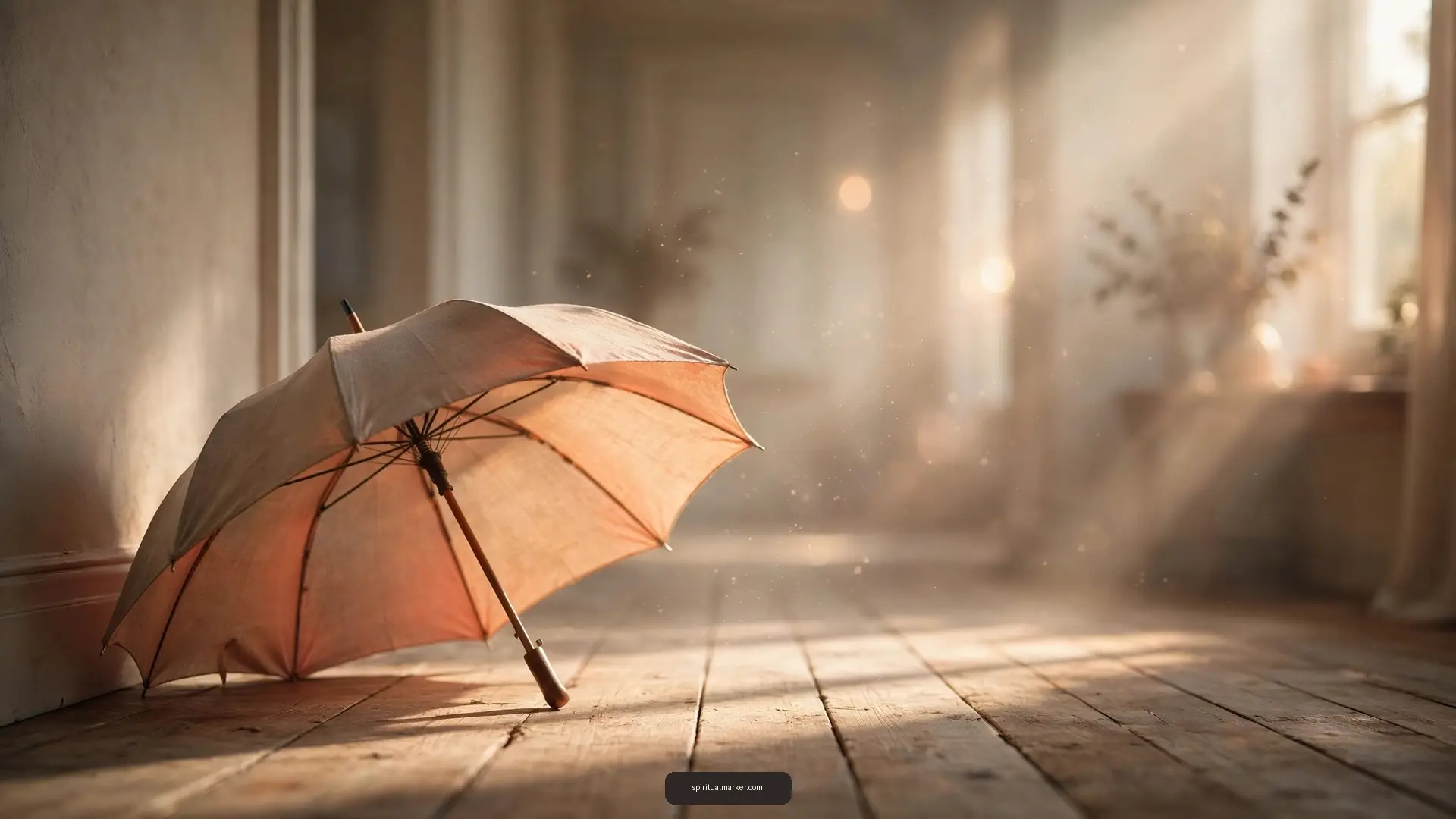
You reach for your umbrella indoors. Someone in the room gasps. They tell you not to open it inside. You pause and wonder whether this warning carries any real weight. Opening an umbrella indoors is one of the most recognized superstitions in the world. People across generations and cultures have treated this act as a serious omen. Yet most have never stopped to ask where this belief actually comes from or what it truly means on a deeper, spiritual level.
The superstition is older than most people realize. It crosses continents, religions, and centuries of human experience. Some trace it to ancient Egypt. Others connect it to Victorian England. Many spiritual traditions assign profound symbolic weight to the simple act of opening a protective canopy under a roof. The umbrella, in countless cultures, is not merely a tool for rain. It is a sacred symbol of protection, divine shelter, and cosmic order.
Whether you believe in superstitions or approach this with healthy skepticism, the layers of meaning around this act deserve your attention. Bad luck from opening an umbrella inside may have practical roots, spiritual dimensions, or both. This article breaks down every angle so you can form your own informed understanding.
Key Takeaways
- The superstition has ancient roots. The belief that opening an umbrella indoors brings bad luck traces back to ancient Egyptian solar worship and protective canopy rituals. It is not a modern invention.
- Umbrellas carry powerful spiritual symbolism. Across multiple cultures and spiritual traditions, the umbrella represents divine protection, royal authority, and a shield against negative spiritual forces.
- Opening one indoors disrupts sacred spiritual boundaries. Many traditions teach that opening an umbrella inside invites chaos, disturbs household spirits, or offends protective deities tied to the home.
- There are also practical historical origins. Early metal-spring umbrellas were dangerous to open indoors. This real physical risk likely reinforced the spiritual warning already present in older belief systems.
- The symbolism varies by culture but the warning is universal. From African kingdoms to Asian imperial courts to European folklore, the message remains consistent: the umbrella belongs in the open, under the sky, where its spiritual function is properly honored.

What Is the Umbrella and Why Does It Carry Spiritual Weight?
Before addressing whether opening an umbrella inside brings bad luck, you need to understand what the umbrella actually represents in the human story. Most people see it as a practical object. Ancient civilizations saw something entirely different. They viewed the umbrella as a portable sky, a miniature dome that mirrored the heavens above. When a person stood beneath one, they stood under a symbol of the cosmic canopy that shelters all of creation.
In ancient Egypt, parasols and canopies were held over pharaohs and deities during processions. They represented the vault of the sky goddess Nut, who arched her body over the earth to protect it. To open such a sacred canopy indoors, away from the sun and sky it was meant to honor, was considered an act of spiritual disrespect. It pulled a sacred symbol out of its proper context and into an enclosed, earthly space where it did not belong.
Across Asian cultures, particularly in China, India, and Southeast Asia, the umbrella served as a royal emblem of power and divine favor. Only rulers and high priests carried ornate ceremonial umbrellas. The number of tiers on an umbrella signaled rank. Multiple tiers meant higher divine connection. To casually open such a symbol in a common indoor space carried a sense of dishonoring the sacred. The spiritual energy of the umbrella required the open sky, not closed walls, to function properly.
The umbrella therefore carries a deeply layered identity. It is protective, powerful, and spiritually charged. These qualities explain why its misuse indoors became associated with disrupted luck, broken protection, and invited misfortune.
Where Did the Superstition About Opening an Umbrella Indoors Begin?
The origins of the bad luck umbrella indoors superstition come from multiple historical streams. Each one adds a layer of explanation. Together, they form a compelling picture of why this warning has survived for so long.
The most frequently cited origin points to ancient Egypt. Egyptians used large feathered or papyrus canopies to shield royals and sacred statues from the sun. These canopies were seen as extensions of the sun god Ra’s protection. Opening one indoors was a direct affront to the solar deity. It implied that you were placing artificial, human-made shelter above divine, solar protection. Ancient Egyptians believed this would anger the sun god and bring punishment in the form of misfortune.
A second major origin comes from 18th-century Britain. The steel-spring umbrella became widely used in England during this period. These early versions were bulky and spring-loaded with significant force. Opening one indoors in a small room could injure a person, knock over objects, or damage furniture. The physical danger was real. Parents and household staff began warning children never to open umbrellas inside. Over time, that practical safety warning merged with older spiritual superstitions to create a stronger, culturally reinforced belief.
A third stream flows from African spiritual traditions. In several West and Central African cultures, the umbrella was a royal and priestly symbol. It belonged exclusively in outdoor ceremonial contexts. Bringing it inside and opening it disrupted the boundary between sacred outdoor spiritual space and the protected indoor domestic space. This was believed to invite ancestral displeasure and misfortune into the home.
These three origins, Egyptian solar worship, British practical danger, and African ceremonial tradition, all converged through trade, colonialism, and cultural exchange into the widespread superstition known today.
7 Spiritual Meanings of Opening an Umbrella Inside
1. Disrupting Divine Protection Over Your Home
The most fundamental spiritual meaning of opening an umbrella indoors is that it disrupts the divine protection already present in your home. Every spiritual tradition, from indigenous animism to organized religion, recognizes the home as a sanctified space. It holds the energy of your family, your ancestors, and the spiritual forces that watch over you. The home has its own energetic field, and that field requires respect.
The umbrella, as a symbol of protective spiritual energy, carries its own distinct force. When you open it indoors, you introduce a competing protection into an already protected space. Spiritual traditions teach that two overlapping protective forces do not simply double your safety. They create interference. Think of it like two radio signals playing at the same frequency. The result is static, not clarity. This energetic interference weakens your home’s spiritual defenses and creates vulnerability to negative energies, bad luck, and misfortune.
Many practitioners of feng shui specifically caution against this act for exactly this reason. Your home’s chi, or life force energy, flows in specific patterns. An opened umbrella indoors blocks and redirects that chi in unpredictable ways. The disruption does not need to be permanent to cause harm. Even a brief disturbance in the home’s energy field can invite unwanted influences that linger long after the umbrella is closed.
Respecting your home as a sacred space means understanding which energies belong there and which do not. The protective energy of the umbrella belongs under the open sky, where it shields you from the elements above. Bringing it inside confuses its spiritual purpose and weakens both its power and your home’s natural protection.
2. Offending the Spirits of the Household
Across many world cultures, the home is inhabited by household spirits or spiritual guardians. In Roman tradition, these were called the Lares and Penates. In Slavic cultures, the spirit is known as the Domovoi. Chinese tradition speaks of kitchen and door gods. African traditions honor ancestral spirits who dwell within the family home. These spiritual guardians are sensitive to disturbances. They expect respect and proper order within their domain.
Opening an umbrella indoors is widely interpreted in these traditions as a form of disrespect to household spirits. The sudden expansion of the umbrella’s canopy in a closed indoor space mimics the act of claiming shelter within someone else’s territory. To household spirits, this looks like an intrusion. It signals that the person opening the umbrella does not trust or acknowledge the protection already provided by the spirits of the home. This act of perceived disrespect triggers withdrawal of spiritual favor, leaving the household exposed to misfortune.
In some Eastern European folk traditions, people believed that household spirits would leave a home entirely if they witnessed such disrespect. A home without its protective spirit was considered deeply unlucky. Illness, financial loss, and family conflict were all attributed to homes that had lost their spiritual guardians. People went to significant lengths to appease offended household spirits, including leaving offerings, burning herbs, and performing rituals of apology.
Whether or not you personally believe in household spirits, the underlying teaching carries wisdom. The home deserves reverence. The energies and presences that make a home feel safe and warm are real, even if their exact nature remains mysterious. Careless acts disturb that sacred atmosphere, and their consequences are felt in ways that may not be immediately obvious but become apparent over time.
3. Blocking the Flow of Positive Energy and Luck
In both Eastern and Western spiritual frameworks, luck is not a random accident. It is a flow of positive energy that moves through your life, your home, and your relationships. This flow responds to your actions, your intentions, and the symbolic meanings of what you do. When you perform an act loaded with negative symbolic energy, you create a blockage in that flow. The positive energy that would have reached you gets redirected or stopped entirely.
Opening an umbrella indoors creates exactly this kind of blockage. The umbrella, when opened inside, physically blocks light and space within a room. Spiritually, it performs the same function on an energetic level. It creates a dome of stagnant energy within the home’s energy field. Positive chi, blessings, and fortunate circumstances cannot penetrate this stagnant zone. They find another path around it, one that does not lead to you. This is why so many people report a string of small misfortunes following this act.
Numerologists and energy healers point out that the umbrella’s circular shape, when opened, creates a closed circle of energy indoors. In sacred geometry, a closed circle indoors represents containment and limitation. It energetically signals to the universe that you are closing yourself off from incoming blessings. The number associated with the umbrella’s ribs, typically eight, is significant. Eight is the number of cycles and infinity in numerology. Opening those eight ribs indoors is said to close off an infinity of potential blessings.
The solution taught across spiritual traditions is simple but powerful. Keep the umbrella closed indoors. Open it only when you step outside and actively need its protection. This preserves the flow of positive energy through your home and signals to the universe that you remain open to receiving good fortune.
4. Invoking the Symbolism of Rain and Hardship
The umbrella exists for one primary purpose: to protect against rain. Rain, in many spiritual and mythological traditions, carries dual symbolism. It represents cleansing, renewal, and divine blessing on one hand. On the other, it represents hardship, grief, and overwhelming emotional challenges. When you open an umbrella indoors, where no rain exists, you create a powerful piece of sympathetic magic. You symbolically invite the rain, and everything it represents, into a space that was dry and safe.
In sympathetic magic, which forms the basis of countless folk traditions worldwide, like attracts like. An object associated with rain, opened in a space, draws rain energy into that space. This is not literal rain. It is the energetic equivalent: emotional overwhelm, financial hardship, conflict, illness, or a general sense that things are going wrong without explanation. Folk practitioners across Europe, Africa, and the Americas identified this principle independently, which speaks to its deep intuitive truth.
In West African Vodun tradition, objects carry the spiritual signature of their purpose. An umbrella’s spiritual signature is bound to water, sky, and protection from elemental forces. Activating that signature indoors calls those elemental forces into your home in a chaotic, uncontrolled way. The rain energy does not flow gently. It floods. This is why many practitioners of traditional African spirituality treat the accidental indoor opening of an umbrella as a serious matter requiring immediate spiritual cleansing of the space.
You do not need to accept every aspect of sympathetic magic to see the wisdom here. Actions carry meaning. Objects carry associations. When you activate a rain tool in a dry space, you are performing a symbolic act with real psychological and, many believe, spiritual consequences. Treating your environment with symbolic awareness is a form of spiritual intelligence that has served humanity well across thousands of years.
5. Challenging the Authority of the Sun and Sky
Returning to the Egyptian origin of this superstition reveals a deeply cosmic layer of meaning. Ancient Egyptians believed that the canopy held over sacred figures and deities represented the sky itself. The sky belonged to Ra, the sun god, and to Nut, the sky goddess. Opening a sacred canopy indoors, away from the sun and open sky, was an act of cosmic defiance. It implied that human-made shelter could replace divine, solar protection.
This theme of challenging divine authority through the misuse of sacred objects appears across many religious traditions. In Hindu cosmology, the sacred umbrella called the Chattra represents Mount Meru, the cosmic axis connecting earth and heaven. The Chattra appears over deities and kings as a symbol of divine mandate from the heavens. To open such a symbol under a roof, cut off from the heavens above, severs that connection. It places the person in a spiritually isolated state, cut off from cosmic blessings and divine guidance.
Buddhist teachings on the ceremonial umbrella reinforce this idea. The Dhamma Chakka, the wheel of dharma, is sometimes represented by the multi-tiered umbrella in Buddhist iconography. It points upward, toward enlightenment and the spiritual heights. Opening an umbrella indoors inverts this symbolism. Instead of pointing toward spiritual elevation, the opened canopy becomes a ceiling, a limitation, a cap on spiritual growth and divine connection.
The spiritual teaching embedded here is one of humility before the cosmos. You are not greater than the sky. Your indoor ceiling is not a replacement for the divine canopy above. Keeping the umbrella closed indoors is a daily practice of acknowledging that some forces and symbols belong to a realm larger than your walls can contain.
6. Awakening Dormant Negative Energies
Many spiritual traditions teach that certain spaces accumulate dormant negative energies over time. These energies rest quietly, kept in check by the protective atmosphere of a well-maintained home. They do not cause harm as long as the home’s spiritual balance remains intact. However, certain actions can awaken these dormant energies and set them in motion. Opening an umbrella indoors is considered one such action in numerous folk traditions.
The logic follows the same pattern as disturbing a sleeping animal. The disturbance causes a reaction that would not otherwise have occurred. In Hoodoo tradition, a rich African American folk magic system, the sudden expansion of any object indoors can be interpreted as a disruption of the spiritual environment. Practitioners describe it as stirring the spiritual sediment of a space. The negative energies that had settled to the bottom rise up, cloud the spiritual atmosphere, and begin influencing daily life in harmful ways.
In Celtic folk belief, spirits and energies attached to a home responded strongly to sudden changes in the environment. An umbrella opened without warning indoors created exactly this kind of sudden change. The rapid expansion, the change in the room’s spatial dynamics, and the foreign energy introduced by the umbrella’s protective symbolism all combined to create a disturbance that could awaken what the Celts called troublesome spirits. These spirits were not necessarily evil, but once awakened, they created confusion, mischief, and misfortune.
Modern energy healers who work with space clearing practices echo this understanding in contemporary terms. They teach that every home holds layers of energy, some positive, some neutral, some negative. Careless actions disturb those layers. The best spiritual hygiene involves not only clearing negative energy when it arises but also avoiding the actions that stir it up in the first place. Keeping the umbrella closed indoors is one such preventive measure.
7. Signaling Spiritual Unpreparedness for Life’s Storms
The final and perhaps most personally relevant spiritual meaning of opening an umbrella inside addresses your readiness for life’s challenges. The umbrella is a symbol of preparedness and protection. You carry it so that when the storm comes, you are ready. Opening it indoors, before any storm arrives, in a space where no rain falls, is a deeply symbolic act of misaligned preparedness. You are preparing for the wrong thing, in the wrong place, at the wrong time.
Many spiritual teachers and mystics interpret this superstition as a lesson about timing and discernment. Life requires you to know when to protect yourself and when to remain open. Opening your defenses prematurely, in safe spaces, depletes the energy and effectiveness of those defenses when real challenges arise. The person who opens their umbrella before the rain comes wastes their protection. The person who opens spiritual defenses in a safe home space drains the protective energy that should be preserved for genuine trials.
In Taoist philosophy, this idea connects to the concept of Wu Wei, or non-action, acting in harmony with the natural flow of circumstances. Opening an umbrella indoors violates Wu Wei. It introduces protective action where none is needed. This creates disharmony in your personal energy field. Disharmony invites exactly the kind of misfortune you were trying to prevent. The Taoist teaching is clear: use protective tools only when protection is genuinely needed. Trust that you are safe when you are safe.
This meaning invites personal reflection. Are there areas of your life where you are armoring yourself unnecessarily? Are you closed off in spaces and relationships where openness would serve you better? The umbrella indoors becomes a mirror. It reflects the places where fear-based protection is blocking your natural flow of joy, connection, and good fortune.
Opening an Umbrella Indoors Across Cultures and Religions
The bad luck umbrella superstition is not confined to one corner of the world. Its reach across cultures is remarkable. This universality strongly suggests that the underlying intuition, that the umbrella is spiritually significant and must be used with care, taps into something genuinely deep in human spiritual awareness.
In Chinese culture, the word for umbrella sounds similar to words associated with scattering and separation. Opening an umbrella indoors in Chinese folk belief risks scattering the family’s luck and separating members from one another. This is why you rarely see umbrellas opened casually inside Chinese homes, particularly traditional ones where feng shui principles guide the arrangement of space and energy.
In India, the ceremonial umbrella called the Chhatri or Chattra is a sacred royal symbol. It appears in Hindu temples sheltering deities and in royal processions marking divine kingship. The Chhatri belongs in sacred outdoor spaces where the sky can receive its upward-pointing symbolism. Opening such an umbrella inside a home or temple without proper ritual context is considered deeply inauspicious. It disrupts the flow of prana, or life force energy, within the space.
In West African and diaspora traditions including Candomble and Vodun, the umbrella appears in ceremonies honoring specific Orishas or divine spirits. Opening an umbrella associated with these spirits in inappropriate contexts, such as inside a home without ritual preparation, is believed to summon those spirits in their unpredictable, challenging aspects rather than their protective, benevolent ones. The result is perceived as spiritual chaos and misfortune.
In Victorian Britain, where the modern form of this superstition became deeply embedded in popular culture, the combination of practical danger and lingering older beliefs created one of the strongest cultural prohibitions in British domestic life. Even today, British people report a stronger aversion to this act than most other nationalities, reflecting the depth of its cultural imprinting.
The Umbrella in World Mythologies and Folklore
World mythologies are filled with canopy imagery that directly connects to the umbrella superstition. These stories reinforce the spiritual logic behind the warning and give it a narrative framework that makes it easier to understand.
In Egyptian mythology, the sky goddess Nut stretched her star-covered body across the sky to shelter the earth from chaos. She was the original divine canopy. The pharaoh’s ceremonial umbrella was a physical representation of Nut’s protective arch. Opening this sacred symbol indoors was equivalent to pulling Nut away from the sky and trapping her in a room. This separated the earth from its divine protector and left humanity exposed to the forces of chaos represented by Set, the god of disorder.
In Norse mythology, the world tree Yggdrasil spread its branches over all the nine worlds like a cosmic canopy. It sheltered gods, humans, and spirits alike. Norse folk traditions inherited a deep reverence for canopy symbolism. Bringing a protective canopy, such as an umbrella, into the home and opening it was interpreted as a poor imitation of Yggdrasil’s sacred sheltering function. Mortal imitations of divine acts invited hubris and its consequences.
In Japanese folklore, the kasa or umbrella appears in numerous ghost stories and supernatural tales. The Kasa-obake is a spirit that inhabits old umbrellas. It represents a kind of spiritual residue that accumulates in objects over time. An old umbrella opened carelessly indoors was believed to release this spirit into the home, creating disturbances, strange sounds, and general misfortune. This piece of Japanese folklore adds another layer to why casually opening umbrellas indoors was considered spiritually dangerous.
In Celtic mythology, the concept of thin places, locations where the veil between the physical and spiritual worlds is fragile, plays a central role. Folk practitioners believed that certain actions could create temporary thin places inside a home. Opening an umbrella indoors was one such action. It momentarily thinned the veil, allowing spirits and energies from the other side to enter the domestic space uninvited.
What Does the Bible Say About Omens and Superstitions Like This?
The Bible does not specifically address umbrellas, since they were not part of the ancient Near Eastern world in the form we know today. However, biblical principles speak directly to questions about omens, superstitions, and the spiritual significance of everyday objects and actions.
The book of Deuteronomy 18:10-12 warns against divination and seeking omens, categorizing such practices among the things the Lord considers detestable. From a strict biblical standpoint, placing spiritual significance in acts like opening an umbrella indoors falls into a category the Bible treats with caution. Christians are directed to trust in God’s protection rather than in the symbolic power of objects and acts.
However, many Christian theologians and folk traditions draw a distinction between formal divination and cultural awareness of symbolic meaning. Respecting symbolic meaning in everyday actions is not the same as practicing divination. Christians who acknowledge this superstition often frame it not as a spiritual law but as a reminder of humility, respect for sacred spaces, and trust in divine protection rather than human or symbolic mechanisms.
The Psalms are filled with canopy imagery. Psalm 91:4 speaks of God covering the faithful with feathers and spreading wings as a shelter. This imagery mirrors the symbolic function of the umbrella in ancient cultures. The biblical writer clearly understood the protective power of the canopy symbol. From this perspective, using the umbrella carelessly, even opening it in the wrong context, can be read as a failure to honor the deeper spiritual meaning that the canopy has always carried in human consciousness.
In Christian folk traditions, particularly in the American South and in parts of Europe, the umbrella superstition persisted alongside Christian faith without contradiction. People viewed it as practical wisdom passed down through generations rather than a competing spiritual system. The underlying message, that the home is a sacred space deserving of respect and care, aligns naturally with Christian teachings on stewardship of one’s household and honor for the sacred.
Is There Any Real Evidence That Opening an Umbrella Indoors Causes Bad Luck?
The honest answer is that no controlled scientific study has confirmed a causal relationship between opening umbrellas indoors and negative life outcomes. Science does not currently have the tools to measure luck, spiritual energy, or symbolic causation. This absence of scientific proof does not invalidate the superstition, but it does place it firmly in the realm of belief, psychology, and cultural meaning rather than empirically verified fact.
What psychology does offer is the concept of the nocebo effect. This is the opposite of the placebo effect. If you believe strongly that something will harm you, that belief itself can create harmful outcomes. A person who opens an umbrella indoors and is convinced bad luck will follow may become more anxious, less attentive, more prone to errors, and more likely to interpret ordinary setbacks as bad luck. The belief creates a self-fulfilling cycle. This is not imaginary. It is a well-documented psychological mechanism with measurable effects on behavior and perception.
Cultural anthropologists point to a different kind of evidence. The near-universal presence of this superstition across unconnected cultures suggests that it taps into a genuine pattern in human experience. When diverse civilizations independently arrive at the same symbolic conclusion about an object, that convergence carries weight. It suggests the intuition behind the superstition connects to something real in human psychology, in the physics of space and symbol, or in the spiritual dimensions of experience that science has not yet fully mapped.
Many people who have casually disregarded this superstition report nothing unusual. Many others report a notable string of small misfortunes following the act. The variable outcomes suggest that personal belief, spiritual sensitivity, and context all play roles in whether the symbolic act produces real-world effects. This is consistent with how most spiritual principles operate: they tend to have stronger effects on those who are attuned to symbolic meaning.
How to Reverse Bad Luck If You Have Already Opened an Umbrella Indoors
If you have already opened an umbrella indoors and feel concerned about potential negative spiritual effects, numerous folk traditions offer remedies. These rituals are designed to cleanse the space, restore spiritual balance, and redirect positive energy back into your home.
The most commonly recommended remedy across multiple traditions is immediate space clearing. Open your windows and doors to allow fresh air and natural light to flow through the space. Many spiritual practitioners also recommend burning sage, palo santo, or frankincense to cleanse the energy of the room. Move the smoke into every corner while setting a clear intention for cleansing and renewal.
In Chinese folk tradition, the antidote to disrupted household luck involves making a small offering to the household spirits. This can be as simple as placing fresh flowers, fruit, or incense at the threshold of the home and speaking words of respect and acknowledgment. The act signals to the spiritual guardians of the home that you recognize the disruption and wish to restore harmony.
A widely shared remedy in European folk magic instructs the person who opened the umbrella indoors to take the umbrella immediately outside, open and close it three times under the open sky, and then bring it back inside closed. This ritual symbolically recalibrates the umbrella’s energy, placing it back under the sky where it belongs before returning it to its proper indoor resting position.
In Hoodoo tradition, sprinkling a mixture of salt and Van Van oil across the threshold of the home and near the spot where the umbrella was opened is used to clear negative energy and restore the home’s spiritual boundaries. Salt in particular is a universal spiritual cleanser used in dozens of traditions for exactly this kind of protective reset.
Beyond these specific rituals, the most powerful remedy in any tradition is intentional refocusing. Anxiety and fear about bad luck amplify negative outcomes through the nocebo effect. Actively choosing to release concern, to trust in the resilience of your home’s spiritual field, and to affirm positive energy through prayer, affirmation, or meditation neutralizes much of the psychological impact of the superstition.
Other Umbrella Superstitions Worth Knowing
The bad luck of opening an umbrella indoors is the most famous umbrella superstition, but it is far from the only one. The umbrella carries a rich web of folk beliefs across cultures that reveal just how deeply this object is embedded in humanity’s symbolic imagination.
Dropping an umbrella is considered bad luck in many traditions. Some folk beliefs specify that the person who drops the umbrella should not pick it up themselves. Having someone else retrieve it avoids transferring the bad luck directly from the ground to the owner’s hands. This mirrors superstitions around dropped objects in general and reflects the belief that contact with fallen objects carries energetic contamination.
Giving an umbrella as a gift is considered deeply unfortunate in several Asian cultures. The word for umbrella in Chinese, san, is a homophone for the word meaning to scatter or break apart. Gifting an umbrella symbolically wishes separation and breakup on the recipient. This superstition is taken seriously enough that umbrellas are one of the most carefully avoided gift items in traditional Chinese culture, alongside clocks and shoes.
Placing an umbrella on a bed, particularly an open one, is considered especially bad in many traditions. The bed is the most personal space in a home, associated with rest, vulnerability, and intimate life energy. An umbrella on the bed introduces the same disruptive energy as opening one indoors, but in a space where you are most spiritually exposed. Folk traditions across Europe and Asia warn against this act specifically.
Finding an abandoned umbrella and bringing it home without cleansing it first is also cautioned against in many folk systems. Abandoned objects, especially ones with strong symbolic associations, may carry the energetic residue of their previous owners. Cleansing a found umbrella before using it is recommended to avoid inheriting whatever spiritual baggage it may carry.
What Should You Actually Do: Practical and Spiritual Guidance
You now have a thorough understanding of the spiritual, cultural, and psychological dimensions of this superstition. The question of what to actually do with this knowledge is personal. Your spiritual framework, cultural background, and personal relationship with symbolic meaning all factor into your choice.
From a purely practical standpoint, keeping umbrellas closed indoors costs you nothing. The act of following this simple guideline is effortless, risk-free, and culturally respectful in nearly every social context. There is no rational argument for ignoring a widespread cultural belief when following it requires no sacrifice at all.
From a spiritual standpoint, treating your home as a sacred space with its own energetic integrity is deeply beneficial regardless of your specific belief system. The habits of mind and action that this superstition encourages, namely respect for the home, awareness of symbolic meaning, and thoughtfulness about the energies you introduce into your living space, are genuinely good spiritual practices.
If you are drawn to energy work, feng shui, or folk spiritual traditions, taking this superstition seriously as a spiritual principle makes complete sense. The layers of meaning explored in this article give you more than enough reason to honor the warning. The spiritual cost of disregarding it is potentially real within these frameworks, while the cost of following it is zero.
If you are skeptical and hold a more secular worldview, the superstition still offers you something valuable: an invitation to develop symbolic awareness. The way you treat objects and spaces reflects and shapes your relationship with the world around you. Treating objects carelessly, without awareness of their cultural and symbolic weight, tends to create an environment of spiritual and psychological carelessness. The reverse is also true. Treating everyday objects and spaces with intention builds a life of greater meaning, stability, and inner richness.
A Final Note
The question of whether it is bad luck to open an umbrella inside has led us on a journey spanning ancient Egypt, Victorian England, African kingdoms, Hindu cosmology, Celtic folklore, and modern psychology. What began as a simple superstition reveals itself to be a sophisticated, cross-cultural spiritual teaching about respect, sacred space, symbolic awareness, and the proper use of protective power.
The umbrella is more than a rain tool. It is a symbol of divine protection, cosmic order, and spiritual shelter that has occupied a sacred place in human consciousness for thousands of years. The near-universal warning against opening it indoors reflects a collective, cross-cultural wisdom about maintaining that sacred symbolism with care and intention.
Whether you view this as spiritual truth, cultural wisdom, or psychological self-management, the underlying message is one worth keeping close. Treat your home as sacred. Respect the symbolic weight of the objects around you. Use protective tools with awareness, not carelessness. These principles serve you well in every dimension of life, visible and invisible.
If you feel drawn to pay closer attention to the symbolic energies in your home and daily life, start small. Notice the objects around you. Ask what they represent. Handle them with the care their meaning deserves. You may find that this kind of symbolic awareness quietly transforms the quality of your everyday experience in ways that feel genuinely fortunate.