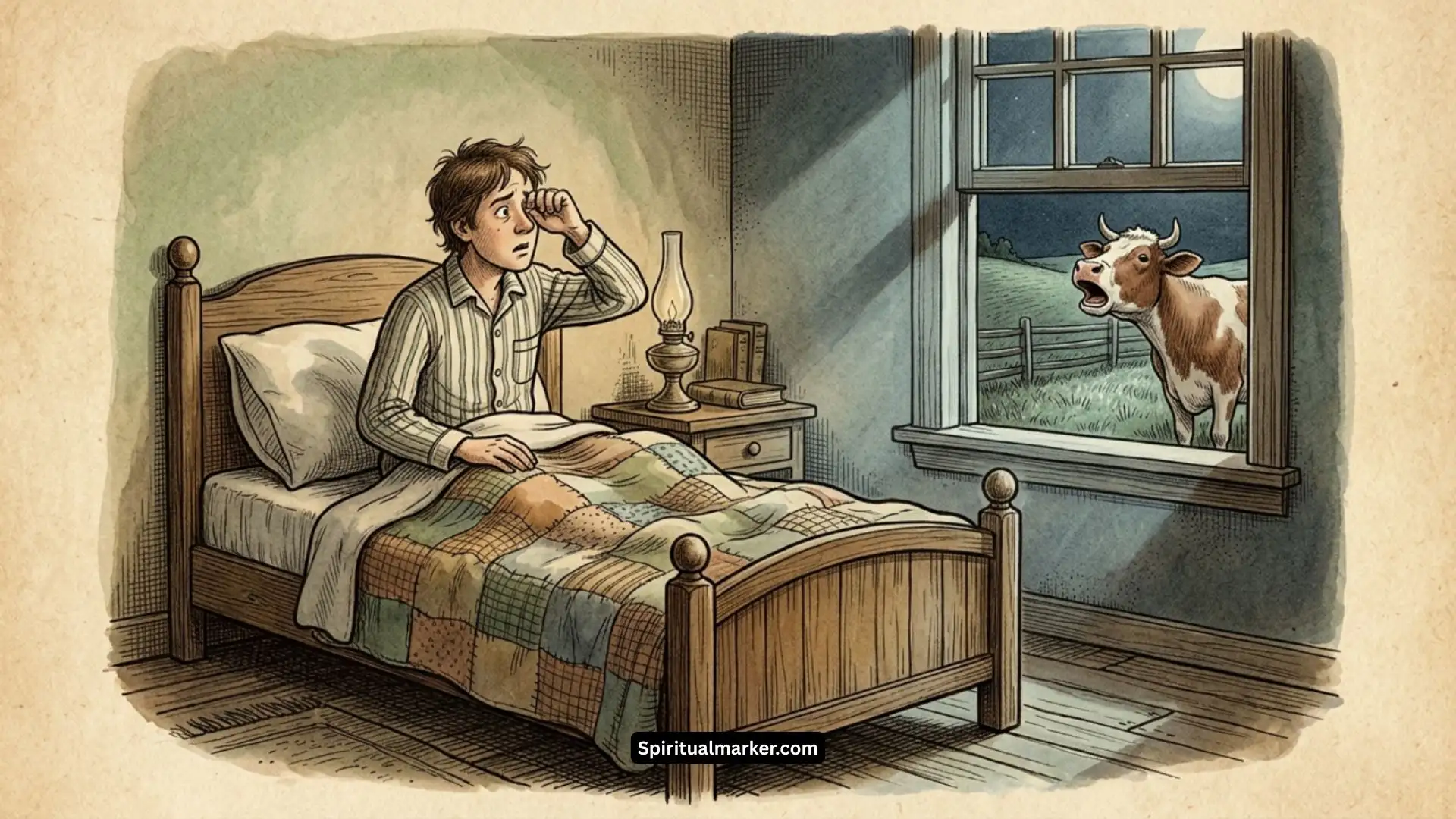
Hearing a cow moo at night is an eerie and unusual sound. The low, mournful call can carry across fields and silence. Many people sense a spiritual message in the noise.
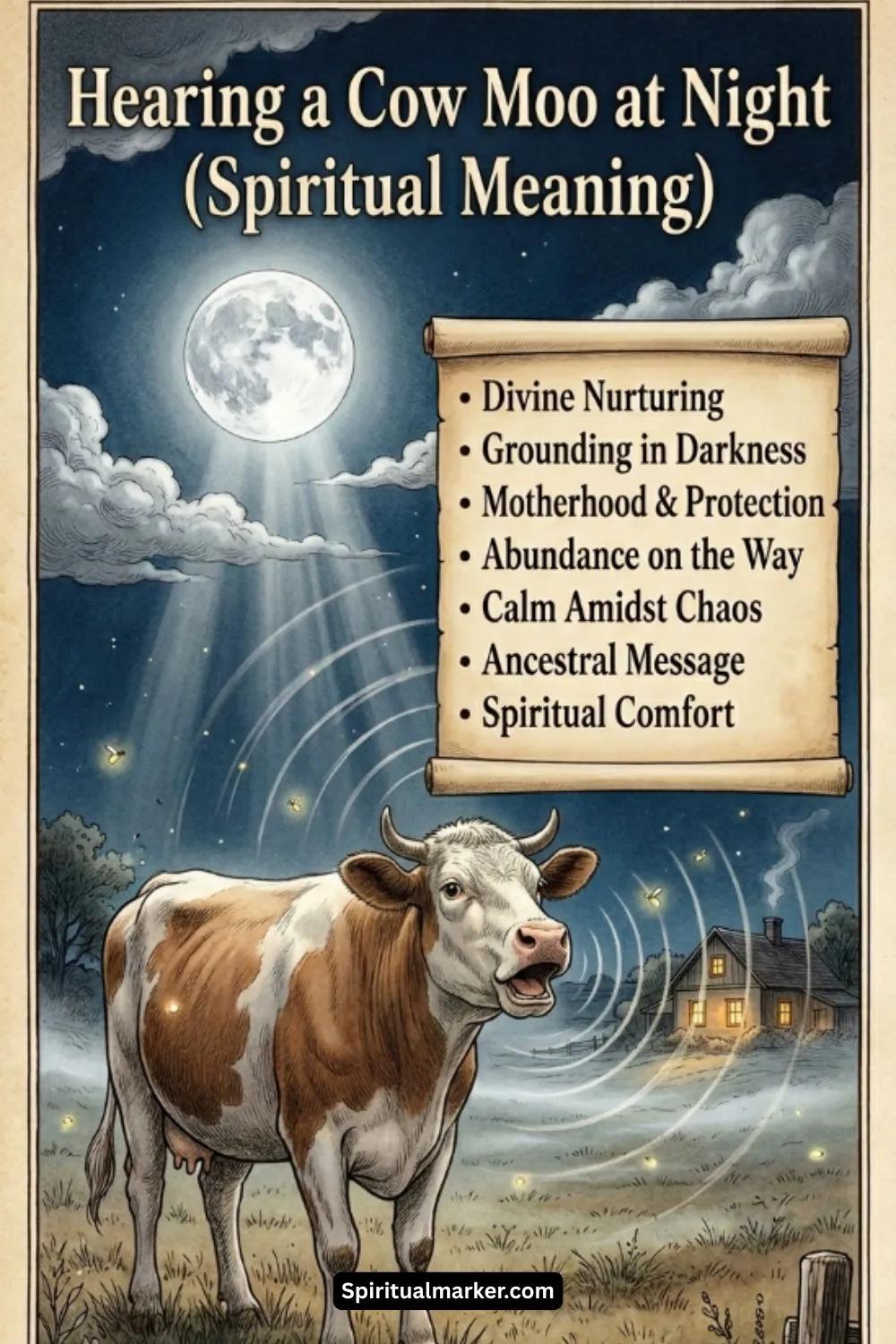
The hearing a cow moo at night spiritual meaning often involves nurturing, abundance, and spiritual grounding. Cows are symbols of fertility and provision. A spiritual meaning of a cow shares that cow-symbol focus, though the article covers the animal in depth.
Some traditions view a night moo as a sign of a spirit nearby or a call to pay attention. Others see it as a reminder to nurture yourself. The number of moos can add detail.
If you hear a cow moo at night, it may bring a message of comfort. A spiritual meaning of hearing a horn out of nowhere also deals with unexplained sounds, though a horn carries a more urgent energy.
Natural Reasons Cows Moo at Night
Before diving into symbolism, it helps to understand the practical side of this behavior, since spiritual meaning often sits alongside a grounded explanation rather than replacing it. Cows are herd animals, and much of their vocal communication relates to locating other members of the group. A cow separated from her calf, even briefly, will often moo persistently until reunited, and this separation anxiety does not pause simply because the sun has gone down. Farmers who have spent years around cattle will tell you that nighttime mooing frequently traces back to a calf wandering too far, a fence gap allowing separation, or feeding schedules shifting.
Weather changes also play a documented role. Cattle are known to react to shifts in barometric pressure, humidity, and approaching storms well before humans notice anything different. A sudden drop in temperature or an incoming weather front can trigger restlessness throughout a herd, leading to vocal behavior after dark. Predators or unfamiliar movement near a pasture can produce the same response, since a cow sensing a coyote, a stray dog, or even an unfamiliar human nearby will often call out as a defensive reaction. None of this contradicts the spiritual reading of the moment. Many traditions actually build on these natural triggers, treating a cow’s heightened sensitivity to its surroundings as exactly why the animal makes a fitting messenger between the physical world and something less visible.
Key Takeaways
- A cow mooing at night is widely viewed as a spiritual signal tied to protection, abundance, and emotional release rather than pure coincidence.
- Many cultures connect this sound to ancestral messages or a warning about upcoming change in the household.
- In Hindu tradition, the cow holds sacred status, so a nighttime moo can be read as a blessing or a call toward mindfulness.
- Superstitions around this sound vary by region, ranging from signs of good fortune to folk warnings about illness or loss.
- The meaning you take from the moment often depends on your personal circumstances, the tone of the sound, and the feeling it stirs in you.
Why Animal Sounds at Night Carry Spiritual Weight
Night has always been treated as a thin space between the ordinary world and something larger. Sounds that break the silence after dark tend to register more strongly in the mind. You are more alert, more sensitive, and more likely to attach meaning to what reaches your ears. This is part of why an owl’s call, a dog’s howl, or a cow’s moo at night feels different from the same sound at noon. The nervous system treats nighttime stimuli as information worth examining closely, and spiritual traditions built on top of that natural alertness.
Cows specifically hold a layered symbolic history. They represent nourishment, since they provide milk that sustains entire communities. Steadiness and patience also define them, given their slow, grounded movement. The animal also represents the maternal, since a mother cow’s bond with her calf is intense and well documented. When this animal makes noise specifically at night, away from its usual daytime rhythm, many believe it points to something stirring beneath the surface of ordinary life. The sound becomes a kind of punctuation mark, asking you to pay attention to what is happening around you or within you.
What Does It Mean When You Hear a Cow Moo at Night?
At its core, hearing a cow moo at night is interpreted as a nudge from the universe, your environment, or your own intuition. It rarely stands for one single fixed meaning. Instead, it functions more like a mirror, reflecting whatever is most active in your life at that moment. Worry over finances can turn the sound into a sign of coming abundance. If you have been grieving, it might feel like a visit from someone who has passed. An anxious decision sitting on your mind might turn the same sound into a warning to slow down and think things through.
This flexibility is not a weakness in the symbolism. It is actually the point. Spiritual signs work alongside your own life context rather than replacing it. A cow’s moo heard during a calm, settled period of life often feels like quiet reassurance. The same sound heard during a stressful week can feel sharper, almost like a call to action. Your emotional state at the moment of hearing it shapes how the message lands, which is why two people in the same town can hear the same sound and walk away with completely different impressions.
7 Spiritual Meanings of Hearing a Cow Moo at Night
Hearing a cow moo during the day rarely feels unusual. At night, however, the same sound can feel surprisingly significant. When the surroundings become quiet, an unexpected animal call naturally draws our attention, and many spiritual traditions have attached symbolic meaning to animals and their behavior. Cows, in particular, carry strong associations with nourishment, stability, motherhood, abundance, and sacredness across different cultures.
From a spiritual perspective, hearing a cow moo at night is sometimes interpreted as more than an ordinary sound. The meaning often depends on what was happening in your life when you heard it, how frequently the cow mooed, and what emotions the experience brought up. These interpretations are rooted in symbolism and folklore rather than scientific evidence, yet they can provide a meaningful framework for personal reflection.
1. A Sign of Protection and Grounding
One of the most common spiritual meanings associated with hearing a cow moo at night is protection, stability, and grounding. Cows are physically strong yet generally calm animals, and their symbolic presence has long been connected with security, nourishment, and a stable way of life. Hearing one during the stillness of night can therefore be interpreted as a reassuring sign during periods when life feels uncertain.
This interpretation becomes particularly meaningful when you are dealing with family concerns, financial pressure, relationship difficulties, or major decisions. The cow’s call may symbolically represent a return to solid ground after a confusing or emotionally unsettled period. Rather than representing danger, the sound can be viewed within spiritual folklore as a reminder that stability remains available even when circumstances feel unpredictable.
The nighttime setting can strengthen this symbolism because darkness often represents uncertainty or the parts of life that we cannot clearly see. A cow’s voice breaking through that darkness may therefore symbolize reassurance, suggesting that you are not as unsupported or unprotected as you may currently feel.
2. A Symbol of Abundance and Prosperity
Another important spiritual meaning of hearing a cow moo at night relates to abundance, prosperity, and material security. This association has deep historical roots. In agricultural societies, cows provided milk, labor, offspring, and other resources, making them valuable sources of household wealth. A healthy herd could directly contribute to a family’s ability to survive and prosper.
Because of this historical connection, cows frequently became symbols of prosperity in folklore and religious traditions. Hearing a cow moo unexpectedly at night can therefore be interpreted as a symbolic indication that a period of greater abundance may be approaching. The idea does not necessarily refer only to money. Abundance can also represent food, opportunities, supportive relationships, successful work, or greater stability in everyday life.
The context of your circumstances can shape this interpretation. If you have been working toward a financial goal, waiting for an opportunity, or trying to create greater security for your family, the sound may feel particularly meaningful. Spiritually, it can represent the principle that periods of effort and uncertainty can eventually give way to greater stability and nourishment.
3. A Connection With Ancestors or Departed Loved Ones
In various folk traditions, animals have sometimes been regarded as symbolic messengers between the physical world and the spiritual realm. This belief appears in different forms across cultures, including traditions in parts of South Asia, Africa, and rural Europe. Within these beliefs, an unusual animal sound may be interpreted as carrying a message from someone who has passed away.
A cow’s nighttime moo can therefore hold a particularly emotional meaning for someone who is grieving. If the sound occurs during a period when you have been thinking intensely about a deceased parent, grandparent, partner, or another loved one, spiritual interpretation may connect the experience with remembrance or ancestral presence.
This does not mean that the cow is literally communicating a message from the deceased. There is no scientific evidence establishing such communication. Rather, the symbolism can provide an emotional language for grief. The cow, traditionally associated with nourishment, care, and family life, can become a powerful symbol through which memories of someone important return to consciousness.
For some people, the experience feels comforting because it transforms an unexpected nighttime sound into a moment of remembrance. The meaning comes partly from the emotional connection the sound creates within the listener.
4. A Call for Emotional Release
Hearing a cow moo at night can also symbolize emotional release, expression, and the need to acknowledge feelings that have remained hidden. Cows generally appear quiet and composed, yet their vocalizations can suddenly become surprisingly loud. From a symbolic perspective, that contrast can represent emotions that remain contained for a long time before eventually demanding attention.
This interpretation can become especially relevant when you have been suppressing sadness, frustration, anger, loneliness, or anxiety. Nighttime often provides fewer distractions than daytime, giving thoughts and emotions more space to surface. An unexpected sound in that quiet environment may therefore become a symbolic reflection of what is happening internally.
Spiritually, the cow’s call can represent the idea that what remains unexpressed does not necessarily disappear. Feelings may continue to exist beneath the surface until something prompts us to acknowledge them. The sound can consequently symbolize a moment when your inner emotional world is asking to be heard rather than ignored.
The interpretation is less about the animal itself and more about the emotional response the experience creates. If the moo immediately made you feel emotional, reflective, or unusually alert, that personal reaction may be central to the symbolism.
5. A Sign of Change and Transition
Another spiritual interpretation connects hearing a cow moo at night with change, transition, and the closing of one phase of life. Across many forms of folklore, unexpected animal behavior or sounds have been viewed as signs that circumstances are shifting. A nighttime call can therefore symbolize movement from something familiar toward something new.
This interpretation may resonate when you are approaching a significant life transition. You might be considering a career change, moving to another place, entering or leaving a relationship, or simply reaching a point where your priorities are changing. The cow’s voice can symbolically represent an interruption of the familiar routine and a reminder that life does not remain permanently still.
The transition does not necessarily have a negative meaning. In fact, cows traditionally represent continuity, nourishment, and grounded living. Their symbolism can suggest that change does not have to mean losing stability. Instead, it may represent carrying the valuable parts of your previous life into a new chapter.
From a spiritual perspective, the nighttime setting adds another layer. Darkness can symbolize the unknown, while the sound provides a clear signal within it. Together, these elements can represent moving forward even when you cannot yet see exactly what lies ahead.
6. Maternal Energy and Nurturing
Because cows have a strong biological and cultural association with motherhood, milk, nourishment, and caregiving, hearing a cow moo at night can also symbolize maternal energy and nurturing. In many societies, the cow has represented the life-giving qualities associated with motherhood because of its ability to nourish others through milk.
Spiritually, this symbolism can extend beyond biological motherhood. It may represent caring for children, supporting family members, protecting someone vulnerable, or developing greater compassion toward yourself. The nighttime call can therefore be interpreted as a symbolic reminder of the importance of care, connection, and emotional nourishment.
This meaning may feel especially relevant when relationships have become distant or when responsibilities have caused you to neglect emotional connections. The cow’s association with nurturing can represent the quieter responsibilities that hold families and communities together. It points toward care that may not always receive attention but remains essential.
There is also a self-nurturing dimension to this interpretation. A person can spend considerable energy supporting everyone else while ignoring their own emotional needs. Within spiritual symbolism, the cow’s nighttime call may represent the nurturing principle itself, bringing attention to the balance between giving care and receiving it.
7. Spiritual Awakening and Heightened Awareness
The seventh interpretation connects hearing a cow moo at night with spiritual awakening, intuition, and heightened awareness. This symbolism has particular relevance in traditions influenced by Hindu thought, where the cow holds a highly respected and sacred position. The cow has historically been associated with qualities such as nourishment, generosity, nonviolence, and reverence for life.
Within this broader spiritual framework, hearing a cow during the quiet hours of night can be interpreted as an invitation to become more attentive to your inner world. Night often creates a naturally reflective environment. With fewer external distractions, thoughts, memories, intuitions, and emotions may become more noticeable.
A sudden moo can therefore act symbolically as a moment of interruption. It captures your attention and brings you fully into the present. From a spiritual perspective, that heightened awareness can be associated with becoming more conscious of patterns in your life, your emotional responses, and the choices you are making.
This interpretation does not mean that every nighttime cow sound represents a supernatural message. Rather, the spiritual significance comes from the meaning you attach to the experience. In this sense, the sound becomes a prompt for awareness, encouraging you to pay closer attention to what has been happening within and around you.
Cow Moo Meaning and Symbolism Across Cultures and Religions
Across Hindu tradition, the cow holds a status far above an ordinary farm animal. It is considered sacred, often associated with the goddess Kamadhenu, a divine cow believed to grant wishes and provide endless nourishment. Hearing a cow at night in many Hindu households is treated with reverence rather than alarm, often interpreted as a blessing entering the home. Some families even pause to offer a quiet prayer of gratitude when this happens, treating the sound as confirmation that sacred energy is present nearby.
In parts of West Africa, cattle hold deep cultural significance tied to wealth, lineage, and social standing. Among certain Maasai and Fulani communities, cattle are viewed almost as family members, and unusual behavior, including nighttime mooing, is taken seriously as a potential sign related to the herd’s wellbeing or the family’s fortune. European folk traditions, particularly in agrarian regions of Ireland, Wales, and parts of Eastern Europe, carried beliefs that cattle could sense supernatural presence before humans could. A cow growing restless or vocal at night was sometimes seen as the animal reacting to something unseen passing through the area, whether a spirit, a weather shift, or an approaching stranger.
Celtic mythology also placed cattle at the center of major legends, most notably in the tale of the Brown Bull of Cooley, where cattle were treated as prizes worth going to war over. This elevated status meant that any unusual cattle behavior, including vocalizing after dark, was watched closely by communities who depended on their herds for survival. Meanwhile, in many Christian farming communities across the American South and rural Europe, a cow’s nighttime call was sometimes linked to the manger scene from the nativity story, where cattle were present at the birth of Christ. This association softened the sound into something gentle, almost sacred, rather than something to fear.
Cow Symbolism in World Mythologies
Ancient Egyptian mythology placed the cow goddess Hathor at the center of fertility, motherhood, and joy. Hathor was often depicted with the head of a cow or wearing cow horns, and she was associated with music, dance, and the nurturing of both the living and the dead. A cow’s sound within this mythological frame was never just noise. It echoed the voice of a goddess tied to life’s continuation. Norse mythology tells of Audhumla, a primeval cow whose milk fed the first being in the universe, Ymir. This story positions the cow as a literal source of creation, reinforcing the idea across Northern European folklore that cattle carry cosmic significance far beyond their farmyard role.
In Greek mythology, cattle appear repeatedly, including the story of Io, a woman transformed into a cow by Zeus, and the famous cattle of the sun god Helios, which were considered untouchable and sacred. These myths reinforced the idea that cattle were not ordinary animals but creatures tied closely to divine will and consequence. Hindu mythology returns again here, since beyond Kamadhenu, the cow is also linked to Lord Krishna, who spent his youth as a cowherd. This connection cemented the cow’s symbolic place as gentle, protective, and spiritually significant throughout South Asian storytelling traditions that continue to shape belief today.
Chinese tradition places the ox, a close relative of the cow, among the twelve animals of the zodiac, representing diligence, strength, and dependable fortune. A person born in the Year of the Ox is traditionally described as steady and trustworthy, qualities that mirror how the animal itself behaves. Within this framework, an unexpected nighttime sound from cattle has sometimes been folded into broader beliefs about fortune shifting, since the ox already symbolizes the slow, certain arrival of reward through patience. Several Native American communities that later incorporated cattle into their agricultural life, particularly after European contact, developed their own layered beliefs, often blending existing animal-spirit traditions with new livestock. In these blended traditions, an animal’s unusual vocalization at night was frequently treated the way any unexpected animal behavior might be treated, as a moment calling for quiet observation rather than panic, with elders sometimes consulted to help interpret what the moment meant for the community.
Rural communities across the American South developed their own distinct layer of cattle folklore, shaped heavily by a blend of Christian belief, African oral tradition, and Appalachian superstition. In many of these communities, a cow calling out after dark without an obvious cause was treated as a sign tied closely to the household rather than the wider land, often interpreted as a relative letting the family know they were thinking of them from afar. Grandmothers in these traditions frequently passed down small rituals tied to the moment, such as pausing to say a quiet word of thanks or stepping outside briefly to check the sky before returning to bed. These regional customs rarely appear in formal religious texts, yet they shaped how entire generations of farming families related to the animals living alongside them, treating the cow not simply as livestock but as a quiet participant in the rhythm of the household’s spiritual life.
Cow Moo Biblical Meaning and Significance
Scripture references cattle frequently, often as symbols of provision and blessing. In Genesis 41, Pharaoh’s dream features seven fat cows followed by seven lean cows, a vision Joseph interprets as a forecast of abundance followed by famine. This passage shaped centuries of biblical interpretation around cattle as messengers of coming seasons, whether prosperous or difficult. The dream did not center on the cows’ sound, but the symbolism of cattle as forecasters of change carried forward into broader spiritual thought.
Job’s story also references cattle as evidence of God’s provision, listing livestock among the blessings restored to him after his suffering. This reinforces a biblical thread connecting cattle to divine restoration and material wellbeing. Within Christian nativity tradition, though not explicitly detailed in the Gospels themselves, longstanding custom places oxen and cattle at the manger where Christ was born, a detail that shaped centuries of art and storytelling. This cultural layer is part of why some Christian communities treat a cow’s call at night with a sense of quiet reverence rather than unease, tying the sound back to a scene of humble sacredness.
Superstitions About Hearing a Cow Moo at Night
Folk superstition tends to be more direct and immediate than broader spiritual symbolism, often tied to specific outcomes expected within days rather than abstract life themes. In several rural European and American farming traditions, a cow mooing persistently at night without clear cause was taken as a sign that weather was about to shift, often toward storms or sudden temperature drops. Farmers paid close attention to this pattern since livestock were believed to sense atmospheric pressure changes before humans could.
Other superstitions lean toward household fortune. A single, calm moo heard once in the night has been viewed in some communities as a sign of good luck arriving soon, particularly related to money or a successful harvest. In contrast, repeated, distressed mooing was sometimes treated as an omen of illness within the family or the herd itself, prompting farmers to check on both their animals and their relatives the following morning. Certain Eastern European folk beliefs held that a cow mooing toward a specific house, rather than into open air, indicated that house would soon receive important news, whether a birth, a death, or a significant visitor.
A more comforting superstition found across multiple cultures suggests that a cow’s nighttime call protects the household from negative energy simply by being voiced. The sound itself was thought to disrupt and scare away lingering bad spirits, functioning almost like a natural alarm system rooted in spiritual folklore. This belief still surfaces today among people raised in farming families, even if they no longer live near livestock themselves.
Does the Color of the Cow Change the Meaning?
Several folk traditions add another layer to this symbolism by factoring in the color of the cow making the sound, particularly in regions where cattle color holds cultural weight. A white cow mooing at night is frequently linked to purity and spiritual clarity in South Asian folklore, often interpreted as an especially gentle or sacred message reaching the listener. White cattle appear repeatedly across religious art and temple iconography, reinforcing this association with higher spiritual significance compared to other colors.
A black cow, by contrast, has historically carried more mixed symbolism depending on the region. In some European folk traditions, black cattle were linked to protection and warding off misfortune, treated almost as guardians of the farm. Other traditions read a black cow’s nighttime call as a closer cousin of warning, particularly around health or loss, echoing broader folk beliefs about black animals signaling caution rather than danger outright. A brown or red cow tends to fall into more grounded symbolism tied to the earth itself, often associated with stability, fertility, and steady material gain rather than dramatic spiritual events. These color-based distinctions are not universal across every tradition, but they show how deeply specific some folk belief systems became when interpreting something as seemingly simple as an animal’s call after dark.
Dreaming About a Cow Mooing: Spiritual and Psychological Meanings
Dreams featuring a mooing cow tend to follow patterns similar to waking interpretations, though dream context adds another layer. A calm cow mooing gently in a dream is frequently linked to feelings of contentment and emotional security in waking life. It often appears during periods when a person feels supported, whether by family, friends, or their own internal stability. Psychologically, this type of dream may reflect a settled subconscious state, free from major unresolved conflict.
A cow mooing loudly or in distress within a dream often points to suppressed emotion trying to surface. Dream analysts frequently connect this imagery to a need for emotional honesty, suggesting the dreamer may be avoiding a difficult conversation or holding back feelings that need expression. If the cow appears trapped, isolated, or unable to reach its herd while mooing, this can reflect feelings of loneliness or disconnection from a support system in the dreamer’s waking life.
From a spiritual lens, dreaming of a cow’s moo at night specifically, rather than during daylight hours within the dream, often carries the same weight as hearing it while awake. It suggests a message arriving from a deeper, less conscious part of the self. Many spiritual practitioners encourage paying attention to the emotional tone of the dream rather than the literal imagery, since fear, comfort, or urgency within the dream often points more accurately to its underlying meaning than the cow itself.
How Many Times a Cow Moos at Night and What It Could Mean
Some folk traditions assign specific meaning to the number of times a cow moos in a single instance, similar to numerology practices found in other animal-based superstitions. A single moo heard once and not repeated is often viewed as a simple acknowledgment, sometimes tied to a minor sign of reassurance rather than a major message. Two moos in close succession have been associated in some traditions with balance, suggesting two related events or decisions are connected and worth examining together.
Three moos, a number carrying spiritual weight across countless traditions, is sometimes interpreted as confirmation, almost like a stronger version of a single sign. This pattern echoes the broader cultural tendency to treat the number three as significant in religious and spiritual contexts more generally. Mooing that continues well beyond three calls, especially if it sounds distressed or frantic, is more commonly tied to the superstition of an approaching warning rather than calm reassurance, prompting many traditional households to check on their animals, their land, or their family’s wellbeing without delay.
What to Do When You Hear a Cow Moo at Night
If a cow’s moo pulls you from sleep, the first helpful step is simply noticing how you feel before your mind starts assigning meaning. Fear, calm, curiosity, and sadness each point toward different interpretations, so your initial gut reaction often matters more than the sound itself. Sit with that feeling for a moment instead of reaching immediately for your phone to search for answers. Many spiritual practitioners suggest a brief pause of stillness right after an unexpected sign like this, treating it as a small window for reflection rather than a problem requiring instant resolution.
Next, consider what has been occupying your thoughts recently. A moo heard during a week of financial stress lands differently than one heard during a season of grief or a period of major decision-making. Matching the sound to your current circumstances, rather than searching for one universal definition, tends to produce a more accurate and personally useful interpretation. Some people find it helpful to write down the date, approximate time, and their emotional state immediately afterward. Patterns often become clearer in hindsight, especially if a similar sign repeats during a meaningful stretch of weeks or months.
If you live near actual cattle, it is also worth a practical check the next morning. Confirming that the herd is safe, the fencing is intact, and no calf has wandered off rules out the mundane explanation first. Once the practical side is settled, you are free to sit with the spiritual reading without second-guessing whether something simpler was actually at play. This two-step approach, checking the physical world before settling into the symbolic one, tends to bring more peace of mind than choosing one explanation and ignoring the other entirely.
A Final Note
A cow moo at night carries centuries of layered meaning, shaped by religion, regional folklore, and personal intuition. None of these interpretations require belief in the supernatural to hold value. Many simply offer a structured way to pause, reflect, and notice what is happening in your own life at the moment the sound reaches you. If this happens to you, consider sitting with the feeling it brings rather than rushing to label it good or bad. Pay attention to your circumstances, your emotional state, and what you have been holding onto lately. You might also keep a small note of the date and time it occurred, since patterns sometimes reveal themselves only in hindsight. Whatever meaning you choose to take from it, let it serve as a gentle reminder to stay present and aware of the quieter signals moving through your daily life.