
Prehnite is a stone of unconditional love and prophecy. Its pale green color and pearly luster give it a gentle, ethereal appearance. In spiritual practice, prehnite carries calming and protective energy.
The prehnite meaning often involves the heart, spiritual connection, and the ability to see ahead. It is known as the stone that heals the healer. A spiritual meaning of green opal shares that green-stone focus, though opal carries a more renewal-oriented energy.
Prehnite is used in crystal healing to calm anxiety, enhance intuition, and protect the home. It can also symbolize peace and spiritual growth. The stone's energy is gentle and supportive.
If you feel drawn to prehnite, it may signal a need for calm. A spiritual meaning of green jade also deals with green stones, though jade carries a more protective energy.
5 Key Takeaways
- Prehnite is called the stone of prophecy because indigenous shamans in South Africa used it for divination and connecting with spiritual realms.
- It primarily activates the heart chakra and solar plexus chakra, supporting both emotional healing and personal confidence.
- Prehnite promotes unconditional love, inner peace, spiritual clarity, and prophetic dreaming.
- Its energy is gentle but consistent, making it particularly valuable during grief, anxiety, and periods of deep personal transformation.
- Prehnite works well alongside crystals like clear quartz, moss agate, and green calcite to amplify its healing and grounding qualities.
What Is Prehnite?
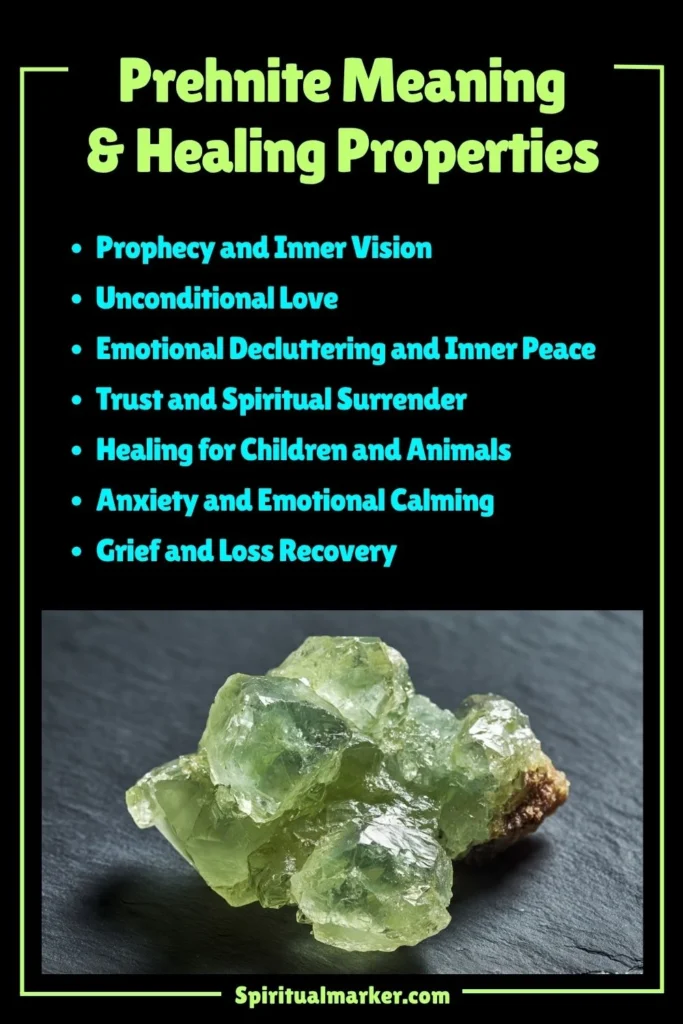
Prehnite is a calcium aluminum silicate mineral that typically forms in pale green, yellow-green, or sometimes colorless shades. Its appearance is often described as translucent to semi-transparent, with a soft, almost glowing quality that makes it visually distinctive. Some specimens carry internal inclusions of epidote needles that give them a mossy, botanical appearance, which deepens their connection to nature symbolism.
It forms primarily in low-grade metamorphic rock and in the cavities of basalt, andesite, and granite. The mineral crystallizes in orthorhombic structures and often appears as botryoidal (grape-like) masses, tabular crystals, or barrel-shaped forms. Deposits exist across multiple continents, with notable sources in South Africa, Australia, China, Scotland, France, and the United States, particularly in New Jersey and Connecticut.
Its hardness measures between 6 and 6.5 on the Mohs scale, which makes it reasonably durable for jewelry use while still requiring careful handling. Unlike jade or serpentine, which share a similar color palette, prehnite has a softer visual presence and a noticeably lighter weight. Spiritually, it also carries a distinctly different energy, one focused more on inner vision and emotional clarity than on protection or grounding alone.
Key Properties at a Glance
| Property | Details |
|---|---|
| Primary Color | Pale green, yellow-green, colorless |
| Mineral Class | Calcium aluminum silicate |
| Hardness | 6 to 6.5 Mohs |
| Chakra Association | Heart chakra, solar plexus chakra |
| Primary Symbolism | Prophecy, unconditional love, inner peace |
| Main Sources | South Africa, Australia, China, France, USA |
| Transparency | Translucent to semi-transparent |
| Energy Style | Calm, visionary, emotionally healing |
| Common Inclusions | Epidote needles (creates mossy appearance) |
| Spiritual Nickname | Stone of Prophecy, Stone of Dreaming |
Historical Significance and Origins
Prehnite holds the distinction of being the first mineral named after a person. Colonel Hendrik von Prehn served as commander of the military forces of the Dutch colony at the Cape of Good Hope in the 1700s. He brought specimens of this distinctive pale green stone back to Europe, and Dutch mineralogist Abraham Gottlob Werner formally named it in his honor in 1788. That naming marked prehnite as a gemstone of historical significance even before its full spiritual reputation was established.
But the stone’s deeper history belongs to the indigenous peoples of South Africa, particularly the Xhosa and neighboring groups, who recognized prehnite long before European contact. Traditional healers and shamans valued it for its perceived connection with the spirit world and its ability to support prophetic vision. In these traditions, prehnite was not a decorative object. It served a practical spiritual function, used during rituals, divination practices, and ceremonies intended to communicate with ancestors and higher spiritual forces.
In later European lapidary traditions, prehnite became associated with tranquility and clarity of vision. Victorian-era collectors prized it for its unusual color and internal glow. As the 20th century brought renewed interest in crystal healing, prehnite gained wider recognition in metaphysical communities, particularly because of its unique combination of heart-centered energy and intuitive clarity. Today it remains one of the more respected stones in spiritual practice precisely because of that combination.
5 Spiritual Meanings of Prehnite
1. Prophecy and Inner Vision
No other spiritual meaning defines prehnite more completely than its connection with prophecy and inner vision. The stone earned its reputation as the stone of prophecy not through modern crystal marketing but through centuries of indigenous use. South African shamans relied on prehnite precisely because they believed it could open pathways of perception that ordinary awareness cannot access. This tradition of visionary use forms the deepest layer of prehnite’s spiritual identity.
In spiritual terms, prophecy does not necessarily mean predicting specific future events. More often, it refers to a quality of awareness that sees clearly through confusion, self-deception, or emotional noise. Many people move through life making decisions clouded by fear, habit, unresolved emotion, or social pressure. Prehnite spiritually represents the clearing of that mental and emotional interference, allowing a person to perceive situations, relationships, and personal patterns with greater honesty and clarity.
Many crystal practitioners believe prehnite enhances prophetic dreaming and intuitive insight, particularly when placed beneath a pillow or held during meditation before sleep. The idea is that prehnite quiets the surface noise of the waking mind and creates greater receptivity to deeper wisdom, whether that comes through dreams, meditation, prayer, or quiet reflection. Its connection with the higher mind makes it a frequently recommended stone for those developing intuitive or psychic awareness.
This spiritual meaning carries a practical dimension too. People often describe using prehnite during periods of important decision-making, not because they expect supernatural answers, but because the stone seems to help them access their own deeper knowing. When external information becomes overwhelming or contradictory, prehnite’s symbolism encourages a return to inner clarity. That quality of inner listening is what the prophetic tradition ultimately points toward.
2. Unconditional Love
Prehnite is strongly connected with unconditional love in crystal traditions, and this connection goes beyond the romantic or sentimental associations that word often carries. Unconditional love in a spiritual context refers to a quality of acceptance that does not depend on conditions, behavior, or personal merit. It represents compassion extended without expectation of return, which many spiritual traditions across history have identified as one of the highest expressions of spiritual development.
The Christian tradition speaks directly to this concept. In 1 Corinthians 13:4-7, love is described as patient, kind, not easily angered, and keeping no record of wrongs. This portrait of love aligned with unconditional acceptance closely mirrors what prehnite spiritually symbolizes in healing traditions. The stone does not represent passionate emotional love but rather the steady, giving, nurturing form of love that extends equally toward the self and toward others.
Many crystal healers connect prehnite with healing relationships that have been strained by resentment, disappointment, or emotional withdrawal. Its heart chakra energy gently encourages people to release emotional grievances that have calcified into permanent bitterness. Rather than forcing emotional openness before a person is ready, prehnite symbolizes the slow softening of emotional armor over time. This makes it especially meaningful for people who have experienced relational betrayal or long-term emotional hurt.
Its connection with unconditional love also extends inward. Self-love forms a central part of prehnite’s spiritual meaning. Many people extend patience and compassion to others while withholding both from themselves. Prehnite’s energy is widely described as encouraging a gentler, more forgiving relationship with oneself, which forms the necessary foundation for healthy outward relationships. You cannot consistently offer what you have entirely withheld from yourself.
3. Emotional Decluttering and Inner Peace
One of prehnite’s most distinctive spiritual qualities is what many practitioners call emotional decluttering. The stone is often associated with the practice of releasing what no longer serves you, not just emotionally, but mentally, spiritually, and even physically in terms of attachments to objects, relationships, or situations that have passed their natural end. This quality connects prehnite with the broader principle of non-attachment found in Buddhist philosophy and many other contemplative traditions.
People carry enormous amounts of accumulated emotional weight. Unresolved grief, outdated resentments, self-limiting beliefs, guilt from long-past events, and anxious anticipation of future scenarios can all occupy significant mental and emotional space. Over time, this accumulation creates a kind of internal crowding that makes it difficult to think clearly, feel genuinely, or respond freshly to life as it actually presents itself. Prehnite spiritually represents the willingness and the capacity to release that accumulation deliberately.
The inner peace that follows emotional decluttering is a recurring theme in prehnite’s spiritual identity. Many people associate peace with the absence of difficulty, but prehnite’s symbolism points toward something different. It reflects a quality of peace that coexists with life’s challenges because it comes from inner clarity rather than outer circumstance. A person who has released old emotional burdens can face new difficulties from a more stable internal foundation. That is the kind of peace prehnite is said to support.
Practitioners often use prehnite in combination with journaling, meditation, or prayer practices focused on identifying and releasing emotional patterns that feel stuck. The stone’s gentle energy is believed to make the process less overwhelming, allowing emotional material to surface gradually rather than all at once. Many people who work with prehnite during these practices describe a feeling of increased mental lightness and emotional spaciousness that builds steadily over time.
4. Trust and Spiritual Surrender
Prehnite carries deep spiritual meaning around the themes of trust and surrender, concepts that appear in virtually every major spiritual tradition. In Proverbs 3:5-6, the instruction to trust in the Lord with all your heart rather than leaning on your own understanding reflects a principle prehnite’s symbolism mirrors closely. The stone is associated with releasing the compulsive need to control outcomes and replacing it with a more trusting orientation toward life.
Control is one of the most common responses to anxiety and fear. When people feel uncertain about the future, they often compensate by trying to manage every variable, rehearsing every possible outcome, and attempting to force results through will alone. This pattern can feel necessary from the inside, but it consistently generates exhaustion, frustration, and increased anxiety rather than genuine security. Prehnite symbolically challenges this pattern by encouraging trust in a larger unfolding process.
Spiritual surrender as prehnite represents it is not passivity or resignation. It is an active choice to release what cannot be controlled while remaining fully engaged with what genuinely is within one’s responsibility. Many spiritual practitioners who work with prehnite describe this as one of its most practically valuable qualities because it addresses one of the most universal sources of human suffering, namely the painful gap between what is and what a person insists it should be.
This meaning becomes especially significant during major life transitions. When relationships end, careers shift, health changes, or circumstances move in unexpected directions, people frequently resist the new reality. Prehnite’s symbolism of trust and surrender encourages acceptance of what is, not as defeat, but as the necessary precondition for genuine adaptation and forward movement. Its calm, watery green appearance reinforces this message visually, reflecting the quality of water that flows around obstacles rather than fighting them.
5. Healing for Children and Animals
Prehnite holds a somewhat unusual spiritual meaning in crystal traditions because of its strong association with healing for children and animals. Many crystal practitioners describe prehnite as one of the most gentle and nurturing stones available, possessing an energy that feels non-threatening and naturally soothing to those who are emotionally vulnerable, highly sensitive, or who cannot consciously engage with healing work on an intellectual level.
Children who experience anxiety, emotional instability, fear, or the aftermath of difficult family circumstances are sometimes supported with prehnite in holistic wellness practices. Its calming, heart-centered energy is thought to help sensitive children feel emotionally safer without introducing anything overwhelming. The stone carries no intensity or stimulating energy. Its effect is simply quiet, consistent, and gentle, which makes it a natural fit for those who need emotional support without additional stimulation.
Animals, similarly, cannot engage intellectually with healing work but can respond to energetic environments. People who use prehnite near anxious or traumatized animals often report noticeable shifts in behavior over time. While these observations remain anecdotal within the crystal healing community, the consistency of the reports reflects how deeply prehnite’s nurturing reputation has taken hold. Its symbolism as a stone of tender, unconditional care extends naturally to all beings who cannot articulate their emotional needs.
This healing quality for the vulnerable reflects something important about prehnite’s broader spiritual character. The stone does not favor the emotionally sophisticated or spiritually experienced. Its energy is accessible, gentle, and indiscriminate in the most generous sense of that word. It meets people, children, and animals exactly where they are, offering emotional support without conditions or complexity.
6 Healing Properties of Prehnite
1. Anxiety and Emotional Calming
Prehnite is one of the most consistently recommended stones in crystal healing for anxiety relief and emotional calming. Its energy works differently than stimulating stones like citrine or carnelian. Rather than energizing or uplifting in an activating sense, prehnite quiets. It creates a sense of emotional steadiness that many anxious individuals describe as deeply welcome, the feeling of a hand resting calmly on a racing heart.
Anxiety often involves a mind that cannot stop producing worst-case scenarios, cycling through potential problems and rehearsing possible responses to situations that have not yet occurred and may never occur. This mental pattern is exhausting and creates real physiological stress responses even when no actual threat exists. Prehnite spiritually symbolizes the interruption of that cycle, not through suppression but through a gentle redirection toward present-moment awareness.
Many people place prehnite in work environments, meditation spaces, or bedrooms specifically because of this calming effect. Its presence in a space is believed to lower the ambient emotional temperature, creating conditions where the nervous system can regulate more easily. Whether viewed as a spiritual tool or simply as a visual reminder of stillness, prehnite serves this function effectively for many people who incorporate it into daily practice.
2. Sleep and Dreaming Support
Because of its long association with prophetic dreaming and inner vision, prehnite is one of the most commonly used crystals for sleep-related intentions. Practitioners place it beneath pillows, on bedside tables, or hold it during evening meditation as a way of setting an intention for clearer, more meaningful, or more restful dreaming. The stone’s calming energy is also believed to ease the mental overactivity that prevents many people from falling or staying asleep.
Dreams have carried spiritual significance across virtually every human culture. In the biblical tradition, dreams served as a primary channel through which divine guidance was communicated, as seen throughout Genesis, Daniel, and the Gospel of Matthew. Many other spiritual traditions treat the dream state as a threshold between ordinary and higher consciousness. Prehnite’s association with this threshold explains why it has maintained its connection with dreaming across so many different cultural and spiritual contexts.
Even for people who do not attach spiritual significance to dreaming, prehnite’s calming properties make it a practical support for sleep quality. The emotional regulation it encourages during waking hours naturally carries over into the night. People who are less emotionally activated before bed generally fall asleep more quickly, sleep more deeply, and wake feeling more restored. Prehnite’s role in supporting emotional calmness throughout the day thus indirectly supports better rest.
3. Grief and Loss Recovery
Prehnite holds a particular reputation in crystal healing communities for supporting people through grief and loss. Its heart chakra connection makes it naturally relevant during bereavement, but its specific energy quality, gentle, patient, and consistently present, makes it particularly suited to the long and non-linear process of grieving. Loss rarely follows a predictable schedule, and prehnite’s symbolism reflects healing that adapts to that reality.
Grief involves not just sadness but a wide range of emotional experiences including shock, anger, guilt, bargaining, profound loneliness, and eventual, gradual integration. Many people move between these states irregularly, feeling better for a period and then experiencing fresh waves of grief when they least expect it. Prehnite does not symbolize rapid emotional resolution. Instead, it represents the kind of steady emotional companionship that makes the long process of grief more bearable.
Its association with releasing what no longer serves also connects prehnite meaningfully to grief work. Part of the difficulty of loss is the human resistance to accepting that something or someone precious is genuinely gone. Prehnite symbolically supports the gradual movement toward acceptance, not the forced letting go that can feel like betrayal, but the natural softening that allows grief to eventually transform into memory, gratitude, and renewed engagement with life.
4. Strengthening Intuition
As the stone of prophecy, prehnite naturally carries strong associations with intuitive development. Many people experience intuition as fleeting impressions, gut feelings, or quiet inner knowing that arrives without a clear logical explanation. These experiences are easy to dismiss in a culture that prioritizes analytical thinking, but many spiritual traditions across history have treated intuition as a legitimate form of knowing that deserves cultivation and attention.
Prehnite is believed to strengthen the relationship between conscious awareness and this deeper intuitive channel. Practitioners who meditate with prehnite regularly often report increased sensitivity to subtle impressions, clearer inner guidance during decision-making, and a greater ability to distinguish genuine intuitive knowing from anxiety-driven projection. This distinction matters enormously because fear and intuition can feel superficially similar but lead in very different directions.
The stone also supports clairsentience, the intuitive ability to feel information through emotional or physical sensation. Because prehnite enhances emotional awareness and calms the noise that normally drowns subtle perception, many sensitive individuals find it helps them access and trust their empathic or intuitive abilities more consistently. Its connection with the heart chakra means that the intuitive information prehnite supports tends to arrive through feeling rather than purely through intellectual insight.
5. Physical Healing Associations
Within crystal healing traditions, prehnite is associated with several areas of physical wellness, though these associations represent metaphysical beliefs rather than medical claims. Practitioners have historically connected it with kidney and bladder health, the shoulders and chest area, the thymus gland, and the connective tissues of the body. Its connection with water in its physical formation (it forms in hydrothermal deposits) lends symbolic resonance to its association with the body’s fluid systems.
Some crystal healers associate prehnite with supporting the immune system and the body’s natural regenerative processes, possibly because of its connection with the thymus, which plays a central role in immune function. Others use it specifically for shoulder tension, a common area where stress and emotional burden physically manifest. The idea that prehnite helps people release what they carry emotionally aligns symbolically with releasing physical tension stored in the shoulders and upper back.
These physical associations should always be understood as complementary to, not replacements for, professional medical care. Crystal healing practices work best as part of a holistic approach to wellness that includes appropriate physical, medical, and psychological support. Prehnite’s value in the physical domain lies primarily in its support for the emotional states, like chronic stress and anxiety, that are widely recognized as contributors to physical health challenges.
6. Decluttering the Mind and Environment
Prehnite carries an unusual and specific healing property that distinguishes it from many other green stones: its strong association with decluttering, both mental and physical. Crystal practitioners often recommend prehnite to people who feel overwhelmed by possessions, disorganized thinking, cluttered living spaces, or an inability to release things they no longer need. This quality connects to prehnite’s broader symbolism of releasing what no longer serves.
Research in environmental psychology consistently shows that physical clutter increases cortisol levels, reduces the ability to concentrate, and contributes to low-grade anxiety. The mental experience of living with too much physical or cognitive clutter mirrors prehnite’s healing focus precisely. Its symbolism encourages the intentional reduction of unnecessary accumulation, creating mental and physical space for clarity, rest, and renewed creative energy.
Many people keep prehnite in their homes or work environments specifically as a reminder to practice this kind of regular clearing. Whether that takes the form of weekly decluttering sessions, daily mental journaling to process accumulated thoughts, or meditative practices aimed at releasing mental preoccupations, prehnite serves as a consistent symbolic anchor for the intention to maintain inner and outer spaciousness. Its calming visual presence reinforces that intention every time it catches your eye.
Prehnite and Chakra Healing
Prehnite works primarily with two energy centers: the heart chakra (Anahata) and the solar plexus chakra (Manipura). This dual association is one of its most distinctive qualities and explains why so many practitioners find it effective for a wide range of emotional and personal development work.
The heart chakra governs love, compassion, emotional trust, forgiveness, and the ability to form and maintain meaningful connections. When this chakra is blocked, people may experience emotional guardedness, difficulty trusting others, a tendency toward resentment, or a feeling of emotional isolation even in the presence of caring relationships. Prehnite’s heart chakra energy works to gently soften these blockages, encouraging emotional openness that develops at a pace the person can manage rather than all at once.
The solar plexus chakra governs personal will, self-confidence, identity, and the ability to trust one’s own judgment. When this center is disrupted, people may feel indecisive, self-doubting, or easily overwhelmed by others’ opinions and expectations. Prehnite’s solar plexus connection supports the development of a calmer, more grounded sense of personal authority. Rather than the assertive, forceful quality that solar plexus healing sometimes focuses on, prehnite encourages a quieter confidence rooted in self-knowledge and inner trust.
Together, these two chakra connections create a uniquely integrated healing focus. Heart and solar plexus work in tandem to support both emotional health and personal identity. When both are in balance, people tend to form healthier relationships, make more aligned decisions, and navigate emotional complexity with greater steadiness. Prehnite’s ability to address both simultaneously makes it particularly useful for people whose emotional struggles are entangled with self-worth and personal confidence.
How to Use Prehnite for Spiritual and Emotional Healing
People work with prehnite in a variety of ways depending on their intentions and spiritual practice. Meditation remains one of the most common approaches. Holding prehnite during meditation, placing it over the heart or solar plexus, or simply keeping it in your meditation space can help create the emotional calm and inner receptivity the stone is associated with. Many practitioners begin a meditation session by setting a clear intention with their prehnite, whether that involves emotional release, clarity of vision, or deeper sleep.
Wearing prehnite as jewelry keeps its energy in consistent contact with your physical and emotional field throughout the day. Pendants that rest near the heart are especially popular because of prehnite’s heart chakra association. Rings and bracelets also provide regular physical contact, which many practitioners believe strengthens the stone’s consistent influence. Wearing prehnite during emotionally demanding days or significant conversations can serve as a physical anchor for the intention to remain emotionally calm and clear.
Placing prehnite in your living or working environment creates a space-level influence that many people find subtle but significant. Bedrooms, meditation corners, creative workspaces, and areas where emotionally difficult conversations often occur are all popular locations. Some people place prehnite near children’s beds or in spaces where anxious pets spend time, drawing on the stone’s reputation for gentle, nurturing energy accessible to the emotionally vulnerable.
Prehnite also pairs well with journaling practices, particularly those aimed at emotional processing, releasing old patterns, or developing intuitive clarity. Holding it while writing or keeping it beside your journal as you work can help ground the emotional energy stirred up by reflective writing. Its decluttering symbolism makes it a natural companion for any practice focused on identifying and releasing what no longer serves you mentally or emotionally.
Prehnite vs. Other Green Crystals
Prehnite shares visual space with several other green stones, and understanding how it differs helps clarify why someone might choose it specifically. Jade is the most commonly confused stone. Both carry green tones and heart chakra associations, but jade’s energy is traditionally connected with protection, prosperity, and long-term endurance. It feels denser and more protective. Prehnite feels softer, more visionary, and more focused on emotional clearing and inner quiet.
Green aventurine carries a more optimistic, opportunity-oriented energy often associated with luck, confidence, and new beginnings. Where prehnite encourages stillness and inner vision, green aventurine encourages forward movement and fresh starts. Moss agate shares prehnite’s connection with nature and slow, organic growth, but its energy focuses more strongly on patience, abundance, and connection with the earth. It lacks prehnite’s prophetic and emotional decluttering qualities.
Green calcite is perhaps the closest energetic relative to prehnite among green stones because both share a focus on emotional release and heart chakra healing. Green calcite tends to work more dramatically and forcefully, supporting the dissolution of rigid emotional defenses. Prehnite works more gently over a longer period, making it better suited to people who need emotional healing that feels safe and gradual rather than emotionally intense.
Caring for Your Prehnite
Prehnite is reasonably durable at 6 to 6.5 on the Mohs scale but benefits from thoughtful care. Store it away from harder stones like quartz, topaz, or sapphire that could scratch its surface. A soft fabric pouch or padded jewelry box works well. Avoid prolonged exposure to direct sunlight, as extended UV exposure can gradually fade its pale green color over time.
Clean prehnite gently using lukewarm water and mild soap with a soft cloth. Avoid ultrasonic cleaners, steam cleaning, and harsh chemical cleaners. Because prehnite sometimes contains natural inclusions or small internal fractures, thermal shock from extreme temperature changes can also cause stress to the stone. Remove prehnite jewelry before intense physical activity, swimming in chlorinated water, or household cleaning tasks involving chemical products.
For energetic cleansing, many practitioners use moonlight, particularly the full moon, which is considered gentle enough for most stones and highly effective for clearing accumulated energetic residue. Sound cleansing with singing bowls or tuning forks works well, as does smudging with sage, palo santo, or lavender smoke. Some people bury prehnite briefly in dry earth or place it among living plants to reconnect it with nature’s grounding energy, which aligns naturally with prehnite’s own earth and water formation origins.
A Final Note
Prehnite earns its quiet reputation fully. It does not announce itself loudly or demand dramatic attention. Its energy works the way real healing works, gradually, consistently, and with a gentle insistence that creates real change over time. People who give prehnite sustained attention in their practice often report feeling more emotionally clear, more trusting of their inner guidance, and more capable of releasing the accumulated emotional weight that quietly exhausts them.
Its meaning as the stone of prophecy reflects a deep truth about inner wisdom. The clearest vision most people need is not of distant future events but of their own present emotional reality seen without the distortion of fear, old pain, or habitual self-protection. Prehnite supports exactly that kind of honest, clear-eyed seeing.
If prehnite calls your attention, consider keeping it close during meditation, wearing it on days when emotional steadiness feels particularly important, or placing it in a space where you do your most reflective thinking. You might also pair it with rose quartz for amplified heart healing, clear quartz for enhanced clarity, or moss agate for deeper grounding in nature’s patient rhythms. However you choose to work with prehnite, its consistent invitation remains the same: slow down, look inward, release what you no longer need, and trust what you find when you do.