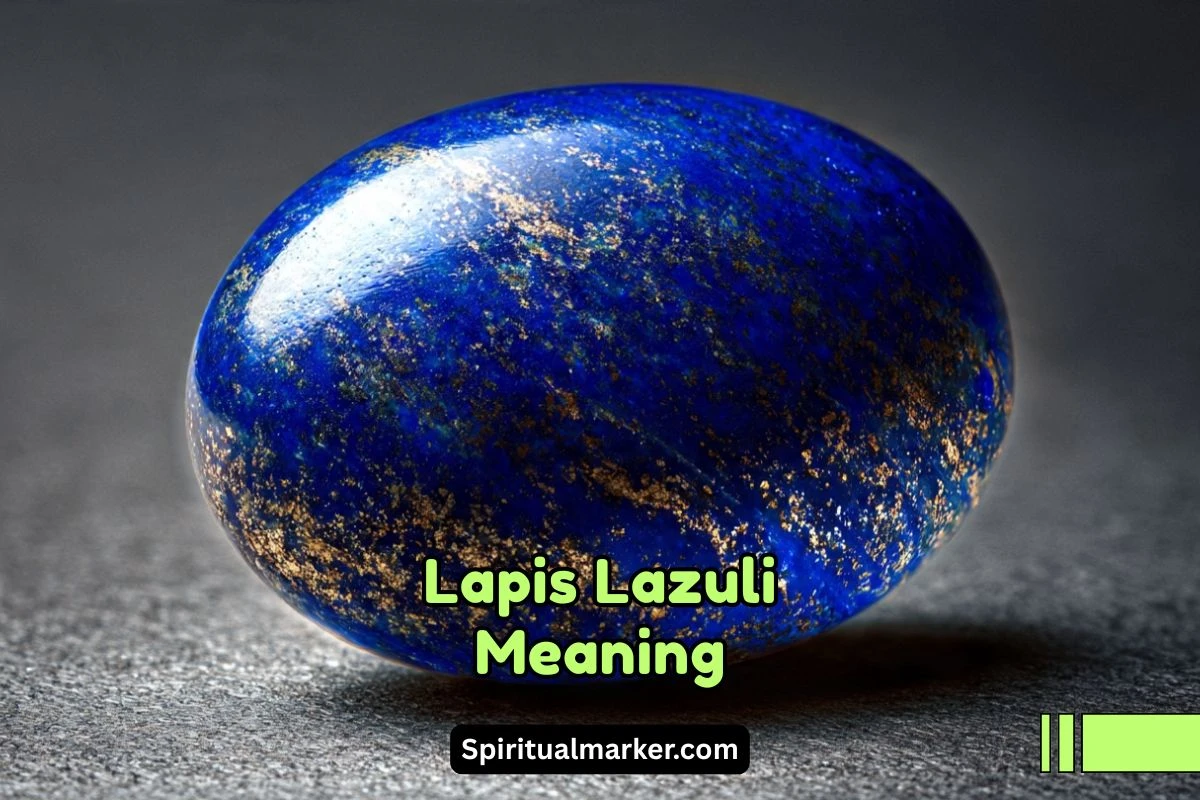
Lapis lazuli is a stone of wisdom and royalty. Its deep blue color flecked with gold evokes the night sky. In spiritual practice, this stone carries powerful and sacred energy.
The lapis lazuli meaning often involves truth, wisdom, and spiritual insight. It is a stone of the third eye and throat chakras, helping to enhance intuition and communication. A spiritual meaning of sodalite shares that blue-stone focus, though sodalite carries a more calming energy.
Lapis lazuli is used in crystal healing to boost confidence, enhance psychic ability, and support meditation. It can also symbolize justice and inner power. The stone's energy is regal and grounding.
If you feel drawn to lapis lazuli, it may signal a need for wisdom. A spiritual meaning of sapphire also deals with blue stones, though sapphire carries a more refined energy.
5 Key Takeaways
- Lapis lazuli symbolizes truth, inner wisdom, royal power, and spiritual awareness.
- It is strongly connected with the third eye chakra and the throat chakra in spiritual traditions.
- Ancient civilizations including Egypt, Mesopotamia, and Greece valued lapis lazuli above almost every other gemstone.
- People use lapis lazuli during meditation, journaling, creative work, and emotional healing to access deeper clarity and authenticity.
- Lapis lazuli scores 5 to 6 on the Mohs hardness scale and requires gentle care to maintain its deep color and polished surface.
What Is Lapis Lazuli?
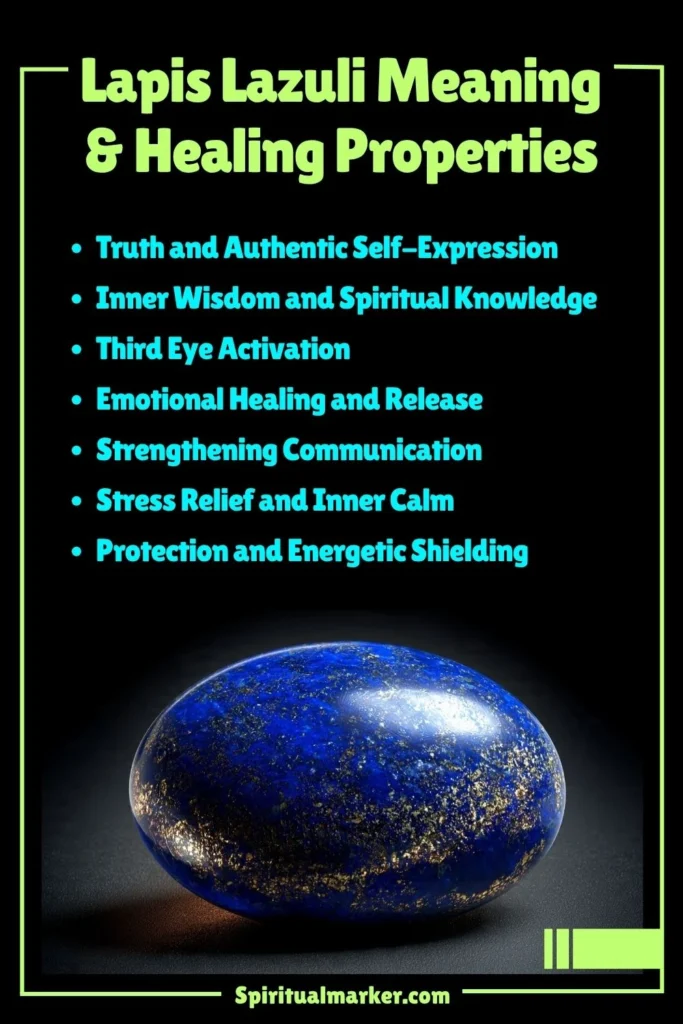
Lapis lazuli is a deep-blue metamorphic rock rather than a single mineral. It forms from a combination of minerals, with lazurite providing its signature blue color, calcite adding white streaks, and pyrite creating the golden flecks that give the stone its characteristic starry appearance. This layered composition makes every piece of lapis lazuli visually unique.
The name itself tells a rich story. Lapis comes from Latin, meaning stone. Lazuli derives from the Persian word lazhward, which referred both to the stone and to the region of Sar-e-Sang in northeastern Afghanistan where the finest deposits have been mined for over 6,000 years. That same Persian root later gave rise to the word azure in English, which is why we still describe clear skies using language borrowed from this ancient blue stone.
Visually, lapis lazuli commands attention in a way that softer stones do not. Its color ranges from medium cornflower blue to deep indigo, sometimes nearly violet in lower-quality specimens and intensely saturated in the finest Afghan material. The golden pyrite inclusions catch light in a way that genuinely resembles stars scattered across a night sky. This visual drama is one reason the stone has attracted human fascination for millennia.
Origins and Formation of Lapis Lazuli
Lapis lazuli forms through a geological process called contact metamorphism. Limestone comes into contact with magma, and the intense heat and pressure transform the original rock’s minerals into new ones. Lazurite, sodalite, calcite, and pyrite crystallize together to create the composite rock that people have prized for thousands of years.
The Badakhshan Province of Afghanistan has produced the world’s most prized lapis lazuli for at least 6,000 years, making it one of the oldest continuously mined mineral deposits on Earth. The ancient Egyptians imported it through long trade routes stretching across Central Asia. Russian deposits in the Lake Baikal region of Siberia also yield high-quality material. Additional sources include Chile, which produces lapis with a more grayish hue, and smaller deposits in Argentina, Pakistan, and the United States.
The rarity and difficulty of extraction historically made lapis lazuli extraordinarily valuable. Mining in the remote Afghan mountains required significant effort, and the stone traveled thousands of miles across dangerous terrain before reaching artisans in Egypt, Mesopotamia, or Greece. This combination of beauty and scarcity reinforced its association with royalty, divine power, and spiritual authority.
Key Properties at a Glance
- Color: Deep blue, indigo blue, royal blue with gold pyrite flecks and white calcite
- Composition: Metamorphic rock containing lazurite, calcite, sodalite, and pyrite
- Hardness: 5 to 6 on the Mohs scale
- Chakra Association: Third eye chakra (primary), throat chakra (secondary)
- Symbolism: Truth, wisdom, royal power, spiritual vision, communication
- Primary Sources: Afghanistan, Russia, Chile, Pakistan, Argentina
- Transparency: Opaque
- Energy Style: Activating, clarifying, empowering, deeply grounding
Historical Use of Lapis Lazuli Across Civilizations
Few gemstones carry as dense a historical record as lapis lazuli. Archaeologists have found lapis lazuli artifacts in burial sites dating back to 7000 BCE in present-day Afghanistan and Pakistan. By 4000 BCE, it was being traded across the ancient world in quantities that suggest an established and sophisticated long-distance commerce network.
In ancient Egypt, lapis lazuli occupied a near-sacred position. Egyptians associated its deep blue with the night sky, the primordial waters, and the divine realm. Pharaohs and high priests wore it in amulets, rings, and ceremonial collars. The famous gold burial mask of Tutankhamun, created around 1323 BCE, incorporates lapis lazuli in the headdress stripes and the eyebrows, demonstrating its place at the absolute apex of Egyptian material culture. Egyptians also ground lapis into kohl eyeliner, believing it protected against the evil eye and strengthened spiritual vision.
In Mesopotamia, Sumerian texts refer to lapis lazuli as the stone of the gods. The Epic of Gilgamesh, one of humanity’s oldest written stories, describes the walls of the legendary city of Uruk as decorated with lapis lazuli. Queen Puabi of Ur, who died around 2600 BCE, was buried with extraordinary quantities of lapis lazuli jewelry, establishing the stone’s status as the ultimate symbol of wealth and divine favor.
During the European Renaissance, lapis lazuli became extraordinarily important in a completely different context. Artists ground the stone into ultramarine pigment, the most vibrant and expensive blue available. A pound of genuine ultramarine cost more than gold at its peak. Painters including Vermeer, Raphael, and Michelangelo used it selectively because of its cost. The tradition of painting the Virgin Mary’s robe in deep blue specifically reflects lapis lazuli’s symbolic association with heavenly truth, divine wisdom, and spiritual purity.
5 Spiritual Meanings of Lapis Lazuli
1. Truth and Authentic Self-Expression
The most consistent spiritual meaning of lapis lazuli across traditions and time periods centers on truth. This stone carries a powerful reputation for helping people access and express their authentic selves without hiding behind fear, social pressure, or self-doubt. In crystal healing traditions, lapis lazuli is frequently described as a stone that makes dishonesty feel uncomfortable and sincerity feel natural.
This connection with truth runs deeper than simple honesty in speech. Many spiritual practitioners believe lapis lazuli works on multiple levels simultaneously. It symbolizes inner truth first, the clarity that comes from knowing your own values, understanding your real feelings, and seeing your own patterns clearly without self-deception. External truthfulness flows more naturally from that internal foundation.
Many people carry hidden truths that they cannot or do not speak. Personal values that feel too vulnerable to share. Creative visions that seem too ambitious to voice out loud. Disagreements with authority figures that feel too risky to express. Lapis lazuli spiritually represents the courage required to bring those inner truths forward. Its energy is often described as emboldening rather than aggressive, supporting confident expression without unnecessary conflict.
This symbolism connects strongly to lapis lazuli’s association with the throat chakra, the energy center linked with authentic communication. When people suppress their truth repeatedly, that suppression creates emotional and energetic tension. Lapis lazuli is believed to ease that tension by encouraging honest expression in a way that feels both grounded and empowered. Many people who work with this stone describe feeling more willing to say what they genuinely mean in conversations that previously felt difficult.
2. Inner Wisdom and Spiritual Knowledge
Lapis lazuli has been called the stone of wisdom across multiple ancient traditions. Its deep blue color, visually reminiscent of the night sky, created a natural symbolic connection with the cosmos, with mystery, and with the kind of knowledge that transcends ordinary experience. Ancient Egyptians believed it carried divine intelligence. Mesopotamian cultures viewed it as a bridge between human consciousness and divine awareness.
In contemporary crystal healing, lapis lazuli symbolizes the wisdom that comes from deep introspection and self-knowledge. This is not the kind of wisdom gathered from books or external sources, though lapis lazuli also traditionally supports intellectual pursuits. This wisdom comes from honest inner reflection, from recognizing patterns in your own life, and from developing the discernment to see through confusion and reach clarity.
Many practitioners who use lapis lazuli during meditation describe an enhanced ability to access intuitive understanding. Questions that felt murky or complicated sometimes become clearer during quiet reflection with the stone nearby. This symbolic function as a clarity amplifier connects directly with the third eye chakra, the energy center associated with intuition, foresight, and inner vision.
The wisdom symbolism of lapis lazuli also connects with its historical use among scholars, scribes, and spiritual leaders. In ancient Egypt, scribes wore lapis lazuli amulets to sharpen their mental precision and align their work with divine truth. Medieval philosophers and alchemists associated deep blue stones with the contemplative mind. These traditions suggest a consistent recognition that lapis lazuli energetically supports the kind of thoughtful, inward-focused mental work that produces genuine understanding rather than surface-level information.
3. Royal Power and Personal Authority
Across virtually every ancient culture that had access to lapis lazuli, the stone became a symbol of royal authority and personal power. Pharaohs wore it. Mesopotamian kings traded for it at enormous cost. The ancient Romans associated it with Jupiter, the most powerful of their gods. This consistent connection with elevated power is not coincidental. It reflects a deep intuitive recognition that lapis lazuli carries a quality of energy that feels authoritative, dignified, and commanding.
In modern spiritual practice, this symbolism translates into what many crystal healers describe as personal sovereignty. This concept refers to the ability to lead your own life from a position of inner strength rather than external permission. People who struggle with self-confidence, who chronically defer to others, or who feel disconnected from their own authority often find lapis lazuli symbolically resonant during those periods of personal work.
The stone’s energy in this context does not feel aggressive or domineering. Instead, practitioners describe it as a stabilizing confidence. The kind of authority that does not need to prove itself through conflict because it is rooted in genuine self-knowledge and clarity of purpose. This quality makes lapis lazuli particularly meaningful for people navigating leadership roles, major life decisions, or personal reinvention periods where a clear sense of self-direction matters most.
There is also a connection here with boundaries and self-respect. Personal authority includes the ability to define what you will and will not accept in your life. Lapis lazuli is sometimes used spiritually during periods when people need to reinforce personal boundaries, assert their needs more clearly, or step into a stronger sense of self-possession after prolonged periods of emotional diminishment.
4. Spiritual Awakening and Third Eye Activation
No stone carries a stronger association with the third eye chakra in crystal healing traditions than lapis lazuli. The third eye, located at the center of the forehead between the eyebrows, governs intuition, spiritual perception, inner vision, and the ability to see beyond surface appearances into deeper patterns. When this energy center feels balanced and active, many people report heightened intuition, clearer dream recall, greater sensitivity to spiritual experiences, and a stronger ability to perceive truth beneath deception.
Lapis lazuli’s spiritual awakening symbolism connects naturally with its deep blue color. In many esoteric traditions, deep blue and indigo represent the frequency associated with expanded spiritual perception and the bridge between ordinary consciousness and higher awareness. Ancient Egyptians explicitly connected the stone with the divine mind. They believed wearing or working with lapis lazuli opened the practitioner’s perception to higher truth and divine guidance.
Many meditation practitioners place lapis lazuli at the center of the forehead during practice, directly over the third eye point. They report that the stone seems to deepen meditative states, encourage more vivid visualization, and sharpen the intuitive impressions that arise during quiet reflection. Whether these experiences reflect energetic properties of the stone or the focused intention of the practitioner, the consistent reports across many different traditions suggest lapis lazuli holds a meaningful place in contemplative spiritual practice.
Spiritual awakening in the lapis lazuli tradition is not described as a sudden dramatic transformation. Instead, it tends to symbolize a gradual deepening of awareness. A person becomes more attentive to intuitive impressions. They begin noticing patterns and synchronicities more readily. They develop a greater capacity for reflection and self-observation. This slow unfolding of inner perception is what many spiritual traditions mean when they speak of awakening, and lapis lazuli’s symbolism aligns precisely with that gradual, deepening process.
5. Creativity, Inspiration, and Intellectual Clarity
Lapis lazuli has a well-documented historical relationship with creative and intellectual work. Scribes in ancient Egypt wore it to sharpen their precision. Renaissance painters ground it into the most prized pigment of their era. Medieval scholars associated deep blue stones with contemplative wisdom. This consistent presence throughout human creative and intellectual history suggests that lapis lazuli’s energetic symbolism genuinely resonates with the kind of mental clarity needed for serious creative and intellectual work.
In crystal healing traditions, lapis lazuli is frequently recommended for writers, artists, musicians, philosophers, teachers, and anyone whose work requires accessing original ideas and clear mental expression. The stone symbolizes the meeting point between inspiration and precision, between the creative impulse and the disciplined mind that shapes it into something communicable. Both qualities matter in any serious creative work.
Creative blocks often develop when a person loses confidence in their own voice or vision. Fear of judgment, perfectionism, self-criticism, or accumulated creative frustration can all sever the connection between inner inspiration and outward expression. Lapis lazuli’s symbolism addresses this specific problem because its dual connection with the third eye and throat chakras covers both the visionary receiving end and the expressive output end of the creative process simultaneously.
Intellectual clarity also features strongly in lapis lazuli’s meaning. Students facing complex subjects, professionals navigating demanding analytical work, and thinkers wrestling with difficult ideas often gravitate toward the stone during mentally demanding periods. Its symbolism centers on the kind of mental sharpness that comes not from stimulation but from quiet, focused depth of attention, the opposite of scattered thinking or mental noise.
6 Healing Properties of Lapis Lazuli
1. Emotional Healing and Release
Lapis lazuli carries strong associations with emotional honesty and healing in crystal traditions. Unlike stones that primarily symbolize emotional softness or gentle comfort, lapis lazuli tends to work at a deeper level. It represents the kind of emotional healing that comes from seeing your own emotional patterns clearly and having the courage to face what you find there honestly.
Many people carry suppressed emotional pain that they have never fully processed. Old grief, unexpressed anger, accumulated resentment, or long-buried disappointment can all continue affecting behavior, relationships, and emotional well-being without the person consciously recognizing the connection. Lapis lazuli in spiritual traditions symbolizes the willingness to look at these deeper emotional realities without flinching away from them.
This emotional healing symbolism connects with lapis lazuli’s reputation for promoting truth. Emotional healing often begins with emotional honesty. Admitting what actually hurts rather than minimizing it. Recognizing genuine feelings rather than rationalizing them away. Acknowledging emotional needs rather than suppressing them in the name of appearing strong. Lapis lazuli spiritually represents that courageous emotional transparency that makes genuine healing possible.
Many practitioners also associate lapis lazuli with releasing emotional patterns that have become habitual without remaining useful. Defensive anger, emotional avoidance, chronic self-criticism, and fear of vulnerability may all have served protective functions at earlier points in a person’s life. Over time, however, these patterns often create more emotional suffering than they prevent. Lapis lazuli symbolizes the insight and inner strength required to recognize those patterns and begin changing them.
2. Strengthening Communication
Lapis lazuli’s connection with the throat chakra gives it a strong healing reputation related to communication at every level. The throat chakra governs not just speech but the full range of expressive activity, including writing, artistic expression, nonverbal communication, and the ability to set clear boundaries with other people. When this energy center feels blocked or imbalanced, people may find themselves struggling to say what they mean, avoiding necessary conversations, or communicating in ways that create misunderstanding.
In crystal healing work, lapis lazuli is frequently used by people who identify as chronically poor communicators or who find themselves regularly misunderstood despite genuine efforts to express themselves clearly. Its symbolic association with truth and clarity in expression makes it particularly relevant for these situations. The stone represents communication that flows from genuine inner clarity rather than from anxiety, people-pleasing, or fear of conflict.
Strengthening communication through lapis lazuli also involves developing the capacity for active listening and empathic understanding. Genuine communication is never one-directional. It requires the ability to hear what others are actually expressing, which often differs from what they are literally saying. The inner quiet and attentiveness that lapis lazuli symbolizes supports this deeper level of communicative understanding as much as it supports clear outward expression.
Many people also work with lapis lazuli during periods involving difficult conversations, negotiations, presentations, or public speaking. The stone’s symbolic association with confident, truth-centered expression can serve as a meaningful energetic anchor during situations that require clear articulation of important ideas or honest discussion of challenging topics.
3. Mental Clarity and Sharpened Focus
Lapis lazuli carries a strong healing reputation for enhancing mental clarity, focus, and analytical precision. This property reflects both its historical use among scribes and scholars and its energetic association with the third eye chakra, which governs clear perception and discernment. People experiencing mental fog, scattered thinking, indecision, or difficulty concentrating often turn to this stone during mentally demanding periods.
Mental clarity in the lapis lazuli tradition differs from the kind of sharpness associated with more stimulating stones. It does not create mental excitation or heightened nervous energy. Instead, its symbolism centers on deep, still focus. The kind of mental clarity that develops when internal noise quiets down and attention settles naturally on what matters most. This quality makes lapis lazuli particularly suited for tasks that require sustained concentration, careful analysis, or extended periods of focused creative work.
Indecision often develops not from a lack of information but from an overabundance of competing thoughts, fears, and external opinions that obscure a person’s genuine inner sense of direction. Lapis lazuli spiritually represents the quiet that reveals what you actually know. When mental noise settles, the decision that aligns with a person’s authentic values often becomes visible with surprising clarity. Many practitioners use the stone specifically during periods of important decision-making for this reason.
4. Stress Relief and Inner Calm
Despite its association with activation and empowerment, lapis lazuli also carries significant calming and stress-relieving properties in crystal healing traditions. Its deep blue color naturally evokes associations with the night sky and deep water, both of which carry strong psychological connections with stillness, depth, and restfulness. Many people find the simple act of holding a piece of lapis lazuli to be physically and mentally soothing.
Stress in many cases develops from two primary sources: external pressure that exceeds a person’s current capacity to manage it, and internal mental noise that amplifies difficulty beyond its actual scale. Lapis lazuli’s healing symbolism addresses both. Its association with wisdom and clarity helps put problems into perspective, while its calming visual and energetic quality helps reduce the physical tension and mental agitation that chronic stress creates.
Many crystal practitioners place lapis lazuli in meditation spaces, on desks during demanding work periods, or beside beds to encourage more restful sleep. Its calming presence without the dulling quality of some softer stones makes it particularly useful for people who need to remain mentally sharp while managing significant stress. The balance between clarity and calm is one of lapis lazuli’s most distinctive healing qualities.
5. Building Self-Awareness and Honest Self-Reflection
Lapis lazuli’s strong symbolic association with truth extends inward in a particularly powerful way. In spiritual traditions, it is frequently used to support the kind of honest self-examination that genuine personal development requires. Seeing yourself clearly is not always comfortable. It involves recognizing both genuine strengths and genuine limitations without the distortions of either excessive self-criticism or defensive self-protection.
Many people carry blind spots about their own behavior, motivations, and patterns that they cannot see without some outside reflection or deliberate inner examination. Lapis lazuli symbolically supports that inner examination process. It represents the courage to look honestly at your own role in your difficulties, the clarity to distinguish between genuine character and conditioned habits, and the wisdom to recognize what needs to change versus what is genuinely worth keeping.
Journaling with lapis lazuli nearby is a practice that many crystal healing traditions specifically recommend. The act of writing creates a structured space for self-reflective honesty, and lapis lazuli’s symbolic energy supports the quality of introspective truthfulness that makes journaling genuinely productive rather than simply repetitive. People often report that writing sessions during which they hold or gaze at lapis lazuli feel more insightful and less mentally circular than writing sessions without it.
6. Protection and Energetic Shielding
Ancient Egyptians explicitly used lapis lazuli for protection, particularly against negative spiritual influences. They carved it into amulets shaped like the eye of Horus, the most powerful protective symbol in their tradition. Scribes wore lapis lazuli figures of Ma’at, the goddess of truth and justice, believing the stone aligned the wearer with cosmic order and shielded them from deception and spiritual harm.
In contemporary crystal healing, lapis lazuli retains a significant reputation as a protective stone. Many practitioners believe it creates an energetic boundary that deflects negative influences, psychic manipulation, and the draining effect of emotionally depleting relationships or environments. This protective quality connects with the stone’s association with personal sovereignty and inner clarity. A person who knows their own mind clearly and communicates their truth confidently is naturally less susceptible to manipulation or energetic depletion.
Lapis lazuli protection in modern practice tends to feel active rather than passive. Unlike stones primarily associated with gentle energetic shielding, lapis lazuli seems to protect through empowerment. Its symbolism centers on strengthening the inner core of clarity and self-possession rather than simply creating a defensive boundary. Strength from within, expressed outward through clear awareness and grounded confidence, forms the core of its protective identity.
Lapis Lazuli and Chakra Healing
Lapis lazuli holds a primary association with two chakras that work closely together: the third eye chakra and the throat chakra. This dual connection makes it one of the more energetically complex stones in crystal healing traditions, capable of supporting both inner perception and outward expression simultaneously.
The third eye chakra, located at the center of the forehead, governs intuition, inner vision, spiritual perception, and the ability to see patterns and meaning beneath surface appearances. When this chakra feels balanced and open, people typically experience strong intuitive clarity, meaningful dream activity, and a natural ability to perceive truth even in complex or ambiguous situations. When it feels blocked, confusion, mental fog, difficulty trusting intuition, and a sense of spiritual disconnection may arise. Lapis lazuli’s deep blue color and its centuries-long association with divine wisdom make it the most classically recommended stone for third eye activation in most crystal healing systems.
The throat chakra governs the full spectrum of authentic expression, including speech, writing, artistic communication, and the ability to set clear boundaries. A balanced throat chakra allows a person to speak their genuine truth clearly and confidently without unnecessary aggression or fearful suppression. Blockages in this area often manifest as difficulty expressing genuine feelings, frequent misunderstandings in communication, a tendency to say what others want to hear rather than what is true, or a persistent sense that one’s authentic voice remains unheard. Lapis lazuli bridges the gap between the visionary third eye and the expressive throat, making it particularly valuable for people whose inner clarity does not yet match their outer expression.
How to Wear Lapis Lazuli Jewelry for Spiritual Growth
Wearing lapis lazuli jewelry keeps the stone’s symbolic energy in close contact with your body throughout the day. The placement of lapis lazuli jewelry matters in crystal traditions because different locations align the stone’s energy with different energetic centers and intentions.
Necklaces and pendants that rest near the throat represent perhaps the most intentional choice for communication-related purposes. Wearing lapis lazuli at the throat level connects it directly with the throat chakra, supporting authentic expression, clear communication, and the courage to speak truth in daily interactions. Many people who work in roles requiring consistent clear communication, such as teachers, speakers, therapists, and writers, prefer lapis lazuli at the throat for this reason.
Earrings position lapis lazuli close to the head and the third eye energy center, making them a strong choice for people focused on enhancing intuition, mental clarity, creative vision, or spiritual perception. Smaller lapis lazuli stud earrings provide subtle energetic proximity without requiring a dramatic visual statement.
Bracelets and rings keep the stone in physical contact with the hands and wrists, which many traditions associate with active doing, creating, and building. People who use lapis lazuli to support their creative work or intellectual output often prefer wearing it on the writing hand or the dominant hand. The consistent physical contact throughout daily work and interaction provides a grounding reminder of the stone’s symbolic intentions.
Some crystal practitioners combine lapis lazuli with complementary stones to create layered energetic support. Clear quartz amplifies lapis lazuli’s clarity and intensity. Sodalite, which shares lapis lazuli’s blue family, deepens the communication and intuition themes without creating overwhelm. Amethyst pairs well for spiritual depth and meditative practice. Pyrite complements lapis lazuli’s protective and empowering qualities while honoring the natural pyrite inclusions already present in the stone itself.
Caring for Lapis Lazuli Jewelry
Lapis lazuli requires thoughtful care because of its moderate hardness and porous surface. Understanding its physical properties helps you maintain the stone’s appearance and structural integrity over time.
Store lapis lazuli separately from harder gemstones such as diamonds, sapphires, rubies, and quartz. At 5 to 6 on the Mohs scale, lapis lazuli scratches more easily than many gemstones. Use soft cloth pouches or padded compartments in a jewelry box to prevent surface damage from contact with harder materials.
Clean lapis lazuli with a soft damp cloth and mild soap. Avoid ultrasonic cleaners, steam cleaning, harsh chemical solutions, or abrasive cleaning tools. Lapis lazuli is porous and can absorb liquids and chemicals that may stain or weaken the stone over time. Brief exposure to water for cleaning is fine, but extended soaking is not advisable.
Remove lapis lazuli jewelry before swimming, bathing, exercising, or doing household cleaning. Chlorine, saltwater, cleaning products, and perspiration can all damage the stone’s surface and affect its color over prolonged exposure. Taking the jewelry off before these activities significantly extends its lifespan and maintains the depth of color that makes lapis lazuli so visually striking.
For energetic cleansing, many practitioners use moonlight exposure, sound cleansing with singing bowls, or smudging with sage or palo santo. Because lapis lazuli is porous, methods involving prolonged water immersion, salt burial, or extended sunlight are generally avoided in crystal healing traditions. Moonlight overnight, sound vibration, or gentle breath intention remain the most recommended energetic cleansing approaches for this particular stone.
Lapis Lazuli Meaning at a Glance
| Aspect | Details |
|---|---|
| Primary Meaning | Truth, wisdom, and inner power |
| Chakra Association | Third eye chakra (primary), throat chakra (secondary) |
| Main Spiritual Symbolism | Spiritual awakening, authentic expression, royal authority |
| Common Colors | Deep blue, indigo blue, royal blue with gold and white |
| Hardness | 5 to 6 Mohs |
| Main Sources | Afghanistan, Russia, Chile, Pakistan, Argentina |
| Emotional Associations | Clarity, courage, self-awareness, emotional honesty |
| Popular Jewelry Types | Necklaces, earrings, rings, bracelets |
| Spiritual Uses | Meditation, journaling, creative work, communication |
| Care Needs | Gentle cleaning, avoid soaking, store separately |
A Final Note
Lapis lazuli stands apart from other gemstones not because of rarity or price alone, but because of what it consistently represents across thousands of years of human history. Truth. Wisdom. Power that comes from within. The courage to see clearly and speak honestly. These are not minor themes. They are central to what it means to live a meaningful, authentic, and deeply aware life.
Its spiritual meaning feels particularly relevant today. Many people navigate lives filled with noise, pressure to perform, and external demands that consistently pull attention away from inner clarity. Lapis lazuli has always symbolized the opposite direction: inward, truthful, wise, and grounded in genuine self-knowledge rather than external approval.
If lapis lazuli draws your attention, consider what that pull might mean for your current chapter. You might wear it as a daily reminder to communicate from a place of genuine truth rather than fear. You might keep it at your desk during creative or intellectual work to support clarity and focused depth. You might hold it during meditation to deepen your practice and access more genuine introspective honesty. You might simply appreciate its extraordinary visual beauty and millennia of human meaning as reasons enough to keep it close.
Whatever draws you to lapis lazuli, the stone carries a weight of meaning that few other gemstones can match. Its deep blue surface has reflected the aspirations of pharaohs, inspired the hands of Renaissance masters, and supported the inner work of countless individuals seeking clarity, truth, and wisdom. That legacy continues today, one quiet moment of genuine self-reflection at a time.