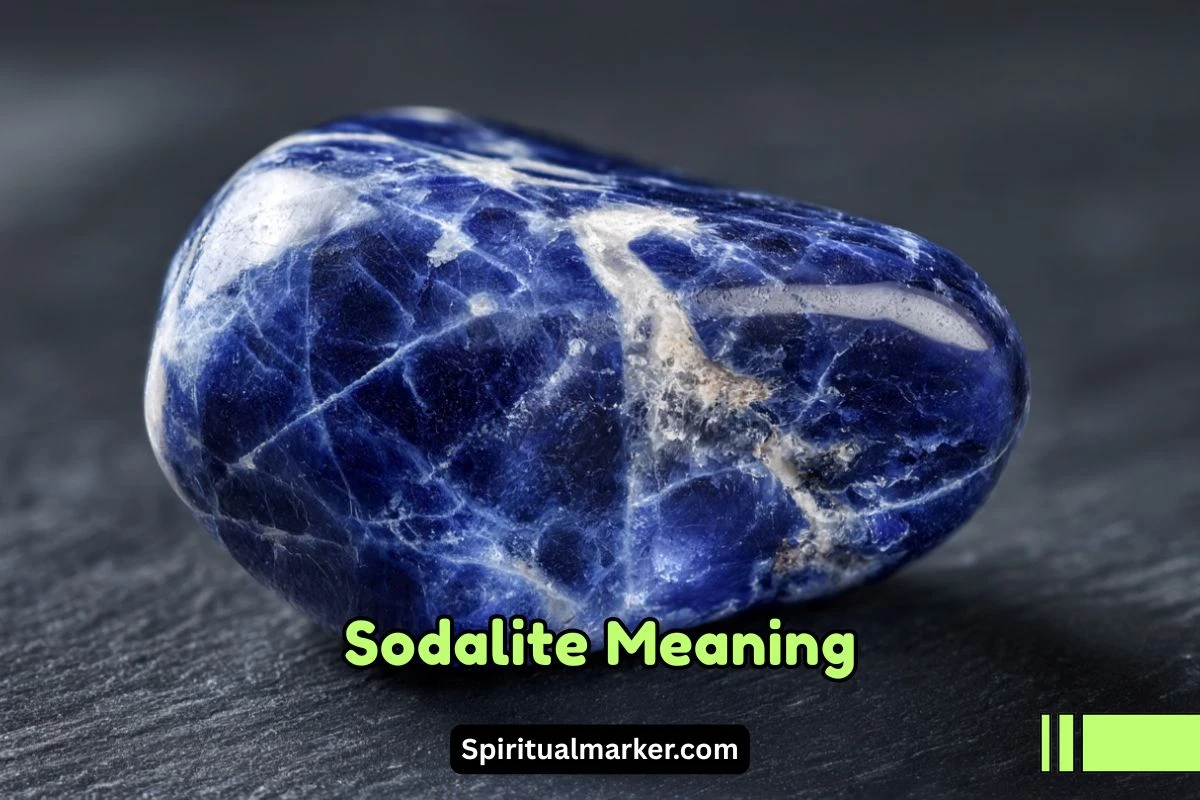
Sodalite is a stone of logic and intuition. Its deep blue color veined with white evokes calm and clarity. In spiritual practice, this stone carries balancing and communicative energy.
The sodalite meaning often involves mental clarity, emotional balance, and spiritual insight. It is a stone of the throat and third eye chakras, helping to express truth and enhance intuition. A spiritual meaning of lapis lazuli shares that blue-stone focus, though lapis carries a more regal energy.
Sodalite is used in crystal healing to calm anxiety, improve communication, and support meditation. It can also symbolize truth and inner peace. The stone's energy is calming and rational.
If you feel drawn to sodalite, it may signal a need for clarity. A spiritual meaning of blue apatite also deals with blue stones, though apatite carries a more energizing energy.
5 Key Takeaways
- Sodalite symbolizes truth, mental clarity, inner wisdom, and authentic self-expression.
- It connects strongly with the throat chakra and the third eye chakra.
- People use sodalite during meditation, creative work, emotional healing, and periods of personal reflection.
- Sodalite scores between 5.5 and 6 on the Mohs hardness scale, making it relatively durable but still requiring gentle care.
- Wearing sodalite close to the throat or forehead is believed to strengthen honest communication and deepen intuitive awareness.
What is Sodalite?
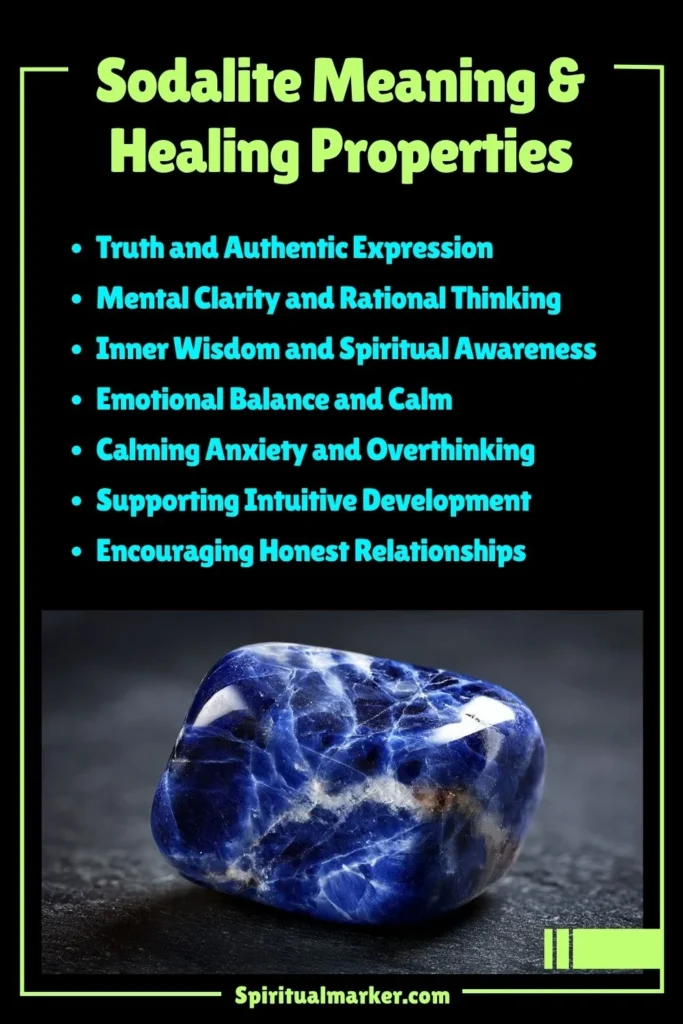
Sodalite is a rich, deep blue mineral that belongs to the feldspathoid group. Its name comes from its high sodium content. It typically appears in shades of royal blue, dark navy, and indigo, often marked with streaks or patches of white calcite that give each piece a distinctive, almost map-like appearance. No two pieces look exactly the same, which adds to the stone’s individual character.
People often confuse sodalite with lapis lazuli because both stones share similar deep blue tones. However, they are mineralogically different. Lapis lazuli is a rock composed of multiple minerals, while sodalite is a single mineral species. Sodalite also lacks the golden pyrite flecks commonly seen in lapis lazuli. Spiritually, sodalite tends to carry a more mentally focused energy, while lapis lazuli leans more toward wisdom and royalty symbolism.
Sodalite is relatively common compared to rarer gemstones, which makes it widely accessible. Its visual appeal and metaphysical reputation have made it a popular choice in crystal healing, jewelry design, and decorative art for generations.
Origins and Formation
Sodalite forms in igneous rocks, particularly in nepheline syenites and related alkaline rock formations. It develops under conditions where silica is low but sodium is abundant. Over geological time, cooling magma creates the conditions that allow sodalite crystals to form within rock masses.
Major sources of sodalite include Brazil, Canada, Namibia, Russia, Greenland, Bolivia, and Afghanistan. Canada, particularly Ontario, has produced some of the world’s most recognized sodalite deposits, including the famous Princess Blue variety discovered near Bancroft in the early 20th century. This particular deposit gained widespread attention after it was used to decorate Marlborough House in London for a royal visit in 1901.
The stone’s deep blue color comes primarily from the presence of sulfur in its chemical structure, combined with sodium, aluminum, silicon, and chlorine. Some varieties of sodalite exhibit a rare optical phenomenon called tenebrescence, where the color temporarily changes when exposed to ultraviolet light and then returns to its original shade. This property appears most notably in hackmanite, a pink to colorless sodalite variety.
Key Properties
| Property | Details |
|---|---|
| Color | Deep blue, navy, indigo, with white veining |
| Composition | Sodium aluminum silicate chloride |
| Hardness | 5.5 to 6 on the Mohs scale |
| Chakra Association | Throat chakra and third eye chakra |
| Symbolism | Truth, clarity, inner wisdom, communication |
| Common Sources | Brazil, Canada, Namibia, Russia, Afghanistan |
| Transparency | Opaque to translucent |
| Energy Style | Mentally clarifying, grounding, truth-oriented |
Historical Use
Sodalite has a long and layered history. Ancient Mesoamerican civilizations used sodalite in ornamental carvings, ceremonial objects, and decorative inlays. Archaeological excavations in parts of South America have found sodalite artifacts dated to pre-Columbian cultures, suggesting that the stone carried cultural and spiritual significance long before modern crystal healing traditions emerged.
The stone was formally identified and named in 1811 by the Scottish geologist Thomas Thomson, though its use in decorative arts preceded that scientific classification by centuries. During the Victorian era, sodalite grew in popularity as an ornamental stone used in architecture, inlay work, and fine decorative pieces. The royal endorsement of Princess Blue sodalite in the early 1900s elevated its status significantly.
In more recent metaphysical traditions, sodalite became associated with writers, teachers, philosophers, and spiritual seekers. Its reputation as a stone of truth and clear thinking made it especially appealing to those engaged in intellectual or communicative work. Modern crystal healing communities continue building on this foundation, using sodalite for mental clarity, emotional honesty, and deepened self-awareness.
5 Spiritual Meanings of Sodalite
1. Truth and Authentic Expression
Many people carry internal narratives that quietly work against them. Self-deception often develops gradually. A person may rationalize unhealthy patterns, minimize their own needs, or avoid confronting uncomfortable truths about their choices, relationships, or emotional states. Within crystal healing traditions, sodalite symbolizes the courage required to see these patterns clearly without defensiveness or avoidance.
The stone’s deep blue color reinforces this symbolism. In many spiritual traditions, blue represents communication, clarity, and the sky’s expansive openness. Sodalite carries that same openness in its energetic symbolism. People often describe its influence as mentally clarifying, as though the fog of confusion or emotional noise begins to settle when they engage with it.
Authentic expression also plays a significant role here. Many individuals struggle to articulate their true thoughts, opinions, and feelings. Fear of judgment, conflict avoidance, or deeply conditioned people-pleasing can prevent genuine self-expression for years. Sodalite spiritually represents the shift toward speaking honestly, even when doing so feels uncomfortable or vulnerable. This symbolism makes it a meaningful stone for anyone navigating periods of personal growth that require difficult honesty.
2. Mental Clarity and Rational Thinking
Sodalite is widely associated with mental clarity because its spiritual energy tends to orient toward the mind rather than purely the emotions. People who feel overwhelmed by mental clutter, indecision, or intellectual confusion often turn toward sodalite as a symbolic anchor. Its energy is described as organizing rather than energizing, which distinguishes it from more stimulating crystals like citrine or carnelian.
The modern world generates extraordinary amounts of information, stimulation, and competing demands on attention. Mental overload is increasingly common, and many people struggle to think clearly during periods of stress, decision fatigue, or emotional overwhelm. Sodalite symbolizes the ability to slow mental activity enough to think deliberately rather than reactively. It represents the calm clarity that emerges when noise subsides.
Many practitioners associate sodalite specifically with logical analysis, critical thinking, and the kind of focused intellectual work that requires mental stamina. Writers, researchers, academics, and creative professionals often find it particularly resonant because their work demands sustained mental engagement. Sodalite spiritually mirrors the mental state required for productive, clear-headed thinking.
This clarity also extends into emotional intelligence. Emotional confusion frequently stems from an inability to observe one’s own feelings with detachment. Sodalite encourages a quality of emotional witnessing, the ability to recognize emotional states without being completely consumed by them. Many people find that mental clarity and emotional clarity tend to develop together, and sodalite symbolically supports both.
3. Inner Wisdom and Spiritual Awareness
Sodalite carries deep associations with inner wisdom and heightened spiritual awareness. While some crystals are linked with external spiritual experiences or heightened psychic sensitivity, sodalite tends to orient toward inward knowing. Its symbolism centers on the wisdom that already exists within a person and the process of learning to trust and access it.
Many spiritual traditions across cultures emphasize that genuine wisdom does not come entirely from outside sources. Ancient Socratic philosophy famously suggested that wisdom begins with self-knowledge. In Hindu tradition, the concept of jnana, or spiritual knowledge, points toward inner realization rather than purely external learning. Sodalite’s spiritual symbolism aligns with this principle. It represents the quiet, steady deepening of self-awareness that comes through honest reflection.
Its connection to the third eye chakra reinforces this meaning. The third eye, located at the center of the forehead in many spiritual frameworks, governs intuition, perception, and inner vision. When people feel spiritually disconnected or mentally scattered, third eye energy may feel blocked. Sodalite is often used symbolically in practices designed to encourage clearer intuitive perception.
People working through major life transitions often find sodalite’s inner wisdom symbolism particularly relevant. During periods of career change, relationship endings, spiritual questioning, or identity shifts, the ability to access internal guidance becomes especially valuable. External advice can only reach so far. Sodalite spiritually encourages people to quiet outer noise and develop confidence in their own discernment.
4. Emotional Balance and Calm
Despite its strong intellectual associations, sodalite also carries meaningful symbolism connected to emotional balance and inner calm. Its energy is frequently described as stabilizing rather than stimulating. People experiencing emotional turbulence, anxiety, or mental restlessness often report a sense of settling when they connect with sodalite during meditation or quiet reflection.
Emotional balance in sodalite’s symbolism does not mean emotional suppression. It refers to a steadier relationship with one’s emotional life, being able to acknowledge and process feelings without becoming destabilized by them. This is a meaningful distinction. Many healing traditions recognize that the goal is not to eliminate emotional sensitivity but to develop the inner steadiness to move through emotional experiences without losing equilibrium.
Sodalite’s calming influence is also related to its strong connection with truth. Emotional turbulence frequently intensifies when people avoid confronting underlying truths about their situations or relationships. When honesty replaces avoidance, emotional calm often follows. Sodalite symbolically links these two processes, suggesting that emotional stability builds naturally on a foundation of honest self-awareness.
Many individuals keep sodalite in environments where stress accumulates, such as workspaces, study areas, or meditation rooms, because they associate its presence with a calmer mental atmosphere. The stone’s cool blue tones visually reinforce this symbolism. Blue is one of the most universally associated colors with calm and mental stillness across cultural traditions worldwide.
5. Spiritual Courage and Self-Trust
One of sodalite’s less commonly discussed but deeply significant spiritual meanings involves courage. Specifically, the courage to trust oneself. Many people carry a persistent habit of second-guessing their instincts, minimizing their perceptions, or deferring entirely to others when it comes to important decisions. This pattern can stem from years of invalidation, criticism, or cultural conditioning that discourages personal authority.
Sodalite spiritually represents the development of self-trust. This does not mean arrogance or the rejection of outside wisdom. It means developing sufficient confidence in one’s own inner voice to act on it without constant external validation. Many healing frameworks recognize this quality as essential to genuine personal growth. Without self-trust, even the most profound spiritual insights remain abstract rather than actively guiding real life choices.
The courage sodalite symbolizes also extends to speaking up. Honest communication often requires a willingness to voice uncomfortable truths, set clear boundaries, or disagree respectfully even when social pressure pushes toward silence. Many people find this kind of communicative courage genuinely difficult, particularly in emotionally charged or high-stakes situations. Sodalite’s association with the throat chakra connects directly to this challenge.
People drawn to sodalite during periods of self-doubt or identity questioning may be subconsciously responding to this symbolism. The stone reflects back a reminder that inner clarity and self-trust are not gifts some people have and others lack. They are capacities that develop through honest reflection, emotional courage, and consistent willingness to know and honor one’s own truth.
6 Healing Properties of Sodalite
1. Mental Clarity and Focus
Sodalite’s most recognized healing property centers on mental clarity and cognitive focus. Within crystal healing traditions, people regularly turn to sodalite when their thinking feels foggy, scattered, or overwhelmed. Its symbolism as a mentally organizing stone makes it particularly valuable during periods that require sustained concentration, analytical thinking, or clear decision-making.
Mental fatigue is a very real experience that affects memory, attention, creative thinking, and problem-solving ability. Many people carry this fatigue silently for long periods before recognizing it. Sodalite is often associated with helping to cut through that accumulated mental heaviness. Its energy is described as sharpening rather than stimulating, which is why it tends to feel more sustainable than high-energy crystals for intellectual work.
Students, writers, researchers, and professionals who engage in heavy cognitive tasks frequently use sodalite in their workspaces. Some place it on their desks, others hold it during breaks between mentally demanding tasks, and many incorporate it into brief meditation practices before starting focused work. The intention behind these uses centers on creating mental conditions that support clearer, more efficient thinking.
This healing property also helps during decision-making. Decisions made from a state of mental clarity tend to reflect a person’s genuine values and priorities rather than reactive emotions or temporary pressures. Sodalite symbolically supports this kind of thoughtful deliberation, encouraging people to slow down mentally before committing to important choices.
2. Enhancing Communication
Sodalite’s strong connection with the throat chakra makes it one of the most commonly recommended crystals for improving communication. The throat chakra governs how people express themselves verbally and non-verbally, how they listen, and how effectively they convey their inner reality to others. When this energy center feels blocked, communication often suffers in various ways.
People may struggle to articulate their thoughts clearly, find themselves frequently misunderstood, hold back their honest opinions under social pressure, or experience chronic difficulty setting verbal boundaries. These patterns can cause significant frustration and emotional strain in personal and professional relationships. Sodalite spiritually addresses these challenges by encouraging clearer, more honest expression from a place of inner calm rather than anxiety or defensiveness.
This healing property extends beyond spoken words. Written communication also falls under sodalite’s energetic influence according to crystal healing traditions. Many writers, journalists, and content creators keep sodalite nearby because they associate it with finding the right words and expressing complex ideas with clarity and precision. The stone symbolizes the bridge between internal thought and external expression.
Sodalite also supports listening. Effective communication requires genuine receptivity, not merely waiting for one’s turn to speak. Many practitioners believe sodalite encourages open, patient listening during conversations. This quality of communication builds deeper understanding and more honest connection between people. It represents a full cycle of authentic communication rather than just the expressive half.
3. Calming Anxiety and Overthinking
Sodalite carries a reputation as an effective symbolic tool for calming anxiety and interrupting cycles of overthinking. Anxiety and excessive rumination share a common pattern: the mind loops repeatedly through worst-case scenarios, unresolved concerns, or emotionally charged memories without reaching resolution. This mental pattern is exhausting, and many people feel trapped within it without knowing how to interrupt it effectively.
Within crystal healing, sodalite is believed to help create mental spaciousness. Rather than feeding anxious thought loops, its energy encourages a kind of mental stepping back. Many practitioners describe this as a shift from being inside the anxiety to observing it from a slight distance. This shift does not eliminate difficult feelings, but it often reduces their overwhelming intensity.
The stone’s association with truth also plays a role here. Anxiety frequently intensifies around uncertainties and unanswered questions. Sodalite symbolically encourages honest assessment of what a person actually knows versus what they are projecting or fearing. This distinction can meaningfully reduce the mental energy fueling anxious thought patterns. Honest clarity often feels calmer than uncertain, looping speculation.
Many people use sodalite specifically before sleep because overthinking often intensifies during quiet nighttime hours. Placing sodalite nearby or holding it briefly during an evening mindfulness practice may support the mental wind-down process. Its cool, steady energy symbolically encourages the mind to release its grip on the day’s unresolved concerns.
4. Supporting Intuitive Development
Sodalite’s connection with the third eye chakra places it among the crystals most associated with intuitive development in healing traditions. Intuition is broadly understood as the ability to perceive something directly, beyond logical analysis. Many spiritual frameworks treat intuition as a form of intelligence that operates differently from rational thought but carries equal or greater value in certain contexts.
People often discount their intuitive perceptions because they cannot fully explain or justify them logically. This creates a persistent inner conflict between what a person senses and what they feel they can reasonably defend to themselves or others. Sodalite symbolically supports learning to trust intuitive insight as a valid source of knowledge. It encourages developing the inner sensitivity required to recognize these quieter signals without immediately dismissing them.
In meditation practices focused on third eye activation, sodalite is sometimes placed on the forehead or held while practicing visualization or contemplative exercises. The intention centers on deepening perceptual sensitivity and developing clearer access to inner knowing. Over time, many practitioners report becoming more aware of intuitive cues in daily life, including stronger gut responses, clearer dream recall, and more reliable inner signals during decision-making.
Sodalite’s role in intuitive development also connects back to its truth symbolism. Authentic intuition differs from wishful thinking or emotionally biased perception. It requires a foundation of honest self-awareness to function clearly. Sodalite symbolically supports both, creating conditions where genuine intuitive perception can develop alongside honest self-knowledge.
5. Strengthening Self-Awareness
One of sodalite’s most enduring healing associations involves the development of deep self-awareness. Self-awareness, in both psychological and spiritual traditions, refers to the ongoing process of honestly observing one’s thoughts, emotions, motivations, patterns, and behaviors. Many frameworks treat self-awareness as foundational to personal growth because meaningful change is nearly impossible without honest understanding of where one currently stands.
Psychologist Daniel Goleman, whose work on emotional intelligence has shaped modern understanding of personal effectiveness, identifies self-awareness as the essential first component of emotional intelligence. Without it, he argues, developing empathy, emotional regulation, or strong social skills becomes significantly harder. Sodalite’s spiritual symbolism aligns directly with this principle. It represents the honest inner seeing that precedes genuine transformation.
Many people find that journaling alongside sodalite deepens the self-awareness process. The stone symbolically creates a safe container for honest self-examination, particularly around patterns that are uncomfortable to acknowledge. This includes habitual emotional reactions, recurring relationship dynamics, self-limiting beliefs, or areas of life where avoidance has replaced honest engagement.
The healing property here is not about self-criticism. Sodalite does not carry a harsh or judgmental energy. Its self-awareness symbolism involves honest observation paired with compassionate acceptance. Seeing oneself clearly and accepting what one sees without shame or self-condemnation forms the kind of grounded self-awareness that actually supports lasting personal growth.
6. Encouraging Honest Relationships
Sodalite’s healing influence extends naturally into interpersonal relationships. Because the stone is so strongly associated with truth, honest communication, and emotional clarity, many practitioners believe it supports healthier, more authentic connection between people. Relationships that lack honest communication often develop invisible emotional distances, unspoken resentments, or repeated misunderstandings that slowly erode genuine connection.
Sodalite symbolically encourages relational honesty. This includes being truthful about needs, boundaries, feelings, and expectations rather than hiding them to avoid conflict or discomfort. Many people are conditioned from an early age to prioritize relational harmony over honest expression. While this instinct sometimes protects relationships in the short term, it frequently creates emotional distance or chronic dissatisfaction over time.
The stone also symbolizes honest listening within relationships. Genuine connection requires being fully present and receptive to another person’s truth, even when it challenges one’s own perspective. Sodalite’s calming energy supports this quality of attention, encouraging people to listen without immediately defending, dismissing, or problem-solving.
In spiritual traditions that emphasize relational healing, sodalite is sometimes used during conversations that require emotional courage and honest vulnerability. Its presence may help create a calmer, more truth-oriented emotional atmosphere. The healing it supports in relationships is not dramatic or instant. It develops gradually through consistent honesty, clearer communication, and a growing willingness to be genuinely known by others.
How to Use Sodalite for Spiritual Growth
Using sodalite for spiritual growth begins with intention. Many practitioners hold the stone during meditation, focusing on a specific area of clarity they are seeking. Whether that involves a decision, a relationship dynamic, a creative block, or a spiritual question, holding sodalite while sitting quietly often helps create the mental stillness needed for genuine reflection.
Placing sodalite in your workspace supports sustained mental clarity during intellectually demanding tasks. Many people keep a piece on their desk, near their computer, or beside their writing tools. The visual reminder of the stone’s symbolism may subtly reinforce the intention to think clearly and communicate honestly throughout the workday.
Wearing sodalite as a pendant near the throat aligns it with the throat chakra and may strengthen the intention around honest communication. Some people prefer sodalite earrings near the ears to support attentive listening. Others wear sodalite bracelets to maintain physical contact with the stone throughout emotionally significant days.
Combining sodalite with complementary crystals can enhance specific intentions. Clear quartz is sometimes paired with sodalite to amplify mental clarity. Amethyst pairs naturally for deepened intuition and spiritual awareness. Lapis lazuli alongside sodalite creates a powerful combination for wisdom and truth-seeking. Blue lace agate complements sodalite’s throat chakra focus with softer, gentler communication energy.
Caring for Sodalite Jewelry
Sodalite requires thoughtful care to maintain its appearance over time. With a Mohs hardness of 5.5 to 6, it is moderately durable but susceptible to scratching when stored alongside harder stones. Always store sodalite jewelry in a soft pouch or padded jewelry box separated from harder gemstones like diamonds, sapphires, or topaz.
Clean sodalite gently with lukewarm water and a mild, unscented soap. Use a soft cloth or very soft brush for any surface buildup. Avoid ultrasonic cleaners, steam cleaning machines, and harsh chemical cleaners as these can damage the stone’s surface or affect its polish. Rinse thoroughly and pat dry with a soft cloth.
Protect sodalite from prolonged sun exposure, which can potentially affect its color over extended time. Avoid wearing sodalite jewelry during heavy physical activity, gardening, swimming, or household cleaning. Chemicals in cleaning products, chlorinated water, and physical impact all pose risks to the stone’s long-term appearance.
For energetic cleansing, many practitioners prefer moonlight, placing sodalite under a full moon overnight to refresh its energy. Sound cleansing using singing bowls or bells works well for sodalite because it avoids any moisture or light exposure concerns. Some people use brief breath meditation while holding the stone, setting the intention to clear accumulated energy and restore its clarity.
Sodalite Meaning at a Glance
| Aspect | Details |
|---|---|
| Primary Meaning | Truth, mental clarity, and inner wisdom |
| Chakra Association | Throat chakra and third eye chakra |
| Main Spiritual Symbolism | Honest communication, self-awareness, intuition |
| Common Colors | Deep blue, navy, indigo with white veining |
| Hardness | 5.5 to 6 Mohs |
| Main Sources | Brazil, Canada, Namibia, Russia, Afghanistan |
| Emotional Associations | Calm, clarity, emotional balance, courage |
| Popular Jewelry Types | Pendants, earrings, bracelets, rings |
| Spiritual Uses | Meditation, focus work, communication healing |
| Care Needs | Gentle cleaning, soft storage, avoid harsh chemicals |
A Final Note
Sodalite stands out because its energy feels both grounding and illuminating at the same time. It does not push. It does not overwhelm. It quietly invites a deeper, more honest relationship with your own mind and inner life. That quality is rare, and it explains why sodalite has maintained its spiritual relevance across centuries and cultural boundaries.
Its meaning centers on truth, clarity, inner wisdom, and the courage to live and communicate authentically. Whether you are drawn to sodalite for its deep blue beauty, its metaphysical symbolism, or its reputation for sharpening mental focus, it carries a consistent message. Honest self-awareness and clear expression are not luxuries. They are foundations for meaningful personal and spiritual growth.
If sodalite resonates with you, consider keeping it close during moments that require clear thinking, honest conversation, or quiet introspection. Many people find that wearing it regularly deepens their relationship with its symbolism. Others place it in spaces where they most need mental clarity. You might also pair sodalite with a consistent journaling practice to strengthen its self-awareness themes. However you choose to work with it, sodalite offers a steady, truth-oriented presence that many find both calming and genuinely clarifying.