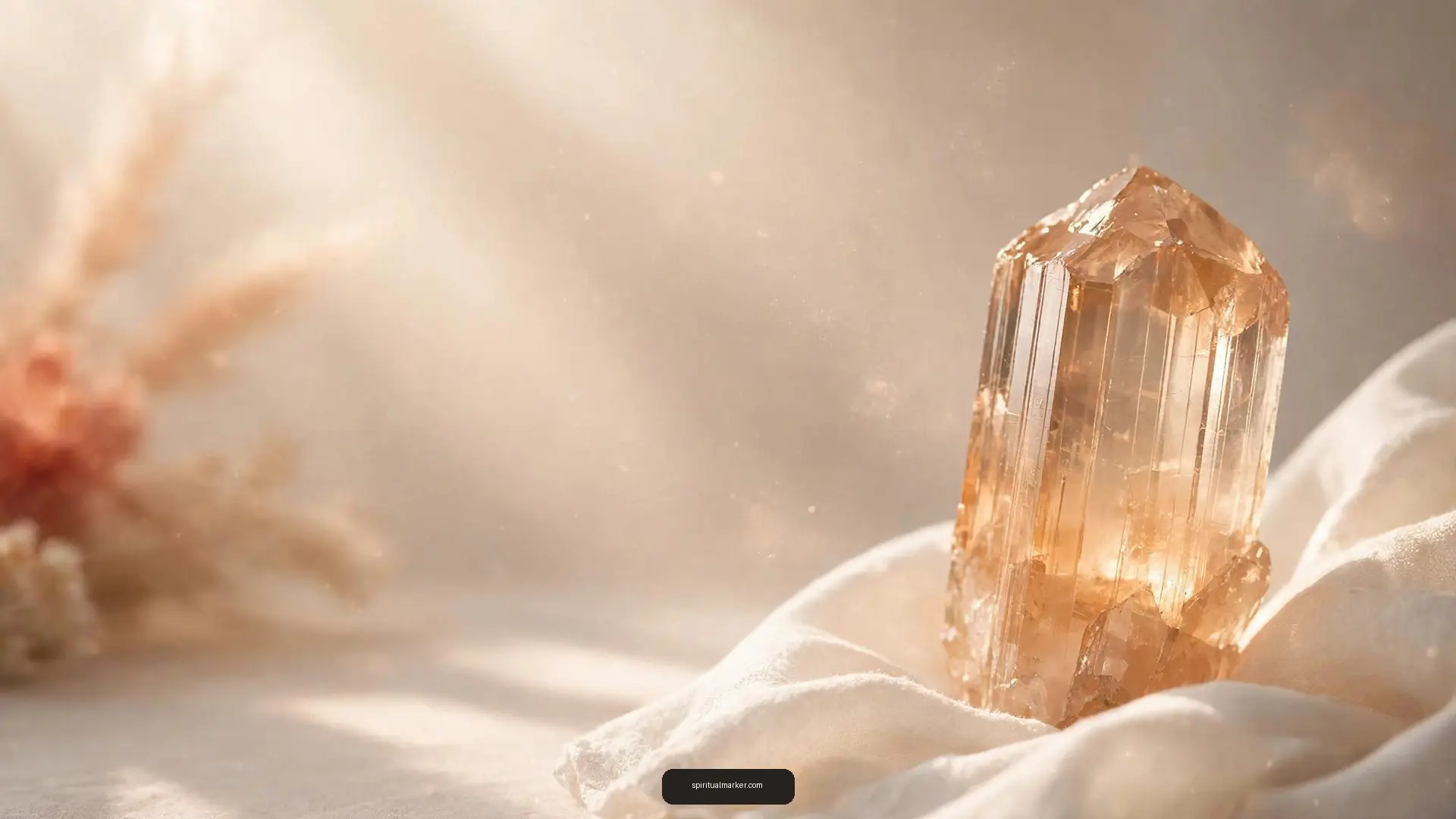
Some stones pull at you before you fully understand why. Scapolite is one of those stones. You might pass it in a crystal shop, notice its soft yellow or violet glow, and feel something shift without being able to name it. That quiet but persistent pull often points to something real about the stone’s energy and what it may reflect back at you.
Scapolite has earned a reputation in spiritual communities as a stone of personal freedom, mental clarity, and purposeful change. People drawn to it during periods of stagnation, indecision, or personal reinvention often describe it as quietly activating. It does not overwhelm. It simply begins shifting things. Patterns that kept you stuck start to loosen. Thoughts that once felt foggy start to sharpen.
Unlike many gemstones that carry long cultural histories written into ancient texts and royal collections, scapolite remained relatively obscure for centuries. Its spiritual significance grew slowly through crystal healing traditions and metaphysical study rather than ancient ceremony. That quieter origin gives it a modern relevance. It speaks directly to the pressures people face today: mental overload, fear of change, difficulty committing to a path, and the struggle to act from inner conviction rather than external pressure.
This article covers the meaning of scapolite, its spiritual symbolism, healing properties, historical background, chakra associations, and practical ways to incorporate it into everyday life. You will also find guidance on caring for scapolite jewelry and preserving its natural beauty over time.
5 Key Takeaways
- Scapolite symbolizes mental clarity, personal freedom, independence, and purposeful transformation.
- It connects primarily with the solar plexus chakra and crown chakra, depending on its color.
- People often turn to scapolite during periods of stagnation, indecision, or major life transitions.
- Scapolite comes in yellow, violet, pink, gray, and colorless varieties, each carrying slightly different energetic emphasis.
- Wearing or meditating with scapolite may strengthen self-trust, problem-solving ability, and emotional independence.
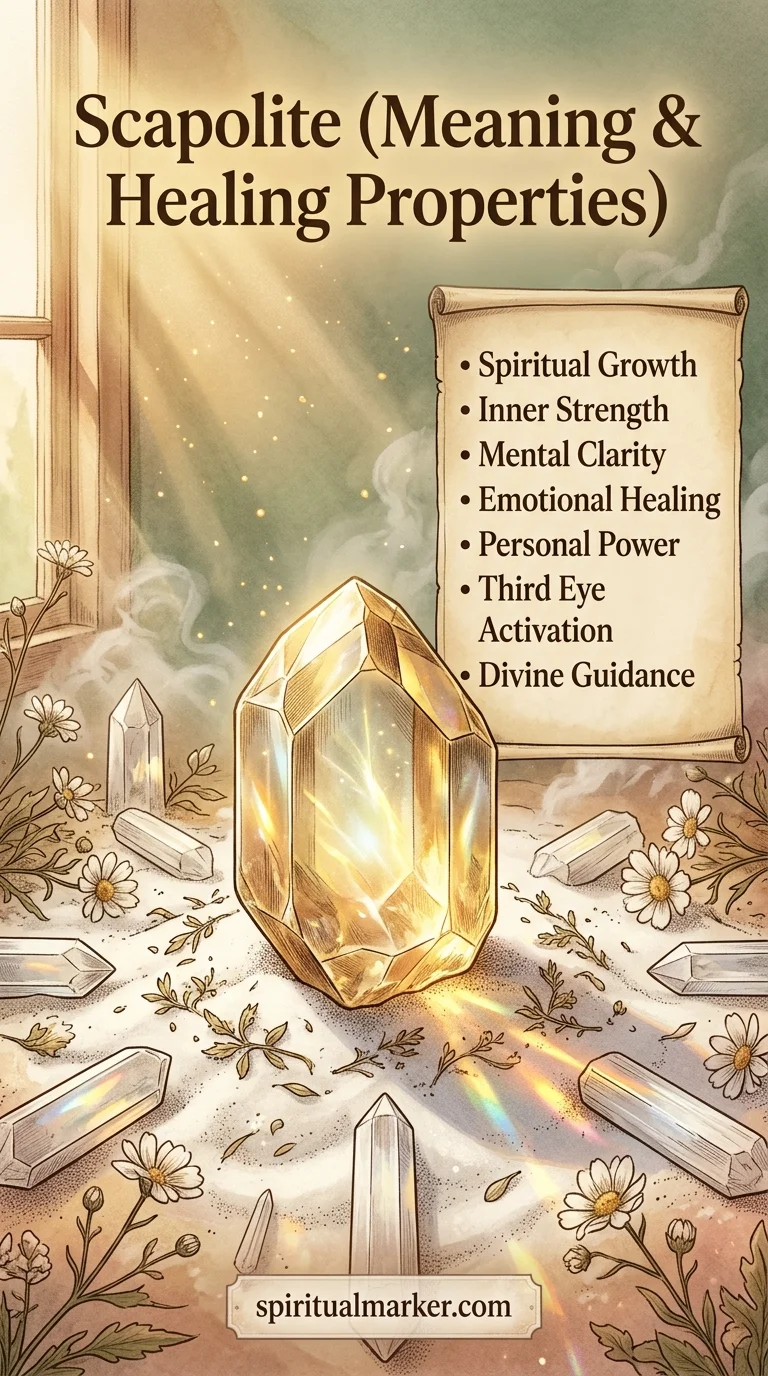
What Is Scapolite?
Scapolite is a group of silicate minerals that form in metamorphic and igneous rock environments. The name comes from the Greek word “skapos,” meaning rod or stem, which refers to the stone’s distinctive prismatic crystal shape. Most scapolite crystals grow in long, columnar formations that look almost architectural in their structure. That visual quality reflects something of the stone’s deeper character: structured, purposeful, and upright.
Scapolite exists on a chemical spectrum between two end members: marialite (sodium-rich) and meionite (calcium-rich). The ratio between these two determines the stone’s exact composition, color, and optical properties. In practical terms, most scapolite specimens fall somewhere between these two poles, making every piece chemically unique.
The color range is notably wide. Yellow scapolite is the most recognized variety, prized in gemstone markets for its warm golden tone and natural chatoyancy (a cat’s eye optical effect) when cut correctly. Violet scapolite carries a cooler, more introspective energy. Pink, gray, and colorless varieties also exist, each with their own appeal and metaphysical associations. Some specimens display strong fluorescence under ultraviolet light, glowing in vivid shades of orange or pink.
Scapolite’s transparency ranges from opaque to fully transparent, with the clearer gem-quality stones commanding higher value among collectors. Its hardness sits at approximately 5.5 to 6 on the Mohs scale, making it moderately durable but requiring thoughtful care when worn as jewelry.
Origins and Formation of Scapolite
Scapolite forms under intense geological pressure. It develops primarily in metamorphic rocks such as marble and gneiss, where heat and pressure transform existing minerals into new configurations. It also appears in some igneous environments and contact zones where magma meets limestone. That formation process carries symbolic weight. Something must be subjected to pressure and transformation before scapolite can exist at all.
Notable sources include Tanzania, which produces some of the finest violet and yellow gem-quality specimens. Myanmar (Burma) has historically yielded exceptional cat’s eye scapolite. Other significant deposits appear in Madagascar, Brazil, Canada, Kenya, Afghanistan, and Norway. Each region produces scapolite with slightly different color characteristics tied to the local mineral environment.
Tanzanian scapolite in particular holds special regard among crystal collectors because of its rich color saturation and strong transparency. The violet specimens from this region carry a depth of color that many associate with spiritual clarity and higher-mind energy.
Key Properties of Scapolite
| Property | Details |
|---|---|
| Color | Yellow, violet, pink, gray, colorless |
| Composition | Silicate mineral group (marialite to meionite) |
| Hardness | 5.5 to 6 on the Mohs scale |
| Chakra Association | Solar plexus (yellow), crown and third eye (violet) |
| Symbolism | Clarity, independence, change, self-discipline |
| Common Sources | Tanzania, Myanmar, Madagascar, Brazil, Canada |
| Transparency | Opaque to fully transparent |
| Energy Style | Activating, clarifying, mentally sharpening |
Historical Use of Scapolite
Scapolite did not occupy a prominent place in ancient gemstone traditions the way emerald, sapphire, or lapis lazuli did. Historical records rarely mention it by name. This is partly because fine gem-quality scapolite was not widely recognized or distinguished from similar-looking stones until mineralogical science advanced significantly in the 18th and 19th centuries. The stone was formally described and named in the early 1800s as European mineralogists catalogued new mineral discoveries from expanding global expeditions.
Cat’s eye scapolite from Myanmar, however, has a longer ornamental history in Southeast Asian cultures. Chatoyant stones held strong protective symbolism in many Asian traditions, believed to guard against negative energy and misfortune. Though often grouped with other cat’s eye stones under broader cultural categories, scapolite specimens with strong chatoyancy participated in that symbolic tradition.
In modern crystal healing traditions, scapolite gained recognition primarily through 20th-century metaphysical practitioners who categorized it alongside other lesser-known minerals for their energetic properties. Writers and healers in the gemstone community began associating it with themes of independence, mental discipline, and purposeful action. These associations have strengthened steadily as more collectors and spiritual practitioners engaged with the stone directly.
5 Spiritual Meanings of Scapolite
1. Personal Freedom and Independence
Among all the themes scapolite carries, personal freedom stands out most consistently. Many people drawn to this stone describe a sense of feeling trapped, whether by circumstances, relationships, thought patterns, or expectations that no longer reflect who they are. Scapolite spiritually resonates with the desire to break free from those constraints and move into greater self-determination.
This symbolism runs deeper than simple rebellion or escape. In crystal healing traditions, scapolite represents the kind of freedom that comes from internal clarity rather than external change. A person may change their environment completely and still feel imprisoned by the same internal patterns. Scapolite’s energy is believed to work at that interior level, helping people recognize where unconscious agreements, fears, or conditioned beliefs have quietly restricted their choices.
Many spiritual practitioners associate scapolite with the moment a person stops waiting for permission. That shift can happen quietly. Someone realizes they have been seeking approval from others before making decisions that are entirely their own to make. Scapolite spiritually reflects the courage required to act from personal conviction. It does not encourage recklessness. It supports deliberate, self-authored movement forward.
This meaning also carries significance for those in helping professions, caregiving roles, or long-term relationships where personal needs have slowly been subordinated to others’ expectations. Scapolite symbolizes the reclamation of personal space without guilt. It encourages emotional self-respect as a foundation for genuine independence rather than isolation.
2. Mental Clarity and Sharp Focus
Scapolite carries a strong reputation for mental clarity. Many crystal practitioners describe its energy as cognitively activating, particularly for people who feel mentally scattered, overwhelmed by competing priorities, or caught in circular thinking that prevents forward movement. Its energy works less like a stimulant and more like a lens that brings blurry mental content into sharper focus.
Mental overload is a modern epidemic. Research consistently shows that decision fatigue, information overload, and chronic stress all degrade cognitive function over time. While scapolite is not a medical treatment, its spiritual symbolism speaks directly to these experiences. Many people use it as a focal anchor during study, creative work, problem-solving sessions, or any task requiring sustained concentration.
The yellow variety carries particularly strong associations with mental sharpness. Yellow in color psychology links to alertness, logical thinking, and intellectual energy. Yellow scapolite spiritually reinforces those qualities. It encourages clear analysis without emotional reactivity. People dealing with complex decisions often find that working with this stone helps them separate what they actually think from what they feel pressured to think.
Violet scapolite shifts this theme slightly toward higher-mind clarity, the kind associated with intuition, spiritual insight, and access to wisdom beyond ordinary reasoning. It connects more with the crown and third eye chakras, encouraging clarity that integrates both rational and intuitive intelligence. Both colors point toward the same core: seeing things as they truly are rather than as fear, habit, or pressure distorts them.
3. Purposeful Change and Transformation
Scapolite’s formation story mirrors its spiritual meaning perfectly. It emerges through pressure and heat. The stone exists because something underwent significant transformation. That origin makes purposeful change one of its most authentic spiritual themes. People navigating major life transitions often find scapolite particularly relevant to their current experience.
What distinguishes scapolite’s approach to transformation from more intense crystals like moldavite or black tourmaline is its emphasis on intention. Scapolite does not symbolize chaotic upheaval or sudden dismantling of structures. Instead, it represents change that proceeds from deliberate choice and self-knowledge. You know what needs to shift. You choose to initiate that shift. Scapolite supports the process of following through.
Many people stay in situations, patterns, or identities long past the point where those things serve them. Fear of the unknown, grief over what must be left behind, or uncertainty about whether they are making the right choice keeps them frozen. Scapolite spiritually reflects the clarity that makes movement possible. It helps dissolve the paralysis that forms around necessary change.
This meaning also appears in smaller forms of personal transformation. Not every meaningful change involves leaving a job, ending a relationship, or relocating. Some of the most significant shifts happen internally: releasing a long-held belief, changing how you speak to yourself, or deciding to stop tolerating situations that diminish your self-worth. Scapolite symbolizes all of these forms of conscious transformation.
4. Self-Discipline and Goal Achievement
Scapolite carries strong associations with self-discipline. This connects directly to its solar plexus chakra influence. The solar plexus governs personal will, motivation, follow-through, and the ability to translate intentions into consistent action. Many people have clear goals but struggle to maintain the daily discipline required to reach them. Scapolite spiritually addresses that gap.
The challenge of self-discipline is rarely about ability. Most people know what they need to do. The difficulty lies in maintaining momentum when motivation dips, when progress feels slow, or when other priorities compete for attention. Scapolite is often associated with the steady, unglamorous work of consistent effort over time. It speaks to the practitioner who shows up every day regardless of mood.
Ancient Stoic philosophy offers a parallel. Thinkers like Marcus Aurelius consistently emphasized that virtue requires daily practice, not occasional bursts of inspiration. His personal writings, compiled in what we now call “Meditations,” repeatedly return to themes of mental discipline, self-accountability, and clarity of purpose. Scapolite spiritually reflects that same orientation. It does not celebrate dramatic effort. It honors sustained commitment.
Many people working toward creative, professional, or personal goals use scapolite as an energetic anchor for their discipline practices. They keep it at a workspace, hold it during planning sessions, or wear it as jewelry that reminds them of their commitments. That symbolic function reinforces intention and provides a physical reference point for personal accountability.
5. Problem-Solving and Practical Wisdom
Scapolite occupies a rare space among crystals because it bridges spiritual clarity with practical intelligence. Many crystals lean strongly toward emotional healing, heart-centered energy, or mystical experience. Scapolite tends toward the intersection of clear thinking and wise action. It supports the ability to assess a situation accurately and respond effectively rather than reacting from habit or emotion.
Practical wisdom differs from raw intelligence. Intelligence involves the ability to process information and reason correctly. Wisdom involves knowing which information matters, which approach fits the situation, and when to act versus when to wait. Scapolite spiritually reflects this more complete form of knowing. It encourages people to bring their full cognitive and intuitive capacity to the challenges in front of them.
People who work in fields requiring constant problem-solving, whether in engineering, medicine, business, education, or creative work, often describe scapolite as mentally supportive. Its energy feels clarifying rather than stimulating. It does not add noise. It removes interference so that genuine insight can surface.
This symbolism also connects to interpersonal problem-solving. Conflicts in relationships, families, and workplaces frequently persist because people cannot see past their emotional reactions to identify workable solutions. Scapolite’s clarifying energy spiritually supports the ability to zoom out, see the actual problem, and engage with it from a calmer, more resourceful state of mind.
6 Healing Properties of Scapolite
1. Breaking Cycles of Stagnation
One of scapolite’s most valued healing associations involves its ability to help people break cycles of stagnation. Stagnation is one of the most common and least discussed forms of suffering. People recognize depression, anxiety, and grief because these states carry identifiable emotional textures. Stagnation is subtler. Life continues. Responsibilities are met. But nothing changes. The same patterns repeat. The same frustrations resurface. The same dreams stay exactly where they were last year.
Many spiritual practitioners believe scapolite works energetically to interrupt this pattern. It is associated with identifying the exact point where a person has stopped moving forward, not from lack of desire but from a subconscious investment in staying where they are. That investment often disguises itself as caution, practicality, or humility. Scapolite’s healing energy is said to bring that investment into conscious awareness where it can finally be examined and released.
The healing process scapolite symbolizes is not about forcing sudden dramatic change. It is about gently but persistently illuminating the internal structures that make stagnation feel safe. Once those structures become visible, the person regains genuine choice about whether to maintain them or begin moving forward again. That restored sense of agency is itself deeply healing.
2. Emotional Independence
Scapolite carries healing associations related to emotional independence. This does not mean emotional isolation or the suppression of relational needs. Rather, it refers to the ability to regulate one’s emotional state internally rather than depending entirely on others for validation, reassurance, or permission to feel okay. That internal emotional stability forms the foundation of healthy relating.
Many people unconsciously outsource their emotional security. They need particular responses from others in order to feel valued, safe, or lovable. When those responses are unavailable, emotional distress follows quickly. Over time, this pattern creates significant vulnerability and often drives people toward relationships or dynamics that feel necessary but are quietly damaging. Scapolite spiritually supports the development of a more internally grounded emotional life.
Healing in this area rarely happens quickly. It involves recognizing old attachment patterns, understanding where they formed, and gradually building a more stable sense of self that does not require constant external confirmation. Scapolite’s energy is believed to support this process by reinforcing self-trust and a clearer sense of personal identity. Many crystal practitioners use it during therapy support, journaling practices, or meditation focused on building emotional resilience.
3. Mental Fatigue and Cognitive Recovery
Within crystal healing traditions, scapolite is frequently associated with recovery from mental fatigue. Extended periods of intense cognitive work, chronic stress, emotional overwhelm, or prolonged decision-making can exhaust the mind in ways that rest alone does not always resolve. People describe feeling mentally flat, creatively blocked, or unable to think clearly even after adequate sleep. Scapolite symbolizes the restoration of cognitive vitality.
This healing property connects to the stone’s broader theme of mental clarity. Just as it helps sharpen focus for someone who is mentally scattered, it also symbolizes the gradual recovery of sharpness for someone whose mental resources have been depleted. Many practitioners keep scapolite in workspaces or creative studios for this reason. Its presence serves as a reminder to protect cognitive energy and a symbolic invitation for that energy to replenish and return.
The yellow variety is especially associated with this quality because of its solar plexus and solar symbolism. Just as sunlight restores energy to a depleted natural landscape, yellow scapolite spiritually reflects the restoration of mental brightness and motivational drive after periods of exhaustion.
4. Releasing Victim Mentality
Scapolite has a particularly pointed healing association that distinguishes it from more universally gentle crystals: its connection to releasing victim mentality. This is a delicate topic. Many people have genuinely experienced harm, injustice, loss, or betrayal. Acknowledging that reality is important. The healing work scapolite symbolizes does not deny those experiences. Instead, it focuses on the moment when a person is ready to stop allowing past pain to determine present choices.
Victim mentality in the sense crystal healing traditions address it refers to a habitual orientation toward powerlessness. A person consistently experiences themselves as acted upon rather than acting. Circumstances are always external and unchangeable. Responsibility always belongs to others. Solutions always require someone else to change first. This orientation, while often rooted in genuine past harm, ultimately perpetuates suffering beyond the original source.
Scapolite spiritually supports the recognition of personal agency. It reminds the person holding it that power over their own mind, choices, and responses has always been present, even when external circumstances felt overwhelming. That recognition does not erase pain. It restores the sense that meaningful action is possible. Many practitioners find this one of scapolite’s most transformative healing associations.
5. Strengthening Willpower
Closely linked to its self-discipline symbolism, scapolite carries healing associations with strengthening willpower. Willpower in psychological research is understood as a limited resource that depletes under stress and can be cultivated through consistent practice. People with strong willpower are significantly more likely to achieve long-term goals, maintain healthy habits, and navigate adversity without losing direction.
Scapolite spiritually connects with that capacity for sustained self-regulation. Many people feel their willpower is fundamentally weak when in fact it has simply been overextended across too many competing demands. Scapolite’s energy is associated with helping people clarify priorities so that willpower is concentrated where it matters most rather than scattered across an unmanageable list of obligations.
Wearing or meditating with scapolite is believed by many practitioners to reinforce the solar plexus chakra, which governs the energetic dimension of will and follow-through. When this energy center feels depleted or blocked, motivation stalls and consistency becomes difficult. Scapolite’s healing influence in this area is gentle but persistent, gradually restoring a person’s connection to their own capacity for purposeful action.
6. Supporting Transitions and New Beginnings
Scapolite carries specific healing resonance with people navigating major life transitions. Career changes, relocations, relationship endings, losses, and health challenges all create periods of profound uncertainty where a person’s usual sense of identity and direction may temporarily dissolve. These transitions are among the most psychologically demanding experiences humans face. Scapolite does not promise ease during these periods. It offers energetic clarity and forward orientation.
Transitions feel most frightening when a person cannot see what comes next. The old structure has collapsed or is in the process of dissolving, and the new one has not yet formed. Scapolite spiritually represents the courage and mental steadiness required to remain functional and intentional during that in-between space. Many people describe this as one of the stone’s most personally meaningful qualities.
New beginnings also require releasing old identities and stories that no longer fit. A person who has always defined themselves through a particular role, relationship, or career must rebuild their sense of self when that anchor disappears. Scapolite’s healing symbolism includes the gradual, honest process of identity reconstruction. It encourages you to build your new chapter from self-knowledge rather than from what is most familiar or expected by others.
Scapolite and Chakra Connections
Scapolite’s chakra associations shift according to its color, making it a versatile stone for chakra-focused healing practices. Yellow scapolite aligns most strongly with the solar plexus chakra, located in the upper abdomen. This chakra governs personal will, confidence, self-discipline, identity, and the ability to act with conviction. When the solar plexus feels balanced, a person moves through life with a sense of grounded personal power. When it feels blocked or overactive, issues with control, self-worth, indecision, and emotional reactivity often surface.
Violet scapolite resonates with the crown chakra and third eye chakra. The crown governs spiritual connection, higher consciousness, and the sense of meaning that frames a person’s entire life experience. The third eye relates to intuition, perception, inner vision, and the ability to see beyond surface-level appearances. Violet scapolite spiritually supports both, encouraging access to wisdom, clarity of spiritual purpose, and the integration of higher understanding into practical daily living.
Some practitioners use scapolite in multi-chakra healing sessions, combining different color varieties to address both personal will and higher awareness simultaneously. This layered approach reflects the stone’s broader symbolism: acting with purpose while remaining connected to larger spiritual context.
How to Use Scapolite for Spiritual Growth
People incorporate scapolite into spiritual practice in several natural ways. Meditation is the most common. Holding yellow scapolite over the solar plexus during meditation may help practitioners connect with themes of personal will, clarity of purpose, and self-discipline. Holding violet scapolite at the forehead or crown may deepen intuitive awareness and access to spiritual insight.
Many people keep scapolite in their workspace because of its mental clarity associations. Placing it near a computer, on a desk, or beside a creative workspace serves as a physical reminder of focused intention. Some practitioners hold a piece briefly before beginning a challenging task to set a clear mental state.
Journaling with scapolite nearby is another practice many find meaningful, particularly when working through decisions, processing a major transition, or examining patterns that have kept them stuck. The stone’s symbolic connection with honest self-assessment makes it a natural companion for reflective writing. Many people also wear scapolite as jewelry, in rings, pendants, or bracelets, to maintain consistent contact with its energy throughout the day. Keeping it close during moments of challenge reinforces the themes of clarity, courage, and purposeful action.
Caring for Scapolite Jewelry
Scapolite requires mindful care because of its moderate hardness and sensitivity to certain conditions. At 5.5 to 6 on the Mohs scale, it can scratch when stored alongside harder gemstones like quartz, topaz, or sapphire. Store scapolite pieces separately in a soft pouch or padded box to protect their surface.
Clean scapolite gently using lukewarm water and a mild soap. Use a soft cloth or brush to remove dirt, then rinse thoroughly and pat dry. Avoid ultrasonic cleaners, steam cleaning, and harsh chemical solutions. These methods risk damaging the stone’s surface or internal clarity. Remove scapolite jewelry before swimming, exercising, or doing household cleaning to protect it from impact and chemical exposure.
Scapolite can be sensitive to prolonged direct sunlight, particularly the violet variety, which may experience slight color fading over extended exposure. Store pieces away from direct sun when not in use. Some practitioners cleanse scapolite energetically using moonlight, sound bowls, or by placing it near cleansing herbs. These practices vary by personal belief and tradition. Handle the stone with intention, and it will serve as a meaningful spiritual companion for years.
Scapolite Meaning at a Glance
| Aspect | Details |
|---|---|
| Primary Meaning | Personal freedom and mental clarity |
| Chakra Association | Solar plexus (yellow), crown and third eye (violet) |
| Main Spiritual Symbolism | Independence, transformation, self-discipline, focus |
| Common Colors | Yellow, violet, pink, gray, colorless |
| Hardness | 5.5 to 6 Mohs |
| Main Sources | Tanzania, Myanmar, Madagascar, Brazil, Canada |
| Emotional Associations | Courage, self-trust, willpower, clarity |
| Popular Jewelry Types | Rings, pendants, bracelets |
| Spiritual Uses | Meditation, goal-setting, journaling, chakra work |
| Care Needs | Gentle cleaning, separate storage, avoid direct sun |
A Final Note
Scapolite does not carry the ancient mystique of lapis lazuli or the cultural romance of emerald. Its significance developed quietly through the honest experiences of people who worked with it and found it genuinely useful. That grounded origin feels appropriate for a stone so strongly associated with practical wisdom, personal freedom, and clear-eyed self-awareness.
If you feel drawn to scapolite, that pull is worth paying attention to. It often appears in a person’s life during a chapter marked by indecision, stagnation, or a quiet but persistent sense that something needs to change. Its energy does not force that change. It simply clarifies the landscape enough that you can see the path forward and trust yourself to walk it.
If you are navigating a major transition, you might find yellow scapolite particularly grounding. If you are seeking deeper spiritual insight alongside practical clarity, violet scapolite may resonate more fully. Those who work with it in daily creative or professional life often find that keeping it close strengthens not just focus but the deeper sense of personal conviction that makes sustained effort feel worthwhile.