
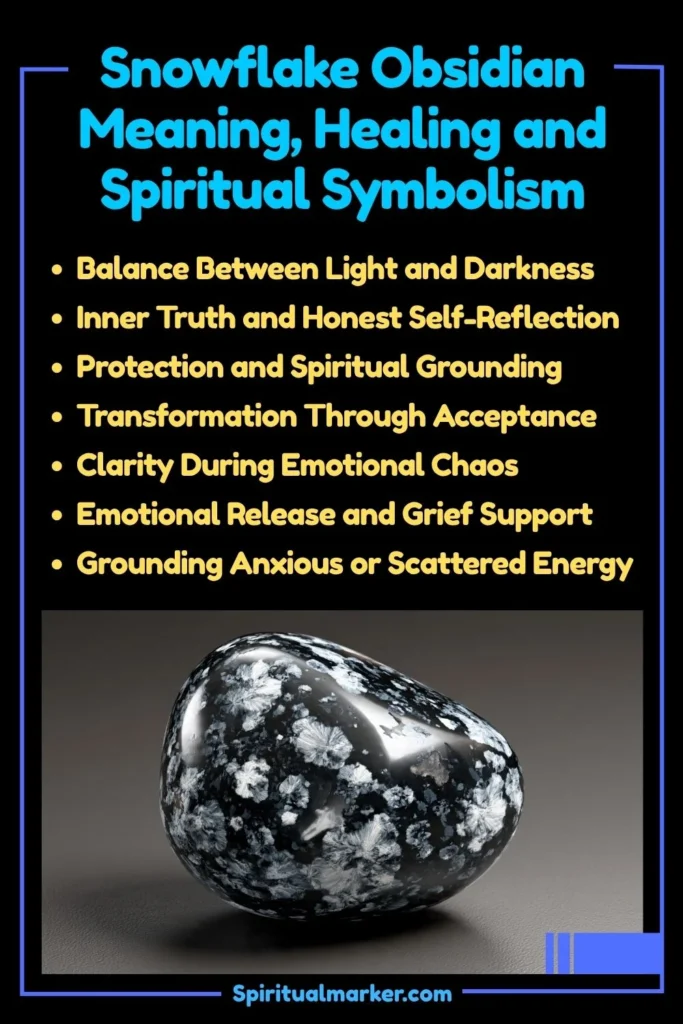
Some stones demand attention with color and brilliance. Snowflake obsidian does the opposite. Its surface is deep black, marked by delicate white patterns that look like frozen crystals caught mid-fall. That contrast is not just visual. It carries meaning. And many people sense it the moment they hold one in their hand.
People often reach for this stone during moments of confusion, grief, or personal transition. Something about its quiet duality feels grounding. The white markings against a black base remind many of light appearing in darkness. For centuries, various cultures have used obsidian as a protective and spiritually significant stone. Snowflake obsidian, specifically, carries an added layer of meaning rooted in balance, clarity, and the wisdom that comes through stillness.
In crystal healing traditions, snowflake obsidian is known for helping people face difficult truths without fear. It does not soften reality. Instead, it builds the inner strength needed to meet reality honestly. Many spiritual practitioners describe its energy as simultaneously grounding and illuminating. That dual quality is exactly what the stone’s appearance suggests: darkness and light, working together.
This article covers the meaning of snowflake obsidian, its spiritual symbolism, healing properties, historical background, and practical ways people use it for growth. You will also find guidance on wearing and caring for snowflake obsidian jewelry in ways that honor both its physical beauty and its deeper significance.
5 Key Takeaways
- Snowflake obsidian symbolizes balance between darkness and light, inner truth, and spiritual clarity.
- Many crystal traditions connect it strongly with the root chakra and third eye chakra.
- People frequently turn to snowflake obsidian during grief, personal transitions, emotional release, and grounding practices.
- It forms from rapidly cooled volcanic lava with white cristobalite inclusions that create its signature snowflake patterns.
- Wearing or carrying snowflake obsidian may support emotional honesty, mental clarity, and spiritual protection.
What is Snowflake Obsidian?
Snowflake obsidian is a naturally occurring volcanic glass. It forms when lava cools rapidly, preventing crystal formation. What makes it distinct from regular black obsidian are the white or grey patches scattered across its surface. These markings come from cristobalite, a form of silica that crystallizes within the glass over time. The result looks strikingly like snowflakes frozen into dark stone.
Its appearance sets it apart immediately. Most black stones feel intense and uniform. Snowflake obsidian feels different. The white markings soften its look without weakening its energy. Many people find it more approachable than pure black obsidian while still carrying that same foundational protective quality.
Mineralogically, obsidian is not a true mineral. It is a volcanic glass, classified as a mineraloid. Its silica content is high, typically between 70 and 75 percent. That composition gives it a glassy texture, a conchoidal fracture pattern, and enough hardness to be worked into tools, weapons, and decorative objects for thousands of years. Ancient peoples valued its sharp edges long before they understood its spiritual significance.
Snowflake obsidian shares this physical toughness while adding a visual softness. The contrast between the two is central to its meaning. It represents the coexistence of strength and gentleness, shadow and clarity.
Origins and Formation of Snowflake Obsidian
Snowflake obsidian forms in volcanic regions where lava flows cool quickly. As the molten rock solidifies at speed, silica molecules cannot arrange themselves into an orderly crystal lattice. The result is glass rather than crystalline stone. Over thousands of years, pockets of cristobalite begin forming within the obsidian matrix. These clusters radiate outward in delicate patterns that resemble snowflakes.
This slow internal transformation adds a layer of symbolism. The snowflake patterns do not appear immediately. They develop gradually inside the stone. Many spiritual traditions read this as a reminder that clarity takes time. Insight does not always arrive instantly. It forms beneath the surface, often invisible until conditions are right.
Major deposits of snowflake obsidian appear in the United States, particularly in Utah, Nevada, and California. Mexico, Iceland, and parts of South America also produce quality specimens. The volcanic geology of these regions creates ideal conditions for obsidian formation. Each deposit carries slightly different visual characteristics depending on lava composition and cooling rate.
Native American communities in volcanic regions of North America have long used obsidian for practical and ceremonial purposes. Its sharp edges made it ideal for cutting tools and arrowheads. Its reflective surface made it a natural choice for ritual use, divination, and connection to ancestral wisdom. Snowflake obsidian, with its striking appearance, held particular visual power within these traditions.
Key Properties of Snowflake Obsidian
| Property | Details |
|---|---|
| Color | Black with white or grey cristobalite patterns |
| Composition | Volcanic glass (amorphous silica) |
| Hardness | 5 to 5.5 on the Mohs scale |
| Chakra Association | Root chakra (primary), third eye chakra (secondary) |
| Symbolism | Balance, truth, protection, clarity, transformation |
| Common Sources | USA (Utah, Nevada), Mexico, Iceland |
| Transparency | Opaque |
| Energy Style | Grounding, protective, truth-revealing |
Historical Use of Snowflake Obsidian
Obsidian holds one of the longest histories of human use among all stones. Archaeological evidence confirms its use as far back as 700,000 years ago, making it one of humanity’s oldest tool materials. Ancient Egyptians, Greeks, Romans, Aztecs, and various Native American cultures all worked with obsidian for different purposes. Its ability to fracture into extremely sharp edges made it invaluable before metal tools existed.
Beyond practical use, obsidian carried deep spiritual significance across many ancient cultures. The Aztecs used polished obsidian mirrors for scrying and divination. These black mirrors reportedly allowed priests to see visions, contact spiritual forces, and access hidden knowledge. The stone’s highly reflective surface made it a natural tool for gazing inward as much as looking outward.
In Mesoamerican traditions, obsidian connected directly with Tezcatlipoca, a powerful deity associated with the night sky, conflict, transformation, and ancestral memory. This connection reinforced obsidian’s reputation as a stone that reveals what is hidden, protects against dark forces, and demands truth rather than comfortable illusions.
Many Native American traditions valued obsidian as a sacred stone tied to protection and ancestral guidance. Its volcanic origin connected it with earth energy, fire, and the raw creative force that shapes landscapes. Snowflake obsidian, with its visually striking white patterns, carried additional symbolic weight representing the light hidden within darkness and the balance between opposing forces.
In more recent metaphysical traditions, snowflake obsidian earned a specific reputation for helping people during times of personal difficulty. Grief counselors, energy workers, and spiritual practitioners began incorporating it into healing sessions focused on emotional release, past trauma, and honest self-examination. Its reputation for revealing difficult truths with compassionate support made it a trusted companion during challenging periods of growth.
5 Spiritual Meanings of Snowflake Obsidian
1. Balance Between Light and Darkness
The most immediate spiritual meaning of snowflake obsidian is written directly on its surface. Black and white exist together, inseparable, neither dominating the other. That visual balance is not accidental symbolism. Many spiritual traditions interpret it as a physical reminder that light and dark are not enemies. They define each other. Struggle and peace, loss and growth, fear and courage, all exist on the same continuum.
Many people carry or wear snowflake obsidian specifically because of this symbolism. Life rarely delivers clarity without confusion first. Healing rarely comes without acknowledging pain. Snowflake obsidian does not pretend otherwise. Its energy, according to many crystal traditions, supports people through the full spectrum of experience rather than encouraging the suppression of difficulty in favor of forced positivity.
This meaning becomes especially significant for people navigating grief, identity shifts, or personal transitions. These experiences rarely feel clean. They involve contradictory emotions. Sadness and relief can coexist. Fear and excitement can arrive together. Snowflake obsidian symbolizes the wisdom to hold those contradictions without requiring them to resolve prematurely. It encourages presence with what is, rather than demanding a tidier emotional reality.
The stone also reflects balance across time. Many practitioners believe snowflake obsidian helps people integrate past experiences with present awareness. Rather than being defined by old wounds or past decisions, the stone symbolizes the capacity to carry personal history with wisdom rather than weight. The white patterns within darkness suggest that every difficult chapter contains something worth keeping.
2. Inner Truth and Honest Self-Reflection
Snowflake obsidian has earned a strong reputation as a truth-revealing stone. Unlike crystals associated with comfort, softness, or emotional ease, snowflake obsidian points inward with a kind of precision. Many practitioners describe its energy as gently confrontational. It does not attack. But it does not allow avoidance either. It encourages people to look clearly at patterns, habits, and beliefs that may have been quietly limiting their growth for years.
This quality makes snowflake obsidian particularly valuable for self-examination. People sometimes carry unexamined assumptions about themselves, others, or the world that quietly shape their decisions without conscious awareness. Some of these beliefs formed during childhood. Others developed as protective responses to painful experiences. Over time, they may no longer serve the person carrying them, yet they remain invisible because they were never directly examined.
Snowflake obsidian spiritually represents the courage required for that kind of honest looking. Many practitioners use it during journaling, meditation, or reflective spiritual practices specifically because they believe it helps surface what normally stays hidden beneath comfortable self-narratives. This is not about self-condemnation. The stone’s symbolism centers on clear seeing without the harshness of judgment.
Ancient use of obsidian mirrors for scrying reinforces this meaning. A mirror shows what is actually present, not what you wish were there. Snowflake obsidian carries that same reflective quality inward. It symbolizes the kind of honest self-awareness that becomes the foundation for genuine change rather than surface-level adjustment.
3. Protection and Spiritual Grounding
Black obsidian has long been considered one of the strongest protective stones in crystal healing traditions. Snowflake obsidian carries this reputation with an added layer of grounding stability. Many practitioners describe it as a stone that creates a stable energetic boundary around a person without creating emotional walls between them and others. The distinction matters. Protection, in this context, means remaining emotionally safe enough to stay open.
Its primary connection to the root chakra supports this protective quality. The root chakra governs a person’s sense of safety, stability, and connection to the physical world. When this energy center feels balanced, people tend to feel more grounded, less reactive, and more capable of handling external pressure without losing their inner footing. Snowflake obsidian’s grounding energy aligns naturally with this function.
Many people who feel emotionally overwhelmed, energetically scattered, or spiritually untethered turn to snowflake obsidian for this reason. Its volcanic origin connects it to earth energy, fire, and the stabilizing force of the physical world. Holding it can feel centering in a way that abstract reassurance rarely achieves. The stone carries a physical weight that many people describe as physically and emotionally anchoring.
In some traditions, snowflake obsidian is also believed to clear negative energy patterns from a person’s energetic field. Rather than simply blocking negative influence from outside, it symbolizes the release of internally generated negativity, including fear, self-doubt, destructive thought patterns, and residual emotional weight from past experiences. That internal clearing often feels more impactful and lasting than purely external protection.
4. Transformation Through Acceptance
Snowflake obsidian symbolizes a specific kind of transformation. Not the dramatic, sudden kind. Not the kind that arrives as inspiration or emotional breakthrough in a single moment. Rather, it represents the transformation that develops through honest acceptance of what is. Many spiritual traditions teach that genuine change begins when a person stops fighting against reality and starts working honestly within it.
This symbolic meaning carries particular relevance during major life changes. Losing a relationship, career, home, health, or sense of identity can create powerful resistance. People often spend enormous emotional energy wishing circumstances were different rather than moving honestly through what has already occurred. Snowflake obsidian symbolizes the turning point where acceptance replaces resistance and real movement becomes possible.
Its volcanic origin reinforces this meaning. Volcanic rock forms through intense heat and pressure. What remains after that process is stone. Dense, enduring, shaped by forces that could have been destructive but instead created something permanent. Many practitioners draw this parallel directly to human experience. The most transformative periods in a person’s life often involve the most intense pressure. Snowflake obsidian symbolizes the strength and clarity that can emerge from that process.
The white cristobalite patterns also carry transformative symbolism. These markings form slowly inside the stone over time, invisible until they become large enough to see. Personal transformation often works similarly. People change in ways they cannot see clearly until those changes have already been forming beneath the surface for months or years. Snowflake obsidian reminds people that growth in progress is still growth, even when it is not yet visible.
5. Clarity During Emotional Chaos
One of snowflake obsidian’s most consistent spiritual associations involves its capacity to bring mental clarity during emotionally turbulent periods. When grief, anxiety, confusion, or overwhelming circumstances cloud a person’s ability to think clearly, this stone is often used symbolically to cut through that noise. Its energy is frequently described as focusing rather than calming. The distinction is important.
Calming stones tend to reduce emotional intensity. Snowflake obsidian does not always reduce intensity. Instead, it helps people think clearly within emotional intensity. Many practitioners believe it supports the kind of clear-headed assessment that becomes necessary when emotions run high but decisions still need to be made. That quality makes it valuable for moments when clarity matters most.
Its secondary connection to the third eye chakra reinforces this clarity symbolism. The third eye chakra governs intuition, perception, and spiritual insight. When this chakra functions well, people tend to read situations more accurately, trust their instincts more confidently, and see beyond surface-level appearances to the deeper dynamics at work. Snowflake obsidian is believed by many practitioners to support this perceptive quality.
People working through major decisions, processing complicated relationships, or trying to find direction during uncertain periods often turn to snowflake obsidian for exactly this reason. It does not make decisions for anyone. But many believe it helps quieten the internal noise enough to hear their own clearest thinking. The white patterns within black stone visually embody this idea: clarity emerging from within darkness.
6 Healing Properties of Snowflake Obsidian
1. Emotional Release and Grief Support
Snowflake obsidian has a long-standing association with emotional release, particularly in the context of grief, loss, and unresolved sorrow. Many crystal healing practitioners recommend it specifically for people carrying suppressed emotional pain. Unlike stones that encourage emotional comfort and warmth, snowflake obsidian is believed to support the actual process of release rather than simply soothing over difficult feelings.
Grief tends to accumulate when people feel unable to fully acknowledge or express their loss. Cultural expectations, personal survival instincts, and the demands of daily life often push grief underground before it has been fully felt. Over time, that buried emotional weight may resurface as irritability, emotional numbness, anxiety, fatigue, or a pervasive sense of disconnection. Snowflake obsidian symbolizes the courage to feel what has been avoided.
Many practitioners use it during meditation, energy work, or grief ceremonies specifically because they believe it creates a safe energetic container for emotional release. Its grounding root chakra energy means that emotional release with snowflake obsidian rarely feels destabilizing. Instead, many people describe the process as clarifying. Difficult feelings surface, are recognized, and begin moving through rather than staying frozen in place.
This healing quality extends beyond formal grief to include any unprocessed emotional experience. Disappointment, betrayal, shame, anger, and fear can all accumulate beneath conscious awareness. Snowflake obsidian’s spiritual reputation for revealing hidden emotional content makes it a practical companion during any period of honest emotional excavation and release.
2. Breaking Unhealthy Patterns
Many crystal practitioners identify snowflake obsidian as one of the most effective stones for helping people recognize and break repetitive unhealthy patterns. These patterns show up in relationships, behavioral habits, emotional responses, and self-limiting beliefs. They often feel automatic rather than chosen, operating below the level of conscious decision-making until something brings them into clear view.
The stone’s truth-revealing energy is central to this healing property. A person cannot change a pattern they cannot clearly see. Snowflake obsidian is believed to support the kind of honest self-awareness that makes patterns visible. This might mean recognizing a recurring relationship dynamic, noticing a habitual thought pattern that appears under stress, or seeing clearly how a protective response developed in childhood continues shaping adult behavior in ways that no longer serve.
Research in psychology supports the idea that pattern recognition is the first step toward behavioral change. Studies on habit formation consistently show that people must identify cues, routines, and rewards before they can effectively rewire habitual responses. Snowflake obsidian’s spiritual symbolism aligns naturally with this understanding. Its energy represents illumination, not judgment. The goal is clarity, not condemnation.
This healing property makes snowflake obsidian particularly useful during periods of intentional personal growth. People actively working to change behaviors, improve relationships, or develop new emotional responses often find its grounding and clarifying energy supportive of the consistent self-awareness that genuine change requires.
3. Grounding Anxious or Scattered Energy
Anxiety tends to lift a person out of the present moment. The mind races forward into feared futures or backward through regretted pasts. The body may feel physically unsteady even when external circumstances are safe. Grounding practices bring attention back to the present moment and the physical body. Snowflake obsidian’s strong root chakra energy makes it a natural ally in this process.
Its volcanic origin connects it with the earth itself. Many practitioners hold or carry snowflake obsidian during periods of acute anxiety because the physical weight and coolness of the stone provides a sensory anchor. Attention moves toward what is tangible and present rather than what is feared or imagined. That shift may seem small, but it can interrupt the cycle of mental escalation that anxiety typically follows.
Spiritually, snowflake obsidian is believed to support energetic coherence during periods of fragmentation. When life feels chaotic, when too many changes are happening simultaneously, or when a person feels pulled in multiple directions, scattered energy can make basic decision-making feel exhausting. The stone’s grounding quality is associated with drawing dispersed attention back to a centered, stable point.
Many meditation teachers and energy workers recommend combining snowflake obsidian with breath awareness practices for this reason. The stone supports the body while the breath anchors the mind. Together they create conditions where anxious energy can settle rather than escalate. Its presence during meditation is often described as stabilizing in a way that purely mental techniques sometimes cannot achieve alone.
4. Strengthening Inner Resilience
Resilience is not the absence of difficulty. It is the capacity to move through difficulty without losing one’s essential self. Snowflake obsidian symbolizes exactly this quality. Its volcanic formation tells a story of endurance. Formed under extreme heat, shaped by forces that could have dissolved it, the stone emerges solid, structured, and visually striking. That origin story mirrors the resilience many people develop through navigating their own most challenging experiences.
Spiritually, many practitioners believe snowflake obsidian builds resilience by supporting honest self-knowledge. A person who knows themselves clearly knows what they can draw on during hard times. They know their genuine strengths, not just the ones they perform for external validation. They know their actual values, not just inherited assumptions. That self-knowledge forms the stable core from which genuine resilience operates.
The stone is also associated with perspective during hardship. White patterns emerging within black stone suggest that something worth seeing exists within darkness. People who develop the habit of looking for genuine meaning within difficult experiences, not toxic positivity but real insight, tend to navigate challenges with more stability and less emotional collapse. Snowflake obsidian symbolizes that searching, perceptive quality.
Many people who have worked with snowflake obsidian during difficult periods describe a gradual strengthening that feels different from simply becoming more emotionally defended. Resilience supported by honest self-knowledge feels open rather than armored. The person remains capable of genuine connection and emotional presence while also possessing the inner stability to weather difficulty without being defined by it.
5. Supporting Mindfulness and Present-Moment Awareness
Much of human suffering has roots in mental time travel. People replay the past or pre-experience feared futures while the actual present moment passes largely unnoticed. Mindfulness practices address this directly by training attention to return to present experience repeatedly. Snowflake obsidian supports this orientation through its grounding energy and its visual invitation to notice what is actually present.
Its surface rewards close looking. The white snowflake patterns vary from stone to stone. No two pieces of snowflake obsidian are identical. Spending a few moments genuinely looking at a piece, tracing the white formations against the black background, naturally pulls attention away from abstract thought and into present sensory experience. That simple shift is exactly what mindfulness aims to cultivate.
Research on mindfulness consistently shows its effects on anxiety, depression, and stress regulation. A 2018 meta-analysis published in JAMA Internal Medicine confirmed that mindfulness meditation programs produce moderate improvements in anxiety, depression, and pain. Snowflake obsidian does not replace mindfulness practice. But many practitioners use it as a physical anchor that supports and deepens that practice, particularly for people who find purely mental approaches difficult to sustain.
Its association with honest self-reflection also contributes here. Mindfulness is not passive observation. At its most developed, it involves clear, non-judgmental awareness of everything arising in experience, including uncomfortable thoughts, difficult emotions, and physical sensations people typically avoid. Snowflake obsidian’s truth-revealing energy aligns naturally with this non-avoidant orientation toward present experience.
6. Facilitating Spiritual Growth and Soul Work
Snowflake obsidian holds a particular reputation within deeper spiritual traditions for supporting what many practitioners call soul work. This refers to the kind of inner spiritual development that requires confronting aspects of the self that are not comfortable to acknowledge. Shadow work, in particular, a practice of examining disowned, suppressed, or rejected parts of the personality, is frequently associated with this stone.
Carl Jung introduced the psychological concept of the shadow to describe the parts of a person’s personality that are pushed into unconscious awareness because they feel unacceptable. Anger, fear, jealousy, shame, desire, grief, all can become shadow material when a person learns they are not allowed to express or acknowledge them. Shadow work involves bringing these aspects into conscious awareness without shame, where they can be integrated rather than continued to be suppressed.
Snowflake obsidian spiritually supports this process because it symbolizes exactly that dynamic: light appearing within darkness, the suppressed becoming visible. Many spiritual practitioners use it during intentional shadow work sessions, deep meditation, or spiritual direction because they believe it creates the energetic conditions necessary for honest inner examination without spiritual collapse.
Its protective grounding energy is especially important during this kind of deep work. Soul-level examination can feel destabilizing if a person lacks sufficient inner stability. Snowflake obsidian’s strong root chakra connection provides an energetic foundation that many practitioners believe makes deeper spiritual exploration feel safer and more sustainable. The stone accompanies the process without forcing it and holds space without overwhelming the person doing the work.
How to Use Snowflake Obsidian for Spiritual Growth
People incorporate snowflake obsidian into their spiritual lives in many ways. Meditation remains one of the most common. Holding a piece in the palm during seated meditation provides a physical anchor for attention while the stone’s energy, according to many practitioners, supports grounded self-awareness. Some people place it at the base of the spine or near the feet during lying-down meditations to strengthen its root chakra connection.
Journaling with snowflake obsidian nearby is another approach many find effective. The act of honest writing about internal experience benefits from the kind of clarity and truth-oriented energy the stone symbolizes. Some practitioners hold the stone briefly before beginning to write, using that moment of physical contact as an intention-setting gesture before diving into deeper reflection.
Placing snowflake obsidian in living spaces also carries meaning for many people. Its presence in a workspace, bedroom, or meditation corner serves as a visual reminder of the values it represents: honesty, balance, clarity, and resilience. Some people place it near entryways to symbolize leaving external energetic demands at the threshold before entering personal space.
Many practitioners also combine snowflake obsidian with complementary stones. Clear quartz is a natural pairing that may amplify clarity. Amethyst may deepen introspective awareness. Smoky quartz shares grounding and protective qualities while adding an element of energetic transmutation. Black tourmaline pairs well for intensified protective work. Each combination creates a slightly different energetic emphasis depending on the person’s intention.
How to Wear Snowflake Obsidian Jewelry
Wearing snowflake obsidian as jewelry keeps its energy close throughout the day. Pendants are especially popular because they allow the stone to rest near the chest, symbolically close to the heart while also remaining visually present as a reminder of the intentions it represents. The stone’s striking appearance means it works as a design element even for people who do not attach spiritual significance to it.
Bracelets allow frequent physical contact with the stone, which many practitioners believe strengthens its grounding effects during active daily life. Some people wear a snowflake obsidian bracelet on the left wrist to symbolize receiving its protective and clarifying energy. Others wear it on the right to symbolize actively embodying those qualities in their interactions.
Rings keep the stone in frequent physical contact while also placing it at the hands, which many energy traditions associate with giving, receiving, and active expression. Some people choose snowflake obsidian rings for daily wear because of both their aesthetic appeal and the consistent subtle reminder they provide. The stone’s visual impact also makes it a strong choice for statement jewelry that sparks conversations about meaning.
Wearing snowflake obsidian during emotionally demanding situations, important conversations, or periods of personal challenge may support the grounded clarity many people associate with the stone. Some practitioners also wear it specifically during spiritual practices, therapy sessions, or any context where honest self-reflection is being actively cultivated.
Caring for Snowflake Obsidian Jewelry
Snowflake obsidian is a relatively durable stone, but its volcanic glass composition makes it vulnerable to sharp impact. It can chip or crack if dropped on hard surfaces or struck against other hard objects. Store it separately from harder gemstones to prevent surface scratches. A soft fabric pouch or padded jewelry box works well for individual pieces.
Clean snowflake obsidian gently using lukewarm water, mild soap, and a soft cloth. Avoid ultrasonic cleaners and steam cleaning, which can damage the stone’s surface or internal structure. Avoid prolonged exposure to harsh chemicals, including perfume, cleaning products, and hand sanitizers. Remove snowflake obsidian jewelry before swimming, intense physical activity, or household cleaning to preserve both its finish and its setting.
Many people who use snowflake obsidian for spiritual purposes also practice energetic cleansing. Common approaches include placing the stone in moonlight overnight, burying it briefly in earth, using sound cleansing with singing bowls or bells, or placing it near cleansing herbs such as sage or cedar. Running water cleansing works for short periods, though extended soaking is not recommended for obsidian as it may affect the stone over time.
Setting clear intentions when working with snowflake obsidian matters to many practitioners. Before using it for meditation, reflection, or healing work, some people take a moment to hold the stone, breathe consciously, and mentally state what they are hoping to work through or cultivate. That simple practice, regardless of metaphysical beliefs, creates a focused psychological state that often makes the session more productive.
Snowflake Obsidian Meaning at a Glance
| Aspect | Details |
|---|---|
| Primary Meaning | Balance between light and darkness, inner truth |
| Chakra Association | Root chakra (primary), third eye chakra (secondary) |
| Main Spiritual Symbolism | Protection, clarity, transformation, honest self-reflection |
| Common Colors | Black with white or grey snowflake patterns |
| Hardness | 5 to 5.5 Mohs |
| Main Sources | USA (Utah, Nevada), Mexico, Iceland |
| Emotional Associations | Resilience, emotional release, grounding, clarity during chaos |
| Popular Jewelry Types | Pendants, bracelets, rings |
| Spiritual Uses | Meditation, shadow work, grief support, pattern breaking |
| Care Needs | Gentle cleaning, protect from impact and harsh chemicals |
A Final Note
Snowflake obsidian stands apart because it does not offer comfortable illusions. Its energy is honest. Its symbolism is direct. It reflects the truth that darkness and light belong together, that growth rarely comes without difficulty, and that genuine clarity requires the courage to look honestly at what is actually present.
Whether you carry it for spiritual protection, use it during meditation, wear it as a daily reminder, or simply appreciate its striking visual contrast, snowflake obsidian carries meaning that resonates across traditions and centuries. Its volcanic origin, its slowly formed white patterns, and its historical role in human ritual and ceremony all point toward a stone with genuine depth.
If snowflake obsidian has caught your attention, that connection is worth following. You might keep a piece nearby during journaling or meditation. You might wear it during a season of personal challenge. You might place it where you can see it as a daily reminder of the balance and clarity you are working toward. However you choose to work with it, the stone rewards honest engagement. And that is, at its core, exactly what it has always represented.