
You have seen it on jewelry, painted on walls, hanging above doorways, and tattooed on skin. The Hamsa Hand appears everywhere in the modern world. Yet most people who wear it or display it do not fully grasp the ancient spiritual power it carries. This is not just a decorative symbol. The Hamsa is one of humanity’s oldest and most universally recognized spiritual emblems, carrying centuries of meaning across vastly different faiths and civilizations.
The word “Hamsa” comes from the Arabic and Hebrew word for the number five, referring to the five fingers of an open hand. This open palm has served as a sacred talisman of protection, blessing, and divine grace for thousands of years. Ancient Mesopotamians used it. Jews, Muslims, Christians, Buddhists, and Hindus have all embraced it. Its reach crosses every major religious tradition and nearly every inhabited continent.
People turn to the Hamsa hand spiritual meaning during times of fear, vulnerability, and change. Parents hang it above newborn cribs. Travelers carry it for protection on long journeys. Lovers gift it as a symbol of divine blessing. Whether you are spiritual, religious, or simply drawn to the symbol’s beauty, understanding what the Hamsa truly means can deepen your relationship with it. This post walks you through everything you need to know about the Hamsa Hand symbol, its spiritual roots, its diverse cultural meanings, and what it can mean for your own life.
Key Takeaways
Before diving into the full meaning, here are five important points to keep in mind throughout this post.
- First, the Hamsa Hand is a cross-cultural symbol of divine protection used across Judaism, Islam, Christianity, Hinduism, and Buddhism, making it one of the most universally respected spiritual emblems in human history.
- Second, the direction of the Hamsa matters spiritually. A hand pointing downward invites abundance and blessings into your life. A hand pointing upward wards off negative energy and evil.
- Third, the evil eye symbol often embedded in the Hamsa’s palm is not decorative. It is a deeply intentional spiritual element representing the ability to deflect and absorb harmful energies directed at the wearer.
- Fourth, the number five is central to the Hamsa’s spiritual meaning. Each finger represents one of the five senses in some traditions, while in others, the number five connects to the five pillars of Islam or the five books of the Torah.
- Fifth, the Hamsa is not just a passive symbol. Spiritual practitioners across many traditions treat it as an active conduit of divine energy, capable of attracting luck, health, happiness, and prosperity when used with intention.
What Is the Hamsa Hand and Why Does It Hold Spiritual Power?
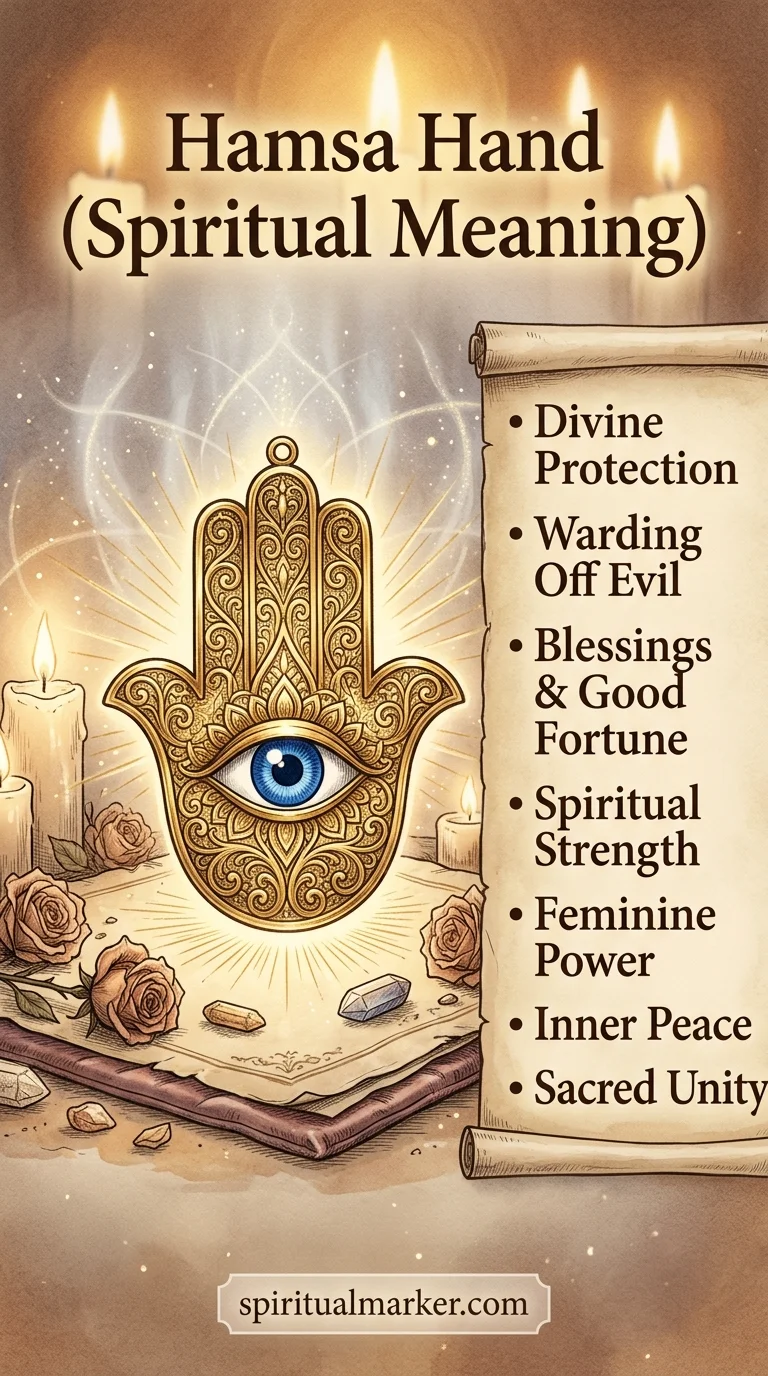
The Hamsa Hand is an open palm amulet, often depicted symmetrically with three fingers pointing upward and two thumbs extending outward on either side. It is sometimes illustrated with an eye in the center of the palm, an artistic element that enhances its protective spiritual energy. The symbol appears in jewelry, art, home decor, tattoos, and sacred objects across dozens of countries and cultures.
Its spiritual power comes from its age and universality. Symbols gain energy through repeated use and collective belief. The Hamsa has been used as a spiritual tool for over 1,800 years, with some historians tracing its roots to Mesopotamia and Carthage in ancient times. When millions of people across centuries place the same meaning onto a single symbol, that symbol carries real weight in the spiritual world.
The hand itself is a profoundly meaningful body part across spiritual traditions. In many faiths, the hand of God represents divine action, creation, and protection. The hand blesses, heals, and shields. The Hamsa takes that universal meaning and concentrates it into a single, wearable, displayable form. It acts as a physical reminder of divine presence in your daily life. Many spiritual teachers describe it as a bridge between the human and the divine, a symbol that keeps one foot in the material world and one in the sacred realm.
Researchers and anthropologists who study sacred symbols note that the Hamsa’s staying power is no accident. Unlike symbols tied exclusively to one religion or region, the Hamsa has adapted across cultures without losing its core meaning. Whether called the Hand of Fatima in Islam, the Hand of Miriam in Judaism, or the Hand of Mary in some Christian communities, its essence remains constant: protection, power, and blessing from the divine.
What Does the Hamsa Hand Symbolize and Represent?
At its most fundamental level, the Hamsa Hand symbolizes protection. It stands as a barrier between the wearer and harmful energies, negative intentions, and the evil eye. This meaning is consistent across every culture and religion that has adopted the symbol. Yet the Hamsa carries far more meaning than protection alone.
The Hamsa also represents divine blessing and good fortune. Many people display it in their homes to attract prosperity, health, and happiness. In this context, it functions less as a shield and more as a magnet, drawing positive energy toward the person or space it occupies. This dual role as both protector and attractor makes the Hamsa uniquely powerful among spiritual symbols.
Another core meaning of the Hamsa is feminine power and divine feminine energy. In many traditions, the hand is specifically associated with a powerful woman, whether Fatima, Miriam, or Mary. These women are figures of strength, wisdom, and grace. The Hamsa honors that energy and connects the wearer to it. Some feminist spiritual communities have reclaimed the Hamsa specifically because of this connection to sacred feminine power.
The eye within the Hamsa adds yet another layer of meaning. This eye, often blue or turquoise, represents watchfulness and spiritual awareness. It sees what others cannot. It perceives negative energies before they arrive. Together, the hand and eye create a symbol of active, vigilant spiritual protection rather than passive hope. The Hamsa does not merely wish for safety. It actively watches for and deflects harm.
7 Spiritual Meanings of the Hamsa Hand
1. Protection Against the Evil Eye
The most ancient and persistent spiritual meaning of the Hamsa Hand is its power to protect against the evil eye, known in Arabic as “al-ayn” and in Hebrew as “ayin hara.” The evil eye refers to a harmful gaze, intentional or unintentional, that carries negative energy capable of causing misfortune, illness, and suffering to the person it lands on. This belief appears in ancient Mesopotamian texts, Greek manuscripts, and Roman writings, making it one of humanity’s oldest spiritual concerns.
The Hamsa’s open palm acts as a spiritual stop sign. It intercepts the harmful energy before it can reach the wearer or the space it protects. The eye embedded in the palm of the Hamsa reinforces this meaning. The eye sees the incoming negative gaze and neutralizes it. Many spiritual healers describe this dynamic as one of spiritual mirroring: the Hamsa reflects harmful energy back to its source, preventing it from taking root in your life.
This protective meaning is why the Hamsa appears so frequently above doorways and entrances. The home is a sacred space, and the Hamsa guards its threshold. Hanging one above your front door sends a clear spiritual message: negative energy is not welcome here. Spiritual practitioners who work with protective talismans often place the Hamsa at entry points to create what they describe as an energetic seal around the living space, turning the entire home into a protected sanctuary.
Interestingly, modern psychology supports the value of protective rituals even without endorsing the supernatural. Research on the psychology of ritual behavior shows that protective symbols reduce anxiety and increase feelings of personal safety and control. The Hamsa serves this function even on a psychological level, making it spiritually and emotionally valuable to the people who use it.
2. Divine Blessing and Prosperity
Beyond protection, the Hamsa Hand carries a powerful meaning of divine blessing. In many Middle Eastern and North African cultures, the open hand of the Hamsa represents God’s hand extending blessings toward the faithful. When you display or wear the Hamsa with the fingers pointing downward, you are spiritually positioning yourself to receive those blessings. The downward-pointing hand pours abundance, health, and good fortune into your life like water flowing from an open palm.
This meaning connects deeply to the concept of divine grace found in many spiritual traditions. Grace is not something you earn. It flows freely from the divine toward those who remain open to receiving it. The Hamsa, worn with intention, symbolizes that openness. You are declaring your readiness to receive what the universe or God has to offer. Many spiritual teachers describe this as one of the most overlooked aspects of the Hamsa’s meaning: it is not only about blocking the bad but actively inviting the good.
In practical spiritual terms, many people place the Hamsa in abundance corners of their homes, near financial documents, or in business spaces to attract prosperity. Feng shui practitioners sometimes incorporate the Hamsa into wealth-attracting arrangements, appreciating its cross-cultural resonance. The symbol carries enough universal energy that it integrates naturally into almost any intentional spiritual practice related to inviting positive abundance into one’s life and work.
The blessing meaning of the Hamsa also extends to relationships. Many couples exchange Hamsa gifts at weddings and significant milestones as a way of calling divine blessing onto their union. Parents place the Hamsa in a child’s room to invite health, happiness, and a blessed life from the very beginning. This tradition of gifting the Hamsa as a vessel of blessing makes it one of the most spiritually intentional gifts you can give someone you love.
3. Feminine Divine Power
The Hamsa carries deep feminine spiritual energy. In Judaism, it is called the Hand of Miriam, honoring Miriam the prophetess, sister of Moses, who played a crucial role in the liberation and survival of the Israelite people. In Islam, it bears the name Hand of Fatima, after Fatima al-Zahra, the beloved daughter of the Prophet Muhammad, revered for her purity, strength, and wisdom. Both of these women represent the highest expression of feminine power within their respective traditions.
The connection to the divine feminine is not incidental. Across many ancient spiritual systems, the hand was associated with feminine energy because hands nurture, create, protect, and heal. These are qualities traditionally associated with the sacred feminine in spiritual philosophy. The Hamsa, as an open hand, embodies all of these qualities simultaneously. It creates a space of safety, nourishment, and grace around whoever carries it.
In modern spiritual communities, the Hamsa has become a symbol of sacred feminine reclamation. Women who connect with goddess spirituality, the divine mother archetype, or feminine-centered prayer traditions often wear the Hamsa as an expression of their spiritual identity. The symbol communicates belonging to a lineage of powerful, sacred women who walked before us and whose spiritual protection extends into the present.
This does not mean the Hamsa is exclusively for women. Men and non-binary individuals also carry the Hamsa with deep meaning. The symbol invites everyone to connect with qualities of nurturing power, intuitive protection, and graceful strength. These are qualities that all human beings need, regardless of gender. Wearing the Hamsa signals your willingness to embody and receive that energy in your own life.
4. Spiritual Awareness and the Third Eye
The eye at the center of the Hamsa holds its own distinct spiritual meaning. This eye is closely associated with the concept of spiritual sight and heightened awareness. In many esoteric traditions, it parallels the third eye, the sixth chakra in Hindu and Buddhist systems, which governs intuition, perception, and spiritual vision. The eye on the Hamsa suggests that its bearer possesses or seeks a deeper level of awareness that ordinary sight cannot access.
Spiritual sight means the ability to perceive truth beyond surface appearances. It means recognizing harmful influences before they take hold. It means seeing the divine in everyday life. The Hamsa’s eye acts as a spiritual companion to your own developing intuition, reminding you to look deeper and trust what you sense even when you cannot fully explain it. Many spiritual teachers describe the Hamsa as a teacher in this regard, training the wearer to cultivate their own spiritual perception over time.
The color of the eye also carries meaning. Blue and turquoise are the most traditional colors for the evil eye within the Hamsa. In many Middle Eastern cultures, blue has long been associated with the divine, purity, and protective energy. The blue eye within the Hamsa thus combines color symbolism with spiritual meaning, creating a layered talisman that operates on multiple levels simultaneously.
People who work with the Hamsa in meditation often focus on the eye as a point of concentration, using it as a gateway to deepen their spiritual practice. The act of gazing at the Hamsa’s eye with intention is said to activate one’s own inner vision. This meditative use of the Hamsa connects it to broader traditions of sacred object contemplation found in Tibetan Buddhism, Christian icon veneration, and Hindu yantra meditation.
5. Good Luck and Positive Energy
Across many cultures, the Hamsa functions as a powerful good luck charm. This meaning runs parallel to its protective and blessing-giving roles but focuses specifically on attracting favorable circumstances and positive outcomes. In Sephardic Jewish communities, the Hamsa appears at celebrations, on wedding invitations, and at the start of new business ventures as a way of calling good fortune into new beginnings.
The concept of luck in spiritual traditions is not simply random chance. It reflects alignment with divine will and the flow of positive universal energy. When you carry a Hamsa with the intention of attracting good luck, you are spiritually signaling your alignment with the positive forces of the universe. This intention itself shifts your energetic frequency in meaningful ways. Spiritual practitioners consistently emphasize that the Hamsa works most powerfully when carried or displayed with conscious awareness of its meaning.
Positive energy attraction through the Hamsa also extends to the people around you. Many people report that after introducing the Hamsa into their homes or personal items, they notice improvements not just in their own circumstances but in the energy of their relationships. The Hamsa creates a field of positive spiritual energy that can influence everyone who enters its sphere. This broader ripple effect makes it a meaningful tool for anyone who wants to cultivate a more positive, harmonious environment.
New ventures, travels, examinations, pregnancies, and career changes are all common moments when people turn to the Hamsa for its luck-attracting energy. The symbol bridges the space between hope and spiritual action. It transforms the passive wish for good outcomes into an active spiritual statement that you are ready to receive them. This proactive quality is what makes the Hamsa one of the most energetically potent good luck symbols in the world.
6. Healing and Physical Well-Being
The Hamsa Hand holds significant meaning in the realm of physical and emotional healing. The hand has been a healing tool across cultures since antiquity. Laying hands on the sick appears in the Bible, in Islamic healing tradition, in Hindu Ayurvedic practice, and in numerous indigenous healing systems worldwide. The Hamsa connects directly to this ancient understanding of the hand as a conduit of healing energy.
In many spiritual healing traditions, the Hamsa is used specifically in contexts of illness, recovery, and emotional pain. Healers and caregivers in Middle Eastern and North African communities traditionally hang the Hamsa near the sick to draw protective and restorative energy into the healing space. The symbol is believed to shield the ill person from additional harm while simultaneously attracting the divine energy needed for recovery.
Emotionally, the Hamsa provides a sense of spiritual comfort and security during times of vulnerability. Grief, trauma, anxiety, and depression all leave a person feeling spiritually exposed. The Hamsa’s protective energy offers a form of spiritual containment during these difficult seasons. Many therapists and counselors who integrate spirituality into their practice note that healing symbols like the Hamsa can support the emotional healing process by providing an external anchor for internal spiritual resources.
The Hamsa also connects healing to the divine rather than leaving it entirely in human hands. This shift in perspective is itself therapeutic. When you believe a higher power participates in your healing, the burden of recovery feels less crushing. The Hamsa Hand serves as a tangible reminder of divine partnership in the healing journey, offering comfort that spiritual support is present even in the most painful moments of life.
7. Connection to the Divine and Spiritual Alignment
Perhaps the deepest spiritual meaning of the Hamsa Hand is its role as a bridge between the human soul and the divine. In many mystical traditions, physical objects serve as anchors for spiritual reality. They hold sacred energy in a form that human beings can see, touch, and interact with daily. The Hamsa performs this function across virtually every tradition that uses it. It makes the invisible presence of the divine tangibly felt in everyday life.
This meaning deepens when you consider the Hamsa’s consistent appearance across traditions with very different theologies. The fact that Jews, Muslims, Christians, Hindus, and Buddhists all find spiritual resonance in the same open-palm symbol suggests that the Hamsa taps into something universal about human spiritual experience. It speaks to something in the human soul that transcends doctrinal boundaries: the deep desire to live under divine protection and in alignment with a higher power.
Wearing or displaying the Hamsa with spiritual intention can serve as a daily alignment practice. Each time you see it, it calls you back to your spiritual center. It asks you to remember that you are not navigating life alone. It reminds you that divine energy is present, active, and accessible to you right now. This quality of spiritual remembrance makes the Hamsa one of the most practical spiritual tools available to people of any faith background.
Spiritual teachers who work across traditions often recommend the Hamsa to seekers who feel disconnected from their faith or from any sense of divine presence. The symbol’s multi-faith acceptance means it rarely conflicts with existing spiritual beliefs. Instead, it enhances and amplifies spiritual awareness regardless of the specific tradition a person follows. It is a symbol that says, in every language and every faith: you are seen, you are protected, and the divine hand is with you.
Hamsa Hand Meaning Across Cultures and Religions
The Hamsa Hand meaning is one of the few spiritual concepts that travels seamlessly across religious boundaries. Its presence in Judaism, Islam, Christianity, Hinduism, and Buddhism speaks to its extraordinary spiritual universality. Each tradition has adapted the symbol to fit its own spiritual language while preserving the core meaning of protection and divine connection.
In Judaism, the Hamsa is called the Hand of Miriam. Miriam was the prophetess who watched over her infant brother Moses as he floated in the Nile, who led the Israelite women in celebratory song after crossing the sea, and who stood as a spiritual pillar of the community throughout the Exodus. The Hand of Miriam connects Jewish wearers to this legacy of watchful, courageous, and celebratory feminine spirituality. In Kabbalistic tradition, the five fingers of the Hamsa correspond to the five books of the Torah, making it also a symbol of sacred scripture and divine law.
In Islam, the symbol is known as the Hand of Fatima or Khamsa, the Arabic word for five. Fatima bint Muhammad is one of the most revered figures in Islamic tradition, especially in Shia Islam where she holds near-divine significance. The Hand of Fatima represents patience, faith, and protection through devotion to God. It is used widely across North African, Middle Eastern, and Mediterranean Muslim communities as a protective amulet worn on the body or displayed in homes and vehicles.
In Christianity, particularly in some Eastern and Mediterranean Christian communities, the open hand appears as the Hand of Mary, connecting the symbol to the Virgin Mary’s protective and intercessory role. Though less prominent in mainstream Christian spirituality, the Hamsa appears in Coptic Christian art and in the folk religion practices of Catholic communities in Spain, Portugal, and Latin America. Some Christian mystics associate the Hamsa’s five points with the Five Wounds of Christ, linking it to redemptive suffering and divine grace.
In Hindu and Buddhist traditions, the open palm holds deep spiritual significance through the mudra, a sacred hand gesture used in meditation and ritual. The Abhaya mudra, the open palm raised in a gesture of fearlessness and protection, is one of the most recognizable mudras across both traditions. Statues of the Buddha and of Hindu deities frequently depict this gesture. The Hamsa’s visual similarity to the Abhaya mudra allows it to integrate naturally into the spiritual vocabulary of these Eastern traditions, carrying the same message of divine protection and fearlessness.
The Hamsa Hand in World Mythologies
The roots of the Hamsa Hand extend into ancient mythological traditions that predate the major world religions. Archaeological evidence suggests that protective hand amulets appeared in ancient Carthage and the Phoenician world as early as the first millennium BCE. These early hand symbols were connected to the goddess Tanit, a powerful deity of protection, fertility, and celestial power. The hand of Tanit, displayed with an open palm and outstretched fingers, served the same protective function that the Hamsa serves today.
In ancient Mesopotamia, the hand appeared in religious iconography as a symbol of divine command and protection. The hand of the god Marduk, the chief deity of Babylon, represented supreme authority and the power to shield the faithful from harm. Mesopotamian homes displayed protective hand symbols to guard against demons, illness, and misfortune. This ancient Mesopotamian tradition likely influenced the spread of the protective hand symbol throughout the ancient Near East, eventually giving rise to the Hamsa as we know it.
Greek and Roman mythological traditions also venerated the power of the hand. The Greek concept of the “evil eye” or “baskania” was countered by apotropaic gestures and symbols, including the open palm. Roman soldiers wore hand amulets into battle. Roman homes displayed the “manus” symbol, an open hand believed to channel divine will and ward off malevolent forces. The widespread Roman empire carried these beliefs across Europe, contributing to the cross-cultural resonance the protective hand symbol enjoys today.
Ancient Egyptian mythology offers another fascinating connection. The goddess Isis, one of ancient Egypt’s most powerful protective deities, was frequently depicted extending her wings and hands over those she protected. The extended, open hand of divine protection is a recurring motif in Egyptian religious art. This Egyptian tradition of the protecting deity’s hand influenced both North African and Middle Eastern spiritual practices for thousands of years, creating fertile ground for the Hamsa’s later development and widespread adoption.
The Hamsa Hand Up vs. Hand Down: What the Direction Means Spiritually
One of the most practically important aspects of Hamsa hand symbolism is the direction the hand faces. This seemingly small detail carries significant spiritual weight. Many people display or wear the Hamsa without knowing that its orientation changes its meaning, and choosing the right direction for your intention matters a great deal.
When the Hamsa points upward, with fingers pointing toward the sky, it functions primarily as a protective amulet. The upward position is an active stance, like a hand raised in a gesture of “stop.” This orientation deflects negative energy, blocks the evil eye, and creates a spiritual barrier around the person or space. Many people who feel threatened, vulnerable, or in need of strong energetic protection choose the upward-pointing Hamsa for this reason.
When the Hamsa points downward, with fingers toward the earth, it transforms into a symbol of invitation and reception. The downward position opens the palm to receive blessings, abundance, and good fortune from above. This orientation channels positive energy downward from the divine realm into the material world. People who want to attract prosperity, fertility, love, or new opportunities often choose the downward-pointing Hamsa as their spiritual tool.
Both directions are spiritually valid and deeply meaningful. Your choice depends on your current spiritual need. Some people wear or display both orientations simultaneously, seeking the dual benefit of protection and attraction. Many spiritual practitioners recommend pausing to set a clear intention when placing or wearing a Hamsa, consciously aligning the symbol’s direction with your specific spiritual goal. This intentional approach transforms the Hamsa from a passive decorative object into an active spiritual companion.
Hamsa Hand Biblical Meaning and Significance
While the term “Hamsa” does not appear in the Bible by name, the spiritual themes it represents are deeply biblical. Scripture contains numerous references to the hand of God as a symbol of protection, power, and blessing. These references align directly with the Hamsa’s core spiritual meanings and reveal the biblical roots of the symbol’s significance.
Psalm 139:10 speaks of God’s hand guiding and holding the believer even in the darkest places. Isaiah 41:10 contains the divine promise: “I will uphold you with my righteous right hand.” Deuteronomy 33:27 describes God’s everlasting arms as a refuge. These passages articulate the same spiritual reality that the Hamsa represents visually: the protective hand of God actively engaged in human life. The Hamsa functions as a visual meditation on these biblical promises.
The connection to Miriam in the Hebrew tradition also carries deep biblical significance. Miriam appears in Exodus as a prophetess and spiritual leader of extraordinary courage. Her role in the Exodus narrative goes beyond simply watching over baby Moses. She organizes the women’s song of praise at the Red Sea in Exodus 15:20-21, becoming one of the first recorded worship leaders in scripture. The Hand of Miriam thus connects wearers to this act of joyful, triumphant praise and to the victory over oppression that the Exodus represents.
In the New Testament, Jesus frequently healed by placing his hands on the sick. This laying on of hands appears throughout the Gospels as an act of divine power flowing through human touch. James 5:14 instructs church elders to lay hands on the sick and pray for healing. This tradition of healing through the hand connects Christian communities to the same ancient understanding of the hand as a conduit of divine energy that the Hamsa embodies. For Christians who use the Hamsa, it can serve as a reminder of the healing power available through Christ.
The Hamsa Hand in the Islamic Tradition: The Hand of Fatima
Within Islam, the Hamsa carries the name Khamsa or Hand of Fatima, and its spiritual significance is deeply woven into Islamic culture and devotional life. Fatima al-Zahra, the daughter of the Prophet Muhammad and wife of Ali ibn Abi Talib, is revered as a model of spiritual purity, strength, and devotion. In Shia Islam particularly, she holds a position of extraordinary honor as one of the fourteen infallibles and as the mother of the Imams.
The story most commonly associated with the Hand of Fatima is a legend of love and faith. When Fatima’s husband Ali planned to take a second wife, Fatima was stirring a pot of food. In her grief and distraction, she continued stirring with her bare hand, feeling no pain because her love for God and her trust in divine will were so complete. The five fingers of the Hamsa in this tradition represent the five members of the Ahl al-Bayt, the household of the Prophet: Muhammad, Ali, Fatima, Hasan, and Husayn.
The Hamsa in Islamic tradition also connects to the five pillars of Islam: Shahada (testimony of faith), Salat (prayer), Zakat (charity), Sawm (fasting), and Hajj (pilgrimage). Each finger of the Hamsa can be understood as one pillar, making the symbol a reminder of the complete structure of Islamic spiritual practice. Wearing or displaying the Hamsa serves as a commitment to living a life grounded in these five foundational acts of devotion.
While some Islamic scholars debate the permissibility of amulets in general, the widespread cultural use of the Khamsa across Muslim-majority countries speaks to its deep integration into popular Islamic spirituality. In Morocco, Tunisia, Egypt, Turkey, and across the Arab world, the Hand of Fatima appears on homes, cars, jewelry, and clothing as a universally recognized symbol of protection and faith. Its use reflects the rich intersection of formal religious doctrine and living spiritual culture.
Hamsa Hand Colors and Their Spiritual Meanings
The color of a Hamsa Hand adds another dimension to its spiritual meaning. Different colors carry different energetic frequencies, and choosing a Hamsa in a specific color can amplify your spiritual intention. This use of color symbolism in sacred objects appears across virtually every spiritual tradition in the world.
Blue Hamsa is the most traditional color, connected to the evil eye and the protective qualities of water and sky. Blue represents truth, clarity, and divine watchfulness. A blue Hamsa provides the strongest protective energy against negative forces and harmful intentions. Turquoise blue in particular is considered especially potent in Middle Eastern protective traditions, associated with both the sky and the divine realm.
Gold Hamsa connects to prosperity, wisdom, and divine light. Gold is the color of the sun, of royalty, and of spiritual illumination. A gold Hamsa is particularly powerful when used to attract abundance, success, and elevated spiritual awareness. Many spiritual practitioners choose gold Hamsa pieces when setting intentions related to career advancement, financial growth, or deepening spiritual wisdom.
Red Hamsa carries energy related to passion, courage, and vital life force. Red connects to the root chakra, to the blood that carries life through the body, and to the fierce protective energy of divine love. A red Hamsa is often chosen by those seeking to strengthen their courage, vitality, and willingness to stand firm against adversity. It combines the Hamsa’s protective qualities with an energizing, activating force.
White or silver Hamsa connects to purity, new beginnings, and spiritual clarity. White reflects all light and represents the clean slate of divine grace. Silver connects to the moon, to intuition, and to the reflective quality that deflects harmful energy. A white or silver Hamsa is particularly meaningful during times of new beginnings, spiritual renewal, and the desire to release the past and move forward in alignment with divine purpose.
Wearing the Hamsa Hand: Spiritual Guidelines and Intentions
Wearing the Hamsa Hand as jewelry is one of the most personal ways to engage with its spiritual energy. Necklaces, bracelets, earrings, and rings all serve as intimate carriers of the symbol’s power. When worn consistently close to the body, the Hamsa creates a continuous field of protective and blessing energy around the wearer.
Many spiritual traditions recommend setting a clear intention when first putting on a Hamsa piece. Take a moment to hold it, breathe deeply, and consciously invite the specific spiritual quality you most need: protection, healing, abundance, clarity, or divine connection. This act of intentional activation transforms the Hamsa from a passive ornament into a living spiritual ally. Some people speak a short prayer or affirmation during this process, aligning their words with the symbol’s energy.
The placement of the Hamsa on the body also carries meaning. Wearing it close to the heart connects it to love, compassion, and emotional healing. Wearing it on the wrist, particularly the left wrist in many traditions, places it near the pulse, connecting it to the vital life force flowing through your body. Wearing it as a pendant positions it in the throat and heart area, linking it to both communication and emotional energy.
Caring for your Hamsa piece is also a spiritual practice. Many people cleanse their Hamsa periodically, especially after periods of stress or intense challenge, using methods like moonlight cleansing, salt water, smudging with sage, or prayer. This practice maintains the symbol’s energetic clarity and renews its protective power. Treating your Hamsa with reverence signals to the universe that you take your spiritual protection seriously and that you value the divine energy this ancient symbol carries.
Hamsa Hand Tattoo Spiritual Meaning
The Hamsa Hand tattoo has become one of the most requested spiritual tattoo designs in the world. People choose to permanently inscribe this sacred symbol on their bodies as a lifelong declaration of their connection to its spiritual meaning. A Hamsa tattoo is not simply a fashion choice. For most people who wear it, it is a permanent spiritual commitment and a deeply personal statement of faith.
Common placements for Hamsa tattoos include the inner wrist, the back of the hand, the forearm, the upper back, and the chest near the heart. Each placement carries additional symbolic weight based on its location on the body. A Hamsa tattooed on the hand itself creates a powerful layering of symbolism: a hand within a hand, doubling the protective energy and marking the wearer as someone who carries divine protection in everything they touch and do.
When choosing a Hamsa tattoo design, many people personalize the symbol with additional spiritual elements. Lotus flowers, mandalas, eyes, geometric patterns, Hebrew or Arabic script, and specific color choices all add layers of personal meaning to the basic Hamsa form. These additions make the tattoo a unique spiritual portrait of the individual’s specific beliefs, intentions, and connection to the divine.
Some spiritual and cultural communities ask that non-members approach Hamsa tattoos, especially those carrying specific cultural or religious meanings, with appropriate respect and awareness. Understanding the symbol’s deep roots and honoring those roots in your intention for wearing it permanently is part of engaging with this symbol in a spiritually mature way. A Hamsa tattoo carried with genuine reverence and intentional spiritual meaning becomes a powerful lifelong ally on your spiritual journey.
Displaying the Hamsa Hand in Your Home
Your home is your sanctuary, and placing a Hamsa in your living space is one of the most powerful ways to activate its spiritual energy in your daily life. The Hamsa works in home environments as a constant, passive spiritual guardian. You do not need to think about it consciously every day. It works through its presence, creating a field of protective and blessed energy throughout the space.
The most traditional placement for a Hamsa in the home is above the front door or main entrance. This positions the symbol as the guardian of the threshold, the first point of contact between the outside world and your sacred interior space. Every person who enters passes beneath the Hamsa’s protective gaze. Every energy that seeks to enter is first filtered through its spiritual field. This threshold placement echoes the ancient mezuzah tradition in Judaism, which places scripture at doorways for similar protective purposes.
Beyond the entrance, many people place the Hamsa in the bedroom for protection during sleep, in the kitchen to bless the food and nourishment prepared there, and in the living room or workspace to attract positive energy into the areas where daily life unfolds. Some families create intentional spiritual altars or sacred corners in their homes that feature the Hamsa alongside candles, crystals, sacred texts, and photographs of loved ones. This combination creates a powerful energetic anchor point for the entire household.
When selecting a Hamsa for your home, trust your intuition about size, material, and design. A large ceramic or wall-hanging Hamsa carries a strong visual and energetic presence. A small metallic or beaded Hamsa placed near a window catches the light and creates a delicate but powerful spiritual point in the room. No single format is superior. The most spiritually effective Hamsa for your home is the one that resonates most deeply with your own energy and aesthetic sense.
A Final Note
The Hamsa Hand is far more than a trend. It is a living spiritual symbol that has traveled across thousands of years, dozens of cultures, and every major religious tradition in the world. Its message has never changed: you are seen, you are protected, and divine grace is available to you right now. That message is as relevant today as it was in ancient Carthage, in biblical Israel, in the early centuries of Islam, and in the temples of ancient India.
Whether you wear the Hamsa as jewelry, display it in your home, meditate with it, or carry it as a tattoo, what matters most is the intention and awareness you bring to it. A symbol only becomes spiritually powerful when it is engaged with consciously. Take time to connect with the Hamsa’s meaning. Let it remind you daily that protective, blessing-giving divine energy surrounds you. Allow it to anchor your spiritual awareness even during the busiest and most chaotic moments of life.
You may find it meaningful to research the specific Hamsa tradition that resonates most deeply with your own spiritual background. Reading more about Miriam in the Jewish tradition, Fatima in Islamic spirituality, or the Abhaya mudra in Buddhist practice can deepen your appreciation of the symbol and strengthen your personal connection to it. You might also consider gifting a Hamsa to someone you love who is going through a difficult time, knowing you are giving them not just an object but a vessel of ancient protective energy and divine blessing.
The Hamsa Hand spiritual meaning ultimately speaks to a universal human experience: the need for protection, connection, and the reassurance that we do not walk through life alone. Whatever you believe, wherever you come from, and whatever challenges you face, the open palm of the Hamsa reaches toward you with the same message it has offered to humanity for millennia. You are held. You are blessed. And the divine hand is with you every step of the way.