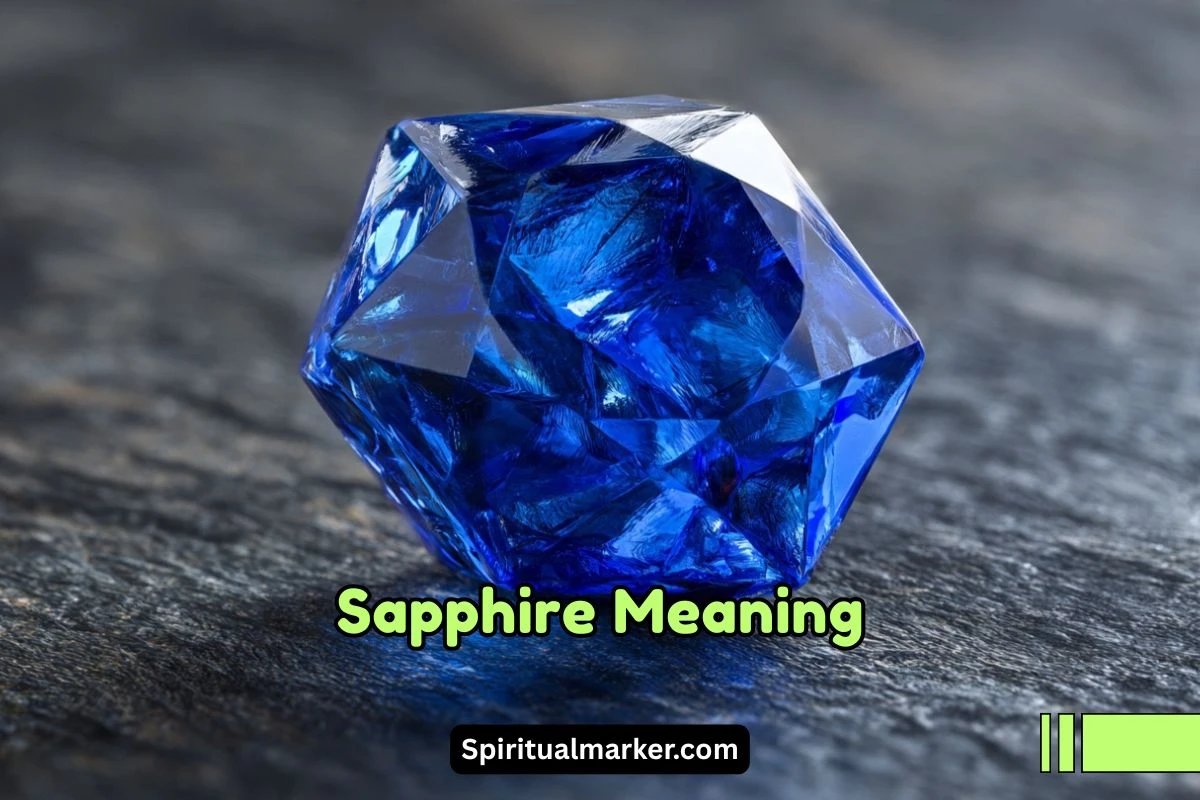
Sapphire is a stone of wisdom and royalty. Its deep blue color evokes the sky and the sea. In spiritual practice, this stone carries powerful and calming energy.
The sapphire meaning often involves wisdom, truth, and spiritual insight. It is a stone of the throat and third eye chakras, helping to express truth and enhance intuition. A spiritual meaning of lapis lazuli shares that blue-stone focus, though lapis carries a more regal energy.
Sapphire is used in crystal healing to boost confidence, enhance mental clarity, and support meditation. It can also symbolize loyalty and inner peace. The stone's energy is regal and grounding.
If you feel drawn to sapphire, it may signal a need for wisdom. A spiritual meaning of blue apatite also deals with blue stones, though apatite carries a more energizing energy.
5 Key Takeaways
- Sapphire symbolizes wisdom, truth, loyalty, and divine connection across multiple ancient traditions.
- The stone connects strongly with the throat chakra and third eye chakra, supporting clarity of thought and honest communication.
- Many spiritual traditions link sapphire with mental focus, emotional steadiness, and spiritual protection.
- Sapphire ranks 9 on the Mohs hardness scale, making it one of the most durable gemstones available.
- Wearing sapphire close to the skin or using it during meditation may strengthen intuition, self-expression, and inner calm.
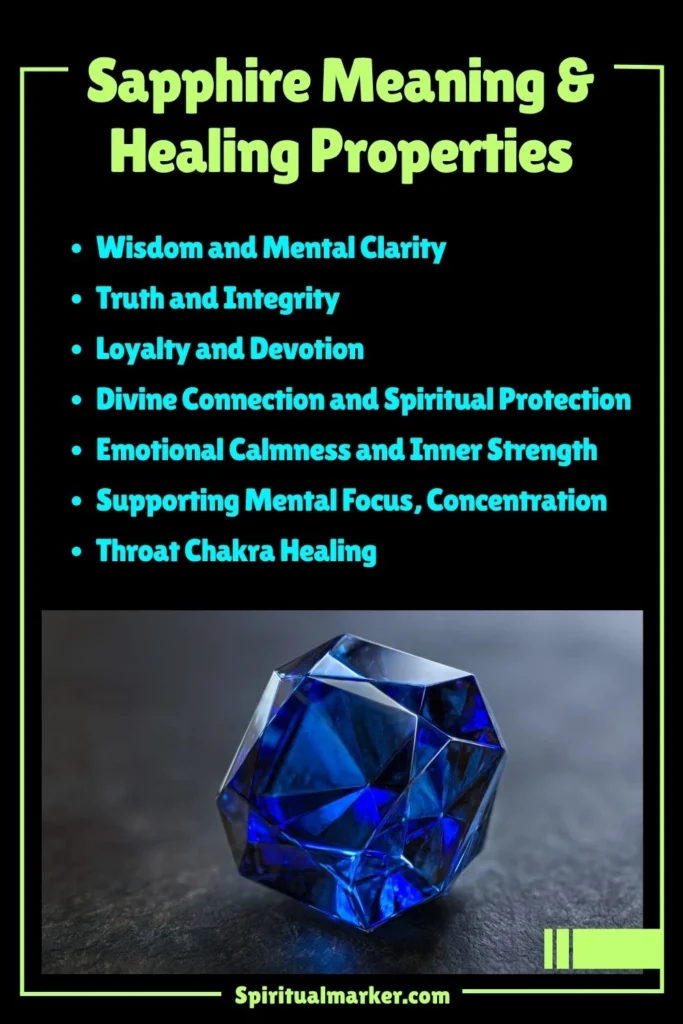
What is Sapphire?
Sapphire is a precious gemstone belonging to the corundum mineral family. It shares the same mineral composition as ruby, with the key difference being color. While ruby earns its red hue from chromium, sapphire gets its iconic deep blue color from trace amounts of iron and titanium within the crystal structure.
Most people picture sapphire as deep blue, but the stone actually appears in a remarkable range of colors. Pink sapphire, yellow sapphire, white sapphire, orange sapphire, and the rare padparadscha sapphire, which blends pink and orange, all belong to the same family. The only corundum color excluded from the sapphire label is red, which remains classified as ruby.
Among all sapphire varieties, blue sapphire holds the strongest spiritual reputation and the longest historical record of sacred use. Its rich, velvety blue has consistently inspired associations with the sky, the sea, divine truth, and infinite knowledge.
Sapphire feels entirely different from softer stones like opal or moonstone. It carries a dense, grounded energy with a sense of quiet authority. Its hardness and structural stability may contribute to why so many spiritual traditions associate it with permanence, integrity, and unwavering truth.
Origins and Formation
Sapphire forms deep within the Earth’s crust under intense heat and pressure. It crystallizes within metamorphic and igneous rocks. This formation process takes millions of years, which may partly explain sapphire’s spiritual connection with patience, longevity, and enduring truth.
The finest sapphires historically came from Kashmir in India, where the unique geological conditions produced stones with an unmatched velvety blue known as “cornflower blue.” Today, major sources include Sri Lanka, Myanmar, Madagascar, Australia, Thailand, Cambodia, and the United States.
Sri Lankan sapphires, often called Ceylon sapphires, are particularly prized for their lighter, brilliant blue tones. Myanmar, formerly Burma, produces stones known for their intense, saturated royal blue. Madagascar has emerged as one of the world’s largest sapphire sources in recent decades.
Each geographic origin produces slightly different characteristics. Spiritual communities sometimes assign additional meaning based on origin, though the stone’s core symbolic themes remain consistent regardless of where it forms.
Key Properties
| Property | Details |
|---|---|
| Primary Color | Deep blue, also pink, yellow, white, orange |
| Mineral Family | Corundum (aluminum oxide) |
| Hardness | 9 on the Mohs scale |
| Chakra Association | Throat chakra, third eye chakra |
| Primary Symbolism | Wisdom, truth, loyalty, divine connection |
| Major Sources | Sri Lanka, Myanmar, Madagascar, Kashmir |
| Transparency | Transparent to opaque |
| Energy Style | Clear, grounding, authoritative, and calming |
Historical Use of Sapphire
The spiritual history of sapphire is extraordinarily rich. Few gemstones have played as consistent a role across as many civilizations and time periods.
Ancient Persians believed the entire Earth rested on a giant sapphire. They thought the sky’s blue color came from light reflecting off this cosmic stone. That belief positioned sapphire as a gemstone of cosmic order and divine architecture from the very beginning.
Ancient Greeks and Romans associated sapphire with Apollo, god of the sun, wisdom, and prophecy. Seekers visiting the Oracle at Delphi sometimes wore sapphire believing it would open the mind to divine messages and higher truth.
In Biblical tradition, the Ten Commandments were said to be inscribed on tablets of sapphire. Medieval Christians associated the stone with heaven, purity, and divine blessing. High-ranking clergy wore sapphire rings as symbols of their connection to sacred truth and spiritual authority.
Vedic astrology, one of the world’s oldest astrological traditions, assigns blue sapphire to Saturn. Known in Sanskrit as Neelam, blue sapphire is considered one of the most powerful planetary gemstones. Vedic practitioners believe it can bring swift transformation, discipline, clarity, and protection to those under Saturn’s influence.
Royal families across Europe and Asia used sapphire in crowns, rings, and ceremonial objects for centuries. The stone represented loyalty, nobility, wisdom, and moral clarity. Perhaps the most famous modern example is the sapphire engagement ring that once belonged to Princess Diana and now worn by Catherine, Princess of Wales.
Medieval European physicians used sapphire in healing practices, believing it could treat eye diseases, reduce fever, and calm an overactive mind. While modern medicine differs significantly, these historical uses reflect sapphire’s long-standing association with clarity, sharpness, and healing.
5 Spiritual Meanings of Sapphire
1. Wisdom and Mental Clarity
Wisdom forms the very center of sapphire’s spiritual identity. This association has remained consistent across civilizations, centuries, and spiritual traditions. Ancient scholars, priests, philosophers, and royalty all connected sapphire with the kind of deep, penetrating knowledge that goes beyond surface thinking.
Modern crystal traditions continue this symbolism. Many practitioners believe sapphire helps the mind cut through confusion. Life presents an almost constant stream of decisions, pressures, information, and competing voices. People often feel overwhelmed not because they lack intelligence, but because clarity becomes difficult to access when stress, emotion, or uncertainty cloud thinking.
Spiritually, sapphire represents a return to clear-headed understanding. Its energy is described as mentally organizing rather than emotionally stimulating. Where some stones encourage emotional depth or creative flow, sapphire tends to symbolize precision of thought, rational awareness, and intellectual grounding.
This meaning is especially significant for those facing important life decisions. Choosing a career path, navigating a relationship crossroads, or confronting a difficult truth all require clear mental focus. Sapphire spiritually symbolizes the steady mind needed to see situations honestly rather than through wishful thinking or emotional distortion.
Many practitioners also connect sapphire’s wisdom symbolism with learning and study. Students, researchers, writers, and teachers have historically associated sapphire with intellectual focus. The stone does not represent raw intelligence, but rather the disciplined, honest pursuit of knowledge. That distinction makes its wisdom meaning feel grounded and practical rather than abstract.
Sapphire also symbolizes wisdom as it relates to knowing oneself. Self-knowledge is widely considered the foundation of genuine wisdom across philosophical and spiritual traditions. Sapphire’s energy is believed to support honest self-reflection, helping people see their own patterns, motivations, and blind spots with greater clarity and acceptance.
2. Truth and Integrity
Truth is perhaps sapphire’s most consistent spiritual symbol throughout history. From ancient civilizations to modern crystal traditions, the stone has been linked with honesty, integrity, moral courage, and authentic communication. Its deep blue color has long been associated with depth, transparency, and unwavering moral clarity.
This symbolism carries particular relevance because truth is rarely simple. Living with integrity requires not just avoiding outright lies but choosing honesty even when silence or distortion would feel easier. Sapphire spiritually represents this kind of courageous honesty. It is not the symbol of comfortable truth but of deep, unwavering commitment to what is real.
Many people struggle with honesty in specific areas of life. Some find it difficult to speak truthfully in relationships out of fear of conflict or rejection. Others struggle with self-honesty, maintaining beliefs about themselves or their situations that protect them from painful realizations. Sapphire spiritually addresses both dimensions, symbolizing honest communication outwardly and honest self-awareness inwardly.
Its connection with the throat chakra reinforces this truth symbolism. The throat chakra governs authentic expression. When this energy center feels blocked, people may struggle with saying what they genuinely mean. They may hold back important words, suppress their true opinions, or communicate in ways that feel disconnected from their actual feelings. Sapphire is traditionally associated with reopening this channel of honest expression.
Truth in sapphire’s spiritual context also connects with moral integrity. Many ancient cultures gave sapphire to leaders, judges, and priests precisely because they associated it with the kind of moral clarity needed for just decision-making. Sapphire spiritually symbolizes the alignment between inner values and outward actions, which forms the foundation of genuine integrity.
3. Loyalty and Devotion
Loyalty has been one of sapphire’s defining spiritual associations for centuries. This symbolism explains why sapphire became the stone of choice for royal engagement rings, fidelity rings, and sacred oath-making ceremonies across multiple cultures and historical periods.
Genuine loyalty requires more than affection or casual commitment. It demands steadfastness during difficulty, faithfulness when circumstances make devotion costly, and the willingness to remain true when easier alternatives exist. Sapphire spiritually represents this deeper, more demanding form of loyalty rather than simple pleasantness.
In romantic relationships, sapphire’s loyalty symbolism carries obvious significance. Many couples choose sapphire engagement rings or anniversary gifts precisely because the stone spiritually represents devoted, enduring partnership. Its hardness and durability on the physical level mirrors what loyal love requires emotionally, the ability to withstand pressure while maintaining structural integrity.
Beyond romantic loyalty, sapphire symbolizes devotion in broader contexts. People may feel called to remain loyal to their spiritual path, their community, their personal values, or their long-term goals during periods when doubt, temptation, or exhaustion make consistency difficult. Sapphire spiritually represents the grounding energy needed to maintain that kind of committed devotion.
Loyalty also connects with sapphire’s protective energy. In many traditions, the stone was believed to protect faithful people from betrayal and deception. While modern interpretations vary, the symbolism reflects a belief that living with integrity and loyal devotion creates a form of spiritual protection, not by preventing hardship, but by anchoring a person in values that provide stability during uncertain periods.
This loyalty symbolism also applies to self-loyalty, which is often the most difficult form. Many people abandon their own dreams, needs, values, or truths to accommodate the expectations of others. Sapphire spiritually encourages remaining loyal to one’s authentic self even when external pressure pushes toward compromise or self-abandonment.
4. Divine Connection and Spiritual Protection
Sapphire’s connection with the divine appears across nearly every major ancient spiritual tradition. Persians connected it with cosmic structure. Biblical tradition linked it with sacred scripture. Medieval Christians associated it with heavenly blessing. Vedic astrologers viewed it as a powerful planetary gemstone bridging human experience with higher cosmic forces.
This consistent cross-cultural pattern is striking. Sapphire has been viewed as a bridge between earthly awareness and higher spiritual reality for millennia. Many spiritual practitioners today continue working with this symbolism during prayer, meditation, and ritual practice.
The connection with divine energy often manifests practically as heightened spiritual awareness. People who meditate with sapphire sometimes describe increased access to intuitive insight, spiritual clarity, and a stronger sense of inner guidance. Whether these experiences reflect literal metaphysical effects or the psychological power of intentional spiritual practice, the experiences themselves carry genuine significance.
Spiritual protection forms another major element of this meaning. Many ancient cultures believed sapphire shielded wearers from spiritual harm, psychic intrusion, deception, and negative energies. In the context of the stone’s broader symbolism, this protective association makes sense. Wisdom, truth, and clarity naturally serve as protection against confusion, manipulation, and self-deception.
Some traditions specifically associate sapphire with clearing spiritual obstacles. Periods of spiritual confusion, doubt, or disconnection may feel like hitting an invisible wall. Sapphire spiritually represents cutting through that fog, not through dramatic spiritual experiences necessarily, but through the steady return of clarity, focus, and authentic spiritual awareness.
The stone’s third eye chakra connection reinforces this spiritual symbolism. The third eye governs intuition, spiritual insight, inner vision, and higher perception. Sapphire’s association with this energy center suggests a spiritual purpose aligned with developing deeper internal knowing rather than relying solely on surface-level external information.
5. Emotional Calmness and Inner Strength
While sapphire is often celebrated for its mental and spiritual qualities, its emotional symbolism carries equal importance. The stone represents a specific type of emotional quality, not softness or emotional expressiveness exactly, but rather composed, steady emotional strength.
Many people confuse emotional strength with emotional suppression. They believe that being strong means hiding vulnerability, pushing through feelings, or appearing unaffected by difficulty. Sapphire’s emotional symbolism challenges that assumption. It represents strength that includes emotional honesty, the ability to face difficult feelings with clarity rather than denial.
In spiritual traditions, sapphire has been associated with calming emotional turbulence. Anxiety, emotional reactivity, fear, grief, and overwhelm can create internal chaos that affects thinking, decision-making, and relationships. Sapphire spiritually symbolizes bringing emotional composure to turbulent inner states without suppressing genuine feelings.
This emotional steadiness proves especially valuable during crisis, loss, or major life transitions. When external circumstances feel unstable, maintaining emotional grounding becomes critically important. Sapphire spiritually represents the emotional anchor that allows people to navigate significant challenges without becoming emotionally lost.
Its emotional symbolism also connects with courage. Facing truth, maintaining integrity, expressing authentic feelings, or making difficult decisions all require emotional bravery. Sapphire spiritually represents this form of courageous emotional honesty, the willingness to feel difficult things clearly rather than avoiding them.
Many practitioners also associate sapphire with releasing unnecessary emotional burdens. Over time, unresolved fears, chronic worries, and accumulated emotional tension can weigh heavily on daily life. Sapphire symbolizes a return to emotional lightness, not through bypassing genuine emotions, but through developing the internal clarity needed to process and release what no longer serves.
6 Healing Properties of Sapphire
1. Supporting Mental Focus and Concentration
Sapphire has been associated with sharper mental focus throughout its history. Ancient scholars and philosophers valued it for exactly this quality. Modern crystal traditions continue this association, particularly among those who work in demanding intellectual or creative fields.
Mental fog is a common experience. Stress, sleep deprivation, emotional overload, and constant digital stimulation all fragment concentration. Many people find it genuinely difficult to sustain focused attention for meaningful periods. Spiritually, sapphire represents the clearing of that mental fragmentation.
Its energy is described by practitioners as organizing and clarifying rather than stimulating. Unlike stones associated with energizing effects, sapphire tends to symbolize settling the mind rather than speeding it up. That distinction is meaningful because mental overactivity is often a greater obstacle to focus than mental sluggishness.
Many people who work with sapphire intentionally keep the stone at their desk, study space, or workspace. The symbolic intention involves creating an energetic environment that supports sustained concentration and clear thinking throughout demanding work sessions.
Vedic astrology supports this connection directly. Practitioners of Vedic traditions often recommend blue sapphire for individuals experiencing mental confusion, lack of direction, or difficulty making clear decisions. The stone is believed to channel Saturn’s influence toward disciplined, organized, focused mental activity.
2. Throat Chakra Healing and Authentic Expression
Sapphire’s connection with the throat chakra makes it particularly significant for people who struggle with authentic communication. The throat chakra governs how people express their truth, share their genuine thoughts and feelings, and communicate with clarity and confidence.
Throat chakra imbalances can appear in multiple ways. Some people speak too much without genuine substance, filling silence rather than communicating authentically. Others struggle with the opposite pattern, holding back important truths, staying silent when speaking would serve them, or communicating in ways deliberately vague or evasive.
Both patterns reflect disconnection from authentic expression. Sapphire spiritually symbolizes reopening that communication pathway. It represents the courage to speak what is genuinely true, even when vulnerability feels risky or unwelcome.
For those working through throat chakra healing, sapphire is often worn as a pendant or necklace, placing the stone physically close to the throat and chest. The symbolic intention involves creating alignment between inner truth and outward expression throughout daily life and interaction.
Authentic communication also requires emotional safety. People suppress truthful expression most often when they fear judgment, rejection, or conflict. Sapphire’s broader symbolism of wisdom and emotional steadiness creates a complementary energetic context, supporting people in speaking authentically from a grounded, clear, emotionally stable place.
3. Third Eye Chakra Activation and Intuition
The third eye chakra sits between the eyebrows and governs intuition, inner vision, spiritual perception, and access to deeper knowing beyond rational thinking. Sapphire is one of the most consistently cited stones for supporting third eye chakra energy across multiple spiritual traditions.
Intuition plays a critical role in good decision-making, yet modern culture heavily privileges rational analysis over inner knowing. Many people have learned to distrust their own intuitive perceptions, especially when those perceptions conflict with external expectations, social pressure, or logical reasoning.
Sapphire spiritually represents reconnecting with intuitive knowing. It does not reject rational thinking but complements it. The stone’s symbolism suggests integrating both intellectual clarity and intuitive awareness rather than choosing one over the other.
Practitioners who work with the third eye often use deep blue sapphire specifically because the stone’s color aligns energetically with the indigo tones associated with this chakra. Meditation sessions involving sapphire sometimes focus on developing stronger access to inner guidance, spiritual perception, and intuitive clarity.
This healing property also carries significance for creative and visionary work. Artists, writers, spiritual teachers, and anyone engaged in meaningful creative expression often struggle with periods of inner silence or creative disconnection. Sapphire’s third eye association may support renewed access to vision, inspiration, and creative insight.
4. Emotional Grounding During Anxiety and Stress
Anxiety and stress represent two of the most common emotional challenges in contemporary life. Both involve a specific type of mental-emotional experience where attention fixates on feared future scenarios rather than remaining present in current reality.
Sapphire’s healing reputation includes a notable association with reducing anxiety and calming overstimulated emotional states. Its energy is consistently described as settling and clarifying rather than activating. This makes it particularly relevant for people whose emotional challenges involve mental overactivity, racing thoughts, chronic worry, or difficulty calming an anxious mind.
Unlike some emotional healing stones that focus on emotional processing and vulnerability, sapphire’s approach to emotional grounding feels more structured and stabilizing. It supports emotional calm by encouraging mental clarity and presence rather than purely emotional catharsis.
Many practitioners recommend sapphire for those experiencing anxiety related to major decisions, uncertain futures, or periods of significant life transition. The stone’s wisdom symbolism supports this application. Anxiety frequently intensifies when people feel uncertain about making the right choice. Sapphire spiritually represents accessing the inner clarity needed to navigate decisions with greater confidence.
Physical placement matters to many practitioners. Some hold sapphire during breathing exercises, mindfulness practice, or moments of acute anxiety. Others wear sapphire jewelry consistently throughout stressful periods as a symbolic reminder to return to clarity, truth, and grounded awareness.
5. Supporting Healthy Relationships and Communication
Sapphire’s healing properties extend meaningfully into relationships. Its combination of truth symbolism, loyalty energy, throat chakra connection, and emotional grounding creates a uniquely relevant healing profile for relational challenges.
Healthy relationships require honest communication, emotional integrity, consistent trust, and the courage to address difficult realities together. These are precisely the qualities sapphire spiritually represents. It makes sense that many people have historically used sapphire during commitment rituals, partnership celebrations, and relationship healing work.
Relationship difficulties often stem from communication breakdowns. Unspoken resentment, avoided conversations, emotional dishonesty, or the gradual accumulation of small misunderstandings can erode emotional closeness over time. Sapphire spiritually symbolizes bringing clarity and honest communication back to strained relational dynamics.
This healing property works equally in family relationships, professional partnerships, and friendships. Any relationship requiring consistent trust, honest communication, and mutual loyalty may benefit from sapphire’s symbolic energy.
The stone’s emotional grounding quality also helps during difficult relational conversations. Discussions involving conflict, truth-telling, or emotional vulnerability can quickly become overwhelming when one or both people feel emotionally reactive. Sapphire symbolically supports maintaining emotional steadiness during these important conversations, allowing greater honesty without emotional escalation.
6. Spiritual Clarity and Alignment
Spiritual practitioners across many traditions have long valued sapphire for its ability to support clear spiritual awareness and genuine alignment with higher purpose. This healing property speaks directly to the experience of spiritual disconnection or confusion that many people encounter during different life phases.
Spiritual confusion often occurs during major transitions, deep loss, significant personal change, or prolonged periods of stress. The sense of inner direction that once felt clear may temporarily dim. Purpose becomes harder to feel. Prayer or meditation may feel less alive. Spiritual practices that once brought clarity may feel hollow or effortful.
Sapphire spiritually represents cutting through that temporary fog. Its energy is associated with restoring connection to genuine inner direction rather than creating artificial spiritual highs. This distinction matters. Real spiritual clarity tends to feel quiet, grounded, and deeply honest rather than dramatically exciting.
Many spiritual practitioners use sapphire during meditation, prayer, ceremonial practice, or quiet reflection specifically to support clearer access to spiritual awareness. The stone is held or worn with the intention of aligning with higher truth and receiving genuine inner guidance.
This healing property also connects with living in alignment with core values. Genuine spiritual clarity is not purely a feeling state. It tends to manifest as consistency between inner values and outward choices, as the experience of living with integrity rather than against one’s deeper convictions. Sapphire symbolically supports this alignment between spiritual awareness and practical daily living.
How to Wear Sapphire Jewelry for Spiritual Growth
People wear sapphire jewelry with different intentions depending on their spiritual goals and personal circumstances. The stone’s placement on the body carries symbolic meaning within many traditions.
Rings are the most historically significant way to wear sapphire. Royal sapphire rings, clerical sapphire rings, and sapphire engagement rings all reflect centuries of intentional symbolic use. In Vedic astrology, blue sapphire is typically worn as a ring on the middle finger of the right hand, though recommendations vary by practitioner. The ring’s constant presence during daily activities supports ongoing energetic connection with the stone’s symbolism.
Pendants and necklaces position sapphire close to the throat chakra and heart, making this jewelry form especially relevant for those working with authentic expression, honest communication, and emotional grounding. A sapphire pendant worn consistently may serve as a daily symbolic reminder of the values of truth, clarity, and integrity.
Bracelets keep sapphire in regular physical contact with the skin throughout daily activities. Many people appreciate bracelets during stressful work periods because the stone remains accessible during moments requiring calm, clear thinking.
Some practitioners combine sapphire with complementary stones. Lapis lazuli amplifies themes of truth and spiritual depth. Amethyst supports intuition and spiritual clarity. Clear quartz may amplify sapphire’s mental clarity properties. Moonstone balances sapphire’s grounding energy with softer intuitive qualities.
Intentional use matters more than constant wearing for many practitioners. Setting a clear intention when putting on sapphire jewelry, whether for clarity during a difficult conversation, focus during important work, or grounding during spiritual practice, adds conscious purpose to the stone’s symbolism.
Caring for Sapphire Jewelry
Sapphire’s extraordinary hardness makes it one of the easiest precious gemstones to care for. With a Mohs rating of 9, only diamond is harder among natural gemstones. This durability means sapphire handles daily wear, cleaning, and general use far better than softer stones.
Clean sapphire jewelry using warm water, mild dish soap, and a soft brush. Gentle scrubbing around the setting removes accumulated oils, lotions, and daily debris without damaging the stone or metalwork. Rinse thoroughly and dry carefully with a soft cloth.
Ultrasonic cleaners are generally safe for sapphire that has not been fracture-filled or heavily treated. However, treatments applied to some commercial sapphires may be vulnerable to these cleaning methods. When in doubt, gentle hand cleaning remains the safest option.
Store sapphire jewelry in a fabric-lined jewelry box or soft pouch. Despite its hardness, sapphire can scratch softer gemstones. Keeping pieces separated prevents accidental damage to other jewelry in your collection.
Heat and chemical exposure should be avoided even with durable sapphire. Remove jewelry before working with household cleaners, chlorine pools, or harsh chemical environments. Extreme temperature changes applied directly to the stone may affect any surface treatments present.
For those who value sapphire spiritually, energetic cleansing is also a common practice. Many practitioners cleanse sapphire under running water, in moonlight, or with sound vibration. Setting renewed intentions with the stone periodically keeps its symbolic purpose feeling fresh and aligned.
Table: Sapphire Meaning at a Glance
| Aspect | Details |
|---|---|
| Primary Meaning | Wisdom, truth, and divine connection |
| Chakra Association | Throat chakra, third eye chakra |
| Main Spiritual Symbolism | Clarity, integrity, loyalty, protection |
| Common Colors | Deep blue, pink, yellow, white, orange |
| Hardness | 9 on the Mohs scale |
| Major Sources | Sri Lanka, Myanmar, Madagascar, Kashmir |
| Emotional Associations | Calmness, courage, authentic expression |
| Popular Jewelry Types | Rings, pendants, earrings, bracelets |
| Spiritual Uses | Meditation, chakra healing, spiritual alignment |
| Care Needs | Mild cleaning, separate storage, avoid harsh chemicals |
A Final Word on Sapphire
Sapphire stands apart in the world of gemstones. Its beauty is undeniable, but its depth of spiritual meaning is what has truly sustained its significance across thousands of years and dozens of civilizations.
Wisdom, truth, loyalty, divine connection, and emotional clarity have followed this stone through ancient Persia, biblical tradition, royal courts, Vedic astrology, and modern crystal healing practice. That consistency speaks to something genuinely powerful within sapphire’s symbolic identity.
Whether you wear sapphire for its visual magnificence, its historical resonance, or its spiritual properties, the stone carries a meaning that feels earned. Centuries of human experience have associated it with the qualities people most admire and most need: clear thinking, honest living, devoted relationships, and genuine spiritual awareness.
If sapphire draws your attention, consider what its symbolism might reflect in your own life right now. Sometimes a particular gemstone resonates during a particular life phase for reasons that become clearer over time. Sapphire has been associated with helping people see themselves and their situations more honestly. That alone makes it worth holding close.