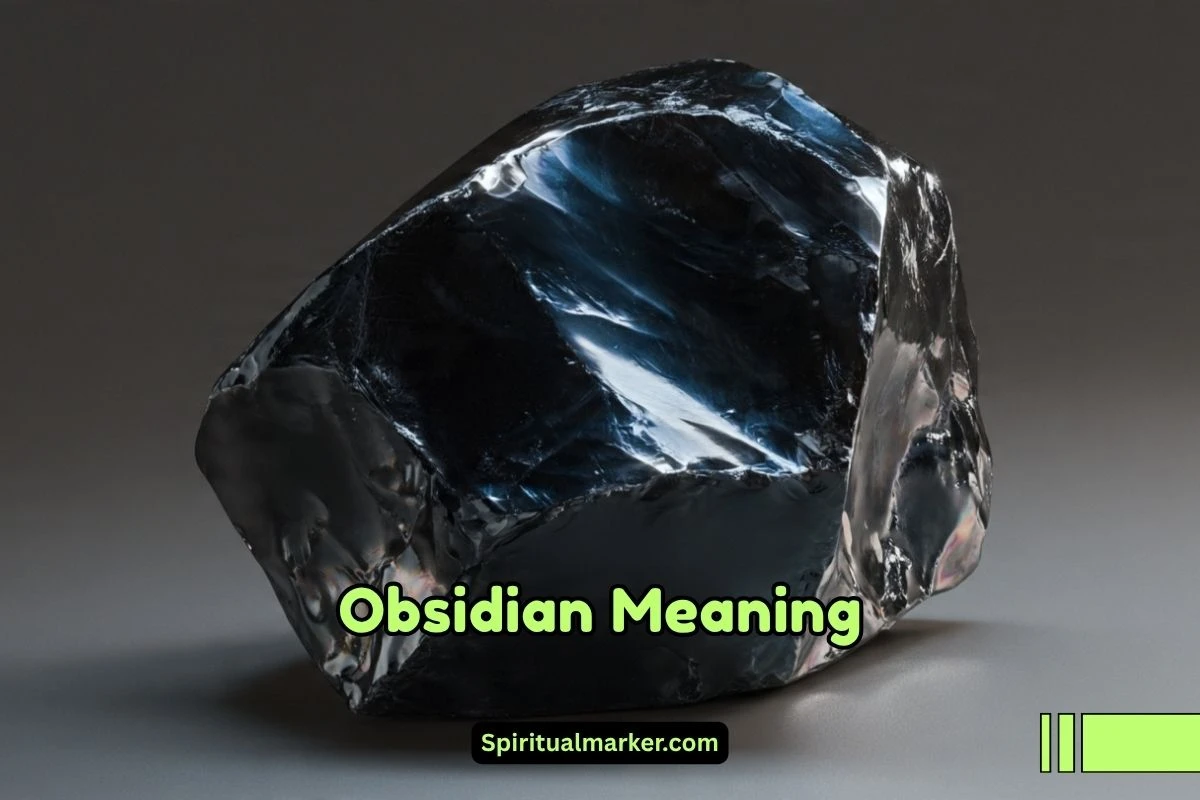
Have you ever picked up a piece of obsidian and felt something shift inside you? Many people describe an immediate, almost electric sense of awareness when they hold this stone for the first time. It does not whisper gently. It speaks clearly. That directness is exactly what makes obsidian so different from softer, more soothing gemstones.
Obsidian has traveled with humanity for thousands of years. Ancient warriors shaped it into blades. Shamans used it as a mirror. Healers carried it during spiritual rituals. Its deep black surface has always attracted people who seek truth, protection, and clarity in a world that often prefers comfortable illusions.
Unlike stones associated with warmth and emotional comfort, obsidian operates on a different frequency. Its energy is bold, grounding, and honest. It does not shield you from difficult truths. Instead, it helps you face them without flinching. That quality makes obsidian one of the most respected and spiritually significant stones in crystal traditions worldwide.
Whether you are drawn to obsidian for its striking appearance, its volcanic origins, or its deep metaphysical reputation, you are connecting with something that has resonated with human beings across centuries and cultures. This article covers obsidian’s full meaning, its spiritual symbolism, healing properties, historical significance, and how you can use it in daily life, spiritual practice, and jewelry.
5 Key Takeaways
- Obsidian is a naturally formed volcanic glass associated with protection, truth, grounding, and emotional clarity.
- Many spiritual traditions connect obsidian with the root chakra and with revealing hidden emotional patterns.
- People commonly use obsidian during shadow work, meditation, grief processing, and energy protection.
- Obsidian forms rapidly from volcanic lava, which contributes to its intense, transformative spiritual energy.
- Wearing or carrying obsidian may support emotional honesty, inner strength, and psychic protection during challenging periods.
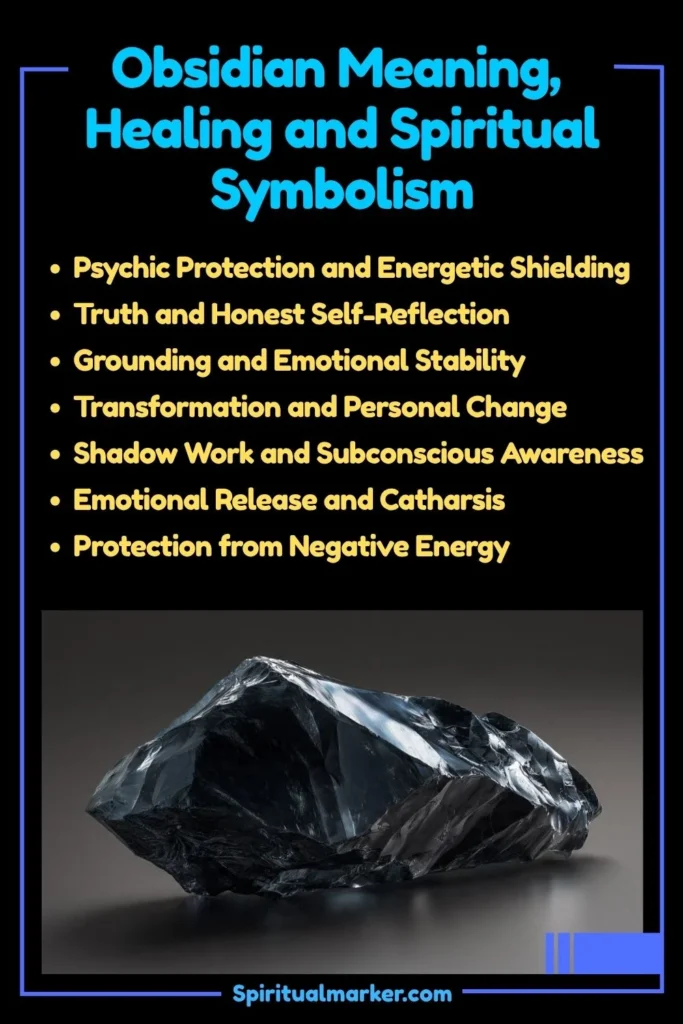
What Is Obsidian?
Obsidian is a naturally occurring volcanic glass. It forms when lava cools so rapidly that mineral crystals do not have time to develop. The result is a glassy, smooth stone with a deep black appearance and a distinctive sharp edge when fractured.
Scientifically, obsidian is not technically a mineral. It is classified as a mineraloid, a naturally occurring substance that lacks the crystalline structure found in most gemstones. Its composition is primarily silicon dioxide, similar to quartz, but its formation process creates an entirely different physical and energetic character.
Its surface is usually intensely black, though some varieties include streaks of white, flashes of gold or silver, or rainbow iridescence depending on trace mineral content and light interaction. That visual range is part of what makes obsidian so visually striking and spiritually fascinating.
Many people confuse obsidian with black tourmaline or hematite because all three appear dark and are associated with protective energy. However, obsidian carries a more intense and emotionally penetrating energy. Where black tourmaline deflects negativity outward, obsidian tends to pull unresolved emotional content inward for examination. That distinction matters deeply in spiritual practice.
Origins and Formation
Obsidian forms at volcanic sites where silica-rich lava flows and cools rapidly upon contact with air or water. This rapid cooling process prevents the slow crystallization that creates most gemstones. Instead, the lava solidifies almost instantly into a glassy, amorphous structure.
Because obsidian forms from volcanic activity, it carries a natural connection to transformation, fire, and raw elemental power. Spiritually, these origins reinforce its reputation as a stone of intense change, purification, and truth.
Major obsidian deposits exist across several geologically active regions. Notable sources include Mexico, Iceland, Italy, the United States, Japan, Ethiopia, and Turkey. The famous obsidian deposits near Teotihuacan in Mexico have been mined and traded for over 10,000 years, demonstrating how deeply this stone is woven into human history.
The stone’s formation happens fast in geological terms. That speed becomes part of its spiritual symbolism. Transformation does not always require decades. Sometimes change arrives suddenly, intensely, and completely, much like lava solidifying into glass.
Key Properties
| Property | Details |
|---|---|
| Primary Meaning | Protection, truth, grounding, shadow work |
| Chakra Association | Root chakra, also third eye |
| Main Spiritual Symbolism | Psychic protection, emotional honesty, inner strength |
| Common Colors | Black, mahogany, snowflake, rainbow |
| Hardness | 5 to 5.5 Mohs |
| Main Sources | Mexico, Iceland, USA, Italy, Japan, Ethiopia |
| Emotional Associations | Courage, clarity, release, self-awareness |
| Popular Jewelry Types | Pendants, bracelets, rings, palm stones |
| Spiritual Uses | Meditation, protection grids, shadow work, scrying |
| Energy Style | Intense, grounding, truth-revealing, transformative |
Historical Use
Obsidian’s history with humanity is extraordinary in both its depth and reach. Archaeological evidence places obsidian tools in human hands more than 700,000 years ago. Its naturally sharp fracture edges made it ideal for crafting blades, arrowheads, surgical instruments, and ceremonial objects long before metal existed.
Ancient Aztec and Mesoamerican civilizations revered obsidian deeply. They crafted ritual mirrors from polished obsidian surfaces and used them in divination ceremonies to contact spiritual realms, reveal hidden truths, or communicate with ancestors. The Aztec deity Tezcatlipoca, whose name translates roughly to “Smoking Mirror,” was directly associated with obsidian mirrors. Priests believed that gazing into polished obsidian could reveal visions, expose deception, and pierce through spiritual illusions.
In ancient Egypt, obsidian was imported from distant volcanic regions and used in amulets, ceremonial blades, and burial objects. Its association with the underworld and the afterlife made it a stone of spiritual passage and protection.
Ancient Greek and Roman healers used obsidian in medical instruments because its razor-sharp edges caused less tissue tearing than metal. Even modern surgical researchers have studied obsidian blades because their edge can be thinner than the finest steel scalpels.
Native American traditions in the American Southwest treated obsidian as a sacred stone of protection and spiritual sight. It appeared in ritual objects, trade networks, and ceremonial contexts across dozens of distinct cultural groups.
In medieval Europe, obsidian occasionally appeared in alchemical texts as a stone associated with transformation, hidden knowledge, and confronting shadow. That reputation carried forward into modern metaphysical traditions.
The consistent theme across cultures separated by vast distances of time and geography is obsidian’s association with truth, protection, and seeing clearly through illusion. Few stones carry that same historical consensus.
5 Spiritual Meanings of Obsidian
1. Psychic Protection and Energetic Shielding
Obsidian is perhaps most widely known for its protective spiritual symbolism. Across cultures and throughout history, people have used this stone to shield themselves from negative energies, harmful spiritual influences, and psychic disruption. This meaning is not incidental. It is one of the most consistent themes in obsidian’s global spiritual reputation.
Many people who work in emotionally demanding environments feel drawn to obsidian’s protective energy. Therapists, caregivers, empaths, healers, and people in conflict-heavy situations sometimes describe obsidian as creating a kind of energetic boundary. That boundary does not make a person emotionally cold. It prevents unintentional absorption of other people’s emotional distress.
Spiritually, obsidian’s protective energy also extends inward. It is believed to protect a person from their own self-destructive patterns, unconscious fears, and negative internal dialogue. This dimension of protection makes it particularly meaningful during periods of emotional vulnerability, grief, or psychological pressure.
Many practitioners place obsidian near doorways, windows, or workspace entrances to symbolically guard emotional and spiritual space. Others carry it as a daily talisman during stressful periods. The stone’s dense, dark appearance reinforces its reputation for absorbing and neutralizing difficult energy rather than allowing it to accumulate around or within a person.
This protective symbolism becomes especially significant in spiritual traditions that emphasize energy sensitivity. People who feel easily affected by crowded spaces, emotional tension, or negative social environments often find that obsidian represents a grounding anchor. It keeps them emotionally stable without requiring emotional withdrawal or social avoidance.
Obsidian protection is not about building emotional walls permanently. It is about maintaining energetic sovereignty while remaining emotionally present, engaged, and authentic in a demanding world.
2. Truth and Honest Self-Reflection
Obsidian is deeply connected to truth. Many spiritual traditions describe it as a mirror for the inner self. Just as ancient Aztec priests used polished obsidian mirrors for divination, modern practitioners view the stone as symbolically reflecting what a person cannot easily see about themselves.
This meaning is not always comfortable. Obsidian does not soften difficult realizations. It does not present emotional truths gently or wrap them in reassurance. Instead, it symbolizes the kind of honest self-examination that eventually leads to genuine growth. That directness is simultaneously its greatest gift and its most demanding characteristic.
Many people resist self-reflection because it requires confronting personal behaviors, unconscious fears, or repeated emotional patterns that feel unflattering or painful. Obsidian symbolizes the courage required for that confrontation. Its spiritual meaning encourages people to look honestly at resentments they carry, emotional patterns that cause harm, and beliefs about themselves that no longer hold truth.
This is why obsidian appears so frequently in shadow work, a spiritual and psychological practice involving deliberate examination of suppressed emotions, hidden motivations, and unconscious patterns. Shadow work is demanding precisely because it asks people to engage with the parts of themselves they typically avoid. Obsidian is believed to support this process by strengthening emotional courage and clarity during vulnerable moments of self-examination.
Its symbolism as a truth stone also applies to external honesty. People sometimes use obsidian to help them remain truthful in conversations that feel uncomfortable, maintain personal integrity under social pressure, or identify when they are being deceived. The stone spiritually represents clear perception free from wishful thinking or emotional bias.
Many spiritual traditions suggest that truth, even when painful, is always ultimately healing. Obsidian’s spiritual identity is built around that belief. It represents honesty as an act of self-respect rather than self-punishment.
3. Grounding and Emotional Stability
Obsidian is strongly associated with the root chakra, the energy center linked to safety, survival instinct, physical grounding, and emotional stability. When the root chakra feels balanced, people often experience a foundational sense of security, emotional resilience, and mental clarity. When it feels blocked or destabilized, anxiety, emotional instability, restlessness, or feelings of disconnection may surface frequently.
Modern life constantly pulls people away from emotional grounding. Constant digital stimulation, information overload, financial stress, relationship pressure, and physical disconnection from nature contribute to a persistent sense of unrootedness. Many people feel mentally scattered, emotionally reactive, or chronically overwhelmed without fully understanding why.
Obsidian symbolically supports returning to solid ground. Its dense, weighty energy feels grounding to many people in a literal sense. Holding obsidian during moments of anxiety or emotional overwhelm often creates an almost physical sense of heaviness and stillness. That sensation reflects its spiritual reputation as a stone that anchors emotional energy back to stable foundations.
This grounding symbolism is especially meaningful for people who tend toward excessive emotional reactivity, overthinking, or anxiety. Rather than remaining trapped in spiraling thought patterns, obsidian represents the ability to return to the present moment through emotional steadiness and clear inner awareness.
Grounding with obsidian also means accepting difficult emotional realities without dramatizing them. Some spiritual approaches encourage avoiding painful emotions through positivity, distraction, or spiritual bypassing. Obsidian does not support that approach. It symbolizes emotional presence and honesty even when emotions feel heavy, complicated, or difficult to accept.
Its connection with volcanic earth further deepens this grounding symbolism. The stone literally emerged from the planet’s interior. That elemental connection makes it a natural representative of primal earth energy, physical stability, and grounded spiritual awareness.
4. Transformation and Personal Change
Obsidian is born from fire. That volcanic origin carries enormous spiritual weight when considering its symbolism as a stone of transformation. Few natural processes match the intensity of volcanic activity. Landscapes change completely. What existed before is fundamentally altered. New ground forms where none existed previously. Obsidian carries that same principle of radical transformation within its spiritual identity.
Transformation in spiritual contexts is rarely purely comfortable. Real personal change usually requires releasing something familiar. People must let go of old identities, outdated beliefs, harmful relationship patterns, comfortable excuses, or emotional defenses that once served a purpose but no longer support genuine well-being.
Obsidian spiritually represents exactly this kind of release. It does not symbolize gentle gradual evolution. It represents more decisive change. The kind that happens when a person finally confronts what they have long avoided and chooses something genuinely different.
This makes obsidian particularly meaningful during major life transitions. Divorce, career loss, bereavement, recovery from addiction, spiritual awakening, or significant personal reinvention all involve confronting the unfamiliar and releasing what came before. Obsidian symbolically supports people during these intense periods by providing energetic clarity, emotional courage, and a reminder that transformation is survivable.
The stone’s transformation symbolism also connects with the practice of alchemy in its spiritual sense, the idea of turning raw, difficult experience into refined personal wisdom. Just as obsidian forms through volcanic intensity rather than gentle geological accumulation, meaningful personal transformation often happens through challenge rather than comfort.
Many practitioners believe that carrying or meditating with obsidian during transition periods helps them remain emotionally present during discomfort instead of retreating into avoidance. That emotional presence during difficulty is often where the most significant personal growth actually occurs.
5. Shadow Work and Subconscious Awareness
Shadow work is one of the most important spiritual practices associated with obsidian. Psychologist Carl Jung coined the term “shadow” to describe the unconscious parts of a person’s personality that they typically repress, deny, or project onto others. These shadow aspects might include suppressed anger, unacknowledged fear, hidden jealousy, repressed grief, or aspects of identity that feel shameful.
Ignoring the shadow does not make it disappear. It typically makes it more influential. Shadow material appears in recurring emotional reactions, patterns in relationships, self-sabotaging behaviors, and unexplained feelings of shame or resentment that seem disproportionate to present circumstances.
Obsidian is spiritually associated with illuminating shadow content. It represents the willingness to look into the darker aspects of emotional experience without flinching. Many practitioners use obsidian during intentional shadow work because they believe it provides psychic clarity and emotional courage necessary for honest self-examination.
This symbolism is consistent with obsidian’s historical use as a mirror for spiritual vision. Just as Aztec priests used obsidian mirrors to see beyond physical appearances into deeper spiritual realities, modern practitioners use obsidian metaphorically to see beyond conscious self-image into honest emotional truth.
Shadow work with obsidian is not about wallowing in negativity or emotional pain. It is about developing complete self-awareness. When people acknowledge their full emotional range honestly, including the parts that feel uncomfortable or unflattering, they become more emotionally integrated, less reactive, and more genuinely compassionate toward both themselves and others.
This is perhaps obsidian’s most profound spiritual gift. Complete self-knowledge is one of the oldest foundations of spiritual development, from ancient Socratic philosophy to modern psychological healing. Obsidian symbolically supports that courageous journey toward total inner honesty.
6 Healing Properties of Obsidian
1. Emotional Release and Catharsis
Obsidian is widely associated with emotional release precisely because its energy does not allow suppressed emotions to remain hidden. Many people carry emotional pain, trauma, grief, resentment, or anger for years without ever fully processing those feelings. Over time, this emotional suppression creates internal pressure that eventually affects energy levels, relationships, mental clarity, and overall well-being.
Within crystal healing traditions, obsidian symbolizes creating a space where suppressed emotions can surface and be released. This process may feel uncomfortable initially. Emotional catharsis rarely feels pleasant in the moment. But many practitioners believe that genuine emotional release, even when painful, ultimately creates greater inner freedom and emotional lightness.
Unlike stones associated with gentle emotional soothing, obsidian does not encourage bypassing emotional pain. It represents moving through it honestly. This distinction is significant in healing traditions that recognize the difference between temporary emotional relief and genuine emotional resolution.
People often seek emotional release through journaling, therapy, movement, breathwork, or spiritual practice. Many combine these practices with obsidian because they believe it strengthens emotional courage and clarity during vulnerable healing moments. Some describe a physical sensation of heaviness lifting after extended periods of meditation with obsidian during emotionally charged processing work.
The stone’s emotional release symbolism also connects with forgiveness. Carrying unresolved resentment or unexpressed grief creates ongoing emotional strain. Obsidian represents the willingness to release those emotional burdens not through denial, but through honest acknowledgment followed by conscious choice to move forward.
2. Clarity of Mind
Mental clarity is one of obsidian’s most valued healing qualities. Many people experience periods where thoughts feel muddled, decisions feel impossible, priorities feel unclear, or emotional confusion creates ongoing mental fog. Obsidian symbolically cuts through that confusion with sharp, direct clarity that mirrors its naturally sharp physical edges.
This clarity property makes obsidian particularly useful during decision-making, conflict resolution, or periods when people feel pulled in multiple directions simultaneously. Its grounding energy helps stabilize mental activity enough that clearer thinking becomes more accessible.
Many practitioners hold obsidian during meditation specifically focused on decision-making or problem-solving. The stone’s symbolism encourages seeing situations as they actually are rather than through the distorting lens of wishful thinking, fear, or emotional bias. This honest perception is the foundation of genuinely clear thinking.
Mental clarity also connects with obsidian’s truth symbolism. Clear thinking requires honest perception. When people allow wishful thinking, denial, or emotional avoidance to influence their thinking, mental clarity suffers. Obsidian represents the commitment to honest perception even when reality feels complicated or challenging.
Some spiritual practitioners also associate obsidian’s clarity properties with enhanced intuition. When mental noise decreases, intuitive awareness often becomes more accessible. Many people report feeling more in tune with their instincts and emotional wisdom after extended work with obsidian during meditation or quiet reflection.
3. Protection from Negative Energy
Obsidian’s reputation as a protective stone is one of its oldest and most consistent healing associations. Ancient peoples across multiple continents and cultures trusted obsidian for protection, which speaks to a deeply intuitive human recognition of its energetic qualities.
In contemporary crystal healing, obsidian is often recommended for people who feel energetically drained, emotionally affected by others, or psychically overwhelmed. Empaths, people-pleasers, caregivers, and those in emotionally demanding professions often describe feeling depleted after extended periods in difficult energetic environments. Obsidian symbolically provides a grounding shield that helps maintain energetic boundaries without emotional disconnection.
Negative energy in spiritual contexts covers a broad range of experiences. It may include other people’s unprocessed emotional distress, emotionally toxic environments, manipulative relational dynamics, or a person’s own unresolved internal negativity. Obsidian’s protective symbolism addresses all of these dimensions rather than only external sources.
Many practitioners place obsidian near their home entrance, meditation space, or workspace to symbolically set protective energetic boundaries. Others wear it as daily jewelry, particularly during periods of conflict, stress, or emotional vulnerability. The stone’s weight and density reinforce its grounding, shielding symbolism.
Protective healing with obsidian is not about creating permanent emotional detachment. It is about maintaining the energetic stability needed to remain genuinely present in demanding situations without absorbing harmful emotional residue.
4. Physical Healing Associations
In traditional healing systems, various cultures attributed physical healing properties to obsidian. While crystal healing is not a substitute for medical treatment, understanding these traditional associations provides context for obsidian’s broader spiritual significance.
Ancient Mesoamerican healers associated obsidian with purification, and some traditions connected it with digestive health, pain relief, and detoxification. Practically, its use in surgical blades across multiple ancient cultures reflected recognition of its physical precision.
Modern metaphysical traditions most commonly associate obsidian with the physical health of the digestive system and detoxification. Some practitioners believe it energetically supports the body’s natural elimination processes, though these associations remain within spiritual tradition rather than medical science.
Obsidian’s grounding properties are sometimes also connected with reducing physical tension held in the body during periods of chronic stress. Because emotional tension and physical tension are closely related, some practitioners use obsidian during body-focused healing practices such as bodywork, breathwork, and somatic therapy to support the release of stress-related physical holding patterns.
5. Support During Grief
Grief is one of the most demanding emotional experiences a person can face. The loss of a loved one, the end of a significant relationship, career collapse, serious illness, or any profound personal loss can leave people feeling emotionally shattered, confused, and deeply unmoored. Obsidian’s healing symbolism is frequently connected with grief support because of its capacity for honest emotional engagement.
Unlike some healing approaches that focus on moving through grief quickly or maintaining emotional positivity during loss, obsidian symbolizes allowing grief its full honest expression. Many traditional cultures that used obsidian in burial rituals recognized its connection with spiritual transition, loss, and emotional passage through darkness.
People experiencing grief sometimes feel pressure to recover quickly, appear strong, or avoid dwelling in sadness. Obsidian spiritually represents the opposite message. Grief requires honest acknowledgment to heal fully. Suppressing it may provide temporary relief but often extends the overall healing timeline while adding additional emotional strain.
Many grief counselors and spiritual practitioners combine obsidian with grief-specific practices including journaling, ritual, ceremony, meditation, and therapeutic conversation. The stone symbolically provides both emotional grounding and the courage to feel grief honestly rather than avoiding its full weight.
Obsidian also carries symbolism connected with transformation after loss. After volcanic destruction, new landscapes eventually emerge. After profound personal loss, a new version of the self gradually develops through honest emotional processing. Obsidian represents both the difficult passage through grief and the eventual emergence of renewed strength.
6. Breaking Repetitive Patterns
Many people recognize harmful patterns in their behavior or relationships but feel unable to change them. Repeated cycles of unhealthy relationships, self-sabotage, emotional reactivity, people-pleasing, avoidance, or addiction represent some of the most challenging aspects of human psychology. These patterns often have deep emotional or unconscious roots that standard logical reasoning cannot easily address.
Obsidian is spiritually associated with breaking repetitive negative patterns because its energy is believed to illuminate the unconscious material that sustains them. Most harmful behavioral cycles are not maintained consciously. They operate through unconscious emotional drives, fear-based beliefs, or survival strategies developed during earlier life experiences.
Spiritual practitioners believe obsidian helps bring unconscious material into conscious awareness, where it becomes available for genuine examination and change. This is directly connected with its shadow work symbolism. When people can honestly see the emotional root of a repeated pattern, genuine change becomes possible in a way that surface-level willpower alone rarely achieves.
Breaking patterns also requires emotional courage. Familiar patterns, even harmful ones, provide a kind of uncomfortable safety through predictability. Choosing a different response, maintaining a new boundary, or ending a cycle requires tolerating the discomfort of genuine change. Obsidian symbolically supports that courageous choice by strengthening inner resolve and clarity during moments when old patterns exert their strongest pull.
Many practitioners use obsidian alongside therapy, journaling, meditation, and consistent self-reflection during conscious pattern-breaking work. The stone represents the committed