
Green amethyst, also called prasiolite, glows with a soft, sea-green light. Its color blends the calm of amethyst with the growth of nature. In spiritual practice, this stone carries healing and transformative energy.
The green amethyst meaning often involves spiritual growth, emotional healing, and connection to nature. It is a stone of the heart and crown chakras, helping to open the heart and deepen meditation. A spiritual meaning of green fluorite shares that green-stone focus, though fluorite carries a more mental energy.
Green amethyst is used in crystal healing to release negativity, attract abundance, and support spiritual awakening. It can also symbolize renewal and hope. The stone's energy is gentle and uplifting.
If you feel drawn to green amethyst, it may signal a need for growth. A spiritual meaning of amethyst also deals with amethyst, though purple amethyst carries a more psychic energy.
Key Takeaways
- Green amethyst, or prasiolite, symbolizes emotional clarity, spiritual growth, and heart-mind alignment.
- It connects with both the heart chakra and the third eye chakra, making it rare among green stones.
- People often use green amethyst during periods of personal transformation, grief recovery, and spiritual awakening.
- Most green amethyst on the market forms through heat treatment of natural amethyst or light amethyst.
- Wearing green amethyst as jewelry may support emotional balance, mental clarity, and compassionate self-awareness.
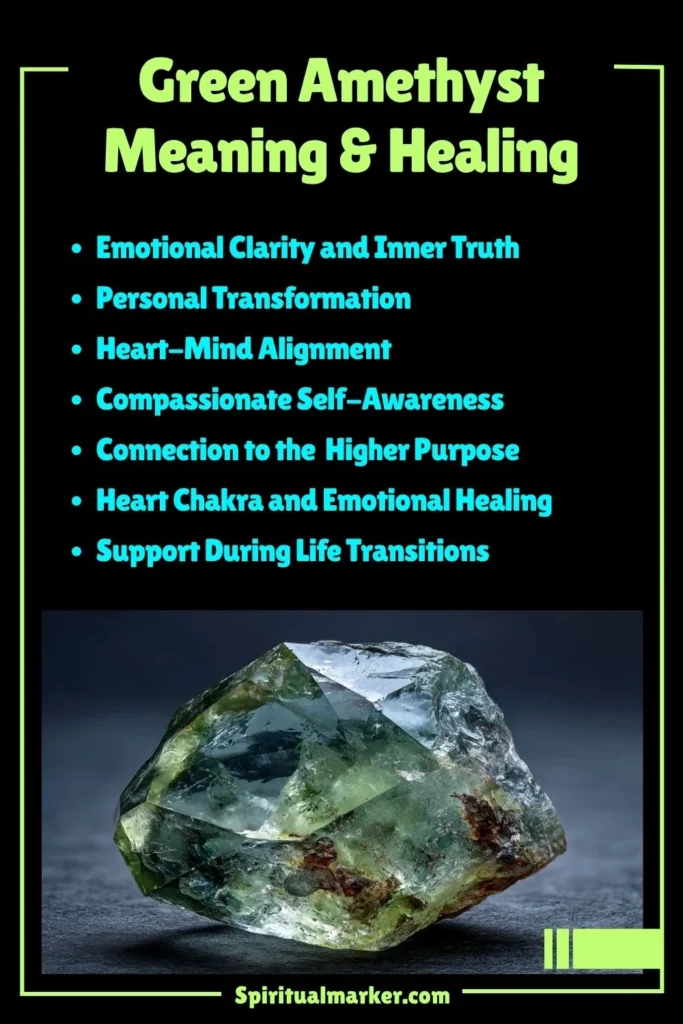
What is Green Amethyst?
Green amethyst is the gemological variety of prasiolite, a green form of quartz. It shares the same mineral family as purple amethyst but displays soft green shades ranging from pale, almost transparent mint to deeper sage and olive tones. Its color gives it a natural, almost botanical quality that many people find deeply calming.
Unlike purple amethyst, which forms with its color naturally in most cases, most commercially available green amethyst results from heat treatment. Specific amethyst deposits, particularly those from Brazil and Poland, contain the right chemical composition to turn green when heated to around 500 degrees Celsius. The resulting color ranges from pale leek-green to a more saturated, glassy sage. Natural prasiolite does exist, but it is significantly rarer and commands higher value among collectors.
Many people confuse green amethyst with other green stones such as green tourmaline, peridot, or jade. However, green amethyst has a glassy, transparent quality that distinguishes it visually. It does not carry the waxy density of jade or the bright yellow-green fire of peridot. Its appearance feels cleaner, quieter, and more introspective. Spiritually, this distinction matters. Green amethyst carries amethyst’s traditional connection with mental clarity and spiritual perception, blended with the heart-centered energy most people associate with green stones.
Origins and Formation
Prasiolite forms within quartz veins embedded in igneous and metamorphic rock. Like all quartz varieties, it grows through a process of silicon dioxide crystallization within cavities and fissures over geological time. The green color in natural prasiolite comes from iron content reacting with heat sources deep within the earth, whether through geothermal activity or proximity to volcanic formations.
The most significant natural deposits of prasiolite come from Montezuma in Minas Gerais, Brazil, as well as Thunder Bay in Canada and parts of Poland. Brazilian deposits remain the most commercially prominent. Heat-treated prasiolite typically originates from amethyst deposits across Brazil, where the iron content within the quartz responds predictably to controlled heating.
The transformation process itself carries symbolic weight. Purple amethyst, long associated with spiritual protection and mental clarity, undergoes a fundamental shift through heat and pressure to become something new. Many crystal practitioners see this as a reflection of the stone’s core spiritual message: that personal transformation, though uncomfortable, produces something both beautiful and clear.
Key Properties
- Also Known As: Prasiolite, green quartz, vermarine
- Color: Pale mint, sage green, olive green, leek green
- Composition: Silicon dioxide (SiO2)
- Hardness: 7 on the Mohs scale
- Chakra Association: Heart chakra, third eye chakra
- Symbolism: Clarity, transformation, compassion, spiritual growth
- Common Sources: Brazil, Canada, Poland
- Transparency: Transparent to translucent
- Energy Style: Clarifying, grounding, heart-centered
Historical Use and Cultural Significance
The history of green amethyst as a distinct gemstone is relatively modern compared to other crystals with centuries of documented use. However, amethyst itself carries one of the richest recorded histories in gemstone tradition. Ancient Greeks believed amethyst prevented intoxication. The name derives from the Greek word “amethystos,” meaning “not drunk.” They also associated it with mental clarity, calm judgment, and clear thinking. These qualities transferred into green amethyst’s spiritual identity as the stone gained recognition.
In broader cultural traditions, green stones consistently appeared as symbols of fertility, life, emotional restoration, and divine connection to the natural world. Ancient Egyptians used green stones in amulets and burial rites to symbolize resurrection and the continuity of life. In Celtic traditions, green carried associations with the living world, growth, and the sacred connection between humans and the earth.
Within modern crystal healing communities, green amethyst gained traction largely because of its unique dual-chakra associations. Spiritual practitioners recognized that its combination of heart-centered energy and mental clarity made it a powerful ally for those seeking emotional wisdom rather than emotional reaction. It fills a specific role that neither pure amethyst nor purely green stones occupy alone.
5 Spiritual Meanings of Green Amethyst
1. Emotional Clarity and Inner Truth
Emotional clarity sits at the center of green amethyst’s spiritual identity. Unlike stones associated with emotional release through intensity, green amethyst symbolizes the kind of clarity that emerges after the emotional noise settles. Many people carry unspoken emotional truths for years. They sense something is wrong in a relationship, a career, or a personal belief system, but cannot quite articulate what they feel or why. Green amethyst spiritually represents the moment those quiet truths begin surfacing with coherence.
This symbolism connects directly to green amethyst’s dual association with both heart and mind. Many emotional struggles persist not because people cannot feel their emotions, but because they cannot understand them. Emotional clarity requires both the heart’s honesty and the mind’s ability to make sense of that honesty. Green amethyst represents this bridge. It symbolizes the state where emotional experience and mental comprehension align, allowing people to see their own inner lives more accurately.
In spiritual traditions, inner truth is not always comfortable. Clarity sometimes means recognizing painful realities about oneself, a relationship, or a life path. Green amethyst does not symbolize avoidance or emotional softening at the expense of honesty. Instead, its meaning centers on the courage to see clearly, combined with the compassion to respond to that clarity with patience and self-understanding rather than judgment or panic.
People going through significant transitions often feel emotionally muddled. They may want to move forward but feel anchored to confusion, conflicted loyalties, or unresolved emotional residue from past experiences. Green amethyst spiritually represents clearheadedness during these periods. It symbolizes the gradual restoration of inner focus when external circumstances feel overwhelming or emotionally disorienting.
2. Spiritual Growth and Personal Transformation
Green amethyst carries especially strong symbolism around personal transformation because of its own physical origin story. It begins as purple amethyst. Through sustained heat and pressure, it becomes something entirely different in appearance while retaining the same essential mineral structure. Many spiritual practitioners see this as a perfect natural metaphor for human growth. The core of who you are does not disappear through transformation. It simply reveals itself in a new form.
Spiritual growth rarely follows a clean or comfortable path. Most people experience periods of internal disruption, identity questioning, and emotional disorientation before genuine transformation takes hold. Green amethyst symbolizes the process itself, not just the destination. Its energy is associated with staying grounded and mentally clear during the uncomfortable middle stages of growth, when old patterns have begun dissolving but new ones have not yet fully formed.
This symbolism resonates strongly with people in recovery from addiction, grief, toxic relationships, or long-term emotional suppression. These individuals often know intellectually that change is necessary. Emotionally, they may still feel pulled toward familiar patterns even when those patterns cause harm. Green amethyst spiritually represents the clarity and courage needed to keep moving forward when returning to old ways would feel easier in the short term.
In many spiritual frameworks, true growth requires releasing outdated self-concepts. A person may define themselves through their pain, their role in a family system, their professional identity, or a long-held story about their own limitations. Green amethyst symbolizes the willingness to let those outdated definitions soften and eventually dissolve. Its spiritual energy centers on openness to becoming rather than defending a fixed version of oneself.
3. Heart-Mind Alignment
One of the most distinctive aspects of green amethyst’s spiritual symbolism is its connection to both heart and mind simultaneously. Most gemstones in crystal traditions favor one of these energy centers. Amethyst traditionally works with mental clarity, intuition, and spiritual perception through the third eye. Green stones typically connect with compassion, emotional healing, and love through the heart chakra. Green amethyst holds both energies at once.
This dual quality makes it particularly meaningful for people who experience significant tension between what they feel and what they think. Someone may intellectually know they should leave a harmful situation but feel emotionally unable to act. Another person may feel deep love for someone while recognizing mentally that the relationship damages them. Green amethyst spiritually addresses this tension directly. Its symbolism encourages alignment rather than choosing one voice over the other.
In many spiritual traditions, wisdom is not simply intelligence or emotional sensitivity in isolation. It emerges when head and heart stop competing and begin informing each other honestly. The Book of Proverbs describes wisdom as more valuable than silver or gold, something that guards the paths of justice and protects those who walk in integrity (Proverbs 2:9-10). Green amethyst symbolically reflects this integration. Its energy is associated with wise emotional response rather than pure reaction or pure detachment.
People who feel perpetually torn between logic and emotion often describe a sense of internal exhaustion. Making decisions feels paralyzing because no answer satisfies both the analytical mind and the feeling heart simultaneously. Green amethyst’s spiritual meaning centers on easing this exhaustion by encouraging both aspects of inner experience to function together in collaborative clarity rather than opposition.
4. Compassionate Self-Awareness
Self-awareness is a quality many people value intellectually but struggle to practice with genuine compassion. Most people can see their own patterns when prompted. They recognize their emotional triggers, habitual reactions, and recurring mistakes. The difficulty lies in holding that awareness without immediately collapsing into self-judgment, shame, or defensive denial. Green amethyst spiritually represents the quality of seeing yourself clearly while maintaining internal kindness.
This is a precise and valuable spiritual quality because genuine change requires both honesty and self-compassion working together. Harsh self-judgment often produces shame, which paradoxically makes behavioral change harder rather than easier. Research in psychology consistently shows that self-compassion, rather than self-criticism, is more strongly associated with personal accountability and sustained behavioral improvement. Green amethyst’s symbolism aligns with this principle spiritually.
Many people have spent years being harshly self-critical in the belief that this keeps them honest or motivated. Green amethyst spiritually challenges this assumption. Its energy represents the possibility that honest self-knowledge can coexist with gentle self-regard. People do not need to tear themselves apart to understand themselves. They need clarity, patience, and the emotional safety to look inward without flinching.
Its symbolism also extends to how people witness others. When internal self-compassion grows, it naturally influences how a person relates to the struggles and mistakes of those around them. Green amethyst’s connection with compassionate awareness therefore radiates outward from the individual into their closest relationships. It represents a deepening of empathy rooted in genuine self-knowledge rather than surface-level niceness.
5. Connection to the Divine and Higher Purpose
Green amethyst carries a spiritual symbolism linked with divine connection and awareness of higher purpose. This quality comes partly from its heritage as a variety of amethyst, a stone associated across many traditions with spiritual perception, divine protection, and elevated consciousness. Green amethyst inherits this dimension and blends it with the grounding, life-affirming energy of green.
Many people move through long seasons of life feeling spiritually disconnected. They may practice religion or spiritual disciplines without feeling a genuine sense of presence, meaning, or inner alignment. They go through the motions. Green amethyst spiritually represents the reawakening of that inner sense of meaning. It symbolizes the return of spiritual perception after numbness, distraction, or disillusionment have dimmed it.
In many spiritual traditions, purpose is not discovered through external achievement but through an internal quieting that allows a person to hear something deeper than ambition or anxiety. Green amethyst’s energy is associated with this quieting. Its calming green tones and clarifying spiritual associations make it a natural companion for prayer, meditation, or reflective practices aimed at reconnecting with a sense of meaning beyond the ordinary pace of life.
Its symbolism also reflects the idea that spiritual growth and ordinary human life are not separate. Green amethyst does not represent escapism from the material world into some rarefied spiritual state. Instead, it symbolizes the integration of spiritual awareness into everyday emotional life, relationships, and daily decisions. This grounded spirituality is one of its most meaningful and enduring qualities.
6 Healing Properties of Green Amethyst
1. Mental and Emotional Clarity
Green amethyst’s most widely recognized healing property centers on mental and emotional clarity. Within crystal healing traditions, it is believed to help reduce mental fog, emotional overwhelm, and the kind of circular thinking that keeps people trapped in unresolved emotional loops. Many people describe their minds as overactive. They replay conversations, rehearse future conflicts, and struggle to quiet internal noise even during rest. Green amethyst symbolically works against this tendency toward mental clutter.
This property feels especially significant for people experiencing decision fatigue. Modern life presents constant choices, many of which carry emotional weight. Over time, the mental energy required to navigate competing emotions and obligations creates genuine cognitive exhaustion. Green amethyst is believed to support the kind of mental stillness needed for clear, grounded decision-making. It does not make decisions feel effortless, but its symbolism points toward a quieter inner space from which clearer thinking becomes possible.
Practitioners often use green amethyst during journaling, reflective meditation, or any practice requiring honest inner examination. Its association with both mental clarity and emotional compassion makes it well suited for moments when a person needs to think clearly about emotionally charged situations without becoming either detached or overwhelmed.
2. Heart Chakra and Emotional Healing
Green amethyst connects with the heart chakra, the energy center associated with love, empathy, forgiveness, grief, and emotional trust. When this chakra feels blocked or imbalanced, people may notice emotional guardedness, difficulty trusting others, chronic emotional numbness, or patterns of emotional withdrawal. Green amethyst is believed to gently support reopening emotional pathways that have closed through repeated hurt or protective emotional armoring.
What distinguishes green amethyst from other heart chakra stones is the quality of its healing energy. Stones like rose quartz symbolize soft, nurturing love. Green aventurine carries luck and opportunity. Green amethyst brings something more specific: the emotional clarity needed to actually understand one’s own heart rather than simply feeling it. This is healing that involves comprehension alongside sensation. It helps a person not only feel their emotional truth but begin to make sense of it.
People processing grief often report feeling emotionally overwhelmed and cognitively scattered simultaneously. Green amethyst’s dual quality addresses both dimensions. It is believed to support the emotional side of grief while helping the mind process the experience with greater steadiness. Its symbolism does not rush grief or minimize it. Instead, it creates internal space for loss to be felt and understood without completely destabilizing the person experiencing it.
3. Third Eye Activation and Spiritual Perception
Green amethyst’s heritage as a quartz variety maintains its connection with the third eye chakra, the energy center associated with intuition, inner vision, spiritual perception, and clarity of insight. Within crystal traditions, the third eye is believed to govern a person’s ability to see beyond surface appearances, both in external situations and within their own inner life. Green amethyst is one of the few green stones to carry this third eye association alongside its heart chakra properties.
Many people feel spiritually curious but mentally blocked. They sense that something deeper exists beyond the surface of daily experience but cannot quite access it through formal spiritual practice alone. Green amethyst symbolically supports spiritual perception by encouraging a quieter, more receptive state of inner attention. It does not force spiritual experiences but creates internal conditions more conducive to them.
Its third eye association also reflects heightened discernment. In spiritual and practical terms, discernment means the ability to sense what is true, trustworthy, or aligned with one’s deepest values versus what is misleading, draining, or misaligned. Green amethyst is believed to support this quality, helping people make wiser assessments of situations, relationships, and choices that carry significant personal meaning.
4. Stress Relief and Emotional Regulation
Green amethyst carries a notable reputation for stress relief within crystal healing traditions. Its calming visual quality, rooted in soft green tones, naturally evokes associations with forests, open landscapes, and the slowing effect that natural environments have on mental overstimulation. Research consistently shows that exposure to green environments reduces cortisol levels and promotes psychological calm. Green amethyst spiritually carries similar symbolic associations.
People who experience anxiety or chronic stress often describe a persistent sense of internal urgency. Even during moments of external calm, the nervous system remains activated. Green amethyst symbolically represents emotional regulation rather than emotional suppression. The distinction matters. Emotional regulation involves learning to feel emotions without being completely governed by them. Green amethyst’s energy is associated with this quality of internal steadiness, particularly during emotionally charged periods.
Many people place green amethyst in workspaces, meditation areas, or bedroom environments to support a calmer ambient energy. Others hold the stone during moments of acute stress as a tactile reminder to slow down internally. Its symbolism focuses on returning to center rather than eliminating difficult feelings. This approach to stress relief aligns with many modern psychological frameworks that emphasize emotional acceptance over emotional avoidance.
5. Support During Life Transitions
Green amethyst is particularly associated with healing support during major life transitions. Career changes, relationship endings, relocations, grief, spiritual shifts, and periods of identity reconstruction all create emotional and mental turbulence that many people find difficult to navigate without losing their sense of inner grounding. Green amethyst symbolically offers stability during these disorienting periods.
Transitions often feel threatening because they require people to release familiar structures before new ones have fully materialized. The space between what was and what will be creates significant emotional vulnerability. Green amethyst spiritually represents trust in the process of becoming. Its symbolism encourages patience with uncertainty, a quality that many find genuinely difficult to maintain without some kind of spiritual or emotional anchor.
Its connection with personal transformation, rooted in its own nature as transformed amethyst, gives green amethyst authentic symbolic credibility in this area. The stone itself has moved through a process of fundamental change. Many people find this physical fact of the stone’s origin deeply meaningful when they are in the middle of their own transformational experiences. Change does not destroy what is essential. Green amethyst reflects this truth in its very composition.
6. Encouraging Authentic Living
Green amethyst carries healing symbolism connected with authentic living, the practice of aligning external behavior with internal truth. Many people operate for years under pressure to conform to others’ expectations, cultural scripts, or internalized ideas about who they should be. This misalignment between inner experience and outward presentation creates chronic low-level emotional dissonance that slowly drains vitality and self-trust.
Green amethyst’s combination of heart clarity and mental perception makes it symbolically suited to this challenge. Authentic living requires knowing what you actually feel, understanding what you actually value, and having the courage to express both honestly in the context of your daily life and relationships. These three capacities align directly with the stone’s spiritual properties: emotional clarity, inner truth, and heart-mind integration.
People who feel chronically inauthentic often describe a particular kind of tiredness. Not physical exhaustion, but a deep weariness that comes from constantly translating their inner world into forms others will accept. Green amethyst symbolically supports the gradual process of reducing that translation gap, allowing inner and outer life to move closer together over time. Its healing presence in this area is gentle but persistently meaningful.
How to Wear Green Amethyst Jewelry for Spiritual Growth
Wearing green amethyst jewelry near the heart and throat holds particular significance in crystal traditions. Pendants and necklaces position the stone at chest level, symbolically aligning it with the heart chakra and the energy of emotional clarity. Many people choose green amethyst pendants specifically because they want a continuous, subtle reminder of their intention toward greater inner honesty and emotional balance throughout the day.
Green amethyst rings and bracelets allow consistent skin contact with the stone. Many crystal practitioners believe this physical closeness supports a more continuous energetic relationship between the stone’s properties and the wearer’s own energy field. Others simply appreciate having a meaningful object nearby during moments of stress, emotional difficulty, or important decisions that require clear inner guidance.
Some practitioners pair green amethyst with complementary stones to create specific energetic intentions. Amethyst may deepen spiritual perception. Rose quartz amplifies the compassionate heart-centered qualities. Clear quartz can amplify and clarify the combined energies. Labradorite may strengthen intuitive perception alongside green amethyst’s third eye associations.
Wearing green amethyst during meditation, yoga, prayer, or journaling is common among those who use it intentionally for spiritual and emotional growth. The stone’s calming visual quality and symbolic associations make it a natural companion for any practice requiring internal focus, emotional honesty, or quiet inner attention.
Caring for Green Amethyst Jewelry
Green amethyst scores a 7 on the Mohs hardness scale, which makes it reasonably durable for daily wear. However, it still benefits from thoughtful care. Store it separately from harder stones like diamonds, sapphires, or rubies that could scratch its surface. A soft fabric pouch or lined jewelry box works well for storage.
Clean green amethyst using lukewarm water, mild soap, and a soft cloth. Avoid ultrasonic cleaners and steam cleaning, as these methods may affect the stone’s surface polish over time. Keep it away from prolonged direct sunlight. Like many quartz varieties, green amethyst can fade with extended UV exposure. This is particularly important for heat-treated stones where color stability may be less robust than in natural specimens.
Remove green amethyst jewelry before intense physical activity, swimming, or household cleaning with chemical products. Regular gentle maintenance preserves both its visual beauty and its structural integrity over years of wear.
Those who use green amethyst for spiritual purposes often cleanse it energetically using methods such as moonlight exposure, sound cleansing with singing bowls, or placing it near dried herbs like sage or lavender. Spiritual cleansing practices vary widely. The method that feels most resonant to you is typically the most meaningful one within personal spiritual practice.
Green Amethyst Meaning at a Glance
| Aspect | Details |
|---|---|
| Primary Meaning | Emotional clarity and spiritual growth |
| Also Known As | Prasiolite, green quartz, vermarine |
| Chakra Association | Heart chakra, third eye chakra |
| Main Spiritual Symbolism | Clarity, transformation, heart-mind alignment |
| Common Colors | Pale mint, sage green, olive green |
| Hardness | 7 Mohs |
| Main Sources | Brazil, Canada, Poland |
| Emotional Associations | Clarity, compassion, authentic self-expression |
| Popular Jewelry Types | Pendants, rings, bracelets, earrings |
| Spiritual Uses | Meditation, emotional healing, transition support |
| Care Needs | Avoid prolonged sunlight, gentle cleaning only |
A Final Note
Green amethyst occupies a meaningful and somewhat rare space among gemstones. It does not simply comfort or simply clarify. It does both together. That combination of heart energy and mental perception makes it particularly valuable for people navigating the intersection of emotional experience and inner truth.
Whether you are drawn to its soft green clarity for aesthetic reasons, spiritual ones, or simply because it feels right when you hold it, that connection is worth taking seriously. Many people find that stones draw their attention precisely when they carry relevant symbolism for the current season of life. Green amethyst’s core themes of clarity, transformation, compassion, and authentic living speak to experiences that are deeply human and perennially relevant.
If green amethyst has caught your attention, you might consider wearing it during your next period of personal reflection, keeping it nearby during emotionally important conversations, or simply allowing its calm visual presence to slow your internal pace during demanding days. Its symbolism rewards patient, honest inner attention, which is perhaps the most valuable spiritual practice of all.