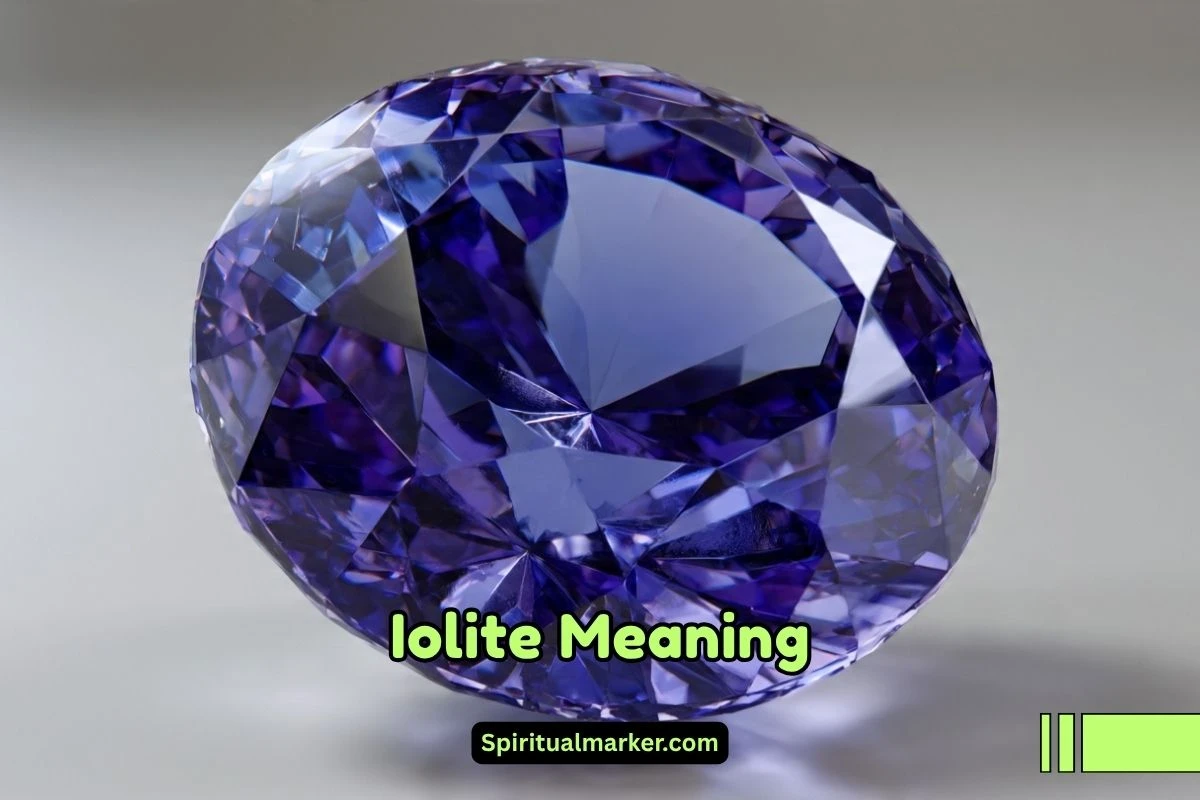
Have you ever felt drawn to a gemstone before knowing anything about it? Many people who encounter iolite for the first time feel an almost instant pull toward its deep violet-blue color. It carries a quiet intensity that feels both calming and quietly awakening at the same time.
For centuries, people have connected iolite with inner vision, mental clarity, spiritual direction, and emotional resilience. Ancient Norse navigators reportedly used thin slices of iolite as polarizing filters to locate the sun on overcast days, earning it the legendary title of the “Viking’s Compass.” That historical association with navigation and direction runs deep in iolite’s spiritual identity even today.
Unlike gemstones associated primarily with love or protection, iolite works on a different level. Its energy feels connected to the mind, the inner eye, and the courage to look honestly at your own life. Crystal healers, spiritual practitioners, and gemstone enthusiasts consistently associate it with self-awareness, purpose, and the strength required to follow your own path.
This article covers iolite’s meaning, its spiritual symbolism, healing properties, historical significance, and practical ways to use it for personal and spiritual growth. You will also learn how to wear and care for iolite jewelry while preserving both its beauty and energetic qualities.
Key Takeaways
- Iolite symbolizes inner vision, mental clarity, spiritual direction, and emotional strength.
- Many traditions link iolite with the third eye chakra and throat chakra, supporting intuition and honest communication.
- People use iolite during meditation, creative work, life transitions, and recovery from addiction or emotional confusion.
- Iolite displays a rare optical property called pleochroism, showing different colors when viewed from different angles.
- Wearing or carrying iolite may support clearer thinking, stronger self-awareness, and deeper spiritual insight.
What Is Iolite?
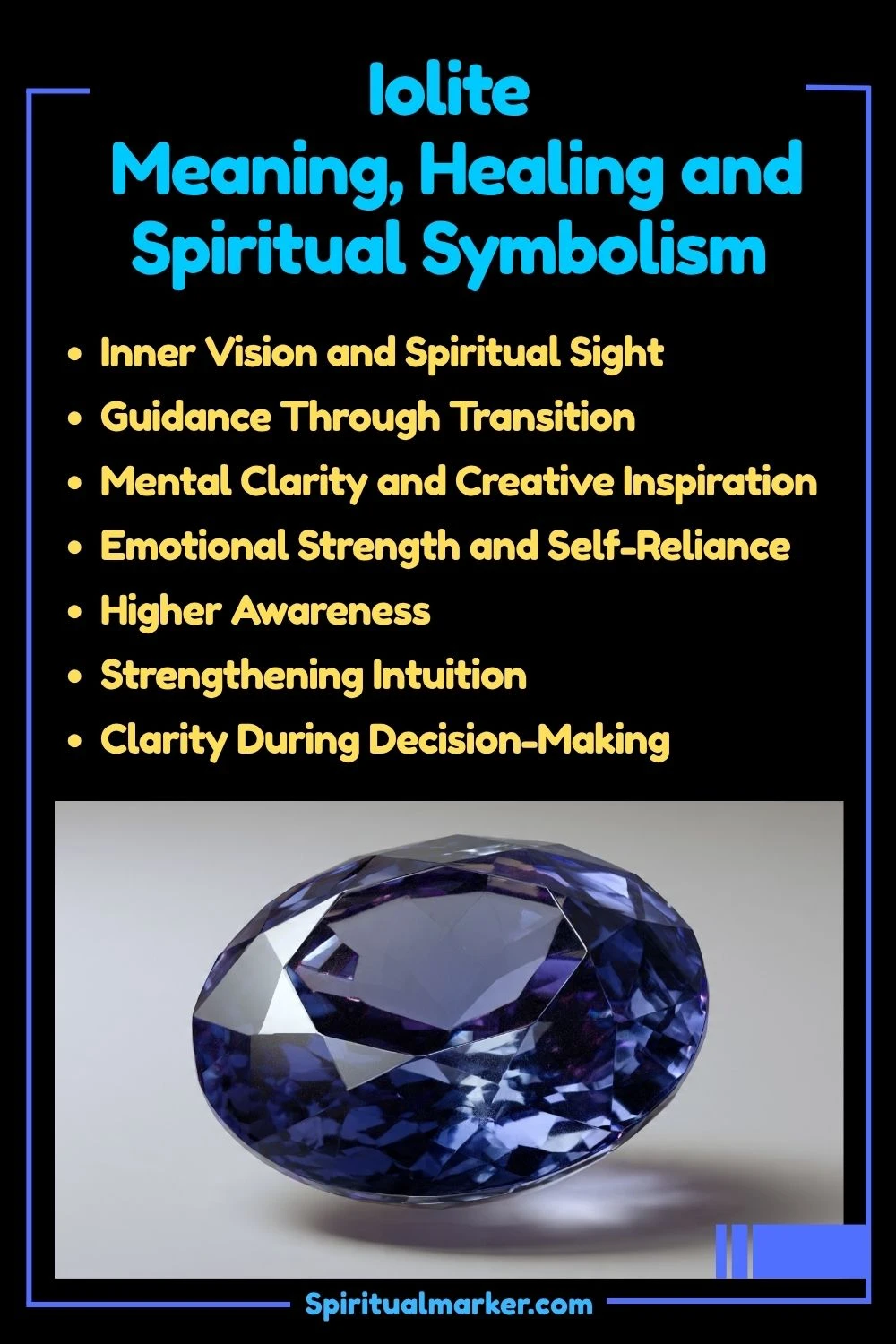
Iolite is a naturally occurring gemstone known for its striking shades of violet-blue, indigo, and grayish-blue. Its color range often makes people compare it to sapphire or tanzanite, but iolite carries its own distinct visual character. Its color shifts subtly depending on the angle of light, giving it a living, dimensional quality that feels almost hypnotic.
Scientifically, iolite belongs to the cordierite mineral group. Its name comes from the Greek word ios, meaning “violet.” In mineralogy, it is also called cordierite after French geologist Pierre Louis Antoine Cordier, who formally described the mineral in the early nineteenth century.
One of iolite’s most fascinating physical properties is pleochroism. When you rotate iolite under light, it appears violet-blue from one direction, pale grayish-blue from another, and nearly colorless or yellowish from a third angle. This rare optical quality sets it apart from most other gemstones and contributes to its reputation for shifting perspective and revealing hidden truths.
Many people compare iolite to tanzanite or blue sapphire at first glance. However, iolite feels more accessible, more grounded in its energy, and considerably more affordable. Spiritually, iolite carries a unique identity tied to vision, navigation, and inner knowing that distinguishes it clearly from other blue gemstones.
Origins and Formation
Iolite forms in metamorphic and igneous rocks through geological processes involving intense heat and pressure. It appears in granite pegmatites, gneisses, and contact metamorphic zones where aluminum-rich rocks undergo transformation over millions of years. This geological origin connects iolite symbolically with endurance, pressure-driven transformation, and the strength developed through difficult processes.
Major iolite sources span several continents. India remains one of the most significant producers, particularly in the states of Tamil Nadu and Orissa. Other important sources include Sri Lanka, Myanmar, Brazil, Norway, and Tanzania. Gem-quality specimens also appear in parts of Canada, Madagascar, and the United States.
Norwegian deposits hold particular historical significance. Vikings from Scandinavia are believed to have used thin iolite slices as navigational tools during sea voyages. By holding a polished piece toward the sky, navigators could determine the sun’s position even through heavy cloud cover by observing changes in the stone’s polarized light. This remarkable practical application deepened iolite’s symbolic identity as a stone of guidance, direction, and vision.
The stone’s pleochroic nature played a central role in this ancient navigational use. Different angles revealed different information, which mirrors the spiritual idea that multiple perspectives reveal deeper truths about life and the self.
Key Properties
| Property | Details |
|---|---|
| Color | Violet-blue, indigo, grayish-blue, pale blue |
| Composition | Magnesium iron aluminum silicate |
| Hardness | 7 to 7.5 on the Mohs scale |
| Chakra Association | Third eye chakra, throat chakra |
| Primary Symbolism | Vision, clarity, inner guidance, strength |
| Common Sources | India, Sri Lanka, Myanmar, Brazil, Norway |
| Optical Property | Pleochroism (color shifts with angle) |
| Energy Style | Focused, clarifying, spiritually awakening |
Historical Use
Ancient and medieval cultures across several continents recognized iolite as a stone of special perceptual power. Its ability to filter polarized light gave it an almost magical reputation among those who understood its navigational properties. Norse seafarers relied on it before magnetic compasses became widely available in Europe, making iolite a literal tool of survival and direction during dangerous ocean voyages.
In ancient India, iolite held a strong association with the third eye and spiritual insight. Vedic traditions connected gemstones with planetary energies, and iolite was sometimes associated with the planet Saturn, which governs discipline, karma, self-awareness, and long-term wisdom. Some ayurvedic and gemstone healing traditions used iolite to sharpen mental focus and support spiritual reflection.
Greek and Roman cultures also valued iolite, though records are less specific about its ritual uses. Its violet-blue color naturally connected it with themes of royalty, wisdom, and divine insight in classical antiquity.
In later metaphysical and crystal healing traditions, iolite became closely tied to the third eye chakra and the exploration of inner consciousness. Practitioners began using it to support meditation, dream work, creative inspiration, and emotional honesty. These traditions continue in contemporary crystal healing communities around the world.
5 Spiritual Meanings of Iolite
1. Inner Vision and Spiritual Sight
Iolite carries perhaps its strongest spiritual symbolism around the concept of inner vision. The third eye chakra, which iolite is most frequently associated with, governs intuition, perception, spiritual awareness, and the ability to see beyond surface-level appearances. When this energy center feels active and balanced, people often report heightened clarity about their own motivations, stronger intuitive impressions, and a deeper sense of spiritual direction. When it feels blocked, life can feel confusing, directionless, or spiritually flat.
Iolite symbolically supports the opening of this inner perceptual awareness. Many spiritual practitioners believe that clarity does not always come from gathering more information externally. Sometimes it requires turning attention inward and honestly examining the beliefs, fears, desires, and patterns that quietly shape behavior. Iolite is often used as a symbol of this internal turning, encouraging people to look within before looking outward for answers.
Its historical connection to Viking navigation reinforces this meaning powerfully. Just as ancient navigators used iolite to locate the sun’s position through dense cloud cover, spiritual practitioners often use it symbolically to locate their own inner direction during periods of confusion, doubt, or uncertainty. The stone does not create clarity artificially. Instead, its symbolism centers on helping people access clarity that already exists within them but remains obscured by emotional noise, fear, or mental overwhelm.
This spiritual meaning becomes especially significant for people at major crossroads in life. Career changes, relationship decisions, spiritual questioning, and personal reinvention all require honest self-reflection. Iolite’s symbolism encourages that reflection without distortion. Many people drawn to the stone during these periods describe its energy as quietly clarifying rather than dramatically transformative.
2. Guidance Through Transition
One of iolite’s most resonant spiritual themes involves navigating life transitions with greater clarity and courage. Change is rarely comfortable. Most people experience at least some emotional resistance, fear, or confusion during major life shifts, even when the change is ultimately positive. Endings, beginnings, and the uncertain territory between them can feel disorienting without a reliable inner compass.
Iolite spiritually represents that inner compass. Its symbolism as the Viking navigator’s stone runs through many metaphysical interpretations of its energy. Navigators needed both courage and clarity to steer through unknown waters. They could not rely on visible landmarks during storms or fog. Instead, they depended on accurate perceptual tools and their own skill to maintain direction. Iolite carries this symbolism directly into emotional and spiritual territory.
Many crystal practitioners associate iolite with the courage to leave familiar emotional territory when growth requires it. This might involve releasing relationships that no longer support personal well-being, stepping away from careers that feel meaningless, or letting go of identities built on others’ expectations. These transitions often feel frightening precisely because they require movement toward the unknown. Iolite symbolically represents the willingness to move forward despite that uncertainty.
Its energy is often described as mentally strengthening rather than emotionally comforting. Unlike softer heart-centered stones, iolite works with the part of consciousness that plans, decides, perceives, and acts with intention. This distinction makes it particularly useful for people who need clarity and directional strength rather than emotional soothing during periods of change.
3. Mental Clarity and Creative Inspiration
Across multiple crystal healing traditions, iolite is consistently associated with sharpened mental clarity and creative vision. Artists, writers, musicians, and other creative individuals frequently work with iolite because of its reputation for cutting through mental fog and supporting original thinking. Many describe its energy as mentally “clearing,” like removing a filter that was dulling perceptual sharpness.
Creative blocks often have more to do with mental noise than with a genuine absence of ideas. Anxiety, self-doubt, perfectionism, emotional overwhelm, and fear of judgment can all suppress creative expression long before ideas run dry. Iolite spiritually represents the removal of these internal obstructions. Its symbolism encourages honest creative expression without the distortion caused by excessive self-criticism or fear of imperfection.
This quality also extends into analytical and problem-solving contexts. People dealing with complex decisions, intellectual challenges, strategic planning, or academic demands sometimes feel drawn to iolite for its association with mental focus. Its energy is described as clarifying rather than stimulating. It does not artificially energize the mind. Instead, its symbolism centers on helping the mind work with greater precision and less internal interference.
Iolite’s pleochroism adds a meaningful layer to this interpretation. A stone that reveals different colors depending on the angle of observation naturally symbolizes the value of shifting perspective. Many creative and intellectual breakthroughs come not from finding new information but from seeing existing information from a different angle. Iolite spiritually reflects this principle in a tangible, visually demonstrable way.
4. Emotional Strength and Self-Reliance
Iolite carries a spiritual reputation for supporting emotional strength, personal responsibility, and self-reliance. While it connects with emotional themes, its approach differs from softer heart-centered stones. Iolite does not primarily soothe emotional pain. Instead, it symbolizes the kind of quiet inner strength that develops when people honestly face their own patterns, take responsibility for their choices, and commit to personal growth without emotional denial.
Many practitioners associate iolite with breaking patterns of emotional dependency or self-deception. People sometimes build identities around relationships, roles, substances, or external approval without recognizing how fragile those foundations actually are. When those external supports disappear or shift, emotional instability often follows. Iolite spiritually represents the development of a stronger inner foundation that does not depend entirely on external validation or comfort.
Some crystal healing traditions specifically associate iolite with addiction recovery and the process of rebuilding emotional clarity after prolonged patterns of avoidance or self-numbing. This connection exists because recovery requires extraordinary levels of honest self-reflection, courage, and willingness to examine uncomfortable truths. Iolite’s symbolism of clear inner vision and navigational direction aligns naturally with these themes.
The stone also reflects the idea that true emotional strength develops through honest self-awareness rather than emotional suppression or performance. Many people mistake emotional stoicism for emotional strength, but chronic suppression of genuine feelings can eventually create deeper emotional problems. Iolite spiritually encourages honest emotional recognition alongside the mental clarity to navigate those emotions constructively rather than being overwhelmed by them.
5. Spiritual Awakening and Higher Awareness
Iolite is frequently described as a stone that supports spiritual awakening and expanded consciousness. Its deep violet-blue color naturally connects it with higher states of awareness, spiritual perception, and the kind of consciousness expansion that many practitioners seek through meditation, prayer, and spiritual practice. In color symbolism, violet and indigo consistently appear in traditions related to spiritual authority, divine insight, and mystical perception.
Many meditators use iolite because they believe it deepens awareness during quiet reflection. Its third eye chakra association places it at the center of spiritual perception practices. Some practitioners report that working with iolite during meditation seems to support clearer visualization, more vivid inner imagery, and stronger intuitive impressions. Whether viewed scientifically or spiritually, iolite’s reputation in meditative contexts remains strong across diverse healing traditions.
Spiritual awakening generally refers to the gradual expansion of self-awareness and perceptual capacity. A person does not necessarily have dramatic mystical experiences. More often, awakening involves small but consistent shifts in perspective, deepening emotional honesty, greater empathy, and an expanding sense of meaning. Iolite spiritually reflects this gradual unfolding rather than sudden revelation.
Its historical connection to navigational sight reinforces the idea that spiritual awareness involves seeing clearly, not seeing differently for its own sake. Iolite symbolizes perception sharpened by honesty, discipline, and willingness to look at reality without distortion. This grounded quality prevents its spiritual associations from drifting into fantasy. Instead, its awakening symbolism remains rooted in clarity, courage, and authentic inner seeing.
6 Healing Properties of Iolite
1. Strengthening Intuition
Iolite carries a consistent reputation as an intuition-strengthening stone in crystal healing traditions worldwide. Intuition is not mystical guesswork. It is the mind’s ability to synthesize pattern recognition, emotional awareness, and stored experience into rapid perceptual insights. Many people who feel disconnected from their intuition have often spent years prioritizing external information, others’ opinions, or logical analysis over their own inner knowing.
Iolite healing traditions suggest the stone helps people reconnect with their intuitive perceptual capacity. This reconnection involves learning to trust inner impressions rather than immediately dismissing them in favor of external validation. Many healers believe this process develops slowly through consistent self-reflection, honest self-observation, and deliberate attention to intuitive signals. Iolite symbolically supports this development.
People who work with iolite for intuitive development often do so through meditation, journaling, or quiet reflective practices that slow the mind enough for subtle inner impressions to surface. The stone does not create intuition where none exists. Instead, many practitioners believe it helps clear mental clutter that obscures intuitive perception. This clearing quality explains why iolite frequently appears in third eye healing practices centered on deepening self-awareness.
2. Clarity During Decision-Making
Life presents decisions at every level, from small daily choices to major crossroads that fundamentally alter personal direction. Mental fog, emotional reactivity, fear, and conflicting desires can all compromise decision-making quality. Iolite is widely associated with the kind of mental clarity that supports better decisions, particularly during emotionally charged or high-stakes situations.
Many crystal practitioners believe iolite helps separate emotional reactivity from genuine inner knowing. Emotional reactions are not always reliable guides to wise decisions. Fear, grief, anger, or excitement can each temporarily distort perception and lead to choices people later regret. Iolite symbolically supports the mental composure needed to examine options more objectively without completely disconnecting from emotional wisdom.
This healing quality is particularly relevant during major life crossroads. Career decisions, relationship choices, relocation considerations, and major financial commitments all require clear-headed evaluation alongside genuine emotional awareness. Iolite’s association with balanced clarity between mental and emotional perception makes it a relevant symbolic tool during these critical decision points.
3. Supporting Recovery from Addiction and Emotional Numbing
Some of the most meaningful healing associations connected with iolite involve recovery from addiction, emotional numbing, and self-destructive patterns. These situations share a common element: they typically involve long-term avoidance of emotional pain through external substances, behaviors, or emotional shutdown rather than genuine healing.
Recovery from these patterns requires extraordinary levels of self-honesty, sustained courage, and the willingness to feel emotions that have been suppressed, sometimes for years. Iolite’s symbolism of clear inner vision and honest self-perception aligns directly with these recovery requirements. Its energy is often described as supportive of the mental clarity needed to face difficult truths without collapsing under their emotional weight.
Importantly, many healing practitioners do not present iolite as a substitute for professional support during addiction recovery. Crystal healing traditions typically position iolite as a complementary symbolic support that reinforces the inner clarity and self-awareness already being developed through therapy, community support, or other professional resources. Its value in this context is symbolic and supportive rather than curative.
The stone also connects with the process of rebuilding self-trust after periods of self-neglect or self-harm. People emerging from addiction or prolonged emotional numbness often struggle with self-doubt, shame, and difficulty trusting their own perceptions again. Iolite symbolically represents the gradual restoration of clear inner seeing and the courage to navigate life from that renewed self-awareness.
4. Improving Concentration and Mental Focus
Iolite is widely associated with improved mental focus and concentration in crystal healing traditions. Its connection with the third eye chakra naturally extends into cognitive qualities such as attention, mental organization, and the ability to sustain focus on meaningful work. Many students, professionals, and creative workers keep iolite nearby during demanding intellectual tasks.
Mental distraction often stems from anxiety, emotional overwhelm, or unresolved internal conflict as much as from external stimuli. When the mind is partially occupied with emotional processing, worry, or unresolved tension, concentration suffers noticeably. Iolite symbolically addresses this dynamic by encouraging greater alignment between emotional and mental states, allowing attention to settle more fully on present-moment tasks.
Many practitioners also associate iolite with clearer verbal and written expression. Because the stone connects with both the third eye and throat chakra, it bridges perception and communication in ways that support more precise articulation of ideas. Writers, speakers, educators, and professionals who rely on clear communication sometimes use iolite during work that demands both clarity of thought and quality of expression.
5. Promoting Healthy Sleep and Dream Awareness
Iolite appears frequently in crystal traditions connected with sleep quality and dream awareness. Its calming yet perceptually clarifying energy makes it a popular choice for placement near sleeping spaces or under pillows among those who practice crystal healing. Many people also associate it with more vivid, meaningful, and memorable dreams.
Dreams have occupied significant space in spiritual traditions across cultures and centuries. Ancient Egyptians, Greek oracles, indigenous communities worldwide, and modern depth psychologists have all attributed meaningful information to dream content. Iolite’s spiritual connection with inner vision extends naturally into this territory. Many practitioners believe it supports more conscious dream engagement, allowing impressions, symbols, and emotional content from dreams to surface more clearly into waking awareness.
For people who struggle with restless thinking at night, iolite’s clarifying energy is believed to help quiet mental activityand support deeper relaxation. Its association with the third eye may help redirect overactive mental energy from anxious looping into quieter, more receptive states that support natural sleep rhythms.
6. Building Honest Self-Awareness
Perhaps the most consistent healing theme woven through iolite’s spiritual identity involves deep, courageous self-awareness. Many emotional, relational, and spiritual problems develop not because people lack intelligence or good intentions but because accumulated self-deception, denial, or blind spots prevent honest self-perception. Iolite is widely associated with the willingness and ability to see oneself clearly.
This quality requires courage. Honest self-reflection often involves acknowledging patterns, fears, motivations, or behaviors that feel uncomfortable to examine. Many people resist genuine self-awareness because it can produce temporary emotional discomfort before producing growth. Iolite spiritually represents the courage to look honestly rather than comfortably at one’s own inner life.
Many spiritual traditions emphasize that genuine external change follows internal clarity. A person who understands their own motivations, emotional patterns, relational habits, and core values is far better positioned to make meaningful changes than someone who remains unaware of these interior dynamics. Iolite healing traditions consistently reflect this principle by positioning the stone as a catalyst for honest inner work rather than as a source of external magical change.
How to Wear Iolite Jewelry for Spiritual Growth
People wear iolite jewelry in different ways depending on their spiritual intentions and personal goals. Because iolite connects strongly with both the third eye and throat chakra, pendants and necklaces remain especially meaningful choices. Wearing iolite at the throat or slightly higher keeps it close to both energy centers during daily life.
Iolite earrings hold particular significance in intuition-centered practices. Wearing the stone near the temples and the sides of the head symbolically aligns it with perception, mental clarity, and the third eye area. Many practitioners who work specifically with intuitive development prefer this placement.
Iolite bracelets allow regular physical contact with the stone throughout daily activities. Some people find that touching the stone briefly during stressful moments or important decisions helps them return to a clearer mental state. This tactile engagement reinforces the stone’s symbolic role as a navigational anchor during moments of uncertainty.
Many practitioners combine iolite with complementary crystals to create more layered energetic support. Labradoriteamplifies intuitive awareness and mystical perception. Amethyst deepens spiritual calm and supports meditation. Clear quartz may amplify iolite’s clarifying properties. Lapis lazuli reinforces the connection between inner truth and clear communication. These combinations work well for people seeking both mental clarity and spiritual depth simultaneously.
Some people wear iolite during meditation, creative sessions, important conversations, or journaling to reinforce the stone’s association with clear perception and honest self-expression. Consistent use within intentional practices tends to deepen the personal meaning the stone holds over time.
Caring for Iolite Jewelry
Iolite is relatively durable with a Mohs hardness of 7 to 7.5, making it more resistant to everyday wear than softer stones like opal or moonstone. However, iolite has cleavage planes that can make it susceptible to chipping under sharp impact. Careful handling preserves both its appearance and structural integrity.
Store iolite jewelry separately from harder stones such as sapphire, topaz, or diamond to prevent surface scratching. Soft fabric pouches or padded compartments in jewelry boxes work well for storage.
Clean iolite with lukewarm water, mild soap, and a soft cloth or brush. Avoid ultrasonic cleaners and steam cleaning, as these methods may stress the stone along its natural cleavage planes. Avoid prolonged exposure to harsh chemicals, including household cleaners and chlorinated water.
Remove iolite jewelry before intense physical activity, swimming, or heavy manual work. While iolite handles daily wear reasonably well, unnecessary impact or chemical exposure shortens the stone’s lifespan.
Many spiritual practitioners also choose to cleanse iolite energetically on a regular basis. Common methods include placing it under moonlight, particularly during full moon phases. Some use sound cleansing with singing bowls, bells, or tuning forks. Others prefer burying the stone briefly in dry earth or surrounding it with cleansing herbs such as rosemary or dried sage. Spiritual cleansing methods vary widely based on personal tradition and belief.
Table: Iolite Meaning at a Glance
| Aspect | Details |
|---|---|
| Primary Meaning | Inner vision, clarity, and spiritual guidance |
| Chakra Association | Third eye chakra, throat chakra |
| Main Spiritual Symbolism | Navigation, perception, courage, self-awareness |
| Common Colors | Violet-blue, indigo, grayish-blue |
| Hardness | 7 to 7.5 Mohs |
| Main Sources | India, Sri Lanka, Myanmar, Brazil, Norway |
| Historical Name | Viking’s Compass |
| Optical Property | Pleochroism |
| Popular Jewelry Types | Pendants, earrings, bracelets, rings |
| Spiritual Uses | Meditation, intuition work, dream awareness, clarity |
| Emotional Associations | Strength, self-honesty, clarity, direction |
| Care Needs | Gentle cleaning, protect from sharp impact |
A Final Note
Iolite stands apart from many gemstones because its symbolism feels simultaneously ancient and deeply personal. Its legacy as the Viking’s Compass gives it a grounded historical identity. Its third eye chakra connections give it spiritual depth. Its pleochroic nature makes it a living symbol of shifting perspective and layered perception.
People are consistently drawn to iolite during periods when life demands greater clarity, honest self-reflection, or renewed sense of direction. Its meaning centers on inner vision, mental clarity, emotional strength, and the courage to navigate life authentically. Whether viewed through a metaphysical lens or appreciated simply as a remarkable gemstone, iolite continues to resonate with people who feel the need for a clearer, more honest inner compass.
If iolite has captured your attention, that pull may reflect something meaningful about where you are right now in your personal journey. Some people wear it as a symbol of commitment to honest self-awareness. Others carry it as a navigational reminder during uncertain transitions. Many simply appreciate its extraordinary beauty and the quiet sense of mental steadiness it seems to represent.
You might consider pairing iolite with a consistent journaling or meditation practice to deepen its personal significance. You could also explore combining it with stones like amethyst or labradorite if spiritual perception and inner clarity are areas you want to develop further.