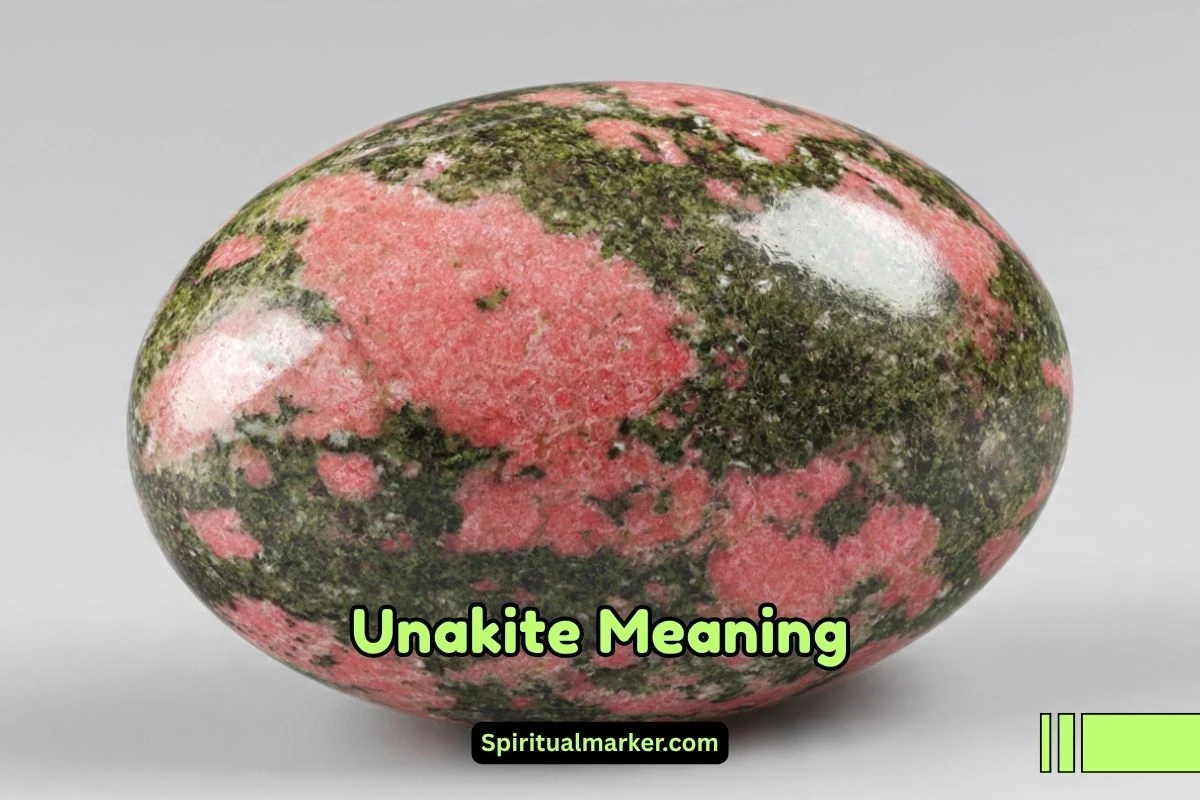
Have you ever picked up a stone and felt instantly steadied? That is the kind of quiet, grounding power many people associate with Unakite. Its earthy blend of mossy green and dusty rose feels immediately different from bold, flashy gemstones. Something about it feels settled, patient, and emotionally honest.
People have used Unakite in spiritual and healing practices for decades. It carries a reputation for emotional balance, patient growth, and deep inner healing. Many crystal enthusiasts turn to it during difficult life transitions. Others rely on it during meditation or emotional recovery work.
Unlike stones celebrated for intense energetic stimulation, Unakite works differently. Its energy feels slow, steady, and deeply stabilizing. That quality is precisely why spiritual practitioners, crystal healers, and gemstone collectors continue to value it. It does not force transformation. It creates conditions where transformation becomes possible naturally.
This article covers the full Unakite meaning, its spiritual symbolism, healing properties, historical background, chakra associations, and practical ways to use it in your daily spiritual life. You will also learn how to wear and care for Unakite jewelry while preserving its natural beauty and energetic quality.
5 Key Takeaways
- Unakite symbolizes emotional balance, patience, grounding, and compassionate growth.
- Most crystal traditions connect Unakite with the heart chakra and the root chakra.
- People frequently use Unakite during emotional recovery, pregnancy, grief, and personal transformation.
- Unakite forms from a combination of green epidote, pink feldspar, and quartz, giving it a uniquely layered energy.
- Wearing or carrying Unakite may strengthen feelings of emotional stability, self-awareness, and grounded spiritual presence.
What Is Unakite?
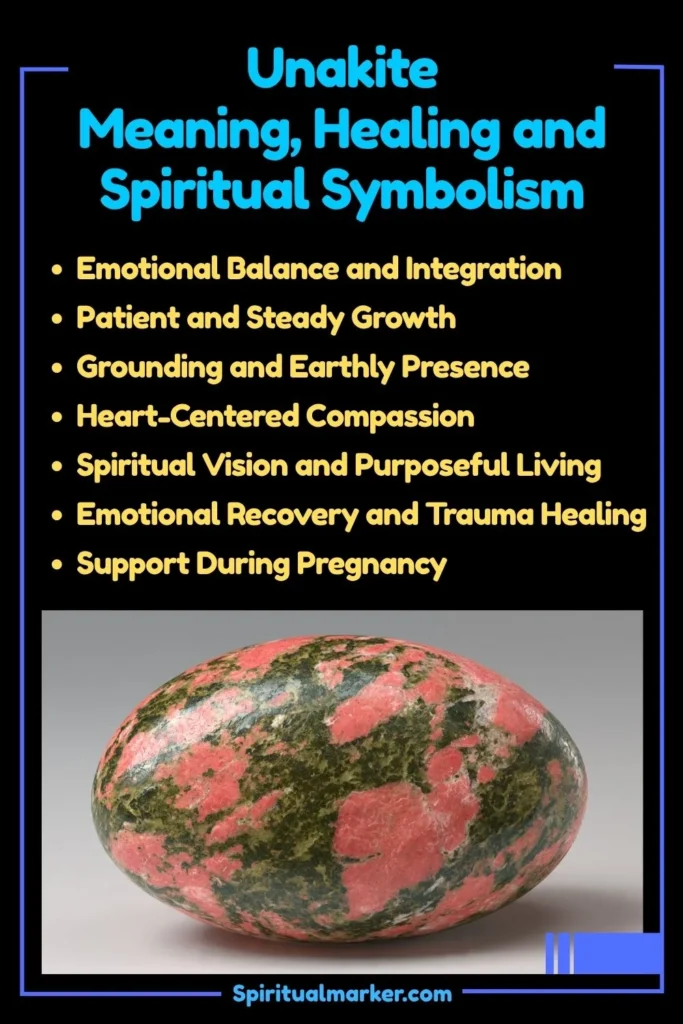
Unakite is an igneous rock composed primarily of three minerals: green epidote, pink orthoclase feldspar, and clear to milky quartz. These three elements bond together naturally during geological processes, creating a stone with a visually distinctive mottled appearance. Its color pattern typically features patches of earthy green alongside warm, muted pink or peach tones.
The combination is visually striking in a calm, natural way. Unakite does not display the dramatic color play of opal or the deep saturation of sapphire. Instead, its beauty feels organic, grounded, and honest. Many people find that aesthetic deeply appealing precisely because it mirrors what the stone symbolizes spiritually.
It is worth noting that Unakite is technically classified as a rock rather than a single mineral. That distinction rarely matters to crystal practitioners, but it reflects the stone’s layered nature. Its energy comes from the combined qualities of three distinct minerals working together, which many healers believe gives it a more balanced and integrative spiritual identity.
Gemologically, Unakite ranks between 6 and 7 on the Mohs hardness scale, making it relatively durable compared to softer healing stones like selenite or green opal. This durability also contributes to its use in jewelry, decorative carvings, tumbled stones, and palm stones.
Origins and Formation
Unakite gets its name from the Unaka Mountains in North Carolina, where it was first formally identified in the late nineteenth century. The name itself carries geographic meaning, tying the stone directly to the rugged, forested mountain landscapes of the American Southeast.
Beyond North Carolina, Unakite deposits have been found across many regions. South Africa, Brazil, China, Sierra Leone, and Zimbabwe all produce Unakite in varying qualities. Significant deposits also exist along the shores of Lake Superior in the United States, where glacial activity spread the stone across large geographic areas.
Unakite forms through a geological process called hydrothermal alteration. This occurs when hot, mineral-rich fluids move through existing granite rock layers over vast periods. The feldspar within the granite gradually transforms into epidote through this chemical process. The resulting stone carries this geological history within its layered structure, which many spiritual traditions interpret as symbolic of slow, patient transformation.
That geological patience mirrors the spiritual symbolism many people associate with Unakite. It did not form quickly. It developed through gradual chemical change across enormous timescales. Many crystal practitioners believe that energetic quality influences how the stone works in healing and personal growth contexts.
Key Properties at a Glance
| Property | Details |
|---|---|
| Primary Composition | Green epidote, pink feldspar, clear quartz |
| Hardness | 6 to 7 on the Mohs scale |
| Primary Chakra | Heart chakra, root chakra |
| Core Symbolism | Balance, patience, emotional healing, growth |
| Main Sources | USA, South Africa, Brazil, China, Zimbabwe |
| Transparency | Opaque |
| Energy Style | Grounding, nurturing, steady, integrative |
| Popular Uses | Meditation, pregnancy support, grief healing, emotional balance |
Historical Use and Cultural Significance
Unakite’s formal discovery in the United States occurred in the 1870s, but its use in spiritual and decorative contexts expanded significantly throughout the twentieth century. The stone appears as architectural decorative material in several notable buildings in Washington D.C., including areas surrounding the Smithsonian Institution. This early decorative use reflects Unakite’s visual appeal as a naturally patterned stone.
Indigenous communities in regions where Unakite naturally occurs historically used various green and earth-toned stones in ceremonial and healing contexts. Green stones broadly represented life force, fertility, and connection to the earth in many North American indigenous traditions.
Within modern crystal healing traditions, which developed significantly during the mid to late twentieth century, Unakite became associated with emotional and physical integration. Practitioners began connecting it with pregnancy, recovery, and emotional balance work. Authors such as Judy Hall featured Unakite prominently in widely read crystal healing reference books, cementing its reputation within the broader metaphysical community.
Today, Unakite appears consistently in crystal healing kits, meditation spaces, and holistic wellness practices worldwide. Its balanced color composition and grounding energy have earned it a lasting place in both spiritual traditions and gemstone collecting communities.
5 Spiritual Meanings of Unakite
1. Emotional Balance and Integration
Unakite’s most enduring spiritual meaning centers on emotional balance. The stone visually represents this through its own composition. Green epidote and pink feldspar do not simply coexist within Unakite. They integrate into one cohesive whole. Many spiritual practitioners interpret that physical integration as a direct metaphor for emotional wholeness.
Most people carry emotional experiences that feel fragmented. Past wounds exist alongside current joys. Grief appears alongside gratitude. Confidence and insecurity often occupy the same internal space simultaneously. This is a normal part of emotional life, but it can feel disorienting and difficult to navigate.
Unakite spiritually symbolizes the work of bringing these fragmented emotional experiences into balance. It does not represent the elimination of difficult emotions. Instead, it represents the integration of all emotional experiences into a more coherent inner landscape.
This symbolism makes Unakite particularly meaningful during life transitions. Career changes, relationship endings, losses, moves, and personal reinventions all create emotional fragmentation. Something ends while something new begins. Grief and hope occupy the same emotional territory simultaneously. Unakite spiritually reflects that both experiences are valid and part of the same healing process.
Many people also connect Unakite’s integration symbolism with personal identity. People who have experienced significant emotional challenges sometimes feel uncertain about who they are. Healing feels incomplete when certain emotional experiences feel too painful to acknowledge fully. Unakite’s spiritual meaning encourages emotional wholeness that includes all parts of a person’s experience rather than only the comfortable parts.
2. Patient and Steady Growth
Few spiritual symbols represent patience as naturally as Unakite. Its geological formation required enormous spans of time. Its appearance reflects slow, layered development rather than sudden crystalline brilliance. That patient quality runs through virtually every spiritual interpretation of the stone.
Personal growth rarely happens on demand. Most meaningful change unfolds over months or years through consistent emotional work, repeated small choices, and gradual shifts in perspective. People often feel frustrated when progress seems invisible or painfully slow. Spiritual traditions connected with Unakite frequently address exactly that frustration.
Unakite symbolizes trust in the process of gradual development. It reminds you that growth happening beneath the surface is still growth. A seed developing underground for weeks looks identical to a seed that has not been planted at all. But the difference between them is enormous. Unakite spiritually reflects this unseen but real developmental process.
This symbolism becomes especially powerful during periods of emotional recovery. Healing from grief, trauma, heartbreak, or long-term stress rarely produces dramatic visible change quickly. People sometimes feel that recovery is failing because daily life still feels difficult. Unakite’s spiritual identity encourages a longer perspective. Slow healing is not failed healing. It is the most natural form healing takes.
Many practitioners describe Unakite as a stone for people who have grown impatient with themselves. Its energy symbolizes emotional self-compassion during slow growth periods. It encourages continued effort without harsh internal criticism when results feel distant or uncertain.
3. Grounding and Earthly Presence
Unakite carries strong grounding symbolism within crystal traditions. This grounding quality comes partly from its root chakra association and partly from its deeply earthy visual character. Its green tones reflect dense foliage and mossy forest floors. Its warm pink tones carry the feeling of sun-warmed soil.
Spiritual grounding refers to maintaining emotional and mental stability during intense experiences. Without grounding, people may feel emotionally scattered, mentally overstimulated, spiritually unmoored, or disconnected from daily reality. This is common during periods of intense emotional work, significant life change, or prolonged stress.
Unakite symbolizes the return to solid emotional ground. It encourages presence in the body and connection with the physical world. Many practitioners use it during meditation to maintain mental clarity while exploring deeper emotional or spiritual territory. Rather than allowing introspection to become overwhelming, Unakite symbolically keeps practitioners emotionally anchored throughout the process.
This grounding dimension also connects to practical daily life. Stress, anxiety, and emotional overwhelm can detach people from immediate sensory experience. Unakite’s symbolism encourages conscious return to the present moment. It is associated with noticing what is immediate, real, and physically present rather than remaining trapped in mental projections about the past or future.
Some practitioners connect Unakite’s grounding symbolism with nature itself. Like the forests its colors evoke, Unakite symbolizes stability through rootedness. Trees withstand storms not because they are rigid but because their roots extend deeply into the earth. Spiritually, Unakite reflects this same principle in emotional life.
4. Heart-Centered Compassion
Unakite’s pink feldspar component directly connects it with heart chakra energy in most crystal healing traditions. The heart chakra governs love, compassion, emotional trust, forgiveness, empathy, and the quality of connection people maintain with themselves and others.
When heart chakra energy flows openly, people experience emotional availability, healthy vulnerability, and meaningful connection. When it feels blocked or closed, emotional detachment, relational distance, resentment, or difficulty trusting others may emerge. Unakite’s spiritual symbolism involves supporting gentle reopening of emotional pathways that have become guarded or closed.
This compassion extends in both directions. Unakite symbolizes compassion toward others and, perhaps more importantly, toward yourself. Many people find it easier to extend patience and kindness to others than to themselves. After painful experiences, internal criticism often intensifies. People judge their emotional reactions, their healing pace, their perceived failures, and their lingering pain harshly.
Unakite spiritually represents the choice to treat yourself with the same emotional gentleness you would naturally offer someone you love. This is not an abstract spiritual concept. It has measurable practical effects. Research in psychology consistently shows that self-compassion supports faster emotional recovery, more resilient mental health, and healthier interpersonal relationships than self-criticism does.
The stone’s compassion symbolism also extends into how people navigate conflict within relationships. When communication breaks down or trust has been damaged, emotional defensiveness often escalates further conflict. Unakite spiritually represents approaching relational difficulty with patience and emotional openness rather than immediate defensive reactivity.
5. Spiritual Vision and Purposeful Living
Unakite carries an often overlooked spiritual meaning connected with clarity of spiritual vision and purposeful direction. Many crystal traditions associate it with the third eye chakra in addition to the heart and root chakras, creating an energetic connection between grounded presence and intuitive awareness.
This combination is significant. Grounding keeps people rooted in practical reality. Spiritual vision helps people identify meaningful direction within that reality. Together, these qualities symbolize purposeful living, which many people describe as one of the most sought-after experiences in both spiritual and psychological growth.
Unakite spiritually reflects the idea that clarity about direction comes through emotional honesty rather than intellectual analysis alone. Many people seek purpose by thinking harder about their lives. But emotional clarity, which involves recognizing what genuinely matters to you on a deeper level, often provides more useful directional information than rational analysis alone.
People going through significant personal transitions frequently report confusion about what they want or where they are headed. Unakite symbolizes gentle, grounded spiritual clarity that develops through patient inner work rather than sudden external revelation. This makes it particularly meaningful for those navigating major life changes, career pivots, spiritual awakenings, or significant identity shifts.
Its connection with spiritual vision also reflects the idea that meaningful growth requires both inner work and outward action. Unakite symbolizes the integration of internal awareness with purposeful movement in the world.
6 Healing Properties of Unakite
1. Emotional Recovery and Trauma Healing
Unakite has a deep association with emotional recovery, particularly in contexts involving grief, loss, trauma, or prolonged emotional suffering. Its integrative energy symbolically addresses the fragmented emotional experience that often accompanies significant loss or trauma.
Trauma and grief frequently create emotional dissociation. People describe feeling detached from their own experience, numb, emotionally locked, or unable to access feelings they know exist internally. This emotional fragmentation is a natural protective response, but it can become an obstacle to long-term healing when it persists well beyond the initial acute phase.
Unakite spiritually encourages gradual emotional reintegration. Rather than forcing emotional confrontation before a person feels ready, its symbolism centers on creating emotional safety. Many practitioners describe this as the stone supporting the conditions where buried emotions can surface naturally without overwhelming the person experiencing them.
Its association with the heart chakra directly supports this healing quality. Emotional trauma frequently affects the heart chakra most deeply, creating emotional walls that protect against further pain but also limit connection, vulnerability, and emotional intimacy. Unakite symbolizes the patient process of emotional reopening that happens when a person feels genuinely safe.
This healing property also connects to emotional acceptance. Many trauma survivors struggle with emotions related to their experience, including shame, anger, guilt, or fear. Unakite spiritually represents approaching all emotional experiences with nonjudgmental awareness rather than forcing premature resolution or suppression.
2. Support During Pregnancy and New Beginnings
Unakite has a particularly well-established reputation as a pregnancy stone within crystal healing traditions. Practitioners frequently recommend it for people navigating pregnancy, childbirth recovery, new parenthood, and fertility journeys. Its symbolism of patient growth, nurturing energy, and physical grounding feels intuitively aligned with the pregnancy experience.
Pregnancy represents one of the most profound examples of slow, patient biological development. An embryo develops through gradual cellular differentiation over many weeks before any visible external change appears. This process mirrors Unakite’s core symbolic identity in a remarkably direct way.
Beyond biological symbolism, the emotional experience of pregnancy involves significant vulnerability, uncertainty, physical change, and emotional intensity. Many people carry anxiety, fear, or unresolved emotional material that surfaces during pregnancy. Unakite’s grounding and emotionally nurturing symbolism makes it a stone many practitioners associate with emotional steadiness throughout that vulnerable process.
Its association with new beginnings also extends beyond pregnancy. Major life changes such as new careers, new relationships, geographic moves, or personal reinventions all carry the emotional texture of beginning something unfamiliar. Unakite symbolizes grounded courage during unfamiliar beginnings, encouraging trust in gradual development rather than demanding immediate visible results.
Many people also keep Unakite near them during recovery from physical illness or surgery. Its symbolic connection with patient healing and physical integration makes it emotionally meaningful during health recovery journeys.
3. Stress and Anxiety Reduction
Unakite’s grounding energy gives it a natural reputation as a stress-reducing stone within crystal traditions. Its earthy green and warm pink tones visually reinforce this calming quality. Many people report feeling immediately steadier simply by holding a piece of Unakite during anxious moments.
Stress and anxiety create a particular kind of mental fragmentation. The mind races between past regrets and future fears. Present-moment awareness diminishes. Physical symptoms such as tension, shallow breathing, disrupted sleep, and emotional irritability emerge. Emotional reactivity increases, making patient communication and clear thinking more difficult.
Unakite symbolically addresses this state by encouraging return to grounded, present-moment awareness. Its energy is commonly described as emotionally cooling, particularly during periods when anxiety or emotional overwhelm make clear thinking difficult.
Many practitioners place Unakite at workdesks, meditation spaces, or bedside tables during stressful periods. Holding it during moments of acute anxiety is also a common practice. The physical weight and texture of a smooth Unakite palm stone can itself create a tactile anchor to present-moment physical experience, which is a well-recognized technique in mindfulness-based stress reduction.
Research consistently supports the effectiveness of grounding practices for anxiety management. While these studies examine practices such as deep breathing, body awareness, and nature exposure rather than specific crystals, the underlying principle of returning conscious attention to immediate physical experience is precisely what Unakite symbolically represents.
4. Relationship Healing and Emotional Communication
Unakite appears frequently in spiritual practices related to relationship healing. Its combination of heart chakra energy and patient grounding makes it symbolically aligned with the emotionally careful work of repairing damaged relational bonds.
Relationships accumulate emotional residue over time. Unspoken resentments, misunderstood intentions, repeated emotional patterns, and unresolved conflict quietly build beneath the surface of daily interaction. Many relationships do not end dramatically. They gradually cool through accumulated emotional distance.
Unakite symbolizes the patient work of emotional repair. This involves both emotional honesty and emotional vulnerability. Many people find that one without the other creates further damage. Honest communication without emotional vulnerability can feel cold or weaponized. Emotional vulnerability without honesty can feel manipulative or unclear. Unakite spiritually reflects the integration of both.
Its connection with forgiveness also plays an important role in relationship healing. Forgiveness within spiritual traditions rarely means pretending harmful behavior was acceptable. It more accurately refers to releasing the ongoing emotional suffering that comes with carrying resentment. That release benefits the person doing the forgiving more than it benefits the person being forgiven. Unakite symbolizes this process of releasing emotional weight without denying the reality of what caused it.
The stone’s symbolism also extends to your relationship with yourself. How you treat yourself emotionally shapes how you engage with others. People who practice emotional self-compassion consistently show up with more patience, empathy, and emotional availability in their relationships with others.
5. Physical Healing and Recovery Support
While crystal healing traditions are spiritual and should never replace professional medical care, Unakite is widely associated with physical recovery and bodily healing in metaphysical practices. Many practitioners connect it specifically with the health of the reproductive system, heart, lungs, and musculoskeletal structure.
Its association with physical healing likely reflects its symbolic qualities rather than any direct biological mechanism. The patience, integration, and grounding it symbolizes translate naturally into the emotional dimensions of physical recovery. Illness and injury often create fear, emotional fragmentation, identity disruption, and significant stress. These emotional challenges are real and meaningful parts of the recovery experience.
Many practitioners suggest that Unakite supports emotional steadiness during physical healing processes. Feeling emotionally grounded, patient, and self-compassionate during illness or injury recovery may support better adherence to treatment, reduced anxiety, and greater emotional resilience throughout the process.
Some crystal traditions also associate Unakite with cellular regeneration and tissue recovery. While these claims carry no clinical evidence base, they reflect the stone’s symbolic association with slow, patient biological development. Practitioners who incorporate Unakite into recovery practices typically do so alongside conventional medical treatment rather than as a replacement.
6. Spiritual Growth and Third Eye Activation
Unakite’s connection with the third eye chakra gives it a spiritual growth dimension that many people overlook. While it is primarily known as a heart and root chakra stone, many practitioners believe Unakite also supports intuitive awareness, spiritual clarity, and visionary perception.
The third eye chakra governs intuition, inner wisdom, imagination, and the ability to perceive patterns and meaning beneath the surface of events. When this chakra feels open and balanced, people often experience heightened intuitive awareness, clearer pattern recognition, and stronger connection with their own inner knowing.
Unakite’s contribution to this chakra is distinctly different from how stones like lapis lazuli or amethyst operate. Its energy is grounded and patient rather than intense or expansive. It encourages intuitive awareness that feels stable and practically applicable rather than spiritually overwhelming or destabilizing.
Many practitioners describe Unakite’s effect on spiritual growth as integrative. It helps people connect intuitive insights with emotional understanding and ground both within practical reality. This integration of spiritual perception, emotional intelligence, and grounded presence creates a foundation for purposeful spiritual growth rather than spiritual bypassing, which refers to using spiritual practices to avoid rather than address emotional realities.
This combination of third eye clarity, heart chakra compassion, and root chakra grounding is one reason many experienced crystal practitioners consider Unakite a deeply complete spiritual stone despite its relatively modest appearance.
Unakite and Chakra Alignment
Unakite works most powerfully within the heart chakra, root chakra, and third eye chakra. Understanding how it engages each of these energy centers helps clarify why its healing properties feel so well-rounded and emotionally comprehensive.
The heart chakra, located at the center of the chest, governs love, compassion, forgiveness, emotional trust, and relational connection. Unakite’s pink feldspar component directly resonates with this energy center. It encourages gentle emotional opening, compassionate awareness, and the patient rebuilding of emotional trust after periods of pain or disconnection.
The root chakra, located at the base of the spine, governs physical safety, grounded presence, survival instincts, and foundational stability. Unakite’s earthy green epidote resonates with this energy center. It encourages physical groundedness, emotional steadiness, and a sense of fundamental security within the body and the world.
The third eye chakra, located at the center of the forehead, governs intuition, inner vision, pattern recognition, and spiritual clarity. Unakite’s quartz component contributes resonance here. It encourages grounded spiritual perception, intuitive clarity, and meaningful connection between inner awareness and outer experience.
The fact that Unakite engages all three of these chakras simultaneously explains why many practitioners describe it as an integrative stone rather than a specialized one. It does not focus all its energy on one dimension of healing. Instead, it creates conditions for a more comprehensive kind of balance.
How to Use Unakite for Spiritual and Emotional Healing
Meditation represents one of the most common ways people work with Unakite. Holding a smooth Unakite palm stone during meditation provides a tactile grounding anchor that helps maintain present-moment awareness while exploring deeper emotional or spiritual territory. Many practitioners place it over the heart during lying-down meditation to directly support heart chakra work.
Carrying Unakite as a pocket stone throughout the day is another widely practiced approach. The practice of reaching for it during stressful moments or emotionally difficult interactions keeps its grounding symbolism physically accessible. Many people find that the simple act of physically holding the stone creates a brief but meaningful conscious emotional pause during reactive moments.
Crystal grids incorporating Unakite often focus on themes of healing, balance, relationship repair, or personal growth. Combining Unakite with rose quartz amplifies compassion and heart-centered energy. Pairing it with smoky quartz deepens grounding and emotional release. Adding clear quartz may amplify all of Unakite’s properties simultaneously.
Journaling alongside Unakite is a practice some emotional healing practitioners recommend. Placing the stone near your writing space or holding it before beginning a journaling session may help you access emotional honesty more naturally. Many people find that emotional authenticity comes more easily when they feel grounded and emotionally safe.
Placing Unakite in specific areas of your home also carries significance for some practitioners. A bedroom placement may support peaceful emotional processing during sleep. A workspace placement may encourage grounded focus during stressful professional periods. A living room placement may support emotional openness during relational interactions.
How to Wear Unakite Jewelry for Spiritual Growth
Unakite jewelry appears in many forms, from pendant necklaces to rings, bracelets, and earrings. Because Unakite primarily connects with the heart chakra, pendants worn close to the chest carry particular symbolic significance. The physical proximity to the heart center symbolically aligns the stone with emotional healing, compassionate awareness, and heart-centered spiritual growth.
Unakite bracelets remain popular because they allow continuous skin contact throughout the day. Many people believe consistent contact with the stone gradually deepens its energetic influence. Wearing a bracelet on the left wrist is sometimes recommended in crystal traditions because the left side is associated with receiving energy. Wearing it on the right wrist may emphasize expressing the stone’s qualities outward in daily interactions.
Unakite rings carry symbolism connected with intentional communication and conscious action. Because your hands are involved in nearly every daily activity and interaction, some practitioners believe wearing Unakite as a ring keeps its grounding and compassionate energy actively present throughout the day.
Many people choose to combine Unakite with other complementary crystals in layered jewelry. Rose quartz deepens compassion and self-love. Amethyst adds calm intuitive awareness. Black tourmaline strengthens grounding and protection. Green aventurine amplifies themes of emotional growth and fresh opportunity.
Wearing Unakite with conscious intention matters more than the specific piece you choose. Many practitioners recommend setting a clear personal intention when first putting on new Unakite jewelry. This intention might focus on emotional healing, patience during a difficult period, relational repair, or grounded spiritual growth.
Caring for Your Unakite Crystals and Jewelry
Unakite’s hardness of 6 to 7 on the Mohs scale makes it reasonably durable compared to softer healing stones. However, thoughtful care preserves both its physical appearance and the symbolic connection many practitioners develop with their stones over time.
Store Unakite separately from harder stones such as topaz, sapphire, or diamond that could scratch its surface. A fabric-lined jewelry box or soft cloth pouch works well for storage. Keeping pieces separated from each other prevents accidental surface damage during storage.
Clean Unakite gently using lukewarm water and a mild, non-abrasive soap. A soft cloth or gentle natural bristle brush removes surface dust without scratching. Avoid ultrasonic cleaners and steam cleaning, as these methods can damage the stone’s surface or weaken the bonds between its mineral components over time.
Limit prolonged exposure to harsh chemicals including household cleaners, perfumes, and hairspray. Remove Unakite jewelry before swimming in chlorinated pools or saltwater, as prolonged chemical exposure may dull its surface polish.
Energetic cleansing is a practice many crystal practitioners maintain alongside physical cleaning. Common approaches include placing Unakite under full moonlight overnight, surrounding it briefly with the smoke of dried sage or palo santo, setting it near selenite for several hours, or using sound from singing bowls or bells. These practices vary widely based on personal spiritual tradition and belief.
Many practitioners also regularly restate their intentions with Unakite pieces they work with frequently. This practice keeps the personal connection with the stone alive and meaningful over time.
Table: Unakite Meaning at a Glance
| Aspect | Details |
|---|---|
| Primary Meaning | Emotional balance and patient healing |
| Heart Chakra | Compassion, love, forgiveness, emotional trust |
| Root Chakra | Grounding, stability, physical presence |
| Third Eye Chakra | Intuition, spiritual vision, clarity |
| Composition | Green epidote, pink feldspar, clear quartz |
| Hardness | 6 to 7 Mohs |
| Main Sources | USA, South Africa, Brazil, China, Zimbabwe |
| Core Symbolism | Integration, growth, patience, emotional healing |
| Emotional Themes | Balance, self-compassion, recovery, trust |
| Spiritual Uses | Meditation, pregnancy support, grief recovery, relationship healing |
| Popular Jewelry | Pendants, bracelets, rings, palm stones |
| Care Needs | Gentle soap, soft cloth, avoid harsh chemicals |
A Final Note
Unakite stands apart because its symbolism feels quietly true rather than dramatic. It does not promise instant transformation or sudden spiritual breakthroughs. It reflects something more honest. Healing takes time. Growth happens in layers. Emotional balance requires both patience and compassionate self-awareness.
Its earthy beauty, layered mineral composition, and integrative spiritual energy make it meaningful for people at many different stages of life. Those navigating grief, personal reinvention, relational healing, pregnancy, trauma recovery, or simply the persistent work of becoming more emotionally whole often find Unakite deeply resonant.
Whether you approach Unakite through a metaphysical lens, as a symbolic tool for emotional reflection, or simply as a naturally beautiful stone that feels grounding to hold, its core message remains consistent. Balance is possible. Growth is happening even when invisible. You deserve the same patient compassion you would offer anyone else going through something difficult.
If Unakite has caught your attention, that pull may be worth honoring. Some stones find us during the chapters when their symbolism speaks most directly to where we are. Keep it close. Work with it slowly. Let it reflect the steady, patient kind of healing it has always symbolized.