
You have an old mirror. Maybe it is cracked. Maybe it just does not belong in your space anymore. But the moment you think about throwing it away, something stops you. That familiar chill. That quiet voice that says, “Be careful.”
This feeling is not irrational. It is deeply human. Mirrors have carried spiritual weight for thousands of years. Across cultures, religions, and centuries of folklore, the mirror has never been seen as just a piece of glass. It has been treated as a portal, a soul-catcher, a divination tool, and a bridge between the physical and spiritual worlds.
The superstition most people know is simple: break a mirror, get seven years of bad luck. But the real story goes much deeper than that. How you dispose of a mirror matters. Whether it is broken or whole, the way you handle it can either protect your energy or leave you spiritually exposed.
This blog post covers everything you need to know about how to dispose of a mirror without bad luck. You will learn the spiritual meaning behind mirror superstitions, what different cultures believe, how to perform protective rituals, and the safest practical steps to take. Whether you believe deeply in the spiritual or simply respect old traditions, this guide will help you move forward with clarity and peace of mind.
Key Takeaways
- Mirrors are spiritually significant objects believed to hold energy, reflect the soul, and act as portals in many cultures worldwide.
- Breaking a mirror without precaution is traditionally linked to seven years of bad luck, rooted in ancient Roman beliefs about the soul’s seven-year renewal cycle.
- Proper disposal rituals, such as wrapping the mirror in cloth, burying it, or using salt, are believed to neutralize negative energy before discarding.
- Different cultures have unique methods for safely dealing with broken or unwanted mirrors, from covering them with black cloth to returning them to the earth.
- You do not have to be deeply spiritual to benefit from these practices. The act of being intentional about disposal is itself a powerful energetic reset.
Why Mirrors Are More Than Just Reflective Glass
Most people treat a mirror as a household item. But history disagrees. Ancient civilizations treated mirrors as sacred objects. The earliest mirrors were pools of dark water. Then came polished obsidian, bronze, and finally silver-backed glass.
In virtually every ancient culture, the ability to see your own reflection was considered supernatural. It was not taken lightly. The Greeks believed the reflection was a glimpse of the soul. The Romans believed disturbing that reflection disturbed the soul itself. Chinese Feng Shui treats mirrors as powerful energy amplifiers. They can double the good and double the bad, depending on placement.
Even today, Jewish tradition covers mirrors during Shiva, the mourning period after a death. The belief is that the spirit of the deceased should not see its reflection and become confused or trapped. This is not superstition for superstition’s sake. It reflects a deep, cross-cultural belief that mirrors interact with spiritual energy in ways that ordinary objects do not.
When you plan to throw away a mirror, you are not just discarding glass. You are releasing an object that may have absorbed years of your energy, your reflection, your emotional states, and your household’s spiritual atmosphere. That deserves intentionality.
The Spiritual Meaning of Mirrors and Why Disposal Matters
Mirrors are believed to be memory holders. Every time you look into a mirror, it captures a piece of your energy. Over months and years, a mirror in your home absorbs the emotional imprints of everyone who has used it. Joy, grief, stress, love, and fear can all become embedded in a mirror’s energy field, according to many spiritual traditions.
This is why disposing of a mirror carelessly is considered risky. When you shatter or discard a mirror without ritual precaution, you may be releasing all of that stored energy back into your environment at once. That sudden release is what many traditions associate with the onset of bad luck, misfortune, or spiritual disturbance.
Feng Shui practitioners warn that broken mirrors should never be left in a home, even temporarily. A cracked mirror is seen as a symbol of fractured relationships, broken health, or disrupted chi (life force energy). The longer it stays, the longer it can affect the people living there.
In Western occult traditions, mirrors are used for scrying, which is a form of divination that involves gazing into a reflective surface to receive visions or spiritual messages. This gives mirrors an even stronger association with the unseen world. An object once used as a spiritual tool needs careful decommissioning, not a casual toss into the trash.
Understanding this background is what makes proper mirror disposal so important. It is not about fear. It is about respect for the energetic and spiritual dimensions of an object that has been central to human spiritual life for millennia.
7 Spiritual Reasons Mirror Disposal Must Be Done Carefully
1. Mirrors Are Believed to Trap Souls and Spiritual Energy
One of the oldest and most widespread beliefs about mirrors is that they can trap the soul or spiritual essence of those who look into them. This is why, in many cultures, mirrors in a room where someone has died are immediately covered. The fear is that the soul of the deceased might see its reflection and become confused, delaying its passage to the afterlife.
When you throw away a mirror without ritual, you risk releasing any trapped spiritual energy without direction or intention. That energy does not simply disappear. According to many spiritual traditions, it disperses into your environment. This dispersal is believed to create spiritual static in your home, manifesting as unexplained bad luck, emotional heaviness, or a general sense of unease.
Covering the mirror in black cloth before moving it is one of the most widely recommended steps. Black is considered a protective color in many spiritual systems. It absorbs and neutralizes stray energy rather than letting it scatter freely. This single step can significantly reduce the spiritual risk associated with mirror disposal.
The soul-trapping belief also explains why antique mirrors are treated with extra caution. An old mirror has had more time to absorb more energy from more people. Disposing of an antique mirror therefore requires more deliberate ritual cleansing before removal from the home.
2. The Seven-Year Bad Luck Superstition Has Ancient Roots
The famous seven-year bad luck curse from breaking a mirror is not random. It traces back directly to ancient Roman beliefs about the human soul. Romans believed the soul renewed itself completely every seven years. The mirror was seen as a vessel that held the soul’s current image. Break the mirror, break the soul’s vessel, and the soul would need seven full years to heal and restore itself.
This belief fused with the high cost of mirrors in medieval Europe. Glass mirrors were enormously expensive luxuries in the 15th and 16th centuries. Servants who broke them were met with devastating consequences from their employers. The spiritual curse may have reinforced the very real economic punishment, creating a powerful cultural memory that has lasted centuries.
Interestingly, the number seven carries deep spiritual significance across multiple traditions. In the Bible, seven represents completeness and divine order. In numerology, seven is the number of spiritual seeking and inner truth. The Romans choosing seven years for the soul’s renewal cycle was not arbitrary. It reflected a universal understanding of seven as a period of deep, meaningful change.
Knowing this history helps you treat the superstition with appropriate seriousness. It is not just old folklore. It is a layered belief system built on real philosophical and spiritual foundations across multiple civilizations.
3. Mirrors Absorb and Amplify the Energy of Your Home
Feng Shui is one of the most detailed systems in the world for understanding how objects affect energy flow. Within this framework, mirrors are considered some of the most powerful objects in any space. They double whatever they reflect. A mirror facing a beautiful garden doubles abundance. A mirror facing clutter doubles chaos.
Over time, a mirror in your home absorbs the dominant energies of the space. A mirror in a happy, loving home may carry warm, positive energy. A mirror in a space marked by conflict, grief, or illness may carry heavy, stagnant energy. When you dispose of that mirror, you release whatever it has been holding.
This is why many Feng Shui practitioners recommend cleansing a mirror’s energy before disposal, even if it is not broken. Burning sage or palo santo around the mirror, speaking an intention for release, or leaving the mirror in sunlight for several hours are all ways to discharge its accumulated energy. This step transforms the mirror from an energy carrier into a neutral object, making disposal far safer energetically.
The amplification aspect of mirrors also means that how you feel during disposal matters. Approaching the task with anxiety or dread may reinforce negative energy. Approaching it with calm, clear intention shifts the energetic outcome dramatically.
4. Broken Mirrors Represent Shattered Wholeness in Many Traditions
Across multiple spiritual traditions, wholeness is sacred. A complete, unbroken object holds its energy intact. When an object breaks, its energy is considered fractured and unstable. This applies to mirrors in a particularly potent way because mirrors are already associated with the soul, which is the most sacred form of wholeness in human experience.
In Hindu traditions, breaking certain objects during auspicious ceremonies is considered a serious omen. A cracked or broken mirror in the home is believed to invite negative planetary influences, particularly from Saturn, which governs karma, discipline, and long-term consequences. Remedies often involve proper burial of broken glass with prayers, not casual disposal.
Native American traditions hold that broken objects release the spirit they contain. A broken mirror is believed to release a spirit that was held within the reflection. Without proper ceremony or acknowledgment, this spirit may wander and cause disturbance. Many traditions involve returning broken mirror pieces to the earth through burial, allowing the spirit to reconnect with its source.
The common thread across these traditions is that breaking represents loss of protection. A whole mirror protects the reflection it holds. A broken mirror leaves that energy exposed and volatile. Proper disposal rituals are essentially acts of spiritual repair, bringing closure to the object’s energetic life before it leaves your space.
5. Mirrors Act as Portals in Occult and Mystical Traditions
In Western mystical traditions, mirrors are portals. They are gateways between the visible and invisible worlds. The use of mirrors for scrying, spirit communication, and divination is documented across multiple centuries and cultures. Dark mirrors, also called black mirrors, are still used today by practitioners of various occult traditions to communicate with spirits or access higher states of consciousness.
Even ordinary household mirrors, according to these traditions, can become unintentional portals if used repeatedly or placed in spiritually significant locations. A mirror opposite a bedroom door, for example, is considered particularly dangerous in both Feng Shui and certain Western esoteric systems. It is believed to allow energy, and potentially entities, to move freely through the home.
When you dispose of a portal object without ritual sealing, you may leave that doorway open. Ritual sealing involves deliberately closing the mirror’s energetic function before removal. This can be as simple as speaking aloud, “I close and seal this mirror. No energy passes through it any longer.” Combining this verbal intention with the physical act of covering the mirror creates a dual-layered seal that many traditions consider highly effective.
This portal aspect is why many spiritual traditions absolutely forbid placing mirrors in bedrooms or facing beds, as the sleeping person is considered most spiritually vulnerable. It also explains why covering mirrors at night was a common practice in many households before electricity changed modern sleeping habits.
6. The Direction You Face During Disposal Carries Energetic Significance
This is a lesser-known but important spiritual consideration. Direction matters in many spiritual traditions. In Feng Shui, different compass directions carry different elemental and energetic qualities. North is associated with water and career. South is associated with fire and fame. East relates to wood and family. West relates to metal and creativity.
When you carry a broken or unwanted mirror out of your home, the direction you face and exit can influence the energetic outcome. Many practitioners recommend exiting through the back door or a side door rather than the front door. The front door is considered the main energy gate of the home. Carrying a mirror loaded with old or negative energy through the front door is believed to drag that energy back through your home’s primary entry point.
In some African spiritual traditions, particularly those rooted in Yoruba practice, broken glass and mirrors are carried out with specific prayers and in specific directions depending on the nature of the energy they hold. The direction of the setting sun, for example, is associated with endings, release, and completion, making it an auspicious direction for disposal.
You do not need to follow a complex system to apply this principle. Simply carrying the mirror out of the home with calm, deliberate intention while avoiding the front door is enough to honor this spiritual tradition in a practical way.
7. Salt Is a Universal Spiritual Cleanser for Mirror Disposal
Almost every major spiritual and religious tradition recognizes salt as a purifying agent. In Shintoism, salt is sprinkled at entrances after funerals to purify the space. In Catholic tradition, blessed salt is used in exorcisms and spiritual cleansing. In Wiccan practice, salt circles are used for protection. In Hoodoo and rootwork traditions, salt is a primary ingredient in cleansing baths and floor washes.
The relevance to mirror disposal is direct. Sprinkling salt over a mirror before disposal is believed to neutralize any negative or stagnant energy the mirror has absorbed. Wrapping the mirror in a cloth and placing salt crystals on top before sealing it in a bag adds a powerful layer of spiritual protection to the disposal process.
Some traditions recommend leaving the mirror covered in salt overnight before final disposal. This extended contact allows the salt to draw out and absorb deeper layers of stored energy. The salt is then discarded separately, never reused, because it is considered to now carry the discharged energy.
The combination of salt and black cloth is considered particularly potent in many traditions. Black cloth contains and neutralizes the energy. Salt actively draws it out. Together, they create a two-phase cleansing process that addresses both the containment and the discharge of whatever the mirror has been holding.
How to Dispose of a Broken Mirror Without Bad Luck
Safety comes first. Broken mirror glass is razor-sharp. Before any spiritual ritual, protect yourself physically. Wear thick gloves. Use a broom and dustpan, not bare hands. Place the shards in a thick, puncture-resistant bag.
Once the practical safety step is handled, move into the spiritual realm of the disposal process.
Step one: Acknowledge the mirror. This sounds simple, but it is genuinely powerful. Stand over the broken mirror and speak aloud. Acknowledge that the object served you. Thank it, if that feels right. This act of acknowledgment signals your intention to close the mirror’s energetic chapter consciously.
Step two: Apply salt to the shards. Sprinkle a generous amount of coarse salt over the broken pieces before sweeping them up. As you do this, hold the intention that the salt is neutralizing and absorbing any energy the mirror held. Let the salt sit for at least ten minutes before sweeping.
Step three: Sweep and contain. Sweep the salted shards into a dustpan and transfer them to a thick bag. Wrap the bag in black cloth or paper to contain the energy. Seal it completely.
Step four: Smudge the area. After the glass is removed, burn white sage, palo santo, or frankincense over the area where the mirror broke. Move in a counterclockwise circle, which is associated with banishing and releasing energy. Open a window to let the displaced energy leave.
Step five: Dispose outside the home promptly. Do not let the wrapped shards sit inside your home. Remove them the same day, ideally by the end of the day. Place them in an outdoor trash receptacle, not a bin inside the home.
How to Dispose of a Whole Mirror Without Bad Luck
A whole, unbroken mirror is easier to handle but still deserves ritual intention before disposal.
Cleanse it with smoke first. Pass burning sage or palo santo around the mirror’s entire surface. Speak an intention: “I cleanse this mirror of all energy it has held. It is now neutral and released.” This verbal and energetic act resets the mirror before it leaves your space.
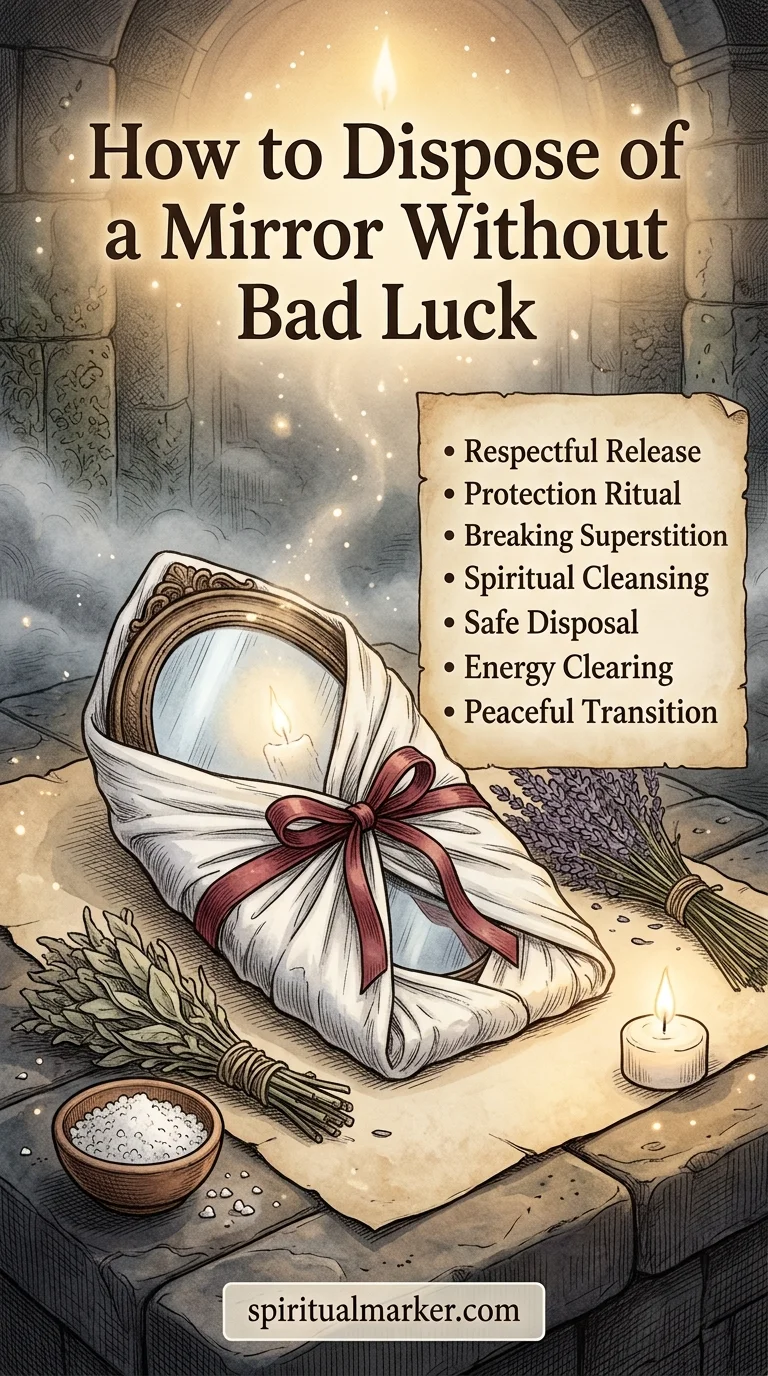
Cover it completely. Wrap the entire mirror in an old cloth, preferably black or white. Black absorbs. White purifies. Either color works. The covering prevents the mirror from reflecting anything further during transport, which is considered important in multiple traditions.
Donate with discernment. If the mirror is in good condition, donating it is a beautiful option. But consider where it goes. Donating a mirror that held difficult energy to a charity or friend without cleansing it first may pass that energy along. Always cleanse before donating.
Bury it if possible. In many traditions, returning objects to the earth is the most complete form of energetic release. If the mirror is small and can be wrapped and buried safely, this option is considered especially powerful. The earth absorbs and neutralizes all energies.
Mirror Disposal Beliefs Across Cultures and Religions
In ancient China, mirrors were believed to ward off evil spirits. Broken mirrors, however, were seen as invitations for those same spirits to enter. The traditional remedy involved wrapping the broken mirror in red paper, which represents good fortune, and burying it deep in the ground. Red was believed to counteract the bad luck carried by the broken glass.
In Italian folklore, breaking a mirror was linked to death in the family within seven years. To break the curse, the broken pieces had to be taken to a river and washed away by running water. Running water was believed to carry away and dissolve negative energy permanently.
In Mexican folk traditions, particularly those rooted in Día de los Muertos practices, mirrors are treated as objects that can show the dead their own reflection. Broken mirrors during the days of the dead are taken very seriously. Pieces are often buried near the family altar with prayers for the deceased.
In Russian superstition, dropping a mirror and having it break is considered a warning from the universe. The proper response is not panic, but prayer and immediate burial of the pieces. Some Russian traditions also recommend spitting three times over the left shoulder after breaking a mirror, as this is a general protective gesture against bad luck in Slavic cultures.
In Jewish Kabbalah, mirrors are understood as objects that reveal hidden aspects of the self. A broken mirror in Kabbalistic thought can indicate a fracture in self-perception or spiritual identity. The repair process is internal, involving prayer, reflection, and acts of kindness, alongside the proper physical disposal of the glass.
The Role of Intention in Mirror Disposal
Intention is the most powerful tool you have. Every ritual, every prayer, every act of salt and smoke is ultimately a vehicle for conscious intention. The ritual creates the container. The intention fills it with meaning and power.
When you approach mirror disposal with clear, calm, and purposeful intention, you change the energetic outcome. You are not just throwing away glass. You are consciously closing an energetic chapter. That shift in consciousness is what the rituals are designed to facilitate.
Doubt and fear can weaken intention. If you feel deeply anxious about disposing of a mirror, spend a few minutes in quiet before beginning. Breathe slowly. Set a clear intention: “I release this mirror with gratitude and peace. No harm follows it out of my space.” Repeat this as many times as you need until it feels true in your body, not just your mind.
Ritual without intention is just theater. The salt, the smoke, the black cloth, and the directional exit all carry power because of what they represent and activate in your belief system. Engage with them consciously and your disposal will be energetically complete.
What to Do After Disposing of a Mirror to Clear Your Space
Disposal is step one. Space clearing after disposal is equally important. Once the mirror is gone, the area where it stood or broke benefits from a thorough energetic cleansing.
Open all windows. Fresh air is one of the most underrated energetic cleansers. Allow air to move freely through the home for at least thirty minutes after mirror disposal.
Burn cleansing herbs. White sage remains the gold standard for spiritual space clearing. Palo santo is a warmer, gentler alternative. Frankincense resin burned on charcoal is used in Catholic, Orthodox Christian, and many Middle Eastern spiritual traditions and is considered deeply purifying.
Use sound. Sound vibration breaks up stagnant energy. Clapping your hands in corners, ringing a bell, or playing high-frequency music such as 432 Hz or 528 Hz tones can shift the energetic quality of a room quickly after mirror removal.
Place protective objects. After clearing, consider placing a black tourmaline crystal, a bowl of salt, or a protective symbol in the area where the mirror stood. This seals the space with positive, protective energy before anything else moves into the void.
Set a new intention for the space. Speak aloud or write down what you want the energy of that space to feel like now. “This space holds peace, clarity, and positive energy.” Words spoken with conviction carry energetic weight in virtually every spiritual tradition.
Can You Keep a Broken Mirror for Good Luck?
Some people have heard that keeping broken mirror pieces can reverse bad luck. This is a minority belief, but it exists. In certain folk magic traditions, a piece of broken mirror kept in a small pouch with herbs and salt is believed to become a protective talisman. The logic is that the mirror, now broken and cleansed, no longer reflects outward. Instead, it reflects inward, protecting the person who carries it.
However, most mainstream spiritual traditions strongly advise against keeping broken mirror pieces. The energetic risk is generally considered higher than any potential benefit. Broken glass holds fractured energy, and prolonged proximity to that energy is rarely recommended by spiritual practitioners.
If you feel drawn to keep a small piece for ritual purposes, make sure you thoroughly cleanse it with salt and smoke first. Keep it wrapped in a protective cloth. Store it away from sleeping areas and from spaces where you eat or spend significant daily time.
Mirror Superstitions You Should Know Before Disposal
Never look into a broken mirror. This is one of the most consistent warnings across mirror superstitions worldwide. Looking into a broken mirror is believed to show you a fractured version of your soul or your future. Avoid this during the entire disposal process.
Do not let children near a broken mirror. Children are considered more spiritually sensitive and less energetically protected than adults in many traditions. Keep them away from broken mirror glass for both physical and spiritual reasons.
Never dispose of a mirror during a new moon if you can help it. The new moon is a time of endings and new beginnings, which sounds appropriate. But many practitioners believe that disposing of energetically loaded objects during the new moon draws more attention from the spiritual realm during a time when the veil is considered thinner. The waning moon phase is traditionally the most auspicious time for releasing and removing old objects from the home.
Avoid mirrors during thunderstorms. In folk traditions across Europe and parts of Asia, mirrors were covered during thunderstorms. The belief held that lightning could travel through a mirror’s reflective surface. While modern physics does not support this, the superstition reflects an older belief that mirrors are conductors of powerful energy, both physical and spiritual.
A Final Note
Mirrors have held spiritual significance for longer than recorded history. The belief that they interact with energy, soul, and the unseen world is not irrational. It is one of the most consistent threads running through human spiritual experience across every culture and era.
How you dispose of a mirror says something about how you treat the invisible dimensions of your life. You do not need to be deeply religious or spiritually devoted to take this seriously. The act of being intentional, careful, and respectful costs you nothing except a few extra minutes. What it can give you is peace of mind, a clear energetic space, and confidence that you handled the transition with wisdom.
You may want to consider starting the process with a simple prayer or spoken intention, regardless of your specific belief system. A clear, heartfelt statement of release is more powerful than any elaborate ritual performed without true engagement.
Salt, smoke, black cloth, and deliberate intention are your four most important tools. Use them with calm confidence. Exit through a side or back door. Dispose of the mirror away from your home promptly. Cleanse your space afterward. And then move forward without looking back.
The bad luck that mirrors are feared to bring is not inevitable. It is a potential that proper intention and respectful disposal can fully neutralize. You have the knowledge now. You have the tools. Handle your mirror with the care it deserves, and your space will reflect nothing but the energy you choose to hold.