
Sunday carries a quiet, sacred energy. It is the first day of the week in many cultures and a day of rest for others. Those born on Sunday are often said to carry a special blessing.
The Sunday spiritual meaning often involves light, joy, and spiritual purpose. In many traditions, Sunday is associated with the sun and divine connection. A spiritual meaning of Monday born shares that day-of-birth focus, though Monday carries a different energy.
People born on Sunday are often described as optimistic, charismatic, and destined for leadership. Some traditions view them as children of the sun. The time of day can add detail.
If you were born on Sunday, it may signal a bright path. A spiritual meaning of Saturday born also deals with day-of-birth symbolism, though Saturday carries a more disciplined energy.
What is the Meaning of Sunday
The word “Sunday” literally means “Day of the Sun.” Its roots trace back to ancient Germanic and Roman traditions that honored the Sun as a sacred celestial force. In Latin, Sunday was called Dies Solis, meaning “Day of the Sun.” Many modern languages still preserve this connection.
At its core, Sunday symbolizes illumination. Human civilizations have always depended on the Sun for survival. The Sun brings warmth, visibility, growth, and life itself. Without sunlight, crops fail, seasons collapse, and life becomes impossible. Because of this dependence, ancient societies viewed the Sun not merely as a physical object in the sky but as a divine expression of power and creation.
Spiritually, Sunday often represents:
- Renewal
- Clarity
- Divine connection
- Life force energy
- Rest and restoration
- Hope after struggle
- Awakening of consciousness
Unlike weekdays associated with labor, tension, or routine, Sunday traditionally became linked with reflection and spiritual realignment. People pause, pray, spend time with loved ones, and reconnect with values that often get buried during busy weeks.
Psychologically, Sunday also holds symbolic meaning. Many people see it as a transition point between endings and beginnings. One week closes while another quietly prepares to start. That emotional “bridge” gives Sunday a reflective quality. It invites introspection while also pointing toward future possibilities.
In spiritual traditions, this dual energy matters deeply. Sunday represents completion and rebirth at the same time.
Symbolism and Representation of Sunday
Sunday symbolism centers around the Sun itself. Nearly every ancient civilization associated the Sun with divine authority, cosmic order, vitality, and enlightenment. As a result, Sunday became a symbolic extension of those qualities.
The most common representation of Sunday is light. Not merely physical light, but spiritual light. Light reveals what darkness hides. It symbolizes truth, wisdom, awareness, and awakening. Many spiritual teachings use sunlight as a metaphor for higher consciousness or divine presence.
Sunday also symbolizes leadership. The Sun occupies the center of the solar system, and spiritually, it reflects themes of centrality, influence, and personal power. People connected with Sunday often display qualities associated with natural leadership, visibility, or strong individuality.
Another important symbol connected to Sunday is gold. Gold represents purity, royalty, divine energy, wealth, and immortality in many traditions. Ancient kings wore gold crowns partly because the metal mirrored the Sun’s brilliance. This connection reinforced the idea that rulers carried solar authority.
Sunday further represents:
- Joy and optimism
- Creativity and self-expression
- Spiritual rebirth
- Healing energy
- Confidence and personal identity
- Generosity and warmth
- Higher wisdom
In some traditions, Sunday symbolizes the soul’s victory over hardship. The sunrise after a dark night became a powerful metaphor for survival, hope, and resurrection. This explains why many religious systems later connected Sunday with salvation and spiritual renewal.
Even modern psychology reflects these ancient symbolic patterns. People frequently associate sunny days with happiness, openness, and emotional upliftment. The symbolic power of Sunday still influences human emotions, routines, and collective consciousness today.
11 Spiritual Meanings of Sunday
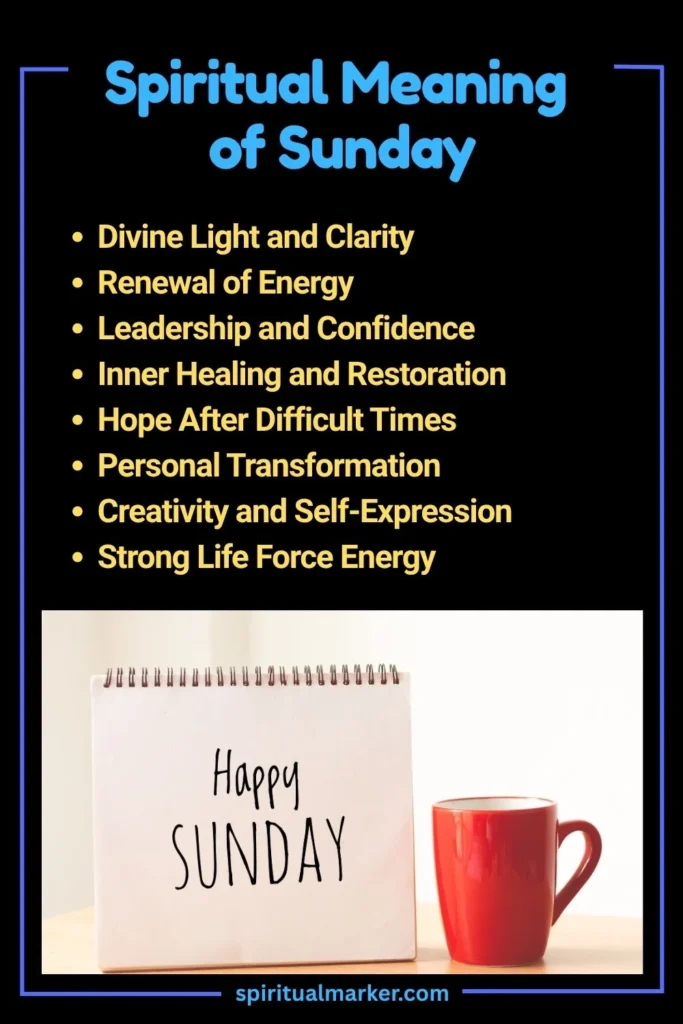
1) Spiritual Awakening
Many people move through the week on autopilot. Work, obligations, stress, and noise slowly pile up until the mind feels crowded and the spirit feels distant. Sunday has long carried the symbolic role of interruption. It breaks routine. It creates a pause between what has been and what is about to begin. Across spiritual traditions, this pause becomes sacred because it gives people room to wake up internally.
In Christianity, Sunday represents resurrection and rebirth through the rising of Christ. This symbolism reaches far beyond theology. Resurrection reflects the human experience of returning from emotional darkness, spiritual numbness, or inner exhaustion. For centuries, believers have viewed Sunday morning as a reminder that no difficult season lasts forever. Light returns. Consciousness rises again. Faith renews itself.
At the same time, many metaphysical traditions associate Sunday with heightened awareness because of its connection to the Sun. The Sun reveals what darkness conceals. Spiritually, this translates into greater clarity about the self, relationships, habits, and life direction. People often notice that Sunday naturally encourages introspection. There is less pressure to perform and more opportunity to reflect. Questions that remain buried during busy weekdays suddenly rise to the surface.
2) Divine Light and Clarity
Sunday’s association with divine light comes directly from its relationship with the Sun, which has symbolized truth, consciousness, and sacred illumination across civilizations for thousands of years. Ancient Egyptians honored Ra as the solar force of creation. In Vedic traditions, Surya represented both physical light and spiritual intelligence. Christianity also repeatedly uses light as a metaphor for God’s presence, wisdom, and guidance.
Because of this symbolism, Sunday often carries the spiritual meaning of mental and emotional clarity. After a chaotic week filled with distractions, uncertainty, and emotional overload, Sunday offers a chance to mentally reset. Many people instinctively seek quietness on Sundays because silence allows hidden thoughts and emotions to become visible.
Spiritually, light represents revelation. It exposes illusions, confusion, and denial. This is why Sunday is frequently associated with insight and self-honesty. People may suddenly recognize unhealthy relationships, destructive habits, or neglected dreams during moments of Sunday reflection. The symbolic light of the day illuminates what the soul has been trying to communicate.
Religious traditions reinforce this meaning through worship practices centered on illumination. Churches often describe God as a guiding light. Candles are lit during prayer ceremonies to symbolize divine wisdom entering human consciousness. Meanwhile, Eastern traditions use Sun salutations and solar mantras to align the body and mind with higher awareness.
3) Renewal of Energy
By the time Sunday arrives, many people feel mentally scattered and physically drained. The modern world rarely slows down willingly. Constant notifications, responsibilities, deadlines, and emotional demands gradually exhaust both body and spirit. Sunday traditionally serves as a sacred counterbalance to this exhaustion.
In biblical tradition, the idea of sacred rest originates from the creation narrative, where God rests after completing the work of creation. This concept shaped the spiritual meaning of renewal across generations. Rest was never meant to symbolize laziness. Instead, it represented restoration, balance, and reconnection with the divine source of life.
Astrologically, Sunday carries the influence of the Sun, which governs vitality, life force, and inner radiance. In many spiritual systems, the Sun is viewed as the energetic center from which strength flows. Sunday therefore becomes symbolically linked to replenishment. It is seen as the moment when depleted energy begins to rebuild itself.
This renewal is not purely physical. Emotional fatigue often runs deeper than bodily tiredness. People carry invisible burdens throughout the week, including stress, disappointment, fear, and unresolved tension. Sunday creates a psychological reset point where emotional pressure temporarily loosens. That is one reason why quiet Sunday mornings often feel emotionally lighter than other days.
Cultural traditions also reinforce this spiritual rhythm. Families gather for meals. Communities come together for worship. Individuals spend time in nature, reflection, or solitude. These rituals slow the nervous system and reconnect people with stability and belonging.
4) Leadership and Confidence
Sunday carries strong associations with leadership because the Sun has traditionally symbolized authority, courage, identity, and self-expression. In astrology, the Sun represents the core self. It governs confidence, vitality, and personal power. Because Sunday belongs symbolically to the Sun, the day naturally became connected to leadership qualities across spiritual traditions.
Ancient rulers often aligned themselves with solar symbolism to project divine authority. Egyptian pharaohs associated themselves with solar deities. European monarchs used sunlight imagery to communicate power and legitimacy. In Vedic astrology, the Sun represents kingship, honor, discipline, and strength of character. These associations shaped the spiritual belief that Sunday strengthens personal confidence and inner authority.
Spiritually, leadership does not only refer to controlling others. In many traditions, true leadership begins with self-mastery. Sunday encourages people to reflect on their values, choices, and purpose. This self-awareness strengthens integrity, which becomes the foundation of authentic confidence.
Faith traditions also connect confidence with divine support rather than ego. Biblical teachings often portray courage as something rooted in trust in God rather than personal pride. People who feel spiritually aligned tend to approach challenges with greater calmness and resilience because they believe their lives carry meaning beyond temporary obstacles.
Sunday’s atmosphere often encourages bold decision-making because the day symbolizes fresh beginnings. Many individuals plan goals, clarify priorities, or recommit themselves to important responsibilities on Sundays. This pattern reflects the day’s deeper symbolic connection to direction and purposeful action.
5) Inner Healing and Restoration
Emotional wounds often remain hidden beneath daily activity. People stay busy because silence can force difficult feelings to surface. Sunday interrupts that constant movement. It creates space where emotions finally have room to breathe. That is one reason why the day holds such deep associations with healing and restoration.
In Christianity, Sunday worship emphasizes grace, forgiveness, mercy, and renewal. Many believers see the day as spiritually therapeutic because it offers reassurance that suffering is not permanent and brokenness is not final. Biblical passages about healing frequently emphasize restoration not only of the body, but also of the heart and spirit.
The emotional atmosphere of Sunday tends to feel gentler than other days. Homes become quieter. Families reconnect. People spend more time reflecting, praying, journaling, or simply resting. These slower rhythms support emotional processing. They allow buried stress and sadness to gradually soften.
Metaphysical traditions also associate Sunday with restorative solar energy. The Sun symbolizes warmth, nourishment, and life force. Spiritually, warmth often represents emotional safety. When people feel spiritually safe, healing becomes possible. Old resentment, grief, shame, or disappointment can begin losing their emotional grip.
Healing on Sunday is not always dramatic or immediate. Often, it appears through subtle emotional shifts. Someone forgives themselves after months of guilt. Another person regains hope after a painful period. Others simply feel calmer and more grounded after spending quiet time in reflection.
Cultural practices reinforce this healing symbolism. Shared meals create emotional comfort. Worship gatherings create community support. Time spent outdoors restores mental balance. Even simple Sunday routines can become spiritually restorative because they reconnect people with stability and meaning.
6) Hope After Difficult Times
One of Sunday’s strongest spiritual meanings is hope. Every Sunday morning carries a symbolic message that darkness eventually gives way to light. This symbolism appears repeatedly across religions, myths, and cultural traditions because it reflects a universal human experience: people endure hardship, yet continue searching for renewal.
In Christianity, Sunday represents resurrection after suffering. The resurrection story transformed Sunday into a symbol of victory over despair, grief, and fear. For believers, the day serves as a reminder that painful endings are not always final endings. New life can emerge from loss.
Even outside religious contexts, Sunday psychologically represents transition. It stands between the exhaustion of the past week and the possibility of a new beginning. This positioning gives the day emotional significance. Many people instinctively use Sunday to mentally reset because it feels hopeful by nature.
The Sun itself strengthens this symbolism. Every sunrise reflects consistency and renewal. Civilizations throughout history interpreted the daily return of sunlight as proof that life continues despite darkness. Sunday, ruled by the Sun, therefore became associated with perseverance and emotional resilience.
During difficult periods, people often cling to routines that create stability. Sunday traditions such as prayer, family gatherings, shared meals, or quiet reflection provide emotional grounding. These rituals remind individuals that they are not completely alone in their struggles.
Hope on Sunday does not always appear as excitement or certainty. Sometimes it exists simply as endurance. A quiet belief that healing is still possible. A willingness to continue despite confusion. Spiritually, this form of hope can be incredibly powerful because it keeps people emotionally connected to the future.
7) Personal Transformation
Transformation rarely happens instantly. Most personal change develops slowly through repeated reflection, emotional honesty, and spiritual growth. Sunday has become strongly associated with transformation because it represents renewal, rebirth, and fresh beginnings across multiple traditions.
In Christianity, major spiritual events carry Sunday symbolism. The resurrection occurred on Sunday, and Pentecost traditions further connected the day with spiritual empowerment and inner change. These associations shaped the belief that Sunday carries transformative energy capable of renewing the soul.
Astrologically, the Sun symbolizes identity and self-realization. Because Sunday belongs to the Sun, it becomes connected to the process of becoming more authentic. Spiritually, transformation often means shedding false identities, unhealthy attachments, or limiting beliefs that prevent growth.
Many people naturally use Sunday to reevaluate their lives. They reflect on mistakes, reconsider priorities, or recommit themselves to important goals. This pattern reveals the deeper symbolic function of the day. Sunday acts as a threshold between who we were and who we hope to become.
Transformation also requires honesty, and Sunday’s quieter atmosphere supports self-examination. During busy weekdays, distractions prevent deep reflection. Sunday slows external demands enough for internal truths to surface. That is why major realizations often happen during peaceful moments of solitude or prayer.
In spiritual traditions, transformation frequently involves fire symbolism connected to the Sun. Fire purifies, refines, and reshapes. Likewise, personal growth often requires discomfort, discipline, and emotional courage. Sunday symbolically represents this refining process through its solar associations.
8) Creativity and Self-Expression
Sunday’s connection to creativity comes from its solar symbolism. The Sun radiates outward naturally, and spiritually this outward movement reflects self-expression, inspiration, and creative vitality. Many artistic and spiritual traditions associate sunlight with imagination because light reveals possibility and awakens emotional energy.
People often feel more creatively open on Sundays because the day carries less external pressure. The nervous system relaxes. Mental clutter decreases. This calmer state allows intuition and imagination to surface more freely. Writers, artists, musicians, and thinkers frequently describe Sunday as emotionally spacious compared to the intensity of weekdays.
In astrology, the Sun governs individuality and authentic identity. Creativity becomes spiritually significant because it allows people to express their deepest inner nature. Creating something meaningful often feels healing because it reconnects individuals with parts of themselves neglected by routine and responsibility.
Religious traditions also contain creative dimensions tied to Sunday. Sacred music, architecture, poetry, storytelling, and ritual all emerged from humanity’s desire to express spiritual experience. Worship itself often becomes a creative act through song, prayer, or communal celebration.
Sunday’s warm emotional atmosphere supports vulnerability, which is essential for genuine self-expression. Creativity requires honesty. People create most authentically when they feel emotionally safe enough to reveal thoughts, emotions, and perspectives that might otherwise remain hidden.
There is also a communal aspect to Sunday creativity. Families cook together, communities gather, and people share stories or traditions passed through generations. These activities reinforce the idea that creativity is not limited to art alone. It also appears through connection, communication, and shared human experience.
9) Strong Life Force Energy
Sunday has long been associated with powerful life force energy because of its direct connection to the Sun, the source of warmth, light, and biological life on Earth. Ancient civilizations recognized this relationship intuitively long before modern science explained it. Without sunlight, crops fail, ecosystems collapse, and life weakens. Spiritually, this reality transformed the Sun into a universal symbol of vitality and strength.
In Vedic philosophy, solar energy represents prana, the life force flowing through all living beings. Practices such as Surya Namaskar, or Sun Salutation, were developed not merely as physical exercise, but as spiritual rituals designed to awaken energy within the body. The movements honor the Sun as both a physical and metaphysical source of vitality.
Sunday therefore became associated with renewal of inner fire. People experiencing emotional fatigue, spiritual emptiness, or mental exhaustion often seek restoration on Sundays because the day symbolically replenishes depleted energy. Even culturally, Sundays tend to involve slower rhythms, nourishing meals, outdoor activity, and rest, all of which support physical and emotional recovery.
This life force symbolism also appears in Christian imagery where divine light brings life to spiritually weary individuals. The idea of being spiritually “revived” or “renewed” reflects the same core concept found in solar traditions: energy returns when the soul reconnects with its source.
Modern psychology indirectly supports these ancient beliefs. Exposure to sunlight influences mood regulation, sleep cycles, and energy levels. Natural light improves alertness and emotional stability, which helps explain why sunny Sunday mornings often feel emotionally uplifting.
10) Connection with Divine Purpose
Many people spend much of their lives searching for direction. They wonder whether their work matters, whether they are fulfilling their potential, or whether their life carries a deeper purpose beyond routine survival. Sunday has traditionally become a day for contemplating these questions because it creates spiritual and emotional distance from ordinary obligations.
The Sun’s symbolism strongly influences this meaning. Across spiritual systems, the Sun represents the central self, the soul’s essence, and the core purpose that gives life meaning. Sunday therefore becomes associated with alignment between external actions and inner truth.
Religious traditions reinforce this connection through communal worship and reflection. Sunday sermons, prayers, hymns, and sacred readings often focus on moral direction, spiritual identity, and service to something greater than oneself. These practices encourage people to step back from temporary concerns and reconsider the deeper trajectory of their lives.
In many spiritual traditions, purpose is not viewed as a fixed destination. Instead, it is treated as an ongoing relationship between the individual and the divine. Sunday rituals support this relationship by creating moments of stillness where insight can emerge gradually.
People often experience heightened clarity about life direction on Sundays because the mind becomes less distracted. During quiet reflection, priorities become easier to recognize. Values that were ignored during stressful weekdays return to awareness. This process strengthens the sense of living intentionally rather than mechanically.
The symbolism of sunrise also contributes to this meaning. A sunrise marks beginning, orientation, and movement forward. Spiritually, Sunday sunrise rituals represent alignment with higher guidance and renewed commitment to meaningful living.
11) Emotional Warmth and Generosity
Sunday often feels emotionally different from the rest of the week. Even people who do not participate in religious practices frequently describe Sundays as softer, calmer, and more emotionally connected. This atmosphere contributes to Sunday’s spiritual association with warmth, kindness, and generosity.
The Sun itself symbolizes unconditional giving. It provides light and warmth continuously without asking for anything in return. Spiritually, this became a metaphor for generosity, compassion, and service. Sunday inherited these qualities through its solar symbolism.
Across cultures, Sunday traditions emphasize connection. Families gather for meals. Friends visit each other. Communities worship together. Shared time becomes more valuable because people temporarily step away from work pressures and personal ambition. These rituals strengthen emotional bonds and encourage empathy.
Religious teachings associated with Sunday also emphasize compassion and service. Christianity encourages acts of charity, forgiveness, and communal care. Many spiritual traditions teach that true spiritual growth naturally produces greater kindness toward others.
Emotionally, generosity on Sunday extends beyond material giving. It often appears through patience, listening, emotional presence, and forgiveness. A calm Sunday conversation with loved ones can carry deep healing power because emotional attention itself becomes an act of care.
Sunday’s slower pace also allows people to reconnect with gratitude. Gratitude softens emotional defensiveness and increases generosity naturally. When people feel spiritually nourished, they tend to share more freely with others.
This warmth creates a ripple effect. Communities built around shared meals, worship, kindness, and mutual support often use Sunday gatherings to reinforce emotional solidarity. In this way, Sunday’s spiritual meaning extends beyond individual reflection into collective healing and connection.
Religious, Cultural, and Mythological Significance of Sunday
Sunday holds sacred importance across many civilizations, religions, and mythological traditions. Although interpretations differ, one theme appears repeatedly: Sunday connects humanity with divine power and cosmic order.
In ancient Egypt, the Sun god Ra stood at the center of religious life. Egyptians believed Ra traveled across the sky each day, bringing light and sustaining existence. His daily journey represented victory over darkness and chaos. Sunday naturally became associated with sacred solar energy.
Greek mythology linked the Sun with Helios, the radiant god who drove a golden chariot across the heavens. Later, Apollo absorbed many solar attributes and became associated with healing, prophecy, music, and illumination. These myths reinforced the connection between sunlight and higher wisdom.
In Roman tradition, Sol Invictus, meaning “Unconquered Sun,” became one of the empire’s most powerful religious symbols. The Sun represented invincibility, eternal life, and imperial authority. Roman influence helped spread solar symbolism throughout Europe.
In Hindu tradition, Surya, the Sun god, symbolizes health, vitality, truth, and spiritual enlightenment. Many devotees still offer prayers to Surya on Sundays. Surya Namaskar, or Sun Salutation, remains one of the most spiritually significant yoga practices connected to solar energy.
Japanese mythology honors Amaterasu, the Sun goddess, as a divine ancestor and central figure in Shinto belief. Her light symbolizes harmony, order, and life itself.
Within Christianity, Sunday later gained profound importance because of Jesus Christ’s resurrection. Christians began viewing Sunday as a sacred day of worship, hope, and renewal rather than merely a solar celebration.
Culturally, Sunday evolved into a communal pause. Families gathered. Markets closed. Religious ceremonies took place. Music, food, storytelling, and rest became part of Sunday traditions across many societies. Even secular cultures continue to treat Sunday differently from other days, reflecting centuries of spiritual conditioning and collective symbolism.
Astrological Meaning and Significance of Sunday
Astrologically, Sunday belongs to the Sun. In astrology, the Sun represents identity, ego, vitality, purpose, confidence, and conscious self-expression. It governs how people shine in the world and how they define their sense of self.
The Sun occupies a central role in astrology because it symbolizes the core essence of a person. While the Moon governs emotions and hidden instincts, the Sun reflects conscious identity and life direction.
Sunday therefore carries strong solar energy. This energy often expresses itself through:
- Ambition
- Charisma
- Creativity
- Leadership
- Confidence
- Recognition
- Personal magnetism
People influenced strongly by Sunday energy may feel naturally drawn toward visibility. They often prefer meaningful impact over anonymity. Many enjoy inspiring others, leading projects, expressing artistic talents, or pursuing goals that allow them to leave a lasting mark.
Astrology also associates the Sun with fire energy. Fire signs such as Leo, Aries, and Sagittarius frequently resonate with Sunday symbolism because they value action, passion, courage, and self-expression.
Color symbolism matters as well. Gold, orange, and bright yellow connect strongly with Sunday energy. These colors symbolize vitality, abundance, wisdom, and confidence.
From an energetic perspective, Sunday is often considered ideal for:
- Meditation focused on clarity
- Goal setting
- Spiritual cleansing
- Prayer and gratitude
- Recharging emotional energy
- Building confidence and motivation
Ancient astrologers believed the Sun strengthened vitality and life force. Because of this belief, Sunday gained a reputation as a favorable day for beginnings, blessings, and acts of spiritual devotion.
Biblical Meaning of Sunday
In Christianity, Sunday holds profound spiritual significance because it commemorates the resurrection of Jesus Christ. According to the New Testament, Jesus rose from the dead on the first day of the week, which Christians recognize as Sunday.
This event transformed Sunday into a symbol of victory, eternal life, redemption, and spiritual renewal.
One of the most referenced biblical passages related to Sunday is:
“He is not here: for he is risen.”
Matthew 28:6
This verse captures the central meaning of Sunday in Christianity. Darkness, suffering, and death did not have the final word. Resurrection brought hope and new life.
Another important verse appears in the Gospel of Mark:
“Now when Jesus was risen early the first day of the week…”
Mark 16:9
The phrase “first day of the week” became spiritually significant because it represented a new beginning. Sunday symbolized the start of renewed life through faith.
The Book of Acts also references believers gathering on Sunday:
“And upon the first day of the week, when the disciples came together to break bread…”
Acts 20:7
This passage suggests early Christians already treated Sunday as a sacred day for worship and fellowship.
The biblical symbolism of Sunday includes:
- Resurrection
- Redemption
- Divine mercy
- Spiritual rebirth
- Light overcoming darkness
- Renewal of faith
- Eternal hope
In Christian theology, Jesus is also metaphorically associated with light. One famous verse states:
“I am the light of the world.”
John 8:12
This symbolism connects beautifully with older solar imagery while giving it a new spiritual meaning centered on divine truth and salvation.
For many believers, Sunday remains a weekly reminder that renewal is always possible, even after suffering, loss, or spiritual exhaustion.
Why Sunday is a Holiday in Christianity
Sunday became the primary Christian holy day because believers honored it as the day of Christ’s resurrection. Early Christians gradually shifted away from the Jewish Sabbath, which occurred on Saturday, and began gathering on Sunday for worship.
This transition did not happen instantly. The earliest Christians were heavily influenced by Jewish traditions. Over time, however, Sunday gained increasing importance because resurrection theology stood at the center of Christian identity.
By the fourth century, Roman Emperor Constantine officially recognized Sunday as a day of rest in the Roman Empire. In 321 CE, he declared Sunday a public holiday. This decision strengthened Sunday observance throughout Christian regions.
Several factors contributed to Sunday becoming a Christian holiday:
First, resurrection symbolism gave Sunday extraordinary spiritual importance.
Second, communal worship helped create shared identity among Christians.
Third, rest itself carried theological meaning. Rest allowed believers to reconnect with God, family, and spiritual reflection rather than constant labor.
Christian traditions eventually developed customs around Sunday that included:
- Church attendance
- Prayer and scripture reading
- Family meals
- Charity and kindness
- Reflection and gratitude
- Rest from ordinary work
Even in secular societies today, Sunday often remains associated with slower rhythms, family connection, and emotional reset. Many modern weekend structures trace their origins back to Christian Sunday observance.
Astrological Significance of Being Born on Sunday
People born on Sunday traditionally carry strong solar energy. In astrology and spiritual folklore, the Sun shapes their personality, emotional expression, and life path.
Sunday-born individuals often radiate noticeable presence. Others may remember them easily, even after brief interactions. They frequently possess natural warmth, charisma, or confidence that attracts attention without deliberate effort.
Many traditions believe Sunday-born people symbolize:
- Leadership
- Creativity
- Optimism
- Strong self-belief
- Generosity
- Courage
- Ambition
- Spiritual vitality
They often crave meaningful achievement rather than passive existence. Recognition matters to them, although the healthiest Sunday-born individuals balance ambition with humility.
Emotionally, many Sunday-born people dislike staying trapped in negativity for long periods. They naturally seek movement, improvement, and emotional recovery. Their presence can uplift others during difficult times.
However, solar energy also carries challenges.
A strong Sun personality sometimes struggles with pride, stubbornness, impatience, or excessive need for validation. Some Sunday-born individuals feel pressured to appear strong even when emotionally exhausted inside.
Spiritually, many traditions suggest Sunday-born people carry lessons related to identity and purpose. They often spend years learning how to balance external success with inner fulfillment.
Interestingly, folklore from several cultures claims Sunday-born children possess “fortunate energy.” Traditional sayings frequently describe them as blessed, protected, or destined for visibility in some form.
The old nursery rhyme captures this belief clearly:
“Sunday’s child is full of grace.”
That single line survived for generations because people repeatedly associated Sunday births with charm, elegance, warmth, and favorable destiny.
Personality Traits of Sunday Born Boy Vs Girl
Personality Traits of a Sunday Born Boy
A boy born on Sunday often displays strong confidence from an early age. He may naturally take initiative in group settings or prefer leadership roles rather than passive participation. People frequently notice his energy before they fully know him.
Many Sunday-born boys possess ambitious personalities. They enjoy proving themselves, achieving recognition, and building a sense of personal accomplishment. Even as children, they may dislike feeling overlooked or underestimated.
Emotionally, they often appear optimistic and resilient. Challenges motivate them more than they discourage them. This does not mean they never struggle internally. In fact, some Sunday-born men quietly carry pressure related to success, pride, or responsibility.
Creativity also appears strongly in many Sunday-born boys. They may gravitate toward performance, entrepreneurship, public speaking, sports, art, or leadership-oriented careers.
Positive traits often include:
- Charisma
- Courage
- Determination
- Loyalty
- Protective instincts
- Strong motivation
Potential weaknesses may include:
- Ego sensitivity
- Dominance issues
- Impatience
- Need for admiration
- Difficulty admitting vulnerability
At their best, Sunday-born men inspire others through confidence combined with generosity and integrity.
Personality Traits of a Sunday Born Girl
A girl born on Sunday often carries magnetic warmth and emotional brightness. Many people feel comfortable around her quickly because she naturally radiates friendliness, confidence, or emotional intelligence.
Sunday-born girls frequently value independence and self-expression. They may dislike limitations that suppress creativity or individuality. Many enjoy artistic pursuits, leadership opportunities, or roles that allow them to influence and inspire others.
Emotionally, they often balance strength with compassion. They can appear graceful and confident externally while also carrying deep emotional sensitivity beneath the surface.
Many traditions associate Sunday-born women with elegance, charm, and strong intuition. They often notice emotional dynamics quickly and understand how to motivate or comfort others.
Common strengths include:
- Creativity
- Generosity
- Confidence
- Emotional warmth
- Social intelligence
- Optimism
Potential challenges may include:
- Perfectionism
- Emotional pride
- Sensitivity to criticism
- Desire for external validation
- Difficulty slowing down emotionally
Spiritually, Sunday-born girls are often seen as people who bring light into difficult spaces. Their presence may encourage hope, positivity, or emotional healing for those around them.
A Final Note
Sunday has carried spiritual significance for thousands of years because humanity consistently connected it with light, renewal, and divine presence. Ancient civilizations honored the Sun as the source of life. Religious traditions transformed Sunday into a sacred symbol of resurrection and hope. Astrology linked it with vitality, identity, confidence, and creative power.
When people ask about the spiritual meaning of Sunday or the symbolism of being born on Sunday, they are often searching for something deeper than personality descriptions. They want to understand what certain energies might reveal about purpose, emotional patterns, or spiritual identity.
Sunday symbolism reminds us that human beings naturally seek light after darkness. We search for renewal after exhaustion, clarity after confusion, and hope after struggle. That pattern appears in mythology, astrology, religion, psychology, and everyday life alike.
If you were born on Sunday, many traditions suggest you may carry strong solar qualities such as charisma, resilience, warmth, creativity, or leadership potential. Yet every person expresses these traits differently. Spiritual symbolism should guide reflection, not rigid judgment.
At its deepest level, Sunday represents the enduring human belief that renewal remains possible. Every sunrise quietly repeats the same message: another beginning still exists.