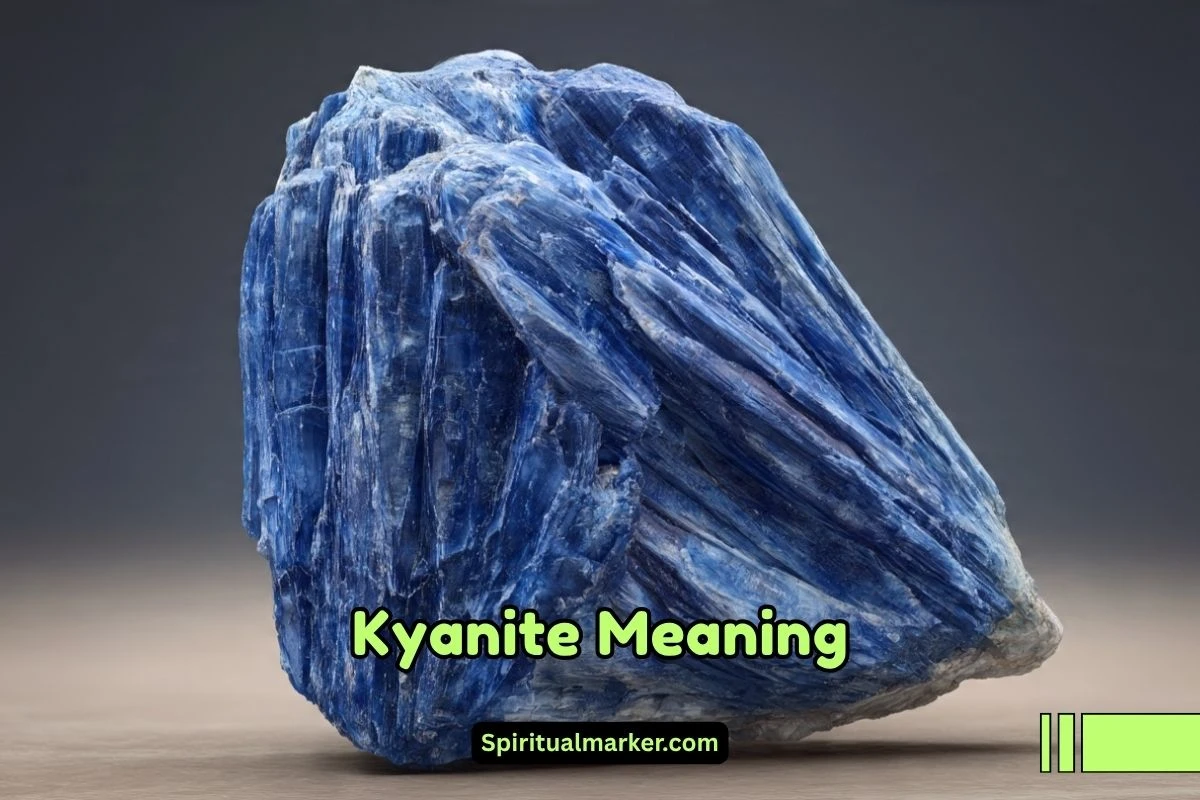
Have you ever looked at a piece of kyanite and felt immediately drawn to its layered blue color? Most people do. That cool, electric blue catches the eye instantly. But longtime crystal practitioners will tell you the real pull goes much deeper than appearance.
Kyanite is one of the most respected stones in crystal healing traditions. People have used it for centuries across many cultures. Shamans, spiritual teachers, energy healers, and everyday people have all turned to this stone during periods of personal struggle, emotional confusion, or spiritual seeking.
What makes kyanite stand out is not just its color. It is one of the very few gemstones believed to maintain its own energetic balance naturally. Most crystals are thought to absorb surrounding energies over time. Kyanite reportedly does not. Many practitioners claim it never needs cleansing. That quality alone sets it apart in the world of gemstones and crystal healing.
Beyond that unusual property, kyanite carries strong symbolism around truth, mental clarity, calm communication, and energetic alignment. People frequently reach for it when life feels disorganized internally. When the mind races. When words feel stuck. When the connection between thoughts, feelings, and actions starts to break down.
This article covers the full meaning of kyanite, its spiritual symbolism, healing properties, historical background, and practical ways people use it. You will also learn how to wear kyanite jewelry and care for it properly over time.
5 Key Takeaways
- Kyanite symbolizes truth, alignment, mental clarity, and calm communication.
- Many crystal traditions link kyanite strongly with the throat chakra and third eye chakra.
- Kyanite is one of the rare gemstones believed to never require energetic cleansing.
- People commonly use kyanite during meditation, creative work, conflict resolution, and spiritual alignment practices.
- Wearing kyanite as jewelry may strengthen self-expression, inner calm, and mental focus throughout daily life.
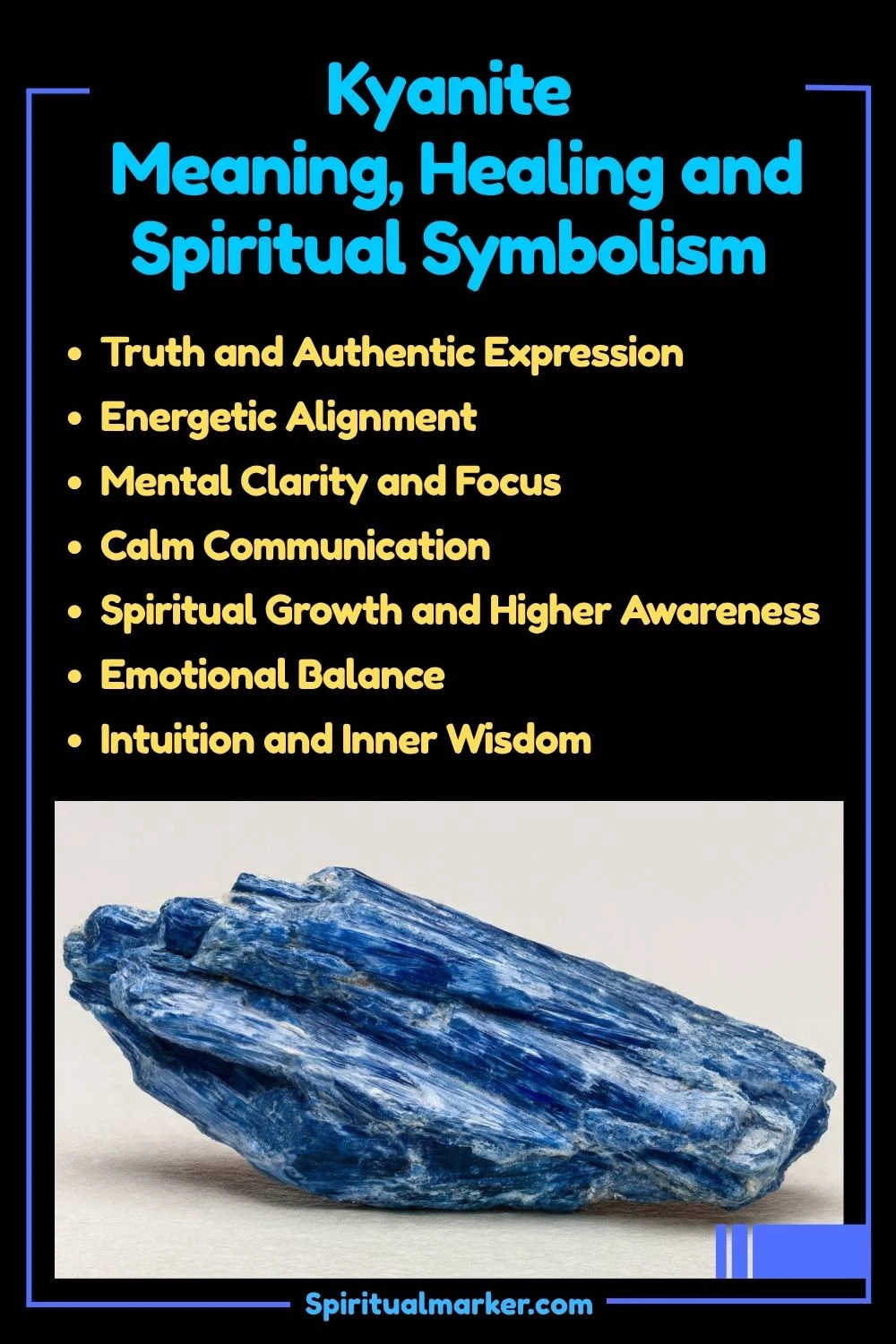
What is Kyanite?
Kyanite is a naturally occurring aluminium silicate mineral known for its distinctive blade-like crystal formation and striking color range. Its most famous form is deep blue, but kyanite also occurs in green, orange, black, gray, white, and indigo shades. Each color variation carries slightly different symbolic associations in spiritual traditions.
The name kyanite comes from the Greek word kyanos, meaning deep blue. This etymology reflects the stone’s most well-known and commercially valued appearance. The blue variety remains the most widely used in both jewelry and crystal healing work.
Mineralogically, kyanite is unusual because it has two different hardness ratings depending on the direction you measure it. Along its length, kyanite rates between 4.5 and 5 on the Mohs scale. Perpendicular to its length, it rates between 6 and 7. This anisotropic property makes it technically challenging to cut and polish, which is part of why kyanite commands respect in the gem trade.
Many people associate kyanite with sapphire because of their shared blue tones. However, kyanite is structurally different, more brittle, and far more affordable. Spiritually, kyanite carries a sharper, more mentally focused energy compared to sapphire’s traditionally royal associations.
Origins and Formation
Kyanite forms deep within the metamorphic rock environment. It typically develops under conditions of high pressure and relatively low temperature. These conditions occur as existing rocks transform over long geological periods. The stone appears in schists, gneisses, and quartz veins across several continents.
Major sources of high-quality kyanite include Brazil, Nepal, India, Tibet, Kenya, Russia, Myanmar, and the United States. Brazilian kyanite is especially well known for its vivid blue color and relatively long crystal blades. Nepali and Tibetan kyanite carries strong associations with Himalayan spiritual traditions, which adds cultural depth to its metaphysical reputation.
The stone’s formation under intense geological pressure gives it a meaningful symbolic layer. Many practitioners believe kyanite embodies the idea that clarity and strength develop through difficulty. Just as the stone forms under immense natural pressure, personal clarity often emerges only after intense personal challenge.
Green kyanite deserves separate mention. It forms in slightly different geological conditions and carries symbolism tied more closely to nature, the heart chakra, and emotional truth. Orange kyanite, found primarily in Tanzania, connects with themes of creativity and personal motivation. Black kyanite carries protective and grounding symbolism. Blue kyanite remains the most widely known and spiritually referenced variety.
Key Properties
| Property | Details |
|---|---|
| Primary Color | Blue (also green, orange, black, gray, white) |
| Composition | Aluminium silicate |
| Hardness | 4.5 to 7 Mohs (anisotropic) |
| Chakra Association | Throat chakra, third eye chakra |
| Symbolism | Truth, alignment, clarity, communication |
| Common Sources | Brazil, India, Nepal, Kenya, Russia |
| Crystal Structure | Triclinic, blade-shaped |
| Energy Style | Clear, calming, mentally focused |
Historical Use
Kyanite has a long and cross-cultural history as a stone associated with spiritual guidance, truth, and navigation. Ancient civilizations reportedly suspended kyanite from threads to use as a compass. The crystal’s natural magnetic qualities and blade structure were believed to align with true north when suspended freely. This practical association with direction deepened its symbolic connection to inner truth and finding one’s path.
In ancient Greek and Roman spiritual contexts, blue stones were frequently associated with divine truth and higher communication. Kyanite’s deep blue color placed it among stones linked to the sky, the divine, and clear spiritual vision. Some historical accounts connect blue blade crystals to offerings made at oracles and sacred sites associated with prophecy.
In Tibetan and Himalayan healing traditions, blue and indigo stones were considered powerful tools for activating higher mental states and spiritual clarity. Monks and spiritual teachers used certain blue minerals during meditation and prayer to support focus, mental stillness, and connection with higher consciousness. Kyanite aligned naturally with these uses.
In South American shamanic traditions, blade-shaped crystals were sometimes used in ritual practices tied to cutting away spiritual blockages. Kyanite’s naturally elongated blade form gave it symbolic relevance in ceremonies focused on clearing negative energy and restoring personal alignment.
Modern crystal healing traditions draw from all of these historical associations. Today, kyanite appears regularly in energy healing sessions, meditation practices, sound healing, and spiritual coaching work. Its reputation for alignment, truth, and clarity has only grown stronger in contemporary spiritual communities.
5 Spiritual Meanings of Kyanite
1. Truth and Authentic Expression
Kyanite’s deepest spiritual meaning centers on truth. Not just speaking truthfully to others, but recognizing what is true within yourself. Many people carry emotional and mental layers built from years of external expectations, social conditioning, fear of rejection, or habitual people-pleasing. Those layers slowly separate a person from genuine self-awareness.
Spiritually, kyanite is believed to cut through those layers. Its blade-like structure feels symbolically relevant here. The stone represents the idea that truth can cut cleanly without cruelty. It separates what is real from what is performed, what is authentic from what is constructed for outside approval.
This meaning resonates most powerfully for people who struggle with honest self-expression. Someone who regularly silences their real opinions in relationships. Someone who performs emotional strength while privately feeling exhausted. Someone who wants to speak authentically but fears the consequences. Kyanite spiritually symbolizes the courage to close that gap between internal truth and external expression.
Many spiritual traditions across cultures treat honest expression as a fundamental form of personal integrity. In Buddhist teachings, right speech forms one of the eight paths to ethical and spiritual development. In many African spiritual systems, the alignment between inner truth and outer action creates what practitioners describe as spiritual health. Kyanite reflects this universal principle, regardless of the spiritual lens a person applies.
This symbolism also extends beyond words. Living truthfully includes making decisions that align with genuine values rather than external pressure. Kyanite’s spiritual meaning encourages that broader form of truth. Not just saying honest things, but building a life that honestly reflects who you are.
2. Energetic Alignment
One of kyanite’s most unique spiritual qualities involves its association with energetic alignment. In crystal healing traditions, alignment refers to the state where a person’s physical, emotional, mental, and spiritual layers feel connected and balanced rather than fragmented or disjointed. Many people experience misalignment during periods of stress, grief, major transition, or prolonged inner conflict.
Kyanite is believed to work directly on this fragmentation. Many practitioners describe it as a stone that restores internal coherence. When your mind tells you one thing, your emotions say another, and your actions reflect something else entirely, that internal contradiction creates significant personal strain. Kyanite spiritually symbolizes the restoration of unity within those layers.
This quality is connected to its reputation for never needing cleansing. Unlike crystals that accumulate and hold stagnant energy, kyanite is believed to continuously channel and distribute energy in a balanced way. Scientists have not verified these metaphysical claims. But this belief remains central to kyanite’s spiritual identity across many healing traditions. The idea that the stone itself embodies consistent alignment makes it symbolically powerful for people seeking that same quality within themselves.
Chakra alignment represents a specific form of this broader symbolism. In yogic and Hindu energy traditions, the seven chakras form an internal column of energy centers along the spine. When these centers feel blocked or unbalanced, emotional and physical difficulties may follow. Kyanite is associated with aligning this entire column, not just one chakra. Its energy is described as flowing upward through the energy body, clearing blockages and restoring natural movement.
3. Mental Clarity and Focus
In traditions that value mental sharpness and intellectual honesty, kyanite holds an important place. The stone is closely associated with clarity of thought, intellectual focus, and the ability to cut through confusion to reach clear understanding.
Mental fog affects almost everyone at some point. Stress, emotional overwhelm, decision fatigue, or chronic worry can all cloud the mind significantly. Thoughts become circular. Decisions feel impossible. Simple problems feel enormously complicated. In crystal healing traditions, kyanite symbolizes the restoration of clear, organized thinking during these foggy periods.
Many people who work in highly cognitive fields, including researchers, writers, students, analysts, teachers, and strategic planners, report feeling drawn to kyanite. Whether or not the stone carries literal metaphysical influence, its symbolism as a clarity stone creates a meaningful focal point during demanding intellectual work.
Psychologically, ritual objects and personal symbols can support mental performance by reducing anxiety and strengthening a sense of intentional focus. A student who keeps kyanite on their desk during exam preparation may benefit not from magical influence but from the symbolic reminder to stay calm and think clearly. That psychological anchor has measurable value regardless of one’s metaphysical beliefs.
Kyanite’s clarity symbolism also applies to emotional thinking. During conflict or emotional pain, people often struggle to think clearly because emotional reactivity floods the rational mind. Kyanite spiritually represents the ability to remain mentally clear even while holding difficult emotions. That balance between emotional awareness and mental calm forms one of the stone’s most practical symbolic qualities.
4. Calm Communication
Kyanite’s strong connection to the throat chakra makes calm communication one of its most frequently cited spiritual themes. The throat chakra, known in Sanskrit as Vishuddha, governs all forms of expression including speech, writing, creative communication, and the ability to listen with genuine openness.
When the throat chakra feels blocked or unbalanced in energy healing traditions, people may notice several patterns. Difficulty expressing needs clearly. Fear of speaking in conflict. Tendency to over-explain or become defensive. Difficulty listening without immediately forming a response. Chronic unexpressed emotional tension. Kyanite is believed to help restore balance in this energy center, encouraging calmer and more authentic forms of communication.
This does not mean kyanite magically makes difficult conversations easy. Real communication challenges require real emotional effort. But spiritually, kyanite symbolizes the intention to communicate with honesty and calm. Holding that intention consciously creates real behavioral shifts, regardless of whether the stone carries measurable energetic influence.
This symbolism becomes especially relevant during conflict resolution. Arguments and disagreements frequently escalate because both parties feel emotionally flooded. Reactive communication takes over. Words become weapons instead of bridges. Kyanite’s association with calm communication represents the spiritual intention to slow that reactive pattern down. To pause, feel, breathe, and respond from a more grounded emotional place.
Many teachers, counselors, coaches, mediators, and public speakers feel naturally drawn to kyanite. Its symbolism aligns with their professional and personal values around clear, honest, and thoughtful expression. Some wear kyanite jewelry specifically during high-communication situations to reinforce their intention to speak carefully and listen deeply.
5. Spiritual Growth and Higher Awareness
Kyanite’s connection to the third eye chakra gives it strong associations with spiritual growth, intuitive development, and higher awareness. The third eye chakra, called Ajna in Sanskrit, governs intuition, inner vision, spiritual perception, and the ability to see patterns beneath the surface of ordinary experience.
Many spiritual practitioners describe kyanite as a stone that bridges the rational mind and intuitive awareness. People who rely almost entirely on logical analysis sometimes struggle to access intuitive knowledge. People who operate primarily from intuition sometimes struggle to organize their insights clearly. Kyanite spiritually symbolizes the balance between these two modes of knowing.
This quality makes kyanite particularly meaningful during meditation and contemplative practice. When the mind quiets and habitual thoughts slow, subtler forms of awareness become accessible. Kyanite’s symbolism encourages this deeper receptivity. Many practitioners place it on their forehead, hold it in their palms, or simply keep it nearby during meditation to reinforce their intention to enter a more spacious, perceptive state of mind.
Spiritual growth in most traditions involves progressively releasing what is false about how we see ourselves and the world. That process requires enormous honesty and clarity. Kyanite’s combined associations with truth, clarity, alignment, and higher perception make it symbolically ideal for long-term spiritual development. It reflects the intention to keep moving toward greater awareness, even when that process feels uncomfortable or slow.
6 Healing Properties of Kyanite
1. Emotional Balance
Kyanite is strongly associated with emotional balance because of its symbolism around alignment and internal coherence. Emotional balance does not mean the absence of difficult feelings. It means the ability to hold a wide range of emotions without being completely overwhelmed by any single one.
Many people experience emotional imbalance during periods of sustained stress, grief, major transition, or prolonged conflict. Emotions swing between extremes. Calm moments feel fragile. Small triggers create large reactions. This pattern exhausts both the person experiencing it and those around them.
Within crystal traditions, kyanite is believed to stabilize emotional fluctuations by restoring the connection between the emotional body and the broader energetic system. When emotional energy flows more harmoniously, extreme swings become less frequent and less intense. People describe this as feeling more settled internally, even when external circumstances remain difficult.
This healing symbolism is especially relevant for people recovering from emotional trauma. Trauma often disrupts the emotional nervous system’s ability to return to baseline after activation. Spiritually, kyanite represents the gradual process of helping that baseline reset. It does not rush emotional healing or force premature emotional closure. Instead, it symbolizes the patient restoration of emotional steadiness over time.
2. Reduction of Anxiety and Mental Noise
Anxiety and mental noise represent some of the most widespread personal struggles in contemporary life. The mind’s tendency to repeat worries, anticipate threats, replay past events, or race through catastrophic scenarios creates a deeply uncomfortable internal environment. Many people carry this mental noise constantly, even during sleep.
Kyanite is frequently associated with quieting this internal static. Its symbolism around mental clarity extends specifically into the realm of anxiety reduction. Many practitioners describe the stone’s energy as mentally cooling and quieting. Similar to how cold water reduces the intensity of inflammation, kyanite spiritually represents reducing the intensity of overactive mental loops.
Clinically, anxiety treatment involves multiple evidence-based approaches including cognitive behavioral therapy, mindfulness training, somatic practices, and medication when appropriate. Crystal use is not a replacement for these proven methods. But symbolic tools that support mindfulness and intentional calm have value as complementary practices for many people.
Research published in various psychological journals confirms that ritual objects, grounding practices, and personal symbols can support emotional regulation and reduce subjective anxiety levels. Kyanite, held during breathing exercises or placed in a calm environment, may serve this supportive role for many people. The stone’s visual and tactile qualities reinforce its symbolic function as a calming presence.
3. Improved Communication Skills
Because kyanite is so closely tied to the throat chakra and authentic expression, many people associate it with practical improvements in how they communicate. This healing dimension is less about dramatic spiritual transformation and more about the quiet shifts that happen when someone becomes more intentional about their words.
Communication struggles often stem from fear. Fear of judgment. Fear of conflict. Fear of being misunderstood. Fear of saying something wrong and damaging a relationship. These fears cause people to either over-communicate defensively or under-communicate through avoidance. Both patterns create distance rather than connection.
Kyanite symbolizes the healing of communication fear by encouraging honest expression from a place of calm. When you work with kyanite’s symbolism intentionally, you reinforce the value of saying what you genuinely mean, listening to what others genuinely say, and holding space for honest dialogue even when it feels vulnerable.
This healing quality is particularly meaningful for people in leadership, teaching, caregiving, or creative work. These roles demand clear, consistent, and emotionally intelligent communication. Kyanite’s symbolism reminds practitioners in these fields to speak from alignment rather than performance.
4. Support During Major Life Transitions
Kyanite’s symbolism around alignment, truth, and clarity makes it especially relevant during major life transitions. Career changes. Relationship endings or beginnings. Relocation. Loss of a loved one. Health challenges. These moments often create profound internal disorientation. The mental and emotional frameworks a person has relied on suddenly feel unreliable or obsolete.
During transitions, people often need help staying connected to their core identity rather than being swept entirely away by external change. Kyanite spiritually represents that inner anchor. Its energy is associated with helping people remain clear about who they are and what they value during periods when everything around them feels uncertain.
This quality reflects ancient wisdom found across many traditions. In Stoic philosophy, Marcus Aurelius wrote extensively about the importance of maintaining inner alignment regardless of external turbulence. In many spiritual traditions, the greatest tests of character occur precisely during major disruption. Kyanite’s symbolism embodies the idea that clarity and truth are most needed when life feels least stable.
Many people carry kyanite during job interviews, difficult medical appointments, challenging family conversations, or significant personal decisions. The stone serves as a tangible reminder of their intention to remain clear, honest, and aligned with their deepest values during moments that test their composure.
5. Intuition and Inner Wisdom
Kyanite’s connection to the third eye chakra gives it a meaningful healing role in developing and trusting intuitive awareness. Intuition is not mystical in the way popular culture often portrays it. Research in cognitive psychology confirms that intuitive knowledge represents the rapid processing of accumulated experience and pattern recognition at speeds beyond conscious analysis.
Many people struggle to trust their intuition because analytical culture teaches skepticism toward any knowledge that cannot be immediately rationalized. They have a clear inner sense about a person, a decision, or a situation. But instead of honoring that sense, they override it with logic and later regret the outcome.
Kyanite spiritually symbolizes trusting inner wisdom while maintaining intellectual honesty. It does not encourage reckless impulsiveness based on emotion. It encourages the deeper form of knowing that combines genuine experience, emotional intelligence, and clear perception. That combination is powerful in any area of life.
Working with kyanite’s symbolism around intuition can be especially valuable for creative professionals, therapists, coaches, healers, and leaders. These fields require the ability to read subtle situations accurately and respond from a place of genuine insight rather than habitual reaction. Kyanite’s third eye associations reinforce the development of exactly this quality.
6. Protection of Energy and Boundaries
Black kyanite in particular carries strong associations with energetic protection and personal boundary work. But blue kyanite also holds a protective dimension tied to its alignment symbolism. When your internal energetic system feels aligned, you are naturally less vulnerable to external emotional disruption.
Many people who work in emotionally demanding environments, including healthcare workers, teachers, social workers, therapists, and crisis counselors, report feeling energetically depleted after intense work periods. They absorb emotional energy from others throughout the day. Over time, this absorption creates exhaustion, emotional blunting, or chronic compassion fatigue.
Kyanite’s symbolism addresses this by representing energetic integrity. When your own energy moves in a clear, balanced, and aligned way, the energetic charge of outside situations has less disruptive influence. This is less about building emotional walls and more about maintaining a strong, clear internal center from which you engage the world.
This protective symbolism also connects to personal boundaries. Many people struggle with boundaries not because they do not know what they need, but because they fear that expressing needs will create conflict or rejection. Kyanite’s association with honest expression and throat chakra balance supports the courageous communication of genuine needs. Clear boundaries expressed from a calm, honest place are a form of energetic protection that no crystal alone can create, but kyanite can symbolically support.
How to Wear Kyanite Jewelry for Spiritual Growth
Wearing kyanite as jewelry remains one of the most accessible and personally meaningful ways to work with its symbolism. The position on the body where you wear it carries its own significance in crystal traditions.
Kyanite necklaces and pendants that rest near the throat feel especially aligned with the stone’s communication and truth-telling symbolism. Many people wear kyanite close to the throat during important conversations, public speaking events, creative presentations, or emotionally significant meetings.
Kyanite earrings carry associations with mental clarity and heightened awareness because of their proximity to the head and ears. Practitioners who work heavily with intuition, learning, or complex thinking sometimes prefer earrings for this reason.
Kyanite bracelets and rings keep the stone in constant tactile contact with the skin throughout daily activity. Some people find that physical contact with kyanite during stressful moments serves as a grounding reminder to breathe, slow down, and return to a calmer internal state.
You can also combine kyanite with complementary stones to expand its energetic symbolism. Lapis lazuli amplifies truth and inner wisdom themes. Amethyst deepens intuitive and third eye associations. Aquamarine reinforces the communication and emotional calm dimensions. Clear quartz amplifies kyanite’s energy across all its symbolic dimensions.
Caring for Kyanite Jewelry
Kyanite requires consistent but straightforward care to maintain its beauty and structural integrity over time. Because of its brittle nature and anisotropic hardness, certain precautions matter more with kyanite than with harder gemstones.
Store kyanite separately from other jewelry. Its brittle blade structure can chip or fracture when it knocks against harder materials. A soft fabric pouch or padded individual compartment in a jewelry box protects it well.
Clean kyanite gently using lukewarm water and a soft cloth. Mild dish soap is acceptable for light cleaning. Avoid ultrasonic cleaners, steam cleaning, and abrasive materials. These methods can damage kyanite’s delicate crystalline structure over time.
Avoid prolonged sun exposure. Strong ultraviolet light can fade kyanite’s blue color gradually. Store it away from windowsills and direct sunlight when not in use.
Remove kyanite jewelry before swimming, exercising intensely, or doing heavy manual work. The combination of impact risk and chemical exposure from pool water or cleaning products can compromise both the stone and its metal setting.
Because kyanite is believed to maintain its own energetic balance without needing cleansing, energetic maintenance is minimal compared to other crystals. However, many practitioners still prefer to refresh their stones periodically. Brief moonlight exposure, sound cleansing with a singing bowl, or setting the stone beside cleansing herbs like sage or rosemary are common options that feel personally meaningful without risking physical damage.
Table: Kyanite Meaning at a Glance
| Aspect | Details |
|---|---|
| Primary Meaning | Truth, alignment, and mental clarity |
| Chakra Association | Throat chakra and third eye chakra |
| Main Spiritual Symbolism | Honest expression, energetic alignment, higher awareness |
| Common Colors | Blue, green, orange, black, white |
| Hardness | 4.5 to 7 Mohs (anisotropic) |
| Main Sources | Brazil, India, Nepal, Kenya, Russia |
| Emotional Associations | Calm, clarity, truth, focus |
| Popular Jewelry Types | Necklaces, earrings, rings, bracelets |
| Spiritual Uses | Meditation, communication, energy alignment |
| Care Needs | Gentle cleaning, separate storage, avoid impact |
A Final Note
Kyanite earns its respected place in crystal traditions through a rare combination of qualities. Its striking appearance draws people in. Its symbolism keeps them connected. Truth, clarity, alignment, and calm expression are not abstract spiritual ideals. They are practical qualities that shape how people experience themselves and the world around them.
Whether you view kyanite through a metaphysical framework or simply appreciate it as a beautiful stone with meaningful symbolism, its themes remain consistently valuable. The intention to communicate honestly. The commitment to staying mentally clear under pressure. The desire to align your inner life with your outer one. These are universal human goals, and kyanite has symbolized them across cultures and centuries.
If kyanite calls your attention, that pull may reflect something genuine about where you are in your personal journey. Some people wear it as a daily reminder of their commitment to honest living. Others keep it during meditation or creative work. Many simply find that its presence feels quietly stabilizing in ways that are difficult to fully explain but easy to appreciate.
You might try wearing it during your next important conversation and notice whether the simple act of holding an intention creates a different experience than you expected.