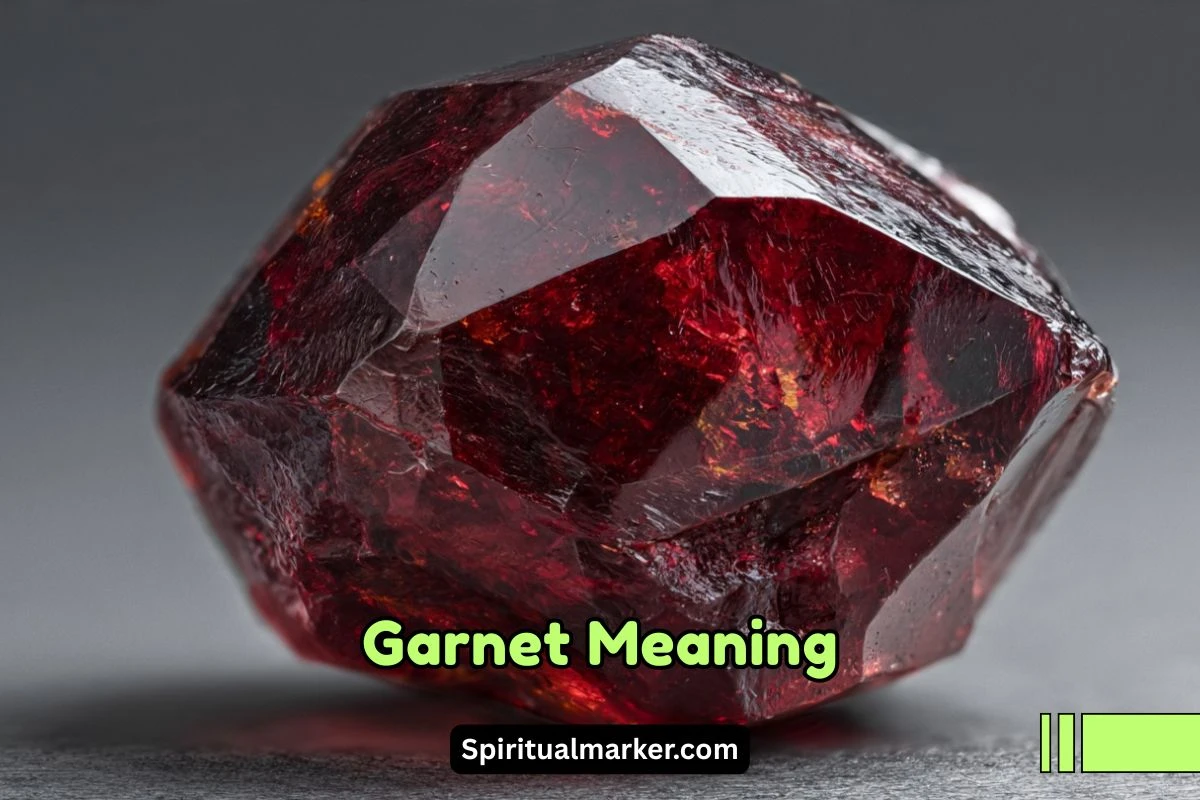
Garnet is a stone of passion and protection. Its deep red color evokes fire, blood, and vitality. In spiritual practice, this stone carries energizing and grounding energy.
The garnet meaning often involves love, courage, and physical vitality. It is a stone of the root and heart chakras, helping to boost energy and attract love. A spiritual meaning of red calcite shares that red-stone focus, though calcite carries a more physical energy.
Garnet is used in crystal healing to increase energy, support the heart, and boost confidence. It can also symbolize commitment and protection. The stone's energy is warm and motivating.
If you feel drawn to garnet, it may signal a need for passion. A spiritual meaning of ruby also deals with red stones, though ruby carries a more intense energy.
5 Key Takeaways
- Garnet symbolizes passion, protection, regeneration, and emotional strength.
- Most spiritual traditions connect garnet with the root chakra and sacral chakra, grounding energy and fueling inner fire.
- People use garnet during meditation, emotional recovery, creative work, and spiritual protection practices.
- Garnet exists in multiple colors, though the deep red variety remains the most widely recognized and symbolically significant.
- Wearing garnet jewelry close to the body may strengthen feelings of vitality, courage, and energetic stability.
What Is Garnet?
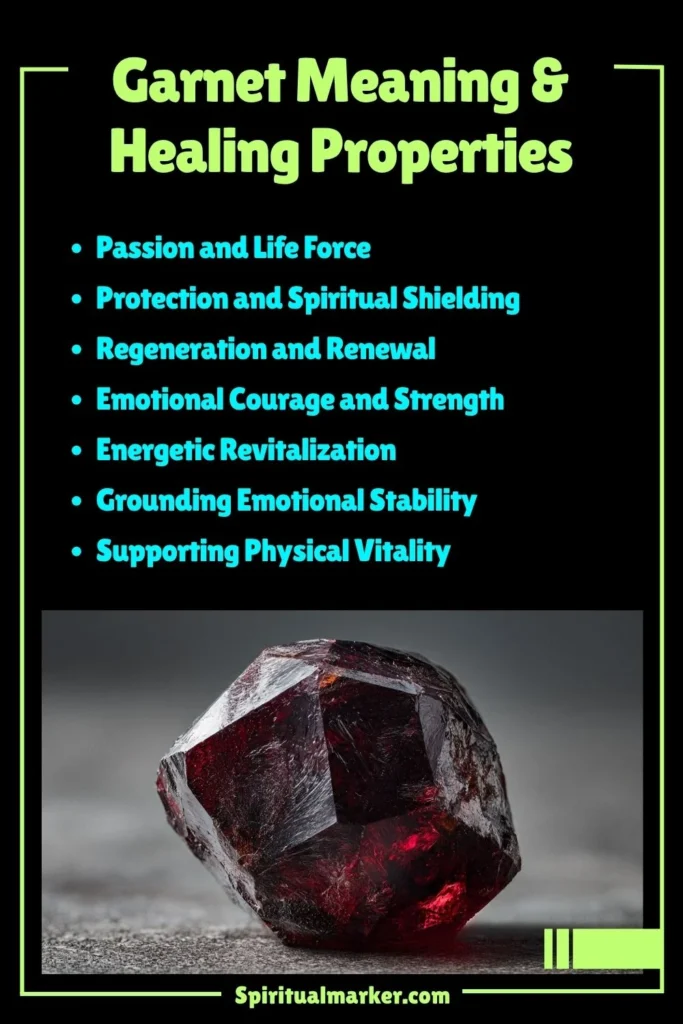
Garnet is a naturally occurring silicate mineral group that appears in a wide range of colors. Most people picture a rich, wine-red stone when they hear the name. That red variety, often called almandine garnet, remains the most recognized. But the garnet family also includes green, orange, yellow, pink, and even colorless stones.
Each variety forms under different geological conditions and carries slightly different mineral compositions. What all garnets share is a cubic crystal structure and a natural brilliance that reflects light with intensity and warmth.
Garnet forms deep within the earth under conditions of extreme heat and pressure. Metamorphic rocks, where temperatures and pressures transform one type of stone into another, commonly contain garnet crystals. This formation process ties the stone symbolically to transformation, resilience, and deep inner strength.
Many people compare garnet to ruby because both stones share similar red tones. However, garnet tends to have a darker, earthier hue. Rubies lean toward a brighter, more saturated red. Spiritually, garnet carries a denser, more grounding energy compared to ruby’s solar intensity.
Origins and Formation
Garnet forms through metamorphic processes deep within the earth’s crust. When mineral-rich rocks are subjected to intense heat and pressure over long geological periods, garnet crystals grow within the host rock. This slow, pressurized formation connects garnet symbolically to patience, endurance, and transformation through difficulty.
Garnet deposits exist on nearly every continent. India, Sri Lanka, Madagascar, Tanzania, Brazil, Russia, and the United States all produce significant garnet. Africa, particularly Mozambique and Tanzania, has become a major modern source for fine-quality garnet gems including the rare and brilliant tsavorite and demantoid varieties.
The diversity of garnet’s geographic origins reflects its cultural reach. Virtually every ancient civilization that valued gemstones encountered garnet in some form. From Egyptian pharaohs to Roman soldiers to medieval European nobility, garnet crossed cultural boundaries with ease.
Its physical durability also contributed to its widespread use. Garnet ranks between 6.5 and 7.5 on the Mohs hardness scale, depending on the variety. This makes it tough enough for everyday jewelry while remaining accessible for carving, setting, and spiritual use.
Key Properties
| Property | Details |
|---|---|
| Primary Colors | Deep red, orange, green, yellow, pink, black |
| Composition | Silicate mineral group |
| Hardness | 6.5 to 7.5 Mohs scale |
| Chakra Association | Root chakra, sacral chakra |
| Symbolism | Passion, protection, strength, regeneration |
| Common Sources | India, Madagascar, Tanzania, Brazil, Russia |
| Transparency | Transparent to opaque |
| Energy Style | Grounding, activating, deeply stabilizing |
Historical Significance of Garnet
Garnet’s history stretches back more than 5,000 years. Archaeological evidence places garnet jewelry and carvings in ancient Egypt, Rome, ancient India, and pre-Columbian America. Its role in human spiritual and cultural life has been remarkably consistent across vastly different civilizations.
Ancient Egyptians placed garnet among their most treasured gemstones. Pharaohs wore garnet amulets as symbols of power and divine protection. Egyptian craftsmen set garnet into gold jewelry with extraordinary skill. The stone appeared in burial sites, suggesting Egyptians believed it carried protective energy into the afterlife.
Ancient Romans prized garnet deeply. Roman signet rings carved with garnet seals were used to stamp important wax documents. The stone was seen as a symbol of authority and personal power. Roman soldiers carried garnet talismans believing the stone would protect them during battle and ensure safe return home.
In medieval Europe, garnet became heavily associated with faith, loyalty, and protection. Christian clergy incorporated garnet into ceremonial objects. Medieval healers prescribed garnet to treat inflammatory conditions, believing the stone’s fiery color corresponded with healing inflammation in the body. This association between garnet’s red color and blood gave rise to beliefs about the stone’s ability to stimulate circulation and restore vitality.
Ancient Indian spiritual traditions included garnet in Vedic astrology systems. Certain garnet varieties were associated with Rahu, a significant astrological body in Hindu cosmology. Wearers believed garnet could balance Rahu’s influence, bringing clarity, protection, and reduced karmic obstacles.
Native American tribes in the Southwest also used garnet. Warriors and hunters carried garnet for protection and strength. Some tribes used garnet projectile points in warfare, combining the stone’s physical hardness with its believed spiritual protective power.
5 Spiritual Meanings of Garnet
1. Passion and Life Force
Garnet’s most recognized spiritual meaning centers on passion. This is not passion limited to romantic love. It encompasses the full spectrum of life force energy, including creative passion, spiritual devotion, purposeful ambition, and the raw drive to pursue what matters most.
Many people go through long periods feeling emotionally flat. Daily routines, unresolved grief, burnout, or disconnection from personal goals can slowly drain the internal fire that makes life feel meaningful. Spiritual traditions across multiple cultures have associated garnet with rekindling that inner flame when it dims or nearly disappears entirely.
The stone’s deep red color connects visually and symbolically with blood, the heart, and the circulatory force that sustains physical life. In many ancient healing systems, what sustains physical life also mirrors what sustains spiritual vitality. Garnet’s passion symbolism therefore operates on multiple levels simultaneously. It speaks to the body’s energy, the heart’s emotional depth, and the soul’s fundamental drive to create, connect, and contribute.
Many spiritual practitioners turn to garnet specifically during periods of creative stagnation. Artists, writers, musicians, and other creators sometimes describe using garnet during work sessions, believing it helps them reconnect with the enthusiasm and inspiration they felt before fatigue or self-doubt interfered. While individual experiences vary widely, the consistent theme is garnet’s association with reigniting purposeful energy.
This passion symbolism also carries a deeper warning embedded in the stone’s tradition. Passion without grounding can become scattered, obsessive, or destructive. Garnet’s energy is fiery but also deeply earthy. It does not symbolize reckless emotional burning. It represents focused, purposeful life force that moves toward meaningful goals with both intensity and stability.
2. Protection and Spiritual Shielding
Across almost every ancient culture that valued garnet, one meaning remained constant: protection. Soldiers, travelers, healers, and spiritual leaders carried garnet as a shield against physical danger, spiritual harm, and energetic negativity.
The belief in garnet’s protective power appears across ancient Rome, medieval Europe, ancient India, and indigenous cultures of the Americas. This cross-cultural consistency is rare among gemstones. It suggests that something about garnet’s appearance, density, or energetic quality resonated with diverse human experiences of safety and spiritual shielding.
In spiritual traditions, garnet is often believed to create a strong energetic boundary around the person carrying or wearing it. This does not mean the stone physically deflects harm. Rather, many practitioners believe it strengthens personal energetic boundaries, helping the wearer remain less vulnerable to overwhelming external energy, psychic disturbance, or emotionally draining environments.
Some traditions specifically associate garnet with protection during travel. Ancient travelers carried garnet believing it would light their path in darkness and protect against accidents or attacks. This symbolism still resonates for people who use garnet during major life transitions, metaphorical journeys of personal change, or periods of vulnerability when they feel especially exposed to outside pressures.
Garnet’s protective symbolism also extends inward. Many spiritual healers believe garnet helps protect against self-destructive thought patterns, including fear-based thinking, excessive self-doubt, or the slow erosion of personal boundaries that happens when people consistently deprioritize their own needs. In this sense, garnet’s protection is both external and deeply personal.
3. Regeneration and Renewal
Garnet carries powerful symbolism around regeneration. Where green opal represents gentle emotional renewal that unfolds like a soft rain, garnet’s regeneration symbolism feels more like a fire that burns away what no longer serves before making space for new growth. Both processes are forms of renewal. They simply feel different in practice.
This regenerative quality connects garnet to seasonal cycles in several ancient traditions. Just as autumn strips a forest bare before winter gives way to spring, garnet is believed to support the process of releasing what is exhausted, outdated, or emotionally dead before new energy can take root.
Many people drawn to garnet are in some form of active transition. They are ending a relationship, leaving a career, recovering from illness, rebuilding after loss, or fundamentally reconsidering who they are and what they want. Garnet spiritually reflects this active regenerative process. Its energy is not passive or gentle. It supports change that requires courage, decisiveness, and genuine willingness to let go.
In certain metaphysical traditions, garnet is specifically associated with physical regeneration. Healers historically linked garnet’s deep red color with blood and believed it could support cellular renewal and physical recovery. While modern medicine does not endorse these claims, the symbolic connection between garnet and physical vitality remains culturally significant.
The stone’s formation story reinforces its regenerative symbolism. Garnet grows under extreme geological pressure over vast periods. What begins as unremarkable mineral material slowly transforms under intense conditions into a brilliantly structured crystal. Spiritually, this mirrors what humans experience during difficult personal transformations. Pressure and time produce depth, and garnet reflects that truth.
4. Emotional Courage and Strength
Garnet is one of the few gemstones whose spiritual meaning centers explicitly on courage. Many healing stones are associated with calming, softening, or soothing emotional experience. Garnet takes a different position. Its symbolism focuses on strengthening emotional resolve and developing the inner courage needed to face difficult realities honestly.
Emotional courage is not the same as emotional suppression. Many people confuse the two. Suppression means denying, hiding, or refusing to acknowledge emotional pain. Courage means acknowledging pain clearly and choosing to move forward anyway. Garnet spiritually supports the latter. Its energy is associated with clear-eyed emotional honesty paired with the inner strength to act despite fear.
This distinction becomes especially important during periods of personal upheaval. When facing major decisions, confronting unresolved trauma, leaving unhealthy situations, or rebuilding after significant loss, people often need more than comfort. They need the inner fire to take the next difficult step even when uncertainty makes it frightening. Garnet symbolizes that specific quality of emotional courage.
Ancient warriors who carried garnet were not seeking emotional comfort before battle. They were seeking something that strengthened their resolve. Translated into modern spiritual practice, garnet serves a similar function. It is not a stone for avoiding difficulty. It is a stone for meeting difficulty with greater inner strength.
Many practitioners also connect garnet’s courage symbolism with authentic self-expression. People who habitually suppress their true feelings, hide their genuine personality, or consistently choose safety over authenticity often feel a gradual erosion of inner vitality. Garnet’s spiritual energy is believed to encourage honesty with oneself before honesty with others, creating an internal foundation for courage that grows more naturally over time.
5. Deep Commitment and Devotion
Throughout recorded history, garnet has carried strong symbolism around commitment, fidelity, and devotion. Lovers exchanged garnet as tokens of loyalty. In medieval traditions, garnet represented the eternal bond of the heart because its deep red color evoked both blood and love simultaneously.
This symbolism extends well beyond romantic love. Garnet is associated with any form of deep, sustained commitment. This includes commitment to creative work, to spiritual practice, to family bonds, to long-term personal healing, or to the patient pursuit of a meaningful goal that requires years of effort rather than weeks.
Many people begin significant undertakings with tremendous enthusiasm only to falter as the initial excitement fades. Garnet’s devotion symbolism speaks directly to this pattern. Its energy is traditionally associated with sustained passion rather than fleeting excitement. It symbolizes the willingness to continue showing up for what matters most even when motivation temporarily diminishes.
In spiritual relationships between practitioners and their path, garnet often symbolizes the deepening of commitment over time. Spiritual growth frequently involves periods of doubt, dryness, or apparent stagnation. Garnet reflects the understanding that true devotion does not depend on constant emotional highs. It persists through difficult seasons because it is grounded in something deeper than momentary feeling.
Garnet also appears in traditions associated with sacred vows and ceremonial commitment. Wedding ceremonies in some cultures incorporate garnet as a symbol of enduring love. Spiritual initiations in various traditions use garnet to mark the solemnity of a new commitment to a particular path or community. This ceremonial use reinforces garnet’s association with binding, intentional, and deeply felt devotion.
6 Healing Properties of Garnet
1. Energetic Revitalization
Garnet is widely associated with restoring depleted energy. People going through prolonged illness, burnout, emotional exhaustion, or extended periods of stress often report feeling drawn to garnet during recovery. Its fiery symbolism connects directly with themes of restored vitality and renewed physical and emotional energy.
This healing property differs from simple stress relief. Garnet does not primarily soothe or calm. Instead, its energy is traditionally described as activating and restorative. Crystal healing traditions often distinguish between stones that calm overactive energy and stones that replenish depleted energy. Garnet firmly belongs in the second category.
Many practitioners use garnet alongside restorative practices such as adequate rest, nourishing food, gentle movement, and emotional support. The stone is believed to symbolically amplify the body’s natural regenerative capacity during recovery periods rather than replacing necessary self-care.
Physical exhaustion and emotional depletion frequently reinforce each other. When people feel emotionally drained, physical energy suffers. When physical vitality drops significantly, emotional resilience weakens. Garnet’s healing symbolism addresses both simultaneously by supporting the root life force that underlies both physical and emotional functioning.
Energetic revitalization also involves releasing what drains energy. Many people unknowingly carry emotional burdens, maintain draining relationships, or sustain habits that consistently deplete their reserves. Garnet’s healing energy encourages honest assessment of where vitality is leaking and the courage to make necessary changes.
2. Grounding Emotional Stability
Garnet is a deeply grounding stone. Its strong connection with the root chakra, the energy center associated with safety, stability, physical presence, and foundational security, gives it a stabilizing quality that many people find profoundly steadying during emotionally turbulent periods.
Emotional instability often develops when people feel fundamentally unsafe. This can result from early attachment wounds, chronic stress, identity uncertainty, or living through prolonged external chaos. The root chakra in many spiritual systems represents the foundation of the entire energetic body. When it feels weak or depleted, everything above it becomes harder to sustain.
Garnet’s healing role in emotional grounding centers on reestablishing that foundational sense of safety. Many practitioners believe the stone helps people reconnect with physical presence, immediate reality, and the basic sense that they have the inner resources to manage what life requires. This grounded emotional state creates a more stable platform from which deeper emotional healing can occur.
Grounding also helps manage emotional reactivity. People who feel energetically ungrounded often experience stronger emotional reactions, more difficulty regulating intense feelings, and a greater tendency toward anxiety, overwhelm, or emotional volatility. Garnet’s stabilizing energy is believed to reduce this reactivity by reconnecting people with their deeper emotional foundation.
Many practitioners use garnet during challenging periods specifically because its grounding quality provides emotional steadiness without emotional numbness. It does not suppress or minimize difficult feelings. Instead, it creates a sense of inner solidity that allows people to acknowledge difficult emotions without being destabilized by them.
3. Stimulating Creative Expression
Garnet’s connection with the sacral chakra gives it significant healing relevance for creativity, sensory experience, and authentic self-expression. The sacral chakra governs creative energy, pleasure, emotional fluidity, and the capacity to pursue what genuinely inspires passion and meaning.
When the sacral chakra feels blocked, creative flow often slows or stops entirely. People may feel emotionally flat, uninspired, disconnected from pleasure, or unable to access the imaginative energy that once felt natural. Garnet is often used in healing practices aimed at restoring creative vitality when it has been suppressed, depleted, or blocked by fear and self-judgment.
Creative suppression is a significant but often underacknowledged form of emotional damage. Many people learn early in life that creative expression is frivolous, risky, or likely to attract criticism. Over time, they internalize these messages and gradually disconnect from their natural creative impulses. The result is not simply reduced artistic output. Creative suppression frequently contributes to broader emotional flatness, diminished passion, and a reduced sense of personal aliveness.
Garnet’s healing in this area focuses on reigniting the willingness to create without guaranteeing the result will be perfect or universally valued. Many practitioners describe the stone’s energy as helping dissolve the fear-based creative blocks that prevent people from starting, expressing, or completing creative work they genuinely care about.
The link between garnet and creative healing also connects with sensory awareness. People who are deeply grounded and energetically healthy tend to feel more alive to sensory experience, including the pleasures of beauty, nature, music, and physical engagement with the world. Garnet’s healing energy supports this fuller sensory presence as part of broader creative and emotional restoration.
4. Strengthening Personal Boundaries
One of garnet’s most practically valuable healing associations involves personal boundaries. Many people struggle to maintain healthy emotional boundaries, either becoming emotionally porous and absorbing others’ energy indiscriminately, or erecting such rigid emotional walls that genuine connection becomes impossible.
Healthy personal boundaries require both self-awareness and emotional courage. People need enough self-knowledge to recognize when their boundaries are being violated, and enough courage to respond clearly even when doing so risks conflict or disapproval. Both qualities appear prominently in garnet’s spiritual symbolism, which is why many practitioners connect the stone with boundary healing.
Garnet is not associated with aggressive boundary enforcement or emotional combativeness. Its boundary symbolism is grounded and purposeful. The stone represents clear, confident self-protection rather than fearful defensiveness. This distinction matters because boundaries established through fear tend to be either too rigid or too inconsistent, while boundaries built on genuine self-respect tend to be clearer and more sustainable.
Many people who struggle with boundary issues have experienced early environments where their needs were consistently dismissed, overridden, or made to feel inappropriate. Healing this pattern requires rebuilding a fundamental sense of personal legitimacy, the deep belief that one’s needs, feelings, and limits are valid and deserving of respect. Garnet spiritually supports this rebuilding process.
In practical healing work, garnet is sometimes used during journaling, therapy, or meditative reflection focused on identifying and articulating personal needs more clearly. Many practitioners believe the stone’s activating energy helps people access the clarity and courage needed to define where they end and others begin, especially in relationships where that line has historically been unclear.
5. Supporting Physical Vitality
Historical healing traditions consistently linked garnet with physical health, blood, and circulatory vitality. Medieval healers believed the stone could treat hemorrhaging, inflammatory conditions, and physical weakness. Ancient Ayurvedic texts included garnet among stones believed to support physical strength and bodily harmony.
Modern crystal healing does not replace medical treatment. Anyone with serious physical health concerns should work with qualified medical professionals. However, garnet’s symbolic association with physical vitality remains meaningful within holistic wellness contexts.
The doctrine of signatures, an ancient healing philosophy that connected the appearance of natural substances with their healing relevance, linked garnet’s blood-red color with the circulatory and reproductive systems. While this system lacks scientific validation as medical treatment, it shaped centuries of healing practice and contributed to garnet’s enduring reputation as a stone of physical strength and regeneration.
Many contemporary crystal practitioners use garnet symbolically during recovery from illness, during periods of physical exhaustion, or when they feel their physical energy reserves have become significantly depleted. The stone is often viewed as an energetic companion during the body’s natural healing process rather than a replacement for it.
Garnet’s association with the root chakra reinforces this physical vitality connection. In many energetic healing traditions, the root chakra governs not only emotional security but also physical health, bodily awareness, and the fundamental will to live and thrive. Supporting root chakra energy symbolically through garnet is believed to create a stronger energetic foundation for overall physical resilience.
6. Overcoming Fear and Anxiety
Garnet carries significant healing symbolism around fear and anxiety. Unlike stones primarily associated with gentle calming, garnet addresses fear more directly by building the inner strength and grounded presence needed to face what feels threatening without becoming paralyzed by it.
Fear and anxiety often operate most powerfully in the imagination rather than in immediate reality. Anticipatory fear, the anxiety about what might happen rather than what is actually happening right now, keeps many people emotionally trapped in worst-case scenarios. Garnet’s grounding energy is believed to help pull awareness back into present reality, reducing the power of future-focused fear by anchoring attention in the immediate moment.
This is not about suppressing fear. Healthy fear is a protective signal worth acknowledging. Garnet’s healing role is not suppression but rather developing the capacity to feel fear without being controlled by it. Many practitioners describe the stone’s energy as courage-strengthening rather than fear-eliminating, a subtle but important distinction.
Anxiety frequently has energetic roots in an underactivated root chakra. When people feel fundamentally unsafe, either physically or emotionally, the nervous system remains in a state of alert that easily tips into anxiety. Garnet’s root chakra connection addresses this energetic pattern by supporting a deeper sense of foundational safety and personal security.
Long-term anxiety can also erode a person’s belief in their own capacity to handle difficulty. Each time anxiety prevents action, the belief that challenging situations are truly manageable weakens slightly further. Garnet’s healing symbolism around courage, strength, and inner fire directly counters this pattern by reinforcing the belief that people have genuine inner resources to meet what life requires of them.
How to Wear Garnet Jewelry for Spiritual Growth
People wear garnet jewelry in many ways depending on their spiritual intentions. Rings are particularly associated with garnet because of the stone’s historical use in signet rings and ceremonial jewelry. Wearing garnet on the hand connects the stone’s energy with action, decisiveness, and purposeful engagement with daily life.
Necklaces and pendants bring garnet close to the heart and throat, connecting its grounding energy with emotional expression and personal authenticity. Many practitioners wear garnet near the chest during periods of emotional healing or when they need to access emotional courage during difficult conversations.
Bracelets allow frequent physical contact with the stone throughout the day. Many people who use garnet for grounding purposes prefer wearing it on the wrist where they can touch it easily during stressful moments, using the physical contact as a grounding reminder.
Some practitioners pair garnet with complementary stones to create balanced energetic combinations. Black tourmaline may amplify garnet’s protective qualities. Carnelian deepens the connection with creative and sacral energy. Clear quartz may clarify garnet’s intentional energy and amplify its effect. Citrine pairs well with garnet for those seeking both vitality and positive momentum simultaneously.
The most important factor in wearing garnet spiritually is intentionality. The stone’s symbolism is most meaningfully engaged when the wearer brings conscious awareness to what they are seeking. Simply wearing garnet without reflection is perfectly valid as aesthetic enjoyment. Those who engage it spiritually often set a clear intention with the stone before beginning a new phase of healing or growth.
Caring for Garnet Jewelry
Garnet is a durable gemstone that handles everyday wear well. With a Mohs hardness of 6.5 to 7.5, most garnet varieties resist scratching from common materials. However, harder gemstones like sapphire, ruby, and diamond can still scratch garnet’s surface if stored together carelessly.
Store garnet jewelry in fabric-lined pouches or divided jewelry boxes to prevent contact with harder stones. This simple precaution preserves the surface polish and overall appearance over many years of use.
Clean garnet using warm water, mild soap, and a soft brush or cloth. Rinse thoroughly and dry completely before storing. Most garnet varieties respond well to gentle mechanical cleaning. Avoid ultrasonic cleaners for fractured or heavily included stones, as vibration can widen existing fractures. Steam cleaning is generally safe for most garnet but should be avoided for stones that have been treated or filled.
Remove garnet jewelry before intense physical activity, chemical exposure, or prolonged immersion in water. While garnet is relatively tough, extended chemical exposure from cleaning products or chlorinated water can dull the surface finish over time.
Many people who work with garnet spiritually also practice energetic cleansing regularly. Common approaches include brief exposure to moonlight, sound cleansing with singing bowls or bells, or placing the stone on a selenite charging plate overnight. Some practitioners bury garnet briefly in the earth, connecting the stone back with its geological origins. Spiritual cleansing methods vary widely according to personal practice and tradition.
Garnet at a Glance
| Aspect | Details |
|---|---|
| Primary Meaning | Passion, protection, regeneration, strength |
| Chakra Association | Root chakra, sacral chakra |
| Main Spiritual Symbolism | Courage, vitality, commitment, devotion |
| Common Colors | Deep red, orange, green, yellow, black |
| Hardness | 6.5 to 7.5 Mohs |
| Main Sources | India, Tanzania, Madagascar, Brazil, Russia |
| Emotional Associations | Courage, emotional stability, inner fire |
| Popular Jewelry Types | Rings, pendants, bracelets |
| Spiritual Uses | Grounding, protection, creative healing |
| Care Needs | Warm water, mild soap, separate storage |
A Final Note
Garnet is not a gentle stone. It does not whisper softly or work in the background without your awareness. Its energy is ancient, grounded, fiery, and deeply purposeful. People drawn to garnet are often at a turning point. They are ready to stop enduring and start moving forward with genuine intention.
Its meaning spans thousands of years and dozens of cultures. Yet the core themes remain strikingly consistent. Passion. Protection. Regeneration. Courage. Devotion. These are not accidental associations. They reflect something real about the stone’s physical presence and the way human beings have experienced it across time.
Whether you approach garnet through a spiritual lens, a historical lens, or simply an appreciation for beautiful gemstones, its depth is undeniable. It is a stone with weight, purpose, and character.
If garnet has drawn your attention recently, consider what that might reflect about your current moment. Perhaps you are rebuilding something important. Perhaps you are seeking the courage to make a decision you have been postponing. Perhaps you simply need to feel more grounded and alive in daily life.
You might try wearing garnet during a period of intentional personal growth, meditating with it during moments of uncertainty, or simply keeping it visible in a space where you do meaningful work. Many people find that living with garnet deliberately creates a subtle but consistent reminder of their own inner strength and the depth of what they are capable of.