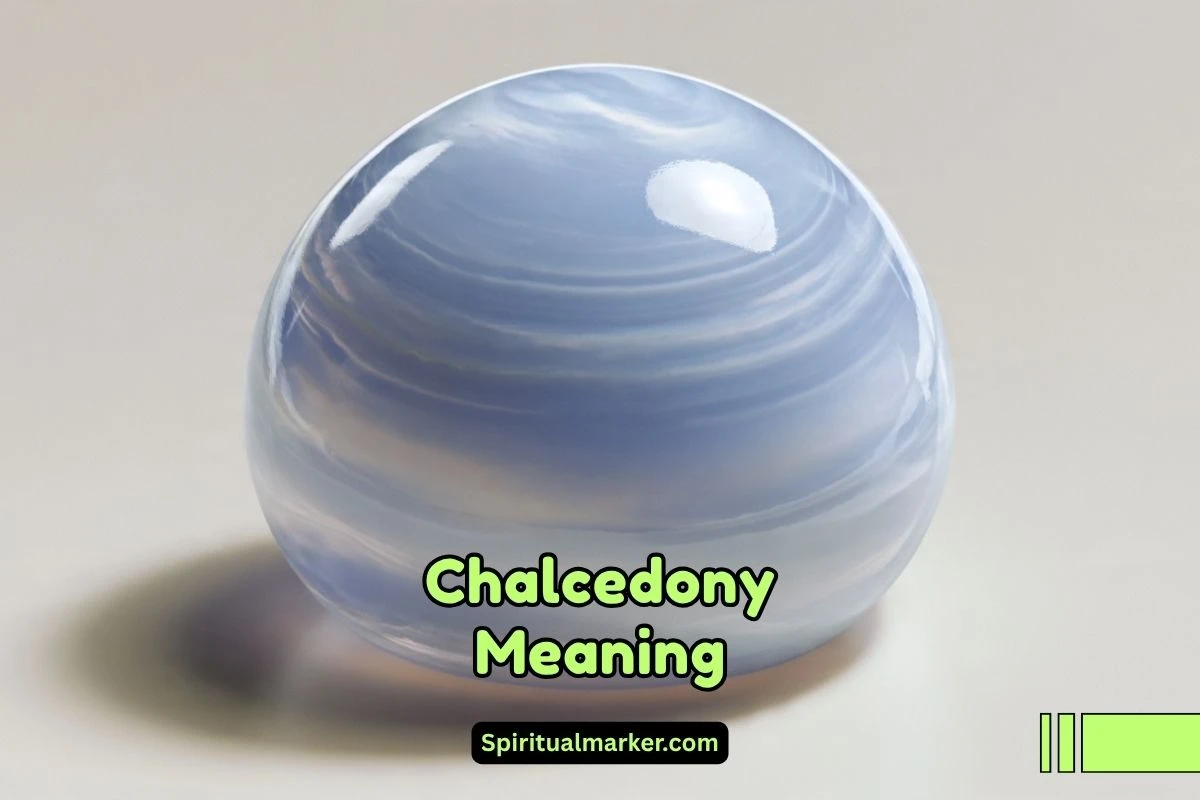
Have you ever felt pulled toward a pale, silky gemstone without knowing exactly why? Many people experience that quiet magnetic pull when they first encounter chalcedony. Its smooth surface, cool touch, and soft waxy glow create a sensory experience that feels immediately calming.
People have carried chalcedony across centuries and continents. Ancient warriors wore it for protection. Orators held it to strengthen their voices. Healers placed it on aching bodies. Spiritual teachers used it to encourage honest communication and emotional stillness.
What makes chalcedony enduring is not its dramatic appearance. It holds no fiery brilliance like a ruby or sharp clarity like a diamond. Its power feels different. Quieter. More inward. Chalcedony works on the emotional and spiritual interior, soothing what cannot always be seen from the outside.
Today, crystal practitioners, gem therapists, jewelry lovers, and spiritual seekers all continue to value this stone. They wear it during difficult conversations. They carry it through grief. They hold it during meditation. They gift it to people who need emotional steadiness or calm.
This article covers everything meaningful about chalcedony: its definition, origins, historical significance, spiritual meanings, healing properties, chakra connections, and practical ways to use it. You will also learn how to care for chalcedony jewelry so its beauty lasts.
5 Key Takeaways
- Chalcedony symbolizes calm, communication, emotional balance, and inner strength across many spiritual traditions.
- The stone connects strongly with the throat chakra and heart chakra, supporting honest expression and emotional healing.
- Ancient civilizations in Greece, Rome, Egypt, and Mesopotamia used chalcedony in ritual, medicine, and protection.
- Blue chalcedony remains the most spiritually significant variety, though all forms carry meaningful energetic properties.
- Wearing or carrying chalcedony may support emotional clarity, stress relief, and deeper self-awareness over time.
What Is Chalcedony?
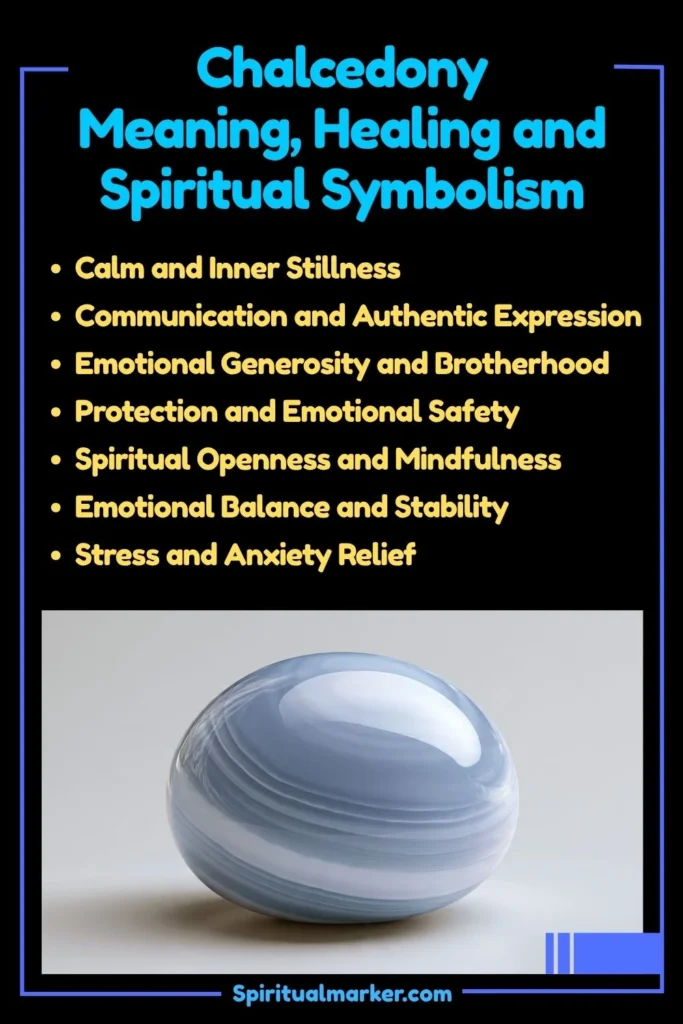
Chalcedony (pronounced kal-SED-uh-nee) is a microcrystalline form of silica. It belongs to the quartz family. Unlike large crystal formations, chalcedony forms with extremely fine crystal structures invisible to the naked eye. This microscopic texture gives the stone its smooth, waxy luster and consistent appearance.
The stone appears in a wide range of colors. Blue, lavender, gray, white, and pale pink represent the most recognized forms. Other well-known varieties include agate, jasper, carnelian, chrysoprase, onyx, and bloodstone, all of which fall under the chalcedony family umbrella.
Pure chalcedony, sometimes called blue chalcedony or common chalcedony, typically appears in soft, muted tones rather than bold saturated hues. Its beauty is understated. Many people describe it as visually restful, almost like looking at still water or a misty morning sky.
Spiritually, chalcedony carries a reputation for gentleness, emotional nurturing, and clear communication. It does not energize or excite. It steadies and softens. That emotional quality explains why people throughout history reached for it during both personal and public moments of pressure.
Origins and Formation
Chalcedony forms through a process involving silica-rich fluids moving through rock cavities. As the fluid cools and evaporates slowly, microscopic quartz crystals deposit and harden layer by layer. Over geological time, these layers build into the smooth, dense material known as chalcedony.
This gradual formation process gives chalcedony symbolic significance in many spiritual traditions. The stone does not form quickly or dramatically. It develops through patience, repetition, and slow layering, which mirrors the way emotional healing and spiritual growth typically work in human life.
Chalcedony deposits appear across nearly every continent. Turkey, India, Brazil, Namibia, Uruguay, Madagascar, and the United States all produce significant quantities. Turkish chalcedony holds particular historical importance because the ancient city of Chalcedon in modern-day Turkey gave the stone its name.
Some of the most spiritually prized varieties come from specific regions. Namibian blue chalcedony is admired for its clean, translucent blue color. Brazilian specimens often display a slightly more lavender tone. Indian chalcedony varies widely in appearance, ranging from pale gray to soft blue-green.
Key Properties at a Glance
| Aspect | Details |
|---|---|
| Mineral Family | Microcrystalline quartz (silica) |
| Common Colors | Blue, gray, lavender, white, pale pink |
| Hardness | 6.5 to 7 on the Mohs scale |
| Chakra Association | Throat chakra, Heart chakra |
| Primary Symbolism | Calm, communication, emotional balance |
| Main Sources | Turkey, India, Namibia, Brazil, USA |
| Transparency | Translucent to opaque |
| Energy Style | Gentle, soothing, emotionally stabilizing |
| Spiritual Uses | Meditation, communication healing, grief support |
| Popular Varieties | Agate, carnelian, jasper, chrysoprase, onyx |
Historical Use of Chalcedony
Chalcedony has one of the longest documented histories of any gemstone. Its presence in ancient cultures across multiple continents reflects how deeply people connected with its unique energy and practical qualities.
Mesopotamian civilizations carved chalcedony into cylinder seals as early as 3000 BCE. These seals served as official signatures and sacred objects. The Mesopotamians believed chalcedony protected against negative energy and malicious spirits. Wearing it was considered a practical form of spiritual armor.
In ancient Greece and Rome, chalcedony carried strong associations with eloquence and honest speech. Roman orators reportedly wore chalcedony rings or amulets before speaking publicly. They believed the stone strengthened their clarity of thought and helped them communicate persuasively without losing emotional control. The Roman author Pliny the Elder wrote about chalcedony’s value among those who spoke publicly or negotiated important agreements.
Egyptian artisans used chalcedony in amulets, carved figurines, and jewelry worn by royalty and priests. The stone appeared in tombs as a protective object meant to support the deceased in the afterlife. Certain Egyptian healing papyri referenced chalcedony in remedies for throat ailments and emotional distress.
Native American traditions in various regions regarded chalcedony as a sacred stone connected with goodwill, generosity, and spiritual brotherhood. Some tribal healers used it in ceremonial contexts to encourage peaceful communication between groups and to support healing rituals for emotional and physical ailments.
During the Renaissance period, European physicians classified chalcedony as a medicinal stone. Medical texts from that era described it as beneficial for melancholia, fever, and diseases of the throat. While these claims reflect historical beliefs rather than modern medical science, they reveal how consistently chalcedony was associated with both emotional calm and physical well-being.
This long, cross-cultural history is not coincidental. Chalcedony has consistently attracted people seeking emotional steadiness, clearer expression, and spiritual protection. Its reputation has evolved across thousands of years without losing its central themes.
5 Spiritual Meanings of Chalcedony
1. Calm and Inner Stillness
Chalcedony is perhaps most consistently associated with calm. Across cultures and centuries, people have turned to this stone when internal noise becomes overwhelming. Its soft appearance alone communicates stillness. Holding it often creates an immediate physical sense of settling.
Spiritually, chalcedony symbolizes the kind of calm that does not come from avoiding difficulty. It represents emotional steadiness within difficulty. Many spiritual traditions distinguish between emotional avoidance and emotional equanimity. Avoidance means not feeling. Equanimity means feeling without losing balance. Chalcedony is believed to support the second kind.
This meaning feels particularly relevant in modern life. Most people experience daily mental overstimulation. Screens, responsibilities, social expectations, and unresolved emotional tension create a baseline of internal noise. Chalcedony spiritually represents the stillness that exists beneath that noise. It does not eliminate stress, but it symbolizes the quiet center that remains accessible within stressful conditions.
Many crystal practitioners describe chalcedony’s energy as emotionally “cooling.” This concept appears in both metaphysical traditions and historical descriptions of the stone. The idea is not that the stone numbs emotion. Rather, its symbolic energy is believed to reduce the temperature of emotions that have become overheated through prolonged stress, conflict, or emotional pressure.
This cooling quality makes chalcedony symbolically meaningful during heated interpersonal moments. Arguments, difficult conversations, and periods of high emotional tension can benefit from the spiritual presence of a stone associated with emotional steadiness and grounded communication. Many people carry chalcedony specifically for moments when they need to respond thoughtfully rather than react emotionally.
Calming symbolism in chalcedony also extends into sleep and rest. People who struggle with overthinking, insomnia caused by anxiety, or nighttime emotional restlessness sometimes place chalcedony near their sleeping space. Spiritually, the stone is believed to create a more peaceful energetic environment during rest. The result many people report is not dramatic, but a gradual quieting of mental activity that feels impossible to force through willpower alone.
2. Communication and Authentic Expression
No other spiritual meaning defines chalcedony more consistently than communication. Ancient orators, diplomats, healers, and teachers across multiple civilizations reached for this stone before moments requiring honest and effective speech. That long association with spoken truth reflects something deeply embedded in chalcedony’s spiritual identity.
Its connection to communication stems partly from its strong relationship with the throat chakra, the energy center in many spiritual traditions that governs expression, listening, honest speech, and personal truth. When the throat chakra functions openly, people communicate authentically. They express needs clearly. They listen actively. They speak with both confidence and compassion. When this energy center feels blocked, people often find expression difficult.
Chalcedony spiritually symbolizes the gentle reopening of blocked expression. Many people carry significant unexpressed emotion. Grief that has never been spoken aloud. Boundaries that were never articulated. Truths about personal needs that remained buried beneath people-pleasing behavior. Chalcedony does not force expression. Instead, it symbolizes emotional safety around the act of speaking honestly.
This meaning extends beyond spoken communication into written expression as well. Writers, journalists, therapists, teachers, and anyone whose work depends on communicating complex ideas often feel drawn to chalcedony. The stone’s spiritual symbolism encourages clarity in thought before it becomes clarity in speech or writing. It represents the internal alignment between what a person feels and what a person ultimately expresses.
Communication healing with chalcedony also involves listening. In many spiritual interpretations, genuine communication requires equal parts speaking and hearing. Chalcedony is believed to support receptive listening alongside expressive honesty. This dual quality makes it meaningful in situations involving conflict resolution, couples counseling, family dynamics, or any relationship where both speaking and hearing have broken down.
Its symbolism around communication also includes self-honesty. People sometimes struggle to articulate their truth to others because they have not yet fully acknowledged it to themselves. Chalcedony spiritually encourages internal honesty as the foundation of authentic external expression. It represents the relationship between self-awareness and the capacity to communicate that awareness with clarity and compassion.
3. Emotional Generosity and Brotherhood
Ancient texts and spiritual traditions repeatedly link chalcedony with generosity, goodwill, and emotional openness toward others. This meaning appears so consistently across independent cultural sources that it forms one of the stone’s most reliable spiritual themes.
Emotional generosity refers to the capacity to extend warmth, empathy, patience, and care toward others without emotional depletion or resentment. Many people genuinely want to be emotionally giving but find that chronic stress, personal pain, or emotional exhaustion makes generosity feel difficult or even impossible. Chalcedony spiritually symbolizes the emotional abundance from which genuine generosity flows.
The stone’s association with brotherhood reflects a broader social dimension of its meaning. Unlike stones primarily focused on individual healing or personal ambition, chalcedony carries a communal symbolism. It represents emotional goodwill extended beyond personal relationships into broader community spaces. Native American traditions that used chalcedony in ceremonial contexts often emphasized harmony between groups, peaceful resolution of collective tension, and the importance of goodwill in community life.
This communal dimension feels increasingly meaningful in fragmented social environments. Digital communication, political division, and cultural polarization frequently reduce people’s sense of shared humanity. Chalcedony spiritually represents the energetic antidote to that fragmentation. It symbolizes remembering what human beings share rather than what separates them.
Emotional generosity as a spiritual theme also connects with giving without expectation. Many healing traditions emphasize that authentic generosity flows from a place of genuine abundance rather than emotional debt. When people give emotionally out of obligation, fear, or exhaustion, both the giver and receiver feel the difference. Chalcedony symbolically encourages emotional giving that arises from inner wholeness rather than emotional scarcity.
For people in caregiving roles, including parents, therapists, teachers, healthcare workers, and community leaders, this meaning carries particular relevance. Those who consistently give emotionally to others often need spiritual reminders that their own emotional reserves matter. Chalcedony’s symbolism of generosity includes generosity toward oneself as the sustainable foundation for giving to others over time.
4. Protection and Emotional Safety
Chalcedony has been used as a protective stone for longer than almost any other gemstone in recorded history. Mesopotamian cylinder seals, Egyptian burial amulets, Roman warrior talismans, and Native American ceremonial stones all reflect a shared belief in the stone’s protective qualities. While the specific nature of that protection varies across traditions, the underlying theme remains consistent.
Spiritually, chalcedony’s protective symbolism focuses primarily on emotional and psychic protection rather than physical defense. In modern spiritual practice, this translates into the idea of creating an energetic boundary around one’s emotional body. People who are highly sensitive to emotional environments, those who absorb others’ emotions easily, or individuals who feel emotionally vulnerable in certain social situations often describe chalcedony as providing a kind of quiet shield.
This protective quality does not involve aggression or defensiveness. It reflects the same calming symbolism that runs through chalcedony’s other meanings. Protection through emotional steadiness rather than emotional walls. The stone spiritually represents maintaining inner equilibrium even when external emotional environments feel draining, chaotic, or threatening.
Many sensitive people, empaths, and highly attuned individuals describe feeling emotionally overwhelmed after extended social interaction. Large gatherings, emotionally intense relationships, or environments with significant interpersonal conflict can leave these individuals feeling depleted, anxious, or emotionally raw. Chalcedony is frequently recommended within crystal healing communities for exactly this kind of emotional sensitivity.
Its protective symbolism also extends to nighttime and dream states. Ancient texts occasionally mentioned chalcedony in connection with disturbing dreams, nighttime fears, or nocturnal anxiety. While those descriptions reflect historical beliefs rather than scientific claims, they reflect a consistent cultural pattern of using the stone to create emotional safety during vulnerable moments. Many contemporary practitioners continue placing chalcedony near sleeping spaces for similar reasons.
Protection in chalcedony’s spiritual context finally includes protection from one’s own emotional reactivity. People often cause harm, damage relationships, or make poor decisions during moments of emotional flooding. Chalcedony spiritually symbolizes the buffer between feeling a strong emotion and reacting to it in ways that create regret. It represents the pause that allows a more thoughtful, grounded response to emerge.
5. Spiritual Openness and Mindfulness
Chalcedony carries a quieter form of spiritual symbolism than stones associated with mystical visions, intense spiritual experiences, or sudden energetic awakenings. Its spiritual energy tends toward receptivity, presence, and mindful awareness rather than dramatic spiritual encounters.
This quality makes chalcedony meaningful for people at every level of spiritual development. Beginners exploring spirituality or meditation sometimes feel overwhelmed by stones associated with intense energetic experiences. Chalcedony’s gentle spiritual symbolism creates an accessible entry point. It encourages spiritual curiosity without demanding intensity.
The stone’s connection to mindfulness appears across several traditions. Mindfulness, as both a spiritual practice and a modern psychological approach, involves paying attention to present-moment experience without judgment. It requires slowing the mind enough to observe thoughts and emotions as they arise rather than becoming immediately swept away by them. Chalcedony spiritually mirrors this process. Its calm, steady energy symbolizes the quality of mind that mindfulness cultivates.
Many meditation practitioners use chalcedony specifically because they believe it encourages non-reactive awareness during practice. Rather than amplifying emotional content or stimulating spiritual excitement, the stone symbolizes holding awareness gently without grasping or pushing away. This quality aligns with contemplative traditions across Buddhism, Christian mysticism, Sufi practice, and indigenous spiritual frameworks that value receptive stillness.
Spiritual openness in chalcedony’s symbolism also involves being open to learning, changing, and expanding one’s perspective without the defensive resistance that ego protection creates. Chalcedony spiritually encourages humility and genuine curiosity about spiritual truth. It represents the attitude of a student rather than the certainty of someone who has stopped growing.
Its spiritual meaning also reflects the value of ordinary moments. Some spiritual traditions emphasize peak experiences, powerful insights, or transformative events as the primary territory of spiritual life. Chalcedony’s symbolism redirects attention toward the spiritual depth available in quiet, unremarkable daily moments. This perspective shift often proves surprisingly powerful for people who have spent years waiting for dramatic spiritual experiences while missing the subtler depth already present.
6 Healing Properties of Chalcedony
1. Emotional Balance and Stability
Chalcedony is deeply associated with emotional balance. People experiencing prolonged emotional instability, mood volatility, chronic irritability, or emotional extremes often feel drawn to this stone. Its gentle energy symbolizes the stabilizing influence that helps emotions find a more consistent, manageable level.
Emotional balance does not mean feeling happy all the time. It means navigating a full range of emotions without losing one’s internal center. Sadness, frustration, disappointment, and fear are all normal human experiences. What chalcedony spiritually represents is the capacity to feel those emotions fully without being capsized by them.
Within crystal healing traditions, practitioners believe chalcedony helps integrate emotional experience more smoothly. Unprocessed emotions tend to accumulate. Over time, this accumulation may express itself through sudden emotional outbursts, emotional numbness, or chronic anxiety that seems disconnected from any identifiable cause. Chalcedony is believed to support gradual emotional integration, reducing the internal pressure created by emotions that have been avoided or suppressed.
Many individuals find that emotional balance becomes increasingly difficult during major life transitions. Relationship changes, career upheaval, grief, illness, relocation, and personal reinvention all destabilize the emotional system. During these periods, the internal resources that normally provide stability may feel temporarily unavailable. Chalcedony symbolizes emotional steadiness as an external reminder of that internal capacity during moments when accessing it feels difficult.
This healing property also relates to emotional reactivity in close relationships. People who find themselves reacting more intensely than situations seem to warrant often carry accumulated emotional stress from multiple sources. Chalcedony spiritually represents reducing that reactive charge, helping people respond more thoughtfully to everyday emotional friction in relationships and daily life.
2. Support for Communication Difficulties
Chalcedony’s healing connection with communication remains one of its most distinctive and consistently reported properties. People who struggle with expressing themselves clearly, who avoid necessary conversations, who feel silenced by fear of conflict, or who cannot find words for deep emotional experiences often seek chalcedony specifically for this reason.
Communication difficulties take many forms. Some people speak too much when anxious and say less than they intend. Others shut down entirely when feeling vulnerable and leave important things unspoken. Many people know what they feel internally but cannot translate that feeling into clear, honest language. Chalcedony is believed to support the alignment between inner experience and outer expression.
Therapists, counselors, and communication coaches have noted that many relational conflicts arise not from genuine incompatibility but from failures of honest expression. People assume others understand their unstated needs. They expect their emotional signals to be read correctly without being named directly. Chalcedony’s healing symbolism encourages a more direct, transparent approach to emotional communication.
For those who have experienced relationships where honest expression was punished, criticized, or met with indifference, communication may carry emotional risk. Chalcedony healing work often involves rebuilding trust in the act of honest expression after previous experiences made vulnerability feel dangerous. Its energy symbolizes the safety that authentic communication requires in order to happen freely.
Public speaking is another area where chalcedony’s healing symbolism proves meaningful. Many people experience significant anxiety around speaking in front of groups, presenting professionally, or contributing ideas in social situations. While that anxiety has many roots, chalcedony has historically been associated with calming nerves around verbal expression and strengthening the confidence to speak clearly from an authentic place.
3. Stress and Anxiety Relief
Chalcedony’s calming energy makes it one of the most commonly recommended stones for stress and anxiety within crystal healing traditions. Its symbolism as a cooling, soothing stone translates into practical use during periods of prolonged stress, daily anxiety, or situational worry that disrupts emotional functioning.
Stress typically involves a physical and emotional state of heightened alert that the body and mind maintain long after the triggering situation has passed. Chronic stress keeps the nervous system in a state of readiness that eventually creates exhaustion, emotional depletion, and physical symptoms. People often describe this state as feeling unable to relax even when circumstances allow it.
Many practitioners use chalcedony during breathing exercises, meditation, or grounding practices specifically because they believe its energy encourages the physiological and emotional state associated with relaxation. While crystal healing operates in the territory of symbolic and intentional practice rather than clinical medicine, the psychological effect of intentional calming rituals can be meaningful in stress management.
Anxiety often carries a future-oriented quality. The anxious mind projects worries forward, rehearsing difficult scenarios that may never occur. Chalcedony’s connection with present-moment mindfulness spiritually counteracts this forward-projecting mental habit. Its symbolism encourages returning attention to the present moment rather than remaining trapped in imagined future difficulties.
Situational anxiety around specific events, conversations, examinations, or social situations represents another area where chalcedony sees frequent use. Carrying the stone during an anxiety-provoking event creates a physical anchor connected to calming intention. The act of holding or touching chalcedony during stressful moments serves as a mindfulness cue that helps redirect attention from anxious anticipation to present-moment awareness.
4. Physical Healing Associations
Historical traditions across multiple cultures associated chalcedony with specific physical ailments, particularly those involving the throat, voice, lymphatic system, and respiratory function. While these associations reflect historical beliefs and should not replace medical care, they form part of chalcedony’s documented healing history.
Ancient Roman and Greek physicians mentioned chalcedony in texts addressing throat inflammation, hoarseness, and fever. The stone’s association with the throat chakra in modern crystal traditions echoes these older physical connections. Many crystal healers continue placing chalcedony near the throat during energy healing sessions aimed at supporting throat health, thyroid function, or issues affecting voice and communication physically.
Some historical texts also mentioned chalcedony in connection with lactation, fertility, and maternal well-being. Nursing mothers in certain ancient Mediterranean cultures wore chalcedony amulets. Whether this practice produced physical benefits or provided meaningful psychological comfort, it reflects the stone’s long association with nurturing and gentle physical support.
Contemporary crystal healing practitioners often associate chalcedony with the lymphatic system and immune support. These associations stem from the stone’s connection with cleansing, gentle energy flow, and its historically noted cooling properties. Again, these are symbolic healing associations rather than medically verified claims. Anyone experiencing physical health concerns should consult qualified medical professionals.
The cooling symbolism of chalcedony also appears in references to inflammation, fever, and overheated conditions. Multiple ancient traditions used the stone symbolically in contexts where reducing excess heat was the therapeutic goal. This cooling principle extended beyond physical temperature into emotional and energetic states, reinforcing chalcedony’s consistent identity as a stone of calming and balance.
5. Strengthening Self-Reflection and Self-Awareness
Chalcedony supports the internal work of self-reflection by creating the emotional conditions necessary for honest self-examination. Self-awareness requires a degree of emotional safety. People rarely examine themselves honestly when they feel emotionally defensive, overwhelmed, or harshly self-critical. Chalcedony symbolizes the gentle internal environment where self-reflection can happen with curiosity rather than judgment.
Many people confuse self-reflection with self-criticism. They examine their behavior, choices, and emotional patterns through a lens of harsh evaluation that quickly becomes discouraging. Genuine self-reflection, by contrast, involves honest observation without emotional punishment. Chalcedony’s healing symbolism supports this distinction by encouraging emotional gentleness as the foundation for honest self-examination.
Journaling with chalcedony nearby is a practice recommended in many crystal healing communities for this reason. The combination of reflective writing and the stone’s calming symbolic presence creates a container for honest inner exploration without emotional overwhelm. People often report that writing while holding chalcedony helps them access emotional content they normally avoid or cannot easily articulate.
This healing property also connects with identifying unconscious emotional patterns. Many people repeat emotional cycles in relationships, decision-making, and stress responses without realizing the underlying patterns. Self-reflection with chalcedony symbolically supports the kind of quiet inner attention needed to recognize those patterns before they repeat once more.
Increased self-awareness ultimately supports every other area of healing that chalcedony symbolizes. Clearer communication, emotional balance, authentic generosity, and meaningful spiritual growth all depend on knowing oneself honestly. Chalcedony’s healing contribution at this foundational level makes it meaningful across multiple life domains simultaneously.
6. Supporting Grief and Emotional Transitions
Chalcedony appears frequently in conversations about grief, loss, and major emotional transitions. Its calming, steady energy makes it particularly meaningful during periods when the emotional landscape has been profoundly disrupted. Grief creates an internal state that few other human experiences parallel in intensity or complexity.
Loss takes many forms. The death of a loved one represents the most immediate association, but grief also accompanies the end of relationships, the loss of health, major career changes, geographical relocation, and the dissolution of significant life structures. Any experience that removes something central to a person’s sense of self or security may trigger genuine grief.
During grief, emotional experience often feels chaotic and unpredictable. Waves of sadness arrive unexpectedly. Moments of unexpected calm alternate with sudden emotional flooding. Physical exhaustion accompanies emotional processing. Many people feel pressure to move through grief more quickly than feels natural. Chalcedony symbolizes patience with that process. Its energy does not rush emotional healing or suggest that grief should resolve on any particular timeline.
The stone’s historical use in burial rituals and death ceremonies across multiple cultures reinforces this connection. Ancient Egyptians, Romans, and various indigenous traditions included chalcedony in funerary contexts as a supportive presence for both the deceased and the grieving. This cross-cultural pattern suggests an intuitive recognition of the stone’s calming, emotionally sustaining qualities during life’s most difficult transitions.
For people moving through grief or major life transitions, chalcedony also symbolizes continuity through change. Just as the stone forms through gradual layering over immense geological time, emotional healing through grief develops through accumulated small experiences rather than single moments of resolution. Chalcedony spiritually reflects the dignity of that slow, layered process.
Varieties of Chalcedony and Their Specific Meanings
Chalcedony exists in a remarkable range of varieties, each carrying its own specific symbolism while sharing the calming foundation of the broader stone family.
Blue chalcedony represents the most spiritually associated variety. Its soft blue tones connect it strongly with the throat chakra and communication. Many practitioners recommend blue chalcedony specifically for public speakers, therapists, writers, teachers, and anyone whose work centers on verbal or written expression.
Carnelian, an orange-red chalcedony, carries very different energy. It is associated with courage, motivation, creativity, and vitality. Where blue chalcedony calms, carnelian energizes. It represents bold action and creative confidence.
Chrysoprase, a bright apple-green chalcedony, connects strongly with heart chakra healing, emotional renewal, and compassion. Its vibrant green color links it with growth, hope, and emotional abundance.
Agate encompasses a wide family of banded chalcedonies. Individual agate varieties carry diverse symbolism, but most share associations with grounding, stability, protection, and balance. Blue lace agate, specifically, mirrors blue chalcedony’s calming communication themes in a softer, more visually gentle form.
Onyx and sardonyx represent the darker chalcedonies, associated with strength, self-discipline, and protection. They carry more structurally grounding energy and have historically appeared in warrior amulets and protective talismans.
Bloodstone carries powerful associations with vitality, courage, and physical strength. Ancient warriors used it for protection in battle. Modern practitioners associate it with physical endurance and emotional resilience during prolonged challenges.
Chalcedony and Chakra Connections
Chalcedony’s primary chakra connection sits at the throat, the energy center governing expression, honest communication, listening, and personal truth. When the throat chakra flows freely, people speak authentically. They listen with genuine attention. They express needs without excessive fear of judgment or rejection.
Many people carry throat chakra imbalances without recognizing them as such. Persistent difficulty asserting needs, chronic people-pleasing, unexplained anxiety around speaking up, or habitual dishonesty with oneself and others may all reflect throat chakra patterns. Chalcedony spiritually supports the gentle reopening of this center.
The stone also carries meaningful connections with the heart chakra, the energy center associated with love, compassion, forgiveness, and emotional connection. Its calming, nurturing energy complements heart chakra healing by reducing the emotional defensiveness that blocks genuine connection and open-hearted communication.
Some practitioners also associate chalcedony with the third eye chakra when working with varieties that carry more introspective, mindful energy. This connection reflects the stone’s symbolism around self-reflection, inner observation, and receptive spiritual awareness.
Using chalcedony in chakra work typically involves placing the stone near the throat during meditation, wearing it as a necklace at throat level, or simply holding it during verbal expression practices such as mantra repetition, affirmations, or mindful speaking exercises.
How to Wear Chalcedony Jewelry for Spiritual Growth
Wearing chalcedony jewelry is one of the most accessible ways to carry its symbolic energy throughout daily life. The specific form of jewelry matters less than the intention behind wearing it, though certain styles align more directly with particular spiritual goals.
Chalcedony necklaces remain among the most spiritually significant options because they position the stone near the throat. For people focused on improving communication, emotional expression, or throat chakra healing, a necklace that rests near the collarbone or throat creates meaningful symbolic proximity to the relevant energy center.
Chalcedony bracelets provide consistent physical contact with the stone throughout the day. Many people find that feeling the stone against their wrist during stressful moments provides a grounding, mindful reminder to pause before reacting. Some practitioners use bracelets specifically for emotional regulation, touching the stone consciously when they feel emotional intensity rising.
Chalcedony rings carry their own symbolism. Wearing the stone on the hand that actively gestures during conversation creates a connection between the stone’s communication symbolism and the physical act of expression. Some people choose the ring finger on the left hand, traditionally associated with heart energy, when their primary intention involves emotional healing.
Chalcedony earrings position the stone near the ears, which in some spiritual traditions relates to receptive listening. For people working on improving their capacity to hear others deeply and honestly, earrings carry particular symbolic resonance.
You can also wear chalcedony in combination with complementary stones. Rose quartz amplifies its heart-healing qualities. Aquamarine deepens its connection with honest, courageous communication. Amethyst adds spiritual clarity and introspective depth. Lapis lazuli strengthens the throat chakra connection and encourages authentic self-expression.
Caring for Chalcedony Jewelry
Chalcedony is reasonably durable compared to softer gemstones, rating 6.5 to 7 on the Mohs hardness scale. With appropriate care, it can maintain both its physical appearance and its spiritual significance for many years.
Store chalcedony jewelry separately from harder gemstones such as diamonds, sapphires, or rubies to prevent surface scratching. A soft pouch or lined jewelry box provides adequate protection during storage.
Clean chalcedony using lukewarm water, mild soap, and a soft cloth or brush. Rinse thoroughly and dry completely before storing. Avoid ultrasonic cleaners, steam cleaning equipment, and harsh chemical jewelry cleaners. These methods may damage the stone’s surface finish over time.
Remove chalcedony jewelry before physical activities involving impact, exposure to household chemicals, swimming in chlorinated water, or extended sun exposure. While chalcedony handles everyday wear reasonably well, protective habits extend its longevity significantly.
Many people who value chalcedony spiritually also cleanse it energetically on a regular basis. Common practices include placing it under moonlight overnight, burying it briefly in clean soil, holding it under running water with conscious intention, using sound vibration from singing bowls or tuning forks, or placing it near cleansing herbs such as sage, cedar, or lavender.
Energetic cleansing practices vary widely and reflect personal belief systems. There is no single correct method. What matters most is the intentional act of renewing the stone’s connection with its symbolic meaning for you specifically.
Table: Chalcedony Meaning at a Glance
| Aspect | Details |
|---|---|
| Primary Meaning | Calm, communication, and emotional balance |
| Chakra Connection | Throat chakra (primary), Heart chakra |
| Main Spiritual Symbolism | Inner stillness, authentic expression, protection |
| Common Colors | Blue, gray, lavender, white, pale pink |
| Hardness | 6.5 to 7 Mohs |
| Main Sources | Turkey, Namibia, India, Brazil, USA |
| Emotional Associations | Calm, generosity, self-awareness, stability |
| Popular Varieties | Agate, carnelian, chrysoprase, onyx, bloodstone |
| Spiritual Uses | Meditation, grief support, communication healing |
| Care Needs | Mild soap, soft cloth, avoid harsh cleaners |
A Final Note
Chalcedony does not announce itself dramatically. It does not flash, dazzle, or overwhelm. It simply holds its quiet, steady presence wherever it is carried. That quality is precisely what has drawn people to it across thousands of years and dozens of cultures.
Its spiritual meaning centers on calming what is agitated, opening what has closed, and steadying what has been shaken. Whether you are working through grief, navigating a difficult relationship, struggling to speak your truth, or simply seeking more daily calm, chalcedony’s symbolism speaks to those needs in a language that feels both ancient and immediately personal.
For those drawn to crystal healing, chalcedony offers a gentle, accessible starting point. For experienced practitioners, it remains a deeply reliable stone for emotional grounding and communication work. And for those who simply appreciate beautiful gemstones with rich histories, chalcedony rewards attention with a story that spans millennia.
If this stone keeps appearing in your awareness, that pull may be worth following. Wear it, carry it, or simply place it somewhere visible during periods when you most need what it symbolizes: stillness, honesty, and the quiet confidence to speak your truth.