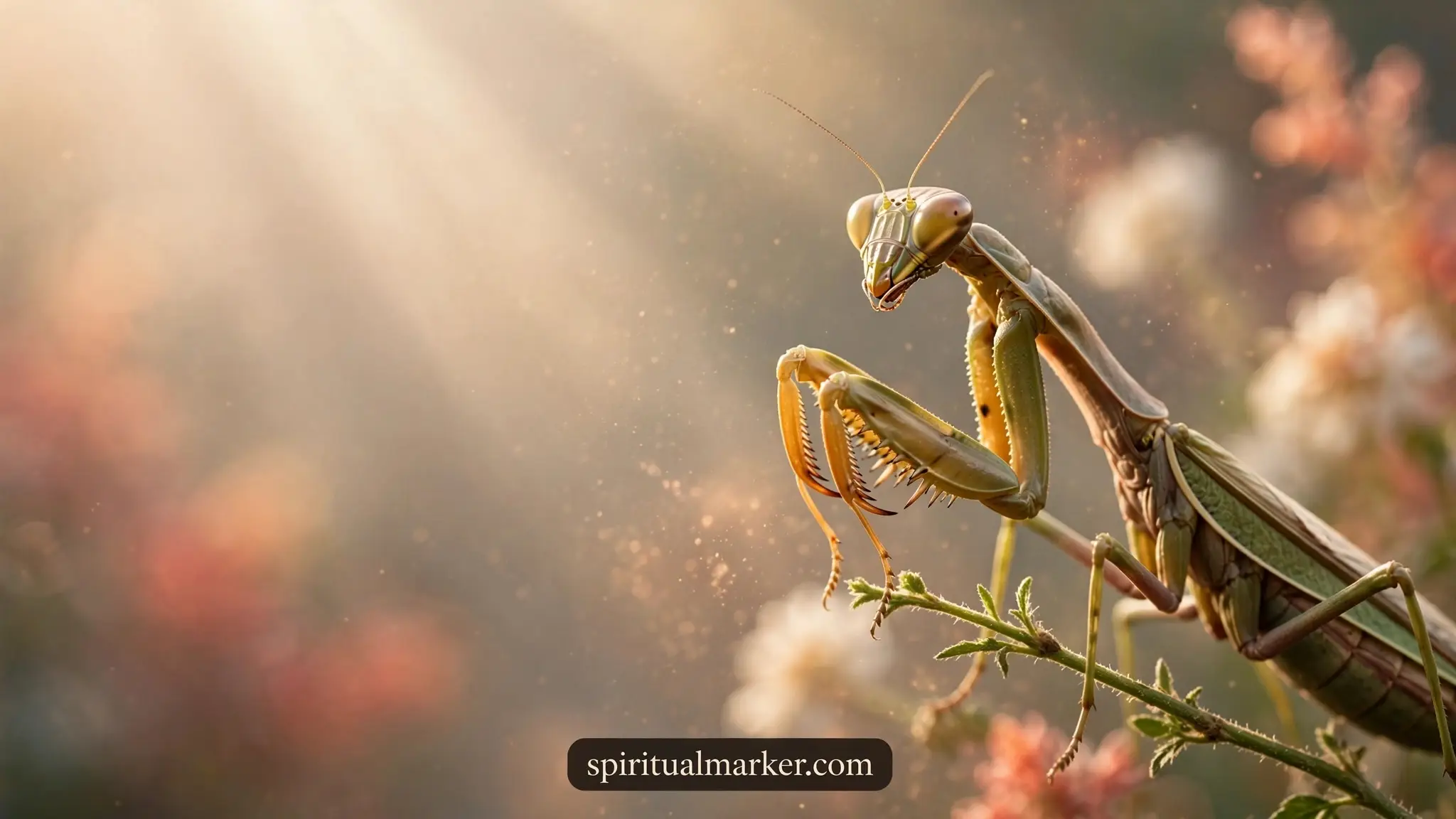
You spot a praying mantis clinging to a leaf, perfectly still, its triangular head turned toward you like it already knows your name. Something about that gaze feels different from a random bug encounter. It feels deliberate. That is exactly why the praying mantis spiritual meaning has fascinated mystics, shamans, and everyday people across thousands of years and dozens of cultures.
This insect does not move like other creatures. It waits. It watches. It strikes only when the moment is right. Spiritually, that pattern is loaded with meaning. The mantis symbolism touches on patience, intuition, stillness, and the kind of quiet power that does not need to shout to be effective. Ancient Egyptians linked it to the afterlife. Indigenous African tribes saw it as a divine messenger. Greek folklore named it after a prophet.
You will learn what a praying mantis sighting means spiritually, how different cultures and religions interpret this insect, what it represents in mythology, and what it means when one shows up in your dreams. Whether the mantis appeared on your porch, in your garden, or in a vivid dream last night, this breakdown will help you understand the message behind the moment.
Key Takeaways
- The praying mantis symbolizes stillness and patience. Its hunting style, waiting motionless before striking, mirrors a spiritual lesson about timing and calm focus rather than rushed action.
- It is widely seen as a messenger or guide. Across African, Asian, and Indigenous traditions, the mantis often arrives as a sign from spirit, ancestors, or the universe itself.
- Its name comes from its prayer-like posture. The folded front legs resemble hands clasped in prayer, giving this insect a deep connection to meditation, faith, and inner stillness.
- Dreaming about a mantis often points inward. Psychologically, it can reflect a need to slow down, trust your intuition, or pay closer attention to your surroundings.
- Color and context shape the message. A green mantis, a brown mantis, or one seen during a major life decision can each carry a slightly different spiritual nuance.
What Is a Praying Mantis and Does It Hold Spiritual Power?
A praying mantis is a predatory insect found on nearly every continent, instantly recognizable by its elongated body, triangular head, and bent front legs held together as if clasped in prayer. There are more than 2,400 known species, ranging from the orchid mantis that mimics flower petals to the giant Asian mantis that can grow over six inches long. Biologically, it is simply an ambush predator. Spiritually, it has become one of the most symbolically rich insects on earth.
Its name itself gives away the spiritual hook. Early naturalists looked at its folded legs and saw something reverent, something that looked like worship. That single visual detail launched centuries of spiritual projection onto this small creature. People did not just see a bug. They saw a tiny figure paused mid-prayer, and that image stuck.
Beyond appearance, the mantis earns its spiritual reputation through behavior. It can rotate its head nearly 180 degrees, giving it a field of vision unmatched by most insects. It strikes with such speed that the human eye barely registers the motion. It remains motionless for long stretches, blending into bark or leaves, before committing fully to one decisive action. Stillness followed by precision is rare in nature, and rarer still in human behavior, which is exactly why so many traditions hold this insect up as a teacher.
What Does Seeing a Praying Mantis Symbolize or Represent?
When a praying mantis crosses your path, most spiritual traditions agree on one core theme: pay attention to your pace. You may be rushing through a decision, a relationship, or a season of life. The mantis appears as a living reminder to slow down, observe fully, and act only when you are certain. It rarely symbolizes danger. It symbolizes discernment.
A mantis sighting frequently represents a call to trust your intuition. Because the insect relies on stillness and acute perception rather than speed or strength, it models a kind of wisdom that values inner knowing over outer noise. If you have been second-guessing a gut feeling, seeing this insect can feel like permission to listen to it.
It also represents balance between patience and decisive action. The mantis does not wait forever. It waits exactly long enough, then commits fully. Spiritually, that balance speaks to people stuck in either extreme, those who act too impulsively or those who never act at all. Seeing this creature nudges you toward the middle path, where calm observation meets confident timing.
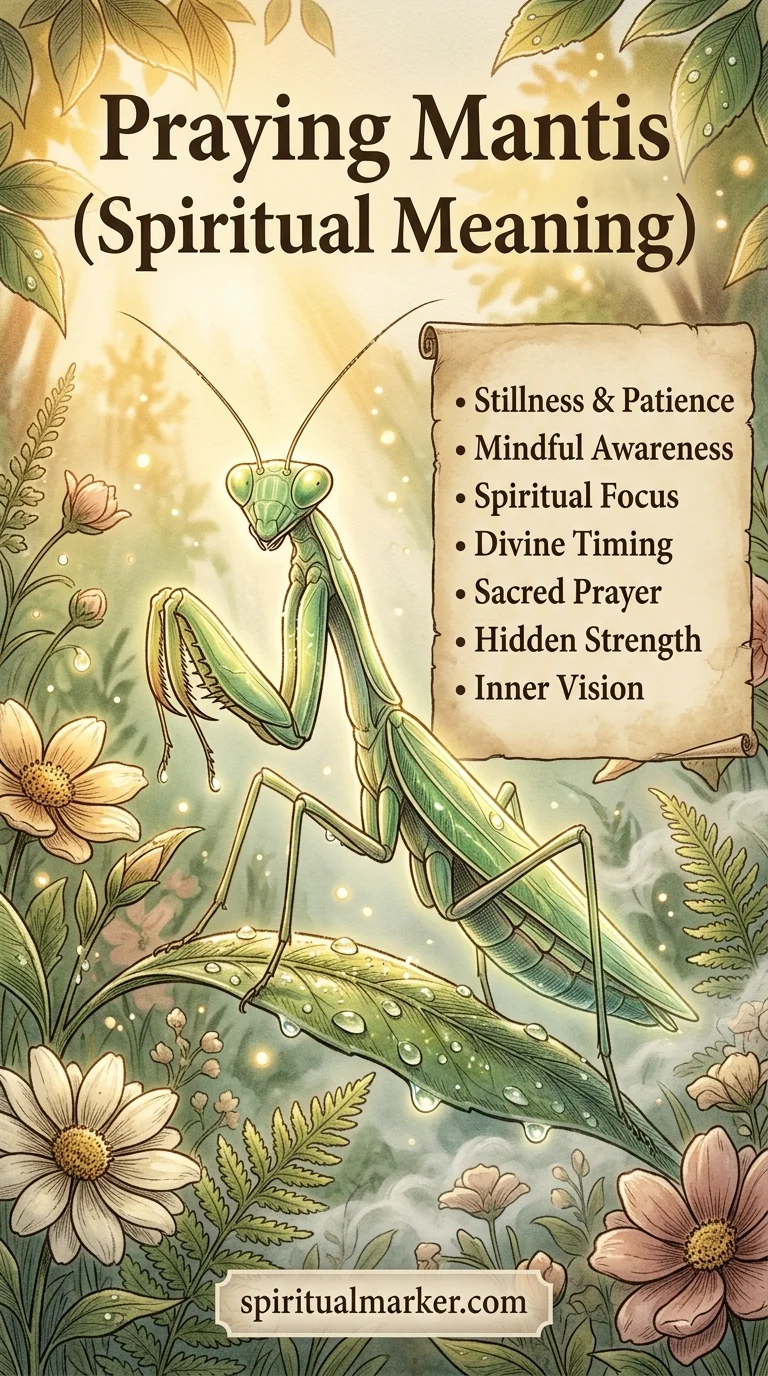
7 Spiritual Meanings of the Praying Mantis
1. A Call to Stillness and Patience
Life often teaches us that success belongs to those who move the fastest, speak the loudest, or work the hardest. Yet the praying mantis presents a completely different lesson. It spends long periods remaining perfectly still, conserving its energy while observing everything around it. Rather than chasing every opportunity, it waits with remarkable patience until the right moment arrives. This behavior has made the praying mantis one of the strongest spiritual symbols of stillness, patience, and purposeful timing.
When a praying mantis appears, many spiritual traditions interpret it as a reminder that constant action is not always the answer. There are seasons when growth happens beneath the surface, even if nothing appears to be changing externally. Just as seeds develop underground before breaking through the soil, our own lives often require quiet periods where preparation matters more than visible progress.
This symbolism becomes especially meaningful during times of uncertainty. You may feel pressure to make immediate decisions, fix every problem, or force situations into place. The mantis gently challenges that mindset by showing that patience is not the same as inactivity. It represents a state of alert readiness, where you remain attentive, emotionally grounded, and prepared without becoming anxious or impulsive.
Many spiritual teachers also associate this meaning with mindfulness. The mantis exists completely in the present moment. It does not appear distracted by what happened yesterday or consumed by what might happen tomorrow. Instead, it gives its full attention to what is directly before it. That quality encourages us to slow our racing thoughts and reconnect with the present, where clarity often becomes much easier to find.
In this sense, the praying mantis reminds us that some answers arrive only after we stop chasing them. Patience creates space for wisdom, and stillness often reveals opportunities that hurried minds completely overlook.
2. Heightened Intuition and Awareness
The praying mantis possesses extraordinary awareness of its surroundings. It can turn its triangular head far beyond what most insects can manage, allowing it to observe nearly everything without moving the rest of its body. This unique characteristic has inspired centuries of spiritual symbolism connected to intuition, perception, and heightened awareness.
Across many spiritual traditions, the mantis represents the ability to notice what remains hidden from ordinary observation. People who encounter a praying mantis often describe feeling more sensitive to subtle signs, emotional shifts, or inner impressions shortly afterward. While these experiences cannot be scientifically verified as spiritual events, they have become deeply rooted in folklore and personal belief.
This symbolism frequently appears during periods when something feels uncertain. Perhaps a relationship no longer feels authentic, a career path seems misaligned, or an opportunity raises both excitement and hesitation. Even when logical evidence remains incomplete, intuition often recognizes patterns long before the conscious mind catches up. The praying mantis symbolizes confidence in that quiet inner knowing.
Rather than encouraging suspicion, however, the mantis promotes careful observation. It teaches discernment instead of fear. True intuition develops through calm attention rather than emotional reactivity. By slowing down and paying closer attention to conversations, recurring patterns, and inner feelings, people often notice details they previously overlooked.
Spiritually, heightened awareness also extends beyond external events. A mantis encounter may symbolize growing self-awareness, inviting you to notice your own habits, emotional triggers, recurring thoughts, and spiritual needs. As awareness expands, wiser choices often become more natural because they arise from deeper clarity rather than momentary emotion.
3. Connection to Prayer and Devotion
Few insects carry a name as spiritually symbolic as the praying mantis. Its folded front legs closely resemble hands joined in prayer, and this distinctive posture has inspired religious and spiritual interpretations across cultures for centuries. Although the insect is not actually praying, its appearance naturally evokes ideas of reverence, contemplation, and sacred connection.
Many people view a praying mantis sighting as an invitation to renew their relationship with the divine, however they personally define it. For some, that means returning to regular prayer. For others, it involves meditation, quiet reflection, gratitude, or spending intentional time in nature. The central message remains the same: meaningful spiritual connection often grows in silence rather than constant activity.
This symbolism carries particular significance during seasons of distraction. Modern life fills our attention with endless notifications, responsibilities, and noise, leaving little room for reflection. The still posture of the mantis stands in striking contrast to that constant busyness. It reminds us that spiritual nourishment rarely comes through hurried moments. Instead, it develops gradually through consistent periods of quiet presence.
Many contemplative traditions emphasize that silence allows people to hear what constant activity often drowns out. Whether someone believes in God, the universe, guardian spirits, or simply the wisdom of the inner self, moments of stillness create opportunities for deeper insight. The praying mantis symbolizes this quiet openness.
Its prayer-like stance also represents humility. The insect appears calm, composed, and fully present, offering a visual reminder that genuine devotion does not require elaborate ceremonies or public displays. Sometimes the deepest spiritual experiences emerge through simple moments of gratitude, reflection, and sincere attention.
4. A Messenger from the Spirit World
Throughout history, numerous cultures have regarded unusual animal encounters as meaningful spiritual events rather than random coincidences. The praying mantis holds a particularly respected place within several African traditions, Indigenous belief systems, and various forms of modern spirituality, where it often symbolizes communication between the physical and spiritual worlds.
In these traditions, the sudden appearance of a praying mantis may suggest that guidance is arriving from beyond ordinary awareness. People sometimes report seeing one shortly after praying for direction, grieving the loss of a loved one, or questioning an important life decision. Although interpretations differ widely, many describe these encounters as deeply personal and emotionally significant.
Part of this symbolism comes from the mantis itself. Its calm gaze, slow movements, and direct eye contact create an unusual sense of presence compared to many other insects. People frequently describe feeling that the mantis is observing them with unusual intention, which strengthens its reputation as a spiritual messenger.
Different traditions interpret these messages differently. Some believe the mantis carries reassurance from ancestors. Others see it as confirmation that spiritual guides are nearby or that the universe has acknowledged a heartfelt prayer. Still others interpret the encounter as a reminder to pay closer attention to recurring dreams, meaningful coincidences, or inner convictions that have been repeatedly surfacing.
From a broader symbolic perspective, the praying mantis represents openness to guidance rather than certainty about its source. Whether viewed through religious faith, cultural tradition, or personal spirituality, its appearance encourages thoughtful reflection on the possibility that wisdom sometimes arrives through unexpected moments.
5. Camouflage and the Power of Adaptability
The praying mantis ranks among nature’s most remarkable masters of camouflage. Many species blend almost perfectly with green leaves, tree bark, flowers, or dry branches, making them nearly invisible to both predators and prey. This extraordinary ability has given the mantis powerful spiritual associations with adaptability, wisdom, and strategic timing.
Spiritually, camouflage does not symbolize deception. Instead, it reflects the ability to adjust wisely to changing circumstances without losing one’s true identity. Life constantly requires adaptation as careers shift, relationships evolve, and unexpected challenges emerge. The mantis demonstrates that flexibility often creates strength rather than weakness.
This lesson becomes especially valuable during periods of transition. Entering a new workplace, moving to a different community, or navigating unfamiliar social situations often requires observation before action. Rather than rushing to establish control or gain attention, the mantis symbolizes learning the environment first. Careful observation allows thoughtful decisions to replace impulsive reactions.
Many leadership experts and psychologists also recognize observation as an essential skill for effective decision making. Spiritual traditions express a similar principle through the symbolism of the mantis. Quiet awareness frequently produces better outcomes than constant visibility. There is wisdom in knowing when to speak, when to act, and when simply to watch.
The mantis also reminds us that outward appearances rarely reveal the whole story. Just as the insect remains hidden within its surroundings while maintaining complete confidence in its abilities, people often possess strengths that do not require constant recognition. True influence grows through wisdom, consistency, and well-timed action rather than continual self-promotion.
6. Transformation Through Cycles
Growth rarely happens all at once. The praying mantis illustrates this truth through its own remarkable life cycle. Before reaching adulthood, it molts several times, shedding its rigid outer shell to allow further development. Each stage leaves the insect temporarily vulnerable, yet every molt becomes essential for its survival and maturity.
Because of this process, many spiritual traditions associate the praying mantis with transformation, renewal, and personal evolution. It symbolizes the reality that meaningful growth often requires releasing old identities, beliefs, habits, or relationships that can no longer support the next stage of life.
Periods of transformation frequently feel uncomfortable because they involve uncertainty. A career change, relocation, healing journey, divorce, spiritual awakening, or major personal shift can leave someone feeling exposed and uncertain about what comes next. The mantis reflects this vulnerable stage with remarkable accuracy. During each molt, it cannot immediately return to normal activity. It must allow time for its new outer layer to strengthen before moving forward.
Spiritually, this serves as a powerful reminder that change is rarely instant or effortless. Personal growth unfolds through stages, each requiring patience and resilience. Looking back, many people recognize that their most difficult transitions also became the foundation for their greatest wisdom.
The praying mantis therefore represents hope within transformation. Even when familiar parts of life fall away, the process itself may be preparing something stronger and more authentic. Every ending creates space for another beginning, and every stage contributes to the person we gradually become.
7. Feminine Power and Fierce Boundaries
The praying mantis has become widely recognized as a symbol of feminine strength, largely because of the female’s dominant role within the species. Although popular stories often exaggerate the well-known behavior of females consuming males after mating, scientists note that this occurs far less frequently than folklore suggests and depends heavily on environmental conditions. Even so, the symbolism surrounding the female mantis has remained powerful across many spiritual interpretations.
Rather than focusing on aggression, spiritual traditions often view the female mantis as representing independence, self-preservation, and unwavering commitment to purpose. She prioritizes survival, reproduction, and instinct without seeking approval from others. This has made the praying mantis a meaningful symbol for people learning to establish healthier boundaries in their own lives.
Many individuals spend years placing the needs of others ahead of their own emotional, physical, or spiritual well-being. Over time, this pattern can lead to exhaustion, resentment, and loss of identity. The praying mantis symbolizes the importance of recognizing personal worth and protecting one’s energy with confidence rather than guilt.
This symbolism resonates particularly strongly in discussions of feminine spirituality, where the mantis often represents quiet authority instead of loud dominance. It demonstrates that strength does not always announce itself. Sometimes true power appears calm, composed, and deeply rooted in self-respect.
More broadly, the mantis reminds everyone, regardless of gender, that healthy boundaries create stronger relationships rather than weaker ones. Respecting your own values, protecting your peace, and remaining faithful to your purpose are not acts of selfishness. They reflect emotional maturity and spiritual balance, allowing compassion for others without sacrificing yourself in the process.
Praying Mantis Symbolism Across Cultures and Religions
In ancient Egypt, the mantis held genuine religious weight. Egyptians associated the insect with the afterlife and sometimes depicted it as a guide that helped souls find their way through the underworld. Its still, watchful posture matched perfectly with the Egyptian reverence for patient guardianship of sacred passages.
The San people of southern Africa hold one of the deepest spiritual connections to this insect of any culture on earth. In San cosmology, the mantis is often identified with a trickster-creator deity, sometimes called Kaggen or Cagn, who shaped the world and continues to communicate with humans through dreams and signs. For the San, a mantis sighting is rarely casual. It often signals that the divine is actively present and watching.
In Chinese tradition, the mantis appears in martial arts history through Northern Praying Mantis Kung Fu, a fighting style inspired directly by the insect’s quick strikes and patient stance. Spiritually, this connects the mantis to disciplined focus, controlled aggression, and the idea that small, precise movements can overcome larger opposing forces.
European folklore took a slightly different turn. Medieval farmers in parts of France and Italy believed a mantis pointing its folded legs toward someone could indicate the direction to walk if lost, treating the insect as a quiet, accidental guide through unfamiliar territory. This belief, while less formalized than African or Egyptian traditions, still reflects the universal human instinct to read meaning into the mantis’s deliberate, prayer-like stillness.
Praying Mantis Symbolism in World Mythologies
Greek mythology gave the praying mantis its scientific name through the word “mantis,” meaning prophet or seer. Ancient Greeks believed the insect possessed supernatural insight, capable of pointing lost travelers toward home or revealing hidden truths through its unblinking gaze. This is the same root that gives us the word “divination,” tying the mantis permanently to prophecy and foresight.
In San mythology, the trickster deity Kaggen takes the form of a mantis to walk among humans, observe their behavior, and occasionally test their character through clever, sometimes mischievous interactions. This mythological framing positions the mantis as both creator and observer, a being deeply involved in human affairs despite its small, unassuming physical form.
Some West African oral traditions describe the mantis as a spirit that once held a human form before being transformed for disobeying spiritual laws, doomed to forever pray for forgiveness in its folded, motionless posture. Whether literal belief or symbolic teaching tale, this myth reinforces the same idea found across cultures: the mantis is never just an insect. It carries a story.
Praying Mantis Biblical Meaning and Significance
The praying mantis is not named directly in scripture, but its symbolism aligns closely with several biblical themes around stillness, patience, and prayer. Psalm 46:10 instructs believers to “be still, and know that I am God,” a verse many Christians naturally connect to the mantis’s motionless, watchful posture. The insect becomes a living illustration of a verse many struggle to practice.
The folded posture of the mantis also echoes the biblical model of prayer found throughout both the Old and New Testaments, where kneeling, bowing, and stillness accompany sincere communication with God. 1 Thessalonians 5:17 calls believers to “pray without ceasing,” and some interpret the mantis’s near-constant prayer-like stance as a small natural reminder of that continual devotion.
It is worth noting clearly that the mantis holds no formal place in biblical doctrine, and any spiritual meaning attached to it within a Christian context is symbolic interpretation rather than scriptural fact. Many believers simply enjoy the parallel as a gentle nature-based reminder of faith, rather than treating the insect as a religious sign in itself.
Praying Mantis Colors and Their Spiritual Meanings
A green praying mantis, the most commonly encountered color, carries strong ties to growth, healing, and renewal. Green naturally represents the heart chakra in many energy-based spiritual systems, so a green mantis often signals emotional healing, the strengthening of relationships, or a season of personal growth taking root.
A brown praying mantis leans more grounded and practical in its symbolism. Brown connects to the earth element, stability, and survival instincts. Spotting a brown mantis frequently points toward financial matters, practical decisions, or a need to ground yourself firmly before moving forward with a major life choice.
A rare pink or orchid mantis sighting, while biologically tied to specific species rather than random coloration, often gets interpreted spiritually as a sign of rare beauty, deception revealed, or hidden gifts about to surface. Because these mantises mimic flowers to lure prey, the spiritual lesson centers on looking beyond surface appearances to find truth.
A white or albino mantis, exceptionally rare in nature, carries the heaviest spiritual weight in most traditions. White consistently represents purity, divine connection, and major spiritual awakening across nearly every culture. An encounter with one is often described by spiritual practitioners as a once-in-a-lifetime sign tied to significant life transformation.
Praying Mantis as a Spirit Animal and Totem
People who feel a strong, recurring connection to this insect often claim it as a spirit animal or totem, meaning it acts as a guiding presence throughout life rather than appearing only in single moments. If the mantis is your spirit animal, you likely possess natural patience, sharp intuition, and an ability to read situations before others notice anything is happening at all.
Mantis totem energy often shows up strongest during major decision points. You may find yourself naturally pausing before reacting, observing people’s body language closely, or waiting for the right moment rather than forcing timing. This is not hesitation or fear. It is the calculated stillness the mantis itself embodies in nature.
People with mantis as a totem also tend to value solitude and quiet reflection over constant social stimulation. Just as the mantis spends most of its life alone, waiting and observing, those connected to this totem often recharge best in silence, away from noise and unnecessary distraction. Honoring this need rather than fighting it tends to strengthen your spiritual clarity significantly.
Dreaming About a Praying Mantis: Spiritual and Psychological Meanings
A dream featuring a praying mantis often reflects your relationship with patience and timing in waking life. If the mantis in your dream remains calm and still, it usually signals that you are handling a current situation with appropriate caution and wisdom. The dream affirms your current pace rather than warning against it.
If the mantis appears aggressive or strikes suddenly in your dream, this commonly points to suppressed frustration or a decision you have delayed for too long. Psychologically, the dreaming mind often uses predator imagery to represent parts of yourself, your assertiveness, your boundaries, your ambition, that feel restrained during your waking hours.
Dreaming of multiple mantises together frequently relates to community, family dynamics, or feeling watched and judged within a group setting. Pay close attention to where the dream takes place, since a mantis appearing in your childhood home often points to unresolved family patterns, while one appearing in a workplace setting usually points to career-related caution.
From a purely psychological lens, dream researchers note that insect dreams in general often correlate with feelings of being small, overlooked, or underestimated in some area of life. A mantis specifically, given its hunting precision, may reflect an unconscious desire to finally act decisively after a long period of being passive or overlooked by others.
A Final Note
The praying mantis earns its spiritual reputation honestly. Few creatures embody patience, perception, and precise timing as clearly as this small, watchful insect. Whether it appeared on your windowsill, in your garden, or in a dream that stuck with you long after waking, the message tends to circle back to the same core idea: slow down, trust what you sense, and act when the moment is truly right rather than when fear or impatience pushes you forward.
If a mantis has recently entered your life, sit with the encounter rather than rushing to label it. Notice your circumstances at the time, your emotional state, and which of the seven meanings above resonates most strongly with what you are currently navigating. You might keep a short journal entry about the encounter, including the color of the mantis, where you saw it, and what was happening in your life that week. Patterns often reveal themselves clearly only in hindsight, and this small, quiet insect may turn out to be one of the more meaningful teachers you encounter this year.