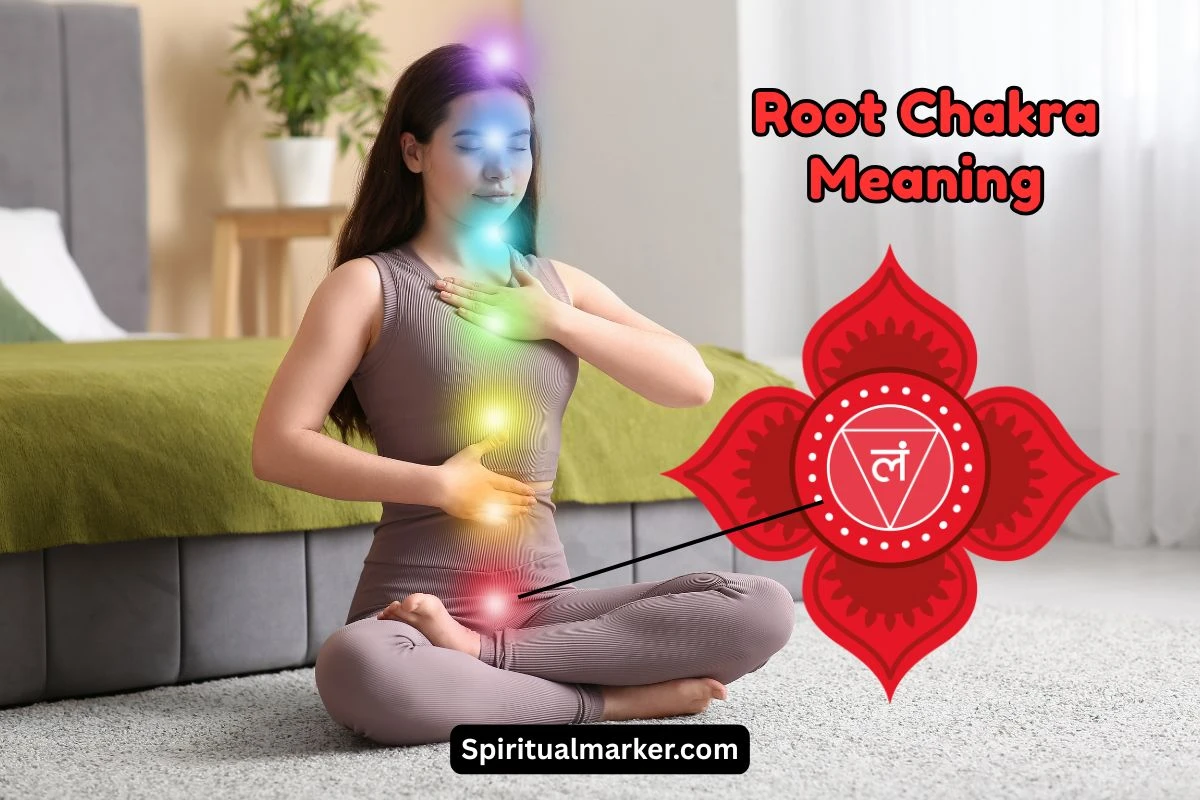
The root chakra sits at the base of the spine. It is the first chakra, often called Muladhara, which means root support. This energy center governs survival, safety, and grounding.
The root chakra meaning often involves stability, security, and the ability to feel at home in your body. When balanced, it brings a sense of calm and trust. A spiritual meaning of sacral chakra shares that chakra focus, though the sacral relates to creativity and emotion.
When blocked, the root chakra can cause anxiety, fear, or a sense of being ungrounded. Practices like walking barefoot, spending time in nature, and eating root vegetables can help open it. The color associated with this chakra is red.
If you feel ungrounded, the root chakra may need attention. A spiritual meaning of crown chakra also deals with chakra symbolism, though the crown relates to divine connection.
What Is the Root (Muladhara) Chakra?
At the base of your spine sits the most primal, foundational energy center in your body. It is called the root chakra, or in Sanskrit, Muladhara. The word itself tells you everything: “Mula” means root, and “Adhara” means support or base. Together, Muladhara translates to the foundation upon which everything else is built.
In the ancient system of yogic philosophy, the human body contains seven major chakras, or energy centers. These chakras run along the central channel of the body, called the Sushumna Nadi, beginning at the base of the spine and rising to the crown of the head. The root chakra is the first chakra in this system, and it anchors the entire energetic body to the physical world.
Think of it this way: a tree without strong, deep roots will collapse at the first storm. The same is true for you. Without a stable, open, and functioning root chakra, the other six chakras above it have no true foundation to stand on. Spiritual growth, emotional resilience, mental clarity, and physical vitality all depend, at least in part, on the health of your Muladhara.
The root chakra governs your most instinctual needs. It is connected to your sense of survival, safety, belonging, and physical identity. It holds the energy of your earliest experiences, including those formed in childhood, your relationship with family, your sense of belonging in the world, and your fundamental belief about whether life is safe or threatening. When those early experiences were stable and nurturing, the root chakra tends to thrive. When they were chaotic, neglectful, or traumatic, the root chakra often becomes blocked or imbalanced.
This chakra is also deeply tied to the physical body itself. Unlike the higher chakras, which relate to emotions, intellect, and spirituality, the root chakra is unapologetically physical. It rules the body’s basic needs: food, shelter, warmth, rest, and safety. It is the chakra of the earth, of the material world, and of the present moment.
Ancient texts like the Yoga-Tattva Upanishad and the Sat-Chakra-Nirupana describe Muladhara as the seat of Kundalini energy, the coiled serpent power that lies dormant at the base of the spine until awakened through spiritual practice. In this tradition, activating and balancing the root chakra is the essential first step toward any meaningful spiritual journey.
Where Is the Root Chakra Located?
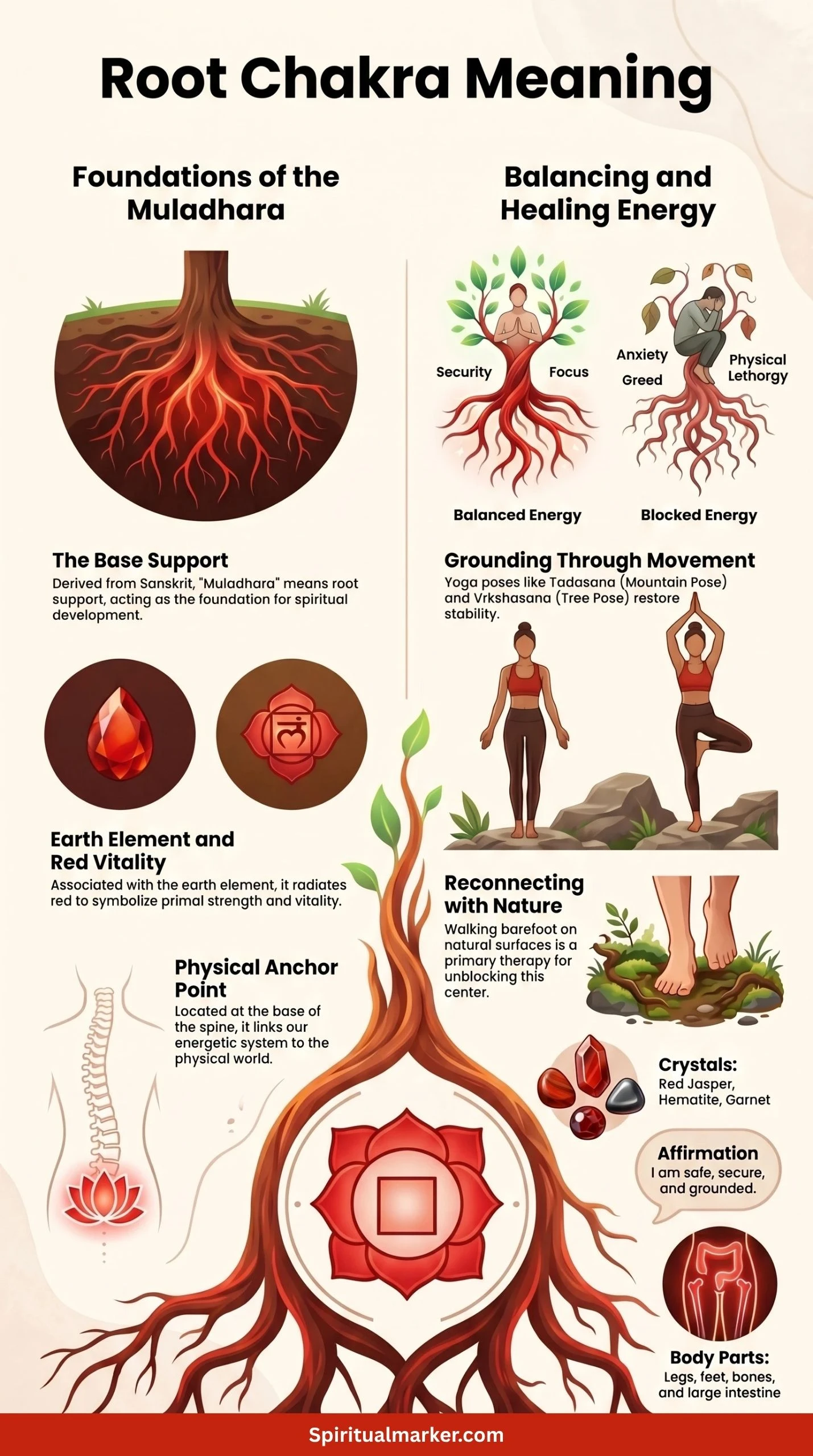
The root chakra location is at the very base of the spine, in the area of the perineum, which sits between the genitals and the anus. In anatomical terms, it corresponds roughly to the coccyx (tailbone) and the pelvic floor muscles.
When you sit on the ground in meditation, the root chakra is the point of your body that connects most directly with the earth. This is not a coincidence. Its physical placement reinforces its spiritual purpose: to keep you anchored, present, and connected to physical reality.
In men, the root chakra is located at the perineum. In women, it is positioned slightly higher, near the cervix. However, in both cases, its energetic influence radiates throughout the lower body, including the legs, feet, lower spine, and the base of the pelvis.
The root chakra also has a corresponding location on the front of the body, roughly at the pubic bone area. Some energy healers work with both the front and back aspects of each chakra, recognizing that energy flows through the body in all directions.
When practitioners perform energy healing, Reiki, or acupuncture, they pay particular attention to the root chakra location when a client reports feelings of insecurity, fear, financial anxiety, chronic fatigue, or disconnection from the body. These are all signals that the first chakra may need attention.
What Is the Root Chakra Responsible for?
The root chakra is responsible for a wide range of physical, psychological, and energetic functions. Understanding its responsibilities helps you recognize when it is out of balance and what it needs to thrive.
At its most fundamental level, the root chakra governs survival instincts. This includes the basic biological drives that every human being shares: the drive to eat, sleep, stay warm, find shelter, and protect yourself from danger. These are not abstract concepts. They are primal, embodied impulses, and the root chakra is their energetic home.
Beyond pure survival, the root chakra is responsible for your sense of safety and security in the world. This extends beyond physical safety to psychological safety. Do you feel secure in your relationships? Do you trust that your needs will be met? Do you believe you belong here, in this body, in this life? These are root chakra questions.
The Muladhara also governs your relationship with money and material resources. Financial anxiety, a scarcity mindset, the fear of losing your home or job, and the constant worry about not having enough are all expressions of root chakra imbalance. On the flip side, a person with a healthy root chakra feels a quiet confidence in their ability to meet their needs and sustain themselves in the physical world.
Your sense of identity and belonging also originates here. This chakra holds the energy of your tribal identity, your family of origin, your cultural roots, and your sense of place in the community. It asks: do you know who you are at the most basic level? Do you feel that you belong somewhere and to someone?
The root chakra is also responsible for your physical vitality and connection to your body. When it is healthy, you feel present in your body, energized, and grounded. You are not floating in your head, overwhelmed by anxiety or disconnected from physical sensation. You feel here, now, solid, and real.
Characteristics of the Root Chakra
Every chakra has a distinct set of characteristics that define its nature and energy. The root chakra has a rich symbolic language that has been refined over thousands of years of yogic tradition.
Element
The element associated with the root chakra is Earth. This is deeply fitting. Earth is solid, stable, and tangible. It provides the ground beneath your feet and the nutrients that sustain life. The earth element in the Muladhara chakra represents matter, physicality, density, and permanence. When your root chakra is balanced, you carry the quality of earth within you. You are steady, reliable, patient, and present. You are not easily swept away by emotional storms or external chaos.
Working with the earth element is one of the most powerful ways to heal the root chakra. This means spending time in nature, walking barefoot on soil or grass (a practice known as earthing or grounding), gardening, eating root vegetables, or simply sitting on the ground and feeling its solid support beneath you.
Color
The color of the root chakra is red, specifically a deep, rich, vibrant red. Red is the color of blood, of fire, of the life force itself. It is a color of power, vitality, passion, and primal energy. In color therapy, red is known to stimulate the nervous system, increase alertness, and promote a sense of physical presence and energy.
When working with the root chakra, surrounding yourself with the color red can have a subtle but real effect on your energy. This might mean wearing red clothing, placing red crystals like red jasper or garnet in your space, or visualizing a glowing red light at the base of your spine during meditation.
Symbol
The symbol of the root chakra is a four-petaled lotus flower, typically depicted in deep red or crimson. Each of the four petals represents one of the four aspects of the mind in yogic philosophy: Manas (mind), Buddhi (intellect), Chitta (consciousness), and Ahamkara (ego). These four facets of awareness all find their most basic expression in the root chakra.
At the center of the lotus sits a downward-pointing triangle, which represents the grounding of energy into the earth and the feminine principle of contraction and stability. Inside the triangle is a symbol of the Muladhara bija (seed) mantra, and often a depiction of the Kundalini serpent coiled three and a half times around a lingam (a symbol of creative potential).
The entire image conveys downward, inward, stabilizing energy. It is the opposite of the expansive, upward-reaching energy of the higher chakras. The root chakra draws you down, in, and into the present moment.
Mantra
The seed mantra (bija mantra) of the root chakra is LAM (pronounced “lum”). Chanting LAM is believed to activate and purify the Muladhara energy center. The vibration of this sound resonates at the frequency of the earth element and the first chakra.
In traditional Nada yoga (the yoga of sound), chanting bija mantras is considered one of the most direct and powerful ways to influence chakra energy. When you chant LAM repeatedly, either aloud or silently in meditation, the vibration is said to loosen stagnant energy in the root chakra, stimulate the associated nerve plexus, and begin the process of awakening the Kundalini energy sleeping at its base.
Other associated mantras and prayers include “I am safe,” “I am grounded,” and “I belong.” These affirmations function as verbal anchors that reinforce the core qualities of a healthy Muladhara.
Ruling Planet and Deity
The root chakra is associated with the planet Saturn, which governs structure, discipline, boundaries, and the material world. In Hindu tradition, the deity associated with Muladhara is Lord Ganesha, the elephant-headed god of beginnings, who removes obstacles and establishes a stable foundation for all endeavors. The goddess Dakini is also associated with this chakra as its Shakti energy, representing the raw creative and protective power of the earth.
Sense and Body Parts
The sense organ connected to the root chakra is smell, the most primal of the five senses and the one most directly linked to instinct and memory. The organ of action is the anus and large intestine, which govern the release of what the body no longer needs.
The body parts governed by the root chakra include the legs, feet, knees, hips, tailbone, lower spine, adrenal glands, kidneys, and the large intestine. Problems in any of these areas can reflect or contribute to a root chakra imbalance.
Emotions, Mental Health and the Root Chakra
The connection between the root chakra and emotional wellbeing is profound and often underestimated. The Muladhara is not merely a physical energy center. It is the energetic container for your most deeply held emotional patterns, particularly those formed in early life.
Fear is the primary emotion of an imbalanced root chakra. When the first chakra is blocked or underactive, fear becomes the dominant lens through which you experience life. This is not just the fear of specific threats. It is a generalized, ambient anxiety, a background hum of “something is wrong” or “I am not safe.” This kind of chronic, diffuse fear is one of the hallmarks of a disrupted Muladhara.
The root chakra is also deeply connected to trauma. Traumatic experiences, especially those involving physical threat, abandonment, poverty, domestic instability, or loss, are stored in the root chakra’s energetic field. This is consistent with modern somatic psychology, which recognizes that trauma is held in the body, particularly in the lower body, hips, and pelvic region. Practices like somatic experiencing, trauma-sensitive yoga, and body-based therapy all work, in part, by addressing this root-level stored tension.
Anxiety disorders, PTSD, and chronic stress are all conditions that reflect, at least in part, a destabilized root chakra. When the body’s threat-detection system (governed by the amygdala and the sympathetic nervous system) is constantly activated, the root chakra remains in a state of hypervigilance. The body cannot distinguish between past threats and present safety. Grounding practices that restore root chakra balance can be powerful complements to clinical mental health treatment.
On the opposite end, when the root chakra is overactive, it can produce a different set of emotional challenges. Greed, hoarding, materialism, rigidity, aggression, and an excessive attachment to security are all signs of an overactive Muladhara. The person becomes so fixated on physical safety and material accumulation that they lose the capacity for spontaneity, trust, or spiritual openness.
A balanced root chakra produces emotional states of calm, security, trust, patience, and equanimity. You feel rooted in yourself. You can face uncertainty without panic. You have a quiet confidence in your own resilience and in the basic goodness of life. You feel at home in your body and at home in the world.
Signs and Symptoms of a Blocked Root Chakra
Recognizing a blocked root chakra is the first step toward healing it. The symptoms can be physical, emotional, behavioral, or relational, and they often appear together in clusters.
Emotional Symptoms
The emotional signs of a blocked or imbalanced root chakra are often the first that people notice, though they rarely connect them to chakra health.
Chronic anxiety and fear are the clearest signals. When the root chakra is blocked, the nervous system operates in a near-constant state of low-grade alarm. You might worry about money even when your finances are stable. You might feel vaguely unsafe even when no real threat exists. You might struggle to relax, to be present, or to feel that everything is okay.
Low self-worth and insecurity are also common. The root chakra holds the foundation of your identity, the most basic sense of “I exist and I matter.” When this energy is depleted or blocked, you may struggle to feel that you have a right to be here, to take up space, or to ask for what you need.
Disconnection from the body is another major emotional symptom. Many people with a blocked Muladhara report feeling “in their heads,” dissociated from physical sensation, or emotionally numb. They may intellectualize everything while struggling to feel present in their physical experience.
Depression, hopelessness, and a sense of not belonging also arise from root chakra imbalance. When your foundation is unstable, the entire structure above it feels precarious. You may feel rootless, adrift, or as if you do not quite fit in anywhere.
Materialism and financial obsession can reflect an overactive root chakra. A relentless focus on accumulating wealth, possessions, or security at the expense of relationships and spiritual growth signals that the Muladhara is stuck in survival mode.
Trust issues and difficulty with commitment are also root chakra symptoms. Because this chakra governs belonging and safety, its disruption often shows up in relationships as an inability to trust others, to commit to a home or community, or to feel truly connected.
Physical Symptoms
The body speaks the language of the chakras, and the root chakra is no exception. Because it governs the lower body and the adrenal system, its imbalances tend to manifest in very specific and recognizable physical ways.
Lower back pain is perhaps the most common physical symptom of root chakra imbalance. The lumbar spine and sacrum are directly in the energetic territory of the Muladhara, and chronic tension or pain in this area often reflects stored fear, instability, or an unresolved threat response in the nervous system.
Problems with the legs, knees, and feet are also associated with the root chakra. These include conditions like sciatica, varicose veins, plantar fasciitis, and chronic leg tension. The legs are your literal means of standing your ground and moving through the world. When the root chakra is imbalanced, this can manifest physically in how you carry and use your lower limbs.
Adrenal fatigue is a significant physical sign. The adrenal glands, which sit above the kidneys and produce stress hormones like cortisol and adrenaline, are governed by the root chakra. Chronic stress, overwork, and a prolonged threat response can exhaust the adrenals, leading to fatigue, insomnia, immune suppression, and hormonal imbalance.
Digestive issues, particularly those affecting the large intestine, such as constipation, IBS, and bloating, can reflect root chakra blockage. These conditions often have a significant stress and anxiety component, which points directly back to the Muladhara.
Weight issues, both unexplained weight gain (as the body tries to create a sense of physical security and groundedness through mass) and unexplained weight loss or poor appetite, can be connected to root chakra disruption.
Immune system weakness, frequent colds, chronic infections, and slow recovery from illness can also indicate a depleted root chakra. The body’s basic vitality and defense system draws on the foundational energy of the Muladhara.
How to Support and Balance the Root Chakra
Healing the root chakra is a multidimensional process. It works on the body, the mind, the emotions, and the energy field simultaneously. The most effective approach combines several of the following practices consistently over time.
Grounding in nature is the most direct and powerful root chakra healing tool available to you. The human body is designed to connect with the earth, and modern life has largely severed that connection. Walking barefoot on soil, grass, or sand allows the earth’s natural electrical charge to conduct through your body, reducing cortisol levels and calming the nervous system. Research published in the Journal of Environmental and Public Health confirms that earthing has measurable effects on inflammation, stress, and sleep quality.
Nourishing your body with root vegetables is a simple but effective way to strengthen the Muladhara. Foods like beets, carrots, sweet potatoes, parsnips, turnips, radishes, garlic, and ginger carry the energy of the earth and are nutritionally supportive of the root chakra’s associated organ systems. Red-colored foods, including tomatoes, red apples, and pomegranates, also support this chakra energetically.
Establishing routines and physical stability directly nourishes the root chakra. This chakra thrives on predictability, structure, and consistency. Creating a regular sleep schedule, a morning routine, regular mealtimes, and consistent daily habits sends a powerful signal to your nervous system that you are safe, cared for, and stable.
**Working with root chakra crystals is another valuable healing tool. Red jasper is the quintessential root chakra stone, known for its grounding, stabilizing properties. Garnet activates courage and physical vitality. Black tourmaline and obsidian offer powerful protection and energetic clearing. Hematite has a dense, magnetic quality that draws scattered energy back into the body. Placing these stones at the base of the spine during meditation, or simply carrying them in your pocket, can support the Muladhara throughout the day.
Aromatherapy using earth-based essential oils can also support root chakra healing. Scents like patchouli, cedarwood, vetiver, sandalwood, and frankincense have a grounding, centering quality that resonates with the first chakra. Using these oils in a diffuser, in a warm bath, or as part of a self-massage practice can help anchor scattered energy.
Sound healing using binaural beats or solfeggio frequencies tuned to 396 Hz, which is the frequency associated with the root chakra, can facilitate deep energetic clearing and balancing. Listening to these frequencies during meditation or before sleep can have a measurable effect on anxiety levels and sense of groundedness.
Therapy and somatic healing work are essential for anyone dealing with deep-rooted trauma or chronic anxiety. Modalities like EMDR (Eye Movement Desensitization and Reprocessing), somatic experiencing, and trauma-sensitive yoga work directly on the nervous system and body-held trauma, which are the deeper layers of root chakra imbalance. No amount of crystals or affirmations alone will fully resolve the impact of significant early trauma without professional support.
Root Chakra Affirmations for Strength and Stability
Affirmations for the root chakra work by consciously replacing fearful, scarcity-based thought patterns with grounded, security-affirming ones. The language of the root chakra is simple, direct, and anchored in the present tense. These affirmations are most effective when spoken aloud, with slow, deliberate breath, while seated on the floor or standing barefoot.
Repeat each affirmation slowly, feeling the words land in your body rather than just your mind. Allow yourself to notice any resistance that arises. Resistance is not a sign that the affirmation is failing. It is a sign that the old pattern is being confronted and challenged.
1. I am safe in my body and in this world.
2. I am deeply rooted and grounded in the present moment.
3. I have everything I need to survive and thrive.
4. I trust in the stability of the earth beneath my feet.
5. I belong here. This is my place.
6. My body is my home, and I feel at peace within it.
7. I release all fear and choose to feel secure.
8. I am connected to the nourishing energy of the earth.
9. My basic needs are always met with ease and gratitude.
10. I am strong, stable, and fully present.
11. I trust my body’s wisdom to keep me safe.
12. I am worthy of love, stability, and security.
13. I let go of survival fears and choose to feel abundant.
14. I am anchored in who I am and where I come from.
15. Financial security flows to me naturally and consistently.
16. I am at peace with my past and grounded in my present.
17. I honor my body and give it what it needs to thrive.
18. I feel the support of the earth beneath me at all times.
19. I release the need to control and trust the process of life.
20. I am rooted. I am here. I am enough.
Use these affirmations as part of a daily practice, ideally in the morning before you engage with the demands of the day. Pairing them with a few minutes of deep belly breathing or gentle movement amplifies their effect significantly.
Grounding Root Chakra Meditation
This root chakra meditation is designed to restore your sense of physical presence, calm a dysregulated nervous system, and reestablish connection between your body and the earth beneath you. It can be practiced in as little as ten minutes and requires no special equipment or prior meditation experience.
Find a quiet place where you will not be disturbed. If possible, sit directly on the floor, on a yoga mat, or even outdoors on the grass or earth. Cross your legs comfortably in a seated position, or sit with your legs extended in front of you. If sitting on the floor is not accessible for your body, sit in a sturdy chair with your feet flat on the ground. Rest your hands on your knees or thighs, palms facing down.
Begin by closing your eyes and taking three deep, slow breaths. With each exhale, feel your body release tension and settle more deeply into the support beneath you. Let the floor hold your weight completely.
Bring your attention to the base of your spine, the area of your tailbone and perineum. Without forcing anything, simply notice this part of your body. Feel its weight, its warmth, its contact with the ground.
Visualize a warm, rich red light beginning to glow at the base of your spine. With each inhale, this light grows a little brighter, a little warmer, a little more expansive. It is the color of living earth, of deep red clay, of the vital force within you.
As you exhale, visualize roots of red light extending downward from the base of your spine, traveling through the floor, through layers of soil and stone, deeper and deeper into the heart of the earth. These roots are strong, flexible, and deeply nourishing. They connect you to the earth’s endless supply of stability and life.
Breathe in through these roots, drawing up the earth’s grounding energy with each inhale. Feel that energy travel up through your legs, into your pelvis, filling the base of your spine with warmth and solidity.
On each exhale, send any fear, anxiety, or tension downward through the roots, into the earth, where it can be composted and transformed. The earth can hold what you cannot. Trust her to take what you release.
Sit with this visualization for five to ten minutes, breathing slowly and steadily. You may choose to silently repeat the mantra “LAM” or the affirmation “I am safe. I am grounded. I am here.”
When you are ready to close the practice, take three more deep breaths. Feel your body’s full weight on the floor. Wiggle your fingers and toes. Gently open your eyes. Before you stand, take a moment to notice how you feel in your body compared to when you began.
10 Root Chakra Yoga Poses to Boost and Balance Muladhara Energy
Root chakra yoga poses work by combining physical grounding, breath awareness, and conscious engagement of the lower body to stimulate and balance the Muladhara energy center. The poses below form a complete practice sequence that can be done together or individually as needed.
1. Corpse Pose (Shavasana)
Shavasana is often practiced at the end of a yoga session, but it is also a powerful root chakra opener when used intentionally at the beginning. Lying flat on your back with your arms slightly away from your body and your legs hip-width apart, you allow gravity to do the work. The entire back body connects with the earth, activating the body’s natural relaxation response and signaling to the nervous system that it is safe to let go.
Hold for five to ten minutes, focusing on the sensation of the floor supporting every part of your back body. Feel the weight of your pelvis, your shoulder blades, and your skull against the ground. This practice cultivates the root chakra quality of surrender, the ability to trust that you are held and supported.
2. Sun Salutations (Surya Namaskara)
Sun Salutations are a dynamic, flowing sequence of twelve poses linked by breath. They build heat in the body, stimulate the adrenal glands, and create a powerful sense of embodied presence. For the root chakra, the rhythmic repetition of sun salutations is particularly valuable. Repetition is a deeply grounding force. It creates familiarity, predictability, and a sense of stability within movement.
Practice three to six rounds of Surya Namaskara with intentional, steady breathing. Keep your gaze focused and your mind anchored in the physical sensations of each transition. The connection of hands and feet to the mat in each downward dog, plank, and lunge activates the root chakra’s earth element with every round.
3. Child’s Pose (Shashankasana)
Shashankasana, or Child’s Pose, is one of the most deeply grounding postures in yoga. Kneeling on the mat and folding your torso forward over your thighs, you bring your forehead to rest on the floor. This posture puts the body in a position of rest, receptivity, and return to the earth.
The pressure of the lower body against the mat and the folding inward of the torso activate the parasympathetic nervous system, reducing the cortisol response and creating a profound sense of safety. The forehead touching the ground is also associated with surrender, trust, and the acknowledgment that you are supported. For a deeply depleted root chakra, five to ten minutes in Child’s Pose can be more restorative than almost any other practice.
4. Half Bridge Pose (Ardha Setu Bandhasana)
Ardha Setu Bandhasana, or Half Bridge Pose, is practiced lying on your back with knees bent and feet flat on the floor, hip-width apart. As you press firmly through the soles of your feet and lift your hips toward the ceiling, you activate the entire lower body: the feet, the legs, the glutes, the lower back, and the pelvic floor.
This posture directly stimulates the root chakra’s anatomical territory. The strong grounding of the feet into the earth while simultaneously lifting the pelvis creates a powerful energetic current that awakens and balances the Muladhara. Hold for five to eight breaths, pressing the feet firmly and evenly into the mat. Focus on the sensation of the feet grounding down as the hips rise.
5. Easy Monkey Pose (Sukha Hanumanasana)
Sukha Hanumanasana is a gentle version of the full splits that stretches the hip flexors, inner thighs, and groin deeply. This area of the body is one of the primary storage sites for chronic tension, unresolved fear, and unprocessed trauma. Many people hold a remarkable amount of tightness in the hips and groin without realizing it.
From a low lunge position, you gently lower the back knee to the floor and slide the front foot forward, allowing the hips to open toward the ground. The emphasis is on length and release rather than depth. Breathe into the stretch, allowing the hip flexors to soften on each exhale. This release has a profound effect on the root chakra by literally making space in the body’s most primal tension-holding areas.
6. Garland Pose (Malasana)
Malasana, or the deep squat, is perhaps the most primal of all yoga postures. Squatting brings you physically closer to the earth, activates the pelvic floor, and opens the hips, groin, and sacrum with remarkable effectiveness. Before chairs became the standard mode of rest in industrialized societies, squatting was the default resting position for humans worldwide.
Stand with feet slightly wider than hip-width apart and toes turned out. Lower into a deep squat, bringing the torso between the thighs. Press your elbows against your inner knees to gently encourage the hips to open. If your heels do not reach the floor, place a folded blanket beneath them. This posture directly activates Muladhara and creates a powerful sense of being grounded and physically rooted to the earth.
7. Standing Forward Bend (Uttanasana)
Uttanasana, or Standing Forward Bend, is a deceptively powerful root chakra pose. Standing with feet hip-width apart, you fold forward from the hips and allow the upper body to hang toward the floor. The head drops below the heart, which activates the parasympathetic response and has an immediate calming effect on the nervous system.
More importantly, Uttanasana creates a strong sense of downward, inward energy in the body. Rather than reaching up and out, you are drawing in and down, exactly the direction that heals the root chakra. Bend your knees generously if your hamstrings are tight. Let the weight of your torso help release tension in the lower back and sacrum. Hold for eight to ten breaths.
8. Warrior II (Virabhadrasana II)
Virabhadrasana II, or Warrior II, is a standing posture of extraordinary strength, stability, and power. From a wide-legged stance, you bend the front knee to ninety degrees, extend both arms parallel to the floor, and fix your gaze over the front fingertips. The posture requires and builds enormous lower body strength, stability, and groundedness.
This is a root chakra posture because it demands that you stand your ground, literally and figuratively. The wide, stable base of the legs, the downward pressure through both feet, and the strong activation of the glutes, thighs, and core all send powerful stabilizing energy into the Muladhara. The gaze is steady and unwavering, reflecting the root chakra quality of calm, grounded presence. Hold for five to eight breaths per side.
9. Tree Pose (Vrkshasana)
Vrkshasana, or Tree Pose, is the yoga posture most directly analogous to the root chakra’s defining metaphor. Standing on one leg with the sole of the opposite foot pressed against the inner thigh or calf, you raise both arms overhead and find your balance. Like a tree, you must be rooted deeply to stand tall.
The challenge of balancing on one foot forces you into a state of heightened body awareness and present-moment focus. You cannot think about the past or the future in Tree Pose. You can only be here, now, grounded and stable. The pressing of the standing foot into the earth, the engagement of the entire leg, and the active rooting down through the sole of the foot directly stimulate and strengthen the root chakra. Hold for five to eight breaths per side.
10. Mountain Pose (Tadasana)
Tadasana, or Mountain Pose, looks deceptively simple. You are simply standing. But practiced with full awareness, Tadasana is one of the most powerful root chakra poses in the entire yoga canon. Stand with feet together or hip-width apart, spine tall, arms alongside the body, gaze level and steady.
The practice is to feel the ground beneath your feet fully and completely. Press all four corners of each foot evenly into the mat. Feel the weight of your body traveling down through the legs, through the feet, into the earth. Feel the earth pushing back up through your feet with equal and opposite force. This exchange of weight and support is the essence of the root chakra relationship with the earth.
Tadasana teaches you to stand in your own power, to occupy your own space fully and without apology. It cultivates dignity, stability, and a quiet, unshakeable groundedness. In many ways, it is the physical embodiment of everything the root chakra aspires to be.
Reconnecting with Nature
One of the most often overlooked but most essential root chakra healing practices is time in nature. Modern life increasingly disconnects us from the natural world: we live in climate-controlled buildings, wear rubber-soled shoes that insulate us from the earth, stare at screens, and rarely put our hands in soil. This disconnection is not trivial. It has real consequences for the Muladhara.
The root chakra is, at its core, the chakra of the earth element. Its health depends on regular contact with the natural world. Research in environmental psychology consistently shows that time spent in natural settings reduces cortisol levels, lowers blood pressure, decreases anxiety, and improves mood, all outcomes directly related to root chakra balance.
Forest bathing, known in Japanese as Shinrin-yoku, is a practice of mindful presence in a forest or wooded area. Studies from institutions like Nippon Medical School in Japan have found that forest bathing significantly reduces stress hormones, improves immune function, and lowers blood pressure. From a chakra perspective, these effects reflect a profound balancing of the Muladhara through extended exposure to the earth element.
Practical ways to reconnect with nature for root chakra healing include walking barefoot on grass, soil, sand, or stone for at least twenty minutes daily. Sitting with your back against a large tree, gardening with your bare hands in the soil, swimming in a natural body of water, watching a sunrise or sunset, or simply sitting outside in silence are all deeply grounding practices.
Even in urban environments, you can create meaningful contact with the earth. A potted plant, a handful of soil, a walk in a local park, or ten minutes sitting on a patch of grass all carry root chakra medicine. The important thing is intentional, present, sensory engagement with the natural world, not passive exposure.
When you reconnect with nature deliberately and regularly, something fundamental shifts in your nervous system. The chronic low-grade alarm of an unbalanced root chakra begins to quiet. The body remembers that it is part of the earth, held by the earth, and ultimately sustained by it. That remembering is the root chakra healing.
A Final Note
The root chakra is not a mystical luxury. It is the energetic bedrock of your entire life. Every experience of safety, belonging, vitality, and trust flows from the health of your Muladhara. When it is balanced, you move through the world with a quiet, unshakeable confidence that no amount of external achievement can manufacture.
The journey toward a balanced root chakra is, in many ways, the journey toward full embodiment: the willingness to be present in your body, to meet your physical and emotional needs honestly, and to trust that the ground beneath your feet is solid.
If you are just beginning this journey, start small and stay consistent. A few minutes of barefoot walking, one or two affirmations in the morning, a simple grounding meditation, and regular time outdoors can create profound changes over weeks and months. If you carry significant trauma or chronic anxiety, partnering with a somatic therapist or trauma-informed yoga teacher will deepen and accelerate the work.
The path forward begins exactly where you are standing, with the ground beneath your feet, your breath in your body, and the simple, radical act of being here.
References
- https://en.wikipedia.org/wiki/Muladhara
- https://www.yogajournal.com/yoga-101/chakras-yoga-for-beginners/intro-root-chakra-muladhara/
- https://www.easyayurveda.com/2019/09/14/muladhara-chakra/
- https://www.chakras.net/energy-centers/muladhara
- https://www.7chakracolors.com/chakra/root/
- https://dasa.fiu.edu/all-departments/healthy-living-program/_assets/docs/resources/root-chakra.pdf
- https://spacioustherapy.com/1st-chakra-root-muladhara/
- https://myyogateacher.com/articles/root-chakra-muladhara-guide
- https://www.shvasa.com/yoga-blog/what-is-the-root-chakra-in-yoga
- https://www.youtube.com/watch?v=YBtxzyZs2eA
- https://yogajala.com/root-chakra/