You have probably held a lemon and never thought twice about it. You squeezed it into your water. You used it to clean a surface. Maybe you baked it into a cake. But across thousands of years and dozens of cultures, the lemon spiritual meaning has been anything but ordinary. This small, bright yellow fruit carries a weight that goes far beyond its sharp, tangy flavor.
Ancient civilizations treated the lemon as a sacred object. Spiritual traditions in Asia, the Middle East, Europe, and the Americas all assigned the lemon a role in rituals, prayers, and protection ceremonies. People hung lemons above doorways. They buried them at crossroads. They placed them on altars and used them to ward off evil. The lemon was never just food. It was a spiritual tool.
Today, interest in the lemon symbolism and its deeper meaning is growing rapidly. People who follow spiritual practices, energy healing, or folk traditions continue to rely on lemons in powerful ways. Whether you are new to this topic or deepening your knowledge, this post covers everything: the spiritual meanings, cultural symbolism, superstitions, biblical references, dream interpretations, and the real spiritual benefits of the lemon.
Key Takeaways
Before diving into the full depth of lemon spiritual meaning, here are five powerful points worth holding in mind as you read.
- The lemon is a universal symbol of purification and cleansing across multiple spiritual traditions worldwide.
- In many cultures, lemons are used as protective amulets against evil eye, negative energy, and spiritual harm.
- The bright yellow color of the lemon connects it to solar energy, clarity, mental power, and divine light.
- Ancient scriptures, including texts connected to biblical tradition, reference citrus fruit as a sign of blessing, gratitude, and sacred offering.
- Lemons appear in dreams as symbols of challenge, transformation, hidden blessings, and emotional clarity depending on the context of the vision.
What Is the Lemon and Why Does It Hold Spiritual Power?
The lemon, known scientifically as Citrus limon, originates from South Asia. It spread across the world through trade routes and human migration. By the time it reached the Mediterranean, the Middle East, and eventually Europe and the Americas, it had already taken on layers of symbolic meaning. Its vivid yellow color, sharp scent, and acidic bite made it stand out from any other fruit.
Spiritually, the lemon is considered one of the most energetically charged fruits in existence. Its high acidity was seen as the ability to cut through impurity. Its bright color was linked to the sun and divine radiance. Its sharp scent was believed to repel dark forces and negative spirits. These qualities together made the lemon a cornerstone of spiritual practice across many belief systems.
Many spiritual teachers and energy healers note that the lemon vibrates at a high frequency. This means it naturally repels lower vibrations like grief, fear, envy, and stagnant energy. When you bring lemons into your space, you are not simply adding a decorative item. You are introducing a living spiritual force that interacts with the energy around you. That is why so many rituals and spiritual practices worldwide rely on this fruit as a primary tool.
What Does a Lemon Symbolize Spiritually?
The lemon symbolism is rich and layered. On the surface, the lemon represents sourness and sharp challenge. But spiritual traditions see far beyond this surface reading. The lemon stands for purification, resilience, clarity, and renewal. Its outer skin protects a brilliantly bright inner fruit, which many see as a metaphor for the human soul: guarded on the outside, radiant within.
The color yellow carries enormous spiritual weight. It is the color of the solar plexus chakra, which governs personal power, confidence, and mental clarity. When you work with lemons in a spiritual context, you are directly engaging with these energies. The lemon encourages you to stand in your power. It pushes you toward self-confidence and decisive action.
The sourness of the lemon also carries meaning. Many spiritual teachings frame difficulty as a form of purification. The lemon’s bite reminds you that growth often comes through sharpness. Real transformation is rarely sweet at first. The lemon teaches you to work through bitterness to arrive at something greater. That is a deeply spiritual lesson wrapped in a small yellow fruit.
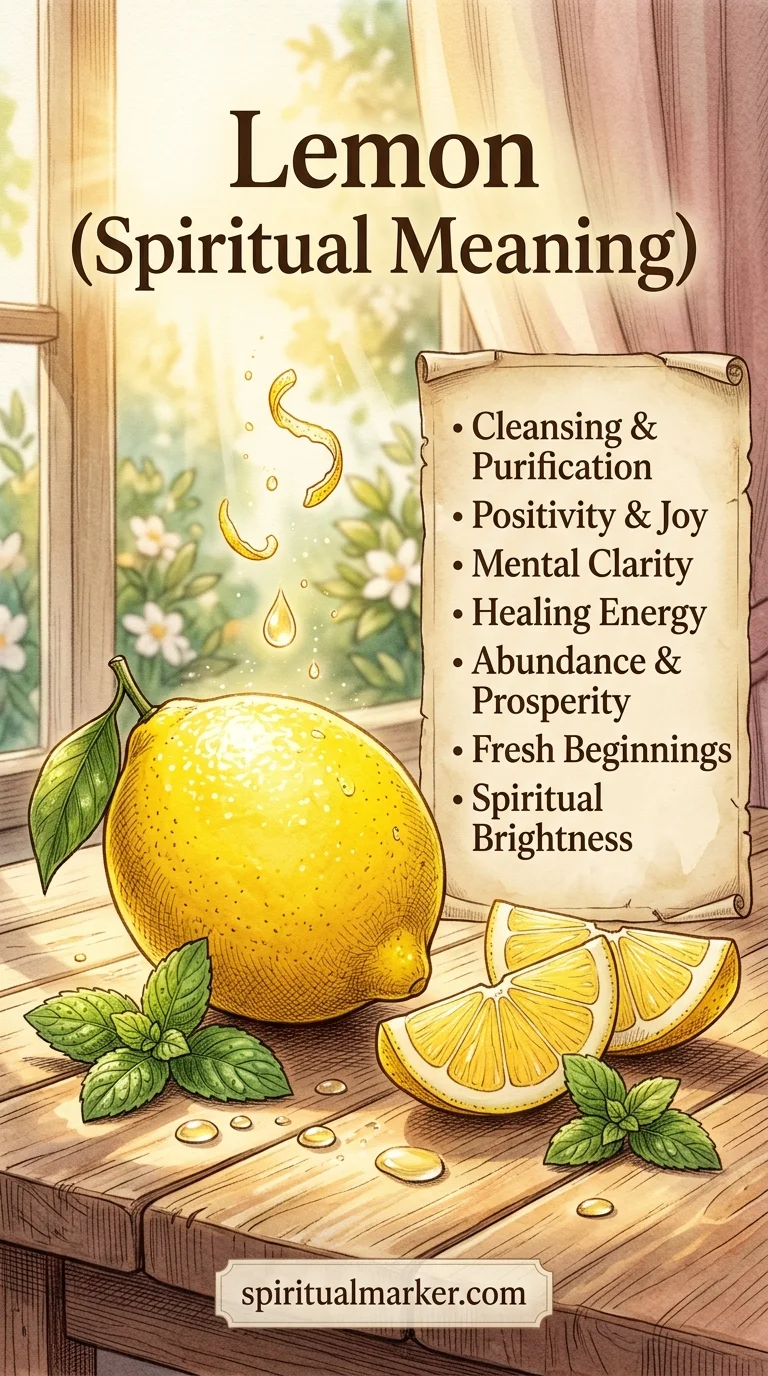
7 Spiritual Meanings of Lemons
1. Purification and Cleansing
The most widely recognized lemon spiritual meaning is purification. Across traditions from West African spiritual practices to South American folk medicine, the lemon is the go-to tool for cleansing negative energy. People wash their floors with lemon water. They place cut lemons in rooms to absorb bad energy. They rub lemon peel over their skin during ritual baths intended to remove spiritual impurity.
This belief is not rooted in superstition alone. The lemon’s natural acidity genuinely kills bacteria and neutralizes odors. Spiritual practitioners say it works the same way on an energetic level. It neutralizes and dissolves the energetic residue that negative emotions, toxic people, or dark environments leave behind. A lemon placed in a room with conflict is said to absorb the tension and shift the atmosphere toward peace and clarity.
In many Latin American spiritual traditions, particularly in Santeria and Curanderismo, lemon is a primary ingredient in limpias, which are spiritual cleansings. A healer passes lemons over the body of a person to pull out illness, fear, grief, or the effects of the evil eye. The lemon is then discarded or buried, taking the negative energy with it. This is not a modern trend. It is a centuries-old practice backed by deep spiritual wisdom.
At home, you can tap into this meaning simply. Squeeze lemon into a bucket of water and mop your floors with intention. Place a halved lemon near your front door with salt on the cut surface. The combination of lemon and salt is considered one of the most powerful purification tools in folk spiritual traditions. Even the act of peeling a lemon slowly and mindfully can serve as a personal ritual of cleansing.
2. Protection Against Evil and Negative Energy
Protection is perhaps the most common reason people use lemons in spiritual practice. In many cultures, the lemon is seen as a shield. It guards the home, the family, and the individual from evil eye, jealousy, curses, and dark spiritual forces. This belief is especially strong in Mediterranean, Middle Eastern, South Asian, and Latin American cultures.
In Indian Vastu and folk traditions, a lemon is often strung with chili peppers and hung above doorways or placed at the entrance of homes and shops. This combination, called a nazar battu or totke, is believed to absorb any negative energy directed at the household before it can enter. Business owners hang fresh lemons outside their shops every Saturday. They believe it keeps the business protected from competitors’ jealousy and financial harm.
In Egyptian and North African traditions, lemons are used in amulets and talismans. Dried lemons are sometimes placed inside small pouches with herbs and protective stones. These pouches are worn or placed under pillows to guard against nightmares and psychic attack. The lemon’s sharp citrus energy is believed to cut through any dark spell or ill intention aimed at a person. Its sourness, spiritually speaking, makes the energy unpalatable for dark forces.
Even within modern spiritual communities, the practice of placing a glass of water with a lemon slice on a windowsill or near the front door is common. This simple act is said to trap and neutralize negative energy before it enters your space. Many people report feeling a noticeable shift in the energy of their home after performing this practice consistently. Whether you approach it as a belief or an intention-setting ritual, the lemon functions as a powerful spiritual guardian.
3. Abundance and Prosperity
The lemon’s connection to prosperity might surprise you, given its sour nature. Yet in numerous spiritual and folk traditions, the lemon is strongly associated with financial abundance, good fortune, and material success. This connection comes partly from the fruit’s golden yellow color, which mirrors gold, wealth, and the radiant energy of the sun.
In Feng Shui, placing a bowl of fresh lemons in the kitchen or near the wealth corner of the home is a widely practiced method of attracting abundance. The bright yellow color activates the energy of prosperity. Lemons are also associated with the wood element in Chinese metaphysics, which governs growth, expansion, and financial development. Keeping lemons fresh in your home is a signal to the universe that you welcome growth and increase.
In Hoodoo and rootwork traditions of the American South, lemon is used in money-drawing spells and rituals. A whole lemon studded with coins or cloves is placed in a prominent spot in the home or buried near the front door to attract wealth. The lemon is also combined with green herbs like basil and bay leaf to create prosperity sachets. The sourness of the lemon is seen as its ability to cut through financial blockages and open new channels of income.
At a symbolic level, the lemon teaches a deeper prosperity lesson. It reminds you that real abundance often starts with something that feels sharp and uncomfortable. The lemon starts sour, but with the right ingredients, it becomes something nourishing, refreshing, and deeply satisfying. Many spiritual teachers use this as a metaphor for the abundance mindset: your greatest opportunities often arrive disguised as your biggest challenges.
4. Mental Clarity and Focus
The lemon’s connection to the solar plexus chakra gives it a strong association with mental clarity, intellectual power, and focused thinking. The solar plexus is the energy center that governs your sense of identity, willpower, and mental sharpness. When this chakra is balanced, you think clearly, make decisions with confidence, and move through challenges without getting mentally stuck.
Research in aromatherapy has repeatedly confirmed that lemon essential oil improves concentration and cognitive performance. A study published in the journal Psychogeriatrics found that lemon aromatherapy significantly improved mood and cognitive function in dementia patients. The scent of lemon activates the brain’s limbic system, which regulates emotion, memory, and motivation. Spiritually, this confirms what ancient practitioners already knew: lemon sharpens the mind and opens the door to divine insight.
Spiritual traditions in Japan and China have long used citrus scents during meditation and prayer. The sharp, clean scent cuts through mental fog and brings the practitioner into a state of heightened awareness. In Japanese kodo, the art of appreciating incense, citrus notes are said to invoke clarity and presence. When you inhale the scent of a freshly cut lemon during meditation, you are participating in a tradition of spiritual focus that spans millennia.
For those who struggle with overthinking, indecision, or mental clutter, the lemon is a deeply relevant spiritual ally. Placing lemon essential oil on your temples before study, prayer, or journaling is said to open your mental channels. Many spiritual workers burn lemon-scented candles during rituals that require precise intention-setting or clear spiritual communication. The lemon, in this context, becomes a bridge between your earthly mind and your higher wisdom.
5. Healing and Renewal
The lemon is a symbol of healing across many traditions. Its high vitamin C content has made it a medicinal staple for centuries, but its healing significance in spiritual practice goes far deeper. Healing, in a spiritual context, is not just about the physical body. It encompasses emotional wounds, energetic damage, and the healing of relationships and environments.
In Traditional Chinese Medicine (TCM), lemon is used to support liver function, which is the organ associated with anger, resentment, and unprocessed grief. Spiritually, working with lemons is believed to help release these stored emotions and restore flow to stagnant energy. Many TCM-informed spiritual practitioners recommend drinking warm lemon water in the morning not just for physical detox, but for emotional and spiritual renewal as well.
In Ayurvedic tradition, lemon is considered a fruit that balances the body’s doshas, particularly pitta and kapha imbalances. Pitta excess manifests as anger, inflammation, and competitive jealousy. Kapha excess manifests as sluggishness, attachment, and emotional heaviness. Both conditions have direct spiritual counterparts. Working with lemon helps a person return to their natural spiritual equilibrium, where compassion, clarity, and energy flow freely.
Beyond individual healing, the lemon is used in the healing of spaces and relationships. When a home has experienced conflict, grief, or illness, spiritual practitioners often recommend a thorough lemon cleansing of the space. Walls are wiped down with lemon water. Windows are cleaned with lemon and vinegar. Fresh lemons are placed in each room. This practice is believed to reset the energy of the space and create the conditions for healing to take root.
6. Love and Relationship Energy
The lemon holds a complex relationship with love and romance in spiritual traditions. On one hand, it is used to attract love, sweeten relationships, and restore harmony between partners. On the other hand, it is sometimes used to cut energetic cords in relationships that have become toxic or spiritually harmful. Both uses reflect the lemon’s core spiritual identity as an agent of transformation.
In Mediterranean folk magic, particularly in Italian and Greek traditions, lemon is used in love rituals meant to bind two people together or to sweeten the heart of a difficult partner. A lemon is sometimes written on with names and intentions, then sealed and placed in honey or sugar to attract loving energy. The acid of the lemon is said to dissolve the barriers between two hearts, making way for genuine connection.
In Hoodoo tradition, lemon is also used to sour a relationship or create distance from someone harmful. This practice, called a “sour jar,” uses the lemon’s acidic nature to energetically separate a person from another. This is not done from a place of malice in traditional practice. It is done to protect a person from ongoing spiritual, emotional, or physical harm. The lemon acts as a spiritual boundary, enforcing the separation that a vulnerable person may struggle to create on their own.
At the heart of the lemon’s love symbolism is the idea of honest connection. Lemons do not pretend to be sweet. They are exactly what they are: sharp, bright, and cleansing. In relationships, the lemon’s energy encourages you to show up authentically, to speak truth with love, and to clear away any energetic dishonesty that may be blocking real intimacy. True love, like the lemon, is both sharp and nourishing at the same time.
7. Transformation and Resilience
Perhaps the most universally resonant lemon spiritual meaning is transformation. The phrase “when life gives you lemons, make lemonade” has become a global cultural wisdom precisely because it captures a deep spiritual truth. The lemon represents the raw material of difficulty. What you do with that difficulty defines your spiritual growth.
Spiritual traditions around the world teach that the soul grows through contrast and challenge. The lemon embodies this teaching perfectly. Its outer skin is bitter and tough. Its inner juice is powerful, sharp, and alive with energy. To access what is most valuable inside the lemon, you have to apply pressure. The same is true of the human spirit. Your deepest gifts and your most radiant inner light often only emerge when life applies pressure to your circumstances.
In Taoist philosophy, the lemon represents the principle of wu wei, which means effortless action through alignment with natural forces. The lemon does not resist its nature. It does not apologize for its sourness. It fully embodies what it is, and in doing so, it becomes valuable to everything around it. The spiritual lesson is clear: radical acceptance of your own nature is the beginning of true resilience and transformation.
Resilience, in a spiritual context, is not about avoiding pain. It is about having the inner resources to move through pain and emerge renewed. The lemon, across traditions, represents exactly this capacity. It survives harsh climates. It resists decay longer than most fruits. Its scent remains powerful even after it dries. Spiritually, the lemon teaches you that your most essential self cannot be corrupted, depleted, or destroyed by external circumstances. You are more durable than you know.
Lemon Symbolism Across Cultures and Religions
The lemon spiritual meaning is not limited to one tradition. It stretches across continents and centuries, woven into the spiritual fabric of vastly different cultures. Each tradition has seen something unique in this bright yellow fruit, yet several core themes repeat: purification, protection, divine favor, and transformation.
In Hinduism, the lemon occupies a sacred place in daily religious life. It is offered to deities during puja ceremonies, particularly to Goddess Durga, Goddess Kali, and Lord Ganesha. The lemon is considered a sattvic fruit, meaning it carries pure, elevated energy that is pleasing to the divine. Lemons are also placed at temples and shrines as protective offerings. In South India, garlands of lemons are strung outside homes during festivals like Pongal and Diwali to invite the blessings of the divine into the household.
In Islam, citrus fruits including lemons are viewed with gratitude as gifts from Allah. The Quran references the beauty and provision of fruit as evidence of divine generosity and mercy. While there is no specific verse dedicated to the lemon alone, Islamic folk traditions from North Africa and the Middle East have long used lemons in spiritual protection and healing practices. Lemon juice mixed with Quranic recitations is sometimes used as a spiritual remedy for anxiety, fear, and illness.
In Judaism, the lemon holds particular significance during the festival of Sukkot. The etrog, a citrus fruit closely related to the lemon, is one of the four species commanded in Leviticus 23:40 to be taken up during celebration. The etrog represents the human heart and its relationship to the divine. Many rabbinical commentaries describe the etrog as the fruit that combines beautiful appearance and beautiful fragrance, a symbol of the person who embodies both knowledge of Torah and good deeds.
In Chinese culture, lemons and citrus fruits are prominent symbols of good luck, especially during the Lunar New Year. The color and shape of citrus fruits mimic gold coins, making them powerful symbols of wealth and prosperity. Bowls of lemons and oranges are displayed in homes and businesses during celebrations to attract abundance and positive fortune for the year ahead. This practice connects the lemon to solar energy and the blessing of heaven on earthly affairs.
Lemon Symbolism in World Mythologies
The lemon’s appearance in world mythology reveals just how deeply ancient peoples valued this fruit. In Greek mythology, the Hesperides were nymphs who guarded a grove of golden fruit trees at the edge of the world. Many scholars believe these golden fruits were citrus, possibly related to the lemon or citron. The fruit of the Hesperides represented immortality, divine favor, and the gifts of the gods. Hercules’ eleventh labor required him to steal this sacred fruit, underscoring how precious and spiritually charged citrus was considered in the ancient Greek worldview.
In Roman tradition, citrus fruits were associated with Venus, the goddess of love and beauty. Roman writers including Virgil and Pliny the Elder described citrus trees with deep reverence. The Romans believed citrus could purify the air, protect against poison, and attract divine blessings. Emperor Augustus had citrus trees planted in his gardens. The presence of citrus in Roman palatial spaces signals its association with power, protection, and divine connection.
In Persian mythology and ancient Zoroastrian tradition, the citron and lemon were symbols of the eternal battle between light and darkness. The bright golden color of the fruit represented Ahura Mazda, the supreme being of light and goodness. Lemons were used in sacred fire ceremonies and placed near the eternal flame as offerings of purity and divine dedication. This mythological role reinforces the lemon’s identity as a fruit of light, standing against the forces of shadow and spiritual impurity.
Lemon Spiritual Meaning in the Bible
The Bible does not mention the lemon by name specifically, but citrus fruit and the concept of the sacred fruit appear throughout scripture in ways that scholars connect to the lemon and its relatives. The broader category of “goodly fruit” in Leviticus 23:40 is widely understood by Jewish and Christian scholars to include citrus. This fruit was to be taken with joy and gratitude during the sacred festival of Sukkot, a feast of dwelling that symbolizes divine provision and protection.
In the Song of Solomon, the beloved is compared to a tree bearing golden fruit, and the scent of the garden is described in ways that suggest citrus. Song of Solomon 2:3 says, “As the apple tree among the trees of the wood, so is my beloved among the sons.” Many biblical commentators note that the Hebrew word tappuach used in this verse may refer to a citrus fruit rather than an apple, as citrus was far more common in ancient Israel. The symbolism of sacred sweetness, provision, and divine love in this text carries the spirit of the lemon.
Proverbs 17:22 states that “a cheerful heart is good medicine.” Many spiritual teachers connect this verse to the lemon’s role as a symbol of healing and joy. The lemon, with its bright color and reviving scent, has long been used to lift the spirit. Its very nature encourages a shift from heaviness to lightness, from darkness to clarity. In this sense, the lemon embodies a biblical principle: the body, mind, and spirit are interconnected, and what heals one dimension supports healing in the others.
Numbers 13:23 describes the abundance of the Promised Land through its extraordinary fruit: “They cut down a branch bearing a single cluster of grapes. Two of them carried it on a pole between them, along with some pomegranates and figs.” Citrus fruit was also part of the abundance of Canaan. The presence of abundant fruit in biblical texts consistently functions as a sign of divine blessing, spiritual alignment, and covenant faithfulness. The lemon, as part of this broader symbolic language of fruit, carries this biblical weight of sacred abundance and favor.
Lemon Superstitions From Around the World
Lemon superstitions are among the most widespread and persistent in global folk tradition. These beliefs have been passed down through generations and remain actively practiced in many parts of the world today. Whether you view them as spiritual facts or cultural heritage, they reveal a deep human relationship with this remarkable fruit.
In Italy, it is believed that placing a lemon under your pillow on certain nights brings prophetic dreams. Some Italian folk traditions also hold that carrying a dried lemon in your pocket protects you from envy and the evil eye. If a lemon you own turns black unusually fast, it is considered a sign that someone has directed negative energy at you or your home. The lemon, in this belief, absorbed the harm meant for you.
In Brazil, particularly in Afro-Brazilian spiritual traditions like Candomblé and Umbanda, lemons are used in rituals to appease certain spirits and to break hexes. A popular superstition holds that throwing a lemon behind you at a crossroads, without looking back, will carry your troubles away. The crossroads in Afro-Brazilian tradition is a place where the physical and spiritual worlds intersect, making it the ideal location for releasing burdens and negative attachments.
In Turkey and across the wider Turkish-speaking world, it is traditional to place a lemon studded with cloves and tied with a red ribbon near the entrance of a new home. This is done to protect the household from jealousy and to attract good fortune during transitions. Moving into a new space is considered spiritually vulnerable, and the lemon serves as a guardian during the period of adjustment and settling in.
In the Philippines, lemon (or the local variant calamansi) is used in spiritual baths called pampaligo ng engkanto. These baths are believed to remove spiritual attachments and attract good luck. Folk healers, called albularyo, use citrus in their practice to cleanse clients of spiritual ailments including anxiety caused by spiritual imbalance, bad luck, and the effects of envy. The lemon is central to these healing traditions because of its believed power to cut through spiritual dirt that cannot be seen with the physical eye.
Dreaming About Lemons: Spiritual and Psychological Meanings
When a lemon appears in your dream, your subconscious and your spirit may be sending you a message worth paying close attention to. Dream interpretations of the lemon vary based on the specific details of the dream, but several core themes emerge consistently across spiritual traditions and psychological frameworks.
Dreaming of a bright, ripe lemon on a tree is generally a highly positive sign. It signals that blessings, abundance, and spiritual clarity are available to you. The lemon on the tree represents potential that is ready to be harvested. Spiritually, this dream tells you that your prayers, intentions, or hard work are about to bear fruit. You are in a period of spiritual ripeness, and the universe is responding to your alignment.
Dreaming of squeezing a lemon carries a more complex meaning. This image often represents a situation in your waking life where you are being pressed or tested. The question the dream invites you to ask is: what are you producing under pressure? If the juice in your dream is clean and fresh, your spirit is telling you that you are handling challenges with grace and producing something valuable from difficulty. If the lemon is dry or yields nothing, the dream may be pointing to emotional depletion or spiritual burnout that needs attention.
Dreaming of a rotten or black lemon is often a warning signal. Many spiritual traditions interpret this image as a sign that negative energy has entered your life or space. This could be in the form of envy from others, unresolved emotional pain, or a spiritual attack. The dream calls you to take action: cleanse your space, review your relationships, and be mindful of what or who you are allowing into your energy field. A rotten lemon in a dream is the spirit’s way of alerting you before the situation causes greater harm.
Dreaming of drinking lemon juice can indicate that you are integrating a difficult truth or processing a challenging experience. To drink something sour in a dream is to accept and internalize a hard lesson. Spiritually, this is a sign of courageous self-honesty and growth. The dream affirms that you are not running from difficulty. You are digesting it and allowing it to strengthen you. This is the highest expression of the lemon’s spiritual meaning in the dream world.
Spiritual Benefits of Using Lemons in Your Daily Life
The spiritual benefits of lemon are both numerous and accessible. You do not need to belong to any specific tradition to work with the lemon’s spiritual energy. Its power is available to anyone who approaches it with intention and awareness.
One of the most immediate spiritual benefits of working with lemons is the shift in energy you feel in your environment. Placing fresh lemons in a bowl on your kitchen table immediately brightens the energy of the room. The color activates feelings of optimism and alertness. The scent stimulates the mind and calms the nervous system. This is not merely a decorative choice. It is a conscious energetic decision to invite clarity and positivity into your daily experience.
Drinking warm lemon water in the morning has become a wellness ritual for millions of people globally, but its spiritual dimension is equally significant. When you begin your day by consuming this cleansing drink with conscious intention, you are setting a spiritual tone for the hours ahead. You are declaring that you welcome clarity, health, and renewal. Many spiritual practitioners recite a short prayer or affirmation as they drink their morning lemon water, amplifying its energetic effect.
Using lemon essential oil during meditation, prayer, or journaling deepens your spiritual practice in measurable ways. The scent activates mental clarity and presence. It dispels mental fog and creates the conditions for genuine spiritual insight. Diffusing lemon oil before your spiritual practice is like clearing a path through a forest: it removes the mental and energetic undergrowth so you can move forward with ease and purpose.
Taking a spiritual lemon bath once a week is a practice that many traditions recommend for energetic maintenance. You simply squeeze several lemons into a warm bath, add sea salt and rosemary if available, and soak with the intention of releasing what no longer serves you. Many people report feeling noticeably lighter, calmer, and more spiritually clear after this practice. It is a full-body spiritual reset that costs very little and delivers profound results.
Lemon Color Symbolism: The Power of Yellow
You cannot fully understand the lemon spiritual meaning without addressing its color. Yellow is one of the most spiritually charged colors in existence. It is the color of the sun, which represents divine light, life-giving energy, and cosmic intelligence. Every major spiritual tradition has a relationship with yellow that affirms its connection to higher consciousness and divine power.
In chakra healing, yellow governs the solar plexus chakra, located at the center of the abdomen. This energy center is the seat of your personal power, self-worth, and mental strength. When your solar plexus chakra is open and balanced, you move through life with confidence, clarity, and purposeful action. The lemon, as a yellow food and spiritual tool, directly nourishes and activates this energy center.
In color therapy and chromotherapy, yellow is used to combat depression, stimulate intellectual activity, and restore optimism. Therapists and spiritual healers use yellow light and yellow objects to help clients reconnect with their sense of purpose and personal power. The lemon, as nature’s most vivid expression of the color yellow, functions as a natural chromotherapy tool. Simply gazing at a bowl of fresh lemons activates the psychological and spiritual effects of yellow in the brain.
Across Buddhist traditions, yellow and gold are the colors of wisdom, enlightenment, and the teachings of the Buddha. Monks wear saffron and golden robes as a symbol of their commitment to spiritual truth. Sacred texts are often stored in yellow silk. The lemon, dressed in nature’s golden yellow, participates in this color language of sacred wisdom and spiritual illumination. Working with lemons is, in this light, a way of aligning yourself with the frequency of enlightened understanding.
A Final Note
The lemon is far more than a kitchen staple. It is a spiritual archive encoded in nature, carrying thousands of years of wisdom, ritual, and healing power. From the temples of ancient India to the healing traditions of Brazil, from the biblical groves of the Promised Land to your own kitchen windowsill, the lemon has always carried a message: you can be both sharp and luminous. You can face bitterness and still radiate light.
The lemon spiritual meaning is ultimately a mirror. It reflects the qualities you need most: clarity, resilience, protection, and the courage to transform difficulty into something nourishing. Every time you hold a lemon, you hold centuries of human spiritual experience in your hand. That is a remarkable thing.
If you feel called to work with the lemon’s energy, start with something small and intentional. Place a bowl of fresh lemons where you spend the most time. Add lemon to your morning routine with mindful intention. Try a lemon spiritual bath and notice how you feel afterward. You can also place a halved lemon with sea salt near your front door and replace it weekly as a simple protective practice. The lemon meets you wherever you are on your spiritual path. All it asks is that you show up with intention and allow its ancient energy to do what it has always done: cleanse, protect, clarify, and renew.