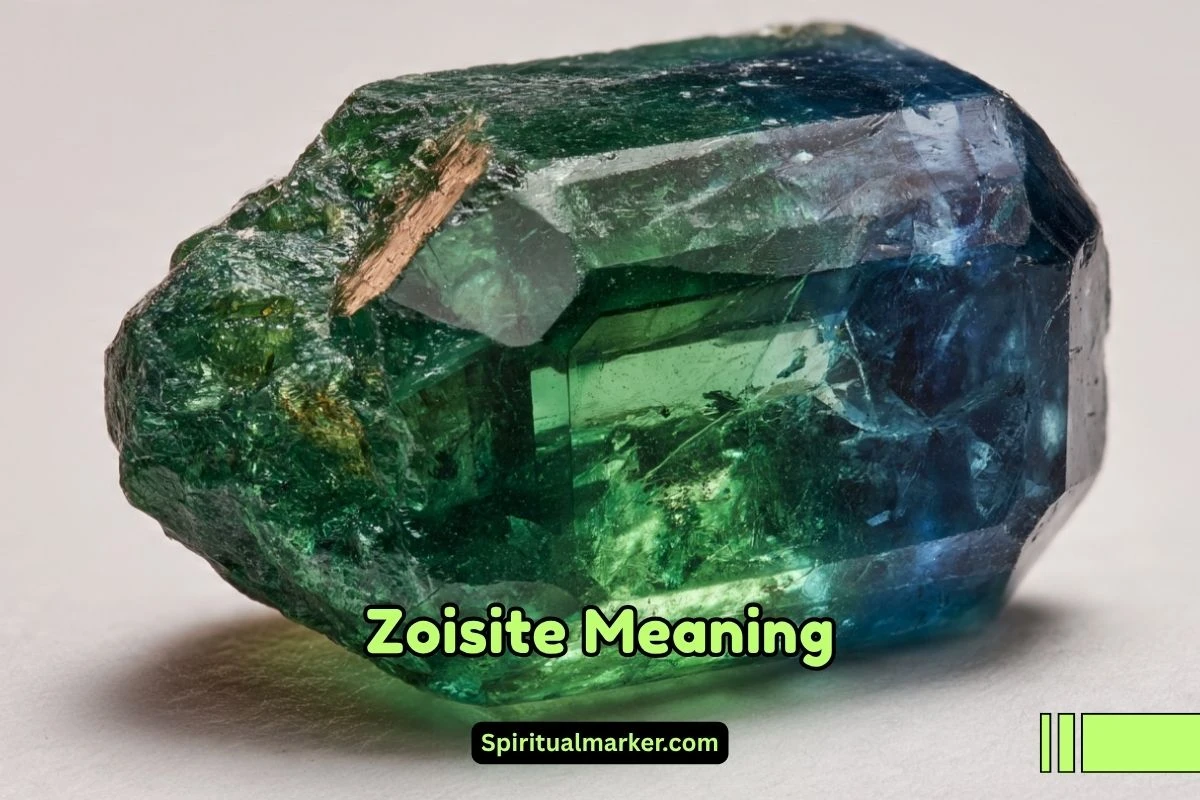
Have you ever picked up a Zoisite crystal and felt something shift inside you? Many people describe a quiet surge of vitality the moment they hold it. That feeling is not coincidence. Zoisite carries a powerful energetic signature that spiritual communities have honored for centuries.
This stone does not whisper. It speaks in deep, earthy tones of growth, regeneration, and emotional truth. Its colors span rich greens, vivid pinks, and striking purples. Each color variation carries its own energy, but the underlying spiritual current remains the same. Zoisite promotes transformation from the inside out.
Crystal healers, spiritual seekers, and gem collectors across the world are drawn to Zoisite for its remarkable emotional and spiritual depth. Some know it as the stone that sits beneath luminous Tanzanite. Others love it as Ruby Zoisite, that bold combination of red and green that looks almost impossibly alive. Either way, this gemstone leaves a lasting impression.
This article covers the meaning of Zoisite, its spiritual symbolism, healing properties, historical roots, and practical ways to use it. You will also learn how to wear it, care for it, and choose the variety that aligns with your needs.
5 Key Takeaways
- Zoisite symbolizes regeneration, emotional healing, and deep spiritual transformation.
- Its varieties include green Zoisite, Ruby Zoisite, Tanzanite, and Thulite, each with unique properties.
- Zoisite strongly activates the heart chakra and the third eye chakra.
- Crystal practitioners use it for emotional recovery, grief processing, and creative rebirth.
- Wearing or meditating with Zoisite may support inner growth, compassion, and energetic alignment.
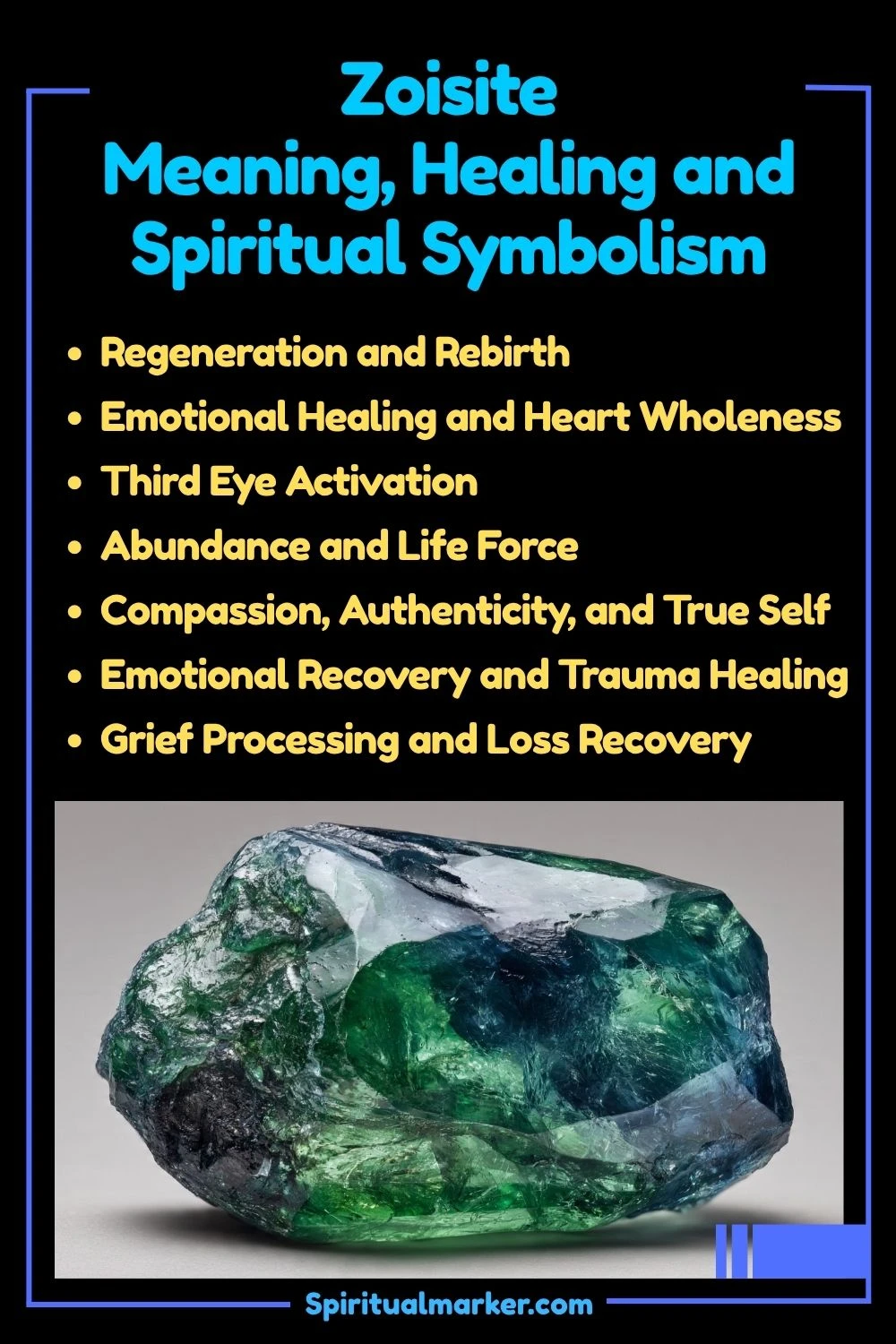
What is Zoisite?
Zoisite is a naturally occurring calcium aluminum silicate mineral. It belongs to the epidote mineral group. Scientists classify it as an orthorhombic mineral, meaning its crystal structure forms at right angles in three distinct directions.
The stone carries a wide color range. It appears in green, pink, yellow, gray, white, and the celebrated blue-violet variety known as Tanzanite. This color diversity exists because of trace elements that enter the mineral during formation. Chromium creates vivid green. Manganese produces pink. Vanadium and titanium create the famous blue-violet in Tanzanite.
Many people first encounter Zoisite through its famous variety Tanzanite, discovered in Tanzania in 1967. Others recognize it through Ruby Zoisite (also called Anyolite), where deep red ruby crystals grow embedded within green Zoisite. That combination is visually striking and spiritually powerful.
Mineralogically, Zoisite registers between 6 and 7 on the Mohs hardness scale. It is durable enough for jewelry but still requires thoughtful care. Its luster is typically vitreous to pearly, giving cut specimens a pleasant visual warmth.
Origins and Formation of Zoisite
Zoisite forms in metamorphic and hydrothermal environments. It develops when aluminum-rich rocks experience heat and pressure deep within the earth’s crust. Calcium-bearing fluids move through cracks and react with existing minerals over millions of years. The result is Zoisite in its many forms.
Its name honors Sigmund Zois von Edelstein, the Austrian scientist who first identified the mineral in 1805. A Slovenian trader brought him samples from the Sau-Alpe mountains in Carinthia, now part of Austria. Zois recognized the mineral as unique and it was later named in his honor.
Major global sources of Zoisite include:
- Tanzania (famous for Tanzanite and Ruby Zoisite)
- Norway (Thulite, the pink variety)
- Kenya (green and Ruby Zoisite)
- Pakistan and India (various green forms)
- Austria and Switzerland (original discovery sites)
- United States (North Carolina and Wyoming deposits)
Tanzania holds particular spiritual significance in the Zoisite world. Local Masai communities first observed blue-violet Zoisite crystals after a lightning fire swept across dry grasslands, exposing the mineral beneath the soil. Some spiritual interpretations see this as symbolic. Zoisite emerging from fire carries its own message about transformation and rebirth.
Key Properties of Zoisite
| Property | Details |
|---|---|
| Chemical Composition | Calcium aluminum hydroxy sorosilicate |
| Crystal System | Orthorhombic |
| Hardness | 6 to 7 on Mohs scale |
| Primary Chakras | Heart, Third Eye, Crown (Tanzanite) |
| Primary Symbolism | Transformation, regeneration, emotional healing |
| Color Range | Green, pink, blue-violet, yellow, gray |
| Main Sources | Tanzania, Norway, Kenya, Pakistan, Austria |
| Luster | Vitreous to pearly |
| Spiritual Energy | Regenerative, activating, compassionate |
| Common Varieties | Tanzanite, Ruby Zoisite (Anyolite), Thulite |
Historical and Cultural Significance of Zoisite
The mineral itself was formally named in the early 19th century. But its most famous variety, Tanzanite, carries a more dramatic modern history. When Tiffany & Co. introduced Tanzanite to the world in 1968, they recognized its cultural potential immediately. The jeweler named it Tanzanite to honor its single-source origin in the Merelani Hills of Tanzania.
Beyond commercial history, local Masai tradition holds Tanzanite as a stone of new life. Masai women were traditionally gifted Tanzanite after childbirth. Blue held deep spiritual meaning in their culture, representing new beginnings, divine protection, and life force. That cultural practice connects Zoisite to themes of birth, renewal, and spiritual protection.
Ruby Zoisite carries different historical roots. The Anyoli people of East Africa used the stone in ceremonial contexts. Its bold red and green combination made it visually distinctive among natural stones. Some African spiritual traditions associated the color combination with vitality and earth energy.
In European mineralogy, Zoisite was valued as a scientific curiosity for decades before becoming popular in jewelry and spiritual practices. Thulite, the pink Norwegian variety, takes its name from the mythical land of Thule, a concept ancient writers used to describe the far north of the known world.
Modern crystal healing traditions adopted Zoisite enthusiastically in the late 20th century. Practitioners began associating its various forms with emotional healing, spiritual activation, and energetic transformation. These uses continue today across crystal healing, meditation, and mindfulness communities worldwide.
5 Spiritual Meanings of Zoisite
1. Regeneration and Rebirth
Zoisite is one of the most powerful symbols of regeneration in the crystal world. Its energy does not simply heal. It rebuilds. Where other stones soothe emotional pain, Zoisite seems to go further by helping rebuild the emotional architecture beneath conscious awareness.
People are naturally drawn to Zoisite during major life transitions. These might include the aftermath of a significant loss, a career collapse, the end of a long relationship, or any period that has stripped away familiar identity structures. In those raw moments, Zoisite spiritually symbolizes the presence of new life forming beneath apparent emptiness.
This meaning connects directly to how Zoisite forms in nature. It develops under enormous geological pressure. Heat and chemical reactions transform raw minerals into something entirely new over millions of years. That geological process mirrors the spiritual symbolism. True regeneration takes pressure, time, and deep internal change.
Many spiritual teachers point to Ruby Zoisite as especially powerful for this symbolism. The combination of red ruby, which represents life force and vitality, embedded within green Zoisite, which represents growth and healing, creates a stone that visually represents life renewing itself within living matter. It is a natural metaphor for rebirth happening inside personal struggle.
Thich Nhat Hanh wrote extensively about the concept of renewal through difficulty, noting that suffering, when faced with awareness, becomes fertile ground for transformation. Crystal traditions around Zoisite reflect a similar principle. You do not emerge from difficulty unchanged. Zoisite symbolizes how that change can become growth rather than damage.
This regenerative symbolism also extends to creative life. Artists, writers, musicians, and entrepreneurs sometimes experience creative burnout so profound that it feels permanent. Zoisite has developed a reputation in spiritual communities as a stone that reawakens creative drive. Its energy is described as activating, productive, and growth-oriented rather than purely soothing.
2. Emotional Healing and Heart Wholeness
Zoisite carries deep associations with emotional healing at the heart level. This is not superficial emotional comfort. Practitioners describe Zoisite’s emotional energy as reaching into protected emotional territory. It works gently but purposefully on feelings that have been buried, denied, or heavily guarded over time.
Grief is one of the emotional experiences most often linked with Zoisite. Grief work requires an unusual combination of emotional courage and emotional safety. A person must feel protected enough to let pain surface while also feeling supported enough to move through it. Zoisite is believed to provide exactly that emotional environment.
The green varieties of Zoisite connect specifically with heart chakra healing. Heart wounds often appear as emotional numbness, difficulty trusting, chronic loneliness, unexplained sadness, or persistent feelings of being emotionally incomplete. These experiences may develop over years of accumulated hurt, disappointment, or unprocessed emotional trauma.
Crystal practitioners believe Zoisite gently helps the emotional body release accumulated pain without flooding the person with overwhelming emotion all at once. This gradual emotional processing mirrors healthy psychological approaches to grief and trauma recovery. Psychological research into grief consistently shows that healing happens in waves rather than through linear progression. Zoisite spiritually reflects that nonlinear emotional reality.
Forgiveness forms another major part of Zoisite’s emotional healing symbolism. Spiritual forgiveness does not erase memory or excuse harmful behavior. It refers to releasing the energetic weight of sustained resentment that continues harming the person carrying it. Many crystal healers believe Zoisite supports this release by softening emotional defensiveness without forcing emotional vulnerability before readiness arrives.
The stone also encourages emotional authenticity. Emotional wounds often create patterns of emotional suppression where people hide genuine feelings to avoid further hurt. Over time, that suppression creates a growing distance between inner emotional reality and outer emotional expression. Zoisite symbolizes closing that gap, gently encouraging people to reconnect with their actual emotional experience.
3. Spiritual Awakening and Third Eye Activation
Tanzanite, the blue-violet variety of Zoisite, carries some of the most intense spiritual awakening symbolism found in any gemstone. It is consistently associated with the third eye chakra and crown chakra, energy centers connected with heightened intuition, spiritual insight, psychic awareness, and connection to higher consciousness.
Spiritual awakening rarely arrives as a comfortable experience. It often involves questioning deeply held beliefs, confronting unconscious assumptions, and releasing the psychological comfort of certainty. Tanzanite symbolizes the courage required to open to these experiences while remaining emotionally grounded through the process.
Many meditation practitioners use Tanzanite specifically during deep spiritual practice. The stone’s energy is described as expansive, illuminating, and spiritually clarifying. Some practitioners report increased dream awareness, deeper meditation states, and heightened intuitive sensitivity when working consistently with Tanzanite.
This spiritual activation symbolism connects to Zoisite’s broader regenerative energy. Spiritual growth requires a willingness to release outdated mental and spiritual frameworks. Like emotional healing, genuine spiritual development involves a kind of internal death and rebirth. Old certainties dissolve. New understanding slowly takes their place.
Ancient Indian yoga philosophy describes the awakening of consciousness through the chakra system as a gradual ascent from physical awareness through emotional intelligence and finally into spiritual clarity. Tanzanite’s connection to the upper chakras places it symbolically within this ascent. It is a stone associated with moving from emotional processing toward spiritual illumination.
Some spiritual traditions also associate blue-violet stones with divine communication and inner wisdom. The color blue has represented spiritual depth, truth, and heavenly connection across many cultures and centuries. Zoisite in its blue-violet Tanzanite form inherits this layered symbolism and adds its own regenerative dimension to it.
4. Abundance and Life Force
Green Zoisite and Ruby Zoisite both carry strong associations with abundance, vitality, and life force energy. This is not exclusively financial abundance. The symbolism is broader and more fundamental. It relates to feeling fully alive, energetically engaged, and capable of growth across all areas of life.
Life force energy appears across many spiritual traditions under different names. In Chinese tradition it is called qi or chi. In Indian philosophy it is called prana. In Japanese culture it is called ki. These concepts share a common idea. Living things carry an animating energy that influences health, motivation, creativity, and spiritual well-being.
Many crystal practitioners associate Zoisite, particularly the Ruby Zoisite combination, with amplifying this life force energy. Ruby is traditionally one of the most vitality-associated gemstones in the world. It carries passionate, activating energy. When combined with Zoisite’s regenerative green energy, the combination creates a stone symbolizing life actively renewing itself through vibrant inner power.
This abundance symbolism also connects to emotional resilience. People who feel energetically depleted often notice reduced capacity for creativity, relationship engagement, problem-solving, and general motivation. Zoisite is believed to help restore energetic vitality by supporting the emotional and spiritual systems that influence physical sense of aliveness.
Farmers and gardeners in some East African traditions historically respected green stones as connected with soil fertility and crop vitality. While these traditions developed around various green stones, the symbolism reflects a broader cultural understanding that green represents productive life energy rather than passive calm. Zoisite carries this active abundance energy within its green varieties.
5. Compassion, Authenticity, and True Self
One of Zoisite’s most spiritually significant meanings involves reconnecting with authentic personal identity. Modern life creates many pressures toward conformity, performance, and emotional masking. People often develop personas over decades that slowly separate them from their genuine values, feelings, and inner voices.
Zoisite spiritually symbolizes the process of returning to authentic selfhood. This is not a dramatic or sudden process. It develops gradually as emotional healing creates more internal space. Old defenses soften. Suppressed aspects of personality re-emerge. Values that once felt abandoned become accessible again.
This meaning connects strongly to compassion as a spiritual practice. Authentic selfhood requires self-compassion because genuine self-knowledge inevitably includes confronting personal weaknesses, past mistakes, and emotional contradictions. Zoisite’s energy is believed to support this honest self-examination without triggering harsh self-judgment.
The Buddhist concept of Bodhichitta, or awakening heart-mind, holds that genuine compassion begins with honest awareness of one’s own suffering. From that honest foundation, compassion for others naturally develops. Zoisite’s spiritual symbolism aligns with this principle. Compassion for others cannot grow sustainably without compassion for yourself.
Many people use Zoisite during journaling, reflective spiritual practice, or therapeutic contexts because they believe it supports emotional honesty without emotional shutdown. That quality makes it particularly valuable during identity rebuilding following major life changes, personal crises, or prolonged periods of disconnection from personal values.
6 Healing Properties of Zoisite
1. Emotional Recovery and Trauma Healing
Zoisite holds a respected place in crystal healing communities as a stone for trauma recovery. Its energy is associated with helping people process emotional experiences that have become lodged deeply within the body-mind system. Crystal practitioners describe this as supporting the release of held emotional trauma without overwhelming the nervous system.
Trauma creates lasting effects in both emotional and physical experience. Psychological research has demonstrated that unresolved trauma can influence stress hormones, sleep quality, immune function, and relational behavior. The body stores traumatic memory in ways that talking alone does not always fully reach. Somatic, creative, and spiritual approaches often complement psychological trauma work by addressing dimensions that conventional verbal therapy may miss.
Crystal healing does not replace professional mental health support. However, many trauma-informed practitioners incorporate Zoisite into broader healing practices because of its supportive and grounding energy. The stone’s symbolism of regeneration feels especially relevant in trauma work, where recovery involves rebuilding an internal sense of safety and wholeness.
Zoisite is often used alongside journaling, meditation, gentle movement, or breathwork. These practices share a focus on embodied, present-moment awareness that supports trauma recovery by building capacity to tolerate difficult emotions gradually. Zoisite’s gentle activating energy is believed to complement these approaches by encouraging emotional openness without force.
2. Grief Processing and Loss Recovery
Grief is one of the most consistent emotional contexts in which crystal practitioners recommend Zoisite. Losing a loved one, ending a significant relationship, experiencing a major life disappointment, or facing sudden change can all create grief that feels isolating and overwhelming.
Zoisite symbolizes the continuity of life through loss. Its regenerative energy reflects the natural world’s ability to renew itself after apparent death. Autumn leads to winter, which leads to spring. Decay creates soil for new growth. Grief, within Zoisite’s spiritual symbolism, is not the end of vitality but a necessary passage within life’s larger cycle.
The stone does not promise that grief will disappear quickly. Its symbolism honors the depth and duration of genuine grief rather than rushing past it. Many practitioners believe this honoring quality is precisely what makes Zoisite valuable during loss. It sits with grief rather than demanding that it end.
Ruby Zoisite carries particular relevance in grief work because the red and green combination visually embodies life persisting alongside and through loss. The ruby’s vibrant red life force energy does not disappear within the green. Both colors coexist. That visual reality reflects a deep truth that grief and vitality can exist simultaneously within the healing heart.
3. Energetic Revitalization and Combating Burnout
Burnout describes a state of physical, emotional, and mental exhaustion caused by prolonged stress. It affects concentration, motivation, creativity, emotional resilience, and physical energy. Many people experiencing burnout describe feeling fundamentally depleted rather than simply tired.
Zoisite’s reputation as a stone of regeneration makes it particularly associated with recovering from burnout in crystal traditions. Its energy is described as neither sedating nor overwhelming. Instead, practitioners characterize it as gently activating, encouraging the slow return of internal energy resources rather than forcing false enthusiasm.
This distinction matters. Some crystals carry intensely stimulating energy. During burnout, that stimulation can feel jarring or even counterproductive. Zoisite’s regenerative quality works differently. It is associated with replenishing depleted vitality from a deep internal level rather than providing a superficial energetic boost.
Many practitioners place Zoisite in workspaces, meditation areas, or living spaces during recovery from burnout. Some carry it daily as a physical reminder to pace themselves and honor their need for genuine restoration. The stone’s symbolism reinforces the message that authentic renewal takes time and cannot be forced.
4. Creative Reawakening
Spiritual communities consistently associate Zoisite with creative regeneration. Artists, musicians, writers, and other creative people sometimes experience prolonged creative stagnation. Creative block can feel similar to grief. The inner vitality that once animated creative work seems to have withdrawn, and forcing creative output feels hollow and frustrating.
Zoisite is believed to help reawaken dormant creative energy by addressing the emotional and spiritual roots of creative blockage rather than simply pushing for productivity. Creative blocks often develop from fear, perfectionism, emotional depletion, grief, or loss of personal authenticity. Zoisite’s healing energy targets these emotional roots.
Its connection with the heart chakra is relevant here. Genuinely creative work requires emotional vulnerability and authentic self-expression. When the heart is closed, protected, or emotionally depleted, creative expression suffers. Zoisite’s heart-centered healing supports the emotional openness that authentic creativity requires.
Many creative practitioners report that consistent work with Zoisite correlates with a gradual return of creative curiosity, willingness to take emotional risks in their work, and a renewed sense of creative identity. These observations are anecdotal but reflect a consistent pattern in spiritual communities around the world.
5. Physical Vitality and Immune Support
Physical healing associations with Zoisite focus primarily on vitality, cellular health, and immune function. Crystal healers traditionally link Zoisite with supporting the body’s natural regenerative processes. This connects logically to the stone’s overarching spiritual theme of regeneration at every level of existence.
Some practitioners associate Ruby Zoisite specifically with blood health and circulation because of ruby’s traditional connection with the heart and blood in crystal healing traditions. The ruby-Zoisite combination is believed to support cardiovascular vitality and physical life force energy.
Green Zoisite is sometimes connected with cellular regeneration and detoxification in crystal healing literature. Practitioners believe it supports the body’s natural cleansing and renewal processes, particularly during recovery from illness or prolonged physical stress.
Thulite, the pink Zoisite variety, carries associations with the reproductive system, thyroid health, and metabolic balance in some crystal healing traditions. Its pink color connects it symbolically with nurturing physical processes.
These physical healing associations represent traditional crystal healing beliefs rather than medically proven therapeutic claims. Crystal healing complements but does not replace professional medical care. Anyone experiencing health concerns should always consult qualified healthcare professionals.
6. Mental Clarity and Decision-Making
Tanzanite specifically carries strong associations with mental clarity, focused thought, and improved decision-making. Its third eye activation symbolism translates into practical mental benefits that practitioners report during crystal healing work.
Many people experience mental fog during periods of emotional stress, grief, creative stagnation, or spiritual confusion. Zoisite, particularly in its Tanzanite form, is believed to support mental clarity by calming emotional interference with clear thinking. When emotional turbulence quiets, mental clarity often improves naturally.
This healing property reflects an important insight from psychology. Emotional regulation significantly influences cognitive performance. Research from neuroscientist Antonio Damasio showed that emotional processing is inseparable from rational decision-making. Emotions do not simply disrupt thinking. They fundamentally participate in it. When emotional wellbeing improves, cognitive clarity often follows.
Practitioners sometimes use Tanzanite during periods requiring important life decisions. Its energy is believed to support the kind of calm, integrated awareness that allows people to access both emotional intelligence and rational judgment simultaneously. That combination produces better decisions than either logic or emotion operating alone.
Varieties of Zoisite and Their Specific Meanings
Green Zoisite
Green Zoisite is the most common form of the mineral. It symbolizes growth, emotional healing, and connection with nature’s regenerative cycles. Its calm green color resonates strongly with heart chakra energy. Practitioners use it for emotional recovery, self-compassion work, and connecting with natural rhythms.
Ruby Zoisite (Anyolite)
Ruby Zoisite combines the vitality of ruby with Zoisite’s regenerative green energy. It symbolizes life force renewal, passionate healing, and the coexistence of vitality with emotional depth. Many practitioners consider it one of the most powerful combinations for grief work, creative rebirth, and emotional courage.
Tanzanite
Tanzanite is the most commercially celebrated Zoisite variety. It symbolizes spiritual awakening, heightened intuition, and connection to higher consciousness. Its blue-violet color activates the third eye and crown chakras. It is associated with spiritual insight, honest communication, and accelerated personal evolution.
Thulite
Thulite is the pink Zoisite variety from Norway. It symbolizes nurturing energy, self-love, and emotional warmth. Its gentle pink resonates with the heart chakra and carries a compassionate, tender energy especially suited to healing self-worth and encouraging emotional vulnerability.
How to Use Zoisite for Spiritual Growth
Meditation is one of the most effective ways to connect with Zoisite’s energy. Hold the stone in your hand or place it on your heart chakra during quiet reflection. Allow the stillness to deepen naturally without forcing any particular emotional experience. Many practitioners find that consistent meditation with Zoisite produces gradual emotional shifts over weeks and months.
Wearing Zoisite as jewelry keeps its energy in consistent contact with your body throughout daily life. Pendants near the heart align with emotional and heart chakra healing. Tanzanite rings or earrings support mental clarity and spiritual awareness during daily interactions.
Placing Zoisite in your environment creates a supportive energetic field in spaces where you rest, create, or reflect. Many people position it near their writing or art space, by their bed, or in meditation areas. Its presence can serve as a constant symbolic reminder of your intention toward regeneration and healing.
Pairing Zoisite with complementary crystals can deepen its effects. Rose Quartz amplifies compassionate heart energy. Amethyst supports spiritual clarity alongside Tanzanite’s third eye activation. Black Tourmaline provides grounding stability that balances Zoisite’s expansive regenerative energy.
Caring for Your Zoisite
Zoisite is reasonably durable at 6 to 7 on the Mohs scale, but some varieties require more careful handling. Tanzanite in particular is heat-sensitive and should never be exposed to sudden temperature changes. Steam cleaning or ultrasonic cleaning can damage Tanzanite significantly.
Clean Zoisite using lukewarm water and mild soap. Use a soft cloth or a very soft brush. Rinse thoroughly and allow it to dry completely before storage. Avoid prolonged exposure to strong sunlight, which may fade some color varieties over time.
Store Zoisite separately from harder gemstones like diamonds, sapphires, or rubies. Although ruby naturally occurs within Ruby Zoisite, loose Zoisite specimens and jewelry pieces should be stored in padded pouches or lined jewelry boxes to prevent surface scratching.
For energetic cleansing, many practitioners use moonlight, sound bowls, selenite charging plates, or placing the stone briefly among dried herbs such as lavender or rosemary. These methods refresh the stone’s energy between uses without risking physical damage the way some water-based cleansing approaches might.
Remove Zoisite jewelry before swimming, exercise, or household cleaning. Chlorinated water can affect surface polish. Physical impact during exercise may chip or crack specimens, particularly near natural cleavage planes in the crystal structure.
Table: Zoisite at a Glance
| Aspect | Details |
|---|---|
| Primary Meaning | Regeneration, emotional healing, spiritual awakening |
| Main Varieties | Green Zoisite, Ruby Zoisite, Tanzanite, Thulite |
| Chakra Associations | Heart, Third Eye, Crown |
| Spiritual Symbolism | Rebirth, life force, compassion, authenticity |
| Hardness | 6 to 7 on Mohs scale |
| Primary Sources | Tanzania, Norway, Kenya, Pakistan, Austria |
| Emotional Associations | Vitality, grief healing, creative renewal, courage |
| Healing Focus | Trauma recovery, burnout, mental clarity, grief |
| Best Uses | Meditation, jewelry, environmental placement |
| Care Needs | Gentle cleaning, avoid heat and hard impact |
A Final Note
Zoisite stands apart from most gemstones because it offers something rare. It combines beauty with depth, variety with coherence, and spiritual intensity with emotional gentleness.
Its meaning centers on one profound idea: life renews itself through challenge rather than despite it. Regeneration, transformation, emotional healing, and spiritual awakening all require a willingness to move through difficulty rather than around it. Zoisite symbolizes that courageous, patient process.
Whether you are drawn to the vivid rebirth energy of Ruby Zoisite, the spiritual clarity of Tanzanite, the nurturing warmth of Thulite, or the quiet growth power of green Zoisite, each variety reflects the same underlying current. Something genuine is always renewing beneath the surface.
If Zoisite is calling your attention right now, that pull is worth honoring. You might try meditating with it for a few minutes each morning, wearing it close to your heart, or simply placing it somewhere you will see it daily as a reminder of your own capacity for growth. Many people find that small, intentional steps with this stone create meaningful change over time.