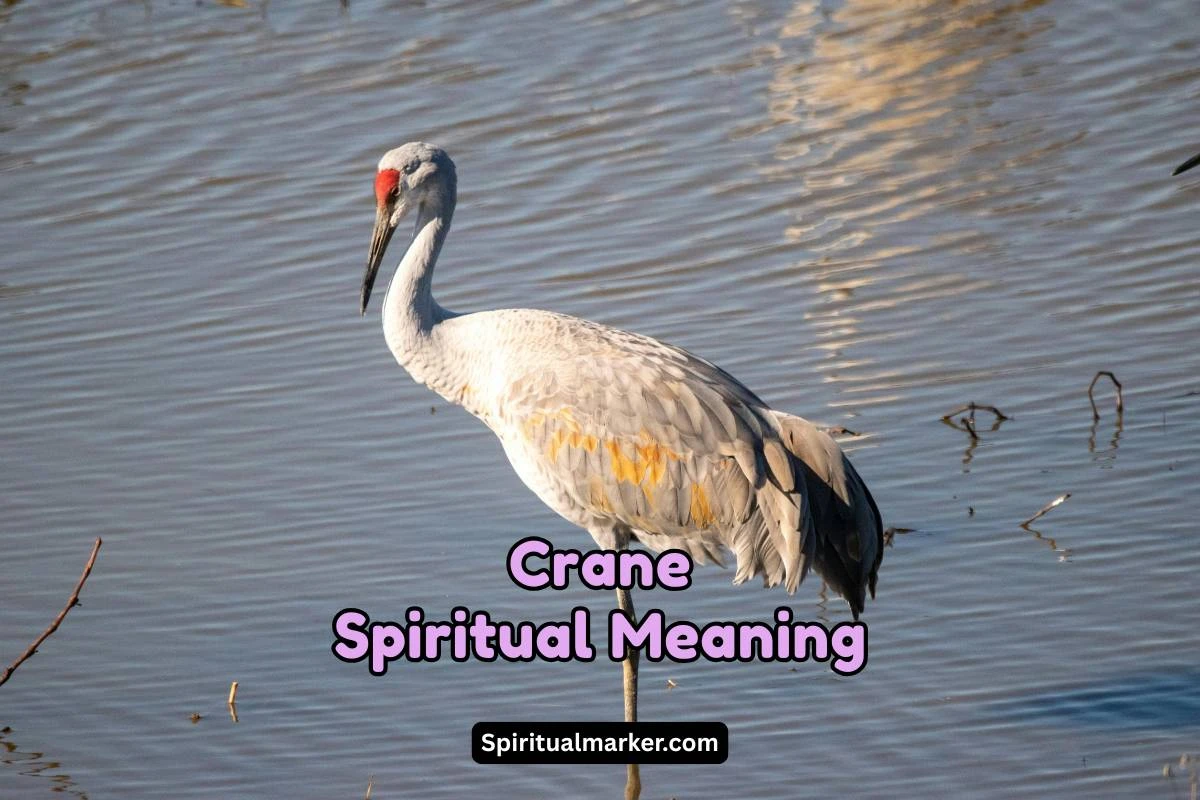
The crane is a symbol of grace and longevity. Its long legs, elegant neck, and intricate courtship dances make it unforgettable. Across cultures, cranes carry deep spiritual meaning and sacred significance.
The crane spiritual meaning often involves longevity, fidelity, and spiritual insight. Cranes mate for life, so they can signal a need for loyalty. A spiritual meaning of a flamingo shares that wading-bird focus, though flamingos carry a more social energy.
Some traditions view cranes as symbols of good luck, healing, and peace. Others see them as a reminder to be patient. The crane's behavior can add detail.
If a crane appears in your life, it may bring a message of balance. A spiritual meaning of a blue heron also deals with wading birds, though herons carry a more solitary energy.
Key Takeaways
- The crane spiritual meaning centers on longevity, wisdom, grace, and divine connection across world cultures.
- In East Asian traditions, the crane represents immortality and good fortune, often appearing in art, temples, and sacred ceremonies.
- The biblical meaning of cranes ties them to faithfulness, seasonal renewal, and attentiveness to God’s voice.
- Seeing a crane in a dream often signals a need for patience, a period of transformation, or a spiritual message being sent your way.
- The crane as a spirit animal or totem calls you toward deeper wisdom, emotional balance, and a higher sense of purpose.
What Is a Crane and Why Does It Hold Spiritual Power?
The crane belongs to the family Gruidae and includes fifteen species found across six continents. These are tall, elegant birds with long necks, long legs, and wingspans that can reach up to eight feet. The Sandhill Crane, the Whooping Crane, the Red-Crowned Crane of East Asia, and the Grey Crowned Crane of Africa are among the most well-known. Each carries its own regional symbolism, but all share common spiritual threads.
What makes the crane spiritually powerful is not just its appearance. It is the crane’s behavior. Cranes are known for their elaborate mating dances, where pairs leap, bow, and call in synchronized movements. These rituals have been observed for hundreds of years and interpreted as acts of devotion, joy, and spiritual celebration. The crane also migrates over enormous distances, flying in coordinated formations that ancient peoples saw as organized, purposeful, and divinely guided.
Cranes also live remarkably long lives. Some species live for 20 to 30 years in the wild, and up to 80 years in captivity. That longevity cemented their association with long life, wisdom, and the accumulation of spiritual knowledge over time. When you understand a crane’s actual behavior and biology, the crane spirit animal symbolism starts to make perfect sense. Nature itself wrote the meaning into this bird’s existence.
What Does Seeing a Crane Symbolize or Represent?
When a crane appears in your life, whether in the physical world, in art, or in a dream, it rarely feels random. Most people who have experienced a crane sighting describe a feeling of being stopped in their tracks. There is something about this bird’s presence that demands attention. Spiritually speaking, seeing a crane often signals that a period of clarity is approaching. The mental fog you have been living in is about to lift.
A crane’s appearance can also symbolize a need for patience and careful observation. Watch how a crane hunts. It stands perfectly still at the water’s edge for long stretches of time, watching, waiting, calculating. Then, in a single precise movement, it strikes. That hunting style is a spiritual lesson. Not every situation calls for immediate action. Some of life’s greatest victories come to those who observe carefully and move only when the moment is exactly right.
Seeing a crane can also represent good news arriving. In many Asian traditions, a crane sighting before an important event is considered a highly auspicious sign, signaling success, long life, or the arrival of a wise mentor. In Native American traditions, the crane often appears to those who need guidance in their community leadership role. The crane is saying: you are ready, step forward with confidence.
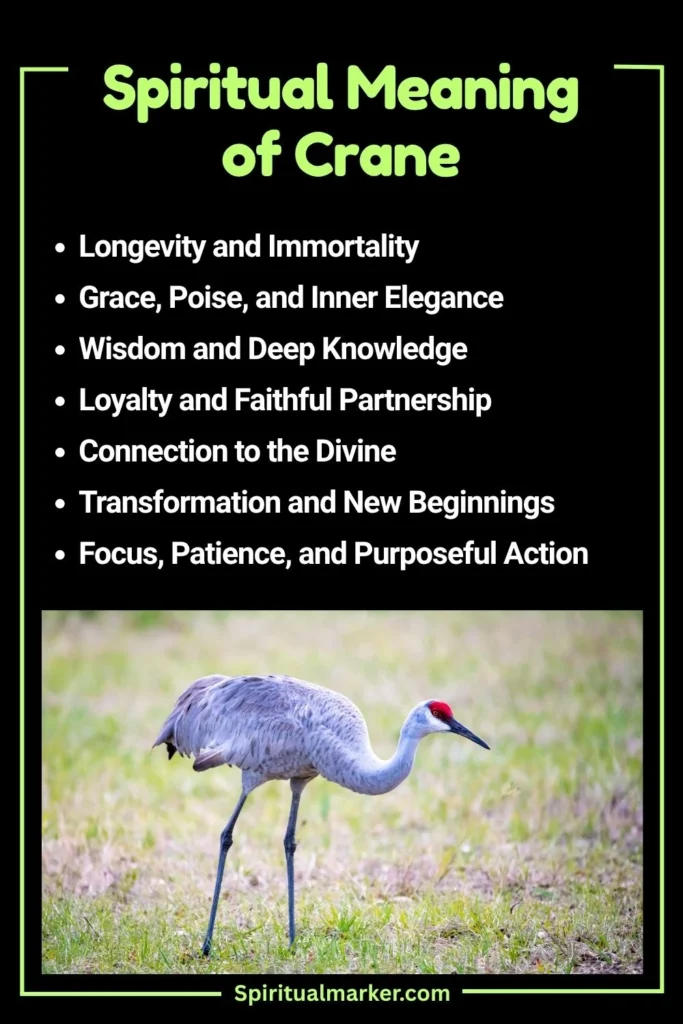
7 Spiritual Meanings of Cranes
1. Longevity and Immortality
Perhaps the most universal of all crane spiritual meanings is its connection to long life and immortality. In Chinese culture, the crane is said to live for a thousand years and was believed to carry the souls of the deceased to heaven. Daoist immortals were often depicted riding cranes through the clouds, symbolizing their transcendence beyond ordinary human limitations. The crane was not just a symbol of living a long time. It represented living so fully and so wisely that death itself lost its sting.
In Japanese culture, the crane’s association with longevity is equally powerful. The Japanese word for crane, tsuru, appears in proverbs about long life, and the tradition of folding 1,000 origami cranes (known as senbazuru) is rooted in the belief that such an act grants the folder a wish, often for long life or healing. This tradition gained global recognition through the story of Sadako Sasaki, a young girl diagnosed with leukemia following the Hiroshima bombing, who folded hundreds of paper cranes while fighting for her life. The crane’s meaning here extended beyond longevity into hope, resilience, and the refusal to surrender.
On a personal spiritual level, the crane as a symbol of longevity asks you to take the long view. It challenges you to move through life with the mindset of someone who is building something lasting, not chasing short-term rewards. It calls you to invest in your health, your relationships, your wisdom, and your spiritual depth, because those are the things that endure.
2. Grace, Poise, and Inner Elegance
The crane moves with a kind of effortless grace that has inspired artists, poets, and spiritual teachers for millennia. Its long, deliberate steps, the fluid arc of its neck, and the breathtaking spread of its wings during flight all communicate a beauty that comes from within. Spiritually, the crane’s grace is not about physical appearance. It is about moving through life with dignity, handling difficulty without losing composure, and carrying yourself with quiet confidence even when circumstances are hard.
The crane teaches that true inner elegance is not performed. It is cultivated through years of practice, self-awareness, and spiritual discipline. A crane does not rush. It does not flap its wings unnecessarily or make noise without purpose. Every movement is intentional. That intentionality is the spiritual gift the crane offers when it appears as your guide or totem. It is asking you whether your actions, words, and choices reflect the grace you are capable of.
This meaning holds special relevance during periods of conflict or pressure. When life pushes you toward reaction, toward anger or panic, the crane spirit whispers something different. It says: respond with poise. Hold your space. You do not need to match chaos with more chaos. Grace is not weakness. It is one of the most powerful forces a human being can embody.
3. Wisdom and Deep Knowledge
Cranes have been associated with wisdom in virtually every culture that encountered them. In ancient Greece, the crane was linked to the goddess Athena, the embodiment of wisdom, strategy, and clear thinking. In Korean culture, the crane is considered a bird of wisdom and justice. African elders in regions where the Grey Crowned Crane is found have long associated the bird with ancestral wisdom and sacred knowledge passed down through generations.
The crane earns this association through its behavior. A crane does not act impulsively. It watches, assesses, and acts with precision. Ancient peoples observed this quality and recognized it as the kind of thinking that leads to good decisions, strong communities, and enduring legacies. The crane became a model for how a wise person should engage with the world: attentively, calmly, and always with a clear sense of purpose.
When the crane appears as a spiritual messenger, it often arrives during times when you are facing a decision that requires more than logic. The crane calls you to access your deeper knowing, the wisdom that lives below the surface of analytical thought. It asks you to sit quietly, observe what is really happening around you, and trust the understanding that emerges from that stillness. That is where true wisdom lives.
4. Loyalty and Faithful Partnership
Cranes are largely monogamous birds, bonding with a single partner for life. The elaborate courtship dances they perform are not just mating displays. They are rituals of reaffirmation, ways of saying to their partner, “I choose you, again, today.” Pairs perform these dances throughout their lives, not just at the beginning of the relationship. That level of ongoing devotion has made the crane a powerful symbol of faithful love and loyal partnership across many world cultures.
In Korean and Japanese wedding traditions, cranes are prominently featured as emblems of marital faithfulness and a long, happy union. Crane imagery appears on wedding robes, ceremonial decorations, and gifts given to newlyweds. The message is clear: build your partnership the way a crane builds its bond, through consistent, joyful, devoted attention to each other.
The spiritual teaching here extends beyond romantic partnership. The crane’s loyalty also points toward faithfulness in friendship, in vocation, and in spiritual commitment. Are you showing up consistently for the people and the callings that matter most to you? The crane asks that question without judgment. It simply models what unwavering devotion looks like and invites you to reflect on where you might deepen your own commitments.
5. Connection to the Divine and the Heavenly Realm
Because cranes fly at remarkable altitudes and disappear into the clouds, ancient peoples across the world saw them as messengers between earth and heaven. In Chinese mythology, cranes were the mounts of the immortals, carrying enlightened beings between the earthly and celestial realms. In Japanese Shinto tradition, the crane is considered sacred, a bird that belongs as much to the heavens as it does to the earth. Several Shinto shrines feature crane imagery as a direct expression of divine presence.
In many African traditions, particularly among the Kalahari San people, certain birds including the crane were seen as intermediaries between the living world and the spirit world. Their appearance was understood as a visitation from ancestors or divine forces wishing to communicate something important. The crane was not just a bird in these worldviews. It was a living doorway to something greater.
On a personal spiritual level, the crane’s heavenly connection invites you to pay attention to your own relationship with the divine. When a crane appears, it may be carrying a message from your higher self, your ancestors, or the spiritual source you connect with. Slow down. Be open. The crane is not flying past randomly. It is bringing you something you need to receive.
6. Transformation and New Beginnings
The crane’s annual migration is one of the most breathtaking spectacles in the natural world. Flocks of thousands travel thousands of miles between seasons, leaving behind what is no longer needed and moving toward what is new. This migratory pattern made the crane a powerful symbol of transformation, seasonal change, and the courage to begin again. The crane does not hold onto the past. It moves forward when the time comes, instinctively and without hesitation.
In many indigenous cultures of North America, the crane’s arrival in spring marked the beginning of a new season of growth, planting, and renewal. Its departure in autumn was a sign to prepare, to gather what had been harvested, and to turn inward during the cold months. The crane carried the energy of natural cycles, reminding people that change is not something to fear. It is the rhythm of life itself.
If the crane has appeared to you during a period of personal transition, the message is direct: your transformation is aligned with a larger, natural process. You are not losing something. You are shedding what no longer serves you. The crane spirit says trust the timing. Trust the direction you are moving in. New beginnings are not just possible. They are inevitable.
7. Focus, Patience, and Purposeful Action
Among all the spiritual meanings of cranes, this one may be the most practically powerful for modern life. The crane is a master of focused, patient action. It can stand motionless for extended periods, its eyes locked on the water, its body perfectly still, before striking with lightning speed and absolute precision. That combination of stillness and decisive action is a spiritual model that very few creatures in nature embody as completely as the crane.
Many meditation traditions use the crane as a visual anchor for the practice of mindful presence. The crane is fully in the moment. It is not thinking about what happened yesterday or worrying about what comes next. It is completely present to what is unfolding right now. That level of focused attention is what makes its action so effective. When the moment comes, the crane does not hesitate, second-guess, or hold back.
The crane appearing as your spiritual guide during a stressful or scattered period is deeply significant. It is calling you back to focus. It is reminding you that the frantic energy you are spending is not the same as purposeful effort. Slow down. Get clear. Identify what truly matters and direct your full attention there. When you strike, strike with everything you have. The crane proves that patience and precision together are unstoppable.
Crane Spiritual Meaning and Symbolism Across Cultures and Religions
Few birds have left as wide a cultural imprint as the crane. Its spiritual significance spans continents and millennia, showing up in the art, mythology, and religious practice of peoples who had no contact with each other. That kind of cross-cultural resonance is not accidental. It speaks to a universal human recognition of something genuinely sacred in this bird.
In China, the crane ranks second only to the phoenix among sacred birds. It represents longevity, good fortune, and high virtue. Chinese emperors wore robes decorated with crane imagery as a sign of elevated status and wisdom. Taoist texts frequently reference the crane as an animal of the immortals, and crane-style kung fu draws directly from the bird’s physical movements to teach practitioners about balance, precision, and spiritual harmony.
In Japan, the crane holds a position of supreme honor. Known as tancho or tsuru, the Red-Crowned Crane is considered a national treasure and appears on the 1,000-yen note. The Japanese saying “Tsuru wa sennen, kame wa mannen” translates to “The crane lives a thousand years, the tortoise ten thousand,” reflecting how deeply crane symbolism is embedded in the culture’s understanding of time, wisdom, and endurance. The crane also plays a central role in Shinto ceremonies and is associated with the gods themselves.
In Korea, the crane is called hak and is considered a symbol of purity, longevity, and nobility. Korean scholars and high-ranking officials wore robes embroidered with cranes as a mark of their moral and intellectual standing. The crane also features prominently in Korean folk paintings, where it often appears alongside pine trees and mountains, another visual language for long life and spiritual endurance.
In Native American traditions, crane symbolism varies by tribe but commonly centers on leadership, endurance, and wisdom. The Chippewa people associate the crane clan with leadership and public speaking. In many Plains tribes, the crane’s patient hunting style was studied as a model for strategic thinking. The crane’s call, which carries over great distances, was interpreted as a powerful voice capable of reaching beyond the ordinary world.
In Celtic traditions, the crane was a bird of great mystery and was associated with the Otherworld. The crane was also connected to the goddess Morrigan and to the concept of secret knowledge. Celtic mythology included stories of sacred crane bags, pouches made from crane skin that contained magical objects and hidden wisdom. The crane in Celtic symbolism was a guardian of esoteric knowledge, not freely given to those who had not earned it.
Crane Symbolism in World Mythologies
The crane appears in myths and legends from across the globe, and in nearly every case, the bird carries a role that is elevated, sacred, or deeply meaningful to the story being told. Greek mythology features the crane prominently in the myth of Geranomancy, the ancient practice of reading omens from the flight patterns of cranes. The Greeks believed the crane’s migration formed letters in the sky, and that skilled observers could read divine messages in those formations. The god Hermes, messenger of the gods, was said to have learned the alphabet from observing cranes in flight.
In ancient Egypt, the crane was associated with the sun god Ra and with the concept of the soul’s journey after death. Two cranes facing each other were a symbol of the rising sun and were used in funerary art to express the hope of resurrection and eternal life. The crane’s ability to travel between the earth and the sky made it a natural symbol for the soul’s ability to travel between the world of the living and the world of the dead.
Chinese mythology tells of the Eight Immortals, Daoist figures who transcended ordinary human life and achieved a state of eternal wisdom. The crane served as their primary means of transport through the heavens. One of the most beloved immortals, the elderly sage He Xiangu, was said to be carried on crane-back through the celestial realm. These stories were not mere entertainment. They encoded a theological claim: the crane belongs to the realm of the highest spiritual attainment.
In Ainu mythology of northern Japan and Siberia, the crane was revered as a sacred ancestor and divine messenger. The Ainu performed elaborate crane dances during ceremonies to honor the spirits of the natural world and to maintain harmony between the human and spirit realms. These dances were not performances. They were prayers, acts of communication with forces that existed beyond ordinary sight.
Types of Cranes and Their Spiritual Meanings
Not all cranes carry identical spiritual energy. The specific species that appears in your life or in your spiritual practice can carry nuanced additional meaning worth paying attention to.
The Red-Crowned Crane (Grus japonensis) is the most spiritually significant crane in East Asian traditions. Its striking white body and brilliant red crown have made it an enduring symbol of divine presence, prosperity, and long life. In both Chinese and Japanese art, this crane appears more than any other species. Spotting a Red-Crowned Crane is considered one of the most auspicious signs a person can receive.
The Whooping Crane of North America carries deeply sacred energy in many Native American traditions. Once on the verge of extinction with fewer than 20 individuals remaining in the wild in the 1940s, the Whooping Crane has become a symbol of resilience, survival against impossible odds, and the power of collective effort to protect what is sacred. Its return from the edge of extinction is itself a spiritual story about hope and the refusal to give up.
The Grey Crowned Crane of sub-Saharan Africa holds a regal, ancestral energy. Its golden crown gives it an almost royal appearance, and many African traditions associate it with the authority of elders, the wisdom of ancestors, and the dignity of leadership. The Grey Crowned Crane is the national bird of Uganda, where it appears on the national flag as a symbol of the nation’s pride and connection to its land and heritage.
The Sandhill Crane, common across much of North America, brings a more grounded, earthy spiritual energy. Its loud, rattling call carries for miles and has long been associated with the power of the spoken word, with proclamation, and with calling people together. If a Sandhill Crane has appeared in your life, it may be calling you to speak up, to use your voice for a meaningful purpose, or to gather your community around something important.
Crane Biblical Meaning and Spiritual Significance
The crane appears directly in the Bible, and the context is deeply instructive. In Jeremiah 8:7, the prophet writes: “Even the stork in the sky knows her appointed seasons, and the dove, the swift and the thrush observe the time of their migration. But my people do not know the requirements of the Lord.” Many biblical scholars note that the Hebrew word used in this passage, agur, refers specifically to the crane, not a generic migrating bird.
The prophetic message here is striking. The crane knows its season. It follows the divine order written into its nature without hesitation, without argument, and without forgetting. The prophet’s charge against the people of Israel was that they, unlike the crane, had become spiritually disoriented. They no longer recognized the times and seasons that God had appointed for them. The crane, in this biblical context, becomes a symbol of faithfulness to divine timing and attentiveness to God’s voice.
In Isaiah 38:14, King Hezekiah, writing from his sickbed as he faces what he believes will be his death, uses the cry of the crane as a description of his own lament: “Like a crane or a swallow, I cried out. I moaned like a mourning dove.” The crane’s cry in this passage represents the raw, desperate prayer of a human soul in crisis, a cry sent upward toward heaven in the hope of being heard. Hezekiah was healed. The crane’s call, in this context, becomes a symbol of prayer that reaches God even in the deepest suffering.
The broader biblical crane symbolism points toward spiritual alertness, seasonal faithfulness, and the power of authentic prayer. These are not minor themes in scripture. They are central to what it means to live a life oriented toward God. The crane, by simply being what it is, preaches a sermon that the biblical prophets found worth repeating.
The Crane as a Spirit Animal and Totem
If the crane is your spirit animal, you carry a distinctive set of gifts and a particular spiritual calling. People with the crane as their totem tend to be deeply thoughtful, unhurried in their decision-making, and capable of an intense focus that others often find remarkable. You likely have a natural gift for seeing the full picture of a situation before acting, and you are rarely rushed into choices you later regret.
The crane totem also marks you as someone with a powerful inner life. You are drawn to depth, to meaning, to the kind of conversations and relationships that go beneath the surface. You may find that you need more solitude than most people around you, not because you are antisocial, but because your mind and spirit need quiet space to process, integrate, and arrive at clarity. That is not a weakness. That is the crane’s gift.
The challenge for those with the crane as a spirit animal can be the tendency toward perfectionism or excessive deliberation. The crane waits long and patiently, but there comes a moment when it must strike. If you find yourself in perpetual waiting mode, the crane spirit calls you to recognize when the moment has arrived and to act decisively. Patience is powerful. Paralysis is not the same thing.
People who are drawn to crane imagery, who feel a resonance with the crane’s symbolism, or who frequently encounter cranes in meaningful moments are being called toward a life of greater intentionality, deeper wisdom, and spiritual attentiveness. The crane does not appear in your consciousness by accident. Take it seriously. Pay attention to what shifts in your inner world when you do.
Dreaming About Cranes: Spiritual and Psychological Meanings
A crane in a dream is rarely a casual image. Dreams about cranes are typically vivid, memorable, and charged with a sense of significance that lingers after waking. Psychologically, the crane in a dream may represent the part of you that seeks higher perspective, the part of your psyche that knows you are capable of more clarity and more wisdom than you are currently accessing.
Spiritually, dreaming of a crane flying is widely interpreted as a sign of positive transformation on the horizon. Something in your life is ascending. A situation that has felt stuck or heavy is about to lift. The crane’s flight in a dream carries the energy of release, of rising above circumstances that have kept you grounded in difficulty. Trust what this dream is pointing you toward.
A dream of a crane standing still at the edge of water suggests that you need to practice more patience in your waking life. You may be rushing toward a conclusion, trying to force a resolution, when the wiser course is to wait and watch. The crane in this image is your own inner wisdom, signaling that the right moment has not arrived yet and that stillness right now is the most powerful thing you can offer.
If you dream of two cranes together, the symbolism leans strongly toward partnership, loyalty, and deep relational connection. This dream may be affirming a significant relationship in your life or calling your attention to the importance of tending to your most meaningful bonds. In many traditions, two cranes in a dream are one of the most auspicious images a person can receive, a blessing for love, partnership, and shared longevity.
A dead crane in a dream should not be interpreted as a negative omen without careful reflection. In many traditions, the death of a sacred animal in a dream represents the end of one phase of life and the beginning of another. It can signal the death of an old identity, an outdated belief system, or a way of relating to the world that no longer serves your growth. The crane is not abandoning you in such a dream. It is completing its service for one chapter of your life and clearing the way for what comes next.
Crane Symbolism in Art, Literature, and Modern Culture
The crane has been a favorite subject of artists, poets, and storytellers for thousands of years, and its presence in human creative expression has not dimmed in the modern era. In classical Chinese ink painting, the crane appears more than almost any other animal, depicted standing in solitude against misty mountains or soaring above clouds, always conveying a mood of transcendent calm and elevated consciousness. These paintings were not decorative. They were meditations, invitations to enter the state of being the crane represented.
In Japanese haiku poetry, the crane appears repeatedly as a symbol of the sacred moment, the flash of pure awareness in which the ordinary world briefly reveals its extraordinary depth. The 17th-century poet Matsuo Basho and others of the classical period used crane imagery to evoke the experience of sudden clarity, the spiritual awakening available in any ordinary moment when you are fully present to receive it.
In modern Western culture, the origami crane has become a globally recognized symbol of peace, healing, and hope, largely through the story of Sadako Sasaki. The story went on to inspire peace initiatives, school programs, and international exchanges of paper cranes as gestures of solidarity and goodwill. The crane’s ancient spiritual meaning translated perfectly into a contemporary language of shared humanity. That kind of staying power tells you something important about the depth of this symbol.
A Final Note
The crane spiritual meaning is one of the richest, most layered symbol systems in the human spiritual vocabulary. From its connection to longevity and immortality, to its role as a divine messenger, to its embodiment of grace, wisdom, loyalty, and purposeful action, the crane speaks a language that resonates across culture, religion, and time. This bird has been telling the same essential story for thousands of years, in Chinese temples, in Japanese poems, in African ceremonies, in Native American traditions, and in the pages of scripture. The story is this: slow down, pay attention, move with intention, stay faithful, and trust the divine order that is holding all things together.
If you feel called to work more deeply with crane energy in your own life, you might consider spending quiet time in nature near water, where cranes are most likely to appear. You could bring crane imagery into your living or meditation space as a visual anchor for the qualities you are cultivating. Folding a paper crane as an act of intentional prayer or meditation is a practice rich with historical and spiritual meaning. Journaling about the qualities the crane embodies and how those qualities show up or need to be strengthened in your own life is another powerful way to engage this symbol.
The crane appeared in your awareness for a reason. Honor that awareness. Let this ancient, graceful, wise bird walk you toward a deeper, more intentional, more spiritually alive version of yourself.