The octopus moves through dark water without a sound, changes color in less time than it takes you to blink, and slips through gaps barely wider than its own eye. There is a reason this creature has fascinated sailors, mystics, and dreamers for thousands of years. The octopus spiritual meaning and symbolism runs far deeper than its eight arms suggest. It touches on intelligence, mystery, regeneration, and the kind of emotional depth most of us spend a lifetime trying to understand.
You might have seen one in a dream. You might have felt strangely drawn to one at an aquarium. Or maybe you simply want to know what this ancient sea creature represents across cultures, religions, and spiritual traditions. Whatever brought you here, this article will walk you through every layer of octopus symbolism, from its biblical associations to its meaning in your dreams. You will leave with far deeper insight into why this creature keeps showing up in stories, art, and spiritual teachings around the world.
Key Takeaways
- The octopus symbolizes intelligence, adaptability, and the ability to navigate life’s hidden depths with grace.
- Its power to regenerate lost limbs makes it a powerful symbol of healing, renewal, and second chances.
- Across cultures from ancient Babylon to Japan to the Pacific Northwest, the octopus has been linked to feminine power, creation, and the spirit world.
- In biblical symbolism, the octopus is tied to mystery, the unknown depths of the sea, and the idea that God works quietly in places we cannot fully see.
- Dreaming about an octopus often reflects feelings of being emotionally overwhelmed, or it can signal a season of growth, intuition, and inner transformation.
What Is an Octopus and Why Does It Hold Spiritual Power?
An octopus is a soft bodied sea creature with eight arms, three hearts, and a brain unlike anything else in the animal kingdom. Its name comes from the Greek word oktopous, which simply means eight feet. Scientists now believe the octopus actually uses six of its limbs as arms and two as legs, yet the number eight still defines how people interpret its symbolism. You will notice this number connects directly to the symbol of infinity, since the figure eight on its side becomes the infinity sign itself.
What gives the octopus its spiritual weight goes beyond its strange biology alone. It is the way this creature behaves. An octopus can solve puzzles, escape sealed containers, and recognize human faces. Two thirds of its neurons live in its arms rather than its head, which means each arm can almost think for itself. This kind of distributed intelligence has no real parallel among land animals, and it gives the octopus a reputation as a creature that holds wisdom in every part of its body, not just its mind.
Spiritually, water itself carries deep meaning. Oceans represent the subconscious mind, raw emotion, and the unknown corners of the soul in nearly every spiritual tradition. Because the octopus lives where light barely reaches, moves silently through that darkness, and seems to understand its surroundings instinctively, people have long treated it as a messenger from the deep. It carries lessons about navigating what we cannot see, both in the ocean and within ourselves.
What Does Seeing an Octopus Symbolize or Represent?
If an octopus has recently crossed your path, whether at an aquarium, in a documentary, on the beach, or through repeated mentions in conversation, your spirit may be nudging you toward something specific. Seeing an octopus often represents a call to use your intelligence and creativity to solve a problem that feels too tangled for a straightforward solution. You are being reminded that you have more resourcefulness available to you than you currently believe.
An octopus sighting can also point toward emotional complexity. You may be juggling several responsibilities, relationships, or emotional threads at once, much like an octopus managing eight arms simultaneously. Rather than reading this as a warning, you can take it as confirmation that you are capable of handling multiple demands without losing your center. The octopus thrives in complexity. It does not panic when life pulls it in different directions.
There is also a quieter meaning tied to camouflage and timing. Octopuses change their skin texture and color to blend into rocks, coral, and sand within fractions of a second. Seeing this creature can symbolize a season where you need to stay low key about your plans until the right moment arrives. You do not need to announce every move you make. Sometimes the wisest path forward is the quiet one.
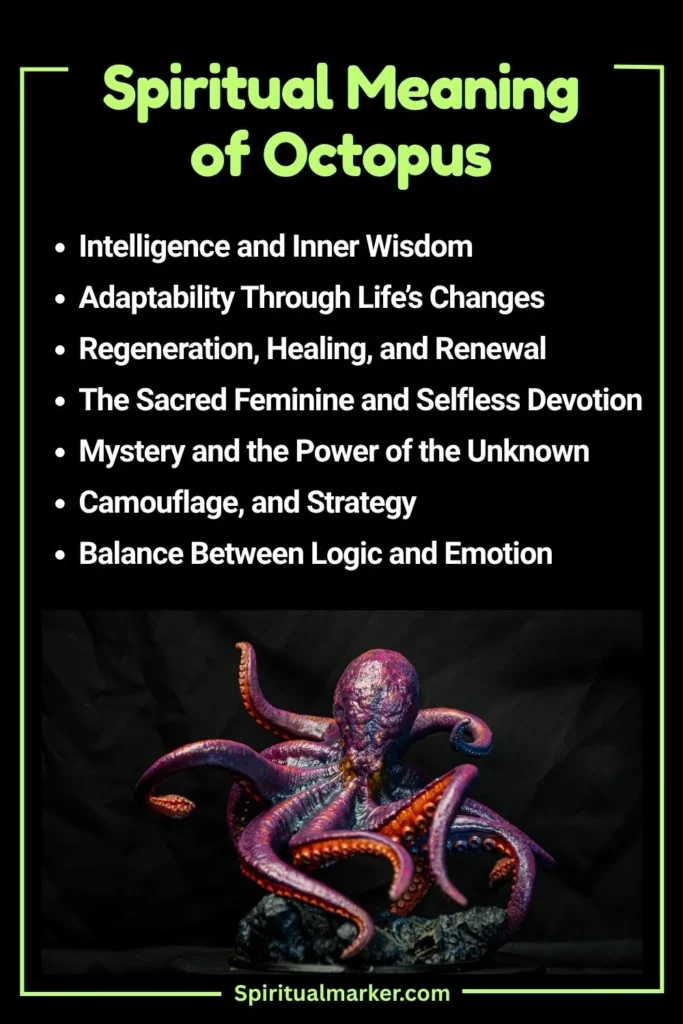
7 Spiritual Meanings of the Octopus
1. Intelligence and Inner Wisdom
The octopus stands as one of the most intelligent invertebrates on the planet, and this trait sits at the center of its spiritual symbolism. Researchers have documented octopuses opening jars from the inside, using coconut shells as portable armor, and remembering solutions to puzzles weeks later. This is not instinct alone. It reflects genuine problem solving ability. Spiritually, the octopus asks you to trust the wisdom you already carry inside you, even when a situation looks confusing on the surface.
Because so much of an octopus’s neural activity happens in its arms rather than its brain, it teaches a deeper lesson about embodied knowledge. Wisdom does not always arrive as a clear thought. Sometimes it shows up as a gut feeling, a hunch, or a sense in your body that something is right or wrong before your mind catches up. The octopus reminds you that intuition deserves the same respect you give to logical reasoning.
2. Adaptability Through Life’s Changes
Few creatures adapt as quickly or as completely as the octopus. It changes its color, texture, and even shape in under a second to match its surroundings, whether that means mimicking a rock, a clump of seaweed, or even another animal entirely. This level of flexibility is rare in nature, and it gives the octopus its strong association with transformation. Spiritually, this creature appears when you are being asked to bend without breaking.
Life rarely moves in a straight line, and the octopus understands this better than most creatures. It does not resist the current. It moves with it, reshaping itself as needed while staying true to its core nature underneath. When you feel uncertain about a major life shift, whether that is a new job, a move, or the end of a relationship, the octopus encourages you to adjust your approach without losing yourself in the process.
3. Regeneration, Healing, and Renewal
An octopus can lose an entire arm to a predator and grow it back within weeks. This biological fact carries enormous spiritual significance. It tells us that loss does not have to be permanent, and that the body, mind, and spirit have built in mechanisms for healing if we give them the chance to work. The octopus does not mourn the limb it lost forever. It focuses its energy on regrowth instead.
This makes the octopus a powerful symbol for anyone walking through grief, illness, heartbreak, or any other form of personal loss. You may have gone through a season where something important was taken from you, whether that was your health, a relationship, your confidence, or financial security. The octopus reminds you that nature has wired living beings to recover. As long as you are still breathing, regeneration remains possible.
4. The Sacred Feminine and Selfless Devotion
The female octopus offers one of the most striking examples of selfless devotion found anywhere in nature. After laying her eggs, she guards them around the clock, sometimes for months, without leaving to feed herself. She will defend her eggs against predators even at the cost of her own life, and in most species, she dies shortly after they hatch. This single act has made the octopus a lasting symbol of the Great Mother archetype and the sacrifices that come with raising and protecting life.
In ancient Babylonian mythology, the goddess Tiamat was closely linked to the octopus and represented the raw force of feminine creative power. According to this tradition, the heavens and the earth emerged from Tiamat’s body, forever linking the octopus with the creative power of the divine feminine. This connection between the octopus and feminine strength continues to surface across different mythologies, often tied to themes of creation, protection, and quiet, unrecognized sacrifice.
5. Mystery and the Power of the Unknown
The octopus lives where sunlight barely reaches, moves through caves and crevices most creatures avoid, and vanishes the moment it senses danger. This deep connection to hidden, unreachable places has earned the octopus a permanent association with mystery. Spiritually, it represents the parts of life and the self that resist easy explanation, the questions you may never fully answer, and the comfort that can come from accepting that some things remain unknown.
This is not a meaning to fear. The octopus does not view the deep, dark ocean as a threat. It treats it as home. When this creature appears in your spiritual life, it may be encouraging you to stop demanding answers for everything and instead grow comfortable moving through uncertainty with patience and trust.
6. Camouflage, Strategy, and Knowing When to Wait
An octopus rarely confronts danger head on. It hides, blends in, and waits for the right opportunity before making its move. This strategic patience is one of the clearest lessons hidden inside octopus symbolism. It teaches that timing matters just as much as effort, and that staying quiet about your goals does not make you weak. It often makes you wiser.
You can apply this lesson directly to your own circumstances. If you are working toward something important, whether a career change, a creative project, or a personal goal, the octopus suggests that discretion can protect your plans from interference. Keep moving forward steadily, stay alert to your surroundings, and reveal your full intentions only when the moment truly calls for it.
7. Balance Between Logic and Emotion
With three hearts and a nervous system spread across its entire body, the octopus exists in a constant state of balance between thought and feeling. It reasons carefully, yet it also responds instinctively to its environment in ways that suggest deep sensory awareness. This dual nature makes the octopus a fitting symbol for anyone trying to honor both the logical mind and the emotional heart at the same time.
Many spiritual seekers lean heavily toward either pure intuition or pure logic, often dismissing the other entirely. The octopus does not choose one over the other. It uses both, fully and simultaneously, to survive and thrive in one of the most demanding environments on earth. This creature invites you to stop treating your heart and your head as opposing forces and start treating them as partners.
Octopus Meaning and Symbolism Across Cultures and Religions
The octopus has held spiritual weight across nearly every culture that lives near the sea, and the meanings attached to it shift depending on the values and beliefs of each tradition. In ancient Minoan Crete, octopus motifs covered pottery and frescoes as direct representations of the sacred energy of the sea. These artifacts, some of the oldest depictions of the creature in human history, suggest that early Mediterranean cultures already viewed the octopus as something closer to a spiritual symbol than a simple food source.
In Polynesian tradition, the octopus connects to the ocean god Kanaloa, and it embodies themes of creation, healing, and the trickster spirit. This trickster element appears again and again across cultures, since the octopus’s gift for disguise naturally lends itself to stories about cleverness and deception. In Japan, both Shinto tradition and the Indigenous Ainu people tell stories of a massive octopus like spirit named Akkorokamui, described as part human and part octopus. Despite its frightening size, this spirit is generally considered benevolent by those who tell its stories, watching over the sea rather than terrorizing it.
Along the Pacific Northwest coast of North America, Indigenous nations such as the Haida developed rich traditions around the octopus, often calling it the Devilfish. The Indigenous tribes of the Pacific Northwest revered octopuses as intelligent and cunning creatures believed to possess the ability to trick and deceive. In some legends, the sea god Kumugwe, known as Copper Maker, presided over an underwater realm of treasure and spiritual power, and the octopus served as its loyal guardian. Only those who could outsmart or appease the creature were allowed to pass. This connects the octopus directly to themes of guardianship and earned wisdom, since nothing valuable in these stories comes without first proving yourself worthy.
Native American traditions across various coastal regions similarly connect the octopus to transformation, rebirth, growth, and prosperity. In Christian symbolism, interpretations vary widely. Some view the octopus’s many arms and shape shifting nature with suspicion, associating it with deception or hidden danger, while others see it as a striking reminder of the diversity and creativity present in God’s creation. This range of interpretation shows just how flexible octopus symbolism becomes once it crosses cultural and religious boundaries.
Octopus Symbolism in World Mythology
Mythology tends to exaggerate the octopus into something far larger and more dramatic than the real creature, and that exaggeration tells you a great deal about how deeply humans feared and respected the ocean’s hidden depths. The most famous example comes from Scandinavian folklore in the form of the Kraken, a colossal sea monster said to drag entire ships beneath the waves. While the Kraken is often described with octopus or squid like features, its true origin likely traces back to sailors encountering giant squid, yet the cultural overlap between the Kraken and the octopus remains strong even today.
In Haida mythology, the octopus appears in a well known legend about a young shaman who was pulled beneath the waves by a Devilfish. According to the story, the young man was assumed dead by his family, but the Devilfish had actually brought him to her father, the chief of the Devilfish people. He eventually married the chief’s daughter and became a respected member of the Devilfish community himself, only to later long for the surface world he had left behind. This story reflects common mythological themes of transformation and the idea that the boundary between the human world and the spirit world is far thinner than it appears.
Central African mythology features its own giant cephalopod monster, often called the Migas, said to dwell in freshwater lakes and swamps and seize unsuspecting victims with its long limbs. Meanwhile, in modern pop culture, the legendary writer H.P. Lovecraft drew on this same primal fear when creating Cthulhu, a cosmic entity with an octopus like head that has gone on to influence horror and fantasy storytelling for nearly a century. Whether ancient or modern, these myths reveal a consistent thread. The octopus represents what lies beyond human control and understanding, and that unknown quality can inspire either deep respect or deep fear, depending on the storyteller.
Octopus Biblical Meaning and Significance
The octopus does not appear by name anywhere in Scripture, which often leaves Christians searching for a more indirect way to understand its biblical significance. One important reference point comes from the dietary laws of Leviticus. According to Leviticus 11:9-12, sea creatures were only considered clean for the Israelites to eat if they had both fins and scales. Since the octopus has neither, it falls under the category of unclean creatures in Old Testament law, alongside other sea life such as shrimp, crab, and squid. This classification reflects ceremonial purity guidelines rather than a judgment on the creature’s spiritual worth.
Beyond dietary law, Scripture frequently uses the sea itself as a symbol of mystery, chaos, and depths beyond human control. The book of Job describes the great sea creature Leviathan in striking detail, using it to illustrate the vastness of God’s power over creation. Job 41 paints Leviathan as a being so fearsome that no human strength could ever subdue it, reinforcing the idea that the deep sea represents territory firmly under divine authority rather than human command. While the octopus is not Leviathan, its multiple arms and ability to vanish into the dark waters place it within this same symbolic category of mystery and divine sovereignty over the unknown.
Psalm 89:9 offers another window into this biblical view of the sea, declaring that God rules the raging of the sea and stills its rising waves. This verse reminds believers that even the most chaotic, unpredictable forces in creation remain under God’s authority. An octopus living quietly in the deep, moving without sound, and adapting instantly to danger can be read as a small, living picture of how God often works behind the scenes, present and active even when His hand is not immediately visible.
Psalm 42:7 contains the well known phrase, deep calls to deep, a verse often interpreted as an invitation to seek a closer, more honest relationship with God beneath the surface level of faith. An octopus dwelling in the depths can serve as a gentle visual reminder of this invitation, encouraging believers to move past surface level spirituality and pursue something far more rooted and real. Likewise, 1 Peter 5:7 calls believers to cast all their anxiety on God because He cares for them, a comforting truth for anyone who feels emotionally overwhelmed, the same way an octopus might appear when life feels like it is pulling you in eight directions at once.
It is worth noting that some Christian teachings, particularly within certain deliverance ministries, interpret the octopus in a far more negative light, associating it with manipulation, control, or spiritual bondage due to its many grasping arms. These interpretations are not universal across Christianity, and most mainstream biblical scholars caution against assigning fixed demonic meaning to a creature never directly named in Scripture. If you encounter an octopus in a dream or vision and feel uneasy, prayer and quiet reflection remain the most trustworthy path toward understanding what that experience means specifically for your own walk of faith.
Octopus as a Spirit Animal and Totem
If the octopus serves as your spirit animal or totem, you likely carry a natural gift for strategic thinking and emotional intelligence. People with this totem tend to read a room quickly, sense tension before anyone speaks a word, and adjust their behavior to fit whatever environment they find themselves in. This is not the same as being fake or dishonest. It reflects a deep awareness of context and timing that most people never fully develop.
Those connected to octopus energy also tend to be highly creative, often drawn toward art, writing, healing professions, or any craft that rewards working closely with the hands. Since the octopus relies so heavily on its arms, it carries a natural connection to anyone who builds, creates, or heals through physical touch and skilled handiwork. If you keep encountering octopus imagery, themes, or even casual mentions in conversation, it may be a sign to lean further into whatever creative or strategic gift you have been holding back.
Dreaming About an Octopus: Spiritual and Psychological Meanings
Dreams about an octopus tend to carry strong emotional weight, and the meaning shifts significantly depending on how the dream actually felt. If you dreamed of an octopus while feeling calm, confident, or even amused, this often signals that you possess more control over a current situation than you realize. A dream about an octopus where you feel at ease and in command of the situation can reveal that you should trust your ability to manifest positive outcomes in your waking life. Your subconscious may be confirming that you are far more equipped to handle your current challenges than your conscious mind gives you credit for.
On the other hand, a dream where an octopus feels threatening, grips you tightly, or traps you in some way often points toward feelings of being emotionally overwhelmed or trapped in a complicated situation. This type of dream frequently appears during periods of high stress, especially when you feel pulled in too many directions by work, relationships, or family obligations. Psychologically speaking, the octopus in this context represents the sheer number of demands competing for your attention, each one feeling like a separate arm wrapping itself around your time and energy.
The color of the octopus in your dream can add another layer of meaning. A black octopus often symbolizes mystery, elegance, and hidden power rather than something purely negative, even though black carries unsettling associations in many other dream contexts. Dreams involving ink clouds, where the octopus releases a dark cloud to escape danger, frequently point toward your own need to create distance from a toxic situation or relationship. The way an octopus uses its ink to confuse a predator and slip away unseen mirrors something your subconscious may be encouraging you to do: protect your peace by stepping back from whatever is currently draining you.
Dreams are deeply personal, and no single interpretation applies universally to every dreamer. The clearest path toward making sense of your own octopus dream involves paying attention to how you felt during the dream itself, what was happening in your waking life at the time, and which details stood out most vividly once you woke up. Your subconscious mind, and many believe your spirit guides as well, often speak through symbols rather than direct statements, and the octopus gives you a rich, layered symbol worth sitting with rather than rushing to interpret.
Octopus Tattoo Meaning and Symbolism
The octopus tattoo has grown into one of the most requested designs in modern body art, and the reasons behind its popularity tie directly back to everything this creature represents spiritually. People choose this tattoo to mark a personal season of transformation, often after surviving a major life change such as illness, divorce, grief, or a difficult recovery. The image of an octopus regenerating a lost arm translates beautifully onto skin as a permanent reminder that healing is always possible, no matter how deep the wound once felt.
Others choose an octopus tattoo specifically for its tie to the infinity symbol. Since the octopus is associated with the number eight, and the number eight rotated on its side becomes the mathematical symbol for infinity, this tattoo often represents unlimited potential, eternal love, or a belief in possibilities without boundaries. A person recovering from heartbreak might choose this design to symbolize their belief that love itself remains infinite, even after one particular relationship has ended.
The placement and color of an octopus tattoo can shift its meaning slightly as well. A tattoo wrapping around the arm or shoulder often emphasizes protection and strength, since the design visually mirrors how an octopus wraps its own limbs around prey or obstacles. A more colorful, swirling design tends to highlight creativity and adaptability, while a darker, more shadowed octopus design often leans into themes of mystery and the unknown. Whatever style you choose, this tattoo carries a built in story about resilience that few other designs can match.
Common Octopus Encounters and What They Might Mean
Beyond dreams, certain real life encounters with octopus imagery or symbolism tend to repeat themselves for people walking through a spiritual awakening. If you keep noticing octopus references in books, conversations, or social media without actively searching for them, this pattern often signals that your intuition is trying to get your attention. Spiritual teachers frequently describe this kind of repetition as a sign from the universe or from your own higher self, nudging you toward a lesson you have not yet fully absorbed.
An unexpected encounter with a live octopus, whether at an aquarium, while diving, or even while watching a wildlife documentary that suddenly grips your attention, can point toward a specific invitation to slow down and observe before acting. Octopuses rarely rush. They study their environment first, then commit fully once the moment is right. If you have been feeling pressure to make a fast decision about a relationship, a career move, or a financial choice, this kind of encounter may be encouraging you to pause and gather more information before moving forward.
Some spiritual practitioners also connect octopus encounters to lunar energy, since the moon’s gravitational pull influences ocean tides and, by extension, many forms of marine life. If your octopus encounter happened near a full moon or during a period of heightened emotional sensitivity, it may be worth paying closer attention to your own emotional tides during that same lunar cycle. Whatever form the encounter takes, treat it as an invitation rather than a riddle that demands an immediate solution.
A Final Note
The octopus carries far more spiritual weight than its strange, otherworldly appearance might suggest at first glance. It teaches intelligence without arrogance, adaptability without losing your core identity, and healing that comes naturally once you stop resisting it. Whether this creature has appeared to you in a dream, through a chance encounter, or simply through your own curiosity about its symbolism, there is likely a reason it found its way into your life right now.
If you want to work with this symbolism more intentionally, take a few quiet moments to reflect on which area of your life currently feels the most tangled or overwhelming. Ask yourself whether you have been hiding a talent that deserves more attention, or whether you have been resisting a season of healing that your body and spirit are already trying to move through. You might also consider keeping a small journal nearby to record any future dreams or encounters involving the octopus, since patterns often reveal themselves only after several entries. Whatever path you choose, let this creature’s quiet confidence in deep, uncertain waters remind you that you are far more capable of navigating your own depths than you may currently believe.