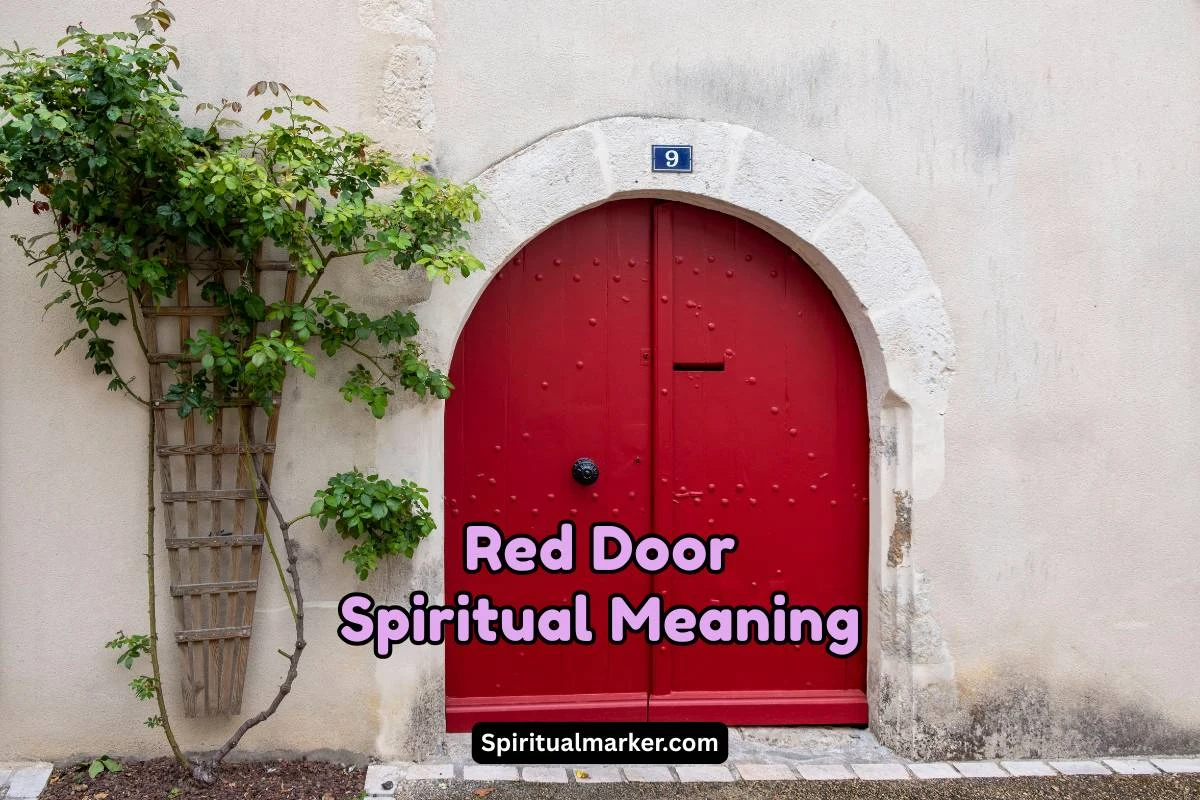
A red door is a striking and inviting sight. Its bold color stands out and draws the eye. Across cultures, red doors carry deep spiritual meaning, history, and sacred significance.
The red door spiritual meaning often involves protection, welcome, and good luck. In many traditions, a red door signals a safe haven or a place of refuge. A spiritual meaning of a horseshoe shares that protective-symbol focus, though a horseshoe carries a more common energy.
Some traditions view red doors as symbols of passion, courage, and new beginnings. Others see them as a reminder to open your heart. The door's condition can add detail.
If a red door appears in your life, it may signal a welcome. A spiritual meaning of a mirror also deals with household symbols, though a mirror carries a more reflective energy.
Key Takeaways
- A red door symbolizes protection in many spiritual traditions, acting as a barrier against negative energy, evil spirits, and harm.
- In Christianity, particularly in certain church traditions, a red door represents the blood of Christ and signals a place of sanctuary.
- Feng shui teachings associate a red front door with good luck, prosperity, and the flow of positive energy into the home.
- Red door symbolism differs meaningfully across cultures, from Colonial American freedom to Scottish debt-freedom traditions to Chinese New Year celebrations.
- Dreaming of a red door often signals a major spiritual or emotional transition, urging you to pay attention to a threshold moment in your life.
What Is the Red Door and Why Does It Hold Spiritual Power?
A door is already a powerful symbol on its own. It marks the line between inside and outside, between the known and the unknown, between safety and vulnerability. Spiritually speaking, a door represents transition, choice, and opportunity. It is where one reality ends and another begins.
Now add red to that door. Red is one of the most emotionally and spiritually charged colors in the human experience. It is the color of blood, which means it carries associations with life force, sacrifice, and vitality. It is the color of fire, which brings in themes of purification, transformation, and divine presence. Red triggers the nervous system. It commands respect. It signals importance.
When these two symbols merge, the red door becomes a spiritual focal point of extraordinary power. It is not passive. A red door does not blend into its surroundings. It declares something. Different traditions have interpreted that declaration differently, but almost all of them recognize that a red door carries intentional spiritual weight. It is a threshold marked by purpose.
Historians, color psychologists, and spiritual scholars alike agree that humans have used color on thresholds for thousands of years. Red, specifically, recurs across unconnected civilizations. That kind of cross-cultural convergence is a strong signal. When people in ancient China, early Christian Europe, Colonial America, and indigenous communities all land on the same color for thresholds and protection, the symbolism carries real archetypal depth.
What Does a Red Door Symbolize or Represent?
At its core, a red door symbolizes a guarded and intentional threshold. It tells visitors, spirits, and passersby that this space is claimed, protected, and significant. Beyond that general meaning, the red door carries several more specific representations depending on context.
A red door can represent welcome and warmth. In many traditions, offering a bright red entrance signals generous hospitality. It tells guests they are expected and honored. At the same time, that same red can represent boundaries and warnings. In protective traditions, red was placed on doorways specifically to repel unwanted forces, whether physical or spiritual.
Red doors also represent passion and aliveness. A home or space with a red door is perceived as one full of energy, creativity, and life. The color does not allow apathy. It also represents transition and change, since doors are by nature places of passage, and red amplifies the transformative quality of that passage.
Finally, a red door represents spiritual significance and intention. Across religions and spiritual systems, marking a threshold with red was never arbitrary. It was a conscious act of consecration, of drawing a spiritual boundary and calling in protection or blessing. That layer of intention is baked into the symbolism at a fundamental level.
7 Spiritual Meanings of a Red Door
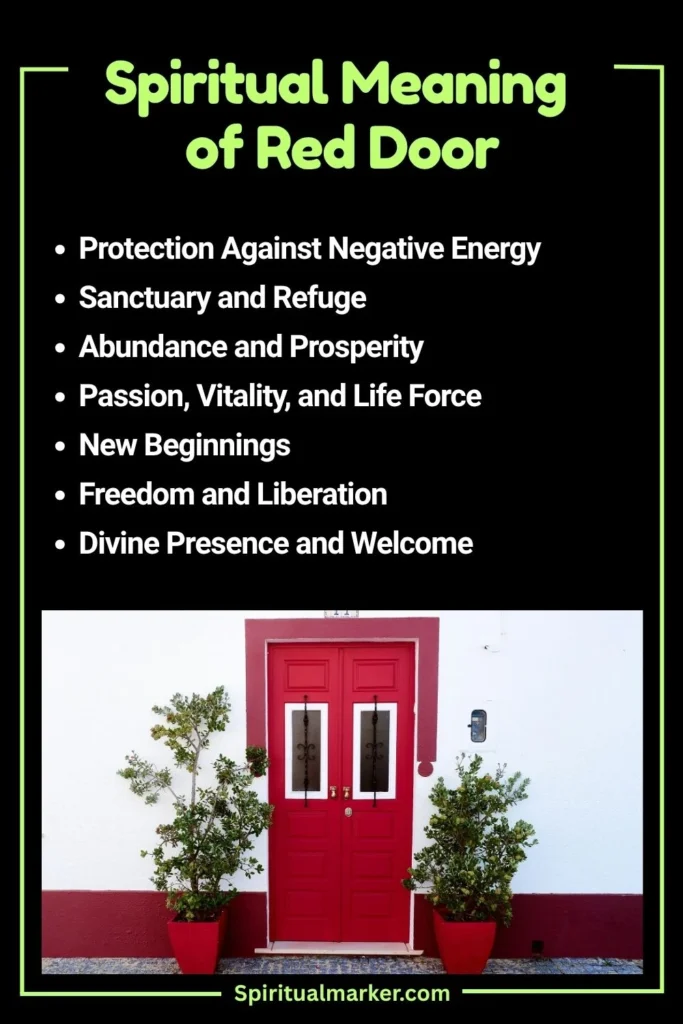
1. Protection Against Negative Energy and Evil
The most universal spiritual meaning of a red door is protection. Across vastly different cultures, red on a doorway was used as a shield. In ancient times, people believed that evil spirits, negative energies, and harmful forces could enter a home through its threshold. Marking the door red was a deliberate act of spiritual defense.
This belief was not limited to one region. Ancient Egyptians used red ochre on thresholds. Various African traditions used red markings near entryways to ward off malevolent forces. In Chinese folk belief, red frightens away evil spirits. The color itself was considered powerful enough to act as a barrier.
The spiritual logic behind this is rooted in red’s association with blood and fire, two of the most powerful purifying and life-giving forces known to ancient peoples. Blood marked life. Fire cleansed. A red door carried both of those energies in concentrated form, making it a potent spiritual guard. Even today, people who paint their doors red often report an intuitive sense of security and boundary-setting that goes beyond the visual.
If you feel called to paint your door red as an act of protection, you are tapping into one of the oldest spiritual practices in human history. That impulse is deeply meaningful and well-supported by cross-cultural tradition.
2. A Sacred Place of Sanctuary and Refuge
In Christian tradition, particularly within Episcopal, Lutheran, and Anglican churches, a red door specifically signals that the building is a place of sanctuary. The red represents the blood of Jesus Christ, signaling that all who pass through that door are covered, forgiven, and safe. Many of these churches have kept their doors red for centuries as an ongoing theological statement.
This idea of sanctuary extends beyond the church building. In broader spiritual terms, a red door marks a space where the outside world’s chaos does not follow you inside. It is a visual and energetic declaration: this is holy ground. This is where healing, rest, and spiritual renewal happen.
The concept of sanctuary tied to a marked threshold goes back to the Hebrew Bible as well. The Passover story is perhaps the most famous example, where Israelite families marked their doorposts with lamb’s blood so that the angel of death would pass over their homes. The threshold, marked in red, became the defining line between safety and danger. That profound imagery has echoed through spiritual tradition ever since.
When you see a red door on a church or sacred building, you are looking at a physical expression of this theology. The door says: come in, you are protected here. That is one of the most spiritually generous messages a threshold can carry.
3. Invitation of Abundance and Prosperity
In feng shui, the ancient Chinese system of spatial and energetic harmony, a red front door is one of the most powerful ways to attract good fortune into a home. Red is associated with the fire element, which brings warmth, visibility, and dynamic energy. The front door, called the “mouth of chi” in feng shui, is where energy enters the home. Painting it red turns that entry point into a magnet for positive, abundant energy.
Feng shui practitioners advise that a red front door facing south is especially powerful for attracting fame, recognition, and prosperity. The directional alignment amplifies the fire element’s qualities. Even in other directions, a red door signals that the home is alive, vibrant, and ready to receive good things.
This meaning is not limited to feng shui. In many folk traditions across Asia, red envelopes filled with money are given during celebrations because red activates the energy of fortune and blessing. Extending that logic to a door makes intuitive sense. A red door says to the universe: this household is open to receiving wealth, warmth, and abundance.
Homeowners who paint their front doors red often notice that the home itself feels more welcoming and energized. Visitors comment on it. The house stands out. In spiritual terms, that visibility is intentional. Abundance follows what is seen, claimed, and energetically activated.
4. A Symbol of Passion, Vitality, and Life Force
Red is the color of blood, and blood is life. In spiritual symbolism, a red door honors the raw vitality of being alive. It does not apologize for existing. It announces itself with full presence. A household that chooses a red door is, consciously or not, aligning itself with energy, passion, and the courage to be visible.
Many spiritual teachers describe the color red as connected to the root chakra, which governs survival, grounding, and physical vitality. The root chakra is your energetic foundation. It connects you to the earth, to your body, and to your most primal sense of safety and aliveness. A red door at your home’s entrance brings that grounded, vital energy into the very first thing you and your guests encounter.
This meaning also connects to the idea of a fully inhabited life. A grey or beige door blends in. A red door steps forward. In spiritual terms, choosing a red door can be an act of claiming your aliveness, your right to be present, passionate, and fully engaged in your life. It is a threshold that reflects the energy of someone who does not dim themselves to fit in.
Some cultures specifically associate red doors with newlywed homes or spaces of new beginnings, further cementing the connection to vitality, passion, and the energetic spark of starting something meaningful.
5. A Gateway to Spiritual Transformation and New Beginnings
Doors are inherently about change. You go through a door and you enter a different space. You leave one reality and step into another. A red door amplifies this quality because red is also the color of fire, and fire transforms everything it touches. Nothing exits a fire unchanged.
In many spiritual traditions, a red door marks the entrance to a liminal space, a threshold where transformation is possible and expected. Crossing a red threshold is, in symbolic terms, an act of willingness to be changed. You are not just entering a room. You are entering a field of transformation.
This meaning resonates strongly with alchemical symbolism, where red represents the final stage of spiritual transformation called the rubedo or “reddening.” In alchemy, this stage signifies the completion of the great work, the full integration of the soul. A red door can thus symbolize arrival, not at a destination, but at a more evolved version of yourself.
For people going through major life transitions, such as a divorce, a move, a career change, or a spiritual awakening, a red door can serve as a powerful personal symbol. It marks the threshold of your new chapter. Each time you cross it, you consciously affirm that you are not the same person you were before. You are in the process of becoming.
6. Freedom, Liberation, and Breaking of Bondage
One of the most historically specific red door spiritual meanings comes from Scottish tradition. When a Scottish homeowner paid off their mortgage, a significant act of financial liberation, they would paint their front door red as a public announcement that their home was free and clear. The red door was a declaration of freedom from debt.
That tradition carries a profound spiritual layer. Debt is bondage. Paying it off is liberation. Marking that liberation with a red door turned a financial act into a spiritual ceremony. The color red announced to the community: this family is free. Their threshold is no longer under burden.
In Colonial American history, a red door also carried meanings of welcome and safety. For travelers on horseback, a red door meant the homeowner offered shelter and hospitality. The door literally signaled freedom from the danger of the road. Some historians also connect red doors in early America to the Underground Railroad, where a red door indicated a safe house for people escaping slavery.
Whether the freedom is from debt, danger, or oppression, the red door has consistently served as a symbol of liberation and safety. That meaning is not just historical. Every time you cross a red threshold, you can connect to that deep current of freedom in the human story.
7. Divine Welcome and the Presence of the Sacred
A red door does not only protect or attract. It also welcomes the divine. In many traditions, the threshold between the human and the sacred is marked with color, and red is among the most common choices. When a space wants to signal that it is open to the presence of God, spirit, or higher consciousness, red appears at the entrance.
In Hinduism, red is the color most associated with Shakti, the divine feminine energy that animates all creation. Temples dedicated to goddess figures frequently feature red at their entrances. The color signals that the goddess is present and that devotees are entering her domain. Red at the threshold becomes an act of reverent greeting to the divine.
In Tibetan Buddhist traditions, red is connected to fierce compassionate energy and is used extensively in sacred architecture and ceremony. Red thresholds in these contexts signal not just protection, but the active, dynamic presence of awakened spiritual energy. Crossing that threshold is an act of spiritual engagement.
Even in more secular spiritual contexts, many practitioners of space clearing, energy healing, or intentional home design use a red door to signal that a home is a consciously spiritual space. It tells anyone who approaches: the people inside are awake, intentional, and connected to something greater than themselves. That kind of declaration at a threshold is one of the most ancient forms of spiritual expression in the human record.
Red Door Symbolism Across Cultures and Religions
The spiritual symbolism of a red door is genuinely global. Its appearance across unconnected cultures points to something archetypal at work.
In China, red is the most auspicious color in the entire cultural palette. During Chinese New Year, doors are repainted red and decorated with red couplets to attract good fortune and drive away bad luck for the coming year. The red door is central to the celebration of new beginnings and prosperity.
In Ireland, a red door is associated with energy, a feisty and welcoming spirit, and a warm household. Irish tradition does not assign the same protective folklore to red doors as some other cultures, but the association with warmth and vitality is consistent.
In the American South, red doors on churches carried the specific meaning of sanctuary. Any person seeking refuge inside was protected on holy ground. This tradition mirrored the European Christian church tradition but developed independently within Southern African American church communities as well.
In Scandinavian countries, barn doors were historically painted red with iron oxide paint to preserve the wood. Over time, the red barn became a cultural symbol of rural home and stability. The spiritual associations of red protection for living spaces gradually extended from barns to homes.
In Judaism, the mezuzah placed on the doorpost of a Jewish home is a physical marker of the threshold as sacred space. While not red, the tradition echoes the same spiritual logic: the doorpost is where the human and divine meet, and it deserves deliberate, intentional marking. The Passover blood on doorposts was the vivid red precursor to this practice.
Red Door Symbolism in World Mythologies
Mythology across the world treats doors and thresholds as places of supernatural significance. Red elevates that significance.
In Greek mythology, Janus was the two-faced god of beginnings, transitions, and doorways. His name gives us the word January, the threshold of the year. Janus presided over all passages, including doors between the mortal and divine worlds. While his doors were not always red, the spiritual weight given to thresholds in Greek myth set the stage for understanding how color on a door could carry divine meaning.
In Roman tradition, homes had household gods called Lares who guarded the threshold. Offerings were made at the door to honor these guardians. The act of marking the threshold as spiritually significant was a daily practice. Red, as the color of protective blood and fire, fit naturally into this framework.
Norse mythology describes Hel, the realm of the dead, as having a gate at the threshold of two worlds. Gates and doors in Norse mythology are consistently treated as places of power and spiritual danger. The color used to mark a door signaled which world you were entering or protecting yourself from.
In African mythological traditions, particularly in Yoruba spiritual practice, the Orisha (divine spirits) are associated with specific colors at thresholds and altars. Certain Orisha connected with protection and transition are honored with red markings. The red threshold signals that this space is under divine guardianship.
Red Door Meaning in the Bible and Christian Tradition
Biblical red door symbolism is among the most spiritually rich in the entire tradition. The most foundational story is found in Exodus 12, during the Passover narrative. God instructed the Israelites to slaughter a lamb and mark their doorposts and lintels with its blood. When the angel of death passed through Egypt, it would see the blood on the doorpost and pass over that household. The marked threshold was the difference between life and death.
That story established the doorpost as a site of divine encounter and protection. The blood, red on the wood of the door frame, became the most powerful protective mark in the Hebrew tradition. Every subsequent use of red at a threshold carries an echo of that foundational story.
In Christian theology, the blood of the Passover lamb is understood as a type, a foreshadowing of the blood of Christ. Jesus is called the Lamb of God, and his sacrifice is understood as the ultimate Passover. Red church doors, therefore, carry a direct theological line back to Exodus. The red door says: the blood of Christ covers this threshold. Death and evil pass over here.
The Episcopal Church formalized this symbolism in its tradition of painting church doors red. Many Episcopal churches worldwide maintain red doors as a visible sign of this theology. The Evangelical Lutheran Church in America follows a similar tradition. Red doors on these buildings signal consecrated ground, a place covered by Christ’s sacrifice and open to all who seek refuge.
Beyond the Passover and crucifixion connections, red in the Bible also represents the Holy Spirit, who descended at Pentecost as tongues of fire. Red doors on churches sometimes reference this event as well, marking the building as a place filled with the Spirit’s presence and power.
Types of Red Doors and What They Mean Spiritually
Not all red doors carry identical spiritual weight. The shade of red, the material, the location, and the condition of the door all add nuance to its meaning.
A deep, burgundy red door tends to carry associations with dignity, seriousness, and deep spiritual authority. It is the color of aged wine and formal power. A home with a burgundy door projects groundedness and quiet confidence.
A bright, fire-engine red door pulses with energy, passion, and extroverted spiritual vitality. It is the color of action and announcement. This shade carries the most direct associations with protection and good fortune in feng shui and Chinese tradition.
A weathered or peeling red door carries a different kind of spiritual message. The fading of the red suggests a threshold that once held strong energy but now needs renewal. In spiritual terms, this can signal that the protective or inviting energy of the space needs to be intentionally refreshed or restored.
A red door on a church is specifically a theological statement, as discussed above. Its meaning is embedded in Christian doctrine and centuries of ecclesial tradition.
A red door on a home can mean protection, prosperity, welcome, or freedom, depending on the tradition and intention of the homeowner. A person consciously choosing red for spiritual reasons brings personal intention into the symbolism, which amplifies its power.
A red interior door is less common but carries meanings of passion and transformation within the domestic space itself. It marks a room as distinct, energetically charged, and worthy of special attention.
Red Door Symbolism in Feng Shui
Feng shui deserves its own section because its treatment of the red front door is unusually detailed and specific.
In classical feng shui, the front door is the most important energetic feature of any building. It is called the “mouth of chi” because it is the primary point through which vital life force energy enters the home. The color of that door directly affects the quality and quantity of energy that flows in.
Red activates yang energy: outward, dynamic, warm, and powerful. A red front door tells the universe that the home is active, visible, and ready to receive blessings. Feng shui masters often recommend red doors for homes that feel stagnant, unlucky, or energetically blocked.
The direction your front door faces matters in feng shui as well. A south-facing red door is especially powerful because south is associated with the fire element, and red amplifies fire energy. This combination supports fame, recognition, and career success. A red door facing east or southeast can support health and family harmony. Different compass directions call for different colors in strict feng shui, but red’s power is strong enough that many practitioners recommend it regardless of direction.
Feng shui also addresses the condition of the front door. A red door in good repair, freshly painted, with clean hardware and a well-maintained entrance, maximizes the flow of positive chi. A dirty, broken, or chipped red door can actually block or stagnate energy, which is worse than no color at all.
Activating a red door in feng shui is sometimes accompanied by a space clearing ceremony, burning incense, ringing a bell, or placing protective symbols near the entrance. These practices complement the color choice and create a more complete energetic activation.
Dreaming About a Red Door: Spiritual and Psychological Meanings
Dreams about red doors are significant and worth careful attention. In dream symbolism, doors always represent opportunities, choices, and transitions. A red door amplifies these themes with the energetic intensity of the color itself.
Dreaming of standing before a red door typically signals that you are facing a major decision or transition in your waking life. The red color suggests this is not a minor crossroads. It is significant. Your subconscious is drawing your attention to a threshold you may be hesitating to cross.
Dreaming of opening a red door is generally a positive and powerful sign. It suggests you are ready to move through a transformation. You are choosing to step into a new chapter with courage and intention. Spiritually, this dream can signal that your guides, your higher self, or divine energy is affirming your readiness.
Dreaming of a locked red door points to something in your life that feels blocked or inaccessible. The red color indicates the thing you are trying to access carries significant emotional or spiritual charge. You may be facing a fear, a resistance, or an external obstacle that needs to be addressed before you can move forward.
Dreaming of a red door opening from the other side suggests that help, opportunity, or spiritual energy is being offered to you from beyond your current awareness. Something or someone is reaching toward you. The question the dream raises is whether you will step forward to meet it.
Psychologically, a red door in a dream activates associations with danger, passion, urgency, or vitality, depending on your personal emotional response in the dream. If the dream felt frightening, your psyche may be processing anxiety about change. If it felt exciting, you are likely in a state of genuine readiness for a new beginning.
Carl Jung would likely have categorized a red threshold dream as an encounter with the archetypal boundary between the conscious and the unconscious. The red color signals that crossing this threshold involves something raw, powerful, and deeply personal. These dreams are worth writing down and sitting with. They tend to arrive at pivotal moments for a reason.
Red Door Symbolism in Home and Sacred Spaces
Beyond personal spirituality and dream interpretation, the red door carries practical spiritual significance in how people design and inhabit their physical spaces.
Many intentional spiritual communities and retreat centers use red doors to mark spaces of sacred gathering, meditation, or healing work. The red signals to participants that they are entering a different kind of space. The ordinary rules of daily consciousness loosen. The work done inside is serious and transformative.
Homeowners who approach their living spaces with spiritual intention often find that painting their front door red creates a tangible shift in how the home feels. Guests comment that the home feels welcoming and alive. The household members often report a renewed sense of energy and vitality. This is not superstition. It is the result of color psychology interacting with centuries of layered cultural and spiritual associations.
In sacred geometry and esoteric architecture, the door is treated as an active spiritual element of any building, not a passive piece of wood or metal. The intention placed into a door’s design, color, and placement affects the energetic field of the entire structure. Red, as one of the most energetically potent colors, makes a correspondingly strong contribution to that field.
Community spaces, temples, and places of worship across many traditions have intuited this truth for millennia. A red door tells everyone who approaches: something important happens here. That message carries real spiritual power, whether the observer knows the symbolic tradition behind it or not.
A Final Note
A red door is a threshold statement. It has been one for thousands of years, across cultures, continents, and spiritual traditions. Whether you approach it through the lens of Christian theology, feng shui, Jungian dream psychology, cultural history, or personal spiritual practice, the message is consistent. Red at the threshold means something.
It means protection. It means welcome. It means vitality and passion. It means freedom and sanctuary. It means transformation is possible here. It means the people inside are intentional about the energy they keep and the energy they invite in.
If you are considering painting your front door red, this is your confirmation that you are working within one of the richest streams of spiritual symbolism in human history. You might choose to set a clear intention as you do it. You might hold in mind what you want your threshold to say: protection, abundance, sanctuary, or transformation. That intention, combined with the centuries of meaning already embedded in the color, creates something genuinely powerful.
If you keep seeing red doors in your waking life or your dreams, pay attention. Your awareness is being drawn to threshold moments, to decisions, to transformations that are asking for your conscious participation. The red door is not asking you to be passive. It is asking you to step through.