
The seahorse is a unique and mystical creature. Its tiny size and horse-like head make it unforgettable. Across cultures, seahorses carry deep spiritual meaning and symbolism.
The seahorse spiritual meaning often involves patience, creativity, and emotional depth. Seahorses are monogamous and carry their young, so they can signal a need for nurturing. A spiritual meaning of a dolphin shares that ocean-creature focus, though dolphins carry a more social energy.
Some traditions view seahorses as symbols of good luck, protection, and gentle strength. Others see them as guides for navigating emotions. The seahorse's behavior can add detail.
If a seahorse appears in your life, it may be a call to be gentle with yourself. A spiritual meaning of a whale also deals with sea creatures, though whales carry a more profound energy.
Key Takeaways
- The seahorse spiritual meaning centers on patience, persistence, and quiet inner strength that defies outward appearances.
- In many cultures, the seahorse is a symbol of good luck, protection, and safe travel, especially across water.
- The seahorse is a powerful symbol of sacred masculinity and nurturing fatherhood, as the male carries and gives birth to offspring.
- Seeing a seahorse, whether in real life or in a dream, often signals that you need to slow down, stay grounded, and trust your journey.
- The seahorse spirit animal or totem encourages you to hold on with grace under pressure and to move through life with thoughtful intentionality.
What Is a Seahorse and Does It Hold Spiritual Power?
The seahorse (genus Hippocampus) is a small, upright-swimming marine fish found in shallow tropical and temperate waters worldwide. Its name comes from the Greek words hippos (horse) and kampos (sea monster). That alone tells you something. Ancient civilizations did not see this creature as small or insignificant. They saw it as something wild, mythical, and powerful.
Seahorses are genuinely extraordinary in the natural world. They are monogamous, often bonding with a single partner for life. They perform elaborate daily greeting rituals, swimming side by side and intertwining their tails. The male seahorse carries fertilized eggs in a special brood pouch and gives birth to hundreds of live offspring. They can change color to camouflage themselves with their surroundings. They move slowly but with deliberate, precise control.
These behaviors translate directly into spiritual symbolism. In many spiritual traditions, the natural characteristics of an animal are seen as its divine message to humanity. The seahorse, with its commitment, patience, adaptability, and quiet power, carries a message that speaks deeply to the human experience.
So yes, the seahorse absolutely holds spiritual power. Ancient Greeks, Celtic cultures, Chinese traditions, and Indigenous coastal communities all recognized this creature as spiritually significant. When a seahorse shows up in your life, it is worth paying close attention.
What Does Seeing a Seahorse Symbolize or Represent?
When a seahorse appears in your life, it rarely feels like a coincidence. You might spot one in an aquarium and feel inexplicably moved. You might find a seahorse figurine, encounter one in a photo, or receive a seahorse-related gift from someone you trust. Each of these encounters carries meaning.
At its core, seeing a seahorse symbolizes patience and persistence. This creature moves slowly. It does not rush. It anchors itself to coral or seaweed with its tail and waits for the right moment. When you see a seahorse, it may be a sign that you are moving too fast or forcing outcomes that need time to unfold naturally.
Seeing a seahorse also represents protection and safe passage. Sailors in ancient times viewed the seahorse as a good omen before long voyages. It was believed to be a guide through uncertain or dangerous waters. In a metaphorical sense, if you are about to make a major life change or navigate a difficult transition, the appearance of a seahorse signals that you are protected.
The seahorse is also a symbol of contentment and mindfulness. It does not fight the current. It bends with it. At the same time, it grips tightly to what anchors it. This speaks to the spiritual art of letting go of what you cannot control while holding firmly to your core values and purpose. When the seahorse appears, ask yourself: What are you gripping too tightly? What current are you fighting unnecessarily?
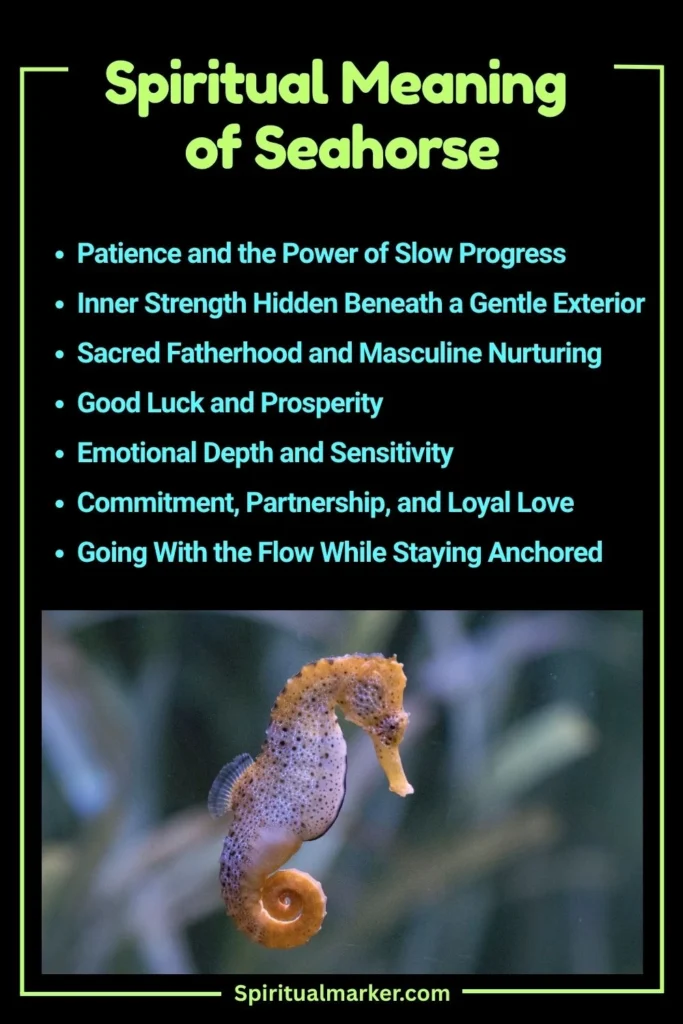
7 Spiritual Meanings of the Seahorse
1. Patience and the Power of Slow Progress
The seahorse is the slowest fish in the ocean. The dwarf seahorse moves at approximately 1.5 meters per hour. Yet it survives. It thrives. It reproduces and continues its lineage with extraordinary success. This is perhaps the most foundational of all seahorse spiritual meanings: patience is not weakness. It is one of the most powerful forces in the universe.
In modern life, you are constantly pressured to move faster, produce more, and reach goals ahead of schedule. The seahorse challenges that idea entirely. Its very existence is a spiritual argument for the value of slow, intentional movement. When the seahorse enters your awareness, it is asking you to reconsider your relationship with time. Not everything worth having comes quickly. Not every seed blooms in one season.
The spiritual invitation here is deeply personal. You may be working toward a goal that feels impossibly far away. You may be healing from something that is taking longer than you expected. The seahorse says: keep going at your pace. Your timeline is not broken. Progress that is slow is still progress. The seahorse does not apologize for its pace. Neither should you.
In meditation and mindfulness practice, the seahorse is often used as a focal symbol for cultivating patience. Practitioners visualize the seahorse drifting gently through warm, clear water, holding on when needed and releasing when the current is right. This imagery helps anchor the mind to the present moment and quiet the anxious need for speed.
2. Inner Strength Hidden Beneath a Gentle Exterior
One of the most striking aspects of seahorse symbolism is the tension between its delicate appearance and its surprising toughness. The seahorse has no stomach. Its digestive system is so inefficient that it must eat almost constantly to survive. It faces predators far larger than itself. Ocean currents can overwhelm it. Yet it persists, generation after generation, in some of the most competitive ecosystems on Earth.
This is a profound spiritual message for anyone who has ever been underestimated. The seahorse embodies quiet, unwavering resilience. It does not roar. It does not flash aggressive colors or puff up to appear larger. It simply continues to exist, to thrive, and to do what it was made to do. That is a form of strength that modern culture rarely celebrates but deeply needs.
If the seahorse is appearing to you repeatedly, it may be affirming your own hidden strength. You may feel like you are barely holding on. You may feel fragile in the face of what life is currently demanding from you. The seahorse spiritual meaning in this context is clear: you are stronger than you look. You are more capable than you feel. Your quiet endurance is not a sign of weakness; it is your greatest power.
Spiritual teachers in various traditions speak of the concept of “gentle power.” This is the ability to influence the world around you not through force but through consistent, rooted presence. The seahorse is the perfect animal embodiment of this principle.
3. Sacred Fatherhood and Masculine Nurturing
Few symbols in the natural world speak to sacred masculinity and nurturing fatherhood as powerfully as the seahorse. In seahorse species, the female deposits eggs into the male’s brood pouch. The male then fertilizes them, carries them through gestation, and gives birth to live young. This process can produce anywhere from a few dozen to over a thousand offspring in a single birth.
This biological reality carries enormous spiritual weight. In many spiritual traditions, the divine masculine is associated with protection, provision, and emotional presence, not just physical strength or dominance. The seahorse is a living embodiment of this balanced masculine energy. It nurtures. It carries. It births. It protects. And it does all of this with a calm, steadfast grace.
For men who feel called to the seahorse as a spirit animal, this symbolism often speaks to their role as a father, mentor, or caretaker. The seahorse encourages men to lean into their nurturing instincts without shame. It affirms that caring deeply is not at odds with strength. In fact, the willingness to carry what others cannot is one of the highest expressions of masculine spiritual power.
For women, the seahorse’s role reversal also holds meaning. It challenges rigid ideas about gender roles in parenting and spiritual leadership. It affirms that love and responsibility transcend gender and that the sacred act of nurturing belongs to all who are called to it, regardless of identity.
4. Good Luck and Prosperity
In many cultures, the seahorse is a powerful symbol of good luck and material abundance. This association is especially strong in Asian spiritual traditions, particularly in Chinese and Vietnamese folklore. The seahorse was historically seen as a type of sea dragon, and dragons in these traditions are firmly linked to wealth, power, and divine favor.
Sailors and fishermen in ancient Mediterranean and Asian cultures carried carved seahorse talismans aboard their vessels. These were believed to protect the ship from storms and bring home safe and prosperous voyages. The seahorse was not just a good luck charm in a casual sense. It was a sacred protective amulet trusted with human lives.
In contemporary spiritual practice, the seahorse is associated with financial flow, career breakthroughs, and the arrival of long-awaited opportunities. If you have been working hard for a breakthrough that has not yet come, the appearance of a seahorse may signal that good fortune is on its way. The key, as the seahorse always reminds us, is patience.
This good luck symbolism also connects to the seahorse’s ability to adapt and blend into its environment. Spiritual teachers often point out that true prosperity comes not from fighting the world around you but from knowing how to move within it wisely. The seahorse does exactly that. It reads its environment, adjusts its coloring, and positions itself to thrive. This is a powerful model for abundance consciousness.
5. Emotional Depth and Sensitivity
The seahorse navigates one of the most complex ecosystems on the planet using heightened sensory awareness. It uses its eyes independently of each other, taking in a panoramic view of its environment at all times. It is extraordinarily sensitive to changes in water temperature, light, and current. This sensitivity is not a liability; it is its greatest navigational tool.
Spiritually, the seahorse represents emotional depth and the gift of sensitivity. If you identify with the seahorse, you may be someone who feels things deeply. You may pick up on emotional undercurrents that others miss. You may find crowded or chaotic environments overwhelming. These traits, often labeled as weaknesses in a fast-paced world, are actually profound spiritual gifts.
The seahorse spirit animal speaks directly to empaths, highly sensitive people, and intuitive souls. It validates the experience of feeling things intensely and reminds you that your emotional intelligence is a form of wisdom. Your sensitivity is not something to be fixed or suppressed. It is a tool for navigating life with greater awareness and compassion.
Many spiritual traditions teach that water is the element of emotion, intuition, and the subconscious mind. As a water creature, the seahorse is deeply connected to these dimensions. When the seahorse appears as your guide, it may be inviting you to honor your emotional landscape more fully. Stop dismissing your feelings. Start listening to them as the navigational data they truly are.
6. Commitment, Partnership, and Loyal Love
Seahorses are among the most romantically devoted creatures in the animal kingdom. Many species form monogamous pair bonds that last through a single breeding season or, in some cases, for life. Each morning, bonded seahorse pairs perform a greeting ritual, changing colors together and swimming side by side in an intricate synchronized dance that can last several minutes.
This extraordinary behavior makes the seahorse one of the most powerful symbols of faithful love and true partnership. In spiritual terms, the seahorse represents a love that is not flashy or impulsive but steady, intentional, and deeply rooted. It speaks to the kind of relationship built on daily devotion and mutual presence rather than grand gestures.
If the seahorse is appearing to you during a time of romantic uncertainty, it may be carrying a message about what love truly looks like. It may be affirming a relationship that has quiet depth and real staying power. Alternatively, it may be calling you to evaluate whether your current partnership reflects the kind of sacred, reciprocal commitment the seahorse embodies.
The seahorse spirit animal in the context of relationships also speaks to the importance of rituals. The daily greeting dance of the seahorse pair is a reminder that love requires consistent, intentional tending. Small, daily acts of connection are what sustain deep partnership over time. This is not a romantic platitude. It is a spiritual principle lived out in the natural world every single day.
7. Going With the Flow While Staying Anchored
One of the most philosophically rich aspects of seahorse symbolism is its relationship with water currents. The seahorse cannot fight strong ocean currents. It lacks the muscular power. So instead, it wraps its prehensile tail around a piece of coral or seaweed and holds on. It lets the current flow around it without being swept away.
This behavior is a profound spiritual metaphor for navigating life’s chaos with grace. There are currents in your life that you simply cannot stop. Grief, change, loss, uncertainty, the passage of time: these are forces that no amount of struggle will reverse. The seahorse teaches you to anchor yourself to what is real and true and to let the turbulence pass around you without destroying you.
At the same time, when the current becomes calm, the seahorse releases its grip and drifts. It does not cling to its anchor point out of fear. It moves when it is safe to move. This speaks to the spiritual balance between surrendering and holding on, between trust and discernment. The seahorse knows which moment calls for which response.
This meaning is particularly relevant for people in seasons of major transition or upheaval. If your life feels like open ocean right now, the seahorse is telling you to find your anchor. Identify your core values, your truest relationships, your deepest convictions. Hold on to those. Let everything else that is not yours to control simply flow past you.
Seahorse Meaning and Symbolism Across Cultures
Ancient Greek and Roman Symbolism
In ancient Greek mythology, the seahorse held a place of considerable reverence. The Greeks called it hippokampos, a combination of “horse” and “sea monster.” In mythological artwork, Poseidon, the god of the sea, was frequently depicted riding across the waves on the backs of giant seahorses. This imagery positioned the seahorse as a creature of divine power, not just a quirky marine oddity.
The seahorse in Greek culture was associated with safe voyages and divine protection. Sailors carved seahorse images onto their boats and wore seahorse amulets to invoke Poseidon’s protection before setting sail. The seahorse was seen as a messenger between the mortal world and the divine depths of the sea, a creature that could carry prayers to the gods of the ocean.
Roman culture adopted much of this symbolism. Neptune, the Roman equivalent of Poseidon, was also associated with seahorses. Roman mosaics frequently depicted seahorses in scenes of the ocean, reinforcing their role as sacred creatures of the deep. In Roman spiritual life, the seahorse represented the authority of the divine over the chaos of nature, a reassuring symbol in an era when sea travel was extremely dangerous.
Chinese Spiritual Symbolism
In traditional Chinese culture, the seahorse was considered a type of sea dragon. Dragons in Chinese spirituality are among the most auspicious and powerful symbols in existence. They represent imperial power, good fortune, divine authority, and the creative force of the universe. By associating the seahorse with the dragon, Chinese culture elevated it to a position of enormous spiritual significance.
The dried seahorse has been used in traditional Chinese medicine for thousands of years. It was believed to carry potent healing energy, particularly for the kidneys, liver, and reproductive system. The seahorse was thought to embody yang energy, the active, warm, protective life force. Consuming or carrying a seahorse was believed to enhance vitality and strength.
In feng shui, the seahorse is considered a symbol of good luck, especially for career and business. Placing a seahorse figure in the north area of a home or office was believed to attract powerful opportunities and enhance professional success. The seahorse’s connection to water also links it to the flow of abundance and positive life energy in feng shui practice.
Celtic Symbolism
Celtic cultures, deeply connected to the natural world and the spiritual power of water, also had a relationship with seahorse symbolism. In Celtic tradition, the sea was seen as a gateway to the Otherworld, a parallel spiritual dimension where gods, ancestors, and mystical creatures resided. Water creatures were therefore seen as mediators between this world and the next.
The seahorse in Celtic tradition represented grace under pressure and the ability to navigate between worlds. The Celts respected any creature that could thrive in the unpredictable and powerful realm of the ocean. The seahorse, small and unhurried but ultimately indestructible in its quiet way, was admired as a model of spiritual endurance.
Indigenous and Coastal Cultures
Many Indigenous coastal communities across the Pacific, the Americas, and Southeast Asia have developed their own spiritual relationships with the seahorse. In these traditions, the seahorse often represents harmony with nature, the wisdom of slowness, and spiritual protection for families and children.
In some Pacific Island traditions, the seahorse is associated with ancestral protection. Its image is used in ceremonial art to invoke the guidance and protection of ancestors, particularly for children and newborns. The seahorse’s role as a birth-giver connects it to the threshold between the spirit world and the living world.
Seahorse Symbolism in World Mythologies
The seahorse in world mythology occupies a fascinating space, never quite a monster, never quite an ordinary animal. It sits at the boundary of the familiar and the magical, which is precisely where mythology tends to do its most important spiritual work.
In ancient Etruscan art, seahorses appear frequently in funerary imagery. They were seen as guides that carried the souls of the dead across the waters of the underworld to their final resting place. This made the seahorse a symbol of safe transition, spiritual passage, and the continuity of life after death. Far from being a symbol of endings, the seahorse in this context represented a doorway rather than a wall.
In Norse mythology, the sea was home to countless powerful and frightening creatures. The seahorse appears in Norse-adjacent Germanic folklore as a spirit guide of the deep, associated with hidden wisdom and the mysteries that lie beneath the surface of conscious awareness. Scholars have noted that the seahorse’s unusual shape, part horse, part serpent, part fish, made it a natural candidate for mythological status in cultures that prized hybrid, liminal beings.
In Japanese folklore, the seahorse was considered a creature of good fortune and spiritual protection. The Takarabune, or Treasure Ship, which carries the Seven Lucky Gods in Japanese tradition, is sometimes depicted with seahorses swimming alongside it. This further cemented the seahorse’s association with divine favor, abundance, and spiritual blessing.
Seahorse as a Spirit Animal and Totem
What It Means If the Seahorse Is Your Spirit Animal
If the seahorse is your spirit animal, you carry a particular set of gifts and challenges that are intimately connected to this creature’s nature. Spirit animal relationships are not chosen by the conscious mind. They reveal themselves through recurring encounters, dreams, deep emotional resonance, and unexplained attraction to a particular creature.
People with the seahorse spirit animal tend to be deeply empathetic and emotionally intelligent. You likely feel things with great intensity. You may be highly perceptive of other people’s emotions, sometimes to the point of absorbing what they feel. You are probably not the loudest person in the room, but your observations are often the most accurate and insightful.
You also likely have a strong inner world and a rich creative imagination. The seahorse spirit animal is connected to artists, healers, poets, and visionaries. If this is your totem, you may find that your greatest contributions come not from aggressive self-promotion but from the depth and sincerity of what you create and offer to others.
The challenge for seahorse spirit animal people often lies in learning to assert themselves. The seahorse is not confrontational. It hides. It camouflages. While this is a gift in many situations, it can also become a pattern of self-effacement that prevents you from claiming what you rightfully deserve. Your spirit animal is calling you to practice gentle visibility to let your light be seen without waiting for permission.
The Seahorse as a Power Animal
When you call on the seahorse as a power animal, you are invoking a specific kind of energy: the power of patient strength, protective love, and graceful endurance. You would call on seahorse energy when you need to hold your position under pressure without hardening. You might need it when navigating a slow, frustrating process that requires you to trust a timeline you did not choose.
The seahorse power animal is also invoked for matters of love and partnership. If you are working to deepen a relationship, to heal a rupture in a bond, or to open yourself to genuine intimacy, the seahorse can be a powerful guide. Its energy is loyal, warm, and deeply present.
Seahorse Biblical Meaning and Significance
The seahorse does not appear explicitly in the Bible. However, the ocean and its creatures play significant symbolic roles throughout both the Old and New Testaments. In the Bible, the sea represents the unknown, the chaotic, and the divinely controlled. God’s authority over the sea is repeatedly used as a demonstration of divine power and sovereignty.
In this framework, the seahorse carries biblically resonant symbolism. As a creature of the deep that moves slowly, nurtures its young with remarkable care, and survives through patience rather than force, the seahorse reflects several core biblical virtues. Patience is exalted throughout the Psalms and the letters of Paul. Strength made perfect in weakness is a central theme in 2 Corinthians 12:9. The seahorse embodies both.
The seahorse’s faithful partnership also echoes the biblical covenant model of love. The consistent, daily renewal of commitment between seahorse mates reflects the covenantal love described in passages like Song of Solomon and the New Testament depictions of sacrificial, servant-hearted love.
Many Christian spiritual writers have drawn on the symbolism of ocean creatures as vessels of divine teaching. In this tradition, the seahorse, with its paradoxical nature, gentle yet resilient, small yet profound, serves as a reminder that God often places the deepest truths in the most unexpected forms.
Dreaming About Seahorses: Spiritual and Psychological Meanings
Dreams about seahorses are relatively rare, which makes them all the more significant when they occur. In dream interpretation traditions both spiritual and psychological, unusual or vivid dream images carry particularly concentrated meaning.
Dreaming of a seahorse swimming peacefully in clear water is generally considered an extremely positive sign. It suggests that you are in a period of emotional clarity, spiritual alignment, and incoming good fortune. The clear water reinforces the idea that your intuition and emotional perceptions are accurate right now. Trust what you feel.
If you dream of holding a seahorse, this often speaks to a desire for connection, protection, or intimacy. You may be longing for a relationship that feels truly safe and deeply loyal. Alternatively, it may reflect your own nurturing nature and your desire to care for someone or something vulnerable in your waking life.
A seahorse changing colors in a dream is a message about adaptability and identity. You may be in a season where you need to adapt to a new environment or circumstance. The dream may also be raising questions about authenticity. Are you adapting in healthy ways, or are you changing who you are to fit in with people or situations that do not align with your true self?
Dreaming of a seahorse in distress, struggling against a current or trapped, reflects anxiety about your own situation. You may feel overwhelmed by forces beyond your control. The spiritual message in this dream is to find your anchor. Something solid and true exists in your life that can hold you steady. Your subconscious is asking you to identify it and grip it firmly.
From a Jungian psychological perspective, the seahorse in dreams often represents the anima or animus, the inner feminine or masculine principle. Because the seahorse defies typical gender roles in the animal kingdom, dreaming of it may signal a need to integrate the opposing qualities within yourself, to embrace your nurturing side if you tend toward aggression, or to claim your strength if you tend toward self-erasure.
Seahorse Tattoo Meaning and Spiritual Significance
The seahorse tattoo has become increasingly popular in spiritual and creative communities, and for good reason. As a tattoo subject, the seahorse is both visually striking and symbolically rich. People choose this image to represent personal values and life experiences that the seahorse’s symbolism captures perfectly.
A seahorse tattoo often represents resilience after hardship. Many people who have been through difficult periods, illness, loss, or major life upheaval, choose the seahorse as a permanent reminder of their own quiet strength. It says: “I held on. I adapted. I survived.”
For others, the seahorse tattoo is a tribute to fatherhood or paternal love. Because of the male seahorse’s unique role in carrying and birthing offspring, fathers who are deeply connected to their nurturing role sometimes choose this image as a permanent expression of that identity.
The seahorse tattoo also speaks to love and commitment. Couples occasionally choose matching or complementary seahorse tattoos to represent their bond, drawing on the creature’s reputation for monogamy and faithful partnership.
From a spiritual standpoint, wearing a seahorse tattoo is sometimes understood as an invitation for the seahorse’s energy to remain with you as a constant guide. It serves as a daily visual reminder of the values the seahorse embodies: patience, strength, devotion, protection, and the wisdom to flow with life rather than fight it.
Seahorse Color Symbolism and What Each Color Means
Seahorses are extraordinary in their ability to change color in response to their environment. Different seahorse colors also carry specific spiritual meanings worth understanding.
Yellow seahorses are associated with optimism, mental clarity, and intellectual creativity. Seeing a yellow seahorse or working with yellow seahorse imagery may signal a period of insight, new ideas, and positive mental energy.
Orange seahorses carry the energy of warmth, emotional healing, and creative passion. Orange is the color of the sacral chakra, which governs emotions, creativity, and relationships. An orange seahorse is a powerful symbol for anyone working through emotional healing or seeking to reignite creative fire.
White or pale seahorses represent purity, spiritual clarity, and new beginnings. White is universally associated with fresh starts and spiritual purity across many traditions. A white seahorse appearing in your life or dreams may signal that you are entering a genuinely new chapter.
Black seahorses carry deep, mysterious energy. They are associated with the unconscious mind, shadow work, and hidden truths. A black seahorse may be inviting you to look beneath the surface of your current situation or to begin the challenging but liberating work of exploring your own shadow self.
Purple or blue seahorses connect to intuition, spiritual wisdom, and divine communication. These colors are associated with the third eye and crown chakras. Their appearance often signals heightened spiritual awareness or an invitation to deepen your meditation and contemplative practice.
A Final Note
The seahorse is one of the most spiritually generous creatures in the natural world. It asks nothing from you. It does not demand that you be faster, louder, or more aggressive. It simply moves through the water at its own pace, holds on when it must, releases when it can, and loves with extraordinary faithfulness.
If the seahorse spiritual meaning has found its way to you today, pay attention. This creature rarely shows up by accident. It tends to appear when you most need its particular message: slow down, hold on, trust the current, love deeply, and never underestimate the power that lives quietly within you.
You do not need to fight harder to win. Sometimes the most powerful thing you can do is exactly what the seahorse does: grip what matters, breathe, and let the current pass. Your strength is real. Your pace is enough. Your depth of feeling is a gift. The seahorse has been saying this for millions of years. Now it is saying it to you.