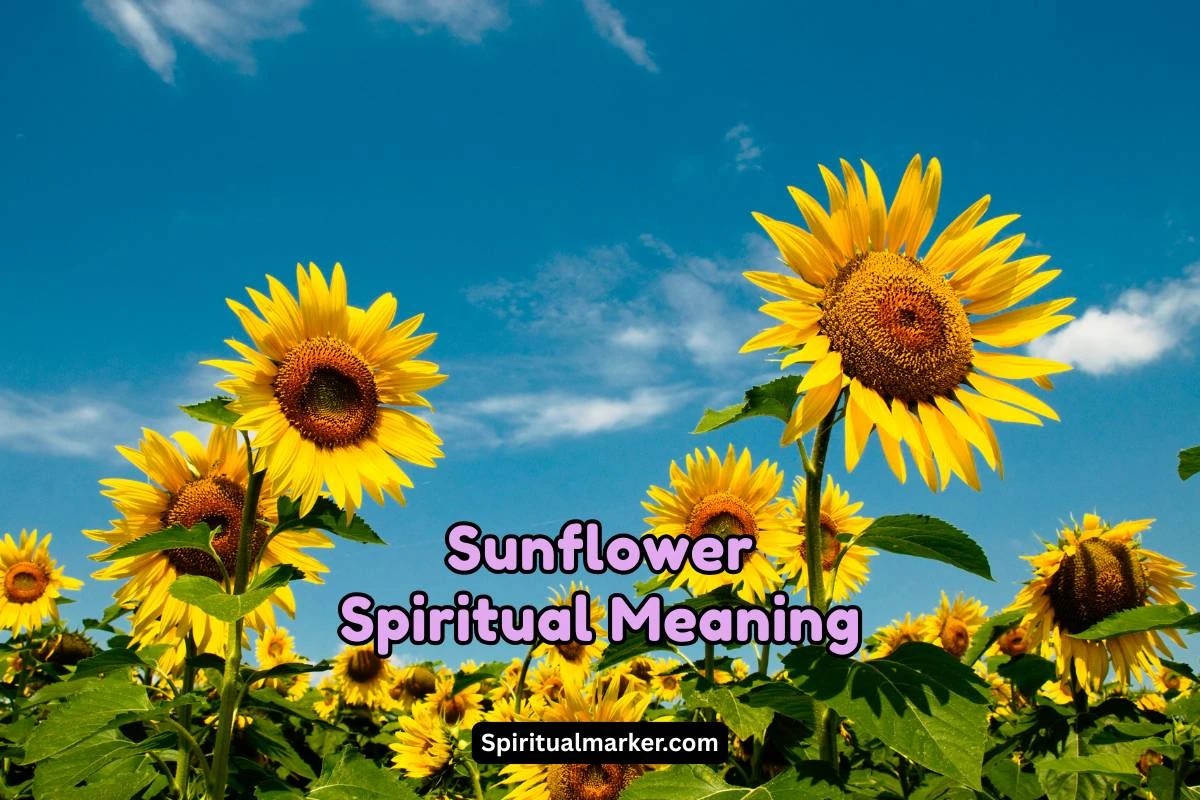
A sunflower turns its face to follow the sun. Its bright yellow petals and towering stalk make it unforgettable. Across cultures, this flower carries deep spiritual meaning and divine significance.
The sunflower spiritual meaning often involves loyalty, joy, and spiritual devotion. Sunflowers are heliotropic, meaning they follow the light, so they can signal a need to stay focused on the positive. A spiritual meaning of a yellow rose shares that yellow-flower focus, though roses carry a more romantic energy.
Some traditions view sunflowers as symbols of good luck, vitality, and nourishment. Others see them as a reminder to stand tall and face the light. The sunflower's size and health can add detail.
If a sunflower appears in your life, it may bring a message of hope. A spiritual meaning of lavender also deals with flower symbolism, though lavender carries a more calming energy.
Key Takeaways
- Sunflowers symbolize faith, loyalty, and spiritual devotion, largely because of their heliotropic nature, their instinct to always face the light.
- The color yellow in sunflowers connects directly to the solar plexus chakra, representing personal power, confidence, and vitality.
- Across cultures from Native American to Chinese to Greek mythology, sunflowers carry powerful and distinct spiritual meanings.
- Dreaming of sunflowers often signals optimism, clarity, and a turning point in your spiritual or emotional journey.
- The biblical symbolism of sunflowers aligns with themes of seeking God, walking in the light, and unwavering trust.
What Are Sunflowers and Do They Hold Spiritual Power?
The sunflower, known scientifically as Helianthus annuus, originates from the Americas. Native peoples cultivated it for food, medicine, and ceremony long before European contact. The name itself comes from Greek: helios (sun) and anthos (flower). Even its scientific name points directly to its solar identity.
One of the most fascinating behaviors of the sunflower is heliotropism. Young sunflowers track the sun from east to west during the day. They reset overnight and face east again by morning. This biological phenomenon has captivated scientists and spiritual thinkers alike. Many believe this behavior is a living metaphor for devotion, faith, and the human desire to seek the light.
Sunflowers are also architecturally remarkable. Their seeds spiral in a Fibonacci sequence, one of the mathematical patterns found throughout nature. Many spiritual traditions see the Fibonacci pattern as evidence of divine design. The presence of this sacred geometry in the sunflower deepens its spiritual significance considerably.
Do sunflowers hold spiritual power? The short answer is yes, at least symbolically. Many spiritual practitioners believe that certain flowers carry energetic frequencies that align with specific spiritual states. The sunflower, with its solar energy, is believed to carry a frequency of joy, clarity, abundance, and higher consciousness. Whether you approach this from a scientific or faith-based lens, the symbolic power of sunflowers is hard to deny.
What Does Seeing a Sunflower Symbolize or Represent?
Seeing a sunflower, whether in a garden, a painting, or unexpectedly in your path, can carry a personal spiritual message. Many people who study symbolism believe that nature communicates with us through signs. A sunflower appearing at a meaningful moment may not be coincidence.
At its core, seeing a sunflower symbolizes hope. It signals that light exists even in difficult seasons. If you have been going through a tough period, a sunflower sighting may be the universe’s gentle reminder that brighter days are ahead. This is one reason sunflowers are so frequently associated with healing and recovery.
Sunflowers also represent clarity and purpose. Just as the flower always turns toward the sun, seeing one may be nudging you to return to your own source of light. That could mean reconnecting with your values, your spiritual practice, or your true purpose in life.
There is also a strong association between sunflowers and new beginnings. Their appearance in spring and summer, their vibrant energy, and their association with the sun all connect them to fresh starts. Many people receive sunflowers as gifts at graduations, new jobs, or the start of a new chapter. The symbolism is fitting and deeply rooted in spiritual tradition.
In some spiritual practices, seeing a sunflower is interpreted as a message from a loved one who has passed. The flower’s warmth and brightness are seen as a comforting presence, a sign that love continues beyond physical life.
9 Spiritual Meanings of Sunflowers
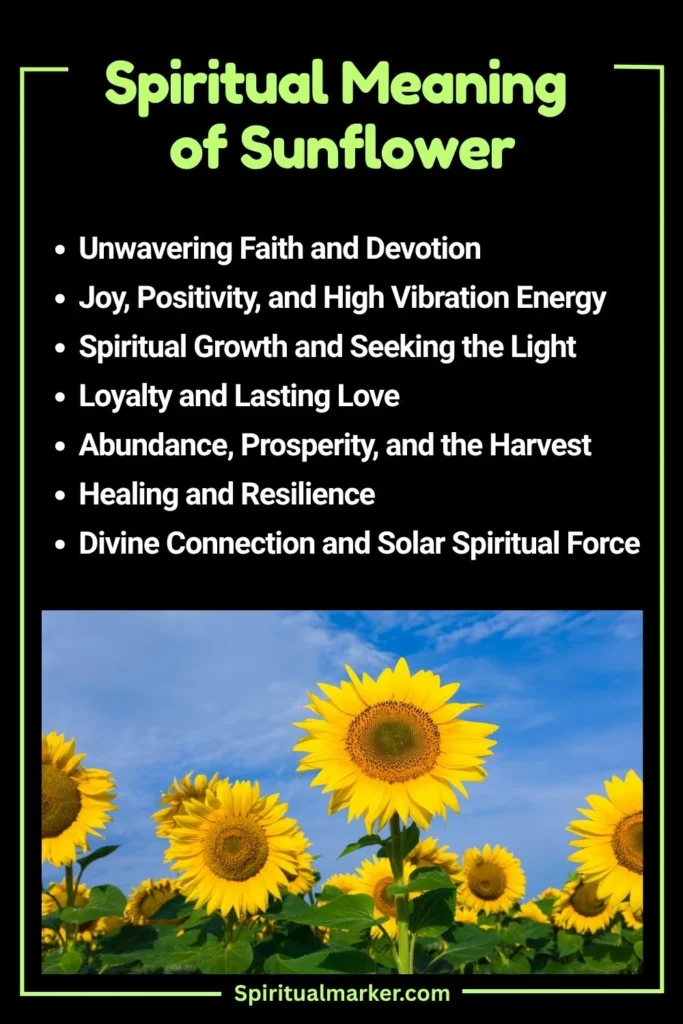
1. Unwavering Faith and Devotion
The most universally recognized spiritual meaning of sunflowers is faith. The sunflower does not waver. Even as clouds pass, even in wind and rain, it orients itself toward the sun. This is a powerful metaphor for spiritual devotion. It represents the kind of faith that holds steady even when the path grows dark.
Many spiritual traditions teach that true faith is not the absence of doubt but the choice to keep turning toward the light regardless. The sunflower embodies this beautifully. It does not choose to face the sun on good days only. It does so persistently, through every season. This quality resonates deeply with people on a spiritual path who are learning to maintain their trust in the divine through life’s challenges.
In practical terms, the sunflower can serve as a powerful spiritual reminder for those who struggle with doubt or fear. Keeping a sunflower image or a living bloom in your space can serve as a daily prompt to return to faith. Spiritual practitioners recommend meditating on the sunflower’s heliotropic nature as a way to strengthen personal devotion.
This connection to faith is also why sunflowers appear so frequently in religious artwork and sacred spaces. From church gardens to temple offerings, the sunflower speaks a language that transcends any one religion. Its message of faithful devotion is universal and timeless.
2. Joy, Positivity, and High Vibration Energy
Few flowers carry the energy of joy as visibly as the sunflower. Its large, bright yellow petals radiate warmth. Its upright posture communicates confidence and positivity. When you look at a sunflower, it is almost impossible to feel heavy or dark. That is not an accident.
In color therapy and spiritual healing, yellow is the color of optimism, mental clarity, and high-frequency energy. The sunflower, saturated in yellow, is believed to carry these qualities energetically. Many healers and energy practitioners use sunflowers or sunflower imagery in their spaces to maintain a high vibrational environment.
From a psychological standpoint, research supports the idea that yellow stimulates dopamine production. The color activates feelings of happiness and mental alertness. Combining this with the flower’s natural beauty creates a powerful mood-lifting effect that many cultures have recognized for centuries.
On a spiritual level, joy is not trivial. Many traditions teach that joy is a spiritual state, not merely an emotion. It is a sign of alignment with one’s higher self and with the divine. In this context, the sunflower becomes a symbol of someone who is living in alignment, someone whose inner light matches their outer expression.
3. Spiritual Growth and Seeking the Light
The sunflower’s upward growth is one of its most spiritually meaningful traits. It grows tall, sometimes over six feet, always reaching upward toward the sky. This vertical growth has long been associated with spiritual ascension, the soul’s journey toward higher consciousness.
In many traditions, the direction “upward” holds sacred meaning. Heaven, enlightenment, and the divine are described as being “above.” The sunflower’s instinct to grow tall and to face the sky connects it symbolically to the soul’s own longing for transcendence and spiritual elevation.
This meaning is particularly relevant for people who are in the midst of a spiritual awakening. A sunflower appearing in your life during such a time can be a confirmation that you are growing in the right direction. It acknowledges the work of self-development and encourages continued upward movement.
The sunflower also teaches a practical spiritual lesson: growth requires a source of light. Just as the flower needs sunlight to grow tall and bloom fully, human beings need spiritual nourishment to grow. The source of that light varies by tradition; it may be God, meditation, nature, community, or inner wisdom. But the sunflower’s lesson is clear. Without turning toward your light source consistently, full growth becomes impossible.
4. Loyalty and Lasting Love
Sunflowers symbolize loyalty in a way that few other flowers do. Their steadfast orientation toward the sun is often used as a metaphor for enduring love and commitment. This is why sunflowers appear so often in wedding arrangements, anniversary bouquets, and gifts between lifelong friends.
In the language of flowers, known as floriography, sunflowers historically represented adoration and loyalty. Victorian-era lovers used them to communicate steadfast devotion. The message was clear: “I will always face the light with you.” That sentiment has survived for centuries because it resonates with something deeply human.
On a spiritual level, loyalty is considered a virtue of the soul. Many spiritual texts describe faithfulness as one of the highest qualities a person can embody. The sunflower, as a natural symbol of this virtue, becomes a reminder to nurture loyalty in your own relationships and spiritual commitments.
Gifting a sunflower to someone carries this symbolic weight. You are not just giving beauty. You are offering a spiritual declaration of steadfast devotion. Many people feel this intuitively without knowing the symbolic history. The sunflower communicates something ancient and true about the nature of love.
5. Abundance, Prosperity, and the Harvest
The sunflower’s connection to abundance is woven into its very biology. A single sunflower head contains anywhere from 1,000 to 2,000 seeds. That extraordinary generativity has made it a symbol of prosperity, fertility, and abundance across cultures.
In feng shui, sunflowers placed in the home or garden are believed to attract positive energy and material abundance. Their solar connection links them to wealth-drawing energy, since the sun governs growth and vitality. Many practitioners recommend placing sunflowers in the kitchen or the abundance corner of the home.
Native American traditions honored the sunflower as a crop deity and a sacred symbol of harvest. The plant provided food, oil, dye, and medicine. Its abundance was literal as well as symbolic. Ceremonies involving sunflowers gave thanks for the earth’s generosity and invited continued prosperity.
From a spiritual perspective, the sunflower teaches that abundance flows from alignment. When the flower faces the sun, it thrives. When you align with your higher purpose and spiritual source, you too are positioned to receive abundance in all its forms: material, emotional, relational, and spiritual. The sunflower is not just a symbol of wealth. It is a map to the conditions that create it.
6. Healing and Resilience
The healing symbolism of sunflowers runs deep. The plant itself has been used medicinally for centuries. Native Americans used sunflower oil to treat skin conditions, sunflower seeds to reduce inflammation, and sunflower leaves to treat fever. The healing is not just metaphorical.
Spiritually, the sunflower represents resilience and recovery. It grows in almost any soil. It withstands heat. It blooms even in difficult conditions. For people walking through seasons of grief, illness, or hardship, the sunflower offers a powerful spiritual metaphor: healing is possible, growth can happen anywhere, and beauty can emerge from struggle.
Many grief counselors and therapists use sunflower imagery in their work precisely because of this resilient quality. Bereaved individuals often feel pulled toward sunflowers without knowing why. Spiritually, this pull may be an instinctive recognition of the flower’s healing frequency. The flower says, wordlessly, that life continues, that light returns, and that wholeness is still possible.
The sunflower also represents the body’s capacity for healing. Its seeds are packed with vitamin E, magnesium, and antioxidants. Its oil nourishes skin and tissue. The plant demonstrates that true healing is holistic, physical, emotional, and spiritual, and that nature provides abundantly for every dimension of our wellbeing.
7. Divine Connection and the Solar Spiritual Force
The sunflower’s deepest spiritual layer connects it to the divine itself. In many traditions, the sun is not merely a star. It is a symbol of God, the universe, or the highest spiritual force. The sunflower, as a flower that worships the sun, becomes a symbol of the soul reaching toward the divine.
Ancient Aztec priests wore sunflowers as sacred emblems of their solar deity. Greek mythology links sunflowers to Apollo, the god of light, truth, and the arts. These associations point to a shared spiritual intuition across cultures: the sunflower represents the human soul’s instinct to seek the highest source of light and truth.
Many modern spiritual practitioners use sunflower meditation as a way to deepen their connection with source energy. The practice involves visualizing yourself as a sunflower, rooted deeply in the earth, stem strong and flexible, face open and turned toward divine light. This meditation is said to ground and illuminate simultaneously, connecting heaven and earth within the self.
The sunflower’s golden color also links it to the divine light described in mystical traditions worldwide. In Hinduism, gold represents the divine. In Christianity, halos glow golden to signify holy presence. In alchemy, gold represents spiritual perfection. The sunflower, clothed in this sacred color, sits at the intersection of nature and the divine.
Sunflower Meaning and Symbolism Across Cultures and Religions
The spiritual meaning of sunflowers is not confined to one tradition or geography. Nearly every major culture that encountered this flower assigned it profound meaning.
In Chinese culture, sunflowers are powerful symbols of good luck, vitality, and long life. They are frequently given as gifts for important life events, particularly for people beginning new ventures. The sunflower’s connection to the sun makes it auspicious, since the sun represents yang energy, the active, life-giving force in Taoist philosophy.
In Native American cultures, the sunflower was sacred long before European contact. Various tribes used it in ceremonial practices, and it was seen as a bridge between the human world and the spirit world. The Hopi people used sunflower pollen in sacred rituals. The Lakota associated the flower with the Sioux harvest ceremony and the abundance of the Great Spirit.
In Incan civilization, the sunflower was a direct symbol of the sun god, Inti. Priestesses of the sun temples wore golden sunflower crowns. Temples were adorned with sunflower imagery crafted in gold. The flower was considered a living embodiment of the divine solar force and treated with deep reverence.
In Japanese culture, sunflowers symbolize vitality, happiness, and good energy. They are associated with summer and the life force of nature. The Japanese also connect sunflowers to nuclear healing in a poignant historical context. After the atomic bombing of Hiroshima, sunflowers were planted to help draw toxins from the soil. This gave them additional meaning as symbols of hope and recovery after devastation.
In Victorian England, the sunflower became associated with the Aesthetic Movement. Artists and intellectuals used it as a symbol of beauty for beauty’s sake and the pursuit of a refined, meaningful life. Oscar Wilde famously adopted the sunflower as one of his emblems.
Sunflower Symbolism in World Mythologies
Mythology adds vivid, emotionally rich layers to the sunflower’s spiritual symbolism. Ancient storytellers used this flower to teach timeless truths about love, devotion, transformation, and the divine.
The most famous mythological story linked to the sunflower comes from Greek mythology. The water nymph Clytie fell deeply in love with Apollo, the god of the sun. Apollo did not return her love. Heartbroken and devoted, Clytie sat on a rock for nine days, eating and drinking nothing, simply watching Apollo drive his sun chariot across the sky. The gods took pity on her and transformed her into a heliotrope flower, which later became associated with the sunflower in European retellings. This myth established the sunflower as a symbol of unrequited love, obsessive devotion, and the soul’s longing for the divine.
In Aztec mythology, the sunflower was associated with Huitzilopochtli, the god of war and the sun. Warriors and priests carried sunflowers into battle as a symbol of the sun’s power. They believed the sunflower connected them to solar energy, which gave them strength and divine protection. Sunflower seeds were used in sacred offerings to the sun deity.
Peruvian mythology tells of the sunflower as a gift from the sun god to humanity. The story teaches that the sun loved the earth so deeply that he sent sunflowers as living messengers of his warmth and light. This myth reflects a worldview in which sunflowers are not just plants but active spiritual intermediaries between the heavens and the human world.
In Slavic folklore, sunflowers were planted near homes to ward off evil spirits. The belief held that the flower’s solar energy created a protective barrier. The sunflower’s face, resembling the sun, was thought to have the power to repel darkness and negative energy.
Sunflower Color Variations and Their Spiritual Meanings
While the classic golden yellow sunflower is the most recognized, sunflowers come in a range of colors. Each variation carries its own distinct spiritual energy and meaning.
Yellow and gold sunflowers, the most common variety, represent joy, faith, and solar energy. They align with the solar plexus chakra, which governs personal power, confidence, and self-expression. Gold sunflowers specifically connect to divine light and sacred wisdom.
Red and burgundy sunflowers carry a much deeper, more passionate energy. These varieties are associated with intense love, courage, and transformation. Red connects to the root chakra, making these sunflowers a symbol of grounded passion and life force energy. They are powerful gifts for those who need courage or are undergoing major life change.
Orange sunflowers bridge the energy of red and yellow. They are associated with creativity, enthusiasm, and the sacral chakra. Orange sunflowers inspire artistic expression and emotional fluidity. Many creative practitioners keep orange sunflowers in their workspace to stimulate inspiration.
White or pale sunflowers carry the spiritual energy of purity, peace, and clarity. White is universally associated with spiritual cleanliness and new beginnings. Pale sunflowers blend this purity with the sun’s warmth, making them powerful symbols of spiritual clarity and enlightened love.
Dark or nearly black sunflower centers, combined with any petal color, are sometimes interpreted as a reminder that light and shadow coexist in all things. Spiritually, this represents integration, the wholeness that comes from accepting both the light and dark aspects of the self.
Sunflowers in the Bible: Biblical Meaning and Significance
Sunflowers as a species were not present in the biblical lands of the Middle East. They originated in the Americas and were not introduced to Europe and the broader world until the 1500s. However, the spiritual themes that sunflowers represent are woven throughout scripture with remarkable precision.
The most direct biblical parallel to the sunflower is found in Psalm 119:105: “Your word is a lamp to my feet and a light to my path.” The sunflower, which turns toward the light to navigate its growth, mirrors this verse beautifully. Just as the flower relies on the sun for direction, the believer is called to rely on God’s word as a guiding light.
John 8:12 records Jesus saying, “I am the light of the world. Whoever follows me will not walk in darkness but will have the light of life.” The sunflower’s heliotropic behavior becomes a living parable for this truth. The believer who consistently turns toward Christ, who orients their life toward the divine light, grows tall and bears fruit. The symbolism is so natural that it has become part of Christian devotional language and art.
The concept of seeking God’s face in scripture parallels the sunflower’s sun-seeking behavior. Psalm 27:8 writes, “My heart says of you, ‘Seek his face!’ Your face, LORD, I will seek.” The sunflower’s persistent orientation toward the sun is a physical embodiment of this spiritual instruction.
Philippians 4:11 speaks of contentment and abundance in all circumstances. The sunflower, which grows and blooms abundantly even in poor soil and fierce heat, illustrates this principle powerfully. It does not wait for perfect conditions to flourish. It makes the most of what it has and produces abundantly regardless.
Many Christian traditions also connect sunflowers to resurrection and eternal life. The sunflower dies in winter and is reborn in spring. Its seeds, which fall to the ground, produce new life. This cycle mirrors the Christian narrative of death and resurrection. Planting sunflowers at Christian burial sites is a practice rooted in this symbolism.
Dreaming About Sunflowers: Spiritual and Psychological Meanings
Dreams involving sunflowers are among the most positive and spiritually significant dreams a person can have. Dream analysts, spiritual teachers, and psychologists largely agree on this point. A sunflower in a dream is almost universally a good sign.
Dreaming of a field of sunflowers is one of the most joyful dream experiences. Spiritually, it signals that you are moving into a season of abundance, clarity, and alignment. You may be approaching a breakthrough in your spiritual journey or entering a period of deep inner peace. Psychologically, it suggests that your subconscious is in a positive and expansive state.
Dreaming of a wilting or dying sunflower carries a more cautionary message. Spiritually, it may indicate that you have been neglecting your connection to your light source. You may be drifting from your values, your spiritual practice, or the relationships that nourish you. This dream is not a punishment but a gentle spiritual nudge to reorient yourself before you lose your bloom.
Receiving a sunflower in a dream is often interpreted as a message of love and affirmation. If the giver is someone you know, the dream may reflect the depth of that relationship or a message of support. If the giver is unknown or appears to be a spiritual figure, many people interpret this as a divine message of encouragement and blessing.
Planting sunflower seeds in a dream speaks to your creative and spiritual potential. You are in a planting phase, laying groundwork for something significant. The dream encourages patience and trust that what you are tending will grow into something beautiful and meaningful.
A single, perfect sunflower in a dream often represents clarity and focus. Your subconscious or your spiritual guides may be pointing you toward a specific path, person, or purpose. This dream invites you to pay close attention to where your energy is naturally drawn in waking life.
From a Jungian psychological perspective, sunflowers in dreams represent the Self, the integrated and radiant whole of the personality. Seeing a sunflower in a dream may signal that you are approaching a new level of psychological integration and self-actualization. Carl Jung himself wrote extensively about solar symbolism as an archetype of the Self and the divine within.
Sunflower as a Spiritual Symbol of the Solar Plexus Chakra
In the chakra system of Hindu and yogic tradition, the sunflower holds a special relationship with the third chakra, known as Manipura or the solar plexus chakra. This chakra sits just above the navel and governs personal power, confidence, willpower, and identity.
The solar plexus chakra is often depicted as bright yellow, the same color as a classic sunflower. This color correspondence is not coincidental in energetic traditions. The sunflower is considered one of nature’s most direct representations of this chakra’s energy.
When your solar plexus chakra is balanced, you feel confident, purposeful, and aligned with your personal power. You move through the world with clarity and decisiveness. Many energy healers recommend placing sunflowers in a room or meditating with sunflower imagery to activate and balance this chakra, especially for those who struggle with self-doubt, fear of failure, or lack of direction.
A sunflower chakra meditation involves sitting quietly, visualizing a golden sunflower at your solar plexus, and breathing deeply as you imagine its petals opening. This practice is said to release energetic blocks in this center and restore your sense of personal empowerment and spiritual confidence.
The sunflower’s connection to the solar plexus also explains why many people feel energized and uplifted simply by being in the presence of sunflowers. The flower’s frequency aligns with this powerful energy center and activates it naturally.
Sunflower Spiritual Symbolism in Modern Spiritual Practices
In the contemporary spiritual landscape, sunflowers have taken on renewed and expanded significance. New Age practitioners, witches, Wiccans, energy healers, and secular spiritual seekers all work with sunflower symbolism in various meaningful ways.
In Wicca and earth-based spirituality, sunflowers are sacred to solar deities and used in Midsummer (Litha) rituals. They are burned, offered, or placed on altars to honor the peak of the sun’s power. Sunflower seeds are used in spells for abundance, protection, and clarity. Sunflower oil is used to anoint candles in rituals for success and vitality.
In crystal and flower essence healing, sunflower essence is believed to support the healing of the ego. It helps individuals step into their personal power without arrogance or insecurity. Sunflower essence is recommended for people who feel either inflated or deflated in their sense of self, helping to balance the healthy expression of personal identity.
Sunflower oil is used in spiritual baths and anointing practices to cleanse the aura and attract positive energy. Many spiritual practitioners add a few drops of sunflower oil to bathwater along with sea salt for a cleansing and empowering ritual bath. The practice is said to clear stagnant energy and invite in clarity and abundance.
In tarot and oracle traditions, images of sunflowers frequently appear on cards associated with the sun, success, happiness, and spiritual growth. The Rider-Waite tarot deck features sunflowers prominently on The Sun card, one of the most positive cards in the entire deck. Sunflowers on tarot cards reinforce themes of vitality, joy, clarity, and divine light.
What It Means When a Sunflower Keeps Appearing in Your Life
If sunflowers keep showing up repeatedly, in your dreams, in your environment, in gifts you receive, or in images you notice throughout your day, this is worth paying attention to. Spiritual traditions often refer to this as a sign or synchronicity, a meaningful coincidence that carries a message for the observer.
Carl Jung described synchronicity as the meaningful alignment of inner states with outer events. When you are going through a specific emotional or spiritual experience and sunflowers keep appearing, the repetition invites you to connect the outer symbol with your inner state.
What is the message? It depends on your situation. If you are in a season of doubt, repeated sunflower appearances may be saying: turn toward the light, keep the faith, trust the process. If you are in a season of grief, the sunflower’s persistence may be reassuring you that healing and warmth will return. If you are at a crossroads, the sunflower may be encouraging you to step boldly into your power.
Many people also report that sunflowers appear frequently after the death of a loved one. They interpret this as a sign from the departed, a message of love, peace, and continued presence. While this cannot be scientifically verified, the comfort it provides is real and spiritually significant for those who receive it.
Paying attention to when and where sunflowers appear can help you decode the message more precisely. A sunflower appearing right before a major decision feels different from one that appears during a moment of joy. Context always enriches interpretation.
A Final Note
The sunflower’s spiritual meaning is as rich and layered as the flower itself. From its roots in ancient mythology to its place in modern spiritual practice, this golden bloom carries wisdom that transcends time and culture. It teaches faith through its heliotropic devotion. It teaches resilience through its ability to grow anywhere. It teaches abundance through its thousands of seeds. It teaches joy simply through its radiant, unapologetic beauty.
What the sunflower offers you, ultimately, is an invitation. It calls you to turn toward your own source of light, whatever that looks like in your life. It reminds you that growth is possible, that joy is your birthright, and that even in difficult seasons, the sun will rise again.
If you feel drawn to sunflowers, trust that pull. Keep them in your home. Plant them in your garden. Notice when they appear unexpectedly in your path. Let their golden, sun-seeking faces be a daily reminder of who you are at your highest and what you are always, in some sacred way, reaching toward.
You might also consider keeping a sunflower journal, noting every time the flower appears in your life and what was happening emotionally or spiritually at that moment. Over time, you may begin to see a beautiful and personal pattern emerge, one that speaks directly to your unique spiritual journey.