
The throat chakra sits at the base of the throat. It is the fifth chakra, often called Vishuddha, which means purification. This energy center governs communication, truth, and self-expression.
The throat chakra meaning often involves honest speech, creativity, and the power of words. When balanced, it brings clarity and confidence in communication. A spiritual meaning of third eye chakra shares that chakra focus, though the third eye relates to intuition and inner vision.
When blocked, the throat chakra can cause fear of speaking, dishonesty, or a sense of being silenced. Practices like singing, journaling, and speaking your truth can help open it. The color associated with this chakra is blue.
If you struggle to express yourself, the throat chakra may need attention. A spiritual meaning of heart chakra also deals with chakra symbolism, though the heart relates to love and compassion.
What Is the Throat Chakra (Vishuddha)?
Your voice is one of the most powerful tools you carry. Not just the sound of it, but the truth behind it. The throat chakra, known in Sanskrit as Vishuddha, is the energetic center that governs how you express that truth to the world.
Vishuddha translates to “especially pure” or “purification” in Sanskrit. This name is no coincidence. The throat chakra is where raw emotion, thought, and inner wisdom get filtered, refined, and released as authentic communication. It sits at the fifth position in the seven-chakra system, placing it right at the bridge between the lower physical chakras and the upper spiritual ones.
In yogic and Ayurvedic traditions, the Vishuddha chakra is considered the gateway between the heart and the mind. The heart chakra below it generates emotion and love, while the third eye chakra above it holds intuition and wisdom. The throat chakra serves as the channel that translates inner experience into outer expression. When it functions well, you speak with clarity, listen with depth, and live in alignment with your truth. When it does not, that inner life stays trapped inside you.
This chakra governs far more than literal speech. It rules creative expression, writing, singing, listening, and even silence. It is connected to timing, knowing when to speak and when to hold back. In many ways, the Vishuddha chakra is less about finding your voice and more about trusting it.
The concept of the throat chakra appears not only in Hindu and yogic traditions but also in various esoteric and metaphysical systems. In the Tantric tradition, each chakra is associated with a specific lotus flower and a corresponding deity. The Vishuddha chakra is associated with the deity Sadashiva, a form of Shiva representing pure consciousness and truth.
Where Is the Throat Chakra Located?
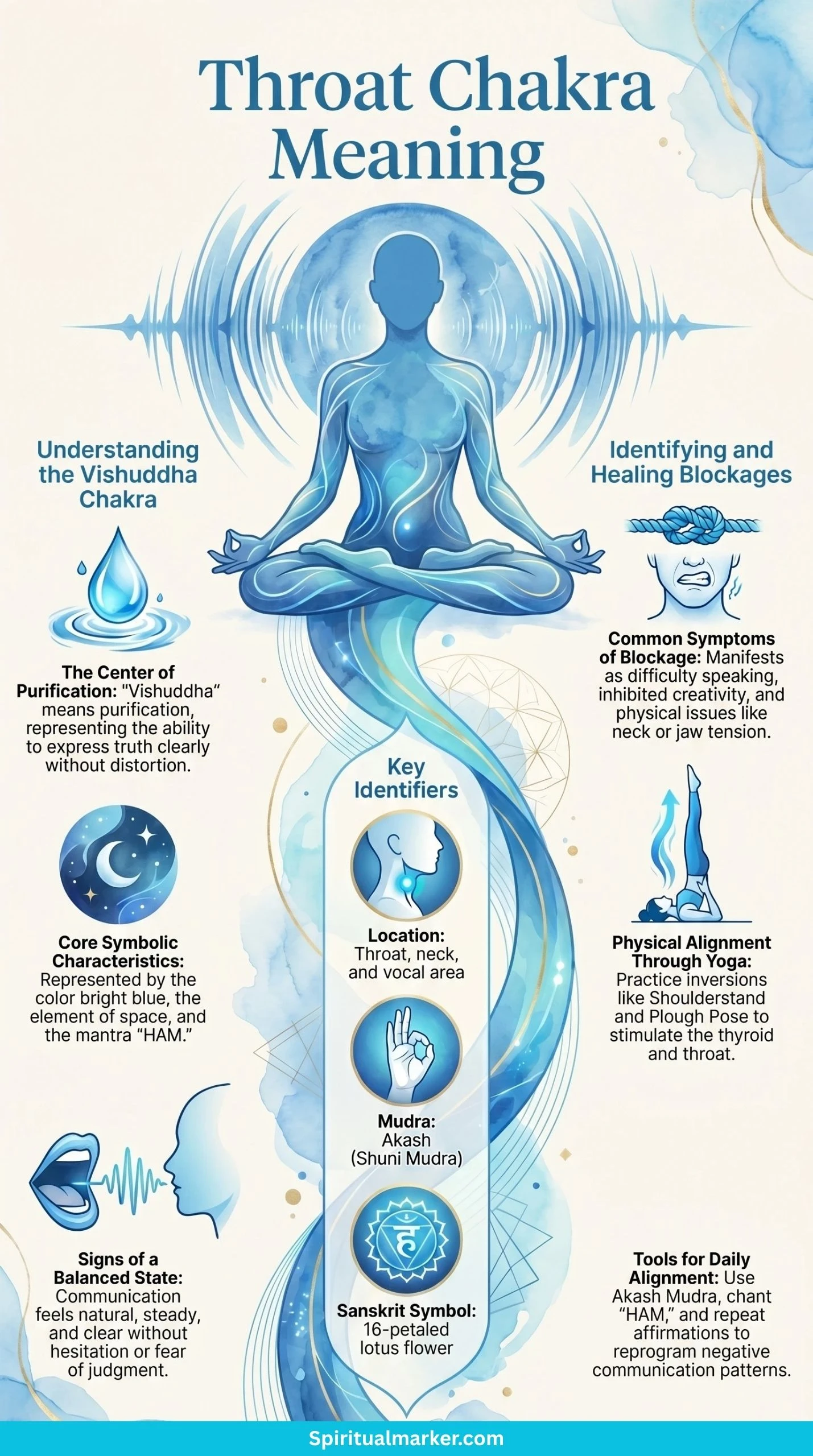
The throat chakra is located in the center of the neck, at the level of the throat and larynx. It sits between the base of the neck and the top of the sternum, roughly in the area of the thyroid gland and the cervical spine.
More specifically, its energetic center is positioned at the fifth cervical vertebra, which aligns with the throat pit, the hollow you can feel at the base of your neck just above the collarbones. Some traditions also associate it with the entire neck, jaw, mouth, and ears, since all of these structures participate in the act of communication.
The Vishuddha chakra is unique in that it sits at a physical crossroads. Everything passes through the throat, breath, food, sound, and words. In many ways, the throat is the most literal gateway of the human body, and the chakra that governs it reflects this symbolic importance. It connects the physical realm below with the consciousness above.
When you feel a lump in your throat before speaking a hard truth, or when you go silent in a moment that demands your voice, you are experiencing the energetic reality of the Vishuddha chakra responding to your inner and outer environment.
What Is the Throat Chakra Responsible For?
The Vishuddha chakra governs the full spectrum of human communication and authentic self-expression. Its responsibilities reach deeper than most people realize.
At the most fundamental level, it oversees verbal communication, the ability to speak clearly, confidently, and honestly. But it also governs listening, which is an often-overlooked component of communication. True listening requires you to quiet your own inner noise and receive what another person is actually saying. That receptive quality is equally a function of the throat chakra.
The Vishuddha is also responsible for creative expression in all its forms. Whether you communicate through writing, music, art, or dance, the throat chakra is involved. Any time you give external form to an internal experience, the fifth chakra is at work. This is why artists, musicians, and writers who feel creatively blocked often show signs of throat chakra imbalance.
Beyond personal expression, the throat chakra governs integrity and alignment between thought, feeling, and action. It is the chakra of saying what you mean and meaning what you say. When your words match your values, the Vishuddha chakra hums with energy. When you suppress your truth, pretend to agree, or habitually silence yourself, that chakra contracts.
The thyroid gland, which sits in the same region, is often considered the physical counterpart to the throat chakra. The thyroid regulates metabolism and energy, and many practitioners note correlations between thyroid disorders and throat chakra imbalances, though these connections remain within the realm of holistic and energetic healing rather than conventional medicine.
Characteristics of the Throat Chakra
Element
The throat chakra is associated with the element of space, also known as Akasha or ether. This is the most subtle and expansive of the five classical elements in yogic philosophy, the others being earth, water, fire, and air. Space is the medium through which sound travels, which makes it the perfect element for a chakra centered on communication and vibration.
Akasha represents infinite potential and the container in which all things exist. When the throat chakra is healthy and open, you feel a sense of spaciousness within yourself. Your words have room to form, your breath flows freely, and you do not feel compressed or constricted in expressing who you are. A blocked throat chakra, by contrast, creates a sense of tightness, restriction, and feeling hemmed in, as though there is no space for your voice to exist.
Working with the element of space means cultivating stillness and openness. It means giving your thoughts room to breathe before you speak them, allowing silence to hold its own weight in conversation.
Color
The throat chakra color is blue, specifically a bright, clear sky blue or turquoise blue. This shade is sometimes described as cerulean or aquamarine, and it carries the qualities of clarity, calm, and open sky.
Blue is the color of the sky and the sea, both vast, open, and connected to the idea of infinite expression. In color psychology, blue promotes calm, clear communication and trustworthiness. It slows the nervous system, encourages measured speech, and creates a sense of safety that allows truth to surface.
When you meditate on the throat chakra, visualizing a glowing blue light at the center of your throat can help activate and cleanse this energy center. Wearing blue clothing, working with blue crystals, or surrounding yourself with blue in your environment are all practices used by energy healers to reinforce Vishuddha energy.
Symbol
The Vishuddha chakra symbol is a sixteen-petaled lotus flower. Each of the sixteen petals corresponds to a Sanskrit vowel sound, and together they represent the full range of vocal expression available to humans.
At the center of the lotus is a downward-pointing triangle inside a circle, representing purification and the downward flow of divine knowledge into human expression. The triangle is enclosed in a circle to symbolize wholeness and the cyclical nature of communication, where speaking and listening feed into each other endlessly.
Inside the circle, many representations of the symbol also include an elephant, sometimes a white elephant, which is the animal associated with the Vishuddha chakra. The white elephant represents purity, wisdom, and the grounded power of deliberate speech. The color white reinforces the chakra’s connection to purity and refined expression.
Some versions of the symbol include the bija mantra HAM at the center, which is the seed sound of the throat chakra and a key element in both meditation and chanting practices.
Mantra
The bija (seed) mantra of the throat chakra is HAM, pronounced as “hum” with a nasal “m” that vibrates at the back of the throat. Bija mantras are single-syllable sounds that carry the concentrated vibrational essence of a specific chakra. Chanting them creates a physical resonance in the body that corresponds to the location and quality of that energy center.
When you chant HAM, the sound naturally vibrates in the throat and chest. This resonance stimulates the tissues and energetic pathways associated with the Vishuddha chakra, encouraging energy to move and unblock.
Beyond HAM, chanting any vowel sound or practicing toning (sustaining a single pitch) also activates the throat chakra because of its deep connection to sound and vibration. The ancient Vedic tradition holds that sound, or Nada, is the very foundation of existence. Chanting, therefore, is not merely symbolic but is understood as a direct engagement with the creative force of the universe.
Practicing just a few minutes of HAM chanting daily, or even humming quietly, can measurably shift your sense of ease around communication and creative expression.
Planet and Deities
In yogic astrology, the throat chakra is often associated with Mercury, the planet of communication, intellect, and commerce. Mercury governs how we process and transmit information, making it a natural planetary match for the Vishuddha chakra.
The presiding deity of the Vishuddha chakra is Sadashiva, a form of Shiva who embodies pure consciousness and cosmic truth. The goddess associated with this chakra is Shakini, who holds four lotus flowers and represents pure knowledge, intuition, and the power of sound.
Emotions, Mental Health, and the Throat Chakra
The relationship between the throat chakra and emotional health is profound and often underestimated. Emotions that go unexpressed do not simply disappear. They accumulate in the body, and the throat, as the physical gateway of expression, often becomes the site where that accumulation shows up most clearly.
Fear is the core emotion associated with a blocked throat chakra. Not fear of danger, but specifically the fear of judgment, rejection, conflict, and not being believed or understood. When you have repeatedly been told that your words do not matter, that your feelings are too much, or that speaking up leads to negative consequences, your throat chakra learns to close. Over time, this becomes a protective habit that operates below conscious awareness.
Shame is another emotion deeply tied to this chakra. When you feel ashamed of who you are, you instinctively silence yourself. You speak less, you minimize your opinions, and you shrink your authentic voice to fit the expectations of others. This is not weakness. It is a learned survival response. But it comes at a high cost to your well-being and sense of identity.
On the other end of the spectrum, an overactive throat chakra can manifest as compulsive talking, difficulty listening, speaking over others, bluntness without compassion, or a tendency to gossip. The energy is not absent but misdirected, flowing without the discernment or depth that a balanced Vishuddha chakra provides.
Research in somatic psychology increasingly recognizes the body’s role in storing and expressing emotional experience. The throat and neck are particularly sensitive to stress. Many people unconsciously tighten their jaw, constrict their throat, or hold their breath when faced with emotional tension. These physical patterns reflect and reinforce the energetic state of the Vishuddha chakra.
Mental health conditions including social anxiety, depression, and complex trauma frequently involve significant disruption to the throat chakra. Difficulty asserting oneself, chronic people-pleasing, suppression of creative urges, and the inability to set verbal boundaries are all patterns that both reflect and perpetuate throat chakra blockage. Working with this chakra through somatic, creative, and meditative practices can serve as a meaningful complement to conventional mental health support.
Signs and Symptoms of a Blocked Throat Chakra
Emotional and Behavioral Symptoms
Recognizing a blocked throat chakra starts with honest self-reflection. The emotional symptoms are often the first and most visible indicators that this energy center needs attention.
Fear of speaking up is one of the most common signs. If you regularly stay quiet in meetings, social situations, or relationships even when you have something meaningful to contribute, the Vishuddha chakra may be constricted. You might know exactly what you want to say but feel an invisible weight that keeps the words inside.
Difficulty saying no is another prominent symptom. Boundaries require vocal expression, and when the throat chakra is blocked, saying no feels dangerous or unkind. You may find yourself agreeing to things you do not want, overcommitting your time, and resentfully fulfilling obligations you never wanted in the first place.
People with a blocked throat chakra often struggle to articulate their feelings or needs in relationships. They know something is wrong, but putting it into words feels impossible or scary. This leads to buildup, eventual explosion, or complete withdrawal, all of which damage relational health.
Chronic dishonesty, even small everyday lies, is a significant throat chakra symptom. This includes lying to avoid conflict, overpromising to please others, or presenting a false version of yourself to the world. The throat chakra thrives on authenticity, and habitual dishonesty disrupts its natural flow.
Social anxiety, particularly the anxiety related to public speaking or being seen and heard, directly correlates with Vishuddha imbalance. The body’s physiological response to public speaking, tight throat, shallow breath, racing heart, is the throat chakra going into defensive contraction.
Creative blocks that specifically prevent you from sharing your work or voice are another manifestation. You might write, paint, or compose music privately but feel paralyzed when it comes to letting others see or hear it. That fear of judgment and the need for external validation before self-expression can flow are hallmarks of this chakra’s disruption.
Physical Symptoms
The physical symptoms of a blocked throat chakra are often localized to the neck, throat, jaw, and mouth, though they can extend into the shoulders and ears as well.
Frequent sore throats, throat infections, and laryngitis are among the most commonly noted physical signs. While these conditions certainly have medical causes, many holistic practitioners observe that people prone to throat issues often also struggle with self-expression.
Thyroid imbalances including hypothyroidism and hyperthyroidism are frequently linked to the throat chakra in energy healing traditions. The thyroid sits directly over the chakra’s location, and its role in regulating metabolic energy mirrors the chakra’s role in regulating expressive energy.
Neck and shoulder tension is extremely common. When you habitually hold back what you want to say, the muscles of the neck, jaw, and upper shoulders tighten in response. Over time, this creates chronic stiffness, pain, and reduced mobility in those areas.
Jaw clenching and bruxism (grinding the teeth, especially during sleep) are physical manifestations of suppressed speech. The jaw tightens as though physically holding the words in, and this tension persists even when you are unconscious.
Ear problems, including tinnitus, recurring ear infections, and difficulty with auditory processing, can also reflect throat chakra imbalance because of the chakra’s connection to both speaking and listening.
Voice changes, such as hoarseness, a frequently cracking voice, speaking unusually softly or unusually loudly, or a persistent feeling of a lump in the throat, are direct physical expressions of Vishuddha disruption.
How to Heal and Balance the Throat Chakra
Healing the throat chakra is a process, not an event. It requires consistent practice, self-compassion, and a genuine commitment to honoring your own voice. The good news is that the Vishuddha chakra responds powerfully to relatively simple practices, especially those involving sound, breath, and creative expression.
Journaling is one of the most accessible and effective ways to start opening this chakra. Writing gives your inner voice a safe space to exist before it has to face the world. You do not need to share what you write. You simply need to write it. This act alone begins to loosen the grip of self-censorship.
Singing and chanting, even privately, are among the most direct ways to activate the Vishuddha chakra. The vibration of your own voice in your own throat is a physical act of self-expression. Singing in the shower, humming while you cook, or joining a community choir all serve the same energetic function: they train you to trust your voice.
Speaking difficult truths with compassion is a more advanced practice but one that brings the deepest healing. This might mean having a conversation you have been avoiding, setting a boundary you have been reluctant to name, or sharing a creative work you have been hiding. Each time you choose authentic expression over protective silence, you strengthen the throat chakra.
Blue crystals such as aquamarine, blue lace agate, lapis lazuli, sodalite, and turquoise are widely used in crystal healing to support the Vishuddha chakra. Wearing them as a necklace or choker places them directly over the chakra, while holding them during meditation can amplify the intention of opening and clearing this energy center.
Essential oils including eucalyptus, peppermint, chamomile, and frankincense are often used to support throat chakra healing. These can be diffused during meditation or applied diluted to the throat area during healing practices.
Dietary choices that support the physical structures of the throat can also serve as a form of holistic care. Blue and purple foods like blueberries, blackberries, and plums carry the vibrational color resonance of the fifth chakra. Warm teas with honey, ginger, and licorice root are traditionally used to soothe and open the throat.
Throat Chakra Affirmations for Authentic Expression and Clarity
Affirmations work on the throat chakra by directly training the mind to associate the act of speaking with safety, truth, and worth. When repeated consistently and with genuine intention, they begin to reshape the internal narrative that silenced you in the first place.
The key to effective throat chakra affirmations is saying them aloud. Thinking them or writing them is valuable, but speaking them activates the very mechanism this chakra governs. Your voice carrying these words is itself a healing act.
I speak my truth with clarity and confidence.
My voice matters and deserves to be heard.
I communicate with ease, honesty, and compassion.
I express myself freely and authentically.
It is safe for me to speak up.
My words create positive change in my life and in the world.
I listen deeply to others and to myself.
I am aligned with my highest truth.
My creative expression flows naturally and freely.
I honor my voice as a sacred part of who I am.
I release the fear of judgment and speak from my heart.
I ask for what I need with confidence and grace.
I set boundaries clearly, kindly, and without guilt.
The universe hears me and supports my expression.
I am worthy of being listened to and understood.
Repeat these affirmations in front of a mirror if possible. Holding eye contact with yourself while speaking strengthens the neural pathways of self-trust that underpin a healthy Vishuddha chakra.
Throat Chakra Meditation for Clarity and Authentic Voice
A throat chakra meditation works directly with the energy of the Vishuddha, using breath, visualization, and sound to clear blockages and restore natural flow.
Find a quiet place where you will not be disturbed. Sit comfortably with your spine upright, either cross-legged on the floor or in a chair with both feet flat on the ground. Rest your hands gently on your thighs, palms facing upward.
Close your eyes and take three deep, slow breaths. With each exhale, consciously release any tension you are holding in your jaw, neck, and shoulders. Let your tongue relax away from the roof of your mouth. Soften the muscles at the back of your throat.
Bring your awareness to the center of your throat. Begin to visualize a bright blue light glowing there, like a perfect blue flame or a sphere of clear blue sky. With each inhale, feel this light grow slightly brighter and more expansive. With each exhale, feel it release any darkness, stagnation, or constriction.
When the visualization feels steady, begin to chant the bija mantra HAM either aloud or as a silent internal vibration. As you chant, feel the sound resonate in your throat, chest, and skull. Notice where it creates vibration and where it does not. Areas of reduced resonance often correspond to areas of energetic blockage.
After ten to fifteen rounds of the mantra, return to silent breathing. Hold the image of the blue light steady and introduce this intention: “I give myself full permission to be heard.” Let that intention settle into the blue light. Feel it absorbed into your throat chakra.
Sit quietly with the sensation for as long as it feels right. When you are ready, take one final deep breath and exhale completely, releasing any residual tension through a long, open-mouthed sigh. Let that sound be uncontrolled and free. It need not be pretty. It simply needs to be yours.
10 Throat Chakra Yoga Poses to Open and Activate Vishuddha Energy
Yoga works on the throat chakra primarily through poses that open the neck, stretch the throat, create space in the chest, and stimulate the thyroid gland. These poses work together to release physical tension held in the throat area and encourage the free flow of prana through the Vishuddha chakra.
1. Fish Pose (Matsyasana)
Fish Pose is perhaps the most direct throat chakra yoga pose available. In this posture, the head drops back and the throat is fully extended and exposed, creating maximum opening in the Vishuddha region.
Lie flat on your back with your legs extended and your arms alongside your body. Press your forearms and elbows firmly into the mat, then arch your chest upward and tilt your head back until the crown of your head rests gently on the floor. Hold the backbend in your chest rather than compressing your neck. Breathe deeply into the throat and chest, feeling the front of the neck stretch and open with each inhale. Hold for five to eight breaths.
Fish Pose stimulates the thyroid and parathyroid glands, improves circulation to the throat region, and physically embodies the act of opening up, making it one of the most symbolically and physiologically resonant postures for Vishuddha healing.
2. Shoulder Stand (Sarvangasana)
Shoulder Stand, often called the “queen of asanas,” has a well-established therapeutic relationship with the throat. The chin lock that occurs naturally in this pose, known as Jalandhara Bandha, directly stimulates the thyroid gland and creates a focused compression in the throat region that, upon release, encourages fresh energy to flow through.
Lie on your back and swing your legs up overhead, supporting your lower back with your hands and pressing your upper arms into the mat. Extend your legs straight up toward the ceiling, keeping your weight in your shoulders rather than your neck. Hold for ten to twenty breaths, keeping your gaze soft and your throat relaxed. Come down slowly and rest in Corpse Pose before continuing.
3. Plow Pose (Halasana)
Plow Pose follows naturally from Shoulder Stand and deepens the Jalandhara Bandha (throat lock), amplifying the stimulation of the Vishuddha chakra. From Shoulder Stand, slowly lower your legs over your head until your toes touch the floor behind you. Keep pressing your hands into your back or extend your arms flat on the mat. Breathe steadily and feel the deep compression and release happening in the throat and neck region.
This posture requires care if you have neck sensitivities, but when practiced safely, it is one of the most powerful postures for direct thyroid and throat chakra stimulation in the entire yoga canon.
4. Camel Pose (Ustrasana)
Camel Pose is a deep heart and throat opener that asks you to extend your chest, neck, and throat simultaneously in a powerful backbend. Kneel on the mat with your knees hip-width apart, hands on your lower back for support. Press your hips forward and begin to arch your spine backward, gradually releasing your head back only if it feels comfortable. Reach for your heels if flexibility allows.
The act of lifting your heart and opening your throat in Camel Pose carries a strong energetic charge for the Vishuddha chakra. It asks your body to take the physically vulnerable and symbolically courageous posture of openness, exposing the throat in a way that mirrors the emotional work of allowing yourself to be heard.
5. Bridge Pose (Setu Bandhasana)
Bridge Pose creates a gentler but effective opening of the throat through the natural chin-to-chest position that forms when you lift your hips. Lie on your back with your knees bent and feet flat on the floor, hip-width apart. Press through your feet and lift your hips toward the ceiling, pressing your arms and shoulders into the mat beneath you. Your chin will naturally draw toward your chest, engaging a mild version of Jalandhara Bandha.
This posture stimulates the thyroid gland, stretches the neck and shoulders, and opens the chest, creating an integrated opening of the entire throat chakra region. It is accessible to most practitioners and can be held for five to ten breaths or repeated dynamically in rhythm with the breath.
6. Lion’s Breath (Simhasana)
Lion’s Breath Pose combines a specific breathing technique with a seated posture to create one of the most direct and powerful releases for the throat chakra. Sit in a comfortable kneeling position or cross-legged, with your hands on your knees, fingers spread wide. Inhale deeply through your nose, then exhale forcefully through your mouth, extending your tongue downward and widening your eyes as though roaring like a lion. The exhale naturally produces a “HA” sound, which directly activates the Vishuddha region.
Lion’s Breath breaks through physical and emotional tension in the throat, jaw, and face simultaneously. It is particularly useful for people who carry chronic jaw tension or who feel suppressed emotional expression lodged in the throat area. It can feel silly at first, which is precisely the point. Releasing self-consciousness through Lion’s Breath is itself a throat chakra healing act.
7. Neck Rolls and Neck Stretches
Simple, slow neck rolls and gentle neck stretches may not carry the dramatic energy of advanced yoga poses, but they are consistently among the most effective practices for releasing physical tension directly stored in the throat chakra region.
Sit tall in any comfortable position. Gently drop your right ear toward your right shoulder and breathe deeply into the left side of the neck, feeling the stretch along the cervical muscles. Hold for five to eight breaths, then slowly roll your head through the center and over to the other side. Continue by slowly rolling your chin toward your chest and breathing into the back of the neck.
This practice releases the accumulated muscular tension of unspoken words, chronic stress posture, and prolonged desk work. Done with conscious intention and breath awareness, it becomes a meditative practice for the Vishuddha chakra rather than a simple physical stretch.
8. Supported Reclined Butterfly (Supta Baddha Konasana with Neck Roll)
Supported Reclined Butterfly opens the chest and throat gently through a passive backbend. Place a rolled blanket or bolster horizontally across your mid-back as you lie down, allowing your chest to open and your arms to fall out to the sides. Bring the soles of your feet together and let your knees fall open.
From here, gently let your head fall back slightly to create a soft throat opening. Breathe deeply and hold for three to five minutes. The restorative quality of this pose makes it ideal for reaching the deeply held, emotionally embedded tension that more active poses cannot always access. It is particularly effective when paired with throat chakra affirmations or calming music.
9. Seated Spinal Twist (Ardha Matsyendrasana)
Seated Spinal Twist works on the throat chakra through its extension of the spine and the natural neck rotation it encourages. Sit with your legs extended. Bend your right knee and cross your right foot over your left leg, placing it flat on the floor. Sit tall, then twist to the right, placing your left elbow against the outer right knee and your right hand on the floor behind you. Turn your head gently to look over your right shoulder.
The rotation through the spine and neck stimulates the energy pathways that run through the Vishuddha region, encouraging the release of stagnant energy. This posture also strengthens the spine, which supports the energetic integrity of the entire chakra column.
10. Corpse Pose with Throat Awareness (Savasana)
Savasana is the integration pose that closes any yoga practice, and when practiced with specific throat chakra awareness, it becomes a powerful tool for sealing the healing work done in the preceding postures.
Lie completely flat on your back with your arms slightly away from your sides, palms facing upward. Close your eyes and consciously soften your jaw, throat, and tongue. With each exhale, feel the muscles of your neck and throat release further into the floor. Visualize the bright blue light of the Vishuddha chakra glowing in your throat, now open, clear, and vibrant.
Stay in Savasana for at least five minutes, allowing your nervous system to integrate the effects of the practice. Savasana teaches you to rest in openness, which is the ultimate state of a balanced throat chakra.
The Throat Chakra and Creative Expression
One of the most overlooked dimensions of the Vishuddha chakra is its role as the seat of human creativity. Every creative act, whether writing a poem, designing a building, or improvising jazz, involves giving an internal experience an external form. That translation from inner to outer is precisely what the throat chakra governs.
Many creative blocks are, at their root, throat chakra blocks. The work is often not the problem. The inner world is often rich with ideas and feeling. What blocks is the fear of expression, the anticipation of judgment, the belief that your voice is not good enough, interesting enough, or worthy of being shared.
Working with the Vishuddha chakra directly, through the practices outlined in this guide, can unlock creative channels that have been closed for years. Artists who begin a consistent throat chakra practice often report surprising breakthroughs. Words begin to flow. Melodies surface. The inner critic quiets.
The ancient tradition of kirtan, devotional call-and-response chanting, is one of the oldest and most effective throat chakra healing practices in existence. In kirtan, the individual voice merges with the collective voice, releasing the self-consciousness that so often blocks creative flow. You do not need to be a trained musician to participate. You simply need to open your mouth.
The Throat Chakra in Relationships
The quality of your relationships is directly shaped by the health of your throat chakra. Every relationship depends on communication, and communication depends on the willingness and ability to express yourself honestly and hear others clearly.
In romantic relationships, a blocked throat chakra often surfaces as avoidance of difficult conversations, resentment that builds from unexpressed needs, and a pattern of small dishonesty that gradually erodes trust. Partners with blocked Vishuddha energy tend to act out what they cannot say, creating conflict without clarity.
Friendships and family dynamics are equally affected. If you grew up in a household where your voice was dismissed, your feelings were minimized, or speaking certain truths was unsafe, your throat chakra adapted to that environment by closing. Healing the Vishuddha chakra often involves, at some point, returning to those relational patterns and consciously choosing a different response.
The throat chakra also governs the quality of your listening. When you truly listen, without formulating your response, without judgment, without rushing to fix or advise, you offer the other person the experience of being heard. This is a profound gift and one that requires a balanced Vishuddha to give consistently.
Healthy throat chakra energy in relationships creates honest intimacy. It allows you to say “I need more time,” “I disagree,” “I love you,” and “I’m hurt” with equal ease, each at the moment it is true.
Distinguishing an Overactive Throat Chakra
While most of the focus in throat chakra discussions falls on blockage and underactivity, an overactive Vishuddha chakra presents its own distinct challenges and deserves attention.
When the throat chakra is overactive, the energy that should flow in balance becomes excessive and misdirected. The most recognizable sign is talking too much or too compulsively, filling every silence, dominating conversations, or feeling an almost physical need to constantly articulate thoughts and opinions.
An overactive throat chakra can also manifest as harsh, blunt, or cutting communication. The person speaks truth, but without compassion or timing. Words land as weapons even when no harm was intended. This is the energy of radical honesty without emotional intelligence.
Gossiping and talking about others rather than speaking directly to them is another hallmark of Vishuddha overactivity. The need to process verbally becomes displaced onto third parties, creating relational harm and dispersing energy that should be going into direct, authentic expression.
Difficulty with silence and solitude is also common. An overactive throat chakra creates discomfort with stillness. There is always a podcast playing, music filling the background, or commentary running. The idea of sitting in genuine, unprompted silence feels intolerable.
Balancing an overactive throat chakra often involves practices of deliberate silence: meditation without sound, consciously choosing not to speak when the reflex arises, and developing a richer relationship with listening. Grounding practices that engage the lower chakras can also help bring the excess energy down and into balance.
Final Thoughts
The throat chakra is not just about the words you speak. It is about the life you live when you honor your own voice. Every time you tell the truth, set a boundary, create something and share it, or listen with full presence, you are nourishing the Vishuddha chakra and, through it, the wholeness of who you are.
The path to a balanced throat chakra is rarely linear. Years of conditioned silence do not dissolve in a single meditation session or yoga class. But each practice adds up. Each chant, each affirmation spoken aloud, each difficult conversation chosen over comfortable avoidance, each creative act offered to the world, these accumulate into a new relationship with your own expression.
If you are new to working with the throat chakra, start small. Journal for ten minutes a day. Hum along to music you love. Practice saying “no” in a low-stakes situation. Chant HAM in your car on the way to work. These small acts are not trivial. They are the foundation of a reclaimed voice.
If you are deeper into this work, consider exploring somatic therapy or trauma-informed yoga, which can support the release of old relational and developmental wounding stored in the throat and body. You might also work with a skilled sound healer, vocal coach, or expressive arts therapist, all of whom offer approaches that align directly with Vishuddha chakra healing.
The Sanskrit word Vishuddha means “especially pure.” Your voice, in its most authentic form, carries that purity. It is worth clearing the path for.
References
- https://www.yogajournal.com/yoga-101/chakras-yoga-for-beginners/chakratuneup2015-intro-visuddha/
- https://www.healthline.com/health/throat-chakra-healing
- https://www.7chakracolors.com/chakra/throat/
- https://innerrainbowhealing.com/blog/throat-chakra
- https://en.wikipedia.org/wiki/Vishuddha
- https://infinitebeingacademy.com/the-throat-chakra-a-comprehensive-guide-to-communication-and-truthful-existence/
- https://www.yogakawa.com/blog/throat-chakra-vishuddha/