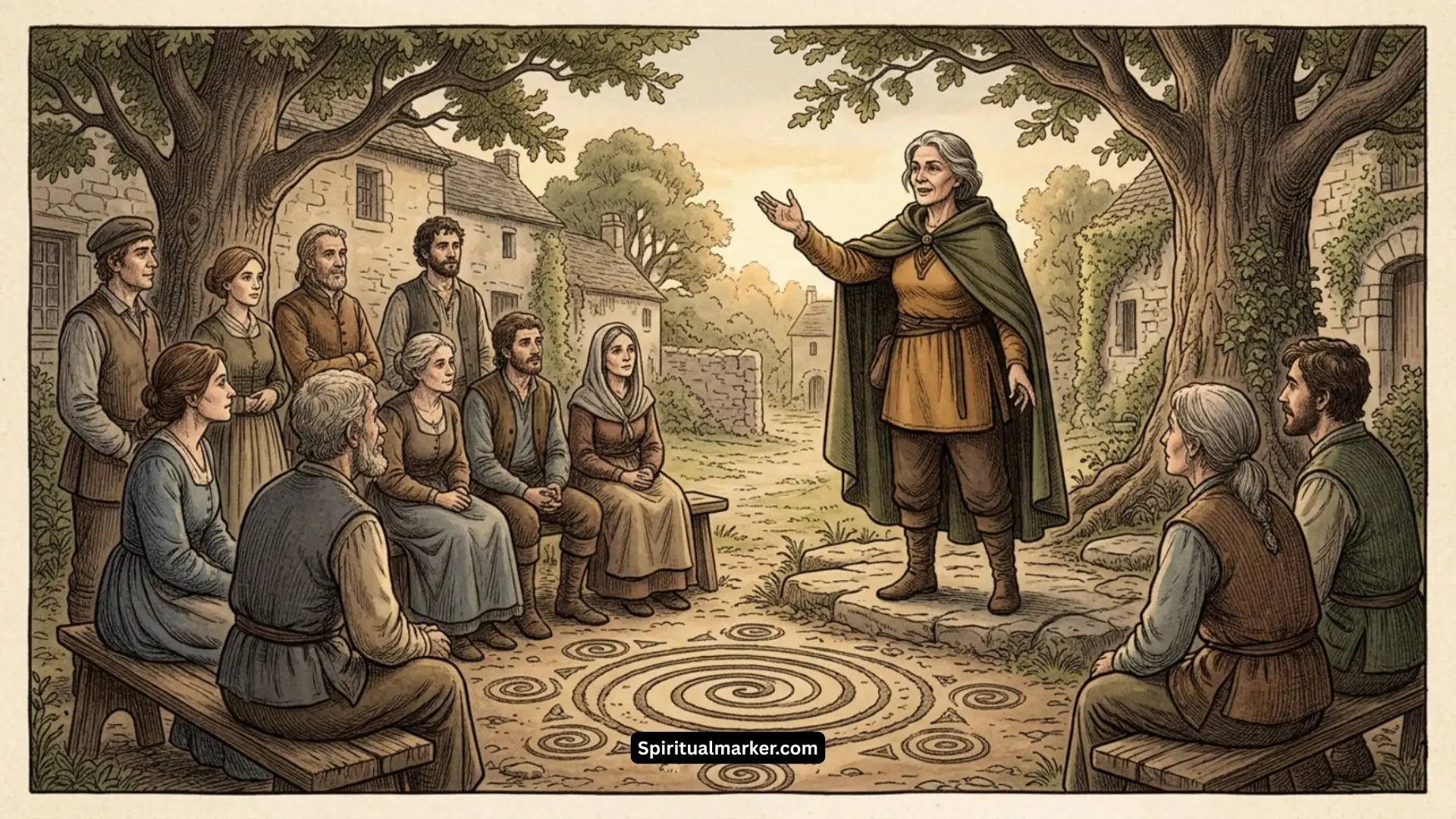
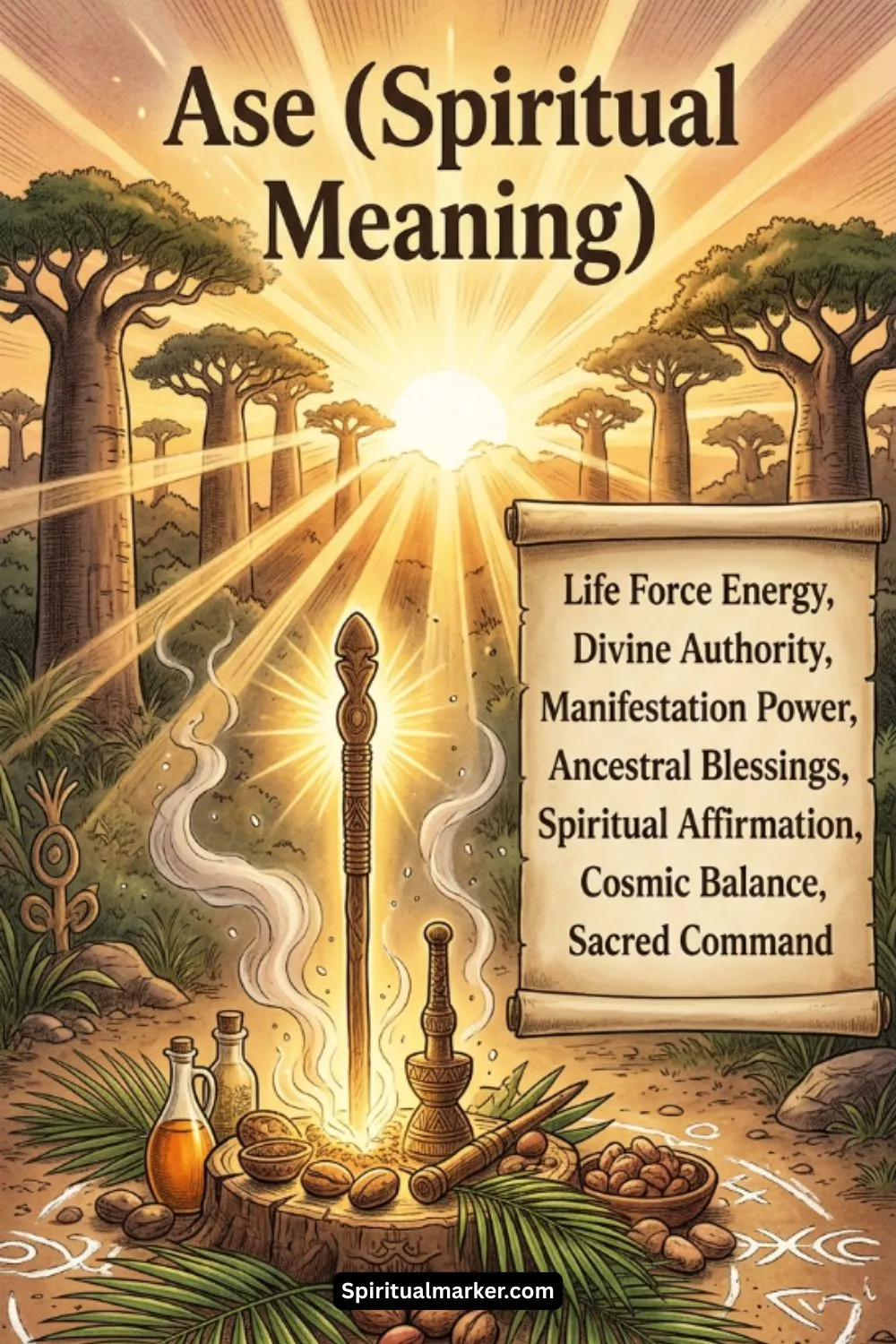
Ase is a powerful concept in Yoruba spirituality. It represents the energy that makes things happen. Across traditions, this force carries deep meaning and spiritual power.
The ase spiritual meaning often involves divine authority, manifestation, and spiritual energy. Ase is the power to create and transform. A spiritual meaning of a Buddha bracelet shares that spiritual-power focus, though the Buddha bracelet carries a more peaceful energy.
Some traditions view ase as a blessing or a command. Others see it as a reminder to align with your purpose. The context of its use can add detail.
If ase appears in your life, it may signal a need for action. A spiritual meaning of an evil eye also deals with spiritual power, though the evil eye carries a more protective energy.
Key Takeaways
- Ase is the sacred life force in Yoruba spirituality that gives life, movement, and creative power to all beings and creation.
- Saying “Ase” affirms and seals a prayer or blessing, much like “Amen,” expressing agreement and spiritual intention.
- Ase links human actions with divine power, growing stronger through ethical living, prayer, rituals, and harmony with the Orishas.
- The concept of Ase spread worldwide through the African diaspora and remains central to traditions such as Candomblé, Lucumí, and Vodou.
- Ase is a living spiritual energy that flows through people, ancestors, nature, and sacred objects, strengthening through faith, community, and spiritual practice.
What Is Ase and Where Does It Come From?
Ase originates from the Yoruba people of present-day southwestern Nigeria, Benin, and Togo. The Yoruba civilization is one of the oldest and most complex in Africa, with a rich tradition of oral literature, theology, and cosmology that dates back thousands of years. Within this tradition, Ase stands as perhaps the most fundamental concept of all.
The word itself is difficult to translate directly into English. Scholars and practitioners describe it as divine power, life force, authority, grace, command, and spiritual energy all at once. In the Yoruba worldview, Olodumare (the Supreme Creator) first possessed Ase, and then distributed it to the Orishas, who in turn shared it with humans and all of creation. This means Ase is not just a religious idea. It is the very substance through which the universe was made and continues to operate.
Linguistically, the word Ase derives from a root meaning “command” or “so shall it be.” When a king or elder spoke with authority in Yoruba society, their words carried Ase. When a healer performed a ritual, they channeled Ase. And, when a priest or priestess consecrated a sacred space, they were working with Ase. The concept blends what modern thinkers might separate into spiritual, political, moral, and creative power into a single unified force.
Many researchers have written extensively about Ase as a cornerstone of not just Yoruba religion but also the broader aesthetic and spiritual traditions it gave rise to across Africa and the diaspora. They described Ase as the power to make things happen, the right moment, and the ability to bring about change. That description captures something essential: Ase is not passive. It is an active, creative, and intentional force.
What Does Ase Symbolize Spiritually?
At its core, Ase symbolizes the indivisibility of spiritual and physical power. In Western thought, we often separate the sacred from the secular. Ase refuses that separation. It teaches that the same divine energy animating the cosmos also moves through your body, your words, and your choices.
Ase symbolizes authenticity and truth. When you speak a truth aligned with your deepest nature and with divine law, that truth carries Ase. This is why Yoruba elders say that a person of high character possesses strong Ase. Their words hold weight. Their blessings land. And, their warnings carry consequence.
The word also symbolizes continuity between ancestors and the living. Yoruba cosmology holds that ancestors pass their Ase to descendants. When a grandmother blesses her grandchild, she transfers spiritual energy accumulated over a lifetime of righteous living. This makes Ase both personal and communal, both inherited and earned.
In ritual contexts, Ase often symbolizes authorization from the divine. A priest performing a ceremony acts with Ase given by the Orishas. Without that spiritual authorization, the ritual holds no power. With it, the ceremony becomes a genuine point of contact between the human and the sacred. This is why initiation processes in traditions like Ifá and Lucumí are so important. They transfer Ase from the tradition to the initiate.
7 Spiritual Meanings of Ase
1. Divine Authorization and Spiritual Authority
The first and most foundational meaning of Ase is divine authorization. In Yoruba theology, power does not originate with humans. It flows downward from Olodumare through the Orishas and into the world. When a person says “Ase,” they acknowledge that all true power is borrowed from the divine. They affirm that what they speak, intend, or do carries the weight of that divine permission.
This meaning appears most clearly in priestly and ritual contexts. An Ifa priest who has been properly initiated carries Ase. That Ase allows them to read the Ifa oracle, communicate with the Orishas, and perform effective ceremonies. A person who has not received this authorization attempts the same actions without spiritual backing. Their words, in the traditional view, carry no real power.
For the everyday spiritual seeker, this meaning of Ase is both humbling and empowering. It reminds you that genuine spiritual authority comes through alignment with truth, righteous action, and connection to something greater than yourself. You cannot manufacture Ase through ego or performance. You cultivate it through integrity, service, and sincere devotion. The more your life aligns with divine principles, the more Ase you carry in your words and actions.
This also explains why elders in Yoruba culture hold such significant spiritual status. Years of ethical living, accumulated wisdom, and devotion to the community literally increase a person’s Ase. Their blessings are not empty words. They carry the spiritual charge of a life well lived.
2. The Affirmation of Truth and Spoken Power
One of the most widely recognized uses of Ase as affirmation comes at the end of prayers, invocations, and blessings. In this usage, Ase functions comparably to “Amen” in Christian and Jewish practice, “Ameen” in Islamic prayer, or “So mote it be” in ceremonial magic. Each of these phrases carries a similar intent: they seal the spoken word and affirm that it resonates with divine truth.
But Ase goes deeper than mere agreement. When you say “Ase,” you are not simply nodding along. You are activating the vibrational power of the words that came before. You are declaring that the prayer or blessing carries spiritual weight. And, you are calling on the divine to recognize and honor what was spoken. This transforms the act of affirmation into a genuine spiritual event rather than a social ritual.
Many traditions within the African diaspora teach that words themselves hold creative power. The Yoruba worldview supports this strongly. Speech is not neutral. When a person of strong Ase speaks a blessing, that blessing tends to manifest. When they speak a curse, it also carries weight. This places enormous responsibility on the speaker and explains why Yoruba elders are careful with their words.
In your personal spiritual practice, using Ase as affirmation can shift your relationship to prayer and intention entirely. Rather than reciting words passively, you engage them actively. You seal each intention with the awareness that your words participate in a living spiritual reality. That shift in perspective is itself a kind of awakening.
3. Life Force and Universal Creative Energy
Ase is the life force that flows through every living being. This meaning aligns Ase with concepts found in many other world traditions: prana in Hindu and yogic traditions, qi or chi in Chinese philosophy, mana in Polynesian spirituality, and ruach in Hebrew scripture. Each of these points to the same fundamental reality: there is an animating energy present in all life, and connecting with it is central to spiritual well-being.
In Yoruba thought, Ase as life force is not uniform. Different beings carry different concentrations of it. The ocean carries tremendous Ase. An ancient tree carries Ase accumulated over centuries. A newborn child arrives in the world with the Ase of their lineage already present within them. A sacred herb used in ceremony carries concentrated Ase activated through ritual intention and preparation.
This understanding transforms how practitioners relate to nature. Plants, rivers, stones, and animals are not merely physical objects. They are carriers of divine energy. This is why so many ceremonies in Yoruba-derived traditions involve natural elements. Offerings placed at a river or under a tree are not superstition. They are a conscious exchange of Ase between the human and the natural world, a reciprocal relationship of spiritual energy.
When you feel deeply alive after time in nature, when a particular place fills you with unexplained peace, or when certain people leave you feeling energized rather than drained, you may be experiencing differences in Ase. Some environments and people carry higher spiritual charge. Ase as life force invites you to become conscious of these energies and to cultivate your own accordingly.
4. Ancestral Connection and Inherited Power
Ase flows through bloodlines. This is one of the most profound aspects of the concept. In Yoruba cosmology, ancestors do not simply disappear at death. They transition into a spiritual state where they continue to influence the living, particularly their descendants. The Ase they accumulated during their earthly lives does not vanish. It transfers to the lineage.
This belief is beautifully practical. It means that honoring your ancestors is not a sentimental exercise. It is a genuine spiritual act that keeps the channel of ancestral Ase open. When you neglect your ancestors or live in ways that dishonor your lineage, that channel can weaken. When you honor them through prayer, remembrance, and righteous living, that channel opens wider. Their accumulated power becomes available to you.
The practice of ancestor veneration within Yoruba and related traditions therefore has direct spiritual purpose. Shrines and altars for ancestors serve as points of contact where the living can communicate with those who have passed. Offerings of food, water, and meaningful objects acknowledge the ancestors and invite their continued guidance and protection. This reciprocal relationship sustains the Ase of the whole community across generations.
For people reconnecting with African spiritual traditions after the historical rupture of the transatlantic slave trade, the concept of ancestral Ase carries particular depth. Your lineage carries power that was never fully erased. Even when names were changed and traditions were suppressed, the Ase of your ancestors persisted. Reconnecting with these roots is, in this framework, also a spiritual reclamation.
5. The Power of Intention and Manifestation
Ase is the energy that bridges intention and reality. When aligned with divine will, your focused intention carries Ase and moves toward manifestation. This is not wishful thinking. It is a deeply structured spiritual understanding of how human consciousness participates in the creative process of the universe.
In Yoruba ritual practice, intention is treated with the utmost seriousness. Before a ceremony begins, practitioners align their hearts, clarify their purpose, and invoke the Orishas who govern the relevant area of life. This preparation is not ceremonial formality. It opens and directs the channel of Ase so that the ritual energy flows toward its intended goal. Scattered or confused intention produces scattered results. Focused, righteous intention concentrates Ase and amplifies its effect.
Scholars of Yoruba religious philosophy note that this understanding of intention and manifestation is highly sophisticated. It does not claim that humans can manipulate reality through sheer will. Rather, it teaches that when human intention aligns with divine order, the creative force of the universe moves in support. The human becomes a conscious co-creator rather than a passive recipient of circumstances.
This meaning of Ase has strong resonance with contemporary discussions of mindfulness, manifestation, and conscious living. However, the Yoruba framework adds an important dimension that popular culture sometimes misses: the alignment must be ethical. Ase does not serve selfish or harmful intentions for long. Sustainable manifestation requires that your goals align with the greater good of your community and with divine principles.
6. Communal and Collective Spiritual Power
Ase is not only personal. It lives and grows in community. When people gather with shared spiritual purpose, their combined Ase multiplies. This is why communal worship, collective prayer, and ceremonial gatherings hold such power in Yoruba-derived traditions. The individual spiritual charge of each participant adds to and amplifies the whole.
This communal dimension of Ase challenges the highly individualistic approach to spirituality common in many modern Western contexts. In the Yoruba worldview, you cannot fully develop your spiritual potential in isolation. You need community. You need elders who transmit wisdom and Ase. And, you need peers who share the journey. And, you need the young who receive what you pass on. Spiritual power flows through relationship, not despite it.
The Egungun masquerade tradition, for example, demonstrates this communal Ase vividly. The masked performer does not simply wear a costume. They become a vessel for the collective Ase of all the ancestors of the community. The assembled crowd’s prayers and songs feed that Ase. The entire event is a communal act of spiritual power-generation that benefits every participant.
In practical terms, this means that the communities you belong to matter spiritually. A community built on integrity, mutual support, and genuine devotion generates positive Ase that flows to all its members. A community built on dysfunction, deception, or exploitation depletes the Ase of everyone involved. Choosing your community is a spiritual act.
7. Healing, Restoration, and Spiritual Balance
In healing traditions connected to Yoruba spirituality, illness is often understood as a disruption or depletion of Ase. Physical, emotional, and spiritual ailments reflect an imbalance in the flow of divine energy. Healing therefore involves restoring that flow rather than simply treating symptoms in the conventional biomedical sense.
Herbalists, diviners, and ritual specialists in Yoruba tradition work with plants, prayers, and ceremony to restore a person’s Ase. Traditional Yoruba plant medicine holds that herbs carry their own Ase. When properly prepared with the right prayers and intentions, they become spiritually charged healing agents. The Orisha Osain governs this domain, and practitioners who work with plant medicine invoke his power to activate the Ase within the herbs they use.
This healing dimension of Ase also operates on a community level. Communities that have experienced collective trauma, such as the descendants of enslaved people, often work with Ase as part of a larger project of spiritual restoration. Reclaiming ancestral traditions, reconnecting with the Orishas, and building community rooted in African spiritual values are all ways of restoring Ase that was suppressed or stolen. This makes spiritual healing and cultural healing inseparable.
On a personal level, working with Ase for healing involves identifying where your life is out of alignment. Where do you compromise your integrity? Where do you neglect your body, your relationships, or your spiritual practice? Addressing those areas with intention, honesty, and appropriate ritual restores the flow of Ase. The result is not just spiritual improvement. It manifests as greater vitality, clarity, and resilience in everyday life.
Ase Across African Diaspora Traditions
When millions of Yoruba and other West African people were forcibly transported to the Americas during the transatlantic slave trade, they carried their spiritual traditions within them. Ase did not stay in West Africa. It traveled. It adapted. And, it took new forms in new environments while retaining its essential character.
In Brazil, Ase became central to Candomblé, the Afro-Brazilian religious tradition that developed primarily among descendants of Yoruba and Fon peoples. In Candomblé, Axé (the Brazilian spelling) refers to the sacred force present in all things, particularly in ritual spaces and consecrated objects. A Candomblé terreiro (temple) is described as having its own Axé, accumulated over generations of devotion. Some terreiros are considered more spiritually powerful than others precisely because of the depth of their accumulated Axé.
In Cuba, the tradition known as Lucumí or Santería preserves much Yoruba theology including the concept of Ase. Cuban practitioners recognize Ase as the divine energy that empowers all rituals and makes the Orishas present and accessible. The concept of fundamentos in this tradition refers to consecrated objects that hold concentrated Ase and serve as points of contact with specific Orishas. These objects are treated with great care precisely because of the Ase they embody.
In Haiti, elements of Ase filtered into Haitian Vodou, where the concept of vital spiritual force manifests differently but shares underlying structures with Yoruba thought. The Lwa (spirits) of Vodou carry and transmit divine power in ways that parallel the Orisha tradition’s understanding of Ase.
In the United States, particularly since the mid-twentieth century, Ase has entered a much broader cultural conversation. The Black Power movement drew on African spiritual and philosophical concepts, and Ase became part of a larger reclamation of African heritage. Today, you can find Ase invoked in contemporary African American spiritual communities, creative arts, literature, and everyday speech, often as a declaration of spiritual resilience and cultural pride.
Ase in Ifá Divination and the Orisha Tradition
No discussion of Ase is complete without examining its role in Ifá divination, the sophisticated oracle system at the heart of Yoruba spiritual practice. Ifá is a body of sacred knowledge composed of 256 literary corpuses called Odu, each containing stories, songs, prayers, and prescriptions. The entire system operates through Ase.
Ifá was inscribed by UNESCO as an Intangible Cultural Heritage of Humanity in 2005, acknowledging its extraordinary complexity and cultural significance. At its center is Orunmila, the Orisha of wisdom and divination, who witnessed the creation of all things and therefore carries supreme Ase in matters of knowledge and destiny. When a properly initiated Ifa priest (Babalawo) consults the oracle, they invoke Orunmila’s Ase to reveal truth that would otherwise remain hidden.
Each Orisha in the Yoruba pantheon governs a specific domain of life and carries Ase corresponding to that domain. Shango (also spelled Sango or Chango) governs thunder, lightning, and justice, and his Ase is fierce and transformative. Oshun governs love, rivers, and abundance, and her Ase is sweet, magnetic, and generative. Ogun governs iron, work, and war, and his Ase cuts through obstacles. Working with the Orishas is working with different qualities of Ase, calling on the specific divine energy needed for a given situation.
The importance of proper initiation in these traditions reflects the understanding that Ase must be transmitted correctly. You cannot receive Ase from a book or an online course alone. It passes through an unbroken chain of transmission from initiated priest to initiated priest, going back through generations to the original transmission from the Orishas themselves. This is why Ifá initiation involves rigorous preparation and ceremony. The initiate’s entire spiritual constitution is realigned to receive and hold the Ase of their patron Orisha and the Ifa tradition as a whole.
Ase Symbolism in Nature and Sacred Objects
Ase does not reside only in people and rituals. It fills the natural world and concentrates in specific places and objects that hold particular spiritual significance. Understanding this helps you see why nature holds such central importance in Yoruba-derived spiritual traditions.
Water carries powerful Ase across virtually all Yoruba-connected traditions. Rivers, in particular, are associated with Oshun and represent the flowing, life-giving quality of divine energy. The ocean belongs to Yemoja (Yemaya), the mother of waters, whose Ase encompasses the vast, ancient, and nourishing power of the sea. Offerings placed at bodies of water are not discarded into nature carelessly. They are delivered to a living repository of sacred power.
Crossroads hold concentrated Ase in Yoruba and many African diaspora traditions. The crossroads is the meeting point of worlds, a liminal space where the seen and unseen intersect. Eshu-Elegba (also known as Legba or Exu) governs the crossroads and all communication between the human and divine realms. Performing rituals at crossroads draws on the Ase of this potent threshold energy. This explains why crossroads appear so frequently in African American folk traditions, Hoodoo practices, and Blues mythology.
Sacred trees, particularly the iroko tree in West African tradition, are considered homes of powerful spiritual forces. An iroko tree that has stood for centuries accumulates Ase the way a great spiritual elder does: slowly, consistently, through continued presence and rootedness. Certain trees are therefore treated with reverence and not cut without proper ceremony and permission from the inhabiting spirits.
In ritual practice, consecrated objects called Ile Orisha or Fundamentos serve as physical homes for Orisha energy. These objects, typically stones, iron implements, or other materials appropriate to the specific Orisha, are ritually prepared to hold concentrated Ase. Once consecrated, they are fed, honored, and spoken to as living presences. The Ase within them is real and active, not symbolic. This is why these objects are treated with such profound care by initiated practitioners.
Ase in Yoruba Cosmology: From Olodumare to Every Living Being
To understand Ase fully, you need to see it within the complete cosmological picture that Yoruba theology provides. At the highest level sits Olodumare, the Supreme Being who created all existence. Olodumare is the source of all Ase. From this infinite well of divine energy, the Orishas were created or emerged, each carrying a portion of Olodumare’s power and governing a specific aspect of creation.
The Orishas in turn interacted with humanity and with the natural world, distributing Ase throughout creation. Humans received a unique endowment: the capacity for ori, the personal spiritual intuition and divine inner self that guides each person toward their destiny. A strong, aligned ori allows a person to accumulate and properly use Ase. A misaligned ori results in wasted potential and spiritual confusion.
This cosmological structure means that every level of creation participates in a constant circulation of Ase. Humans draw Ase from nature through ritual and right relationship. They direct it through prayer and ceremony toward the Orishas. The Orishas receive these offerings and prayers, and they channel Ase back in the form of blessings, guidance, and protection. This circulation, when functioning well, sustains the spiritual health of individuals and communities.
Disruptions in this circulation create problems. When humans neglect their spiritual obligations, when they harm nature carelessly, when they break community bonds, or when they act against divine principles, the flow of Ase becomes blocked. Yoruba divination and ritual exist precisely to identify these disruptions and restore proper flow. The entire religious system is, in a profound sense, a technology for working with Ase.
Ase and Similar Concepts in World Spiritual Traditions
While Ase is distinctly Yoruba in its cultural expression, the underlying concept appears in spiritual traditions around the world. Recognizing these parallels does not erase the specificity of Ase. Rather, it reveals a universal human awareness of a fundamental spiritual reality.
In Hindu and yogic traditions, prana refers to the vital life force that flows through all living beings and through the universe. Practices like pranayama (breath control) and yoga are designed to cultivate and direct this force. The structural parallel with Ase is striking: both are universal, both flow through humans and nature, both can be cultivated through specific practices, and both connect personal vitality to a larger cosmic energy.
In Chinese philosophy and medicine, qi (or chi) functions similarly as the animating life force underlying all phenomena. Traditional Chinese Medicine, acupuncture, and practices like Tai Chi and Qigong all work to maintain the healthy flow of qi through the body and environment. The concept of blockages in qi flow causing illness parallels the Yoruba understanding of Ase disruption causing spiritual and physical problems.
In Polynesian traditions, mana refers to a spiritual power possessed by people, objects, and places. Like Ase, mana can be accumulated through righteous conduct and transmitted through lineage. Like Ase, it grants those who possess it greater efficacy in spiritual and social life. And like Ase, it must be respected and not squandered or misused.
The Hebrew concept of ruach (divine breath or spirit) carries some resonance with Ase as well, particularly in its role as the animating force that God breathes into creation. The biblical account in Genesis of God breathing life into Adam reflects a similar understanding: life itself is a divine gift of spiritual energy rather than a purely biological phenomenon.
These parallels suggest that Ase is not a culturally exotic concept but a sophisticated articulation of something that humans across history and geography have recognized: a living, active spiritual energy that underlies and animates all existence.
How Ase Enters Modern Spiritual Practice
Today, the word Ase travels far beyond traditional Yoruba or diaspora religious communities. You find it in African American churches where it has been adopted as an affirmation alongside “Amen.” You hear it in yoga studios, meditation spaces, and wellness communities where people drawn to African spirituality integrate it into their practice. Also, you see it in tattoos, jewelry, and art, often as a symbol of spiritual identity and empowerment.
This widespread adoption raises real questions about cultural appropriation versus cultural appreciation. Traditional practitioners generally welcome sincere engagement with Ase as a concept. They ask only that people approach it with genuine respect and a desire to understand its origins. Using Ase as a social media hashtag without any knowledge of its Yoruba roots is very different from incorporating it into a serious spiritual practice grounded in real learning and relationship.
For those called to work more deeply with Ase, many opportunities exist. Organizations dedicated to preserving and teaching Ifá offer resources, classes, and pathways toward formal initiation for those who feel called to that level of commitment. Reading foundational texts by scholars like Wande Abimbola, Rowland Abiodun, and John Mason provides intellectual grounding. Engaging with elders and initiated practitioners in the physical world offers the relational context that Ase requires.
At a basic level, you can begin working with the spirit of Ase in your daily life right now. Speak with intention. Honor your ancestors. Care for the natural world. Build and maintain communities of integrity. Act in ways that align your personal desires with the greater good. These practices, which are universal, strengthen your Ase regardless of your specific religious background.
Ase and the Spoken Word: Why Language Holds Spiritual Power
One of the most practically important dimensions of Ase is its connection to the spoken word. In Yoruba tradition, the concept of ase enu (the Ase of the mouth) is taken seriously. Your words carry power. This is not metaphor. It is spiritual fact.
Elders in Yoruba culture are deeply careful about what they say, particularly in the presence of the young and vulnerable. A thoughtless curse from an elder can carry Ase even when said carelessly. A heartfelt blessing carries Ase in proportion to the elder’s accumulated spiritual power and integrity. This is why traditional Yoruba social culture places enormous emphasis on respectful speech, proper greetings, and the careful use of language in ceremonial contexts.
Scholars of Yoruba literature and oral tradition note that oral poetry, praise poetry (oriki), and ritual chants are considered to carry concentrated Ase. When a skilled praise singer recites a person’s oriki, they are not merely complimenting them. They are activating the spiritual power embedded in that person’s lineage, history, and character. The recitation strengthens both the subject and the community that hears it.
This understanding of language as spiritually powerful is deeply countercultural in a world where words are often treated as cheap and disposable. Social media in particular has created a context where speech happens with no sense of weight or consequence. The concept of Ase as enu invites you to reclaim a different relationship to your own words: to speak less but more meaningfully, to affirm what you truly believe, and to avoid words that harm without need.
A Final Note
Ase is not a word you simply learn. It is a reality you grow into. The more you study it, practice with it, and align your life with its principles, the more its depth becomes apparent.
What makes Ase so enduring and so relevant today is exactly what made it powerful centuries ago: it tells the truth about the nature of existence. There is a living, active spiritual energy moving through all things. You are not separate from it. You carry it, transmit it, and shape it through every choice you make. That is not a burden. It is an extraordinary gift.
Whether you are approaching Ase as a practitioner of Ifá, Candomblé, Lucumí, or another Yoruba-derived tradition, or whether you are a curious seeker wanting to understand this concept more deeply, the invitation is the same. Live with integrity. Honor those who came before you. Speak with care. Build relationships rooted in genuine love and mutual support. Care for the world as the spiritually charged place it is.
People across centuries and continents have recognized that the spoken word can heal or harm, that ancestors walk with us, that nature pulses with divine presence, and that living rightly produces a kind of power that nothing can manufacture or take away. Ase is the name the Yoruba gave to all of that. And the more you understand what that name carries, the more you realize it is not just their word. It belongs to every human being wise enough to hear it.
If you want to go deeper, consider reading the works of Wande Abimbola, one of the foremost authorities on Ifá and Ase. Consider seeking out an elder or initiated practitioner in your region who teaches with lineage and integrity. Consider sitting with the natural world and practicing the attention that Ase requires. The path is as old as humanity. The power it leads toward is real. Ase.