
The elephant is a powerful and gentle giant. Its size, intelligence, and loyalty inspire awe. Across cultures, elephants carry deep spiritual meaning and symbolism.
The elephant spiritual meaning often involves strength, wisdom, and family. Elephants are matriarchal, so they can signal a need for community and nurturing. A spiritual meaning of a horse shares that animal-power focus, though horses carry a more independent energy.
Some traditions view elephants as symbols of good luck, patience, and memory. Others see them as guides for leadership. The elephant's behavior can add detail.
If an elephant appears in your life, it may be a call to stand strong. A spiritual meaning of a whale also deals with large, wise animals, though whales carry a more emotional energy.
Key Takeaways
- Elephants symbolize wisdom, strength, and memory across nearly every world culture and spiritual tradition.
- In Hinduism, the elephant-headed deity Ganesha is one of the most widely worshipped gods, representing new beginnings and the removal of obstacles.
- White elephants carry extraordinary sacred significance in Buddhism and Southeast Asian cultures, symbolizing purity, royal power, and divine blessing.
- Dreaming of an elephant often signals a need to trust your instincts, face something you have been avoiding, or reconnect with ancestral wisdom.
- The direction an elephant’s trunk faces carries distinct spiritual meaning, with an upward trunk widely considered a symbol of good luck and positive energy.
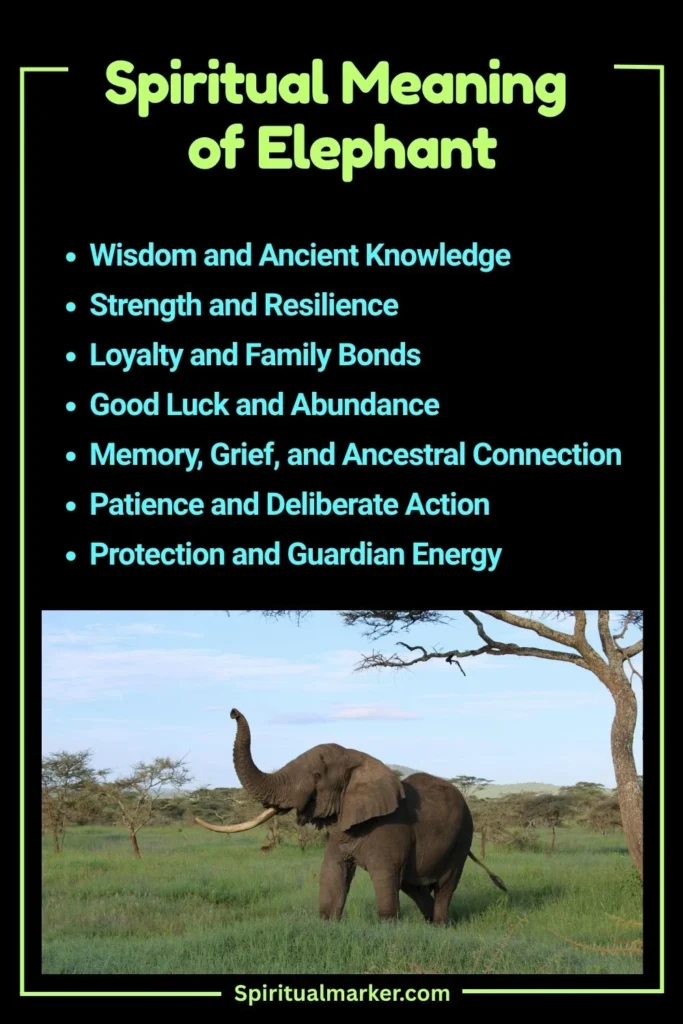
What Are Elephants and Why Do They Hold Such Deep Spiritual Power?
Elephants are the largest land animals on earth. There are three recognized species: the African bush elephant, the African forest elephant, and the Asian elephant. All three have captivated human imagination since the earliest recorded history. They can live for up to 70 years, weigh as much as 14,000 pounds, and possess brains larger than any other land animal.
What makes them spiritually compelling, though, goes beyond physical size. Elephants display behaviors that humans have long associated with soul and consciousness. They grieve their dead by returning to bones and touching them with their trunks. They recognize themselves in mirrors, a rare cognitive ability. They form lifelong bonds with family members and demonstrate remarkable emotional intelligence.
Early humans noticed all of this. They watched elephants and saw something ancient, something knowing. That observation became the foundation for centuries of spiritual symbolism built around this creature. When something in nature reflects human virtue at its highest level, people across cultures tend to assign it sacred status. Elephants earned that status completely and repeatedly, across continents that had no contact with each other.
Their sheer scale also plays a role. Size in the natural world often translates to spiritual authority in human symbolism. A creature this large, this powerful, and yet this gentle became a natural vessel for the idea that true strength does not require cruelty. That paradox sits at the heart of nearly all elephant spiritual meaning.
What Does Seeing an Elephant Symbolize or Represent?
Seeing an elephant in real life is increasingly rare for most people, which means when it happens, it tends to feel significant. Many spiritual traditions teach that animal encounters carry messages from a higher source. Seeing an elephant, whether at a sanctuary, in the wild, or even on a repeated basis in artwork and media, may carry symbolic weight.
At its core, seeing an elephant is widely interpreted as a sign of incoming strength. Something in your life is about to require endurance, patience, or wisdom, and the elephant appears as a reminder that you carry those qualities within yourself. It may also signal the need to honor your memory, whether that means revisiting your past, reconnecting with family, or learning from old patterns rather than repeating them.
Some spiritual practitioners interpret repeated elephant sightings as a nudge toward your life’s purpose. The elephant is an animal that moves with intention. It does not rush, but it reaches its destination. Seeing one may be the universe’s way of telling you to stop rushing and start moving with deliberate focus.
In many African spiritual traditions, seeing an elephant is connected to ancestral wisdom. The elder elephants in a herd carry knowledge of water sources, migration routes, and dangers. That knowledge is passed down through generations. When an elephant appears to you, it may symbolize that your own ancestors are offering guidance. Pay attention to the circumstances around the sighting, as context often deepens the message.
9 Spiritual Meanings of Elephants
1. Wisdom and Ancient Knowledge
Wisdom is the most universal spiritual meaning assigned to elephants across every culture that has encountered them. The elephant’s brain is the largest of any land animal. Their memory is legendary, capable of retaining information about specific locations, faces, and experiences over decades.
In spiritual terms, this memory translates to ancient knowledge. Elephants are seen as keepers of accumulated wisdom, both worldly and divine. Many traditions believe certain animals carry the wisdom of previous ages in their very being. The elephant tops that list.
When elephant energy enters your life as a spiritual symbol, it is often a call to slow down and think deeply. You are being invited to draw on everything you already know before making a decision. Trust the knowledge you have gathered over years of living. The elephant does not need to be told something twice.
Hindu scripture honors the elephant as wise beyond human measure. Ganesha, the elephant-headed deity, is called upon before any new undertaking precisely because wisdom must precede action. That theological positioning says everything about how spiritual traditions view elephant intelligence.
2. Strength and Resilience
Strength is the second great pillar of elephant symbolism. These animals can carry loads of over 800 pounds, uproot entire trees, and cross vast distances through hostile terrain. Yet their power is never chaotic or wasted. It is applied with precision and calm.
Spiritually, the elephant represents the kind of strength that endures rather than explodes. This is not rage-fueled power. This is the power of someone who keeps showing up, who carries heavy burdens without complaint, and who refuses to quit when circumstances get difficult.
When you feel overwhelmed, elephant symbolism reminds you that you are built for more than you think. You have resources you have not yet tapped. Many people find elephant imagery particularly resonant during periods of grief, illness, or professional hardship, precisely because it channels this quality of quiet, unstoppable endurance.
In African spiritual traditions, the elephant is often associated with the strength of community. No elephant faces danger alone. The herd moves together, protects together, and grieves together. Strength, in this framework, is not a solo achievement. It is something cultivated through loyalty and mutual support.
3. Loyalty and Family Bonds
Few animals on earth demonstrate loyalty as visibly as elephants. Elephant herds are matriarchal societies led by the oldest and most experienced female. Every member of the herd is deeply committed to every other member. They protect calves, care for the elderly, and return to the bones of their dead to pay their respects.
Spiritually, this behavior makes the elephant a symbol of sacred bonds. When elephant energy appears in your life, it may be asking you to examine your own commitments. Are you showing up for the people you love? Are you honoring the bonds that hold your life together?
In West African traditions, the elephant represents the power of the family unit as a spiritual foundation. The idea is that your roots, your people, your lineage, are your greatest source of power. Cutting yourself off from that source weakens you spiritually. Remaining connected to it makes you nearly unbreakable.
This symbolism extends beyond blood family. The elephant spirit recognizes chosen families, close friends, and communities built on genuine love. Loyalty in this spiritual framework means showing up even when it is difficult, remembering people in your thoughts and prayers, and putting the health of your bonds above personal convenience.
4. Good Luck and Abundance
Across Southeast Asia, China, India, and much of the African continent, elephants are among the most powerful symbols of good luck and material abundance. This association is ancient and has survived into modern times through feng shui, Hindu puja practices, and decorative traditions worldwide.
The elephant’s association with luck stems partly from its connection to rain and water. Elephants are expert finders of water. Their ability to locate underground water sources and dig with their tusks made them life-saving guides for early human communities. Water, in virtually every spiritual tradition, represents abundance, fertility, and life itself.
In feng shui, placing elephant figurines at the entrance of a home is believed to attract good fortune and protect the household from negative energy. A pair of elephants at the door is thought to bring double the blessing. The upward trunk specifically channels luck inward, like a vessel receiving blessings from above.
Many people in India offer prayers to Ganesha before starting a business, buying a home, or beginning any significant endeavor. Ganesha is not just the remover of obstacles. He is also the bringer of success, wealth, and opportunity. The elephant’s symbolic connection to abundance is therefore backed by active, living religious practice in communities of hundreds of millions.
5. Removal of Obstacles and New Beginnings
The removal of obstacles is one of the most specific and widely honored spiritual meanings attached to elephants. This comes primarily from the Hindu tradition, where Ganesha occupies a unique theological position as the deity invoked at every beginning.
Every threshold in Hindu life, a new home, a new business, a wedding, a journey, receives a Ganesha prayer first. The logic is clear: obstacles block progress, and wisdom clears them. Because the elephant embodies wisdom, it possesses the power to clear the path ahead.
Spiritually, this meaning speaks to fear and hesitation. The obstacles elephants remove are not always physical. More often, they are internal: self-doubt, old wounds, limiting beliefs, and fear of failure. When the elephant appears as your spiritual guide, it may be calling you to remove the mental barriers that have been slowing you down.
New beginnings carry fear along with excitement. The elephant, as a spiritual guardian, is particularly powerful during transitional periods. Starting over after loss, launching a creative project, leaving a relationship, or relocating to a new city, these are exactly the moments when elephant symbolism is most relevant and most comforting.
6. Memory, Grief, and Ancestral Connection
The elephant’s memory is not just a scientific fact. It is a spiritual teaching. Elephants remember kindness and cruelty with equal precision. They return to the sites where loved ones died years after the loss. They touch bones with a reverence that looks unmistakably like grief.
In spiritual terms, this quality connects the elephant to ancestral wisdom and the honoring of the dead. Many African traditions teach that the spirits of ancestors continue to influence the living. Remembering them, honoring them, and learning from them is a sacred responsibility.
When elephant energy asks you to remember, it may be pointing toward something you have buried or avoided. Grief is part of the elephant’s spiritual portfolio. You do not have to be afraid of your grief. You can carry it, as the elephant carries the memory of its herd, with dignity and open tenderness.
Ancestral connection in this framework means more than visiting graves or knowing your family history. It means carrying the lessons of those who came before you. It means recognizing that you did not arrive in this world without a trail of love and sacrifice stretching back generations. The elephant honors that trail and invites you to do the same.
7. Patience and Deliberate Action
Patience is a defining characteristic of elephant behavior. Elephants do not panic. They do not rush. They assess situations with a calm, deliberate intelligence that looks, to human observers, almost meditative. A herd facing a threat will pause, evaluate, and respond with measured collective action.
Spiritually, this is one of the most needed and least celebrated qualities in modern life. The elephant spirit asks you to slow down. Not because speed is bad, but because rushing without awareness leads to mistakes that patience could have prevented. There is wisdom in the pause before the action.
In Buddhist teachings, the elephant is specifically associated with mental calmness and meditative steadiness. The wild elephant represents an untrained mind, restless and reactive. The tamed elephant represents a disciplined mind, one that has learned to respond rather than react. That distinction is the foundation of an entire spiritual practice.
When you are under pressure to move fast, make quick decisions, or respond to others’ urgency, elephant symbolism is a grounding reminder. You are allowed to take your time. The right action taken after careful consideration is worth far more than the quick action taken out of panic.
8. Protection and Guardian Energy
Protection is a consistent thread in elephant symbolism across world cultures. Elephants are fierce protectors of their young and their vulnerable. A mother elephant guarding her calf is one of the most formidable forces in nature. Nothing in the animal kingdom easily challenges a protective elephant.
In spiritual traditions, this quality translates into guardian energy. Elephant statues and carvings are placed at the entrances of temples, homes, and palaces specifically to stand guard against negative energy, evil spirits, and misfortune. This practice appears independently in Hindu, Buddhist, Chinese, and African architectural traditions.
When the elephant appears as a spiritual protector, it often arrives during periods when you feel vulnerable or exposed. It is a reminder that you are not without defense. You have the wisdom to see threats clearly, the strength to stand your ground, and the communal bonds to call on when you need support.
In Thai spiritual culture, the white elephant holds the highest level of protective symbolism. Owning one was historically considered a divine sign of royal protection over an entire kingdom. The protective power of the elephant, in this tradition, extends not just to individuals but to entire communities and nations.
9. Spiritual Authority and Divine Connection
Across the oldest spiritual traditions on earth, elephants occupy a position of divine authority. They are not merely symbols of earthly power. They are understood as messengers, manifestations, and embodiments of divine presence.
In Hinduism, Airavata, the divine white elephant, serves as the mount of Indra, the king of the gods. This elephant emerged from the cosmic ocean at the beginning of creation. It carries the king of heaven, waters the earth with its trunk, and bridges the divine and mortal realms. That is not incidental symbolism. That is a theological statement about the elephant’s sacred status.
In African spiritual systems, elephants are sometimes understood as manifestations of the ancestors themselves, taking animal form to walk among the living and offer guidance. The encounter with an elephant in the wild can therefore be interpreted as a direct message from your lineage, a communication that transcends ordinary language.
This spiritual authority means that elephant energy in your life is never trivial. When the elephant arrives as a symbol, a dream figure, or a repeated encounter, it comes with the weight of the divine behind it. It is asking for your full attention and your deepest respect.
Elephant Meaning and Symbolism Across Cultures and Religions
Elephant Symbolism in Hinduism
No religion has developed a deeper or more elaborate elephant spiritual meaning than Hinduism. The elephant is not merely a symbol in this tradition. It is a deity.
Ganesha, one of the most beloved and widely worshipped deities in the Hindu pantheon, has the head of an elephant and the body of a human child. He is the son of Shiva and Parvati and holds the unique position of being the first deity invoked in any Hindu prayer or ritual. Before a wedding, before a business launch, before a journey, Ganesha is called upon first.
His elephant head is rich with symbolism. The large ears suggest active listening and discernment. The trunk can navigate delicate and powerful tasks, symbolizing adaptability and intelligence. The single tusk Ganesha carries after breaking off the other represents the idea of sacrifice in service of a greater purpose. He used his broken tusk to write the Mahabharata, one of the greatest epic texts in human history.
Airavata, the sacred white elephant of Indra, also carries enormous theological weight. This cosmic elephant emerged from the churning of the primordial ocean and became the vehicle of heaven’s king. Airavata is associated with rain, lightning, and the nourishing power of water. His white color symbolizes purity, and his divine role connects elephants directly to the sustaining forces of the universe.
Elephant Symbolism in Buddhism
In Buddhism, the elephant carries profound meaning rooted directly in the life of the Buddha. Before the birth of Siddhartha Gautama, his mother Queen Maya dreamed that a white elephant carrying a lotus flower entered her womb. This dream was interpreted as a sign that she would give birth to a being of extraordinary spiritual power and purity.
The white elephant in this context represents the highest qualities of the awakened mind: purity, gentleness, power under control, and spiritual luminosity. Buddhist art and architecture frequently feature elephants as protective symbols at temple entrances and along sacred pathways.
The tamed elephant is a central metaphor in Buddhist teachings. The Buddha compared the untrained mind to a wild elephant, destructive and uncontrolled. The trained mind is compared to a tamed elephant, steady, powerful, and capable of carrying great weight without distress. This metaphor appears throughout the Pali Canon and remains central to Buddhist meditation instruction.
In Tibetan Buddhism, the elephant is one of the Eight Auspicious Symbols in certain traditions and is associated with the mental stability needed for deep meditation. The strength of the elephant, applied inward rather than outward, produces the unshakeable calm that characterizes enlightened awareness.
Elephant Symbolism in African Traditions
Africa is home to the largest wild elephant populations on earth, and its spiritual traditions reflect a profound intimacy with these animals. Across West, Central, East, and Southern African cultures, elephants occupy a central place in mythology, ritual, and spiritual authority.
In many West African traditions, the elephant is associated with the qualities of ideal leadership: wisdom, patience, strength, and collective responsibility. Chiefs and kings are often described in praise poetry using elephant metaphors, equating their authority with the elephant’s combination of power and protectiveness.
In Akan culture (Ghana and Ivory Coast), the elephant symbol appears frequently in Adinkra, a system of visual symbols encoding philosophical and spiritual concepts. The elephant represents royalty, strength, and the ability to bear burdens with grace, qualities considered essential to wise governance and personal integrity.
Among the Zulu of Southern Africa, the elephant is a symbol of the chief and of ancestral power. Elephant parts were historically used in royal rituals to transfer the animal’s power and protective energy to the ruler. The elephant’s footprint was seen as a sacred mark on the earth, and the ground where elephants gathered was considered spiritually charged.
Elephant Symbolism in Chinese Culture
In Chinese culture, the elephant has been a symbol of good luck, wisdom, and auspiciousness for thousands of years. The Chinese word for elephant, “xiang,” is a homophone for “auspicious,” which linguistically reinforces the elephant’s lucky associations.
White elephants in Chinese tradition are considered the supreme symbol of good fortune. Emperors historically received white elephants as gifts from Southeast Asian kingdoms, and owning one was considered a divine endorsement of the ruler’s legitimacy.
Elephant imagery in Chinese art often features the animal carrying a vase on its back. The vase symbolizes peace and abundance, and the elephant’s role as carrier transforms it into a vessel of blessings. This image is common in homes and businesses seeking prosperity and harmony.
In feng shui, elephant figurines remain one of the most popular protective and luck-attracting symbols placed at home entrances, on desks, and near windows. The specific placement and trunk position carry different meanings, and practitioners take both details seriously when arranging a space.
Elephant Symbolism in World Mythologies
Elephant Mythology in Ancient India
Indian mythology is saturated with elephant symbolism stretching back to the Vedic period, over 3,500 years ago. The Ashtadiggajas are eight sacred elephants who, in Hindu cosmology, stand at the eight cardinal and intercardinal directions of the universe, supporting the cosmos itself. They are the pillars of creation, holding the world in place with their divine strength.
Each of the eight elephants has a name, a divine consort, and specific cosmic responsibilities. Airavata stands in the east. These mythological elephants appear in the Ramayana, the Mahabharata, and the Puranas, cementing the elephant’s role as a foundational force in the structure of existence itself.
The concept of the elephant as a cosmic pillar appears in multiple ancient Indian texts. Some Puranic cosmologies describe the earth as resting on the back of a giant elephant standing on a turtle floating in a cosmic ocean. This image, while mythological rather than scientific, communicates the elephant’s perceived weight as a spiritual anchor for reality.
Elephant Mythology in Ancient Egypt and Mesopotamia
While elephants were not native to the Nile Delta, they were known to ancient Egyptians through trade and conquest. The city of Elephantine, located on an island at the first cataract of the Nile, was named after the animal, likely because it was a major ivory trading hub. The region was also associated with the god Khnum and the annual flooding of the Nile, connecting the elephant indirectly to the life-giving power of water.
In Mesopotamian mythology, elephants appear in ancient texts as symbols of the exotic and the powerful. Assyrian kings famously hunted elephants as proof of their royal might. The elephant’s tusks, made of ivory, were treasured as sacred luxury materials used in the construction of temples and royal objects.
Elephant Mythology in Greek and Roman Traditions
Alexander the Great’s encounter with war elephants at the Battle of the Hydaspes in 326 BCE introduced the Western world to the elephant’s terrifying power. The Greeks were struck not just by the animal’s size but by its apparent intelligence and discipline in battle. This encounter seeded a mythology of the elephant as a symbol of unconquerable strength and exotic wisdom.
Roman writers, including Pliny the Elder, described elephants as animals of remarkable virtue, capable of understanding language, performing worship-like rituals before the moon and stars, and demonstrating loyalty that rivaled human friendship. These accounts, though sometimes fantastical, reflect a genuine Roman reverence for the elephant as an animal of near-human spiritual depth.
In Roman games and spectacle, elephants performed acts of apparent worship, bowing before the emperor. Roman audiences interpreted this as divine confirmation of imperial authority. The emperor’s power was so great that even the mightiest animal on earth paid homage to it.
Types of Elephants and Their Spiritual Meanings
White Elephant Spiritual Meaning
The white elephant is one of the most powerful spiritual symbols in the world. In virtually every culture that has encountered it, the white elephant represents divine blessing, royal purity, and extraordinary spiritual power. Its rarity in nature makes it a natural symbol for things beyond the ordinary.
In Thailand, a white elephant born in the kingdom is still considered a sacred gift that belongs to the king. These animals are treated with royal honors, given ceremonial baths and special food, and regarded as protective spirits of the nation. The Thai flag historically featured a white elephant, and the animal remains deeply woven into Thai national and spiritual identity.
In Buddhist tradition, the white elephant’s connection to the Buddha’s conception makes it a symbol of the highest spiritual attainment. White represents purity of mind, and the elephant represents mental power and steadiness. Together, they describe the qualities of enlightened consciousness.
The phrase “a white elephant” in English has taken on the meaning of something burdensome and unwanted. But this modern Western usage is almost entirely disconnected from the animal’s profound spiritual meaning in the cultures where it originates. In its native symbolic context, the white elephant is among the most auspicious omens possible.
Black Elephant Spiritual Meaning
Black elephants are not a naturally occurring variety but carry significant symbolic weight in spiritual traditions. Black in spiritual symbolism often represents mystery, depth, the shadow self, and transformative power. A black elephant therefore combines the elephant’s qualities of wisdom and strength with the energy of the deep unconscious and hidden truths.
Encountering black elephant imagery in dreams or meditation is often interpreted as a signal to look inward. Something buried in your subconscious is asking for your attention. The black elephant may be carrying a message that requires you to sit in darkness before you can see clearly.
In some African spiritual traditions, black animals carry the energy of the ancestors and the night, associated with wisdom that lives beyond ordinary daylight awareness. A black elephant in this context is not threatening but deeply wise, a guide into the parts of yourself you have not yet integrated.
Gray Elephant Spiritual Meaning
The gray elephant, the most common form, carries the core spiritual meanings discussed throughout this post: wisdom, strength, loyalty, patience, and abundance. Gray as a color is associated with neutrality, balance, and wisdom earned through experience rather than born from passion.
Gray sits between black and white, between darkness and light. The gray elephant therefore represents integrated wisdom, the kind that comes from having faced both shadow and light and learned from both. It is the color of the elder who has seen much and is no longer swayed by extremes.
In everyday spiritual practice, the gray elephant is the most reliable guide. It is grounded, steady, and rooted in lived experience. When you work with gray elephant energy, you are drawing on the full breadth of this creature’s symbolic inheritance.
The Spiritual Meaning of an Elephant’s Trunk Position
Upward Trunk Meaning
An upward-facing elephant trunk is the most widely recognized symbol of good luck in elephant imagery. This position is universally associated with blessing, positive energy, and the attraction of abundance. The trunk raised high is understood as the elephant showering blessings downward on everything beneath it.
In feng shui, placing an elephant figurine with its trunk raised at the entrance of your home or office is one of the most common practices for attracting good fortune. Many small business owners keep such a figurine near their cash register or on their desk as a daily reminder of prosperity energy.
The upward trunk also carries the meaning of trumpeting in celebration. Elephants raise their trunks when they are joyful, when they greet loved ones, and when they celebrate as a herd. The spiritual message is one of joy, welcome, and openness to all the good things coming your way.
Downward Trunk Meaning
A downward-facing elephant trunk carries different but equally valid spiritual symbolism. While it is sometimes incorrectly characterized as bad luck, the downward trunk in many traditions represents groundedness, stored energy, and the ability to overcome obstacles through patient effort.
Some feng shui practitioners associate the downward trunk with fertility and conception. The trunk pointing toward the earth is seen as channeling reproductive energy downward and outward. Couples hoping to conceive sometimes place downward-trunk elephant figures in their bedroom for this reason.
The downward trunk can also symbolize humility and the wisdom of looking downward, toward the earth, toward roots, toward foundation. Not all blessings come from above. Some of the most important truths are found by looking at what supports you rather than what towers over you.
Elephant Biblical Meanings and Significance
Elephants do not appear directly in the canonical Bible text. The geographic range of biblical events did not typically overlap with wild elephant territory. However, several indirect references and related symbolism make the elephant relevant to biblical and Judeo-Christian spiritual interpretation.
Ivory, the material of elephant tusks, appears repeatedly in the Bible as a symbol of wealth, royalty, and divine favor. In 1 Kings 10:18, Solomon’s great throne is described as made of ivory and overlaid with gold. The “ivory palace” is mentioned in Psalm 45 as a symbol of kingly splendor. Since ivory could only come from elephants, these references place the elephant indirectly at the heart of biblical notions of divine blessing and royal magnificence.
The Book of Maccabees, part of the deuterocanonical scriptures accepted by Catholic and Orthodox Christians, contains explicit references to war elephants used by the Seleucid Empire against the Maccabean forces. These accounts describe elephants as instruments of overwhelming power, reinforcing the elephant’s association with strength and military might.
In Christian theological interpretation, the elephant has been read through the lens of medieval bestiaries, books that assigned spiritual meanings to animals. Medieval Christian writers described elephants as symbols of chastity, temperance, and the patient endurance of suffering. The elephant’s lack of aggression, its gentle family bonds, and its great strength were read as virtues modeled on Christian ideals of strength through humility.
Some Christian commentators drew a specific parallel between the elephant and Christ: both bore enormous burdens, both demonstrated compassion and protective love, and both represented the idea that the greatest power could choose gentleness over domination.
Dreaming About Elephants: Spiritual and Psychological Meanings
Dream of a Friendly or Calm Elephant
Dreaming of a calm, gentle elephant is widely interpreted as a deeply positive spiritual sign. This dream often arrives during periods of stress or uncertainty as a message of reassurance. Something or someone powerful has your back. You are more protected than you feel right now.
Carl Jung, the Swiss psychologist whose work on archetypes and the collective unconscious closely parallels spiritual symbolism, might interpret a calm elephant dream as a visitation from the Self archetype, the wise, integrated whole that guides individual development. The elephant, in this reading, represents the part of you that is already whole and already wise.
On a practical spiritual level, a calm elephant in a dream may be telling you to trust your own wisdom. You already know what to do. The dream is confirmation that your intuition is sound and your path forward is clear.
Dream of an Aggressive or Charging Elephant
A charging or aggressive elephant in a dream is rarely a prophecy of danger. More often, it is a message about suppressed power or avoided confrontation. The elephant is charging because something in your life has been building pressure that you have refused to acknowledge.
This dream often appears when you have been avoiding a difficult conversation, suppressing genuine anger, or refusing to stand up for yourself in a situation that has gone on too long. The elephant charges to get your attention and remind you that your strength is there to be used, not buried.
Some dream interpreters connect the charging elephant to creative or professional power that has been blocked. If you have a project, an idea, or an ambition that you have been afraid to pursue, the charging elephant may be your psyche’s way of saying: move now, the time is right.
Dream of a Baby Elephant
A baby elephant in a dream is almost universally interpreted as a symbol of new beginnings, untapped potential, and innocence. Something new is growing in your life. It is still small and vulnerable, but it carries the seeds of extraordinary strength.
Baby elephant dreams often appear at the early stages of a creative project, a new relationship, or a significant life transition. The message is tender and encouraging: treat this new thing with care. Give it space to grow. Do not rush what needs time to develop into something great.
These dreams may also point toward your inner child, the part of you that holds your original creativity, wonder, and unguarded joy. The baby elephant asks you to protect that part of yourself as fiercely as an elephant mother protects her calf.
Dream of a Herd of Elephants
Dreaming of an elephant herd speaks to community, family, and your need for belonging. The herd is the elephant’s greatest strength. A dream of many elephants together is often a message about the importance of your own human connections.
This dream may appear when you have been isolating yourself, when you have been trying to carry too much alone, or when you have been neglecting the relationships that sustain you. The herd says: you do not have to do this alone. Return to your people. Let them carry some of the weight.
On a spiritual level, the herd may represent your ancestral line, all the people who came before you whose strength and love flows through you. Dreaming of them gathered together is a powerful reassurance that you are held, supported, and never truly alone.
Elephant as a Spirit Animal and Totem
If the elephant is your spirit animal, you likely carry its qualities as core features of your personality and spiritual path. You are deeply loyal to the people you love. Your memory is long, and you hold both gratitude and hurt with equal precision. You do not forget kindness, and you do not easily forgive betrayal.
People with the elephant totem tend to be natural leaders who lead through wisdom rather than force. They are the person in the room who speaks last but whose words carry the most weight. They are the friend who shows up consistently, not brilliantly, and whose presence is the greatest gift they offer.
Your spiritual challenge, if the elephant is your totem, is often learning to let go. The elephant’s memory is a strength, but it can also become a trap. Holding onto old wounds, old grudges, and old versions of yourself too tightly blocks the new wisdom that needs to enter. Release is part of the elephant’s teaching as much as remembrance.
Calling on elephant energy is particularly powerful when you are facing a new beginning, a significant obstacle, or a period that requires more patience than you feel you possess. Sit quietly, visualize the elephant’s presence, and ask for its steadiness and wisdom to move through you. Many spiritual practitioners find that elephant meditation leaves them feeling grounded, calm, and fortified in a way few other visualizations match.
Elephant Symbolism in Art, Jewelry, and Tattoos
Elephant tattoos are among the most popular spiritual tattoos worldwide, and their meaning is as varied as the people who wear them. An elephant tattoo often represents the wearer’s commitment to wisdom, family, and spiritual protection. Many people choose the elephant after a period of major transformation, honoring both what they have survived and what they carry forward.
In jewelry, elephant charms and pendants are worn as daily talismans for good luck, strength, and divine protection. The position of the trunk in the jewelry design carries the same symbolic weight as in figurines: upward for active blessing, downward for grounded energy and fertility.
Elephant art has been used in sacred spaces for thousands of years. Temples in India, Thailand, Cambodia, and Sri Lanka feature elephant carvings and statues as foundational protective elements. Bringing elephant art into your home is a way of channeling this protective, auspicious energy into your daily environment. Many spiritual practitioners treat their elephant figurines not as mere decoration but as active spiritual presences worthy of care and respect.
A Final Note
The elephant’s spiritual meaning is not a relic of ancient times. It is alive and deeply relevant to the challenges and choices you face in your own life right now. Whether you are navigating a new beginning, carrying a burden that feels too heavy, mourning a loss, or searching for the wisdom to take the right next step, the elephant has something to say to you.
Study these traditions and let them inform your own relationship with this extraordinary creature. If elephant energy has been appearing in your life through dreams, repeated imagery, or a persistent pull toward elephant symbolism, take that seriously. Pay attention to the circumstances, the feelings, and the questions that surround those encounters. The message will become clear when you bring the same patient attention to it that the elephant brings to everything it does.
Honor the cultures that gave us this rich body of symbolism. Support elephant conservation efforts wherever you can. The spiritual power of the elephant is inseparable from the physical elephant’s continued existence on this earth. Protecting these magnificent animals is not just an environmental act. It is a spiritual one.