Waking at 4 AM can leave you staring at the ceiling. The hour is quiet, but your mind may feel alert and ready for something.
The spiritual meaning of waking up at 4 AM with a biblical explanation often connects to prayer, spiritual growth, and a call to listen. Some traditions view it as a watch hour, a time when the veil feels thin. If you also wake at 3, biblical meaning of waking up at 3 AM can help you compare.
Scripture speaks of early morning prayer and waiting on God. A 4 AM wake-up may invite reflection, gratitude, or quiet attention instead of panic.
Sleep problems still deserve care. If the pattern moves later, spiritual meaning of waking up at 5 AM may add another layer.
Waking Up at 4 AM and the Law of Attraction
The Law of Attraction teaches that your thoughts shape your reality. Your dominant feelings attract similar experiences. Therefore, timing can reflect energetic alignment.
At 4 AM, the world produces minimal distraction. Energy feels lighter. Your subconscious becomes more accessible. Because of that, your thoughts during this hour carry extra clarity.
If you wake up consistently at 4 AM, your inner mind may be active. Perhaps you are manifesting something important. Or maybe your spirit seeks focus without noise.
This hour invites intention. If you think positively, you amplify that frequency. If you worry, you feed anxiety. The early morning acts like fertile soil. Whatever you plant grows.
Therefore, many spiritual teachers encourage prayer, affirmations, or visualization at this hour. You feel closer to your inner truth. And that alignment strengthens manifestation.
What Does Waking Up at 4 AM Symbolize Metaphysically?
Metaphysically, 4 AM sits between night and dawn. It represents transition. Darkness slowly moves toward light. Because of that, the hour symbolizes awakening.
The number four also carries meaning. In numerology, four represents stability, foundation, and order. Think of four seasons, four directions, four elements. These structures support life.
Therefore, waking at 4 AM may signal foundation building. Your soul may prepare you for growth. You might be shifting from confusion into clarity.
In addition, many traditions call this period the “spiritual hour.” During this time, the veil between physical and spiritual realms feels thinner. Intuition increases. Insight becomes sharper.
Metaphysically, 4 AM can symbolize spiritual activation, inner rebuilding, and divine communication.
10 Spiritual Meanings of Waking Up at 4 AM
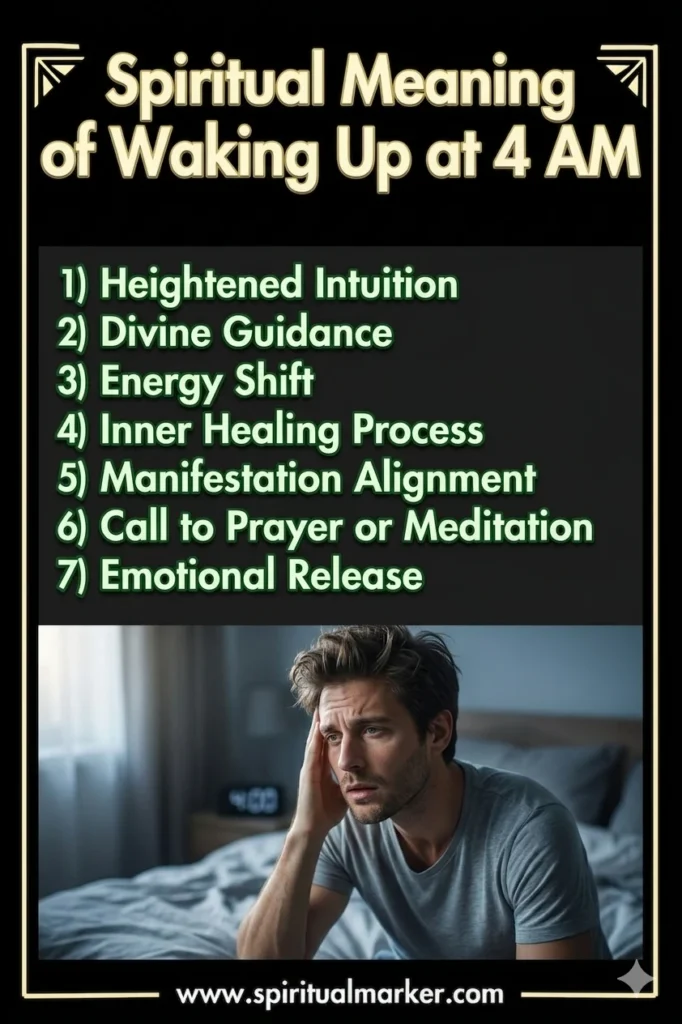
Waking up at 4 AM is often interpreted in spiritual circles as more than just a sleep quirk—it can be seen as a meaningful “nudge” from the soul, the subconscious, or higher guidance.
1. Spiritual Awakening
When someone repeatedly wakes at 4 AM, many spiritual teachers interpret it as a sign of inner awakening already in motion. Awakening rarely begins with fireworks. Instead, it often starts quietly. You may feel restless in your old routines. You may question beliefs that once felt solid. Life can seem both fragile and meaningful at the same time.
At 4 AM, the world feels suspended. Darkness still covers the sky, yet morning approaches. That in-between state mirrors spiritual awakening itself. You are no longer asleep to deeper truths, yet you have not fully stepped into the light of clarity. The body waking at this hour can reflect that internal shift.
Psychologically, this period of awakening also increases awareness. You notice your thoughts more clearly. You sense patterns in your life. Therefore, the early morning silence becomes a stage where your expanding consciousness meets stillness. Many describe it as the beginning of living with intention rather than autopilot.
2. Heightened Intuition
As awakening deepens, intuition often grows stronger. Many new age teachings describe the pre-dawn hours as a time when mental noise decreases. Fewer cars pass. Fewer notifications buzz. The collective world rests. Because external distractions drop, your inner voice grows louder.
At 4 AM, dreams may still linger in your memory. You might wake with a sudden insight about a problem. You may sense a feeling you cannot explain logically. Rather than dismissing it, spiritual traditions encourage observation. Intuition rarely shouts. It whispers.
Furthermore, the brain moves through lighter sleep cycles in the early morning. During these phases, symbolic thinking blends with waking awareness. As a result, insights can surface more easily. When this happens repeatedly, it can feel as if something within you wants attention. Listening with curiosity, instead of fear, allows intuition to strengthen naturally.
3. Divine Guidance
In Christian contemplative traditions, believers often refer to pre-dawn prayer as a sacred watch hour. Figures such as Jesus Christ are described in the Gospels as praying during the night or early morning. Because of this, many Christians view 4 AM awakenings as an invitation rather than an interruption.
Silence supports prayer. When you wake at this hour, distractions fade. Your mind may resist at first. Yet if you sit quietly and speak honestly in prayer, clarity often follows. Some people sense direction regarding relationships, career paths, or moral decisions.
Importantly, divine guidance does not always arrive as an audible voice. Instead, it may come as peace about a choice, conviction about a habit, or courage to take action. Therefore, the 4 AM hour becomes less about mysticism and more about relationship. It becomes a meeting place between human vulnerability and sacred presence.
4. Energy Shift
Holistic systems speak in the language of energy. In yogic philosophy, practitioners describe rising life force as Kundalini. When this energy stirs, people may experience tingling sensations, emotional waves, or unexpected wakefulness. While not every 4 AM awakening signals such movement, spiritual circles sometimes interpret it that way.
Energy shifts also occur during personal growth. When you release old identities, your nervous system recalibrates. Sleep patterns can temporarily change. You might wake feeling alert, even though the clock says it is too early.
Moreover, growth stretches comfort zones. That stretching creates internal friction. The body senses it. Therefore, waking at 4 AM may symbolize internal renovation. Something outdated breaks down, and something new forms. Although the process feels uncomfortable, it often prepares you for expanded awareness.
5. Inner Healing Process
From a depth psychology perspective, the quiet hours give the subconscious space to surface. During the day, tasks and conversations keep painful memories buried. At night, however, the mind processes unfinished emotional business.
If you wake at 4 AM with racing thoughts, grief, or sudden sadness, your psyche may be sorting through unresolved material. Rather than labeling it as weakness, you can view it as healing in progress. The mind attempts to integrate experiences that once overwhelmed you.
Healing rarely moves in straight lines. Some nights feel peaceful. Others feel heavy. Yet each awakening offers a chance to respond differently. You can breathe slowly. You can journal honestly. Over time, emotional charge decreases. The early hour becomes a workshop where broken pieces mend quietly.
6. Manifestation Alignment
Within Law of Attraction teachings, the subconscious mind shapes belief systems that influence behavior. Early morning awakenings occur when the conscious mind feels softer and less guarded. Because of that, affirmations and visualization practices can penetrate more deeply.
If you wake at 4 AM thinking about goals, this may reflect alignment forming beneath the surface. You might feel a strong urge to plan, write, or imagine your future clearly. Rather than scrolling through distractions, focusing on intention during this window can feel powerful.
The key here involves clarity. When the world sleeps, you can ask yourself direct questions. What do I truly want? What belief blocks me? Then you plant new mental seeds through repetition and emotion. Over weeks and months, small internal adjustments reshape external choices.
7. Call to Prayer or Meditation
In many contemplative paths, practitioners intentionally rise before dawn. In Buddhist monasteries across regions such as Thailand, monks begin meditation while darkness still lingers. The quiet supports focus. Distractions remain minimal.
Even outside monastic life, meditation teachers recommend early practice. At 4 AM, the mind has not yet absorbed news headlines or social demands. Because of this, awareness feels fresh. If you repeatedly wake at that hour, it may signal readiness for deeper discipline.
Consistency shapes growth. Sitting for ten minutes each morning can slowly transform emotional resilience. Over time, the hour that once felt inconvenient becomes sacred. Instead of fighting wakefulness, you channel it into stillness and self study.
8. Emotional Release
Traditional Chinese Medicine associates specific hours of the night with organ systems. Around the early morning window, some link wakefulness to lung or liver energy, which symbolically connects to grief and stored anger. Whether taken literally or metaphorically, the idea highlights emotional detox.
When you wake feeling tightness in the chest or unexplained sadness, your body may seek release. Deep breathing expands the lungs. Gentle stretching relaxes tension. Writing uncensored thoughts can lighten emotional weight.
Importantly, suppressed feelings do not disappear. They wait. Nighttime offers privacy for expression. Therefore, 4 AM awakenings can serve as pressure valves. You allow emotion to move instead of stagnate. Gradually, daytime interactions feel less reactive and more balanced.
9. Preparation for Life Change
Before major life transitions, internal awareness often shifts first. You may sense that a chapter nears its end, even if circumstances remain unchanged. Waking at 4 AM during such seasons can reflect subconscious preparation.
The mind rehearses possibilities. It weighs risks. It imagines outcomes. Because fewer distractions compete for attention, clarity strengthens. You might feel both nervous and excited. That mixture signals growth on the horizon.
Change demands courage. Early morning reflection builds that courage quietly. You confront fears while the world sleeps. Then, when opportunity appears, you recognize it faster. In this way, the 4 AM hour becomes a training ground for decisive action.
10. Strengthening Spiritual Discipline
Finally, repeated early rising can cultivate discipline itself. In Hindu practice, the time before sunrise is called Brahma Muhurta. Devotees use it for prayer, mantra, or scripture study. They believe the atmosphere carries a subtle purity during this window.
Discipline shapes character. When you consistently choose reflection over comfort, you train the will. You prove to yourself that growth matters more than convenience. This practice builds confidence in other areas of life as well.
Structure creates freedom. At first, waking at 4 AM feels demanding. Later, it feels empowering. You own the first hour of your day. You set intention before the world sets it for you. Over months, that habit forms a steady spiritual backbone.
Biblical Meaning of Waking Up at 4 AM
From a biblical view, early morning hours hold powerful meaning. Scripture repeatedly highlights seeking God before sunrise.
In Psalms 5:3, David writes, “In the morning, Lord, you hear my voice; in the morning I lay my requests before you and wait expectantly.” This verse shows intentional early prayer.
Similarly, Psalms 63:1 says, “Early will I seek You.” The phrase reflects spiritual hunger. Seeking God first sets the tone for the day.
Even Jesus Christ practiced early rising. In Mark 1:35, it says, “Very early in the morning, while it was still dark, Jesus got up, left the house and went off to a solitary place, where he prayed.” Notice the timing. It was still dark.
These passages reveal a pattern. Early hours create space for communion with God. Distractions fade. Focus sharpens.
Some Christians also connect 4 AM to spiritual watchfulness. In Matthew 25, the parable of the ten virgins highlights readiness. Although the exact hour differs, the theme of staying prepared remains strong.
Furthermore, Psalm 119:62 says, “At midnight I rise to give you thanks.” This verse shows devotion beyond convenience.
Therefore, biblically, waking at 4 AM may signal a call to prayer. It may also reflect spiritual alertness. God often speaks in stillness. The quiet hour invites listening.
Religious and Cultural Meanings Behind Repeatedly Waking Up at 4 AM
Across religions, pre dawn hours carry sacred meaning.
In Islam, believers rise for Tahajjud prayer before Fajr. They value this quiet time for deep connection with Allah. The stillness enhances sincerity.
In Hindu tradition, the period called Brahma Muhurta begins around 4 AM. Many yogis meditate during this time. They believe the mind feels pure and receptive.
Buddhist monks also meditate before sunrise. They train awareness while the world sleeps. This discipline strengthens mindfulness.
In Sikhism, Amrit Vela refers to early morning devotion. Sikhs chant and meditate during these hours. They consider it spiritually rewarding.
In traditional Chinese medicine, 3 AM to 5 AM connects with lung energy. Some believe waking then signals emotional processing, especially grief.
Native spiritual traditions often honor dawn as rebirth. Darkness symbolizes reflection. Sunrise represents renewal.
Because so many cultures revere this time, repeated waking may reflect spiritual sensitivity rather than coincidence.
Spiritual Practices to Make the Most of Spiritual Hours
If you wake at 4 AM, resist frustration. Instead, shift your response. Turn the moment into opportunity.
- Pray or meditate quietly. Speak honestly. Then sit in silence. Listen more than you talk.
- Journal your thoughts. Early insights often carry truth. Write without censoring.
- Practice gratitude. List three blessings. Gratitude shifts mental energy quickly.
- Read a short scripture passage. Reflect slowly. Allow the words to sink in.
- Breathe deeply for five minutes. Calm breathing grounds the body and spirit.
Keep the lights dim. Avoid scrolling your phone. Protect the sacred feeling of the hour. Even fifteen intentional minutes can transform your morning.
Final Thoughts
Waking up at 4 AM can feel mysterious. Yet patterns often carry meaning. While stress sometimes causes sleep disruption, repeated spiritual nudges deserve reflection.
This hour represents transition. It symbolizes foundation and awakening. Biblically, it aligns with seeking God early. Culturally, it connects with prayer and meditation across faiths.
Instead of fearing it, approach it with curiosity. Ask yourself what your spirit needs. Ask God for clarity. Then listen.
Sometimes growth begins in darkness. And sometimes the quietest hours hold the clearest messages.
You Might Also Like
1) Itchy Forehead Superstition and Spiritual Meaning You Didn’t Know
2) Biblical and Spiritual Meaning of Right and Left Hands
3) Choking in Sleep Spiritual Meaning And Dream Analysis
4) Insomnia or Can’t Sleep at Night Spiritual Meaning
5) Spiritual Meaning of Sleeping With Arms Above Head
References
- https://www.alba-matelas.com/en/blogs/la-chronique/se-reveiller-a-4h-du-matin-signification-spirituelle
- https://womenwithalpha.com/spiritual-meanings-behind-waking-up-at-4-am/
- https://timesofindia.indiatimes.com/religion/hindu-mythology/what-is-the-spiritual-meaning-behind-why-you-wake-up-at-3-am-or-4-am/articleshow/115427915.cms
- https://shop.drneetikaushik.com/blogs/news/spiritual-meaning-of-waking-up-at-4-am
- https://www.reddit.com/r/spirituality/comments/14urhyp/does_anyone_know_the_spiritual_significance_of/
- https://www.youtube.com/watch?v=43AfpaM_Ut8