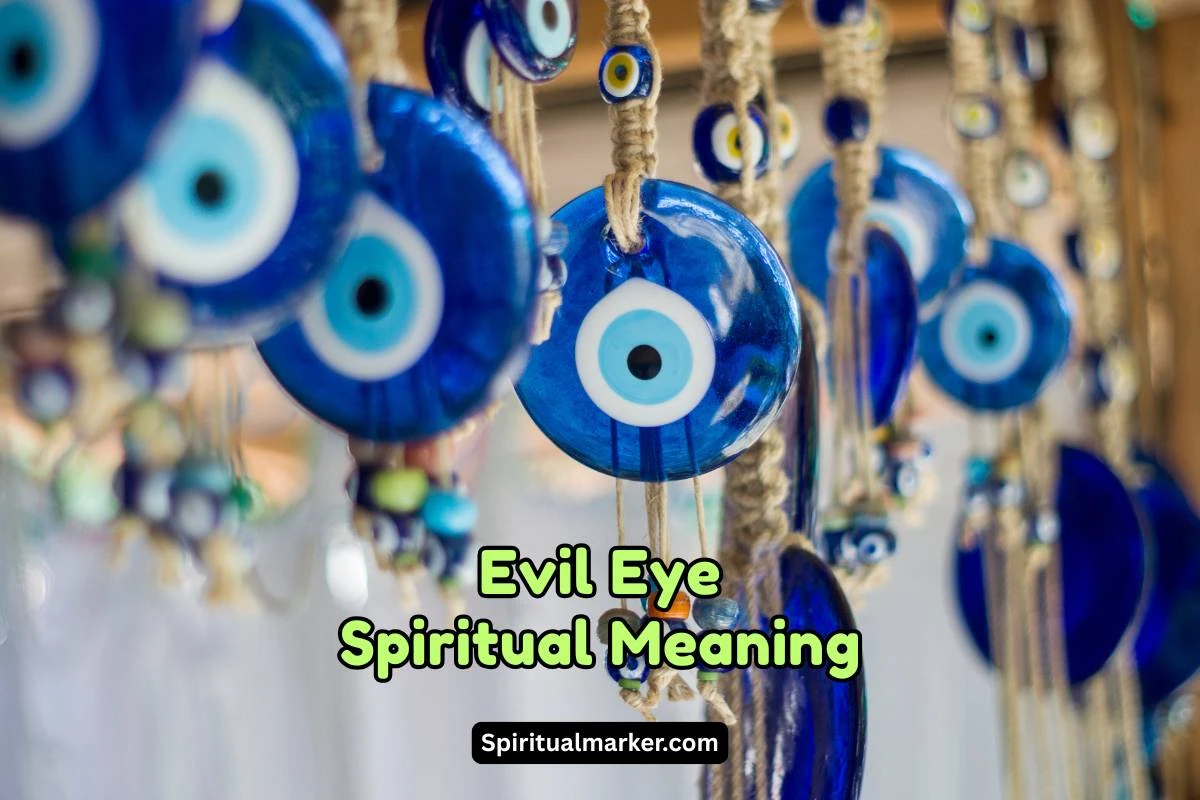
The evil eye is an ancient symbol of protection. Its blue glass and watchful gaze appear in jewelry, art, and architecture. Across cultures, the evil eye carries deep spiritual meaning and symbolism.
The evil eye spiritual meaning often involves protection, warding off envy, and deflecting negative energy. The evil eye is a curse believed to be cast by a malicious glare. A spiritual meaning of a red string evil eye bracelet shares that evil-eye focus, though the red string adds a specific layer.
Some traditions view the evil eye as a symbol of good luck and blessing. Others see it as a warning to be humble. The context of the symbol can add detail.
If the evil eye appears in your life, it may be a call for protection. A spiritual meaning of a mal de ojo bracelet also deals with evil-eye symbolism, though mal de ojo carries a more Latin American energy.
Key Takeaways
- The evil eye symbolizes both the curse of envy and the protection against it, making it one of the few symbols that represents a problem and its solution at once.
- Belief in the evil eye dates back over 5,000 years to ancient Mesopotamia, and it later spread through Greek, Roman, Jewish, Islamic, Hindu, and Buddhist traditions.
- The Bible references an “evil eye” in Mark 7:22 and Matthew 6:22-23, where it describes a spirit of envy and stinginess rather than a magical curse.
- Most evil eye amulets are made in blue and white glass because these colors were historically rare and believed to mirror the protective gaze of the heavens.
- Dreaming about the evil eye often reflects feelings of being watched, judged, or energetically drained, and rarely points to literal danger.
What Is the Evil Eye and Where Did It Come From?
The evil eye describes a curse believed to be transferred through a malicious or envious glance. The person on the receiving end may experience sudden bad luck, illness, accidents, or a string of unexplained misfortunes. Importantly, the person casting the evil eye does not always do so on purpose. Many cultures teach that even an admiring glance, if it carries hidden envy, can cause harm.
Historical evidence places the earliest evil eye beliefs in ancient Mesopotamia, with clay tablets and inscriptions referencing the concept thousands of years before written religion took shape. From there, the belief moved through Egypt, Greece, and Rome. The symbol traces its roots to Mesopotamia more than 5,000 years ago, before spreading its influence across the Middle East, Africa, Latin America, and Europe.
What makes the evil eye so fascinating is its staying power. Unlike many ancient superstitions that faded with modern science, this belief adapted instead of disappearing. Evil eye beliefs appear across Greek, Roman, Jewish, Islamic, Hindu, and Buddhist traditions, along with countless smaller folk and indigenous belief systems around the world. That kind of cultural reach is rare for any single symbol, and it says something about a fear that feels universal: the fear of being noticed by the wrong kind of attention.
The actual word for the amulet itself, nazar, comes from Arabic and Persian roots meaning “sight” or “watching.” The protective charm typically appears as concentric circles of blue, white, and sometimes light blue or black glass, designed to resemble an eye staring back at whoever approaches it. The logic feels almost playful once you understand it. If the curse comes through a stare, then a stare can also defend against it.
What Does the Evil Eye Symbolize and Represent?
At its heart, the evil eye represents two opposing forces living inside one symbol. It stands for the wound and the shield, the threat and the answer to that threat. Most cultures describe the curse as something born from jealousy, covetousness, or unspoken resentment, while the amulet stands for vigilance, faith, and the deliberate intention to stay protected.
This dual symbolism explains why the evil eye feels different from most protective charms. A horseshoe simply brings luck. A four leaf clover simply brings fortune. The evil eye does something more layered. It acknowledges that harm exists, names where that harm tends to come from, and then offers a direct countermeasure in the same breath. Its watchful design represents awareness and vigilance, a steady reminder to stay centered and protected from negativity.
The symbol also represents something deeply human about how we relate to attention itself. Being seen can feel wonderful or threatening depending on the intention behind the gaze. A loving look nourishes. An envious look, even unintentional, drains. The evil eye gives ancient language to a feeling most people recognize instinctively but rarely name out loud: the discomfort of being watched by someone who wants what you have.
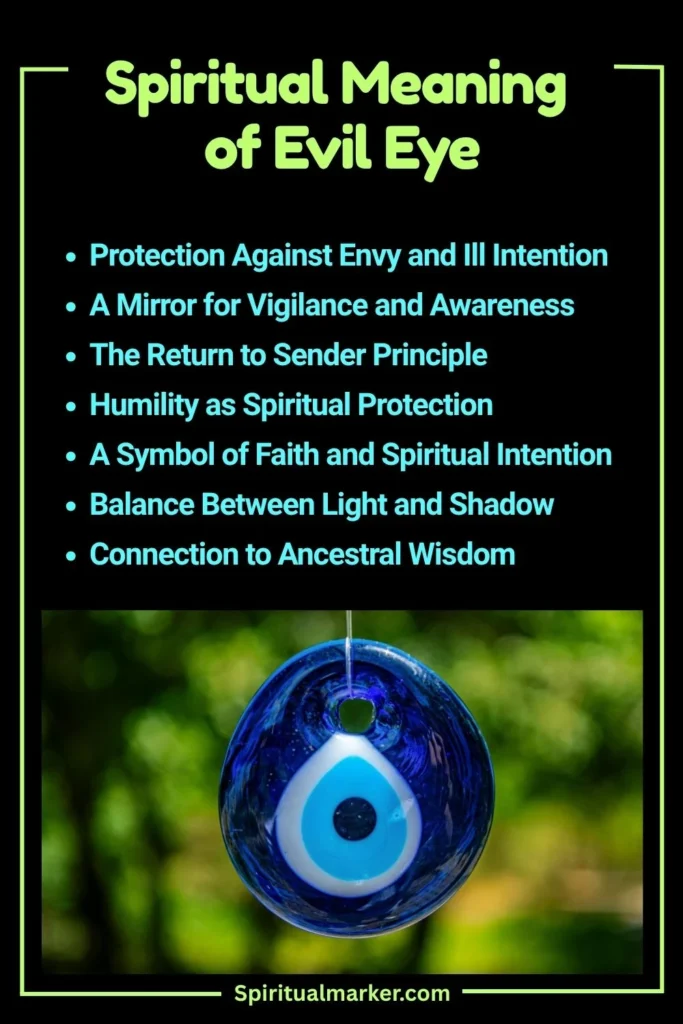
7 Spiritual Meanings of the Evil Eye
1. Protection Against Envy and Ill Intention
Protection sits at the very center of evil eye symbolism. Across nearly every culture that embraces this belief, the amulet exists to shield the wearer from envious or malicious energy directed their way. This protection rarely targets random misfortune. It targets the specific harm believed to come from another person’s jealousy, whether that jealousy is spoken, silent, or entirely unconscious.
People reach for evil eye jewelry during moments when they feel exposed. New success, a public celebration, a pregnancy announcement, or a visible achievement often triggers the impulse to wear protection. The logic makes emotional sense even outside any spiritual framework. Visibility invites attention, and attention sometimes carries weight that feels heavier than it should.
This protective meaning also extends into spaces, not just people. Homes, businesses, cars, and even baby cribs across Mediterranean and Middle Eastern cultures often display an evil eye charm near the entrance. The placement matters. Positioning the symbol where it can “see” anyone approaching reinforces the belief that it actively intercepts harmful energy before it ever crosses the threshold.
Spiritually, this meaning invites a deeper reflection. Protection is rarely about becoming invincible. It is about creating enough internal stability that external negativity, real or imagined, does not destabilize your peace. The evil eye reminds the wearer to stay grounded rather than anxious, even while acknowledging that envy is a real and ancient part of human relationships.
2. A Mirror for Vigilance and Awareness
The evil eye does not simply block harm passively. Its design as an eye staring back carries an active meaning rooted in vigilance. This symbolism teaches the wearer to remain spiritually awake rather than emotionally careless about the energy they absorb from others throughout daily life.
Vigilance here means something practical. It means noticing when a relationship feels draining instead of nourishing. It means recognizing when admiration from someone else starts to feel uncomfortable rather than flattering. The eye shape itself, found in nearly every version of this amulet across history, deliberately mirrors the very thing it defends against. A gaze meets a gaze.
This meaning connects naturally to the third eye concept found in many Eastern spiritual traditions, where inner perception protects a person from being deceived by appearances. The evil eye, while culturally distinct from that idea, shares a similar underlying message. Seeing clearly, both outwardly and inwardly, is itself a form of protection.
Many spiritual practitioners describe carrying or wearing this symbol as a daily reminder to stay present. Distraction and denial leave a person vulnerable. Awareness, even uncomfortable awareness, keeps a person rooted enough to respond wisely instead of reactively when negativity does appear.
3. The Return to Sender Principle
One of the most consistent spiritual meanings tied to the evil eye involves the idea of deflection. Rather than absorbing negative energy and holding onto it, the symbol is believed to send that energy back toward wherever it originated. Many traditions describe this directly as a “return to sender” mechanism built into the amulet’s purpose.
This meaning carries an important nuance worth sitting with. The evil eye is not typically described as a weapon used to harm the person who sent the negativity. The eye symbol within the protective amulet represents spiritual defense against a harmful stare, working to keep negative energy and misfortune away while inviting positivity and good fortune in its place. The goal is restoration of balance, not retaliation.
Spiritually, this teaches an important lesson about boundaries. You can refuse to carry someone else’s negativity without needing to attack them in return. Deflection allows the wearer to maintain their own peace while still acknowledging that harmful energy exists in the world. It is a boundary, not a battle.
This is also why many people believe a cracked or broken evil eye charm signals success rather than failure. The belief holds that the amulet absorbed and redirected a significant amount of negativity, and the breakage marks the moment its protective duty reached its limit. Replacing it simply continues the cycle of spiritual defense.
4. Humility as Spiritual Protection
A surprising and often overlooked meaning behind the evil eye involves humility. In Greek tradition specifically, it is considered possible to cast the evil eye on yourself through excessive pride or boastfulness. This belief encourages people to stay modest about their achievements rather than flaunting success in ways that invite envy from others.
Contrary to popular assumption, the evil eye is not necessarily cast by someone who actively wishes harm on another person. It often stems from admiration, particularly if that admiration carries an undertone of envy toward someone else’s good fortune or success. This understanding shifts the symbol away from pure superstition and toward something closer to a moral teaching about how pride and comparison affect both the giver and receiver of attention.
The spiritual lesson here applies whether or not someone believes in literal curses. Humility softens the sharp edges of social comparison. When a person celebrates their wins quietly and graciously rather than loudly, they naturally invite less resentment from those around them. The evil eye, in this light, becomes a gentle nudge toward groundedness rather than arrogance.
This meaning also asks the wearer to examine their own heart. Are you the one giving an evil eye to someone else through silent envy? Many spiritual traditions encourage regular self-reflection on this exact question, since the line between admiration and envy can blur without much warning.
5. A Symbol of Faith and Spiritual Intention
The protective power of the evil eye is widely described as faith powered. Its effectiveness depends heavily on the belief and intention of the person wearing it rather than the object alone. This meaning places the spiritual weight on the wearer’s mindset, not solely on the glass, stone, or metal used to craft the charm.
This is consistent with how many protective and devotional objects function across world religions. A rosary, a mezuzah, or a protective verse worn close to the body all rely on the wearer’s spiritual engagement to feel meaningful. The evil eye fits naturally into this same category of intentional spiritual practice rather than passive decoration.
Gifting an evil eye charm carries particular significance in many cultures because the intention of the giver becomes woven into the meaning of the object. A piece given out of love and genuine concern for someone’s wellbeing is often considered more spiritually potent than one purchased for oneself. The relationship behind the gift matters as much as the symbol itself.
This meaning also explains why the evil eye continues to resonate even with people who do not consider themselves traditionally religious. Wearing it can function as a personal ritual, a quiet daily reminder to set protective intentions for the day ahead, regardless of whether the wearer believes in literal curses or simply values the symbolic act of self care.
6. Balance Between Light and Shadow
The evil eye carries an inherent symbolism of duality and balance. It exists because darkness exists, and it offers light in direct response to that darkness. This is not a symbol that pretends negativity does not exist in the world. It openly acknowledges envy, ill will, and misfortune while offering a direct counterbalance to those forces.
This balance mirrors a much broader spiritual principle found across many traditions, where protection and threat are understood as two sides of the same coin rather than entirely separate forces. The evil eye does not deny the shadow side of human nature. It simply insists on standing firmly on the side of light while staying honest about what it is defending against.
Many spiritual seekers find this honesty refreshing compared to symbols that promise only positivity without acknowledging real struggle. The evil eye validates difficult emotions like jealousy, insecurity, and fear of judgment as legitimate human experiences, rather than dismissing them as irrational or shameful.
This balance also shows up visually in the design itself. The dark pupil at the center, surrounded by rings of blue and white, creates a literal image of contrast held together in one cohesive shape. Spiritually, this can serve as a reminder that wholeness does not require the absence of darkness, only the presence of enough light to keep it from taking over.
7. Connection to Ancestral Wisdom and Cultural Identity
For many families, the evil eye carries a meaning that extends well beyond personal protection into ancestral connection and cultural identity. Wearing or displaying the symbol often represents a tie to grandparents, traditions, and a long lineage of belief passed down through generations of careful, deliberate practice.
In Greek households, the practice of removing the evil eye through a quiet, whispered prayer is traditionally passed from a grandparent to a grandchild of the opposite sex, and the ritual is meant to stay private rather than openly shared. This kind of transmission gives the symbol a living, breathing quality rather than treating it as a fixed historical artifact frozen in the past.
This meaning matters deeply for people navigating cultural identity, especially within diaspora communities where younger generations sometimes feel disconnected from inherited traditions. Wearing an evil eye charm can become a quiet, personal act of honoring family history without needing to explain or justify that connection to anyone outside the culture.
Spiritually, ancestral symbols like the evil eye carry a kind of accumulated weight. They are not invented fresh by each new generation. They are inherited, refined, and passed forward, carrying with them centuries of collective hope, fear, prayer, and protection. That inheritance gives the symbol a depth that a newly designed charm simply cannot replicate.
Evil Eye Meaning and Symbolism Across Cultures and Religions
The evil eye does not belong to one single culture or faith. It is recognized across continents and represents a long held belief that a malevolent glare can bring misfortune to someone caught unaware. What changes from one tradition to another is not the core fear behind the symbol but the specific rituals built around protecting against it.
In Greek culture, the evil eye is known as “mati,” and protection often comes through a whispered prayer passed down through families along with the burning of cloves to detect whether someone has spoken ill of the affected person. The Greek term traces back to roughly the 500s BCE, making it one of the oldest documented versions of this belief still actively practiced today.
In Jewish tradition, the concept appears as “ayin hara,” which translates directly to evil eye and also functions as a broader term describing evil motives or destructive thoughts. The Hamsa Hand frequently incorporates this protective symbol within Jewish and Islamic cultures, with the five fingers representing fortune, prosperity, and overall positivity.
In Islamic tradition, the concept is called “al-ayn” and is treated as a genuine spiritual reality rather than mere superstition. Protection traditionally comes through specific Quranic recitations, particularly Surah Al-Falaq and Surah An-Nas, along with sincere supplication and humility before God. The emphasis here rests on faith and divine protection rather than the amulet alone holding inherent power.
In Indian and Hindu culture, the belief appears as “buri nazar,” and protective objects called “nazar battu” are commonly tied to door frames or hung near babies and children. Other regional names within Indian culture include “kurdishti” and “karikannu,” reflecting how widely this belief spreads even within a single country’s diverse linguistic landscape.
In Italian culture, protection traditionally comes through the “cornicello,” a small red horn shaped charm, alongside a hand gesture resembling horns. This gesture, called “facendo le corna,” is traditionally made when someone speaks with pride about good fortune, helping ward off the envy their words might attract.
In Buddhist tradition, the framing shifts slightly away from fear toward mindfulness. The evil eye becomes less about literal curses and more about cultivating enlightened awareness that naturally wards off ignorance, encouraging clarity and intentional living rather than reactive fear of other people’s judgment.
Evil Eye Symbolism in World Mythology
Mythology offers some of the richest territory for understanding why the evil eye holds such lasting power over human imagination. The most famous mythological connection comes from Greek mythology through the figure of Medusa, the Gorgon whose gaze turned anyone who met her eyes directly to stone. Her story captures the essence of evil eye fear: a look powerful enough to paralyze, harm, or destroy without any physical contact at all.
Medusa’s image, often carved onto shields and doorways in ancient Greece, served a protective purpose nearly identical to the evil eye amulet. Warriors carried her likeness into battle hoping her fearsome gaze would frighten enemies before any blade was drawn. This mirrors the evil eye’s own logic precisely. A dangerous gaze, reflected back outward, becomes a shield instead of a weapon turned inward.
In ancient Egyptian mythology, the Eye of Horus tells a related but distinct story. Horus, the falcon headed god, lost his eye in battle against Set, and the eye was later restored through healing magic. The restored eye became a symbol of protection, royal power, and good health throughout Egyptian culture. While historians note that the Eye of Horus and the evil eye amulet are visually and culturally distinct symbols, they share an underlying theme worth noting: an eye, once wounded, transformed into a powerful guardian.
Roman mythology contributed its own variations through figures associated with the “fascinus,” a protective charm often shaped like a phallus and used specifically to ward off envious spiritual attack. Roman households commonly displayed these charms at entrances, following the same defensive logic found in nearly every other evil eye tradition across the ancient world.
What unites these mythological threads is a consistent fear running through ancient storytelling everywhere. A gaze carries power. Whether that gaze belongs to a monster, a god, or an envious neighbor, the stories agree that sight itself can wound, and that the only reliable defense against a dangerous eye is another eye, watching right back.
Evil Eye Colors and Their Spiritual Meanings
While the classic evil eye appears in deep blue and white, modern interpretations have expanded the color palette, and each shade is now believed to carry its own distinct spiritual focus. A red evil eye is traditionally associated with protecting strength and courage, while an indigo version, the most commonly used color, is connected to fate and intuitive power.
Light blue versions are tied to protecting one’s voice and capacity for self expression, while orange focuses on joy and happiness. A dark green evil eye is believed to support grounding during stressful moments, and light green is linked specifically to health and success. Purple charms connect to imagination and spiritual sensitivity, yellow ties to physical vitality, pink centers on relationships, and white is associated with peace and calm.
The original preference for blue and white glass was not arbitrary. In ancient times, blue eyes were rare across much of the Mediterranean and Middle East, and rarity often translated into spiritual significance. Some traditions held that people with naturally blue or green eyes were more capable of casting an evil eye, which created a strange logic where the very color feared in a human gaze became the color chosen to defend against it.
This color symbolism gives modern wearers a way to personalize their connection to the amulet. Someone working through anxiety about public speaking might gravitate toward light blue. Someone navigating a difficult financial season might choose light green. The core protective meaning stays intact across every color, but the specific spiritual focus shifts to match what the wearer needs most in that particular season of life.
Evil Eye Meaning in the Bible
The phrase “evil eye” does appear directly in Scripture, though its biblical meaning differs from the superstitious curse found in folk tradition. In Mark 7:20-23, Jesus lists thirteen specific sins originating from the human heart, and “an evil eye” is named among them, alongside theft, deceit, pride, and blasphemy.
Biblical scholars widely agree that this phrase points toward envy and covetousness rather than any magical ability to curse someone through a stare. The Greek phrase in question is associated with affluence and material prosperity, functioning essentially as a euphemism for envy, the act of seeing what others possess and longing for it with obsessive intensity.
Matthew’s Gospel offers an even more detailed treatment of this concept. Matthew 6:22-23 describes the eye as the lamp of the body, stating that a healthy eye fills the whole body with light, while an eye described as “evil” in the original Greek fills the body with darkness instead. This passage sits deliberately between two teachings about money and devotion, and many scholars read it as a metaphor for generosity versus greed rather than literal eyesight.
The person carrying what Scripture calls an “evil eye” views the world through scarcity and self preservation, constantly trying to accumulate as much as possible out of fear regarding what tomorrow might bring. This stands in direct contrast to a generous, open hearted way of seeing the world, where contentment with what is needed allows room for genuine giving.
The Old Testament reinforces this same theme. Proverbs 22:9 teaches that a person with a generous eye will be blessed because they give freely to those in need, while Proverbs 28:22 warns that someone consumed by an evil eye rushes after riches without considering the poverty that may eventually follow them. Deuteronomy 15:9 carries a similar warning against allowing a stingy, resentful heart to withhold generosity from someone in genuine need.
This biblical framing offers a meaningful contrast to folk superstition. Rather than treating the evil eye as an external curse you must defend against, Scripture turns the focus inward, asking the reader to examine their own heart for envy, greed, or a closed hand toward others. For the believer, fear of supernatural curses gives way to confidence rooted in Christ’s victory over evil, replacing superstition with a sound and steady mind.
Dreaming About the Evil Eye: Spiritual and Psychological Meanings
When the evil eye appears in a dream, it tends to stir something unsettling, even for people who do not consciously believe in the symbol’s spiritual power. This dream often reflects either a sense of being judged, watched, or energetically drained, or it may reveal your own fears about standing out, succeeding, or being noticed by others.
The dream symbol holds a built in tension worth paying attention to. The evil eye traditionally represents two things simultaneously: a harmful glance rooted in jealousy or ill intention, and a protective symbol used specifically to reflect or repel that very same negative energy. Because of this duality, the emotional tone of your dream matters far more than the symbol’s mere presence.
If the dream felt threatening or left you anxious upon waking, it often points toward feelings of vulnerability in waking life. This kind of dream commonly highlights deep seated anxieties about social vulnerability, personal reputation, and the unsettling power other people’s opinions seem to hold over your sense of wellbeing. You might be entering a season where you feel unusually exposed, whether through a new relationship, a public achievement, or a personal disclosure you were not fully ready to make.
If instead the dream featured a protective amulet or charm, the meaning often shifts toward reassurance. This version of the dream may point toward a subconscious need for protection or a heightened awareness of negative influences directed your way, while also encouraging genuine self reflection about your current actions and thought patterns.
From a psychological lens, Carl Jung offered a particularly useful interpretation worth sitting with. Jung believed the evil eye in dreams symbolized the “malevolent gaze” rising from the unconscious mind, often representing negative qualities a person unconsciously projects onto others rather than acknowledging within themselves. Read this way, the dream becomes less about external threat and more about an invitation toward honest self examination.
Practically speaking, a recurring evil eye dream is worth treating as a gentle nudge rather than a literal warning. Consider whether any relationships currently feel unbalanced, whether you have been comparing yourself to others more than usual, or whether you have recently achieved something that left you feeling strangely guarded instead of celebrated. The dream rarely demands fear. It usually asks for honest reflection.
Is It Okay to Wear the Evil Eye Symbol?
This question comes up often, and the answer leans toward yes for most people. The evil eye symbol does not belong exclusively to any single religion or culture, and people can wear it as a protective amulet, a spiritual reminder, or simply as a meaningful pattern they find beautiful. What matters most is the intention and respect behind the choice rather than strict gatekeeping over who can or cannot wear it.
That said, approaching the symbol with a basic understanding of its cultural weight adds depth to the experience. Wearing an evil eye purely as a passing aesthetic trend differs meaningfully from wearing it with awareness of the centuries of belief, prayer, and protection woven into its history. Neither approach is wrong, but the second often feels more grounded and intentional.
Some spiritual practitioners also recommend treating the charm with a degree of care once it becomes part of your daily life. Many traditions suggest cleansing the amulet periodically, whether through moonlight, gentle prayer, or simply setting a clear intention when you first put it on. This keeps the symbol feeling active and personal rather than purely decorative.
A Final Note
The evil eye has survived thousands of years for a reason that has very little to do with superstition and everything to do with honesty. It names something real. Envy exists. Comparison wounds. Attention can feel heavy in ways that are hard to explain to someone who has never felt it. Rather than pretending these feelings away, this small blue symbol simply says, I see it, and I am protected anyway.
Its meanings, protection, vigilance, humility, faith, balance, and ancestral connection, work together as one coherent spiritual story rather than scattered ideas. The Bible’s framing adds another valuable layer, gently turning the conversation inward and asking each of us to examine our own heart for envy before worrying too much about anyone else’s.
If this symbol has been showing up in your life lately, whether through a dream, a piece of jewelry someone gifted you, or a sudden curiosity that led you here, consider sitting with what it might be asking of you. You might explore wearing it as a personal reminder to stay humble during good seasons, or use it as a quiet prompt to check your own heart for hidden envy toward someone else. Whatever direction feels right, let the symbol serve its oldest purpose: a gentle, watchful reminder that you are worth protecting.