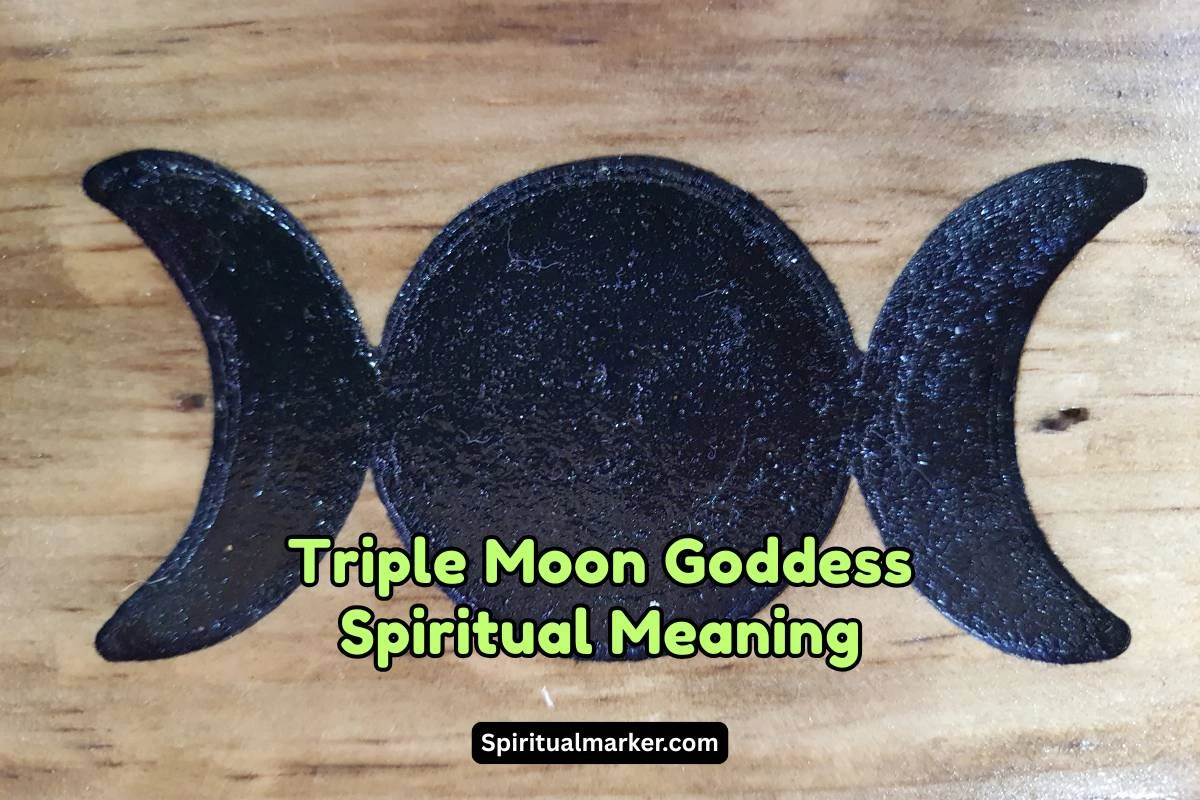
The triple moon goddess symbol is a powerful emblem. It depicts the waxing, full, and waning moon, representing the three phases of womanhood. Across cultures, this symbol carries deep spiritual meaning.
The triple moon goddess symbol meaning often involves the maiden, mother, and crone. Each phase represents a stage of life and feminine power. A spiritual meaning of a moonstone shares that lunar focus, though moonstone carries a more gentle energy.
Some traditions view the triple moon as a symbol of the goddess in her three aspects. Others see it as a map of the spiritual journey. The context of the symbol can add detail.
If the triple moon appears in your life, it may signal a connection to feminine energy. A spiritual meaning of a ring around the moon also deals with lunar symbolism, though a ring carries a different message.
Key Takeaways
- The triple moon goddess symbol shows three lunar phases representing the Maiden, Mother, and Crone stages of womanhood.
- It connects to ancient goddess archetypes like Hecate, Diana, and Selene, long before modern Wicca adopted it.
- Each phase carries distinct symbolism: youth and new beginnings, fertility and power, and wisdom and transformation.
- The symbol was popularized in the 20th century through the work of Robert Graves and later Neopagan traditions.
- People wear or display this symbol to honor feminine energy, intuition, and the natural cycle of life, death, and rebirth.
What Is the Triple Moon Goddess Symbol?
The triple moon symbol, sometimes called the Triple Goddess symbol, depicts a full moon at its center with a waxing crescent on the left and a waning crescent on the right. Together, these three shapes form one continuous image of lunar movement. You are looking at the moon’s entire monthly journey compressed into a single, elegant design.
This symbol holds deep roots in Neopagan spirituality, where it represents the divine feminine in her three classic forms. High priestesses, witches, and modern practitioners have worn this symbol on crowns, necklaces, and ritual tools for decades. The triple moon symbol is associated with feminine energy, mystery, and psychic abilities, and you often see it on crowns or other head pieces, particularly worn by High Priestesses. That detail alone tells you how seriously this symbol has been treated across spiritual communities.
What makes this symbol so compelling is its simplicity. Three shapes, one story. The waxing moon grows toward fullness. The full moon shines at its peak. The waning moon fades back into darkness before the cycle starts again. Women have long recognized their own lives in this same pattern, and that recognition is exactly why the symbol has endured.
The Maiden, Mother, and Crone: What Each Phase Represents
At the heart of the triple moon goddess symbolism sit three archetypes. Each one corresponds to a moon phase and a stage of a woman’s life. None of them stand alone. They flow into each other, the same way one moon phase flows into the next without a hard break.
The Maiden: Waxing Moon
The Maiden sits on the waxing crescent side of the symbol. She represents youth, curiosity, and the thrill of starting something new. The Maiden represents enchantment, inception, expansion, and the promise of new beginnings, along with birth, youth, and youthful enthusiasm. She has not yet been shaped by every hardship life will eventually bring, and that gives her a sense of freedom many people long to recapture.
You can think of the Maiden as the part of you that says yes to new experiences. She is independence before responsibility. She is the spark before the flame. Goddesses like Artemis and Persephone are often linked to this phase, since both embody untamed energy and a refusal to be boxed in by expectation.
The Mother: Full Moon
The Mother stands at the center of the symbol, represented by the full moon. The Mother represents ripeness, fertility, sexuality, fulfilment, stability, power, and life. This is the phase of peak energy, where creation and nurturing take center stage, whether that means raising children, building a career, or pouring love into a passion project.
She no longer searches for her identity the way the Maiden does. She already knows who she is, and her focus shifts toward abundance and giving back. Goddesses such as Selene, Demeter, and Isis often represent this stage, each one tied to fertility, protection, and the steady strength that holding a family or community together requires.
The Crone: Waning Moon
The Crone closes the cycle, shown through the waning crescent. The Crone represents wisdom, repose, death, and endings. Far from being a sad or fearful stage, the Crone carries the accumulated insight of an entire lifetime. She has lived through every phase before her and has the scars and the clarity to prove it.
This phase is often misunderstood in modern culture, which tends to celebrate youth and overlook age. Yet the Crone holds enormous spiritual weight. Hecate, the Greek goddess of crossroads and magic, is one of the oldest and most recognized figures tied to this archetype. She reminds you that endings are never truly final. They are simply doorways leading somewhere new.
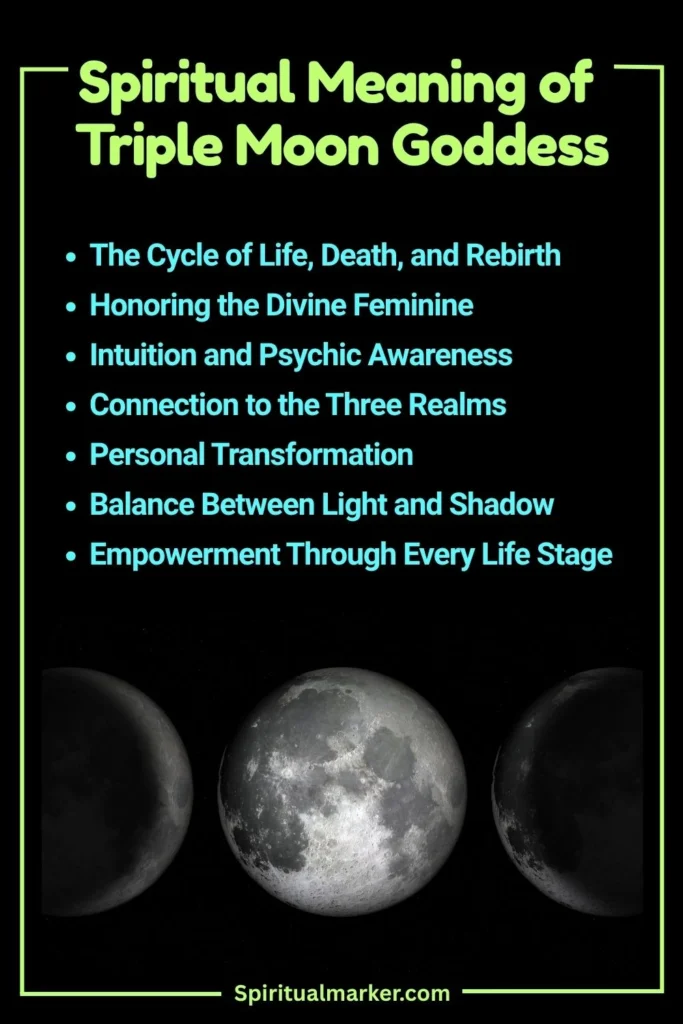
7 Spiritual Meanings of the Triple Moon Goddess Symbol
1. The Cycle of Life, Death, and Rebirth
The most central meaning behind this symbol is the cycle of existence itself. Birth leads to growth, growth leads to peak strength, and peak strength eventually gives way to decline and renewal. Nothing in nature escapes this rhythm, and the triple moon places that truth directly in front of you. It asks you to stop fearing endings and start seeing them as part of a larger pattern that always loops back toward beginning again.
2. Honoring the Divine Feminine
This symbol gives shape to feminine power in a way few other symbols manage. It does not reduce womanhood to one single image. It instead stretches across an entire lifetime, honoring girlhood, motherhood, and elderhood with equal respect. Many people wear this symbol specifically to reconnect with their own feminine energy, regardless of which phase they currently occupy.
3. Intuition and Psychic Awareness
The moon has long been linked to intuition, dreams, and the subconscious mind. The triple moon goddess carries that same association, often tied to psychic ability and inner knowing. Practitioners who work with this symbol frequently use it during meditation or ritual work meant to sharpen intuition and quiet the noise of the rational mind.
4. Connection to the Three Realms
Some traditions extend the meaning of the symbol beyond womanhood, linking each moon phase to a different realm of existence, namely earth, the heavens, and the underworld. Beyond the maiden, mother, and crone, other meanings of the symbol include the planes of earth, the underworld, and heaven, alongside the cycles of life, birth, death, and rebirth. This layered symbolism shows just how flexible the triple moon has become across different spiritual paths.
5. Personal Transformation
Even outside of strict spiritual practice, this symbol speaks to personal change. You move through your own Maiden, Mother, and Crone seasons many times within a single life, not just once. A new job, a new relationship, or a major loss can each trigger a smaller version of this same cycle. The triple moon reminds you that transformation is not something to resist. It is something to move through with grace.
6. Balance Between Light and Shadow
The waxing and waning crescents sit on opposite sides of the full moon, creating visual balance. This mirrors a deeper truth about life itself, where light and shadow always exist side by side. Growth cannot happen without loss, and joy often sits closer to grief than people expect. The symbol invites you to hold both without judgment.
7. Empowerment Through Every Life Stage
Perhaps the most practical meaning of the triple moon is permission. Permission to be young and unsure. Permission to be powerful and nurturing. Permission to grow old and still matter. Society often values only one phase of womanhood at a time, usually youth, but this symbol pushes back against that narrow view and insists that every stage deserves equal honor.
Origins and History of the Triple Goddess Symbol
The history behind this symbol is more layered than most people realize. In his 1944 novel The Golden Fleece, Robert Graves wrote that Maiden, Nymph, and Mother form an eternal royal trinity, with the goddess worshipped in each aspect as New Moon, Full Moon, and Old Moon. His later and far more influential book, The White Goddess, published in 1948, expanded this idea and planted the seed for what would eventually become the modern Maiden, Mother, Crone framework.
It is worth noting that historians remain divided on how far back this exact framework truly goes. Scholar Ronald Hutton argues that the triple moon goddess concept, with each facet tied to a moon phase, is largely a modern creation shaped by Graves and earlier scholars such as Jane Harrison, Margaret Murray, and James Frazer. Even so, triple deities themselves are far from new. Ancient cultures across the Mediterranean and beyond worshipped goddesses in groups of three long before anyone connected those groupings specifically to lunar phases.
One of the clearest ancient links comes from the philosopher Porphyry, writing in the third century. Porphyry described the moon as Hecate, explaining that her power appears in three forms tied to the moon’s varying phases, with the new moon shown through a white robe and lit torches and the full moon shown as the goddess of brazen sandals. This passage represents one of the earliest direct connections between a goddess figure and the three lunar phases, centuries before modern Wicca gave the symbol its current visual form.
The symbol became firmly rooted in Neopagan and Wiccan practice during the 1970s, when interest in goddess worship surged across Western spiritual communities. From that point forward, the triple moon stopped being a scholarly theory and became a living, breathing symbol that people wore, painted, and prayed with.
Goddesses Associated With the Triple Moon Symbol
Several goddesses across different mythologies are tied to this symbol, each one lending her own flavor to the Maiden, Mother, and Crone archetype. The Roman goddess Diana is one of the clearest examples. She was worshipped in three forms, as huntress, as moon, and as ruler of the underworld, which closely mirrors the structure of the triple moon symbol itself.
Hecate remains one of the most enduring figures connected to this symbol, often representing the Crone aspect due to her associations with crossroads, magic, and the underworld. Selene, the Greek personification of the moon, frequently represents the Mother phase, while Artemis, goddess of the hunt and wild places, often stands in for the Maiden. Beyond Greek and Roman mythology, similar triple goddess patterns appear in other cultures as well, including the three Fates of Greek myth and the Norns of Norse tradition, both of which echo the same idea of three feminine figures governing the threads of life and time.
How the Triple Moon Symbol Is Used Today
Modern practitioners use the triple moon goddess symbol in several practical ways. Jewelry remains the most common form, with pendants, rings, and charms often paired with moonstone to strengthen the connection to lunar energy. Many people also incorporate the symbol into altar decor, tattoos, or home decor as a daily reminder of the life cycle it represents.
Ritual work built around the moon’s phases often draws directly from this symbolism. Setting intentions during the waxing moon, taking action during the full moon, and releasing what no longer serves you during the waning moon all map directly onto the Maiden, Mother, and Crone framework. You do not need to follow any specific religion to use this practice. Many people simply find it a useful structure for personal reflection and goal setting throughout the month.
A Final Note
The triple moon goddess symbol carries weight precisely because it refuses to simplify womanhood into one tidy image. It holds space for youth, for strength, and for wisdom all at once, the same way the moon holds every phase within its single monthly journey. Whether you connect with this symbol through Wicca, general spirituality, or simple personal reflection, its message stays the same. Every stage of life deserves honor, and every ending carries a new beginning inside it.
If this symbol speaks to you, consider sitting with each phase individually rather than rushing to claim all three at once. Reflect on which archetype feels closest to where you stand right now, and let that reflection guide how you wear, display, or meditate on the symbol moving forward.