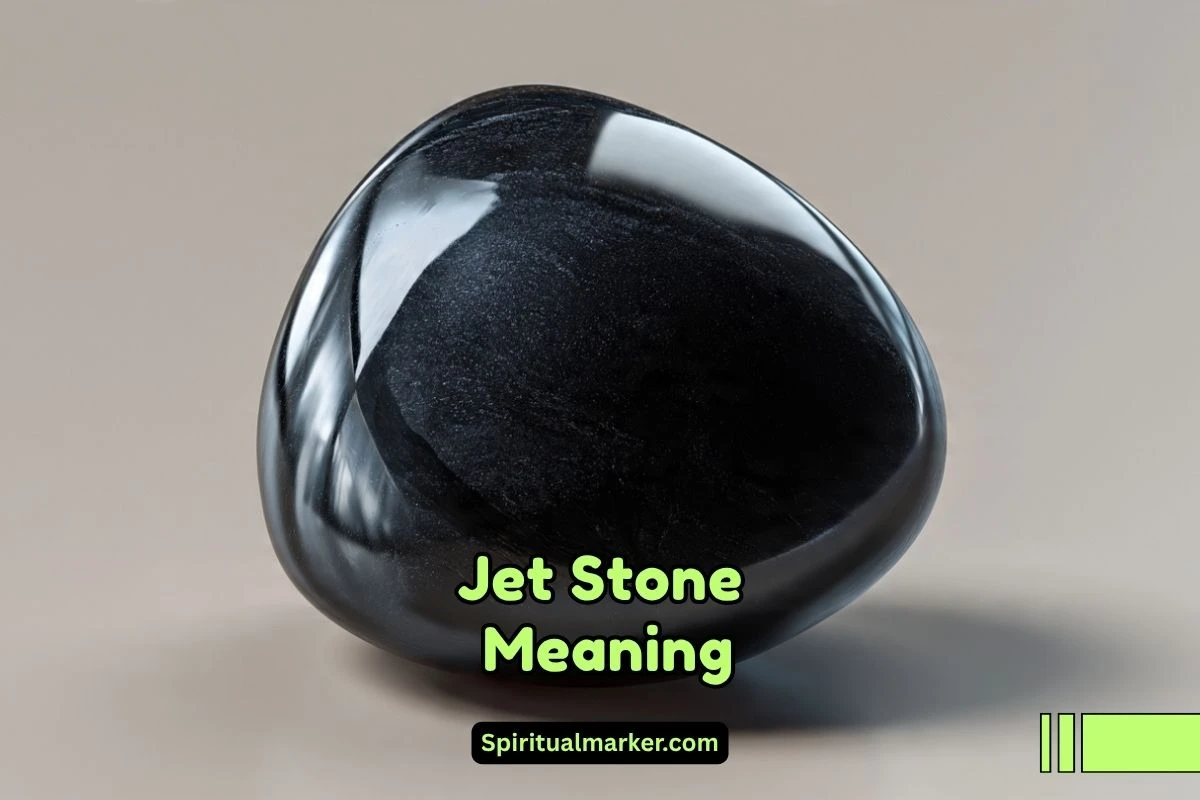
Have you ever touched a piece of jet stone and felt something unmistakably grounding move through you? Many people report an immediate sense of calm, weight, and protection when handling this ancient black gemstone for the first time. That response is rarely accidental.
Jet stone has been used for thousands of years across civilizations. Mourning queens wore it. Ancient priests carved it into protective amulets. Shamans carried it into ritual spaces. Despite changing centuries and cultures, jet stone’s reputation has remained remarkably consistent. People reach for it during grief, fear, spiritual transition, and emotional darkness.
Unlike sparkly gemstones that dazzle with light, jet works from the inside out. Its energy feels dense, deeply rooted, and quietly powerful. That solidity is exactly what draws so many people toward it, especially during periods when life feels unstable, sorrowful, or spiritually uncertain.
This article covers jet stone’s meaning, its spiritual symbolism, healing properties, historical roots, and practical ways to use it for emotional and spiritual support. You will also learn how to wear and care for jet stone jewelry while honoring both its beauty and energetic identity.
5 Key Takeaways
- Jet stone symbolizes protection, grounding, grief healing, and spiritual purification.
- Many traditions link jet stone directly with absorbing negative energy and emotional pain.
- People use jet stone during mourning rituals, meditation, chakra work, and protective spiritual practices.
- Jet is not a true mineral. It forms from ancient compressed wood, making it organic and deeply connected to earth energy.
- Wearing jet stone close to the body may strengthen feelings of emotional stability, protection, and spiritual clarity.
What Is Jet Stone?
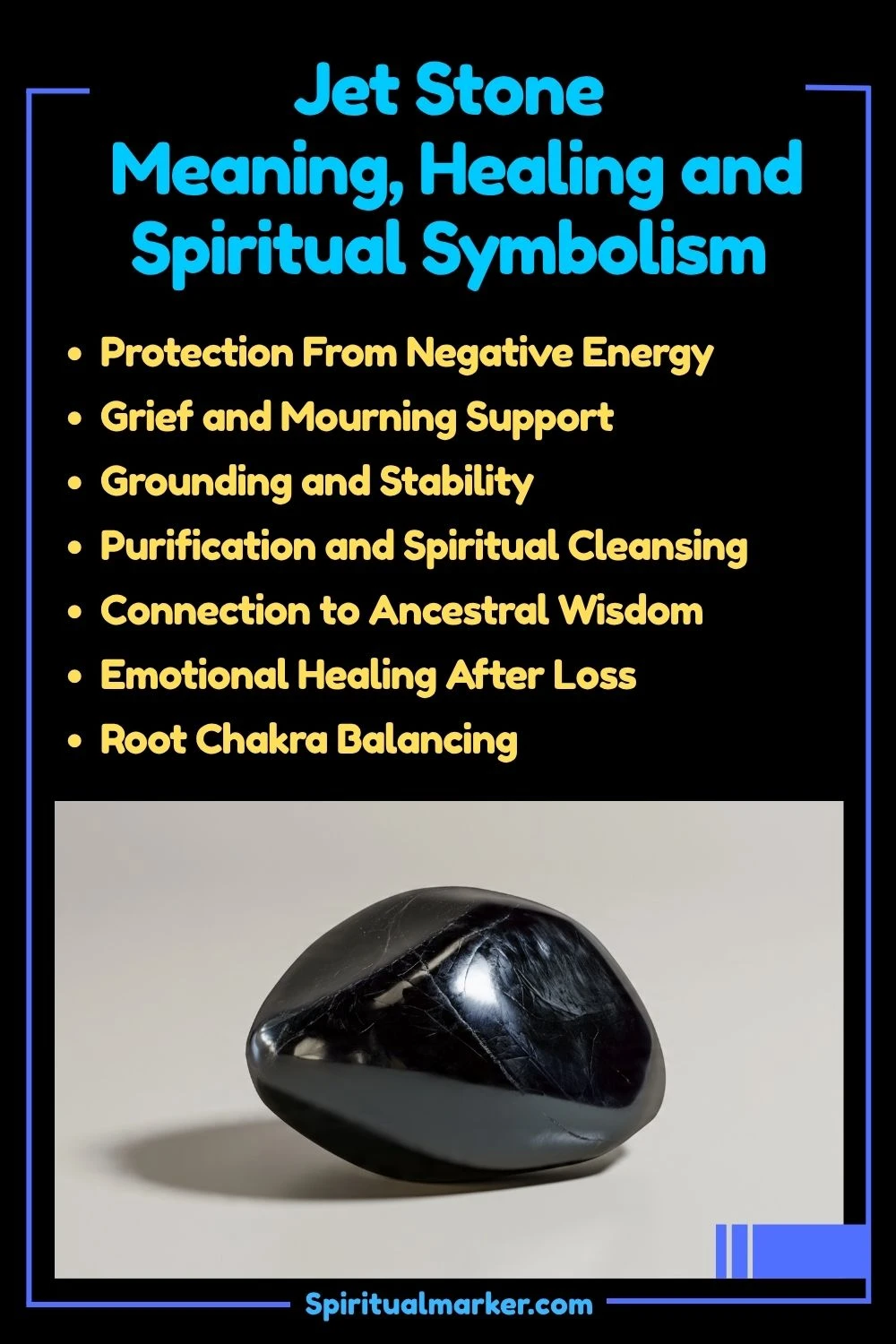
Jet stone is a deep black gemstone with a smooth, slightly waxy surface and a surprising lightness in the hand. Its color ranges from pure black to very dark brown-black. It carries no sparkle, no flash, and no translucency. That total absence of light creates its signature visual identity, one that feels both serious and profoundly calming.
Mineralogically, jet is not a mineral at all. It belongs to a category of organic gemstones, which means it comes from living material rather than geological mineral formation. Jet forms from ancient wood, specifically wood from trees similar to the modern araucaria or monkey puzzle tree. Over millions of years, that wood fell into oxygen-poor water environments. The lack of oxygen prevented normal decay. Instead, the wood slowly compressed under extreme geological pressure and transformed into a dense, black, carbon-rich material.
This origin story matters spiritually. Jet carries the memory of ancient forests. It holds the compressed energy of trees that lived long before recorded human history. Many spiritual practitioners believe this deep connection to ancient organic life gives jet a uniquely grounded and stabilizing energy.
People sometimes confuse jet with black tourmaline, obsidian, or black onyx. All four share dark appearances and protective reputations. However, jet feels noticeably lighter than all three because of its organic structure. Pressing a warm needle against jet will produce a faint smell of burning wood or coal, which immediately distinguishes it from black glass or mineral stones.
Origins and Formation
Jet forms in two primary types: hard jet and soft jet. Hard jet formed in saltwater environments. Soft jet formed in freshwater environments. Hard jet carries greater durability, takes a higher polish, and is generally more prized for jewelry and carving. The famous Whitby jet from England belongs to the hard jet category and remains some of the most historically significant jet in the world.
Whitby, a coastal town in North Yorkshire, England, became the world’s most celebrated source of high-quality jet during the Victorian era. Queen Victoria wore Whitby jet jewelry throughout her forty years of mourning after Prince Albert’s death in 1861. Her choice transformed jet into the defining gemstone of Victorian mourning culture across Britain and beyond.
Other notable jet sources include Spain, particularly the region of Asturias, where jet has been crafted since Roman times. The famous pilgrimage route of the Camino de Santiago brought travelers through Asturias for centuries, and carved jet amulets became popular souvenirs with spiritual protective significance.
Additional sources of jet exist in the United States, Germany, France, Poland, Turkey, and Russia. However, Whitby jet and Spanish jet remain the most historically documented and spiritually significant varieties.
Key Properties
| Property | Details |
|---|---|
| Color | Deep black to dark brownish-black |
| Composition | Organic carbon, compressed ancient wood |
| Hardness | 2.5 to 4 on the Mohs scale |
| Chakra Association | Root chakra, sometimes sacral chakra |
| Symbolism | Protection, grief healing, grounding, purification |
| Common Sources | England, Spain, USA, Germany, Poland |
| Transparency | Opaque |
| Energy Style | Dense, grounding, protective, purifying |
Historical Use
Few gemstones carry a historical record as long and diverse as jet stone. Archaeological evidence places jet in human hands going back over 10,000 years. Neolithic burial sites in Britain have yielded jet beads and carved pendants. The sheer age of that evidence tells you something important. Ancient people were drawn to this stone during their most emotionally profound moments: death, grief, and spiritual transition.
The Bronze Age saw jet used extensively for personal ornaments, particularly in Britain and Ireland. Elaborate jet necklaces, buttons, and spacer beads have been found in burial mounds across Scotland and Yorkshire. These items were clearly more than decoration. They were placed deliberately with the deceased, suggesting strong spiritual significance connected with the afterlife and protection in death.
The Romans who occupied Britain quickly recognized jet’s significance. They carved jet into rings, hairpins, pendants, and animal-shaped amulets. Roman writers noted that burning jet produced a smoke believed to ward off evil and repel spiritual threats. Roman soldiers sometimes carried jet amulets for protection during military campaigns.
In medieval Europe, jet took on strong Christian symbolism. Spanish pilgrims walking the Camino de Santiago often wore carved jet medallions depicting scallop shells, St. James, or protective symbols. The town of Santiago de Compostela became a major center of jet craftsmanship, a tradition that continues today.
The Victorian era produced jet’s most famous cultural chapter. After Queen Victoria began wearing Whitby jet following Prince Albert’s death, demand for jet jewelry exploded across Britain. Jet workshops in Whitby employed hundreds of craftspeople producing brooches, crosses, necklaces, earrings, and cameos for the mourning fashion that dominated upper and middle-class society for decades.
Across entirely separate cultures, Native American traditions in the American Southwest also used jet extensively. The Pueblo peoples of New Mexico considered jet sacred. It appeared in ceremonial objects, jewelry, and the famous Zuni fetish carvings alongside turquoise, shell, and coral. In Navajo tradition, jet represented the North and held protective spiritual associations.
5 Spiritual Meanings of Jet Stone
1. Protection From Negative Energy
Jet stone’s most enduring spiritual meaning is protection. Across nearly every culture that used it, jet was believed to guard its wearer against negative forces, harmful energies, and spiritual threats. This reputation has persisted for thousands of years across vastly different civilizations, which makes it one of the most consistently documented protective symbolisms in gemstone history.
The protective meaning of jet operates on multiple levels. Physically, ancient people wore jet amulets to shield themselves from illness, accidents, and physical harm. Spiritually, they believed jet repelled evil spirits, dark energy, and psychic attack. Emotionally, many modern practitioners associate jet with creating a kind of energetic boundary that prevents external negativity from penetrating a person’s emotional state.
Many crystal healers describe jet as a psychic shield. They believe it absorbs negative energy before that energy can settle into the wearer’s own field. This makes jet symbolically different from stones that simply radiate positive energy outward. Instead of filling you with light, jet is believed to stand guard at the boundary, pulling in what is harmful before it reaches you.
This protective symbolism carries particular weight for people in emotionally draining environments. Some practitioners recommend jet for therapists, caregivers, healthcare workers, and others who regularly absorb emotional pain from the people around them. The stone symbolizes emotional insulation without emotional detachment.
Ancient practitioners also burned jet as incense. Roman records describe jet smoke being used to purify spaces, detect illness, and repel spiritual threats. This burning practice reinforces jet’s identity as an active purifier rather than a passive decorative object. Even in its smoke, jet was believed to push harm outward and away.
2. Grief and Mourning Support
No other gemstone is so deeply and consistently associated with grief as jet stone. Its historical connection with mourning is not symbolic or abstract. It is documented, deliberate, and cross-cultural. Ancient Britons buried their dead with jet. Victorian mourners wore it for decades. Pilgrims carried it during solemn religious journeys. This pattern tells a clear story.
The spiritual meaning of jet in grief work centers on holding emotional weight without breaking. Grief is heavy. It presses down on people with a physical and emotional force that can feel impossible to carry. Jet, with its own dense, compressed, and ancient nature, symbolizes exactly that kind of endurance. It has already survived millions of years of pressure. Spiritually, it represents the capacity to carry grief without being crushed by it.
Many people who have experienced significant loss describe jet as emotionally grounding during acute grief. It does not promise to make grief disappear. Its symbolism does not focus on bypassing pain or moving through it quickly. Instead, jet represents staying present within grief, holding the weight of loss with honesty rather than suppression.
This meaning feels particularly important because modern culture often encourages people to move through grief as quickly as possible. Emotional productivity is valued over emotional authenticity. Jet’s spiritual symbolism quietly pushes back against that pressure. It honors grief as a legitimate, necessary, and deeply human experience rather than a problem to be solved efficiently.
Some grief counselors who incorporate spiritual tools into their practice have noted that clients drawn to jet often feel permission to sit with their sadness more openly. The stone seems to give physical, tangible weight to emotions that otherwise feel shapeless and overwhelming. Holding something dense and grounding during emotional pain creates a form of somatic comfort that supports the grieving process.
3. Grounding and Stability
Jet stone is strongly associated with the root chakra, the energy center at the base of the spine linked with physical safety, emotional stability, financial security, and a sense of belonging in the physical world. When the root chakra feels out of balance, people often experience fear, anxiety, emotional instability, financial worry, or a persistent sense of being unmoored from life.
Jet’s grounding symbolism flows directly from its nature and origins. It formed beneath the earth over millions of years. It carries compressed ancient organic material. It is heavy, opaque, and dark, visually connected with earth and depth rather than sky and light. All of these qualities reinforce its identity as a stone of the earth, oriented downward rather than upward.
People who feel scattered, emotionally overwhelmed, or spiritually unrooted are often drawn to grounding stones instinctively. Jet’s particular form of grounding feels different from other root chakra stones such as red jasper or black tourmaline. Its energy is often described as deeply quiet and still, like the feeling of sitting on bare earth in a silent forest. It stabilizes without exciting. It grounds without pulling you down into heaviness.
This grounding quality makes jet particularly meaningful during periods of major life change. Career loss, relocation, relationship endings, or health challenges can all create emotional and energetic instability. Jet symbolically represents reconnecting with the earth beneath you even when everything above feels chaotic and uncertain.
Many meditation practitioners hold jet in both hands during grounding exercises because its physical weight and cool smoothness create an immediate tactile sense of being anchored. This physical sensation reinforces the spiritual symbolism of stability and rootedness that jet has carried across cultures for millennia.
4. Purification and Spiritual Cleansing
Throughout history, jet stone has been associated with spiritual purification. The Romans burned it to cleanse spaces. Indigenous cultures used it in ceremonial purification rituals. Medieval pilgrims carried it as a spiritually cleansing talisman on sacred journeys. This purification symbolism remains central to jet’s identity in modern crystal practices.
Spiritual purification refers to clearing away energetic residue, emotional heaviness, and psychic debris that accumulates through daily life, traumatic experiences, or prolonged emotional stress. Just as physical spaces accumulate dust and disorder, spiritual traditions often speak of energetic accumulation that dims personal vitality, clarity, and spiritual connection over time.
Jet is believed to work as a purifying absorber. It draws in what is cloudy, heavy, or harmful and holds it within itself. This is why regular energetic cleansing of jet is considered especially important compared to many other gemstones. Because it actively takes in negative energy, practitioners believe it needs periodic clearing so it can continue functioning as an effective purifier.
The purification symbolism also connects deeply with transitions. Moving from one phase of life to another, releasing old emotional patterns, recovering from trauma, or beginning a spiritual practice all involve a form of internal clearing. Jet symbolizes the willingness to let go of what no longer serves you and create energetic space for something healthier and more aligned.
Some spiritual practitioners use jet during cord-cutting rituals, which are intention-based practices designed to release unhealthy emotional ties, past relationships, or outdated energetic connections. Jet’s absorbing and purifying nature makes it symbolically appropriate for these practices because it is believed to draw out lingering energetic attachments and hold them safely away from the person’s own field.
5. Connection to Ancestral Wisdom
Jet stone carries ancestral energy unlike almost any other gemstone. Its formation spans tens of millions of years. It was used by Neolithic people, Bronze Age communities, ancient Romans, medieval pilgrims, Victorian mourners, and Indigenous American cultures. That layered human history creates a powerful symbolic connection with ancestry, memory, and wisdom passed through generations.
For people who work with ancestral healing, past-life exploration, or intergenerational trauma release, jet stone often carries significant meaning. Some practitioners believe jet can help people access ancestral memories and patterns that continue influencing present emotional behavior. Whether viewed literally or metaphorically, this symbolism points toward the idea that understanding where you came from can illuminate why you respond to life as you do.
The ancestral connection also reflects jet’s physical nature. It is made from ancient trees. Those trees were part of ecosystems that no longer exist. They lived through geological eras separated from modern life by immense stretches of time. Spiritually, holding jet means holding a direct physical connection to a world that preceded human civilization entirely.
Many Indigenous traditions treat this kind of deep time connection with great reverence. The Pueblo and Navajo uses of jet in the American Southwest reflect exactly this relationship. Jet was not merely decorative. It carried spiritual weight as a material that bridged the living world with the spirit world, the present with the ancient past, and the individual with the collective human experience of navigating loss, change, and spiritual mystery.
6 Healing Properties of Jet Stone
1. Emotional Healing After Loss
Jet stone’s most recognized healing property involves supporting emotional recovery after significant loss. This includes grief after death, but also the grief that follows relationship endings, identity shifts, career losses, health diagnoses, or any experience that permanently changes the emotional landscape of a person’s life.
Loss creates a kind of emotional wound that heals differently than other injuries. There is no clean recovery timeline. Grief resurfaces unexpectedly. Progress feels nonlinear. People often oscillate between periods of relative stability and sudden, overwhelming emotional waves that feel as raw as the original loss. Jet’s healing symbolism specifically addresses this nonlinear reality.
Its energy is described as emotionally containing. Rather than pushing grief outward or bypassing the pain, jet is believed to create a stable emotional container where difficult feelings can exist without becoming destructive. This makes it symbolically meaningful for people who feel their grief is too large, too uncontrollable, or too frightening to face directly.
Many grief support practitioners who incorporate crystal work report that clients find jet helpful during the acute phases of loss not because it removes pain, but because it helps them feel less emotionally alone within the pain. The stone’s ancient connection with mourning seems to communicate that grief is not shameful or abnormal. It is as old as humanity itself, and you are not the first person to carry this weight.
2. Protection From Emotional Exhaustion
Empathy without protection creates emotional exhaustion. People who work in caregiving roles, therapeutic environments, crisis support, or any situation requiring sustained emotional attentiveness often find themselves depleted by absorbing other people’s distress over time.
Jet stone is frequently associated with creating emotional insulation for these situations. Its protective and absorbing qualities are believed to create a buffer between a person’s own emotional state and the emotional pain of others. This does not mean becoming emotionally distant or uncaring. Instead, jet symbolizes the ability to remain compassionately present without being emotionally consumed.
This distinction matters because effective caregiving requires emotional sustainability. A therapist, nurse, parent, or counselor who absorbs every emotional wave without protection eventually loses the capacity to be emotionally available at all. Jet symbolically supports the healthy separation between empathy and emotional fusion, allowing people to care deeply without drowning in the emotions around them.
3. Anxiety and Fear Relief
Jet stone carries a calming, anchoring quality that many people associate with reducing anxiety and fear. Its dense, grounding energy works directly against the scattered, unmoored sensation that accompanies anxiety. Where anxious energy tends to rise upward and outward, jet’s energy symbolically pulls attention downward and inward, creating a sense of being held rather than scattered.
Some practitioners use jet during panic or acute anxiety episodes because the physical weight and smoothness of the stone create grounding sensory input. When the mind races toward worst-case scenarios, holding something heavy, cool, and solid in the hand creates a physical interruption to the anxiety cycle. This somatic grounding technique is supported by aspects of trauma-informed and somatic therapy, where physical sensations are used to anchor a person in the present moment.
Jet also symbolizes fear transformation rather than fear elimination. Its deep historical use in contexts of death, grief, and spiritual danger suggests that jet was never about escaping difficult realities. Instead, it was about carrying fear without being paralyzed by it. That distinction makes it meaningful for people working through deep-seated fears rather than simply seeking emotional avoidance.
4. Root Chakra Balancing
Jet’s primary chakra association rests firmly with the root chakra, located at the base of the spine. This energy center governs physical safety, basic survival instincts, financial stability, emotional groundedness, and a fundamental sense of belonging and security in the physical world.
When the root chakra feels depleted or blocked, people often experience chronic anxiety, financial fear, emotional instability, difficulty feeling safe in relationships, or a persistent sense of existential insecurity. These are not small disruptions. An imbalanced root chakra can affect nearly every aspect of life because security is the foundation everything else rests upon.
Jet’s dark color, weight, and earth origin make it one of the most symbolically appropriate stones for root chakra work. Many practitioners place jet at the base of the spine during lying-down meditation practices. Others hold it in both hands during seated root chakra visualizations. Its physical density reinforces the intention to reconnect with groundedness, safety, and physical presence.
Regular root chakra work with jet is believed to gradually strengthen a person’s baseline emotional stability. Rather than producing dramatic energetic experiences, jet’s root chakra healing tends to be quiet and cumulative. Over time, practitioners often report feeling less reactive, more emotionally centered, and better equipped to handle external pressure without destabilizing internally.
5. Clearing Stagnant Energy
Stagnant energy accumulates in spaces and within people after prolonged emotional stress, trauma, illness, conflict, or grief. Many spiritual traditions describe this stagnation as an energetic heaviness that clouds mental clarity, reduces vitality, and makes personal growth feel effortful and slow.
Jet is believed to actively absorb and clear stagnant energy from both people and spaces. Some practitioners place jet stones in corners of rooms that feel energetically heavy, particularly after conflict or prolonged emotional difficulty. Others carry jet when moving through environments with intense emotional histories, such as hospitals, funeral homes, or spaces associated with past trauma.
This clearing property connects directly to jet’s ancient burning traditions. Ancient practitioners did not burn jet randomly. They burned it intentionally in specific spaces to purify the energetic environment. That practice reflects a sophisticated understanding of space as energetically active rather than merely physical. Modern crystal practitioners carry this same basic understanding into their use of jet as a purifying stone.
6. Strengthening Personal Boundaries
Healthy personal boundaries protect emotional wellbeing, preserve energy, and create the conditions necessary for authentic relationships. Many people struggle with boundary-setting because of fear, guilt, cultural conditioning, trauma, or deeply ingrained people-pleasing patterns that developed as emotional survival strategies.
Jet stone is symbolically associated with boundary strength because of its protective nature. Its energy is described as firm without being aggressive, stable without being rigid, and protective without creating emotional walls that block connection entirely. This balance makes jet meaningful for people who want to develop clearer personal limits without becoming emotionally closed.
Some practitioners use jet during journaling or reflective practices focused on identifying where their boundaries feel weak or nonexistent. The stone is held as a grounding anchor while examining relationships, situations, or internal emotional patterns that regularly leave them feeling depleted, violated, or emotionally used.
Its ancient protective symbolism supports this modern application. Protective amulets were always about creating a safe boundary between the wearer and whatever threatened their wellbeing. Jet worn today carries that same foundational intention, applied now to emotional and relational safety rather than physical danger.
How to Wear Jet Stone Jewelry for Spiritual Support
Jet stone jewelry appears in many forms. Pendants and necklaces remain among the most popular choices because wearing jet close to the chest positions it near the root of the breath and the body’s energetic center. Some practitioners also associate neck-worn jet with protective energy that stays close to the body’s vital systems throughout the day.
Bracelets and bangles made from jet beads allow constant physical contact with the stone, which many people find grounding during emotionally demanding days. Feeling the beads between the fingers during stressful moments creates a simple, tactile grounding practice that requires no special setting or ritual.
Jet rings and earrings carry their own significance. Rings position jet energy at the fingertips, where it may symbolically influence what you reach toward and what you push away. Earrings keep jet close to the temples and auditory senses, which some practitioners associate with clearer spiritual listening and reduced mental noise.
Because jet’s core symbolism involves protection and grounding, wearing it consistently rather than occasionally tends to align better with its intended purpose. Spiritual protection is not a single event. It is an ongoing energetic posture, and jet worn daily reinforces that intention continuously.
Many practitioners combine jet with complementary stones. Black tourmaline deepens the protective layer. Smoky quartz adds clarity and purification energy. Obsidian intensifies grounding and shadow work. Amethyst softens jet’s density with spiritual clarity and calm intuition.
Caring for Jet Stone Jewelry
Jet requires careful handling because of its organic composition and relatively soft structure. At only 2.5 to 4 on the Mohs hardness scale, it scratches, chips, and dulls far more easily than most mineral gemstones. Understanding that softness helps you preserve jet’s surface and structural integrity over time.
Store jet separately from all other gemstones. Even softer stones like pearls can scratch jet if stored together. Individual fabric pouches or padded compartments in a jewelry box offer the best protection.
Avoid heat and prolonged sunlight. Because jet is organic carbon material, excessive heat can dry it, causing surface cracking or dullness. Direct sunlight over extended periods may also affect the surface. Store jet in cool, shaded environments away from windows.
Clean jet gently using a soft damp cloth. Mild soap is acceptable for occasional deeper cleaning, followed by thorough drying. Avoid soaking jet in water, using ultrasonic cleaners, steam cleaners, or any chemical jewelry solutions. These methods can weaken jet’s surface or penetrate its structure in ways that cause lasting damage.
Remove jet jewelry before exercise, swimming, gardening, household cleaning, or any activity involving chemicals or physical impact. Regular removal during these activities extends the life of the stone considerably.
For energetic cleansing, jet requires special attention compared to most crystals. Because jet is believed to absorb negative energy actively, many practitioners cleanse it regularly to prevent energetic saturation. Common methods include moonlight exposure overnight, sound cleansing with singing bowls or bells, or smudging with sage, palo santo, or cedar smoke. Avoid burying jet in salt or soil because those methods can physically damage the surface. Avoid extended water cleansing for the same reason.
Table: Jet Stone at a Glance
| Aspect | Details |
|---|---|
| Primary Meaning | Protection, grief healing, and grounding |
| Chakra Association | Root chakra |
| Main Spiritual Symbolism | Purification, ancestral wisdom, emotional stability |
| Common Colors | Deep black, dark brownish-black |
| Hardness | 2.5 to 4 Mohs |
| Main Sources | England, Spain, USA, Germany, Poland |
| Emotional Associations | Grief support, fear relief, boundary strength |
| Popular Jewelry Types | Pendants, bracelets, rings, earrings |
| Spiritual Uses | Grounding, protection rituals, grief ceremonies, chakra work |
| Care Needs | Gentle cloth cleaning, no soaking, no heat, store separately |
A Final Note
Jet stone occupies a rare position in gemstone history. Few stones have been trusted by so many different cultures across such vast stretches of human time. From Neolithic burial grounds to Victorian mourning traditions to Native American ceremonial practices, jet has consistently been chosen for the moments that matter most.
Its meaning centers on protection, grounding, grief, and purification. It does not promise to make life easier or pain disappear. It offers something quieter and arguably more honest: the strength to remain present within difficulty, the protection to carry grief without being broken by it, and the grounding to stay rooted when everything else feels uncertain.
If jet stone speaks to you, that attraction may reflect something real about your current emotional season. Some people find it essential during periods of loss. Others carry it as a daily protective companion. Many simply feel held by its ancient, steady, and deeply human history.
Whatever draws you toward jet, you are joining a lineage of people stretching back thousands of years who looked at the same dark stone and found exactly what they needed.